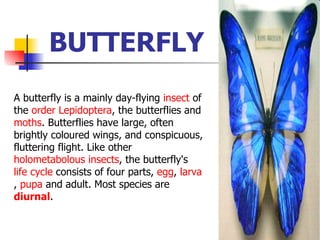
BUTTERFLY   A butterfly is a mainly day-flying  insect  of the  order   Lepidoptera , the butterflies and  moths . Butterflies have large, often brightly coloured wings, and conspicuous, fluttering flight. Like other  holometabolous  insects , the butterfly's  life cycle  consists of four parts,  egg ,  larva ,  pupa  and adult. Most species are   diurnal .
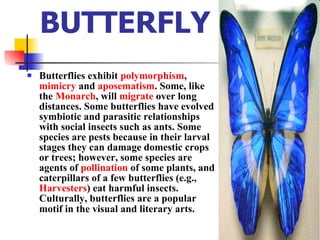
BUTTERFLY Butterflies exhibit  polymorphism ,  mimicry  and  aposematism . Some, like the  Monarch , will  migrate  over long distances. Some butterflies have evolved symbiotic and parasitic relationships with social insects such as ants. Some species are pests because in their larval stages they can damage domestic crops or trees; however, some species are agents of  pollination  of some plants, and caterpillars of a few butterflies (e.g.,  Harvesters ) eat harmful insects. Culturally, butterflies are a popular motif in the visual and literary arts .
SCIENTIFIC CLASSIFICATION Superfamily  Hedyloidea :  Hedylidae   Superfamily  Hesperioidea :  Hesperiidae   Superfamily  Papilionoidea :  Papilionidae   Pieridae   Nymphalidae   Lycaenidae   Riodinidae   Subgroups Rhopalocera (unranked): Lepidoptera Order: Insecta Class: Arthropoda Phylum: Animalia Kingdom:
LIFE CYCLE It is a popular belief that butterflies have very short life spans. However, butterflies in their adult stage can live from a week to nearly a year depending on the species. Many species have long larval life stages while others can remain  dormant  in their pupal or  egg  stages and thereby survive  winters . Butterflies may have one or more broods per year. The number of generations per year varies from temperate to tropical regions with tropical regions showing a trend towards  multivoltinism .
EGG Butterfly eggs are protected by a hard-ridged outer layer of shell, called the  chorion . This is lined with a thin coating of wax which prevents the egg from drying out before the larva has had time to fully develop.
EGG Butterfly eggs are fixed to a leaf with a special glue which hardens rapidly.  Eggs are usually laid on plants. Each species of butterfly has its own hostplant range and while some species of butterfly are restricted to just one species of plant, others use a range of plant species, often including members of a common family.
EGG The egg stage lasts a few weeks in most butterflies but eggs laid close to winter, especially in temperate regions, go through a  diapause  (resting) stage, and the hatching may take place only in spring. Other butterflies may lay their eggs in the spring and have them hatch in the summer.
CATERPILLARS Butterfly larvae, or  caterpillars , consume  plant   leaves  and spend practically all of their time in search of food. Although most caterpillars are herbivorous, a few species such as  Spalgis   epius  and  Liphyra   brassolis  are  entomophagous  (insect eating).
CATERPILLARS Butterfly caterpillars have three pairs of true legs from the thoracic segments and up to 6 pairs of  prolegs  arising from the abdominal segments. These prolegs have rings of tiny hooks called crochets that help them grip the substrate.
CATERPILLARS Some caterpillars have the ability to inflate parts of their head to appear snake-like. Many have false eye-spots to enhance this effect. Some caterpillars have special structures called  osmeteria  which are everted to produce smelly chemicals. These are used in defense.
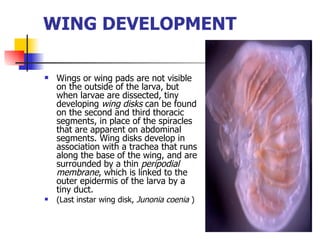
WING DEVELOPMENT Wings or wing pads are not visible on the outside of the larva, but when larvae are dissected, tiny developing  wing disks  can be found on the second and third thoracic segments, in place of the spiracles that are apparent on abdominal segments. Wing disks develop in association with a trachea that runs along the base of the wing, and are surrounded by a thin  peripodial membrane , which is linked to the outer epidermis of the larva by a tiny duct.  (Last instar wing disk,  Junonia coenia  )
WING DEVELOPMENT Wing disks are very small until the last larval instar, when they increase dramatically in size, are invaded by branching  tracheae  from the wing base that precede the formation of the wing veins, and begin to develop patterns associated with several landmarks of the wing.
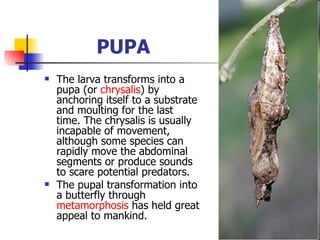
PUPA When the larva is fully grown, hormones such as prothoracicotropic  hormone  (PTTH) are produced. At this point the larva stops feeding and begins "wandering" in the quest of a suitable pupation site, often the underside of a leaf. The larva transforms into a pupa (or  chrysalis ) by anchoring itself to a substrate and moulting for the last time. The chrysalis is usually incapable of movement, although some species can rapidly move the abdominal segments or produce sounds to scare potential predators.
PUPA The larva transforms into a pupa (or  chrysalis ) by anchoring itself to a substrate and moulting for the last time. The chrysalis is usually incapable of movement, although some species can rapidly move the abdominal segments or produce sounds to scare potential predators. The pupal transformation into a butterfly through  metamorphosis  has held great appeal to mankind.
ADULT OR IMAGO The adult, sexually mature, stage of the insect is known as the  imago . As Lepidoptera, butterflies have four wings that are covered with tiny scales (see photo). The fore and hindwings are not hooked together, permitting a more graceful flight. An adult butterfly has six legs, but in the nymphalids, the first pair is reduced. After it emerges from its pupal stage, a butterfly cannot fly until the wings are unfolded.
ADULT OR IMAGO A newly emerged butterfly needs to spend some time inflating its wings with blood and letting them dry, during which time it is extremely vulnerable to  predators . Some butterflies' wings may take up to three hours to dry while others take about one hour. Most butterflies and moths will excrete excess dye after hatching. This fluid may be white, red, orange, or in rare cases, blue.
EXTERNAL MORPHOLOGY
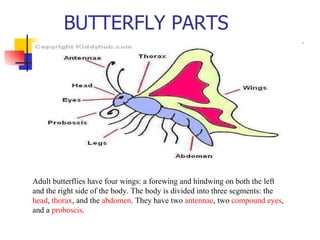
BUTTERFLY PARTS Adult butterflies have four wings: a forewing and hindwing on both the left and the right side of the body. The body is divided into three segments: the  head ,  thorax , and the  abdomen . They have two  antennae , two  compound eyes , and a  proboscis .
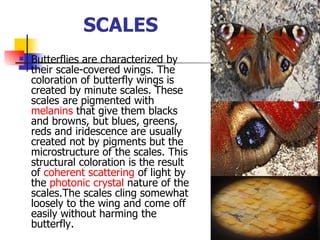
SCALES Butterflies are characterized by their scale-covered wings. The coloration of butterfly wings is created by minute scales. These scales are pigmented with  melanins  that give them blacks and browns, but blues, greens, reds and iridescence are usually created not by pigments but the microstructure of the scales. This structural coloration is the result of  coherent scattering  of light by the  photonic crystal  nature of the scales.The scales cling somewhat loosely to the wing and come off easily without harming the butterfly.
HABITS Butterflies feed primarily on  nectar  from flowers. Some also derive nourishment from  pollen , tree sap, rotting fruit, dung, decaying flesh, and dissolved minerals in wet sand or dirt. Butterflies are important as pollinators for some species of plants although in general they do not carry as much pollen load as  bees . They are however capable of moving pollen over greater distances.
THANK YOU!

Butterfly

  • 1.
    BUTTERFLY A butterfly is a mainly day-flying insect of the order Lepidoptera , the butterflies and moths . Butterflies have large, often brightly coloured wings, and conspicuous, fluttering flight. Like other holometabolous insects , the butterfly's life cycle consists of four parts, egg , larva , pupa and adult. Most species are diurnal .
  • 2.
    BUTTERFLY Butterflies exhibit polymorphism , mimicry and aposematism . Some, like the Monarch , will migrate over long distances. Some butterflies have evolved symbiotic and parasitic relationships with social insects such as ants. Some species are pests because in their larval stages they can damage domestic crops or trees; however, some species are agents of pollination of some plants, and caterpillars of a few butterflies (e.g., Harvesters ) eat harmful insects. Culturally, butterflies are a popular motif in the visual and literary arts .
  • 3.
    SCIENTIFIC CLASSIFICATION Superfamily Hedyloidea : Hedylidae Superfamily Hesperioidea : Hesperiidae Superfamily Papilionoidea : Papilionidae Pieridae Nymphalidae Lycaenidae Riodinidae Subgroups Rhopalocera (unranked): Lepidoptera Order: Insecta Class: Arthropoda Phylum: Animalia Kingdom:
  • 4.
    LIFE CYCLE Itis a popular belief that butterflies have very short life spans. However, butterflies in their adult stage can live from a week to nearly a year depending on the species. Many species have long larval life stages while others can remain dormant in their pupal or egg stages and thereby survive winters . Butterflies may have one or more broods per year. The number of generations per year varies from temperate to tropical regions with tropical regions showing a trend towards multivoltinism .
  • 5.
    EGG Butterfly eggsare protected by a hard-ridged outer layer of shell, called the chorion . This is lined with a thin coating of wax which prevents the egg from drying out before the larva has had time to fully develop.
  • 6.
    EGG Butterfly eggsare fixed to a leaf with a special glue which hardens rapidly. Eggs are usually laid on plants. Each species of butterfly has its own hostplant range and while some species of butterfly are restricted to just one species of plant, others use a range of plant species, often including members of a common family.
  • 7.
    EGG The eggstage lasts a few weeks in most butterflies but eggs laid close to winter, especially in temperate regions, go through a diapause (resting) stage, and the hatching may take place only in spring. Other butterflies may lay their eggs in the spring and have them hatch in the summer.
  • 8.
    CATERPILLARS Butterfly larvae,or caterpillars , consume plant leaves and spend practically all of their time in search of food. Although most caterpillars are herbivorous, a few species such as Spalgis epius and Liphyra brassolis are entomophagous (insect eating).
  • 9.
    CATERPILLARS Butterfly caterpillarshave three pairs of true legs from the thoracic segments and up to 6 pairs of prolegs arising from the abdominal segments. These prolegs have rings of tiny hooks called crochets that help them grip the substrate.
  • 10.
    CATERPILLARS Some caterpillarshave the ability to inflate parts of their head to appear snake-like. Many have false eye-spots to enhance this effect. Some caterpillars have special structures called osmeteria which are everted to produce smelly chemicals. These are used in defense.
  • 11.
    WING DEVELOPMENT Wingsor wing pads are not visible on the outside of the larva, but when larvae are dissected, tiny developing wing disks can be found on the second and third thoracic segments, in place of the spiracles that are apparent on abdominal segments. Wing disks develop in association with a trachea that runs along the base of the wing, and are surrounded by a thin peripodial membrane , which is linked to the outer epidermis of the larva by a tiny duct. (Last instar wing disk, Junonia coenia )
  • 12.
    WING DEVELOPMENT Wingdisks are very small until the last larval instar, when they increase dramatically in size, are invaded by branching tracheae from the wing base that precede the formation of the wing veins, and begin to develop patterns associated with several landmarks of the wing.
  • 13.
    PUPA When thelarva is fully grown, hormones such as prothoracicotropic hormone (PTTH) are produced. At this point the larva stops feeding and begins "wandering" in the quest of a suitable pupation site, often the underside of a leaf. The larva transforms into a pupa (or chrysalis ) by anchoring itself to a substrate and moulting for the last time. The chrysalis is usually incapable of movement, although some species can rapidly move the abdominal segments or produce sounds to scare potential predators.
  • 14.
    PUPA The larvatransforms into a pupa (or chrysalis ) by anchoring itself to a substrate and moulting for the last time. The chrysalis is usually incapable of movement, although some species can rapidly move the abdominal segments or produce sounds to scare potential predators. The pupal transformation into a butterfly through metamorphosis has held great appeal to mankind.
  • 15.
    ADULT OR IMAGOThe adult, sexually mature, stage of the insect is known as the imago . As Lepidoptera, butterflies have four wings that are covered with tiny scales (see photo). The fore and hindwings are not hooked together, permitting a more graceful flight. An adult butterfly has six legs, but in the nymphalids, the first pair is reduced. After it emerges from its pupal stage, a butterfly cannot fly until the wings are unfolded.
  • 16.
    ADULT OR IMAGOA newly emerged butterfly needs to spend some time inflating its wings with blood and letting them dry, during which time it is extremely vulnerable to predators . Some butterflies' wings may take up to three hours to dry while others take about one hour. Most butterflies and moths will excrete excess dye after hatching. This fluid may be white, red, orange, or in rare cases, blue.
  • 17.
  • 18.
    BUTTERFLY PARTS Adultbutterflies have four wings: a forewing and hindwing on both the left and the right side of the body. The body is divided into three segments: the head , thorax , and the abdomen . They have two antennae , two compound eyes , and a proboscis .
  • 19.
    SCALES Butterflies arecharacterized by their scale-covered wings. The coloration of butterfly wings is created by minute scales. These scales are pigmented with melanins that give them blacks and browns, but blues, greens, reds and iridescence are usually created not by pigments but the microstructure of the scales. This structural coloration is the result of coherent scattering of light by the photonic crystal nature of the scales.The scales cling somewhat loosely to the wing and come off easily without harming the butterfly.
  • 20.
    HABITS Butterflies feedprimarily on nectar from flowers. Some also derive nourishment from pollen , tree sap, rotting fruit, dung, decaying flesh, and dissolved minerals in wet sand or dirt. Butterflies are important as pollinators for some species of plants although in general they do not carry as much pollen load as bees . They are however capable of moving pollen over greater distances.
  • 21.