ORDER
LEPIDOPTERA
Submitted to: Dr. Mubashar Hussain
Submitted by: Mah Rukh Majeed
Bs zoology
Course Title: Applied Entomology
Introduction
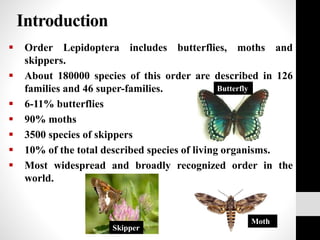
 Order Lepidoptera includes butterflies, moths and
skippers.
 About 180000 species of this order are described in 126
families and 46 super-families.
 6-11% butterflies
 90% moths
 3500 species of skippers
 10% of the total described species of living organisms.
 Most widespread and broadly recognized order in the
world.
Skipper
Butterfly
Moth
 The term Lepidoptera was firstly introduced by
Linnaeus in 1735.
 The word Lepidoptera consists of two Greek words
“Lepido= scales” and “Ptera = wings”
 This makes sense because the insects in this order all
have wings in their adult stage and the scales refer to
the small flakes that coats the wings of these insects.
Etymology
Key characters
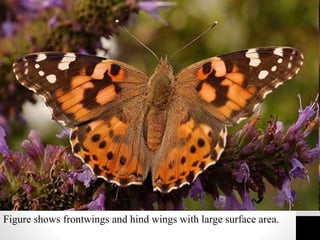
 Adults have four membranous, transparent
and brightly colored wings.
 Hind wings are usually smaller than
forewings, both largely or entirely covered
with scales.
 Large compound eyes that consists of many
light sensitive lens, each with its own
refractive system and each forming its own
portion of image.
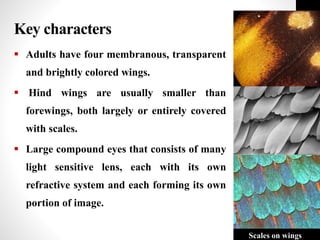
Scales on wings
Figure shows frontwings and hind wings with large surface area.
.
 The scales are modified, hairy and give butterflies and
moths variety of colors and patterns.
 Holometabolous insects (butterflies and moths)
 The proboscis is usually in the form of a coiled tube.
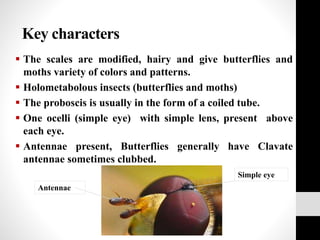
 One ocelli (simple eye) with simple lens, present above
each eye.
 Antennae present, Butterflies generally have Clavate
antennae sometimes clubbed.
Key characters
Simple eye
Antennae
Life Cycle of Lepidoptera
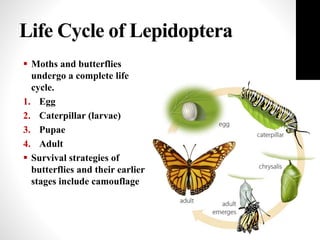
 Moths and butterflies
undergo a complete life
cycle.
1. Egg
2. Caterpillar (larvae)
3. Pupae
4. Adult
 Survival strategies of
butterflies and their earlier
stages include camouflage
Life Cycle of Lepidoptera
 A female may lay only a few eggs or tens of
thousands.
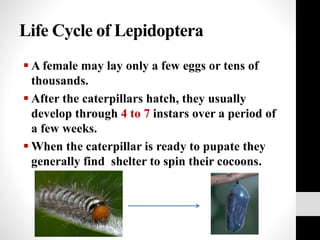
 After the caterpillars hatch, they usually
develop through 4 to 7 instars over a period of
a few weeks.
 When the caterpillar is ready to pupate they
generally find shelter to spin their cocoons.
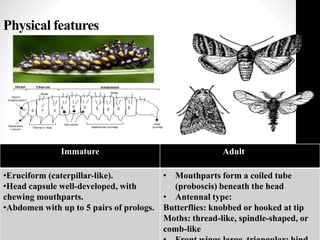
Physical features
Immature Adult
•Eruciform (caterpillar-like).
•Head capsule well-developed, with
chewing mouthparts.
•Abdomen with up to 5 pairs of prologs.
• Mouthparts form a coiled tube
(proboscis) beneath the head
• Antennal type:
Butterflies: knobbed or hooked at tip
Moths: thread-like, spindle-shaped, or
comb-like
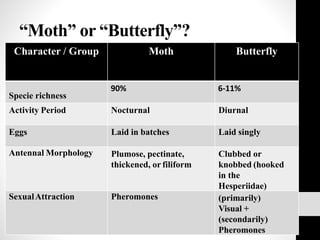
“Moth” or “Butterfly”?
Character / Group Moth Butterfly
Specie richness
90% 6-11%
Activity Period Nocturnal Diurnal
Eggs Laid in batches Laid singly
Antennal Morphology Plumose, pectinate,
thickened, or filiform
Clubbed or
knobbed (hooked
in the
Hesperiidae)
SexualAttraction Pheromones (primarily)
Visual +
(secondarily)
Pheromones
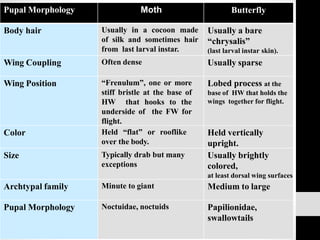
Pupal Morphology Moth Butterfly
Body hair Usually in a cocoon made
of silk and sometimes hair
from last larval instar.
Usually a bare
“chrysalis”
(last larval instar skin).
Wing Coupling Often dense Usually sparse
Wing Position “Frenulum”, one or more
stiff bristle at the base of
HW that hooks to the
underside of the FW for
flight.
Lobed process at the
base of HW that holds the
wings together for flight.
Color Held “flat” or rooflike
over the body.
Held vertically
upright.
Size Typically drab but many
exceptions
Usually brightly
colored,
at least dorsal wing surfaces
Archtypal family Minute to giant Medium to large
Pupal Morphology Noctuidae, noctuids Papilionidae,
swallowtails
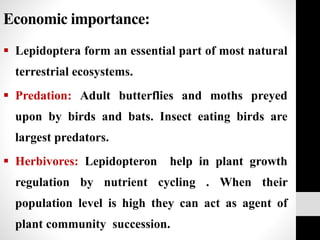
Economic importance:
 Lepidoptera form an essential part of most natural
terrestrial ecosystems.
 Predation: Adult butterflies and moths preyed
upon by birds and bats. Insect eating birds are
largest predators.
 Herbivores: Lepidopteron help in plant growth
regulation by nutrient cycling . When their
population level is high they can act as agent of
plant community succession.
Economic importance:
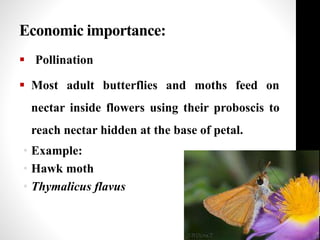
 Pollination
 Most adult butterflies and moths feed on
nectar inside flowers using their proboscis to
reach nectar hidden at the base of petal.
• Example:
• Hawk moth
• Thymalicus flavus
Economic importance:
 Butterflies and moth affect the economy
negatively because they are pests in agriculture
major pests includes tortricidae, noctuidae and
pyralidae.
 Some species are valuable economic resource.
 Domesticated silkworm moth ( bombyx mori),
the larvae of which form silken cocoons.
Economic importance:
Biological control of weed
Pyralid cactus most succesfully
suppressed million of acres of prickly pear
cactus
Alligator weed stem borer ( arcola malloi)
was used to control the aquatic plant
known as alligator weed
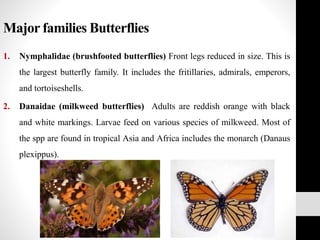
Major families Butterflies
1. Nymphalidae (brushfooted butterflies) Front legs reduced in size. This is
the largest butterfly family. It includes the fritillaries, admirals, emperors,
and tortoiseshells.
2. Danaidae (milkweed butterflies) Adults are reddish orange with black
and white markings. Larvae feed on various species of milkweed. Most of
the spp are found in tropical Asia and Africa includes the monarch (Danaus
plexippus).
Major families Butterflies
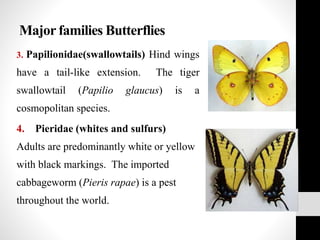
3. Papilionidae(swallowtails) Hind wings
have a tail-like extension. The tiger
swallowtail (Papilio glaucus) is a
cosmopolitan species.
4. Pieridae (whites and sulfurs)
Adults are predominantly white or yellow
with black markings. The imported
cabbageworm (Pieris rapae) is a pest
throughout the world.
Major families Butterflies
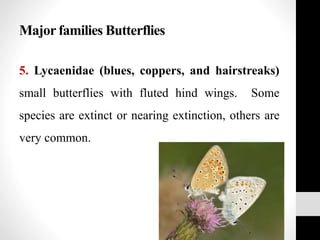
5. Lycaenidae (blues, coppers, and hairstreaks)
small butterflies with fluted hind wings. Some
species are extinct or nearing extinction, others are
very common.
Skipper family
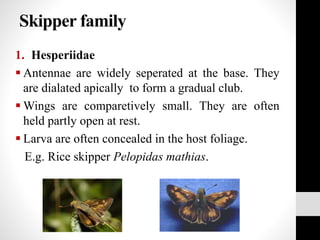
1. Hesperiidae
 Antennae are widely seperated at the base. They
are dialated apically to form a gradual club.
 Wings are comparetively small. They are often
held partly open at rest.
 Larva are often concealed in the host foliage.
E.g. Rice skipper Pelopidas mathias.
Major Moths families
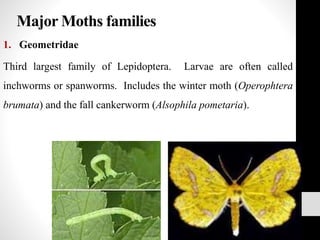
1. Geometridae
Third largest family of Lepidoptera. Larvae are often called
inchworms or spanworms. Includes the winter moth (Operophtera
brumata) and the fall cankerworm (Alsophila pometaria).
Major Moths families
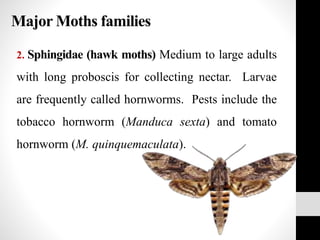
2. Sphingidae (hawk moths) Medium to large adults
with long proboscis for collecting nectar. Larvae
are frequently called hornworms. Pests include the
tobacco hornworm (Manduca sexta) and tomato
hornworm (M. quinquemaculata).
Major Moths families
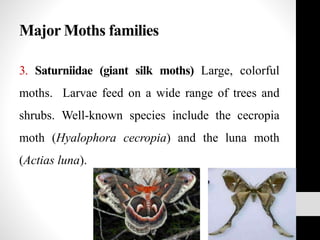
3. Saturniidae (giant silk moths) Large, colorful
moths. Larvae feed on a wide range of trees and
shrubs. Well-known species include the cecropia
moth (Hyalophora cecropia) and the luna moth
(Actias luna).
Conti…
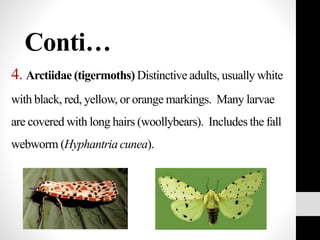
4. Arctiidae (tigermoths) Distinctive adults, usually white
with black, red, yellow, or orange markings. Many larvae
are covered with long hairs (woollybears). Includes the fall
webworm (Hyphantria cunea).
Conti..
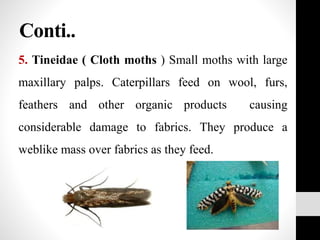
5. Tineidae ( Cloth moths ) Small moths with large
maxillary palps. Caterpillars feed on wool, furs,
feathers and other organic products causing
considerable damage to fabrics. They produce a
weblike mass over fabrics as they feed.
Conti..
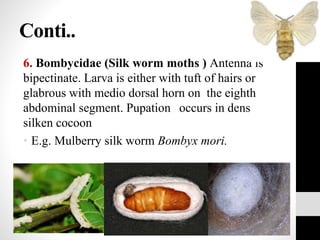
6. Bombycidae (Silk worm moths ) Antenna is
bipectinate. Larva is either with tuft of hairs or
glabrous with medio dorsal horn on the eighth
abdominal segment. Pupation occurs in dens
silken cocoon
• E.g. Mulberry silk worm Bombyx mori.
Conti..
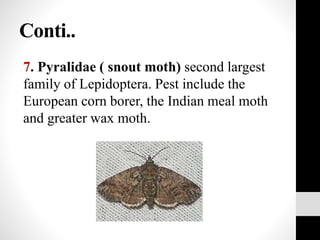
7. Pyralidae ( snout moth) second largest
family of Lepidoptera. Pest include the
European corn borer, the Indian meal moth
and greater wax moth.
Conti..
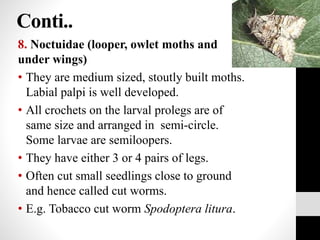
8. Noctuidae (looper, owlet moths and
under wings)
• They are medium sized, stoutly built moths.
Labial palpi is well developed.
• All crochets on the larval prolegs are of
same size and arranged in semi-circle.
Some larvae are semiloopers.
• They have either 3 or 4 pairs of legs.
• Often cut small seedlings close to ground
and hence called cut worms.
• E.g. Tobacco cut worm Spodoptera litura.
References:
1. Arnett, Ross H. (28 July 2000). "Part I: 27". American insects: a
handbook of the insects of America north of Mexico (2nd ed.). CRC
Press. p. 631.
2. Rau, P (1941). "Observations on certain lepidopterous and
hymenopterous parasites of Polistes wasps". Annals of the Entomological
Society of America. 34: 355–366(12).
3. Hall, Jason P. W.; Harvey, Donald J. (2002). "A survey of androconial
organs in the Riodinidae (Lepidoptera)" (PDF). Zoological Journal of the
Linnean Society 136 (2): 171–197
4. "Table complete with real butterflies embedded in resin". Mfjoe.com. 18
December 2009. Archived from the original on 6 May 2010. Retrieved 28
April 2012.
5. Balit, Corrine R.; Ptolemy, Helen C.; Geary, Merilyn J.; Russell, Richard
C.; Isbister, Geoffrey K. (2001). "Outbreak of caterpillar dermatitis
caused by airborne hairs of the mistletoe browntail moth (Euproctis
edwardsi)". The Medical Journal of Australia. 175 (11–12): 641–3
6. Capinera, John L. (2008). "Butterflies and moths". Encyclopedia of
Entomology. 4(2nd ed.). Springer. pp. 626–672.

Order lepidoptera_ppt by Mah Rukh

  • 1.
    ORDER LEPIDOPTERA Submitted to: Dr.Mubashar Hussain Submitted by: Mah Rukh Majeed Bs zoology Course Title: Applied Entomology
  • 2.
    Introduction  Order Lepidopteraincludes butterflies, moths and skippers.  About 180000 species of this order are described in 126 families and 46 super-families.  6-11% butterflies  90% moths  3500 species of skippers  10% of the total described species of living organisms.  Most widespread and broadly recognized order in the world. Skipper Butterfly Moth
  • 3.
     The termLepidoptera was firstly introduced by Linnaeus in 1735.  The word Lepidoptera consists of two Greek words “Lepido= scales” and “Ptera = wings”  This makes sense because the insects in this order all have wings in their adult stage and the scales refer to the small flakes that coats the wings of these insects. Etymology
  • 4.
    Key characters  Adultshave four membranous, transparent and brightly colored wings.  Hind wings are usually smaller than forewings, both largely or entirely covered with scales.  Large compound eyes that consists of many light sensitive lens, each with its own refractive system and each forming its own portion of image. Scales on wings
  • 5.
    Figure shows frontwingsand hind wings with large surface area.
  • 6.
    .  The scalesare modified, hairy and give butterflies and moths variety of colors and patterns.  Holometabolous insects (butterflies and moths)  The proboscis is usually in the form of a coiled tube.  One ocelli (simple eye) with simple lens, present above each eye.  Antennae present, Butterflies generally have Clavate antennae sometimes clubbed. Key characters Simple eye Antennae
  • 7.
    Life Cycle ofLepidoptera  Moths and butterflies undergo a complete life cycle. 1. Egg 2. Caterpillar (larvae) 3. Pupae 4. Adult  Survival strategies of butterflies and their earlier stages include camouflage
  • 8.
    Life Cycle ofLepidoptera  A female may lay only a few eggs or tens of thousands.  After the caterpillars hatch, they usually develop through 4 to 7 instars over a period of a few weeks.  When the caterpillar is ready to pupate they generally find shelter to spin their cocoons.
  • 9.
    Physical features Immature Adult •Eruciform(caterpillar-like). •Head capsule well-developed, with chewing mouthparts. •Abdomen with up to 5 pairs of prologs. • Mouthparts form a coiled tube (proboscis) beneath the head • Antennal type: Butterflies: knobbed or hooked at tip Moths: thread-like, spindle-shaped, or comb-like
  • 10.
    “Moth” or “Butterfly”? Character/ Group Moth Butterfly Specie richness 90% 6-11% Activity Period Nocturnal Diurnal Eggs Laid in batches Laid singly Antennal Morphology Plumose, pectinate, thickened, or filiform Clubbed or knobbed (hooked in the Hesperiidae) SexualAttraction Pheromones (primarily) Visual + (secondarily) Pheromones
  • 11.
    Pupal Morphology MothButterfly Body hair Usually in a cocoon made of silk and sometimes hair from last larval instar. Usually a bare “chrysalis” (last larval instar skin). Wing Coupling Often dense Usually sparse Wing Position “Frenulum”, one or more stiff bristle at the base of HW that hooks to the underside of the FW for flight. Lobed process at the base of HW that holds the wings together for flight. Color Held “flat” or rooflike over the body. Held vertically upright. Size Typically drab but many exceptions Usually brightly colored, at least dorsal wing surfaces Archtypal family Minute to giant Medium to large Pupal Morphology Noctuidae, noctuids Papilionidae, swallowtails
  • 12.
    Economic importance:  Lepidopteraform an essential part of most natural terrestrial ecosystems.  Predation: Adult butterflies and moths preyed upon by birds and bats. Insect eating birds are largest predators.  Herbivores: Lepidopteron help in plant growth regulation by nutrient cycling . When their population level is high they can act as agent of plant community succession.
  • 13.
    Economic importance:  Pollination Most adult butterflies and moths feed on nectar inside flowers using their proboscis to reach nectar hidden at the base of petal. • Example: • Hawk moth • Thymalicus flavus
  • 14.
    Economic importance:  Butterfliesand moth affect the economy negatively because they are pests in agriculture major pests includes tortricidae, noctuidae and pyralidae.  Some species are valuable economic resource.  Domesticated silkworm moth ( bombyx mori), the larvae of which form silken cocoons.
  • 15.
    Economic importance: Biological controlof weed Pyralid cactus most succesfully suppressed million of acres of prickly pear cactus Alligator weed stem borer ( arcola malloi) was used to control the aquatic plant known as alligator weed
  • 16.
    Major families Butterflies 1.Nymphalidae (brushfooted butterflies) Front legs reduced in size. This is the largest butterfly family. It includes the fritillaries, admirals, emperors, and tortoiseshells. 2. Danaidae (milkweed butterflies) Adults are reddish orange with black and white markings. Larvae feed on various species of milkweed. Most of the spp are found in tropical Asia and Africa includes the monarch (Danaus plexippus).
  • 17.
    Major families Butterflies 3.Papilionidae(swallowtails) Hind wings have a tail-like extension. The tiger swallowtail (Papilio glaucus) is a cosmopolitan species. 4. Pieridae (whites and sulfurs) Adults are predominantly white or yellow with black markings. The imported cabbageworm (Pieris rapae) is a pest throughout the world.
  • 18.
    Major families Butterflies 5.Lycaenidae (blues, coppers, and hairstreaks) small butterflies with fluted hind wings. Some species are extinct or nearing extinction, others are very common.
  • 19.
    Skipper family 1. Hesperiidae Antennae are widely seperated at the base. They are dialated apically to form a gradual club.  Wings are comparetively small. They are often held partly open at rest.  Larva are often concealed in the host foliage. E.g. Rice skipper Pelopidas mathias.
  • 20.
    Major Moths families 1.Geometridae Third largest family of Lepidoptera. Larvae are often called inchworms or spanworms. Includes the winter moth (Operophtera brumata) and the fall cankerworm (Alsophila pometaria).
  • 21.
    Major Moths families 2.Sphingidae (hawk moths) Medium to large adults with long proboscis for collecting nectar. Larvae are frequently called hornworms. Pests include the tobacco hornworm (Manduca sexta) and tomato hornworm (M. quinquemaculata).
  • 22.
    Major Moths families 3.Saturniidae (giant silk moths) Large, colorful moths. Larvae feed on a wide range of trees and shrubs. Well-known species include the cecropia moth (Hyalophora cecropia) and the luna moth (Actias luna).
  • 23.
    Conti… 4. Arctiidae (tigermoths)Distinctive adults, usually white with black, red, yellow, or orange markings. Many larvae are covered with long hairs (woollybears). Includes the fall webworm (Hyphantria cunea).
  • 24.
    Conti.. 5. Tineidae (Cloth moths ) Small moths with large maxillary palps. Caterpillars feed on wool, furs, feathers and other organic products causing considerable damage to fabrics. They produce a weblike mass over fabrics as they feed.
  • 25.
    Conti.. 6. Bombycidae (Silkworm moths ) Antenna is bipectinate. Larva is either with tuft of hairs or glabrous with medio dorsal horn on the eighth abdominal segment. Pupation occurs in dens silken cocoon • E.g. Mulberry silk worm Bombyx mori.
  • 26.
    Conti.. 7. Pyralidae (snout moth) second largest family of Lepidoptera. Pest include the European corn borer, the Indian meal moth and greater wax moth.
  • 27.
    Conti.. 8. Noctuidae (looper,owlet moths and under wings) • They are medium sized, stoutly built moths. Labial palpi is well developed. • All crochets on the larval prolegs are of same size and arranged in semi-circle. Some larvae are semiloopers. • They have either 3 or 4 pairs of legs. • Often cut small seedlings close to ground and hence called cut worms. • E.g. Tobacco cut worm Spodoptera litura.
  • 28.
    References: 1. Arnett, RossH. (28 July 2000). "Part I: 27". American insects: a handbook of the insects of America north of Mexico (2nd ed.). CRC Press. p. 631. 2. Rau, P (1941). "Observations on certain lepidopterous and hymenopterous parasites of Polistes wasps". Annals of the Entomological Society of America. 34: 355–366(12). 3. Hall, Jason P. W.; Harvey, Donald J. (2002). "A survey of androconial organs in the Riodinidae (Lepidoptera)" (PDF). Zoological Journal of the Linnean Society 136 (2): 171–197 4. "Table complete with real butterflies embedded in resin". Mfjoe.com. 18 December 2009. Archived from the original on 6 May 2010. Retrieved 28 April 2012. 5. Balit, Corrine R.; Ptolemy, Helen C.; Geary, Merilyn J.; Russell, Richard C.; Isbister, Geoffrey K. (2001). "Outbreak of caterpillar dermatitis caused by airborne hairs of the mistletoe browntail moth (Euproctis edwardsi)". The Medical Journal of Australia. 175 (11–12): 641–3 6. Capinera, John L. (2008). "Butterflies and moths". Encyclopedia of Entomology. 4(2nd ed.). Springer. pp. 626–672.