Notes Wednesday, October 7th 2009 I suggest you study my notes with the book open for reference I hope this is helpful! Good luck =)  If you have any questions concerning the material, please feel free to give me a call: 954-830-3402, or email me: pakula101@gmail.com   General Linguistics LIN 3013
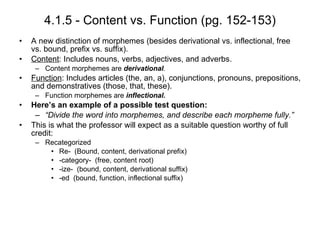
4.1.5 - Content vs. Function (pg. 152-153) A new distinction of morphemes (besides derivational vs. inflectional, free vs. bound, prefix vs. suffix). Content : Includes nouns, verbs, adjectives, and adverbs. Content morphemes are  derivational . Function : Includes articles (the, an, a), conjunctions, pronouns, prepositions, and demonstratives (those, that, these). Function morphemes are  inflectional. Here’s an example of a possible test question:   “ Divide the word into morphemes, and describe each morpheme fully.” This is what the professor will expect as a suitable question worthy of full credit: Recategorized Re-  (Bound, content, derivational prefix) -category-  (free, content root) -ize-  (bound, content, derivational suffix) -ed  (bound, function, inflectional suffix)
File 4.2 – Morphological Processes
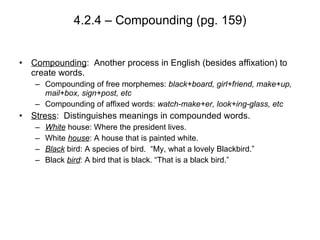
4.2.4 – Compounding (pg. 159) Compounding :  Another process in English (besides affixation) to create words. Compounding of free morphemes:  black+board, girl+friend, make+up, mail+box, sign+post, etc Compounding of affixed words:  watch-make+er, look+ing-glass, etc Stress :  Distinguishes meanings in compounded words.  White   house: Where the president lives. White  house : A house that is painted white. Black  bird: A species of bird.  “My, what a lovely Blackbird.” Black  bird : A bird that is black. “That is a black bird.”
4.2.5 – Reduplication (pg. 160) The duplication of a word to show plurality.  A method not implemented in English, but is common in a language like Indonesian: Something similar to this is used in English, but not in formal grammar: “ I liked her before, but now I ‘like her, like her.’” “ I’m not just hungry, I’m ‘hungry, hungry.’” “ At first, we only went out for coffee, but now we’re ‘dating, dating.’” houses rumahrumah house rumah Meaning Plural Meaning Singular
4.2.6 – Alternations (pg. 161) Alternations : The modification of a morpheme using changes in pronunciation, without the use of affixes  Were once used in Old English, but now alternations are called irregulars. Likewise: R i ng > R a ng > R u ng, Dr i nk > Dr a nk > Dr u nk As well as: the noun (strife) forming into the verb (strive). W o men (“not womans”) W o man M e n (not “mans”) M a n Plural Singular Spoken Spoke Speak Broken Broke Break Alternation & Affixation Alternation Root
4.2.7 – Suppletion (pg. 162) Suppletion : This occurs when a root is modified by forms with absolutely no similarity (form-wise). “ Note that there is simply no systematic similarity between the stems of these various inflecteed forms.  That is, we could not write a productive or general rule that would account for the forms we find”  (Language Files 10). Was Is Past Present Went Go Irregular (Suppletion) Rang Ring Walked Walk Past Present Regular Best Better Good Worst Worse Bad Superlative Comparative Adjective Suppletion
File 4.3 – Morphological Types of Languages
4.3.1 – Classifying Languages by Morphological Type (pg. 163) There are two primary classifications of language morphologies: Analytic Tend to have only free morphemes No affixation (Mandarin is an example of an analytic language). Synthetic : Has both free and bound morphemes. Broken down into three categories: Agglutinating Fusional Polysynthetic
4.3.4 – 1 st  Type of Synthetic Language:  Agglutinating Languages (pg. 165) Refer to #30 on pg. 183 (Turkish example). a) [deniz] : ‘an ocean’ [deniz e ] : ‘ to  an ocean’  [deniz in ] : ‘ of  an ocean’ It can be concluded, through study of this Turkish example that the word [deniz] means ‘an ocean,’ and the [e] and [in] are individual morphemes which mean ‘to’ and ‘of.’ Agglutinating languages can contain multiple words within one word and are easy to “chop up” and rearrange its morphemes to alter the entire word’s meaning. Pro : Without any form of affixation, agglutinating languages are fairly simple: Straightforward bound morphemes are added to roots used to change meaning. Con : Because so many morphemes are used, words can become very lengthy in agglutinating languages.
4.3.5 – Second Type of Synthetic Languages: Fusional Languages (pg. 165) “ Words in fusional languages are formed by adding bound morphemes to stems, like agglutinating languages, but in fusional languages the affixes may not be easy to separate from the stem” (Language Files 10). Spanish is a good example of a fusional language: (See example [13] at the bottom of pg. 165). Pro : Fusional languages, because of their nature, often produce shorter words than agglutinating languages. Con : Because of frequent fusion between affixes and roots, there is often a lot of meaning packed into a very small space. Habl o : The “ o ” represents the person (I/you/he/she/it) and number (singular/plural).  That’s plenty of meaning attached to one letter!
4.3.6 – Third Type of Synthetic Languages: Polysynthetic Languages (pg. 166) This is a type of language that forms highly complex words by combining several roots and affixes.  This is done through the incorporation of nouns as affixes upon a verb “ He  hit the boy .”    “He  boy-hitted .” (More examples on pg. 166).
File 4.4 – The Hierarchical Structure of Derived Words   This is a more abstract section and will seem a little odd at first.   It’s actually not that difficult!  =)
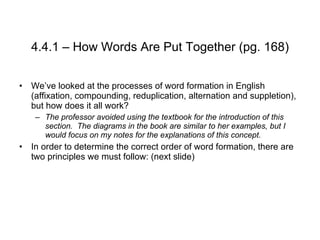
4.4.1 – How Words Are Put Together (pg. 168) We’ve looked at the processes of word formation in English (affixation, compounding, reduplication, alternation and suppletion), but how does it all work? The professor avoided using the textbook for the introduction of this section.  The diagrams in the book are similar to her examples, but I would focus on my notes for the explanations of this concept. In order to determine the correct order of word formation, there are two principles we must follow: (next slide)
Principle #1 Assume that in the process of forming words, bound morphemes are always added  one at a time . un happy ness - Here, “un-” and “-ness” are added simeltaneously, but according to  Principle #1, bound morphemes can only be added  one at a time . un happy ness -Here, “un-” is added first with “happy,” followed by the addition of “-ness.”  This addition is different from the first example because each bound morpheme was added  one at a time .
Principle #2 Assume that there is absolute regularity in the sense that each bound morpheme is attached to one given grammatical class and as a result, produces only that one grammatical class… un  happy: Here, the prefix “un-” is attached to “happy,” an adjective. Because of this instance, the prefix “un-” can only be attached to adjectives. un happy ness -The example above is correct because according to Principle #2, the prefix “un-” can only be attached to an adjective.  “Happy,” is appropriate because it is an adjective. un happy ness -This example is a violation of Principle #2 in that the prefix “un-” is not attaching itself to an adjective such as “happy,” it’s attaching to the noun, “happiness.”
Principle #2 continued.. Illegally il  legal  ly:  Here, the prefix “il-” attaches to the adjective, “legal.” To agree with Principle #2, in all future cases, “il-” must attach to an adjective. il  legal  ly - This instance violates Principle #2 because the prefix “il-” is attaching to the adverb “legally.”  In order to agree with the principle, “il-” must attach itself to an adjective. il  legal  ly -This example agrees with Principle #2 because the prefix “il-” is bound to the adjective “legal.”  Because “legal” is an adjective, everything’s okey dokey.  =)
This concludes the material introduced to us during today’s lecture.  If you have  any  questions at all, please let me know (my phone number and email are at the beginning). I hope you were able to understand and grasp the concepts I attempted to explain!  Once again, good luck!
 

Linguistics Notes - 10/7/09

  • 1.
    Notes Wednesday, October7th 2009 I suggest you study my notes with the book open for reference I hope this is helpful! Good luck =) If you have any questions concerning the material, please feel free to give me a call: 954-830-3402, or email me: pakula101@gmail.com General Linguistics LIN 3013
  • 2.
    4.1.5 - Contentvs. Function (pg. 152-153) A new distinction of morphemes (besides derivational vs. inflectional, free vs. bound, prefix vs. suffix). Content : Includes nouns, verbs, adjectives, and adverbs. Content morphemes are derivational . Function : Includes articles (the, an, a), conjunctions, pronouns, prepositions, and demonstratives (those, that, these). Function morphemes are inflectional. Here’s an example of a possible test question: “ Divide the word into morphemes, and describe each morpheme fully.” This is what the professor will expect as a suitable question worthy of full credit: Recategorized Re- (Bound, content, derivational prefix) -category- (free, content root) -ize- (bound, content, derivational suffix) -ed (bound, function, inflectional suffix)
  • 3.
    File 4.2 –Morphological Processes
  • 4.
    4.2.4 – Compounding(pg. 159) Compounding : Another process in English (besides affixation) to create words. Compounding of free morphemes: black+board, girl+friend, make+up, mail+box, sign+post, etc Compounding of affixed words: watch-make+er, look+ing-glass, etc Stress : Distinguishes meanings in compounded words. White house: Where the president lives. White house : A house that is painted white. Black bird: A species of bird. “My, what a lovely Blackbird.” Black bird : A bird that is black. “That is a black bird.”
  • 5.
    4.2.5 – Reduplication(pg. 160) The duplication of a word to show plurality. A method not implemented in English, but is common in a language like Indonesian: Something similar to this is used in English, but not in formal grammar: “ I liked her before, but now I ‘like her, like her.’” “ I’m not just hungry, I’m ‘hungry, hungry.’” “ At first, we only went out for coffee, but now we’re ‘dating, dating.’” houses rumahrumah house rumah Meaning Plural Meaning Singular
  • 6.
    4.2.6 – Alternations(pg. 161) Alternations : The modification of a morpheme using changes in pronunciation, without the use of affixes Were once used in Old English, but now alternations are called irregulars. Likewise: R i ng > R a ng > R u ng, Dr i nk > Dr a nk > Dr u nk As well as: the noun (strife) forming into the verb (strive). W o men (“not womans”) W o man M e n (not “mans”) M a n Plural Singular Spoken Spoke Speak Broken Broke Break Alternation & Affixation Alternation Root
  • 7.
    4.2.7 – Suppletion(pg. 162) Suppletion : This occurs when a root is modified by forms with absolutely no similarity (form-wise). “ Note that there is simply no systematic similarity between the stems of these various inflecteed forms. That is, we could not write a productive or general rule that would account for the forms we find” (Language Files 10). Was Is Past Present Went Go Irregular (Suppletion) Rang Ring Walked Walk Past Present Regular Best Better Good Worst Worse Bad Superlative Comparative Adjective Suppletion
  • 8.
    File 4.3 –Morphological Types of Languages
  • 9.
    4.3.1 – ClassifyingLanguages by Morphological Type (pg. 163) There are two primary classifications of language morphologies: Analytic Tend to have only free morphemes No affixation (Mandarin is an example of an analytic language). Synthetic : Has both free and bound morphemes. Broken down into three categories: Agglutinating Fusional Polysynthetic
  • 10.
    4.3.4 – 1st Type of Synthetic Language: Agglutinating Languages (pg. 165) Refer to #30 on pg. 183 (Turkish example). a) [deniz] : ‘an ocean’ [deniz e ] : ‘ to an ocean’ [deniz in ] : ‘ of an ocean’ It can be concluded, through study of this Turkish example that the word [deniz] means ‘an ocean,’ and the [e] and [in] are individual morphemes which mean ‘to’ and ‘of.’ Agglutinating languages can contain multiple words within one word and are easy to “chop up” and rearrange its morphemes to alter the entire word’s meaning. Pro : Without any form of affixation, agglutinating languages are fairly simple: Straightforward bound morphemes are added to roots used to change meaning. Con : Because so many morphemes are used, words can become very lengthy in agglutinating languages.
  • 11.
    4.3.5 – SecondType of Synthetic Languages: Fusional Languages (pg. 165) “ Words in fusional languages are formed by adding bound morphemes to stems, like agglutinating languages, but in fusional languages the affixes may not be easy to separate from the stem” (Language Files 10). Spanish is a good example of a fusional language: (See example [13] at the bottom of pg. 165). Pro : Fusional languages, because of their nature, often produce shorter words than agglutinating languages. Con : Because of frequent fusion between affixes and roots, there is often a lot of meaning packed into a very small space. Habl o : The “ o ” represents the person (I/you/he/she/it) and number (singular/plural). That’s plenty of meaning attached to one letter!
  • 12.
    4.3.6 – ThirdType of Synthetic Languages: Polysynthetic Languages (pg. 166) This is a type of language that forms highly complex words by combining several roots and affixes. This is done through the incorporation of nouns as affixes upon a verb “ He hit the boy .”  “He boy-hitted .” (More examples on pg. 166).
  • 13.
    File 4.4 –The Hierarchical Structure of Derived Words This is a more abstract section and will seem a little odd at first. It’s actually not that difficult! =)
  • 14.
    4.4.1 – HowWords Are Put Together (pg. 168) We’ve looked at the processes of word formation in English (affixation, compounding, reduplication, alternation and suppletion), but how does it all work? The professor avoided using the textbook for the introduction of this section. The diagrams in the book are similar to her examples, but I would focus on my notes for the explanations of this concept. In order to determine the correct order of word formation, there are two principles we must follow: (next slide)
  • 15.
    Principle #1 Assumethat in the process of forming words, bound morphemes are always added one at a time . un happy ness - Here, “un-” and “-ness” are added simeltaneously, but according to Principle #1, bound morphemes can only be added one at a time . un happy ness -Here, “un-” is added first with “happy,” followed by the addition of “-ness.” This addition is different from the first example because each bound morpheme was added one at a time .
  • 16.
    Principle #2 Assumethat there is absolute regularity in the sense that each bound morpheme is attached to one given grammatical class and as a result, produces only that one grammatical class… un  happy: Here, the prefix “un-” is attached to “happy,” an adjective. Because of this instance, the prefix “un-” can only be attached to adjectives. un happy ness -The example above is correct because according to Principle #2, the prefix “un-” can only be attached to an adjective. “Happy,” is appropriate because it is an adjective. un happy ness -This example is a violation of Principle #2 in that the prefix “un-” is not attaching itself to an adjective such as “happy,” it’s attaching to the noun, “happiness.”
  • 17.
    Principle #2 continued..Illegally il  legal  ly: Here, the prefix “il-” attaches to the adjective, “legal.” To agree with Principle #2, in all future cases, “il-” must attach to an adjective. il legal ly - This instance violates Principle #2 because the prefix “il-” is attaching to the adverb “legally.” In order to agree with the principle, “il-” must attach itself to an adjective. il legal ly -This example agrees with Principle #2 because the prefix “il-” is bound to the adjective “legal.” Because “legal” is an adjective, everything’s okey dokey. =)
  • 18.
    This concludes thematerial introduced to us during today’s lecture. If you have any questions at all, please let me know (my phone number and email are at the beginning). I hope you were able to understand and grasp the concepts I attempted to explain! Once again, good luck!
  • 19.