
INTRODUCTION

ADE SUDIRMAN, S.Pd

ENGLISH DEPARTMENT
MATHLA’UL ANWAR UNIVERSITY
Introduction
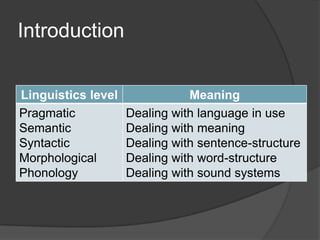
Linguistics level
Pragmatic
Semantic
Syntactic
Morphological
Phonology

Meaning
Dealing with language in use
Dealing with meaning
Dealing with sentence-structure
Dealing with word-structure
Dealing with sound systems
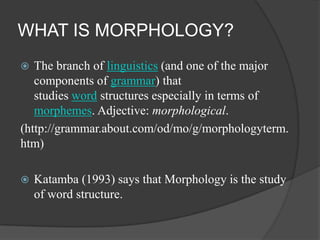
WHAT IS MORPHOLOGY?
The branch of linguistics (and one of the major
components of grammar) that
studies word structures especially in terms of
morphemes. Adjective: morphological.
(http://grammar.about.com/od/mo/g/morphologyterm.
htm)




Katamba (1993) says that Morphology is the study
of word structure.
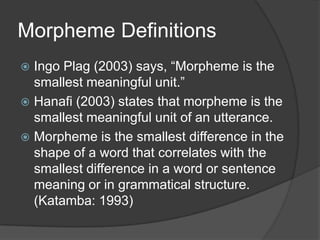
Morpheme Definitions
Ingo Plag (2003) says, “Morpheme is the
smallest meaningful unit.”
 Hanafi (2003) states that morpheme is the
smallest meaningful unit of an utterance.
 Morpheme is the smallest difference in the
shape of a word that correlates with the
smallest difference in a word or sentence
meaning or in grammatical structure.
(Katamba: 1993)

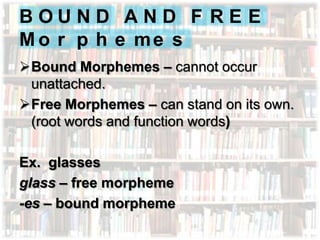
BOUND AND F RE E
M o r p h e me s
Bound Morphemes – cannot occur
unattached.
Free Morphemes – can stand on its own.
(root words and function words)
Ex. glasses
glass – free morpheme
-es – bound morpheme
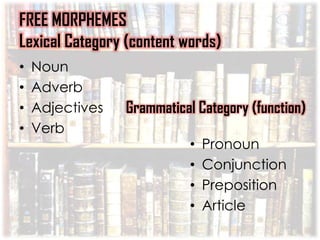
FREE MORPHEMES
Lexical Category (content words)
•
•
•
•

Noun
Adverb
Adjectives
Verb

Grammatical Category (function)
•
•
•
•

Pronoun
Conjunction
Preposition
Article
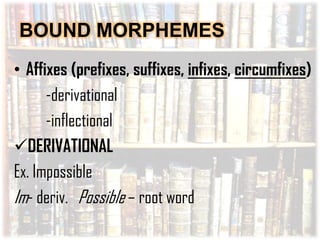
BOUND MORPHEMES
• Affixes (prefixes, suffixes, infixes, circumfixes)
-derivational
-inflectional
DERIVATIONAL
Ex. Impossible
Im- deriv. Possible – root word
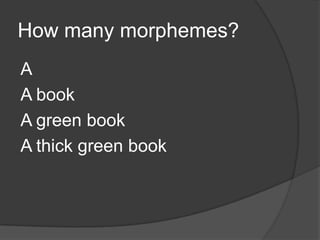
How many morphemes?
A
A book
A green book
A thick green book
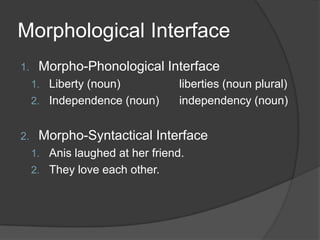
Morphological Interface
1.

Morpho-Phonological Interface
1. Liberty (noun)
2. Independence (noun)

2.

liberties (noun plural)
independency (noun)

Morpho-Syntactical Interface
1. Anis laughed at her friend.
2. They love each other.
Thank you

English morphology, introduction (AdeS)

  • 1.
    INTRODUCTION ADE SUDIRMAN, S.Pd ENGLISHDEPARTMENT MATHLA’UL ANWAR UNIVERSITY
  • 2.
    Introduction Linguistics level Pragmatic Semantic Syntactic Morphological Phonology Meaning Dealing withlanguage in use Dealing with meaning Dealing with sentence-structure Dealing with word-structure Dealing with sound systems
  • 3.
    WHAT IS MORPHOLOGY? Thebranch of linguistics (and one of the major components of grammar) that studies word structures especially in terms of morphemes. Adjective: morphological. (http://grammar.about.com/od/mo/g/morphologyterm. htm)   Katamba (1993) says that Morphology is the study of word structure.
  • 4.
    Morpheme Definitions Ingo Plag(2003) says, “Morpheme is the smallest meaningful unit.”  Hanafi (2003) states that morpheme is the smallest meaningful unit of an utterance.  Morpheme is the smallest difference in the shape of a word that correlates with the smallest difference in a word or sentence meaning or in grammatical structure. (Katamba: 1993) 
  • 5.
    BOUND AND FRE E M o r p h e me s Bound Morphemes – cannot occur unattached. Free Morphemes – can stand on its own. (root words and function words) Ex. glasses glass – free morpheme -es – bound morpheme
  • 6.
    FREE MORPHEMES Lexical Category(content words) • • • • Noun Adverb Adjectives Verb Grammatical Category (function) • • • • Pronoun Conjunction Preposition Article
  • 7.
    BOUND MORPHEMES • Affixes(prefixes, suffixes, infixes, circumfixes) -derivational -inflectional DERIVATIONAL Ex. Impossible Im- deriv. Possible – root word
  • 8.
    How many morphemes? A Abook A green book A thick green book
  • 9.
    Morphological Interface 1. Morpho-Phonological Interface 1.Liberty (noun) 2. Independence (noun) 2. liberties (noun plural) independency (noun) Morpho-Syntactical Interface 1. Anis laughed at her friend. 2. They love each other.
  • 10.