Morphology in linguistic
Prepared by : Munsif siyyal
Roll no : 2013-M.A-ELT-35
Yun-Pi Yuan 1
Morphology
I. Introduction of the Morphology
II. Types of Morpheme
III. Summary
IV. The end
Yun-Pi Yuan 2
Introduction
Morphology:
 The study of the structure of words & how words
are formed (from morphemes)
Yun-Pi Yuan 3
Morpheme
 Morpheme:
 The smallest unit of language that carries meaning (maybe a word or
not a word)
 A sound-meaning unit
 A minimal unit of meaning or grammatical function
 The level of language at which sound and meaning combine

Yun-Pi Yuan 4
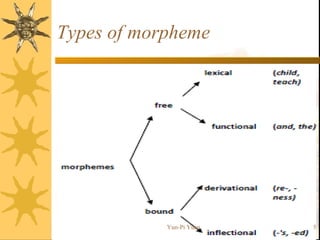
Types of morpheme
Yun-Pi Yuan 5
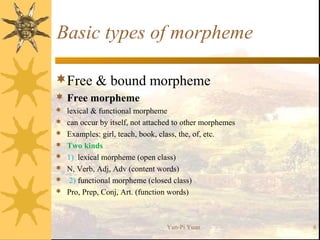
Basic types of morpheme
Free & bound morpheme
 Free morpheme
 lexical & functional morpheme
 can occur by itself, not attached to other morphemes
 Examples: girl, teach, book, class, the, of, etc.
 Two kinds
 1) lexical morpheme (open class)
 N, Verb, Adj, Adv (content words)
 2) functional morpheme (closed class)
 Pro, Prep, Conj, Art. (function words)
Yun-Pi Yuan 6
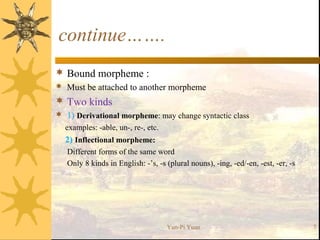
continue…….
 Bound morpheme :
 Must be attached to another morpheme
 Two kinds
 1) Derivational morpheme: may change syntactic class
examples: -able, un-, re-, etc.
2) Inflectional morpheme:
Different forms of the same word
Only 8 kinds in English: -’s, -s (plural nouns), -ing, -ed/-en, -est, -er, -s
Yun-Pi Yuan 7
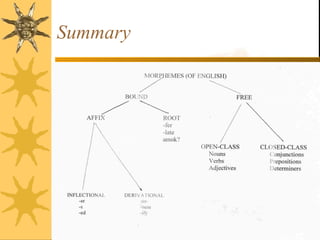
Summary
Yun-Pi Yuan 8
The End
Yun-Pi Yuan 9
The End
Yun-Pi Yuan 9

Morphology of language

  • 1.
    Morphology in linguistic Preparedby : Munsif siyyal Roll no : 2013-M.A-ELT-35 Yun-Pi Yuan 1
  • 2.
    Morphology I. Introduction ofthe Morphology II. Types of Morpheme III. Summary IV. The end Yun-Pi Yuan 2
  • 3.
    Introduction Morphology:  The studyof the structure of words & how words are formed (from morphemes) Yun-Pi Yuan 3
  • 4.
    Morpheme  Morpheme:  Thesmallest unit of language that carries meaning (maybe a word or not a word)  A sound-meaning unit  A minimal unit of meaning or grammatical function  The level of language at which sound and meaning combine  Yun-Pi Yuan 4
  • 5.
  • 6.
    Basic types ofmorpheme Free & bound morpheme  Free morpheme  lexical & functional morpheme  can occur by itself, not attached to other morphemes  Examples: girl, teach, book, class, the, of, etc.  Two kinds  1) lexical morpheme (open class)  N, Verb, Adj, Adv (content words)  2) functional morpheme (closed class)  Pro, Prep, Conj, Art. (function words) Yun-Pi Yuan 6
  • 7.
    continue…….  Bound morpheme:  Must be attached to another morpheme  Two kinds  1) Derivational morpheme: may change syntactic class examples: -able, un-, re-, etc. 2) Inflectional morpheme: Different forms of the same word Only 8 kinds in English: -’s, -s (plural nouns), -ing, -ed/-en, -est, -er, -s Yun-Pi Yuan 7
  • 8.
  • 9.
  • 10.