Presented By Group #2
Mubeen Akhtar (19011502-004)
Isma Kanwal (19011502-024)
Anzla Noor (19011502-011)
Morphology
Morph=form or shape
ology=study of
 The study of internal structure of words
 How words are constructed out of smaller
units (morpheme)
 -which have a meanings or grammatical
function e.g.
 -friendly----constructed from friend &adjective
forming -ly
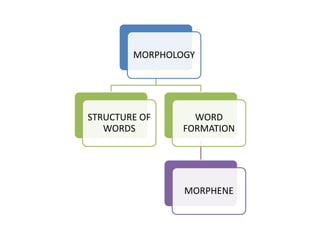
MORPHOLOGY
STRUCTURE OF
WORDS
WORD
FORMATION
MORPHENE
Morpheme
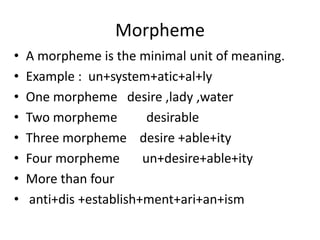
• A morpheme is the minimal unit of meaning.
• Example : un+system+atic+al+ly
• One morpheme desire ,lady ,water
• Two morpheme desirable
• Three morpheme desire +able+ity
• Four morpheme un+desire+able+ity
• More than four
• anti+dis +establish+ment+ari+an+ism
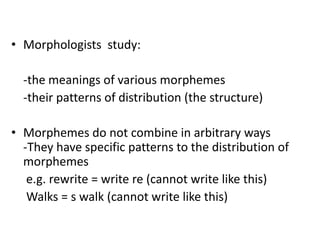
• Morphologists study:
-the meanings of various morphemes
-their patterns of distribution (the structure)
• Morphemes do not combine in arbitrary ways
-They have specific patterns to the distribution of
morphemes
e.g. rewrite = write re (cannot write like this)
Walks = s walk (cannot write like this)
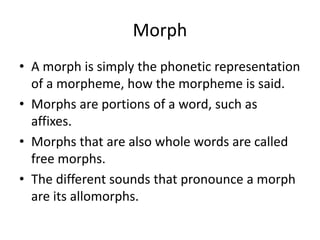
Morph
• A morph is simply the phonetic representation
of a morpheme, how the morpheme is said.
• Morphs are portions of a word, such as
affixes.
• Morphs that are also whole words are called
free morphs.
• The different sounds that pronounce a morph
are its allomorphs.
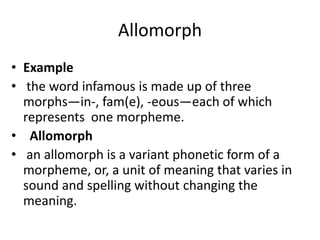
Allomorph
• Example
• the word infamous is made up of three
morphs—in-, fam(e), -eous—each of which
represents one morpheme.
• Allomorph
• an allomorph is a variant phonetic form of a
morpheme, or, a unit of meaning that varies in
sound and spelling without changing the
meaning.
• An allomorph is a morph that has a unique
set of grammatical or lexical features. All
allomorphs with the same set of features
forms a morpheme. ...
• For example, "-en" is a second allomorph
that marks plural in nouns (irregular, in only
three known nouns: ox/ox+en, child/childr+
en, brother/brether+en).
Types of Morpheme
• Free Morpheme
• Bound Morpheme
Free Morpheme
are morpheme that can stand by themselves as a
single word.e.g eat,date,weak etc
Bound Morpheme
are morpheme that cannot stand alone e.g
-un,-er,-less,-ed
Morpheme classes
1.Bases(roots)
2.Affixes
Base(root)
A root morpheme is the morpheme that gives
the word its main meaning.
• Free base morpheme
they can stand alone to function as words.
Examples
womanly,recollect ,bicycle and uneasyetc
• Bound base morpheme :
they cannot stand alone to function as words
Examples
receive,reduce
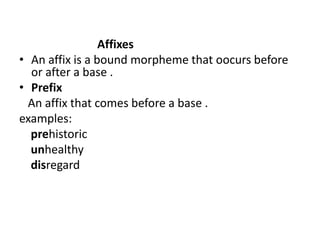
Affixes
• An affix is a bound morpheme that oocurs before
or after a base .
• Prefix
An affix that comes before a base .
examples:
prehistoric
unhealthy
disregard
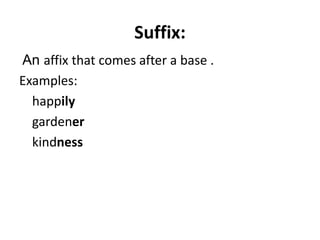
Suffix:
An affix that comes after a base .
Examples:
happily
gardener
kindness
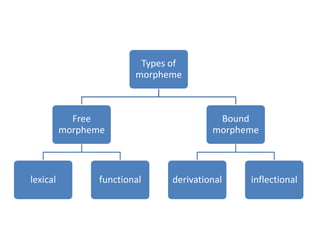
Types of
morpheme
Free
morpheme
lexical functional
Bound
morpheme
derivational inflectional
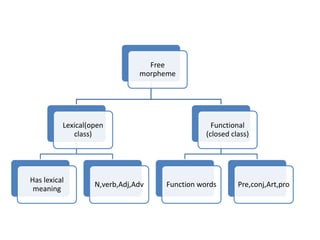
Free
morpheme
Lexical(open
class)
Has lexical
meaning
N,verb,Adj,Adv
Functional
(closed class)
Function words Pre,conj,Art,pro
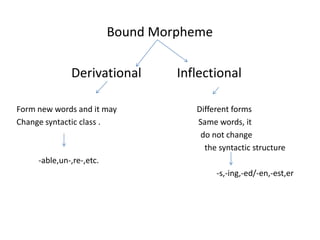
Bound Morpheme
Derivational Inflectional
Form new words and it may Different forms
Change syntactic class . Same words, it
do not change
the syntactic structure
-able,un-,re-,etc.
-s,-ing,-ed/-en,-est,er

Introduction of Morphology

  • 1.
    Presented By Group#2 Mubeen Akhtar (19011502-004) Isma Kanwal (19011502-024) Anzla Noor (19011502-011)
  • 2.
    Morphology Morph=form or shape ology=studyof  The study of internal structure of words  How words are constructed out of smaller units (morpheme)  -which have a meanings or grammatical function e.g.  -friendly----constructed from friend &adjective forming -ly
  • 3.
  • 4.
    Morpheme • A morphemeis the minimal unit of meaning. • Example : un+system+atic+al+ly • One morpheme desire ,lady ,water • Two morpheme desirable • Three morpheme desire +able+ity • Four morpheme un+desire+able+ity • More than four • anti+dis +establish+ment+ari+an+ism
  • 5.
    • Morphologists study: -themeanings of various morphemes -their patterns of distribution (the structure) • Morphemes do not combine in arbitrary ways -They have specific patterns to the distribution of morphemes e.g. rewrite = write re (cannot write like this) Walks = s walk (cannot write like this)
  • 6.
    Morph • A morphis simply the phonetic representation of a morpheme, how the morpheme is said. • Morphs are portions of a word, such as affixes. • Morphs that are also whole words are called free morphs. • The different sounds that pronounce a morph are its allomorphs.
  • 7.
    Allomorph • Example • theword infamous is made up of three morphs—in-, fam(e), -eous—each of which represents one morpheme. • Allomorph • an allomorph is a variant phonetic form of a morpheme, or, a unit of meaning that varies in sound and spelling without changing the meaning.
  • 8.
    • An allomorphis a morph that has a unique set of grammatical or lexical features. All allomorphs with the same set of features forms a morpheme. ... • For example, "-en" is a second allomorph that marks plural in nouns (irregular, in only three known nouns: ox/ox+en, child/childr+ en, brother/brether+en).
  • 9.
    Types of Morpheme •Free Morpheme • Bound Morpheme Free Morpheme are morpheme that can stand by themselves as a single word.e.g eat,date,weak etc Bound Morpheme are morpheme that cannot stand alone e.g -un,-er,-less,-ed
  • 10.
    Morpheme classes 1.Bases(roots) 2.Affixes Base(root) A rootmorpheme is the morpheme that gives the word its main meaning. • Free base morpheme they can stand alone to function as words.
  • 11.
    Examples womanly,recollect ,bicycle anduneasyetc • Bound base morpheme : they cannot stand alone to function as words Examples receive,reduce
  • 12.
    Affixes • An affixis a bound morpheme that oocurs before or after a base . • Prefix An affix that comes before a base . examples: prehistoric unhealthy disregard
  • 13.
    Suffix: An affix thatcomes after a base . Examples: happily gardener kindness
  • 14.
  • 15.
  • 16.
    Bound Morpheme Derivational Inflectional Formnew words and it may Different forms Change syntactic class . Same words, it do not change the syntactic structure -able,un-,re-,etc. -s,-ing,-ed/-en,-est,er