LIC. EN IDIOMA INGLÉS 
INTRODUCCIÓN A LA TRADUCCIÓN 
INGLÉS-ESPAÑOL-INGLÉS 
6° Cuatrimestre 
Lic. Mario DĂ­az Escobedo 
Equipo 2 
Marbella FernĂĄndez Orozco 
Ricardo E. RamĂ­rez Posada 
Esau
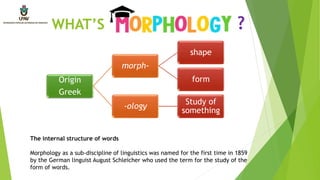
WHAT’S ? 
Origin 
Greek 
morph-shape 
form 
-ology 
Study of 
something 
The internal structure of words 
Morphology as a sub-discipline of linguistics was named for the first time in 1859 
by the German linguist August Schleicher who used the term for the study of the 
form of words.
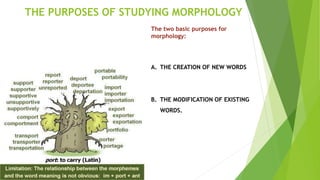
THE PURPOSES OF STUDYING MORPHOLOGY 
The two basic purposes for 
morphology: 
A. THE CREATION OF NEW WORDS 
B. THE MODIFICATION OF EXISTING 
WORDS.
What is a word? 
 They are the smallest independent units of language. 
 They do not depend on other words which means that they can be separated 
from other units and can change position. 
 They have an internal structure and are built up by even smaller pieces.
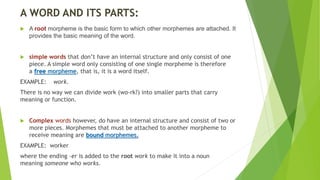
A WORD AND ITS PARTS: 
 A root morpheme is the basic form to which other morphemes are attached. It 
provides the basic meaning of the word. 
 simple words that don’t have an internal structure and only consist of one 
piece. A simple word only consisting of one single morpheme is therefore 
a free morpheme, that is, it is a word itself. 
EXAMPLE: work. 
There is no way we can divide work (wo-rk?) into smaller parts that carry 
meaning or function. 
 Complex words however, do have an internal structure and consist of two or 
more pieces. Morphemes that must be attached to another morpheme to 
receive meaning are bound morphemes. 
EXAMPLE: worker 
where the ending –er is added to the root work to make it into a noun 
meaning someone who works.
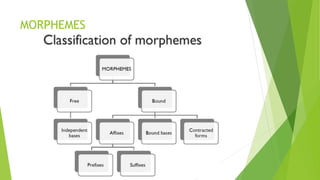
MORPHEMES
Example:
PREFIXES 
They are placed before the root 
Inflection 
They do not change the part of the speech 
Make (verb) True (noun) 
Remake (verb) Untrue (noun) 
Derivation 
They change the part of the speech 
(sometimes) 
Forget (verb) 
Unforgettable (adjective)
SUFFIXES 
They are placed after the root 
● INFLECTIONS 
Do not change the part of the speech. Example: (verb - verb) work – works 
(noun - noun) hand – hands 
● ROOT + BOUND MORPHEMES = NEW WORD 
wonder + ful = wonderful arrive + ing= arriving 
● DERIVATIONAL They change the part of the speech 
(sometimes) 
nation (noun) national (adjective) 
usual (adjective) usually (adverb)

Morphology presentation

  • 1.
    LIC. EN IDIOMAINGLÉS INTRODUCCIÓN A LA TRADUCCIÓN INGLÉS-ESPAÑOL-INGLÉS 6° Cuatrimestre Lic. Mario Díaz Escobedo Equipo 2 Marbella Fernández Orozco Ricardo E. Ramírez Posada Esau
  • 2.
    WHAT’S ? Origin Greek morph-shape form -ology Study of something The internal structure of words Morphology as a sub-discipline of linguistics was named for the first time in 1859 by the German linguist August Schleicher who used the term for the study of the form of words.
  • 3.
    THE PURPOSES OFSTUDYING MORPHOLOGY The two basic purposes for morphology: A. THE CREATION OF NEW WORDS B. THE MODIFICATION OF EXISTING WORDS.
  • 4.
    What is aword?  They are the smallest independent units of language.  They do not depend on other words which means that they can be separated from other units and can change position.  They have an internal structure and are built up by even smaller pieces.
  • 5.
    A WORD ANDITS PARTS:  A root morpheme is the basic form to which other morphemes are attached. It provides the basic meaning of the word.  simple words that don’t have an internal structure and only consist of one piece. A simple word only consisting of one single morpheme is therefore a free morpheme, that is, it is a word itself. EXAMPLE: work. There is no way we can divide work (wo-rk?) into smaller parts that carry meaning or function.  Complex words however, do have an internal structure and consist of two or more pieces. Morphemes that must be attached to another morpheme to receive meaning are bound morphemes. EXAMPLE: worker where the ending –er is added to the root work to make it into a noun meaning someone who works.
  • 6.
  • 7.
  • 8.
    PREFIXES They areplaced before the root Inflection They do not change the part of the speech Make (verb) True (noun) Remake (verb) Untrue (noun) Derivation They change the part of the speech (sometimes) Forget (verb) Unforgettable (adjective)
  • 9.
    SUFFIXES They areplaced after the root ● INFLECTIONS Do not change the part of the speech. Example: (verb - verb) work – works (noun - noun) hand – hands ● ROOT + BOUND MORPHEMES = NEW WORD wonder + ful = wonderful arrive + ing= arriving ● DERIVATIONAL They change the part of the speech (sometimes) nation (noun) national (adjective) usual (adjective) usually (adverb)