Crohn´s disease
Domina Petric, MD
Crohn´s disease is a chronic inflammatory
gastrointestinal disease characterised by transmural
granulomatous inflammation affecting any part of the
gut from mouth to anus.
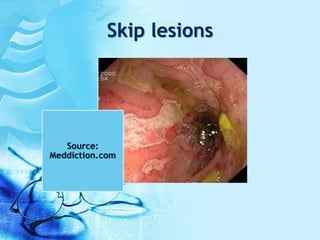
There is unaffected bowel
between areas of active
disease: SKIP LESIONS.
Introduction
Cause
• Cause is unknown.
• Environmental agents are implicated.
• Genetics: mutations of the NOD2/CARD15.
• Colon involvement goes with increased
CARD15 gene expression in macrophages
and intestinal epithelial cells.
• Dysregulated immune responses might be
primary or secondary (infecting gut
commensals like Mycobacterium avium
para-TB).
• E. coli adhesins, p273, may play a role in
developing Morbus Crohn.
Epidemiology
• Prevalence is 0,5-1/1000.
• More common in women.
• Incidence is 5-10/100000/year.
• Presentation is mostly at age of 20
to 40 years.
• Smoking increases risk 3-4 times.
• NSAID may exacerbate disease.
Symptoms
• diarrhoea and urgency
• abdominal pain
• weight loss, failure to thrive
• fever
• malaise
• anorexia
Symptoms
Patients can feel fine one
minute, and deathly ill the
next minute.
Diarrhoea is usually
very smelly.
Signs in the GI tract
• aphthous ulcerations
• abdominal tenderness or
mass
• perianal abscess, fistulae
• skin tags
• anal strictures
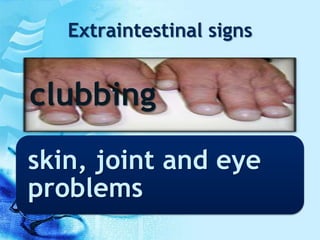
Extraintestinal signs
clubbing
skin, joint and eye
problems
Skip lesions
Source:
Meddiction.com
Complications
small bowel obstruction
toxic dilatation (colonic diameter>6 cm)
abscess formation (abdominal, pelvic,
ischiorectal)
fistulae (colovesical, colovaginal, perianal,
enterocutaneous)
Complications
rectal haemorrhage
colon cancer
fatty liver
primary sclerosing cholangitis
cholangiocarcinoma
Complications
renal stones
osteomalacia
malnutrition
amyloidosis
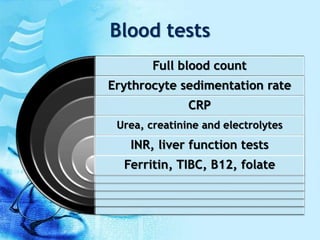
Blood tests
Full blood count
Erythrocyte sedimentation rate
CRP
Urea, creatinine and electrolytes
INR, liver function tests
Ferritin, TIBC, B12, folate
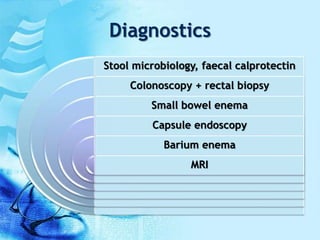
Diagnostics
Stool microbiology, faecal calprotectin
Colonoscopy + rectal biopsy
Small bowel enema
Capsule endoscopy
Barium enema
MRI
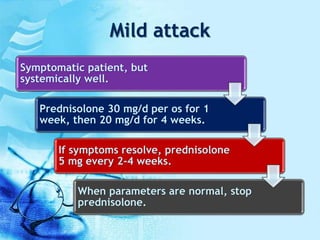
Mild attack
Symptomatic patient, but
systemically well.
Prednisolone 30 mg/d per os for 1
week, then 20 mg/d for 4 weeks.
If symptoms resolve, prednisolone
5 mg every 2-4 weeks.
When parameters are normal, stop
prednisolone.
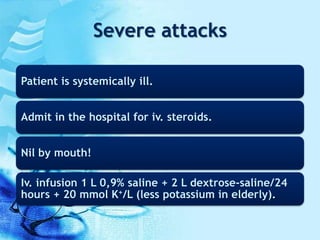
Severe attacks
Patient is systemically ill.
Admit in the hospital for iv. steroids.
Nil by mouth!
Iv. infusion 1 L 0,9% saline + 2 L dextrose-saline/24
hours + 20 mmol K+/L (less potassium in elderly).
Severe attacks
• Hydrocortisone 100 mg/6 h iv.
• Hydrocortisone 100 mg in 100 mL 0,9%
saline/12 hours per rectum is effective
treatment for rectal disease.
• Metronidazole 400 mg/8 hours per os or
500 mg/8 hours iv. can be useful in
perianal disease or superadded
infection.
Severe attacks
• Daily physical examination with full
blood count, erythrocyte
sedimentation rate, CRP, urea,
creatinine and eletrolytes.
• Plain abdominal X ray.
• Consider need for blood transfusion
and parenteral nutrition.
Severe attacks
If the patient is improving after 5 days, transfer
to oral prednisolone 40 mg/day.
If the patient is not improving, INFLIXIMAB or
ADALIMUMAB.
In the case of severe abdominal pain, consider
abdominal sepsis complicating Crohn´s disease.
MEDICATIONS FOR MORBUS CROHN
Azathioprine
Dose is 2-2,5 mg/kg/day per os.
It can be used as a steroid-sparing
agent.
It takes 6-10 weeks for clinical
improvement.
Sulfasalazine
Although unproven
efficacy, sulfasalazine is
useful in Crohn´s disease,
especially high-dose
postoperatively in patients
with ileal resection.
TNFα inhibitors
• Infliximab and adalimumab can
decrease disease activity because TNFα
plays important role in pathogenesis of
Crohn´s disease.
• They counter neutrophil accumulation
and granuloma formation, activate
complement and cause cytotoxicity to
CD4+ T-cells.
Methotrexate
Methotrexate 25 mg im.
weekly for remission
induction is enabling
complete withdrawal from
steroids in patients with
refractory Crohn´s disease.
Nutrition
Enteral nutrition is preferred
(polymeric diet) over the total
parenteral nutrition in exacerbations.
Low residue diets help control
Crohn´s activity.
Literature
• Oxford Handbook of Clinical
Medicine. Longmore M.
Wilkinson I. B. Baldwin A.
Elizabeth W. Ninth edition.
• Meddiction.com
• Wikipedia.org

Morbus Crohn

  • 1.
  • 2.
    Crohn´s disease isa chronic inflammatory gastrointestinal disease characterised by transmural granulomatous inflammation affecting any part of the gut from mouth to anus. There is unaffected bowel between areas of active disease: SKIP LESIONS. Introduction
  • 3.
    Cause • Cause isunknown. • Environmental agents are implicated. • Genetics: mutations of the NOD2/CARD15. • Colon involvement goes with increased CARD15 gene expression in macrophages and intestinal epithelial cells. • Dysregulated immune responses might be primary or secondary (infecting gut commensals like Mycobacterium avium para-TB). • E. coli adhesins, p273, may play a role in developing Morbus Crohn.
  • 4.
    Epidemiology • Prevalence is0,5-1/1000. • More common in women. • Incidence is 5-10/100000/year. • Presentation is mostly at age of 20 to 40 years. • Smoking increases risk 3-4 times. • NSAID may exacerbate disease.
  • 5.
    Symptoms • diarrhoea andurgency • abdominal pain • weight loss, failure to thrive • fever • malaise • anorexia
  • 6.
    Symptoms Patients can feelfine one minute, and deathly ill the next minute. Diarrhoea is usually very smelly.
  • 7.
    Signs in theGI tract • aphthous ulcerations • abdominal tenderness or mass • perianal abscess, fistulae • skin tags • anal strictures
  • 8.
  • 9.
  • 10.
    Complications small bowel obstruction toxicdilatation (colonic diameter>6 cm) abscess formation (abdominal, pelvic, ischiorectal) fistulae (colovesical, colovaginal, perianal, enterocutaneous)
  • 11.
    Complications rectal haemorrhage colon cancer fattyliver primary sclerosing cholangitis cholangiocarcinoma
  • 12.
  • 13.
    Blood tests Full bloodcount Erythrocyte sedimentation rate CRP Urea, creatinine and electrolytes INR, liver function tests Ferritin, TIBC, B12, folate
  • 14.
    Diagnostics Stool microbiology, faecalcalprotectin Colonoscopy + rectal biopsy Small bowel enema Capsule endoscopy Barium enema MRI
  • 15.
    Mild attack Symptomatic patient,but systemically well. Prednisolone 30 mg/d per os for 1 week, then 20 mg/d for 4 weeks. If symptoms resolve, prednisolone 5 mg every 2-4 weeks. When parameters are normal, stop prednisolone.
  • 16.
    Severe attacks Patient issystemically ill. Admit in the hospital for iv. steroids. Nil by mouth! Iv. infusion 1 L 0,9% saline + 2 L dextrose-saline/24 hours + 20 mmol K+/L (less potassium in elderly).
  • 17.
    Severe attacks • Hydrocortisone100 mg/6 h iv. • Hydrocortisone 100 mg in 100 mL 0,9% saline/12 hours per rectum is effective treatment for rectal disease. • Metronidazole 400 mg/8 hours per os or 500 mg/8 hours iv. can be useful in perianal disease or superadded infection.
  • 18.
    Severe attacks • Dailyphysical examination with full blood count, erythrocyte sedimentation rate, CRP, urea, creatinine and eletrolytes. • Plain abdominal X ray. • Consider need for blood transfusion and parenteral nutrition.
  • 19.
    Severe attacks If thepatient is improving after 5 days, transfer to oral prednisolone 40 mg/day. If the patient is not improving, INFLIXIMAB or ADALIMUMAB. In the case of severe abdominal pain, consider abdominal sepsis complicating Crohn´s disease.
  • 20.
  • 21.
    Azathioprine Dose is 2-2,5mg/kg/day per os. It can be used as a steroid-sparing agent. It takes 6-10 weeks for clinical improvement.
  • 22.
    Sulfasalazine Although unproven efficacy, sulfasalazineis useful in Crohn´s disease, especially high-dose postoperatively in patients with ileal resection.
  • 23.
    TNFα inhibitors • Infliximaband adalimumab can decrease disease activity because TNFα plays important role in pathogenesis of Crohn´s disease. • They counter neutrophil accumulation and granuloma formation, activate complement and cause cytotoxicity to CD4+ T-cells.
  • 24.
    Methotrexate Methotrexate 25 mgim. weekly for remission induction is enabling complete withdrawal from steroids in patients with refractory Crohn´s disease.
  • 25.
    Nutrition Enteral nutrition ispreferred (polymeric diet) over the total parenteral nutrition in exacerbations. Low residue diets help control Crohn´s activity.
  • 26.
    Literature • Oxford Handbookof Clinical Medicine. Longmore M. Wilkinson I. B. Baldwin A. Elizabeth W. Ninth edition. • Meddiction.com • Wikipedia.org