ANKIT KUMAR
BRIT
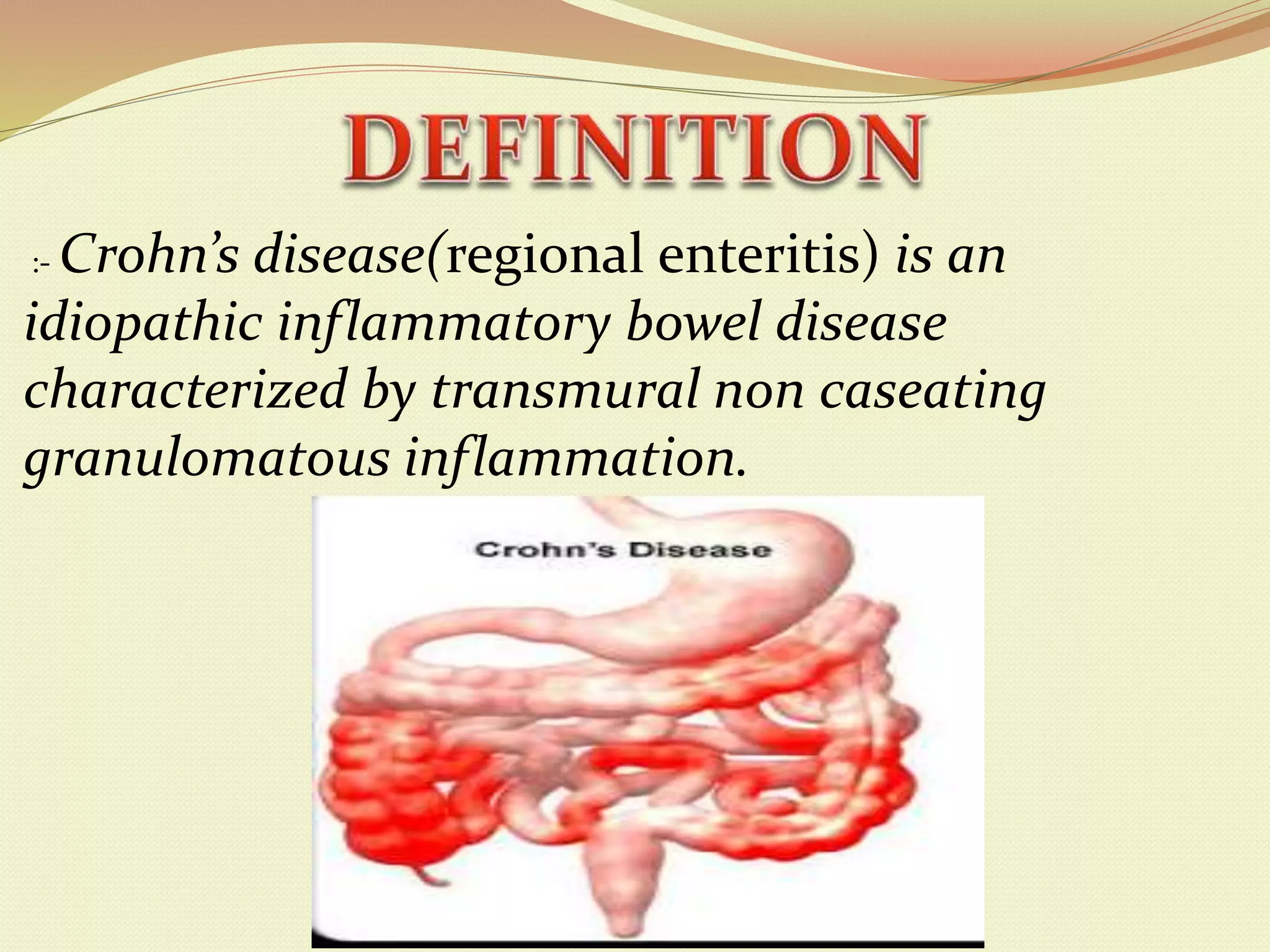
:- Crohn’s disease(regional enteritis) is an
idiopathic inflammatory bowel disease
characterized by transmural non caseating
granulomatous inflammation.
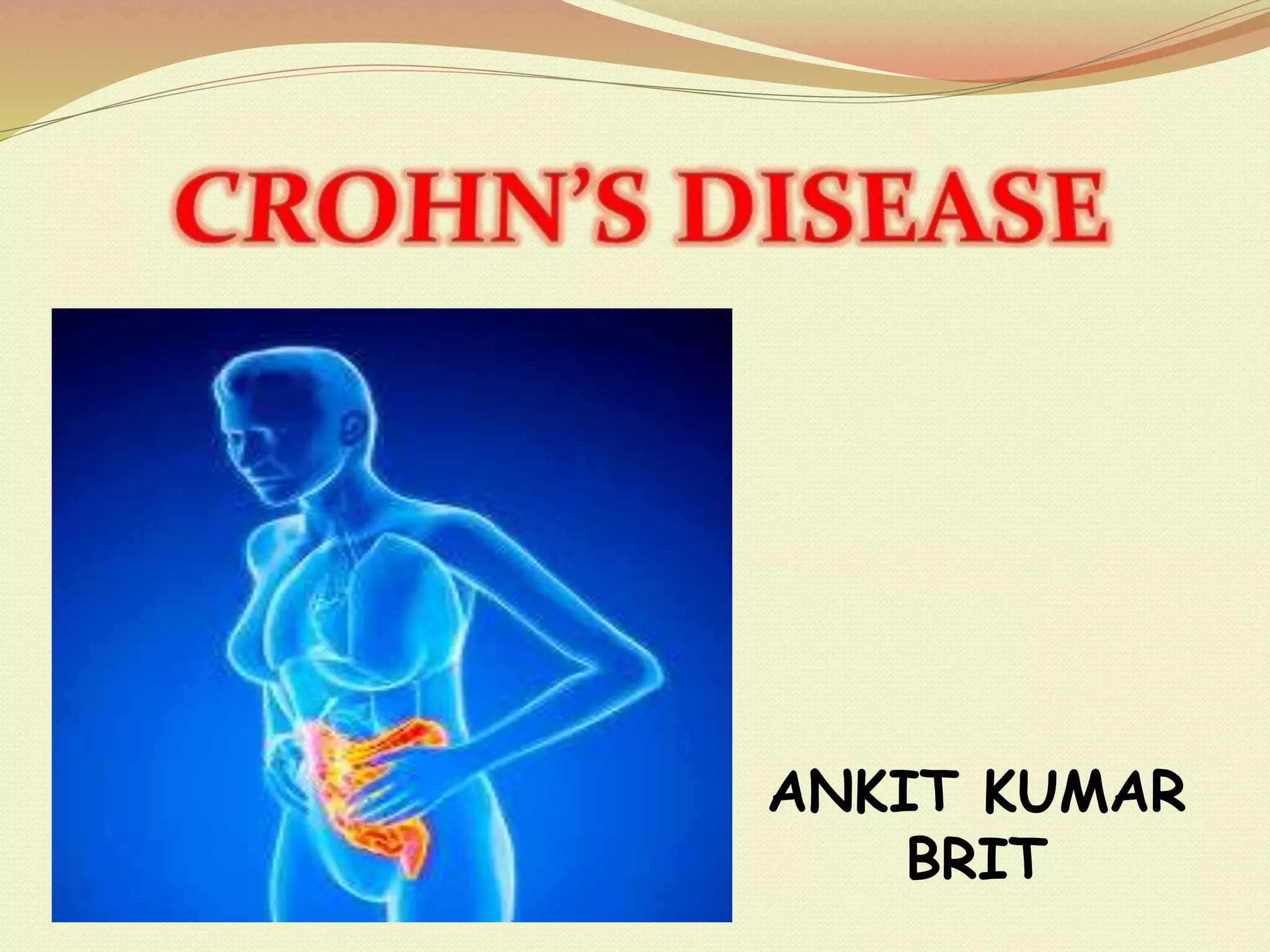
Crohn’s
disease
Acute
Acute onset
resembling
appendicits
Chronic
Chronic ill
health
Low grade fever
Recurrent
attacks of
abdominal pain
and diarrhoea
Tender mass in
the right iliac
fossa
Crohn’s disease of the terminal ileum.
• Heredity: It may inherit genes that make more susceptible to
developing Crohn’s disease.
• The immune system: When triggered, it affects the
gastrointestinal tract, causing inflammation that contributes to
symptoms
• Environmental factors: Bacteria, a virus, or some unidentified
factor in the environment that triggers an abnormal immune
response
• Foreign substances (antigens) in the environment may also be a
cause of inflammation, or it stimulate the body’s defenses to
produce inflammation that continues without control.
• Smoking : smokers with Crohn's disease usually have more severe
symptoms than non-smokers.
:- Any where in the gut from mouth to anus.
Most common-
 Ileo-colic(80%)
 Terminal ilum(30%)
 Right colon (20%)
Distibution
:- Segmental ditribution with skip lesions.
 Crohn’s disease may involve any portion of the gastrointestinal tract but affects
most commonly 15-25 cm of the terminal ileum which may extend into the
caecum and sometimes into the ascending colon:
:- The symptoms of crohn’s disease depend on where the disease
occurs in the bowel and its severity.
- Symptoms can include:
 Chronic diarrhea(bloody and contain mucus or pus)
 Weight loss
 Fever
 Abdominal mass and tenderness feeling of a mass or
fullness in the abdomen
 Rectal bleeding
 Constipation
 Abdominal pain
 vomiting
symptoms that may associated with Inflammatory
Bowel Disease:
 Fever
 Loss of appetite
 Weight loss
 Fatigue
 Night sweats
 Inflammation may also cause a fistula to
develop
 COLONOSCOPY is the best for making the diagnosis of Cohn’s
disease, as it allows direct visualization of the colon and the
terminal ileum, identifying the pattern of disease involvement.
 CT AND MRI are useful for evaluating the small bowel with
enteroclysis. They are useful for looking for intra-abdominal
complications of crohn’s disease such as abscess, fistulae.
 Barium enema, in which barium is inserted into the rectum and
fluoroscopy is used to image the bowel. They are useful for
identifying anatomical abnormalities when strictures of the colon
are too small for a colonoscope to pass through.
Blood tests
 COMPLETE BLOOD COUNT(CBC)- May reveal
anaemia
 ESR(Erythrocyte sedimentation rate) and CRP
(C-reactive protein)- Help to assess the degree of
inflammation.
 ANTINEUTROPHIL CYTOPLASMIC
ANTIBODIES(ANCA)- To identify inflammatory
disease of intestine.
1. Antibiotics
:- Metronidazole, ciprofloxacin, and other antibiotics may be used when
infections occur, or to treat complications of Crohn’s disease
2. Aminosalicylates (5-ASAs)
:- Given either orally or rectally, these drugs work to decrease inflammation in
the lining of the intestines
3. Corticosteroids (Steroids)
:- Given orally, as an injection, rectally, or intravenously, these medications
help reduce inflammation by suppressing the immune system
4. Immune modifiers (Immunomodulators)
:- Given orally or injected, these medications suppress the body’s immune
response so that it cannot cause ongoing inflammation.
5. Biologic therapies (Biologics)
:- Given intravenously or injected, this class of drugs suppresses the immune
system to reduce inflammation by targeting a specific pathway
1. Intestinal complications
 Stricture
 Fistula
 Perforation
 Abscess
 Neoplasm
2. Systemic complications
 Arthritis (it is an informal way of referring to joint pain or
joint disease.)
 Oxalate stones
 Ankylosing spondylitis( it is a type of arthritis that affects
the spine)
 Uveiitis (it is inflammation of the uvea, the middle layer of the eye
between the retina and the sclera (white of the eye), and can lead to vision
loss if left untre.)
 Sclerosing episcleritis( in which peripheral cornea is
opacified by fibrosis and lipid deposition with
neighboring scleritis may occur particularly with herpes
zoster scleritis. Sclerosing keratitis may present with crystalline
deposits in the posterior corneal lamellae.)
 Sclerosing cholangitis(it is a chronic liver disease
characterized by a progressive course of cholestasis with
inflammation and fibrosis of the intrahepatic and extrahepatic
bile ducts.)
 Erythema nodosum( it is initially managed by identifying
and treating any underlying condition present. Simultaneously,
treatment is directed toward the inflamed skin from
the erythema nodosum. Treatments for erythema
nodosum include anti-inflammatory drugs, and corticosteroids
by mouth or local injection.)
3. Postoperatives complications
 Anastomotic recurrence
 Anastomotic fibrostenosis
 Adhesion obstruction
 Other complication are:
 Arthritis
 Gall stones
 Inflammation of the eye and mouth
 Kidney stones
 Liver disease
 Skin rashes or ulcers
Text book of pathology;sixth edition;harsh
mohan
 https://www.crohnsandcolitis.com/crohns/di
sease-treatment
 https://www.webmd.com/ibd-crohns-
disease/crohns-disease/crohns-disease
Crohn's disease

Crohn's disease

  • 1.
  • 2.
    :- Crohn’s disease(regionalenteritis) is an idiopathic inflammatory bowel disease characterized by transmural non caseating granulomatous inflammation.
  • 3.
    Crohn’s disease Acute Acute onset resembling appendicits Chronic Chronic ill health Lowgrade fever Recurrent attacks of abdominal pain and diarrhoea Tender mass in the right iliac fossa
  • 5.
    Crohn’s disease ofthe terminal ileum.
  • 6.
    • Heredity: Itmay inherit genes that make more susceptible to developing Crohn’s disease. • The immune system: When triggered, it affects the gastrointestinal tract, causing inflammation that contributes to symptoms • Environmental factors: Bacteria, a virus, or some unidentified factor in the environment that triggers an abnormal immune response • Foreign substances (antigens) in the environment may also be a cause of inflammation, or it stimulate the body’s defenses to produce inflammation that continues without control. • Smoking : smokers with Crohn's disease usually have more severe symptoms than non-smokers.
  • 8.
    :- Any wherein the gut from mouth to anus. Most common-  Ileo-colic(80%)  Terminal ilum(30%)  Right colon (20%) Distibution :- Segmental ditribution with skip lesions.  Crohn’s disease may involve any portion of the gastrointestinal tract but affects most commonly 15-25 cm of the terminal ileum which may extend into the caecum and sometimes into the ascending colon:
  • 9.
    :- The symptomsof crohn’s disease depend on where the disease occurs in the bowel and its severity. - Symptoms can include:  Chronic diarrhea(bloody and contain mucus or pus)  Weight loss  Fever  Abdominal mass and tenderness feeling of a mass or fullness in the abdomen  Rectal bleeding  Constipation  Abdominal pain  vomiting
  • 10.
    symptoms that mayassociated with Inflammatory Bowel Disease:  Fever  Loss of appetite  Weight loss  Fatigue  Night sweats  Inflammation may also cause a fistula to develop
  • 11.
     COLONOSCOPY isthe best for making the diagnosis of Cohn’s disease, as it allows direct visualization of the colon and the terminal ileum, identifying the pattern of disease involvement.  CT AND MRI are useful for evaluating the small bowel with enteroclysis. They are useful for looking for intra-abdominal complications of crohn’s disease such as abscess, fistulae.  Barium enema, in which barium is inserted into the rectum and fluoroscopy is used to image the bowel. They are useful for identifying anatomical abnormalities when strictures of the colon are too small for a colonoscope to pass through.
  • 12.
    Blood tests  COMPLETEBLOOD COUNT(CBC)- May reveal anaemia  ESR(Erythrocyte sedimentation rate) and CRP (C-reactive protein)- Help to assess the degree of inflammation.  ANTINEUTROPHIL CYTOPLASMIC ANTIBODIES(ANCA)- To identify inflammatory disease of intestine.
  • 13.
    1. Antibiotics :- Metronidazole,ciprofloxacin, and other antibiotics may be used when infections occur, or to treat complications of Crohn’s disease 2. Aminosalicylates (5-ASAs) :- Given either orally or rectally, these drugs work to decrease inflammation in the lining of the intestines 3. Corticosteroids (Steroids) :- Given orally, as an injection, rectally, or intravenously, these medications help reduce inflammation by suppressing the immune system 4. Immune modifiers (Immunomodulators) :- Given orally or injected, these medications suppress the body’s immune response so that it cannot cause ongoing inflammation. 5. Biologic therapies (Biologics) :- Given intravenously or injected, this class of drugs suppresses the immune system to reduce inflammation by targeting a specific pathway
  • 14.
    1. Intestinal complications Stricture  Fistula  Perforation  Abscess  Neoplasm 2. Systemic complications  Arthritis (it is an informal way of referring to joint pain or joint disease.)  Oxalate stones  Ankylosing spondylitis( it is a type of arthritis that affects the spine)  Uveiitis (it is inflammation of the uvea, the middle layer of the eye between the retina and the sclera (white of the eye), and can lead to vision loss if left untre.)
  • 15.
     Sclerosing episcleritis(in which peripheral cornea is opacified by fibrosis and lipid deposition with neighboring scleritis may occur particularly with herpes zoster scleritis. Sclerosing keratitis may present with crystalline deposits in the posterior corneal lamellae.)  Sclerosing cholangitis(it is a chronic liver disease characterized by a progressive course of cholestasis with inflammation and fibrosis of the intrahepatic and extrahepatic bile ducts.)  Erythema nodosum( it is initially managed by identifying and treating any underlying condition present. Simultaneously, treatment is directed toward the inflamed skin from the erythema nodosum. Treatments for erythema nodosum include anti-inflammatory drugs, and corticosteroids by mouth or local injection.)
  • 16.
    3. Postoperatives complications Anastomotic recurrence  Anastomotic fibrostenosis  Adhesion obstruction  Other complication are:  Arthritis  Gall stones  Inflammation of the eye and mouth  Kidney stones  Liver disease  Skin rashes or ulcers
  • 17.
    Text book ofpathology;sixth edition;harsh mohan  https://www.crohnsandcolitis.com/crohns/di sease-treatment  https://www.webmd.com/ibd-crohns- disease/crohns-disease/crohns-disease