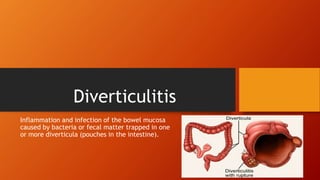
Diverticulitis
Inflammation and infection of the bowel mucosa
caused by bacteria or fecal matter trapped in one
or more diverticula (pouches in the intestine).
Risk Factors/ Causes
 Age (older adults)
 Sex (primarily male
 Low-Fiber diet
 Chronic constipation
 Culture (western)
Manifestations/Signs & Symptoms
(Subjective)
• Abdominal pain (LLQ radiating to back and tender on palpation)
• Nausea/Vomiting
(Objective)
• Fever
• Chills
• tachycardia
Labs/Diagnostics
• CBC
• Hemoglobin&
• Hematocrit
• WBC
• +stool occult
blood
• H&P
• Abdominal assessment
• Colonoscopy
• Barium enema
• Abdominal X-Ray
• CT scan w/ contrast
Medications/Treatments
Uncomplicated
• Antibiotics
• Stool softeners (bulk laxatives)
• High fiber diet
• Decrease intake of fat & red
meats
• Increase levels of physical
activity
• Colon rest (clear liquid diet)
• Increase fluid intake
Complicated
• IV antibiotics
• Opioids
• Iv fluids
• Surgery (perforation)
• Colon resection (severe case)
Complications
• Bowel perforation (rectal bleeding, firm abdomen, and
tachycardia)
• Bleeding (deterioration of bowel)
• Fluid and Electrolyte imbalance
• Peritonitis may occur if bowel is perforated
• Abscess formation
• Bowel obstruction
Interventions
• Perform abdominal assessment (distention, rigidity, and increased episodes of nausea/vomiting= signs of
obstruction)
• Assess v/s (fever, increased RR/HR, chills, diaphoresis, and increased abdominal discomfort= perforation,
abscess, or fistula)
• Maintain NPO
• Nasogastric salem-sump tube (decompression)
• Administer iv fluids
• Administer iv antibiotics
• TPN
• Assess pain (administer opioids)
• Teach client the importance of proper diet (limit seeds or indigestible material)
• Instruct client to avoid irritating the bowel (avoid alcohol)
• Provide client with instructions to promote normal bowel function
Resources
Group
Corina martinez
Kali Duke
Stephanie Anderson
Valerie Lopez
Theresa Schneider
Lewis, Dirksen, Heitkemper, & Bucher. (2014). Medical Surgical Nursing (Ninth ed.). MI.
Lenox, Renner, Tallmadge, & Lunen. (n.d.). RN Adult Medical Surgical Nursing (9th ed.)
(Prater, Ed.).

Diverticulitis

  • 1.
    Diverticulitis Inflammation and infectionof the bowel mucosa caused by bacteria or fecal matter trapped in one or more diverticula (pouches in the intestine).
  • 2.
    Risk Factors/ Causes Age (older adults)  Sex (primarily male  Low-Fiber diet  Chronic constipation  Culture (western)
  • 3.
    Manifestations/Signs & Symptoms (Subjective) •Abdominal pain (LLQ radiating to back and tender on palpation) • Nausea/Vomiting (Objective) • Fever • Chills • tachycardia
  • 4.
    Labs/Diagnostics • CBC • Hemoglobin& •Hematocrit • WBC • +stool occult blood • H&P • Abdominal assessment • Colonoscopy • Barium enema • Abdominal X-Ray • CT scan w/ contrast
  • 5.
    Medications/Treatments Uncomplicated • Antibiotics • Stoolsofteners (bulk laxatives) • High fiber diet • Decrease intake of fat & red meats • Increase levels of physical activity • Colon rest (clear liquid diet) • Increase fluid intake Complicated • IV antibiotics • Opioids • Iv fluids • Surgery (perforation) • Colon resection (severe case)
  • 6.
    Complications • Bowel perforation(rectal bleeding, firm abdomen, and tachycardia) • Bleeding (deterioration of bowel) • Fluid and Electrolyte imbalance • Peritonitis may occur if bowel is perforated • Abscess formation • Bowel obstruction
  • 7.
    Interventions • Perform abdominalassessment (distention, rigidity, and increased episodes of nausea/vomiting= signs of obstruction) • Assess v/s (fever, increased RR/HR, chills, diaphoresis, and increased abdominal discomfort= perforation, abscess, or fistula) • Maintain NPO • Nasogastric salem-sump tube (decompression) • Administer iv fluids • Administer iv antibiotics • TPN • Assess pain (administer opioids) • Teach client the importance of proper diet (limit seeds or indigestible material) • Instruct client to avoid irritating the bowel (avoid alcohol) • Provide client with instructions to promote normal bowel function
  • 8.
    Resources Group Corina martinez Kali Duke StephanieAnderson Valerie Lopez Theresa Schneider Lewis, Dirksen, Heitkemper, & Bucher. (2014). Medical Surgical Nursing (Ninth ed.). MI. Lenox, Renner, Tallmadge, & Lunen. (n.d.). RN Adult Medical Surgical Nursing (9th ed.) (Prater, Ed.).