Monoclonal antibodies
What is an antibody?
An antibody is a protein used by the immune system to identify and
neutralize foreign objects like bacteria and viruses. Each antibody
recognizes a specific antigen unique to its target.
Monoclonal antibodies (mAb) are antibodies that are identical
because they were produced by one type of immune cell, all clones of a
single parent cell.
Polyclonal antibodies are antibodies that are derived from different cell
lines.
Isotypes
According to differences in their heavy chain constant domains,
immunoglobulins are grouped into five classes, or isotypes: IgG, IgA, IgM,
IgD, and IgE.
Monoclonal Antibodies
• Monoclonal antibodies (mAb) are antibodies that
are identical because they were produced by one
type of immune cell, all clones of a single parent cell.
Given (almost) any substance, it is possible to create
monoclonal antibodies that specifically bind to that
substance; they can then serve to detect or purify
that substance.
• Monoclonal antibodies are mono-specific antibodies
that are produced in laboratory from single clone of
B Cells that recognizes only one antigen.
History of Mab development
• 1975 Kohler and Milstein provided the most outstanding
proof of the clonal selection theory by fusion of normal
and malignant cells. This resulted in the first monoclonal
antibodies, for which they received the Nobel Prize in
1984.
• They invented a method for monoclonal antibody
production, technique called somatic cell hybridization.
What Diseases to Target and How?
• Cancer cells express a variety of antigens that
are attractive targets for monoclonal
antibody-based therapy.
• The development of monoclonal antibodies
against specific targets has been largely
accomplished by immunizing mice against
human tumor cells and screening the
hybridomas for antibodies of interest.
- B lymphocytes can mutate into tumor cells that
result in a type of cancer termed myeloma.
- Myeloma cells become “immortal” and will
grow indefinitely in culture.
- Fusion of a single activated B cell and a
myeloma cell will create a hybridoma that can
grow indefinitely in culture.
Hybridomas Technique
Harvest Ab
Monoclonal antibodies
Myeloma cells
Grow indefinitely in
cell culture but don't
secrete the desired
antibody
FUSE Hybridoma cells
Secrete antibody but don't grow
in tissue culture
Grow indefinitely in
cell culture AND
secrete antibody
Polyclonal antibodies:
Polyclonal antibodies are a mixture of antibodies
with different antigen binding sites that may bind
to different epitopes or antigens of the immunizing
agent with varying affinities. They may be of
different antibody classes.
The serum obtained from an immunized animal is
referred to as a polyclonal antiserum.
A polyclonal antiserum contains antibody to
different epitopes and different antigens that were
present in the immunizing inoculum.
Affinity chromatography -
antibody purification.
Antigen can be bound to the
support matrix in order to purify
antigen-specific antibody from a
polyclonal antiserum.
Polyclonal antibodies
(Polyclonal antiserum)
B B B B B B B B
Harvest Ab
Monoclonal antibodies
Monoclonal antibodies:
• Antibodies produced from a single clone of B cells.
• Produced by fusing a B cell secreting the desired antibody
with a myeloma cell capable of growing indefinitely in
tissue culture.
• Monoclonal antibodies all have identical antigen-binding
sites. Thus they all bind to the same epitope with the same
affinity. They are all of the same antibody class (isotype).
Polyclonal antibodies Monoclonal Antibodies
Produced by: Many B cell clones A single B cell clone
Bind to: Multiple epitopes of all A single epitope of a
single
antigens used in the antigen
immunization
Antibody class: A mixture of different All of a single Ab
class
Ab classes (isotypes)
Ag-binding sites: A mixture of Abs with All Abs have the
same antigen
different antigen-binding binding site
sites
Potential for cross-reactivity: High Low
Production of Monoclonal Antibodies
• Somatic Cell hybridization technique is used
for the production of monoclonal antibodies
1. Formation of hybrid cells (B-Cell hybridoma)
2. Selection of B-Cell hybridoma
Formation of hybrid cells (B-cell
hybridoma)
• For the production of B-Cell hybridoma cells
fuse myeloma cells with spleen cells (B-Cells)
of mouse which have been previously
immunized with antigen.
• Antigen should be the one against the
production of antibodies are desired.
• An agent is used to facilitate the fusion such
as Polyethylene glycol.
Formation of hybrid cells (B-cell
hybridoma)
• In practice myeloma and spleen cell produce
complex mixture of multitude of fused cells
and un-fused myeloma and spleen cells. Three
types of fused cells can be produced.
o B-cell with B-cell fused cells
o Myeloma cell with myeloma cell fused
category
o B-cell with myeloma cell fused cells (desirable)
Myeloma cells have been genetically
engineered such that they can not use
hypoxanthine, aminopterin, and
thymidine (HAT medium) as a source for
nucleic acid biosynthesis and will die in
culture.
Only B cells that have fused with the
engineered myeloma cells will survive in
culture when grown in HAT medium.
Hybridoma Selection
The “HAT Trick”
Selection of B-cell hybridoma
• In order to get rid of these unwanted fused and unfused cells
to obtain pure B-Cell myeloma hybrids we make use of a
special selective media called HAT medium (named on its
three constituents).
• HAT selection based on the fact that animal cells utilize two
different pathways for their nucleic acid synthesis.
De novo synthesis refers to the synthesis of complex
molecules from simple molecules such as sugars or
amino acids, as opposed to recycling after partial
degradation. For example, nucleotides are not needed
in the diet as they can be constructed from small
precursor molecules such as formate and aspartate. This
pathway is blocked by HAT medium constitutent aminopterin
which is a folic acid analog.
Salvage pathway is an alternative route of nucleic
acid synthesis in cells with inactivated denovo
pathway. During Salvage pathway purines and
pyrimidines are directly engaged in the synthesis
of DNA and RNA.
The enzyme which catalyze the salvage pathway are
hypoxanthine guanine phosphoribosyl
tranferase (HGPRT) and thymidine kinase.
Mutation to either of these enzymes can block
the salvage pathway utilization for DNA
synthesis.
Selection of B-cell hybridoma
HAT Medium (hypoxanthine-aminopterin-
thymidine medium) is a selection medium for
mammalian cell culture, which relies on the
combination of aminopterin, a drug that acts as a
powerful folate metabolism inhibitor by
inhibiting dihydrofolate reductase,
with hypoxanthine (a purine derivative)
and thymidine (a deoxynucleoside) which are
intermediates in DNA synthesis. The trick is that
aminopterin blocks DNA de novo synthesis, which is
absolutely required for cell division to proceed, but
hypoxanthine and thymidine provide cells with the
raw material to evade the blockage (the "salvage
pathway"), provided that they have the right enzymes
Selection of B-cell hybridoma
• So when mixture of hybridomas and un-fused cells are placed
in HAT medium B-Cell hybridoma are selected on account of
the logic that
• Un-fused myeloma cells and fused myeloma-myeloma cells
cannot grow because they lack HGPRT and thus salvage
pathway alternative way of survived in HAT medium after
Denovo pathway inhibition by aminopterin constituent of HAT
medium.
• Unfused spleen cells and fused spleen cells could not survive
on account of their limited life span.
• Only B-cells myeloma hybrid can survive because B-cells
contribute the missing HGPRT for selvage pathway and
myeloma part imparts the mortal, indefinate division property
to B-Cell hybridomas.
Selection of B-cell hybridoma
• Once B-hybridoma cells are selected they
must be screened for the antigenic specificity
of the secreted antibody. Although many
hybirdoma will produce antibody specific for
the antigen utilized for the immunzation of
mice but some will also synthesize unwanted
antigen specific antibodies. This selection or
screening is done by ELISA and RIA.
• The culture of successful clones can be scale
up for industrial purposes.
1. In vitro maintenance culture vessels are
used. The yield ranges from 10-60 ug/ml
2. In vivo maintenance utilizes mice. The
antibody concentration in the serum and
other body fluid can reach 1-10 mg/ml.
Practical steps in monoclonal antibody production:
1) Immunize animal
2) Isolate spleen cells (containing antibody-producing B cells)
3) Fuse spleen cells with myeloma cells (e.g. using PEG - polyethylene glycol)
4) Allow unfused B cells to die
5) Add aminopterin to culture to kill unfused myeloma cells
6) Clone remaining cells (place 1 cell/well and allow each cell to grow into a
clone of cells)
7) Screen supernatant of each clone for presence of the desired antibody.
8) Grow the chosen clone of cells in tissue culture indefinitely.
9) Harvest antibody from the culture supernatant.
Kuby Figure 4-22
Monoclonal antibody Therapy
• Monoclonal antibody therapy is the use of
monoclonal antibodies to specifically target
cells. The main objective is simulating the
patient’s immune system to attack the
malignant tumor cells and the prevention of
tumor growth by blocking specific cell
receptors.
Radio-Immunotherapy
• Radio-immunotherapy involves the use of
radioactively conjugated murine antibodies
against cellular antigens. Most research currently
involved their application to lymphomas; as
these are highly radio-sensitive malignancies. To
limit radiation exposure, murine antibodies were
especially chosen, as their high immunogenicity
promotes rapid clearance from the body.
Tositumomab is an expamle use for non-
hodgkins lymphoma.
Antibody-directed enzyme pro-drug
therapy (ADEPT)
• ADEPT involves the application of cancer
associated monoclonal antibodies which are
linked to a drug activating enzyme.
• Subsequently systemic administration of a
non-toxic agent results in its conversion to a
toxic drug and resulting a cytotoxic effect
which can be targeted at malignant cells. The
clinical success that it will have a role in future
oncological treatment.
The types of mAb designed
A. Murine source mAbs(omab..mouse; amab…rat): rodent mAbs with
excellent affinities and specificities, generated using conventional
hydrioma technology. Clinical efficacy compromised by HAMA(human
anti murine antibody) response, which lead to allergic or immune
complex herpersensitivities.
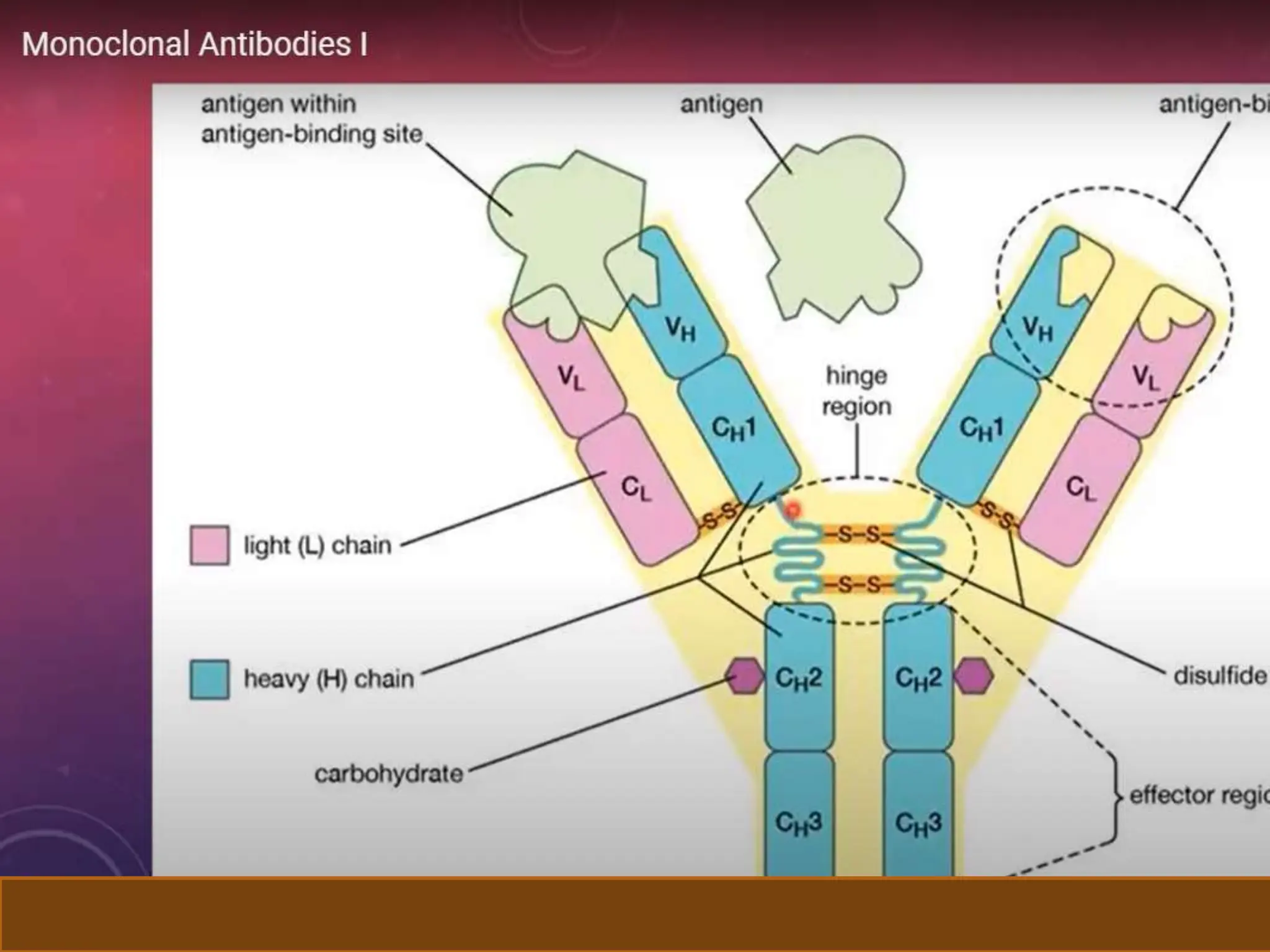
B. ChimericmAbs(ximab):A chimeric antibody (cAb) is anantibody made
by fusing the antigen binding region (variable domains of the heavy
and light chains, VH and VL ) from one species like a mouse, with the
constant domain (effector region) from another species such as a
rabbit
C. Humanized mAbs(zumab): A type of antibody made in the laboratory
by combining a human antibody with a small part of a mouse or rat
monoclonal antibody. The mouse or rat part of the antibody binds to
the target antigen, and the human part makes it less likely to be
destroyed by the body's immune system.
Application Of MAbs:
The application of monoclonal antibodies can be
broadly categorized as:
• a) Diagnostic application
• b) Therapeutic application
• c) Catalytic MAb (Abzymes)
Diagnostic Application
MAbs are utilized in diagnostic kits for the diagnosis of various
infectious diseases, detecting pregnancy, monitoring drug
levels, matching histocompatibility antigen, detecting diabetes,
and cancer.
 FDA licensed a new diagnostic imaging agent that can determine
the extent of disease in patients diagnosed with small cell lung
cancer (SCLC). Because these agents can detect tumor in different
part of the body at one time, it can help physician to advice
certain patients with advanced forms of the disease about
treatment option without requiring further diagnostic tests.
The new agent, Nofetumomab, is a fragment of a monoclonal
antibody that when tagged with the radioisotope technique, can
detect a protein found on the surface of most small lung cancer
cells.
Therapeutic Application
• Improving the out come of bone marrow transplantation by
using CD52 MAbs to prevent Graft-Versus-Host disease and
Graft rejection. Graft-versus-Host Disease (GVHD) is a major
cause of mortality and morbidity after bone marrow
transplantation, but can be avoided by removing T-
lymphocytes from the donor bone marrow.
• However, T-cell depletion increases the risk of graft rejection.
This study examined the use of CD52 MAb to eliminate T-
cells from both donor marrow and recipient to prevent both
GVHD and rejection.
• Alemtuzumab is the monoclonal antibody used for this
purpose.
Catalytic MAb (Abzymes):
The antibodies are extremely efficient at binding ground states of
the target molecule while enzymes obtained their catalytic
efficiency from tight binding of the transition state for the
reaction.
Thus antibodies can be made efficient catalysts if they are made
for reaction transition state.
Lemer and his co-workers explored the probability of enzyme like
action of antibodies by producing hapten-carrier complex where
the hapten structurally resembled transition state and anti-
hapten MAbs generated, gave catalytic activity.
 The hydrolysis of substrate increased thousand fold after
incubation.

Monoclonal antibodies explanation .pptx

  • 1.
  • 2.
    What is anantibody? An antibody is a protein used by the immune system to identify and neutralize foreign objects like bacteria and viruses. Each antibody recognizes a specific antigen unique to its target. Monoclonal antibodies (mAb) are antibodies that are identical because they were produced by one type of immune cell, all clones of a single parent cell. Polyclonal antibodies are antibodies that are derived from different cell lines. Isotypes According to differences in their heavy chain constant domains, immunoglobulins are grouped into five classes, or isotypes: IgG, IgA, IgM, IgD, and IgE.
  • 27.
    Monoclonal Antibodies • Monoclonalantibodies (mAb) are antibodies that are identical because they were produced by one type of immune cell, all clones of a single parent cell. Given (almost) any substance, it is possible to create monoclonal antibodies that specifically bind to that substance; they can then serve to detect or purify that substance. • Monoclonal antibodies are mono-specific antibodies that are produced in laboratory from single clone of B Cells that recognizes only one antigen.
  • 28.
    History of Mabdevelopment • 1975 Kohler and Milstein provided the most outstanding proof of the clonal selection theory by fusion of normal and malignant cells. This resulted in the first monoclonal antibodies, for which they received the Nobel Prize in 1984. • They invented a method for monoclonal antibody production, technique called somatic cell hybridization.
  • 29.
    What Diseases toTarget and How? • Cancer cells express a variety of antigens that are attractive targets for monoclonal antibody-based therapy. • The development of monoclonal antibodies against specific targets has been largely accomplished by immunizing mice against human tumor cells and screening the hybridomas for antibodies of interest.
  • 30.
    - B lymphocytescan mutate into tumor cells that result in a type of cancer termed myeloma. - Myeloma cells become “immortal” and will grow indefinitely in culture. - Fusion of a single activated B cell and a myeloma cell will create a hybridoma that can grow indefinitely in culture. Hybridomas Technique
  • 31.
    Harvest Ab Monoclonal antibodies Myelomacells Grow indefinitely in cell culture but don't secrete the desired antibody FUSE Hybridoma cells Secrete antibody but don't grow in tissue culture Grow indefinitely in cell culture AND secrete antibody
  • 32.
    Polyclonal antibodies: Polyclonal antibodiesare a mixture of antibodies with different antigen binding sites that may bind to different epitopes or antigens of the immunizing agent with varying affinities. They may be of different antibody classes. The serum obtained from an immunized animal is referred to as a polyclonal antiserum. A polyclonal antiserum contains antibody to different epitopes and different antigens that were present in the immunizing inoculum.
  • 33.
    Affinity chromatography - antibodypurification. Antigen can be bound to the support matrix in order to purify antigen-specific antibody from a polyclonal antiserum.
  • 34.
    Polyclonal antibodies (Polyclonal antiserum) BB B B B B B B Harvest Ab Monoclonal antibodies
  • 35.
    Monoclonal antibodies: • Antibodiesproduced from a single clone of B cells. • Produced by fusing a B cell secreting the desired antibody with a myeloma cell capable of growing indefinitely in tissue culture. • Monoclonal antibodies all have identical antigen-binding sites. Thus they all bind to the same epitope with the same affinity. They are all of the same antibody class (isotype).
  • 36.
    Polyclonal antibodies MonoclonalAntibodies Produced by: Many B cell clones A single B cell clone Bind to: Multiple epitopes of all A single epitope of a single antigens used in the antigen immunization Antibody class: A mixture of different All of a single Ab class Ab classes (isotypes) Ag-binding sites: A mixture of Abs with All Abs have the same antigen different antigen-binding binding site sites Potential for cross-reactivity: High Low
  • 37.
    Production of MonoclonalAntibodies • Somatic Cell hybridization technique is used for the production of monoclonal antibodies 1. Formation of hybrid cells (B-Cell hybridoma) 2. Selection of B-Cell hybridoma
  • 38.
    Formation of hybridcells (B-cell hybridoma) • For the production of B-Cell hybridoma cells fuse myeloma cells with spleen cells (B-Cells) of mouse which have been previously immunized with antigen. • Antigen should be the one against the production of antibodies are desired. • An agent is used to facilitate the fusion such as Polyethylene glycol.
  • 39.
    Formation of hybridcells (B-cell hybridoma) • In practice myeloma and spleen cell produce complex mixture of multitude of fused cells and un-fused myeloma and spleen cells. Three types of fused cells can be produced. o B-cell with B-cell fused cells o Myeloma cell with myeloma cell fused category o B-cell with myeloma cell fused cells (desirable)
  • 40.
    Myeloma cells havebeen genetically engineered such that they can not use hypoxanthine, aminopterin, and thymidine (HAT medium) as a source for nucleic acid biosynthesis and will die in culture. Only B cells that have fused with the engineered myeloma cells will survive in culture when grown in HAT medium. Hybridoma Selection The “HAT Trick”
  • 41.
    Selection of B-cellhybridoma • In order to get rid of these unwanted fused and unfused cells to obtain pure B-Cell myeloma hybrids we make use of a special selective media called HAT medium (named on its three constituents). • HAT selection based on the fact that animal cells utilize two different pathways for their nucleic acid synthesis. De novo synthesis refers to the synthesis of complex molecules from simple molecules such as sugars or amino acids, as opposed to recycling after partial degradation. For example, nucleotides are not needed in the diet as they can be constructed from small precursor molecules such as formate and aspartate. This pathway is blocked by HAT medium constitutent aminopterin which is a folic acid analog.
  • 42.
    Salvage pathway isan alternative route of nucleic acid synthesis in cells with inactivated denovo pathway. During Salvage pathway purines and pyrimidines are directly engaged in the synthesis of DNA and RNA. The enzyme which catalyze the salvage pathway are hypoxanthine guanine phosphoribosyl tranferase (HGPRT) and thymidine kinase. Mutation to either of these enzymes can block the salvage pathway utilization for DNA synthesis.
  • 43.
    Selection of B-cellhybridoma HAT Medium (hypoxanthine-aminopterin- thymidine medium) is a selection medium for mammalian cell culture, which relies on the combination of aminopterin, a drug that acts as a powerful folate metabolism inhibitor by inhibiting dihydrofolate reductase, with hypoxanthine (a purine derivative) and thymidine (a deoxynucleoside) which are intermediates in DNA synthesis. The trick is that aminopterin blocks DNA de novo synthesis, which is absolutely required for cell division to proceed, but hypoxanthine and thymidine provide cells with the raw material to evade the blockage (the "salvage pathway"), provided that they have the right enzymes
  • 44.
    Selection of B-cellhybridoma • So when mixture of hybridomas and un-fused cells are placed in HAT medium B-Cell hybridoma are selected on account of the logic that • Un-fused myeloma cells and fused myeloma-myeloma cells cannot grow because they lack HGPRT and thus salvage pathway alternative way of survived in HAT medium after Denovo pathway inhibition by aminopterin constituent of HAT medium. • Unfused spleen cells and fused spleen cells could not survive on account of their limited life span. • Only B-cells myeloma hybrid can survive because B-cells contribute the missing HGPRT for selvage pathway and myeloma part imparts the mortal, indefinate division property to B-Cell hybridomas.
  • 45.
    Selection of B-cellhybridoma • Once B-hybridoma cells are selected they must be screened for the antigenic specificity of the secreted antibody. Although many hybirdoma will produce antibody specific for the antigen utilized for the immunzation of mice but some will also synthesize unwanted antigen specific antibodies. This selection or screening is done by ELISA and RIA.
  • 46.
    • The cultureof successful clones can be scale up for industrial purposes. 1. In vitro maintenance culture vessels are used. The yield ranges from 10-60 ug/ml 2. In vivo maintenance utilizes mice. The antibody concentration in the serum and other body fluid can reach 1-10 mg/ml.
  • 48.
    Practical steps inmonoclonal antibody production: 1) Immunize animal 2) Isolate spleen cells (containing antibody-producing B cells) 3) Fuse spleen cells with myeloma cells (e.g. using PEG - polyethylene glycol) 4) Allow unfused B cells to die 5) Add aminopterin to culture to kill unfused myeloma cells 6) Clone remaining cells (place 1 cell/well and allow each cell to grow into a clone of cells) 7) Screen supernatant of each clone for presence of the desired antibody. 8) Grow the chosen clone of cells in tissue culture indefinitely. 9) Harvest antibody from the culture supernatant.
  • 49.
  • 52.
    Monoclonal antibody Therapy •Monoclonal antibody therapy is the use of monoclonal antibodies to specifically target cells. The main objective is simulating the patient’s immune system to attack the malignant tumor cells and the prevention of tumor growth by blocking specific cell receptors.
  • 53.
    Radio-Immunotherapy • Radio-immunotherapy involvesthe use of radioactively conjugated murine antibodies against cellular antigens. Most research currently involved their application to lymphomas; as these are highly radio-sensitive malignancies. To limit radiation exposure, murine antibodies were especially chosen, as their high immunogenicity promotes rapid clearance from the body. Tositumomab is an expamle use for non- hodgkins lymphoma.
  • 54.
    Antibody-directed enzyme pro-drug therapy(ADEPT) • ADEPT involves the application of cancer associated monoclonal antibodies which are linked to a drug activating enzyme. • Subsequently systemic administration of a non-toxic agent results in its conversion to a toxic drug and resulting a cytotoxic effect which can be targeted at malignant cells. The clinical success that it will have a role in future oncological treatment.
  • 55.
    The types ofmAb designed A. Murine source mAbs(omab..mouse; amab…rat): rodent mAbs with excellent affinities and specificities, generated using conventional hydrioma technology. Clinical efficacy compromised by HAMA(human anti murine antibody) response, which lead to allergic or immune complex herpersensitivities. B. ChimericmAbs(ximab):A chimeric antibody (cAb) is anantibody made by fusing the antigen binding region (variable domains of the heavy and light chains, VH and VL ) from one species like a mouse, with the constant domain (effector region) from another species such as a rabbit C. Humanized mAbs(zumab): A type of antibody made in the laboratory by combining a human antibody with a small part of a mouse or rat monoclonal antibody. The mouse or rat part of the antibody binds to the target antigen, and the human part makes it less likely to be destroyed by the body's immune system.
  • 56.
    Application Of MAbs: Theapplication of monoclonal antibodies can be broadly categorized as: • a) Diagnostic application • b) Therapeutic application • c) Catalytic MAb (Abzymes)
  • 57.
    Diagnostic Application MAbs areutilized in diagnostic kits for the diagnosis of various infectious diseases, detecting pregnancy, monitoring drug levels, matching histocompatibility antigen, detecting diabetes, and cancer.  FDA licensed a new diagnostic imaging agent that can determine the extent of disease in patients diagnosed with small cell lung cancer (SCLC). Because these agents can detect tumor in different part of the body at one time, it can help physician to advice certain patients with advanced forms of the disease about treatment option without requiring further diagnostic tests. The new agent, Nofetumomab, is a fragment of a monoclonal antibody that when tagged with the radioisotope technique, can detect a protein found on the surface of most small lung cancer cells.
  • 58.
    Therapeutic Application • Improvingthe out come of bone marrow transplantation by using CD52 MAbs to prevent Graft-Versus-Host disease and Graft rejection. Graft-versus-Host Disease (GVHD) is a major cause of mortality and morbidity after bone marrow transplantation, but can be avoided by removing T- lymphocytes from the donor bone marrow. • However, T-cell depletion increases the risk of graft rejection. This study examined the use of CD52 MAb to eliminate T- cells from both donor marrow and recipient to prevent both GVHD and rejection. • Alemtuzumab is the monoclonal antibody used for this purpose.
  • 59.
    Catalytic MAb (Abzymes): Theantibodies are extremely efficient at binding ground states of the target molecule while enzymes obtained their catalytic efficiency from tight binding of the transition state for the reaction. Thus antibodies can be made efficient catalysts if they are made for reaction transition state. Lemer and his co-workers explored the probability of enzyme like action of antibodies by producing hapten-carrier complex where the hapten structurally resembled transition state and anti- hapten MAbs generated, gave catalytic activity.  The hydrolysis of substrate increased thousand fold after incubation.

Editor's Notes

  • #2 Use for Gene modification nd e.g of genetic engineering, medicinal protein deriverd from blood of living organism Part of genetic engineering. Immobilized enzyme is also e.g of genetic engineering
  • #3 Once administered medicine are monoclonoal it can multiply in body infinetly No need of any booster dose Clone: colony or multiple of cell identical to each other
  • #50 Hypoxanthine-guanine phosphoribosyltransferase (HGPRT): HGPRT plays a central role in the generation of purine nucleotides through the purine salvage pathway.
  • #51 HAT Medium (hypoxanthine-aminopterin-thymidine medium) is a selection medium for mammalian cell culture, which relies on the combination of aminopterin, a drug that acts as a powerful folate metabolism inhibitor by inhibiting dihydrofolate reductase, with hypoxanthine (a purine derivative) and thymidine