Hybridoma Technology and Monoclonal Antibodies
RAKESH SHARDA
Department of Veterinary Microbiology
NDVSU College of Veterinary Science & A.H.,
MHOW
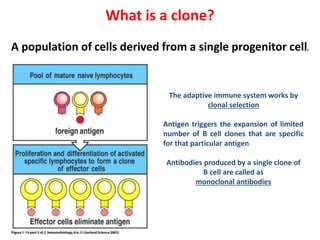
Theory of Clonal Selection
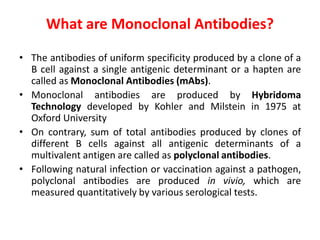
What is a clone?
The adaptive immune system works by
clonal selection
Antigen triggers the expansion of limited
number of B cell clones that are specific
for that particular antigen
Antibodies produced by a single clone of
B cell are called as
monoclonal antibodies
A population of cells derived from a single progenitor cell.
What are Monoclonal Antibodies?
• The antibodies of uniform specificity produced by a clone of a
B cell against a single antigenic determinant or a hapten are
called as Monoclonal Antibodies (mAbs).
• Monoclonal antibodies are produced by Hybridoma
Technology developed by Kohler and Milstein in 1975 at
Oxford University
• On contrary, sum of total antibodies produced by clones of
different B cells against all antigenic determinants of a
multivalent antigen are called as polyclonal antibodies.
• Following natural infection or vaccination against a pathogen,
polyclonal antibodies are produced in vivio, which are
measured quantitatively by various serological tests.
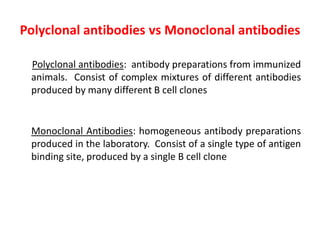
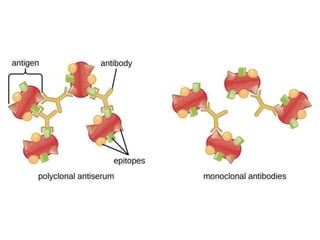
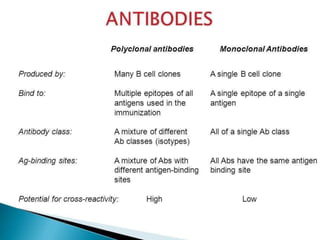
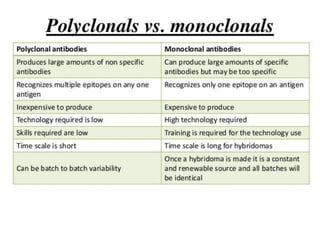
Polyclonal antibodies vs Monoclonal antibodies
Polyclonal antibodies: antibody preparations from immunized
animals. Consist of complex mixtures of different antibodies
produced by many different B cell clones
Monoclonal Antibodies: homogeneous antibody preparations
produced in the laboratory. Consist of a single type of antigen
binding site, produced by a single B cell clone
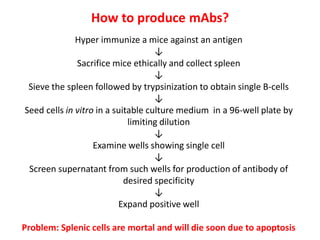
How to produce mAbs?
Hyper immunize a mice against an antigen
↓
Sacrifice mice ethically and collect spleen
↓
Sieve the spleen followed by trypsinization to obtain single B-cells
↓
Seed cells in vitro in a suitable culture medium in a 96-well plate by
limiting dilution
↓
Examine wells showing single cell
↓
Screen supernatant from such wells for production of antibody of
desired specificity
↓
Expand positive well
Problem: Splenic cells are mortal and will die soon due to apoptosis
Q - How to make spleen cells to continuously
produce antibodies?
A - Hybridoma Technology
What is a hybridoma technology?
• A technique to generate continuous supply of
monoclonal antibodies.
• Hybridoma is a fusion of two cells – myeloma
(plasma cell tumor) cells and splenic B cells.
• Takes advantage of the unlimited growth capacity of
myeloma cells and cellular machinery to produce
antibodies of uniform antigenic specificity of B cells
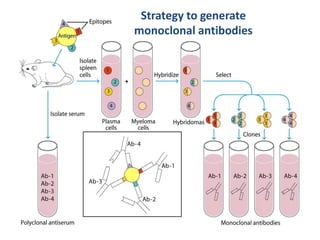
Strategy to generate
monoclonal antibodies
• Normal splenic cells are fused with a cancerous cell
line
– E.g. myeloma, lymphoma (NSO1)
• Fusion is accomplished with PEG (polyethylene glycol)
• The new hybrid cell exhibits properties of both cell
types:
– Unlimited growth (from myeloma cells)
– Secretes monoclonal antibody (from splenic cells)
– Or Secretes cytokines
Hybrid Cells
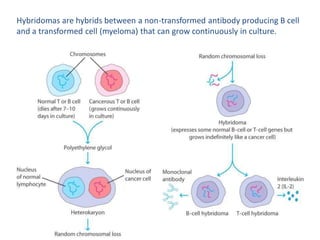
Hybridomas are hybrids between a non-transformed antibody producing B cell
and a transformed cell (myeloma) that can grow continuously in culture.
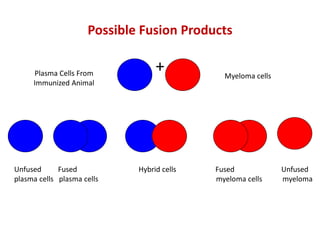
Possible Fusion Products
+
Plasma Cells From
Immunized Animal
Myeloma cells
Unfused Fused Hybrid cells Fused Unfused
plasma cells plasma cells myeloma cells myeloma
Q- How to make only hybridoma cells to survive
and secrete antibodies?
A – 1. Pathways of nucleotide synthesis
2. Non-antibody secreting myeloma cells
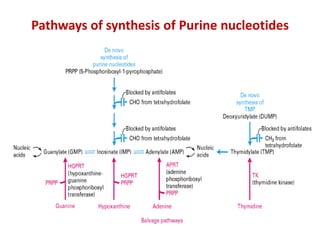
Pathways of synthesis of Purine nucleotides
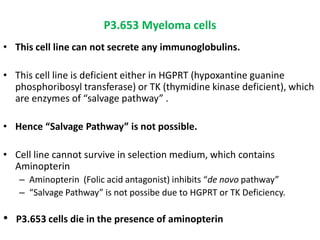
P3.653 Myeloma cells
• This cell line can not secrete any immunoglobulins.
• This cell line is deficient either in HGPRT (hypoxantine guanine
phosphoribosyl transferase) or TK (thymidine kinase deficient), which
are enzymes of “salvage pathway” .
• Hence “Salvage Pathway” is not possible.
• Cell line cannot survive in selection medium, which contains
Aminopterin
– Aminopterin (Folic acid antagonist) inhibits “de novo pathway”
– “Salvage Pathway” is not possibe due to HGPRT or TK Deficiency.
• P3.653 cells die in the presence of aminopterin
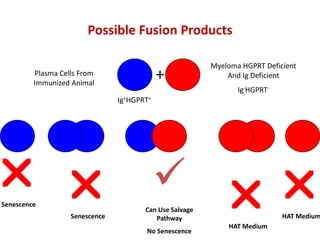
Possible Fusion Products
+
Myeloma HGPRT Deficient
And Ig Deficient
Ig-HGPRT-
Plasma Cells From
Immunized Animal

Senescence

Can Use Salvage
Pathway
No Senescence

HAT Medium

Senescence

HAT Medium
Ig+HGPRT+
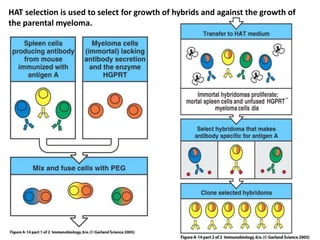
HAT selection is used to select for growth of hybrids and against the growth of
the parental myeloma.
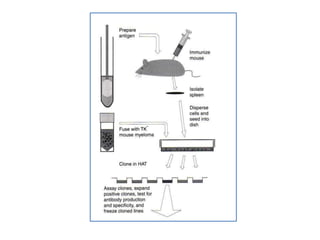
Making Monoclonals
Immunization of mice
• For monoclonal antibody production
– Animal is immunized with antigen
– Spleen cells are isolated
• Intraperitoneal immunization
– Balb/c Mouse
– Day 0: 50 g of Ag in complete Freund’s adjuvant
– Day 14: 25 g of Agin incomplete Freund’s adjuvant
– Day 28: 25 g of Ag in D-PBSA
– Bleed animal and test reactivity to antigen
• Serum is diluted 1:30
– Final boost of 10 g antigen i.V or i.P 3 days before fusion
• Aseptically isolate spleen cells
Fusing Spleen Cells With Myeloma
• Purify spleen cells
– T-cell depletion (anti-Thy 1.2 followed by complement lysis)
– MACS purification (CD138)
• Fusion
– Mix spleen cells and myeloma in 50 mL tube (4:1)
– Spin and resuspend pellet with 1 mL PEG over 15 s
– Mix by swirling for 75 s
– Add 1 mL of SFM (serum free medium) over 15s, swirl for 45s
– Add 2 mL SFM over 30s, swirl 90s
– Add 4 mL HAT over 30s, swirl 90s
– Add 8 mL HAT over 30s, swirl 90s
– Add Above volume in a new container, add HAT till cell
concentration is 1x10⁶ cells/mL
– Add 200 L per well 96 well/plate (200,000 cells/well)
Selection of Hybridomas
• Selecting clones
– Feed wells with new HAT medium (remove old, add 150 L new)
– Feed cells twice a week
– After about 2 weeks test supernatants of potential clones using
ELISA
– Retest +ve clones in 48 hrs
– Expand clones in new 96-well plate with HT NOT HAT
– Retest suspensions, expand in 24-well plate, switch to normal
medium, retest
– Expand in 4-well plate
– Cryopreserve
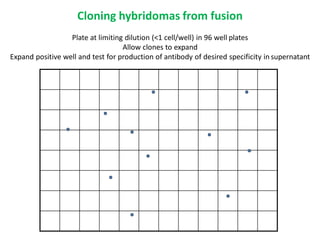
Cloning hybridomas from fusion
Plate at limiting dilution (<1 cell/well) in 96 well plates
Allow clones to expand
Expand positive well and test for production of antibody of desired specificity in supernatant
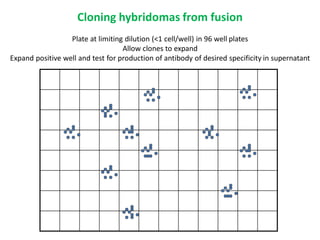
Cloning hybridomas from fusion
Plate at limiting dilution (<1 cell/well) in 96 well plates
Allow clones to expand
Expand positive well and test for production of antibody of desired specificity in supernatant
Ensuring Monoclonality
• To ensure monoclonality sub-clone hybridoma
– Serially dilute @ 1 cell per 3 wells
– Use a spleen cells as feeder cells
– Feeder cells concentration @ 1x10⁶ cells/mL
– 96 well plate, 2x10⁵ cells/well
– Colonies are observed at 5 days
– Replenish with fresh medium @ day 7
– Screening Is done at day 10 and 14
– Clones are cryopreserved same way as parental clones
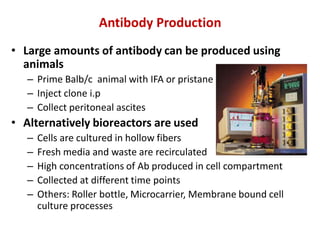
Antibody Production
• Large amounts of antibody can be produced using
animals
– Prime Balb/c animal with IFA or pristane
– Inject clone i.p
– Collect peritoneal ascites
• Alternatively bioreactors are used
– Cells are cultured in hollow fibers
– Fresh media and waste are recirculated
– High concentrations of Ab produced in cell compartment
– Collected at different time points
– Others: Roller bottle, Microcarrier, Membrane bound cell
culture processes
Advantages and disadvantages of monoclonals
Advantages of Monoclonal Abs
• Homogeneity – binds to same epitope with
uniform affinity
• High specificity
• Target oriented
• Small quantity of antigen is required
• Consistent
• Limitless supply of specific reagent
• More easily tested for cross-reactivity
Disadvantages of Monoclonal Abs
• High specificity affects use as diagnostic when
there is minor differences between strains
• Limited sensitivity
• Average affinity is lower than pAb
• Immune rejection
• Expensive
• Time consuming
• Skills
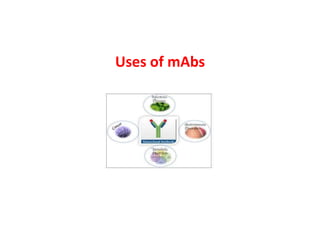
Uses of mAbs
Nomenclature of Therapeutic mAbs
• Use suffix
–ximab for chimeric antibodies and
–umab for humanized antibodies.
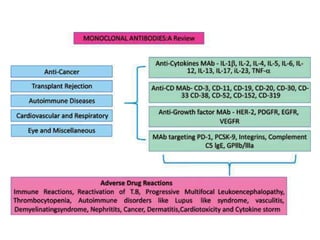
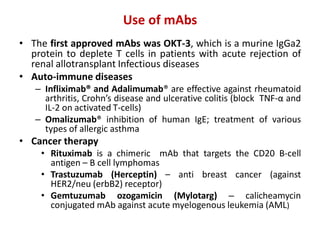
Use of mAbs
• The first approved mAbs was OKT-3, which is a murine IgGa2
protein to deplete T cells in patients with acute rejection of
renal allotransplant Infectious diseases
• Auto-immune diseases
– Infliximab® and Adalimumab® are effective against rheumatoid
arthritis, Crohn’s disease and ulcerative colitis (block TNF-α and
IL-2 on activated T-cells)
– Omalizumab® inhibition of human IgE; treatment of various
types of allergic asthma
• Cancer therapy
• Rituximab is a chimeric mAb that targets the CD20 B-cell
antigen – B cell lymphomas
• Trastuzumab (Herceptin) – anti breast cancer (against
HER2/neu (erbB2) receptor)
• Gemtuzumab ozogamicin (Mylotarg) – calicheamycin
conjugated mAb against acute myelogenous leukemia (AML)
Use of mAbs
• Metabolic disorders
– mAbs targeting secreted fatty acid–binding protein aP2 -
new treatment for type 2 diabetes
– Evolocumab and Alirocumab substantially reduced the
LDL-C level by over 50%
• Infectious diseases
– Raxibazumab® - for the treatment of infectious
inhalational anthrax
– Tocilizumab ® - anti IL-6 mAb used for treating COVID-19

Hybridoma-Technology-and-mAbs.pdf

  • 1.
    Hybridoma Technology andMonoclonal Antibodies RAKESH SHARDA Department of Veterinary Microbiology NDVSU College of Veterinary Science & A.H., MHOW
  • 2.
  • 3.
    What is aclone? The adaptive immune system works by clonal selection Antigen triggers the expansion of limited number of B cell clones that are specific for that particular antigen Antibodies produced by a single clone of B cell are called as monoclonal antibodies A population of cells derived from a single progenitor cell.
  • 4.
    What are MonoclonalAntibodies? • The antibodies of uniform specificity produced by a clone of a B cell against a single antigenic determinant or a hapten are called as Monoclonal Antibodies (mAbs). • Monoclonal antibodies are produced by Hybridoma Technology developed by Kohler and Milstein in 1975 at Oxford University • On contrary, sum of total antibodies produced by clones of different B cells against all antigenic determinants of a multivalent antigen are called as polyclonal antibodies. • Following natural infection or vaccination against a pathogen, polyclonal antibodies are produced in vivio, which are measured quantitatively by various serological tests.
  • 5.
    Polyclonal antibodies vsMonoclonal antibodies Polyclonal antibodies: antibody preparations from immunized animals. Consist of complex mixtures of different antibodies produced by many different B cell clones Monoclonal Antibodies: homogeneous antibody preparations produced in the laboratory. Consist of a single type of antigen binding site, produced by a single B cell clone
  • 9.
    How to producemAbs? Hyper immunize a mice against an antigen ↓ Sacrifice mice ethically and collect spleen ↓ Sieve the spleen followed by trypsinization to obtain single B-cells ↓ Seed cells in vitro in a suitable culture medium in a 96-well plate by limiting dilution ↓ Examine wells showing single cell ↓ Screen supernatant from such wells for production of antibody of desired specificity ↓ Expand positive well Problem: Splenic cells are mortal and will die soon due to apoptosis
  • 10.
    Q - Howto make spleen cells to continuously produce antibodies? A - Hybridoma Technology
  • 11.
    What is ahybridoma technology? • A technique to generate continuous supply of monoclonal antibodies. • Hybridoma is a fusion of two cells – myeloma (plasma cell tumor) cells and splenic B cells. • Takes advantage of the unlimited growth capacity of myeloma cells and cellular machinery to produce antibodies of uniform antigenic specificity of B cells
  • 12.
  • 13.
    • Normal spleniccells are fused with a cancerous cell line – E.g. myeloma, lymphoma (NSO1) • Fusion is accomplished with PEG (polyethylene glycol) • The new hybrid cell exhibits properties of both cell types: – Unlimited growth (from myeloma cells) – Secretes monoclonal antibody (from splenic cells) – Or Secretes cytokines Hybrid Cells
  • 14.
    Hybridomas are hybridsbetween a non-transformed antibody producing B cell and a transformed cell (myeloma) that can grow continuously in culture.
  • 15.
    Possible Fusion Products + PlasmaCells From Immunized Animal Myeloma cells Unfused Fused Hybrid cells Fused Unfused plasma cells plasma cells myeloma cells myeloma
  • 16.
    Q- How tomake only hybridoma cells to survive and secrete antibodies? A – 1. Pathways of nucleotide synthesis 2. Non-antibody secreting myeloma cells
  • 17.
    Pathways of synthesisof Purine nucleotides
  • 18.
    P3.653 Myeloma cells •This cell line can not secrete any immunoglobulins. • This cell line is deficient either in HGPRT (hypoxantine guanine phosphoribosyl transferase) or TK (thymidine kinase deficient), which are enzymes of “salvage pathway” . • Hence “Salvage Pathway” is not possible. • Cell line cannot survive in selection medium, which contains Aminopterin – Aminopterin (Folic acid antagonist) inhibits “de novo pathway” – “Salvage Pathway” is not possibe due to HGPRT or TK Deficiency. • P3.653 cells die in the presence of aminopterin
  • 19.
    Possible Fusion Products + MyelomaHGPRT Deficient And Ig Deficient Ig-HGPRT- Plasma Cells From Immunized Animal  Senescence  Can Use Salvage Pathway No Senescence  HAT Medium  Senescence  HAT Medium Ig+HGPRT+
  • 20.
    HAT selection isused to select for growth of hybrids and against the growth of the parental myeloma.
  • 21.
  • 23.
    Immunization of mice •For monoclonal antibody production – Animal is immunized with antigen – Spleen cells are isolated • Intraperitoneal immunization – Balb/c Mouse – Day 0: 50 g of Ag in complete Freund’s adjuvant – Day 14: 25 g of Agin incomplete Freund’s adjuvant – Day 28: 25 g of Ag in D-PBSA – Bleed animal and test reactivity to antigen • Serum is diluted 1:30 – Final boost of 10 g antigen i.V or i.P 3 days before fusion • Aseptically isolate spleen cells
  • 24.
    Fusing Spleen CellsWith Myeloma • Purify spleen cells – T-cell depletion (anti-Thy 1.2 followed by complement lysis) – MACS purification (CD138) • Fusion – Mix spleen cells and myeloma in 50 mL tube (4:1) – Spin and resuspend pellet with 1 mL PEG over 15 s – Mix by swirling for 75 s – Add 1 mL of SFM (serum free medium) over 15s, swirl for 45s – Add 2 mL SFM over 30s, swirl 90s – Add 4 mL HAT over 30s, swirl 90s – Add 8 mL HAT over 30s, swirl 90s – Add Above volume in a new container, add HAT till cell concentration is 1x10⁶ cells/mL – Add 200 L per well 96 well/plate (200,000 cells/well)
  • 25.
    Selection of Hybridomas •Selecting clones – Feed wells with new HAT medium (remove old, add 150 L new) – Feed cells twice a week – After about 2 weeks test supernatants of potential clones using ELISA – Retest +ve clones in 48 hrs – Expand clones in new 96-well plate with HT NOT HAT – Retest suspensions, expand in 24-well plate, switch to normal medium, retest – Expand in 4-well plate – Cryopreserve
  • 26.
    Cloning hybridomas fromfusion Plate at limiting dilution (<1 cell/well) in 96 well plates Allow clones to expand Expand positive well and test for production of antibody of desired specificity in supernatant
  • 27.
    Cloning hybridomas fromfusion Plate at limiting dilution (<1 cell/well) in 96 well plates Allow clones to expand Expand positive well and test for production of antibody of desired specificity in supernatant
  • 28.
    Ensuring Monoclonality • Toensure monoclonality sub-clone hybridoma – Serially dilute @ 1 cell per 3 wells – Use a spleen cells as feeder cells – Feeder cells concentration @ 1x10⁶ cells/mL – 96 well plate, 2x10⁵ cells/well – Colonies are observed at 5 days – Replenish with fresh medium @ day 7 – Screening Is done at day 10 and 14 – Clones are cryopreserved same way as parental clones
  • 29.
    Antibody Production • Largeamounts of antibody can be produced using animals – Prime Balb/c animal with IFA or pristane – Inject clone i.p – Collect peritoneal ascites • Alternatively bioreactors are used – Cells are cultured in hollow fibers – Fresh media and waste are recirculated – High concentrations of Ab produced in cell compartment – Collected at different time points – Others: Roller bottle, Microcarrier, Membrane bound cell culture processes
  • 30.
  • 31.
    Advantages of MonoclonalAbs • Homogeneity – binds to same epitope with uniform affinity • High specificity • Target oriented • Small quantity of antigen is required • Consistent • Limitless supply of specific reagent • More easily tested for cross-reactivity
  • 32.
    Disadvantages of MonoclonalAbs • High specificity affects use as diagnostic when there is minor differences between strains • Limited sensitivity • Average affinity is lower than pAb • Immune rejection • Expensive • Time consuming • Skills
  • 33.
  • 35.
    Nomenclature of TherapeuticmAbs • Use suffix –ximab for chimeric antibodies and –umab for humanized antibodies.
  • 36.
    Use of mAbs •The first approved mAbs was OKT-3, which is a murine IgGa2 protein to deplete T cells in patients with acute rejection of renal allotransplant Infectious diseases • Auto-immune diseases – Infliximab® and Adalimumab® are effective against rheumatoid arthritis, Crohn’s disease and ulcerative colitis (block TNF-α and IL-2 on activated T-cells) – Omalizumab® inhibition of human IgE; treatment of various types of allergic asthma • Cancer therapy • Rituximab is a chimeric mAb that targets the CD20 B-cell antigen – B cell lymphomas • Trastuzumab (Herceptin) – anti breast cancer (against HER2/neu (erbB2) receptor) • Gemtuzumab ozogamicin (Mylotarg) – calicheamycin conjugated mAb against acute myelogenous leukemia (AML)
  • 37.
    Use of mAbs •Metabolic disorders – mAbs targeting secreted fatty acid–binding protein aP2 - new treatment for type 2 diabetes – Evolocumab and Alirocumab substantially reduced the LDL-C level by over 50% • Infectious diseases – Raxibazumab® - for the treatment of infectious inhalational anthrax – Tocilizumab ® - anti IL-6 mAb used for treating COVID-19