AFFINITY MATURATION
 The process by which B-cells produce antibodies with

increased affinity for antigen during the course of an
immune response.
 A secondary response can elicit antibodies with greater
affinities than in a primary response.
IN VIVO AFFINITY MATURATION
 The process is thought to evolve two interrelated

processes,occuring in the germinal centers of the
secondary lymphoid organs.
1) Somatic hypermutation(SHM)-Mutations in the
variable regions of the immunoglobulin genes.
2) Clonal selection-B-cells that have undergone SHM
must compete for limiting growth resources,including
the availability of antigen.
•The follicular dentritic cells(FDCs) of the
germinal centers present antigen to B-cells
and only the B-cell progeny with the highest
affinities for antigen will be selected to
survive.B-cell progeny that have undergone
SHM but bind antigen with lower affinity will
be out completed and deleted.
IN VITRO AFFINITY MATURATION
 This is based on the principle of mutation and

selection.
 In vitro affinity maturation has successively been used
to optimize antibodies,antibody fragments,antibody
mimetics.
 Random mutation can be introduced using
radiation,chemical mutagens or error prone PCRs.
SOMATIC HYPERMUTATION
 Somatic hypermutation or SHM is a diversity

generating regulated cellular mechanism displayed by
adaptive immune response.
 Somatic hypermutation adds diversity in already
rearranged gene segments.
 The mutation rate is 10-3/base pair/generation than
the spontaneous mutation of about 10-8/base
pair/generation.
•Hence the name hypermutation.
•These mutations occur mostly at “hotspots” in
the DNA, known as hypervariable regions.
•These regions correspond to the
complementarity determining regions, the sites
involved in antigen recognition on the antibody
•These mutation result from nucleotide
substitution rather than addition or deletion.
•They influence the process of affinity
maturation of B cells.
MOLECULES INVOLVED IN SHM
 IgM antibodies expressing V regions that have

undergone SHM, as well as IgG and IgA antibodies
with no somatic mutations.
 Activation-induced cytidine deaminase: A

B cell-specific protein required for SHM.
 Uracil N- glycosylase : Removing uracil generated by

AID deamination.
•Mismatch repair proteins: Mismatch repair
(MMR) normally maintains genomic integrity.
•MMR eliminates mutations that arise
spontaneously in the genome.
•Error-prone DNA polymerases: increase
mutation rate
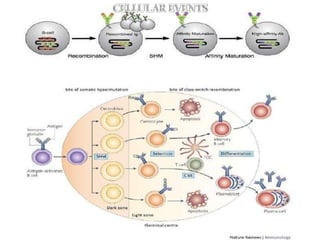
CELLULAR EVENTS

Somatic hypermutation and affinity maturation

  • 2.
    AFFINITY MATURATION  Theprocess by which B-cells produce antibodies with increased affinity for antigen during the course of an immune response.  A secondary response can elicit antibodies with greater affinities than in a primary response.
  • 3.
    IN VIVO AFFINITYMATURATION  The process is thought to evolve two interrelated processes,occuring in the germinal centers of the secondary lymphoid organs. 1) Somatic hypermutation(SHM)-Mutations in the variable regions of the immunoglobulin genes. 2) Clonal selection-B-cells that have undergone SHM must compete for limiting growth resources,including the availability of antigen.
  • 4.
    •The follicular dentriticcells(FDCs) of the germinal centers present antigen to B-cells and only the B-cell progeny with the highest affinities for antigen will be selected to survive.B-cell progeny that have undergone SHM but bind antigen with lower affinity will be out completed and deleted.
  • 5.
    IN VITRO AFFINITYMATURATION  This is based on the principle of mutation and selection.  In vitro affinity maturation has successively been used to optimize antibodies,antibody fragments,antibody mimetics.  Random mutation can be introduced using radiation,chemical mutagens or error prone PCRs.
  • 6.
    SOMATIC HYPERMUTATION  Somatichypermutation or SHM is a diversity generating regulated cellular mechanism displayed by adaptive immune response.  Somatic hypermutation adds diversity in already rearranged gene segments.  The mutation rate is 10-3/base pair/generation than the spontaneous mutation of about 10-8/base pair/generation.
  • 7.
    •Hence the namehypermutation. •These mutations occur mostly at “hotspots” in the DNA, known as hypervariable regions. •These regions correspond to the complementarity determining regions, the sites involved in antigen recognition on the antibody •These mutation result from nucleotide substitution rather than addition or deletion. •They influence the process of affinity maturation of B cells.
  • 8.
    MOLECULES INVOLVED INSHM  IgM antibodies expressing V regions that have undergone SHM, as well as IgG and IgA antibodies with no somatic mutations.  Activation-induced cytidine deaminase: A B cell-specific protein required for SHM.  Uracil N- glycosylase : Removing uracil generated by AID deamination.
  • 9.
    •Mismatch repair proteins:Mismatch repair (MMR) normally maintains genomic integrity. •MMR eliminates mutations that arise spontaneously in the genome. •Error-prone DNA polymerases: increase mutation rate
  • 10.