“
”
Morphology and cell structure of archaea
Chaudhary Devilal Universiry Sirsa
A presentation
Microbiology
• Submitted by
• SANJAY NAGAL
• M.SC. BIOTECHNOLOGY (P)
• REGD NO. 16145190002
Introduction
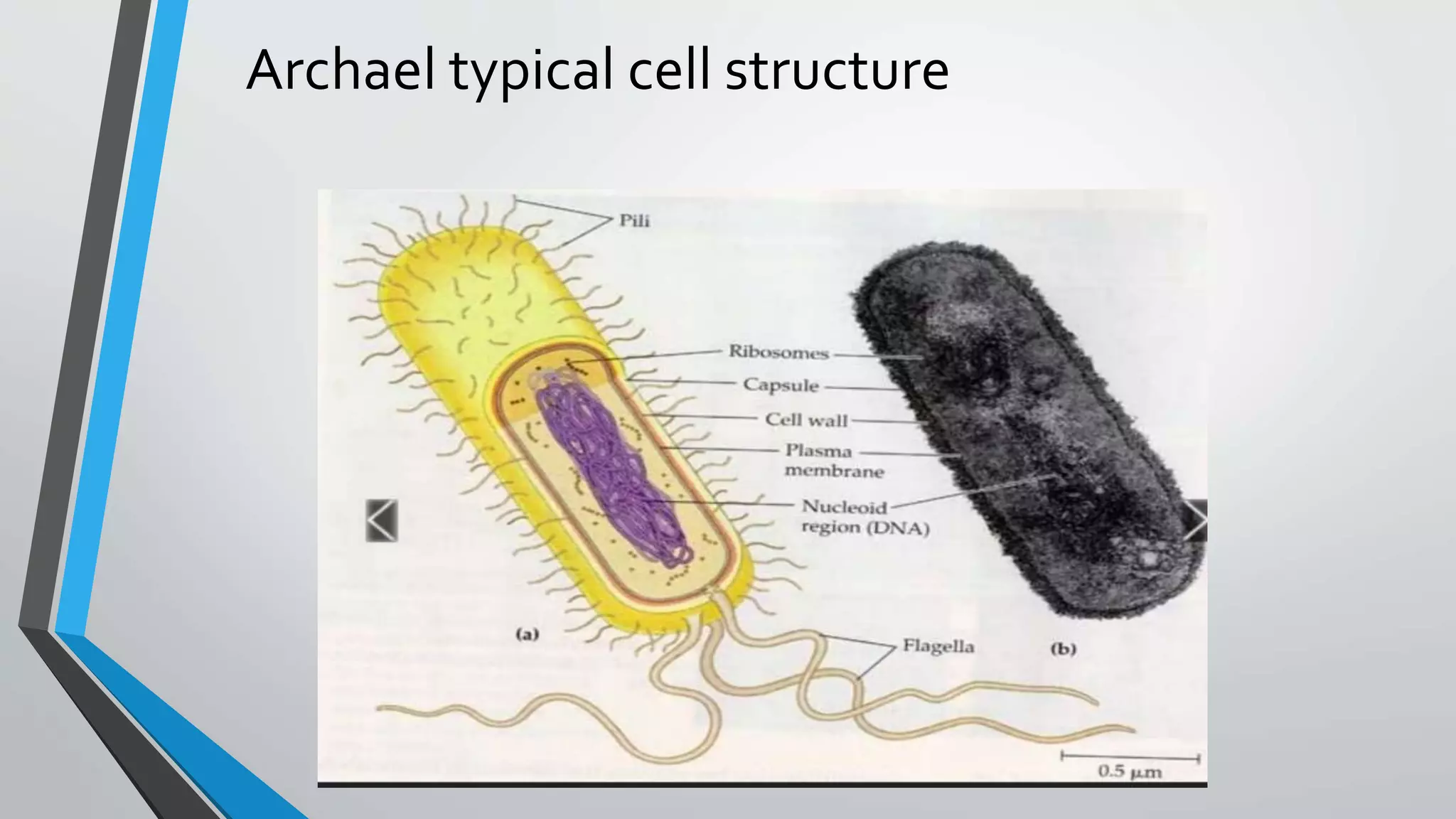
A typical archael cell
Recall that for many years archaea and bacteria had been lumped together and
refferred to as prokaryotes.today archaea and bacteria are rrecognized as distinct
taxa.archeal taxonomy is in a state of flux,but two phyla are Well
established:Crenarchaetota and Euryarchaeota.....The separation of bacteria and
archaea into distinct taxa corelates with the observations that each have unique
and distinguishing ....
Sulfolobus is an extremophile that is found in hot springs and thrives in acidic and
sulphur-rich environments.... Methanosarcina rumen is anaerobic, and is found in
places with little or no oxygen. It is a methane- producing organism that digests
decaying organic matter. It is found in the rumen of a group of animals called
ruminants such as cattle and sheep... Halococcus salifodinae is found in water
with high concentrations of salt.These high salt concentrations would be deadly
to most other forms of life, and so H. salifodinae is also known as an
extremophile......
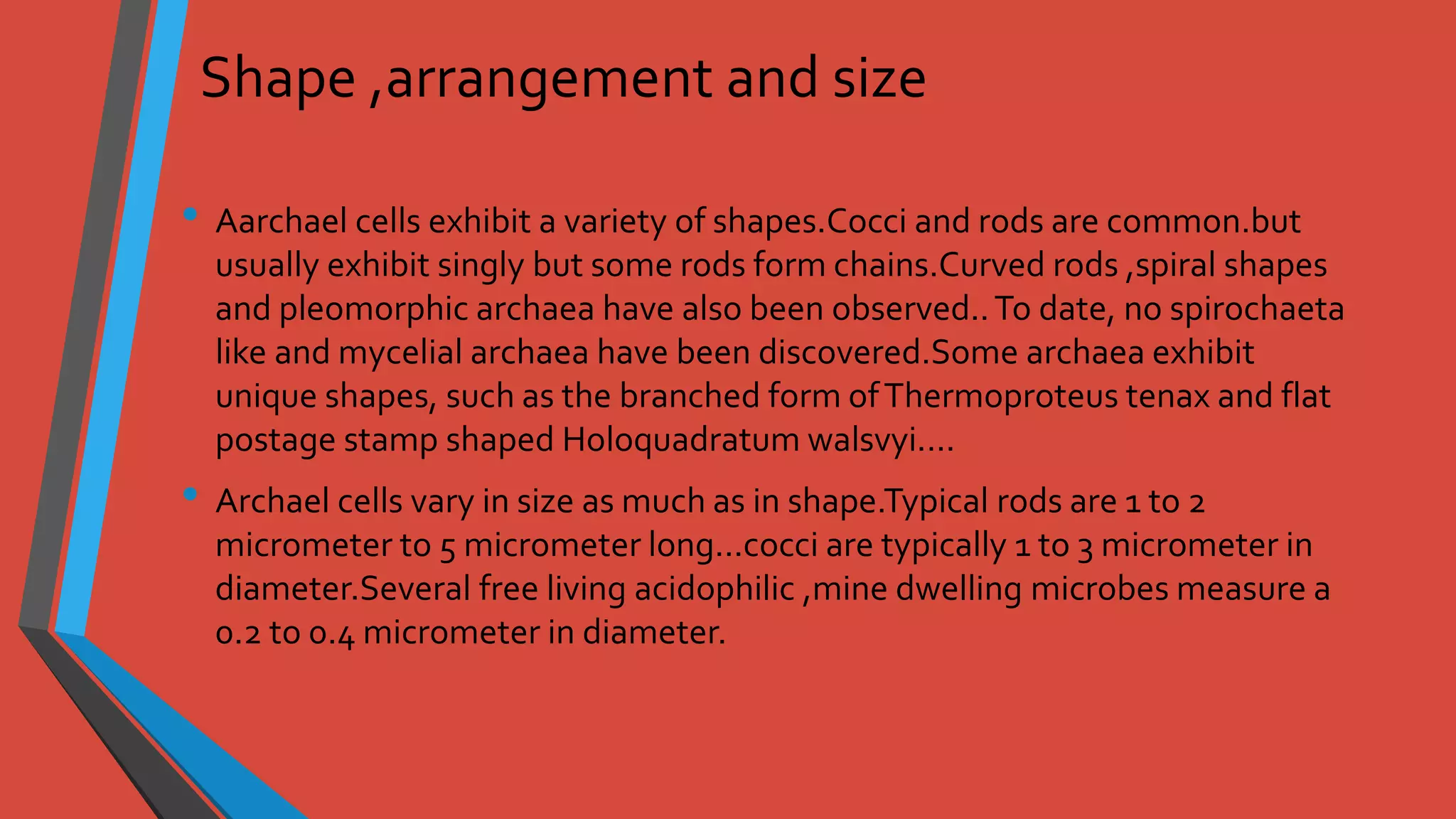
Morphology of archaea..
Shape ,arrangement and size
• Aarchael cells exhibit a variety of shapes.Cocci and rods are common.but
usually exhibit singly but some rods form chains.Curved rods ,spiral shapes
and pleomorphic archaea have also been observed..To date, no spirochaeta
like and mycelial archaea have been discovered.Some archaea exhibit
unique shapes, such as the branched form ofThermoproteus tenax and flat
postage stamp shaped Holoquadratum walsvyi....
• Archael cells vary in size as much as in shape.Typical rods are 1 to 2
micrometer to 5 micrometer long...cocci are typically 1 to 3 micrometer in
diameter.Several free living acidophilic ,mine dwelling microbes measure a
0.2 to 0.4 micrometer in diameter.
Structures in the archael cells
• Archael cell envelops
• Archael plasma memberanes
• Archael cell walls
• Archael cytoplasms
• Ribosomes
• Nucleoid
• External structures like pili ,cannulae ,hami.
• Archael flagella and motility
Archael typical cell structure
Cell structure of archaea
• Cell organization
• Archaea are phylogenetic distinct from bacteria.
• Archael cell walls lacks peptidoglycan.
• Capsules are not widespread.
• Within the archael cytoplasma Nucleoid ribosomes and inclusions may
be found.
• Finally many archaea have flagella for locomotion
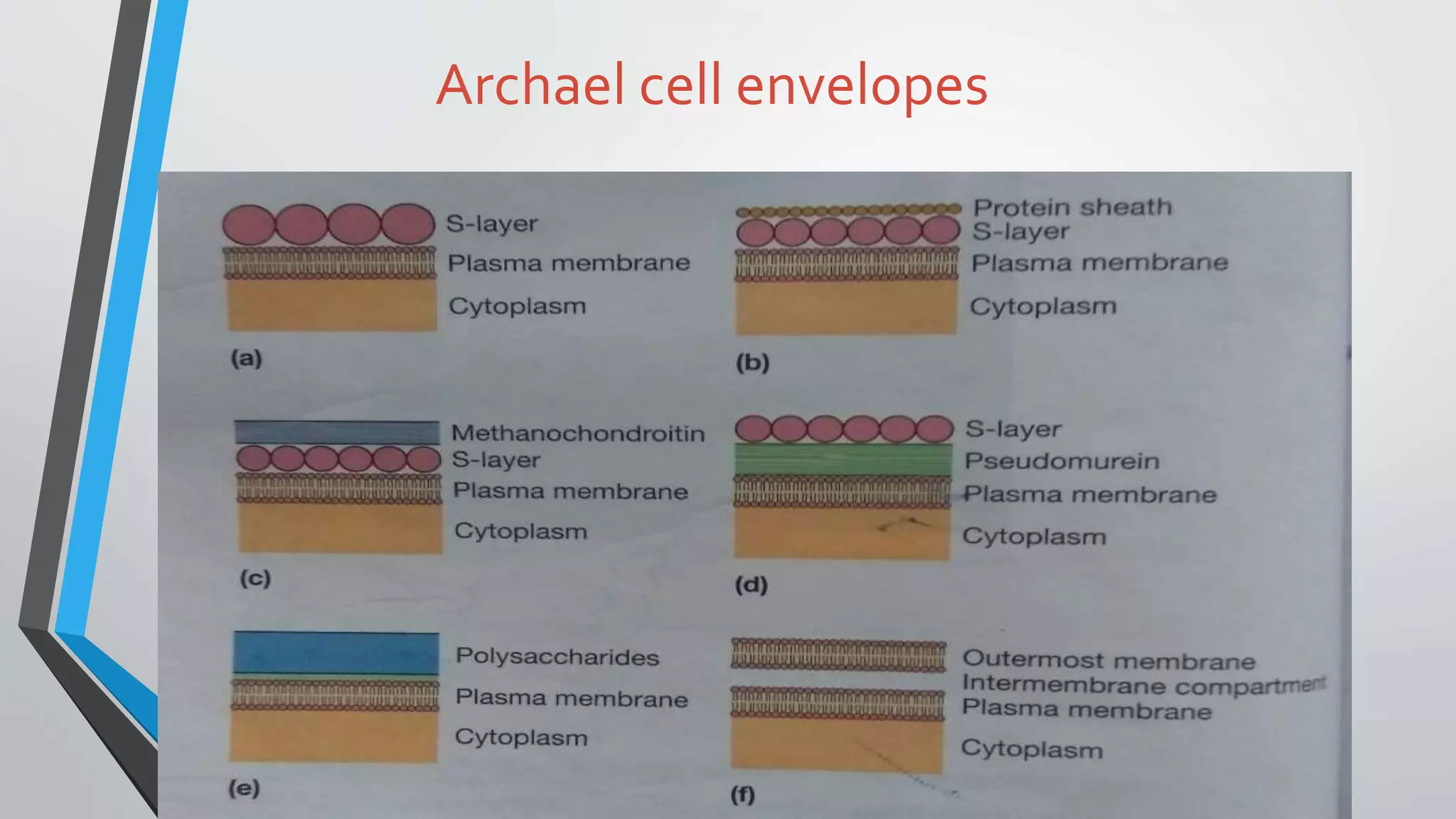
Archael cell envelops
• Microbiologist found some archaea have monolayer membranes that
function as bilayers.This structural difference is due to presence of unique
lipids in archael plasma membranes. For many archaea an S layer is the
major and sometimes only component of cell wall.Finally capsules and slime
layers Are relatively rare among archaea.
Archael plasma membrane
• Archael membranes are composed of lipids that differ from bacterial
and eukaryotic lipids in two ways.
• Firstly they contain hydrocarbon derived from isoprene units five
carbon,branched molecules which in turn affects the fluidity and and
permeability of membrane.
• Second the Hydrocarbons are attached to glycerol by ether links rather
than ester links...
• Two major types of archael lipids have been identified, glycerol diethers
and tetraethers ...
Archael plasma membranes
The basic design of archael membranes is similar to that of bacterial and
eukaryotic membranes.
• there are two hydrophilc surfaces and a hydrophobic core.wben C 20
diethers are used a typical bilayer membrane is formed.when the
membrane is is constructed of C 40 tetraethers a monolayer membrane with
more rigidity is formed.
• The addition of pentacyclic rings further increases the rigidity.
• Thermoplasma and sulfolobus which grow best at temperature over 85
degree are almost completely tetreether monolayers.
• Archaea that live in hot environment have membranes containing some
region with monolayers and some with bilayers.
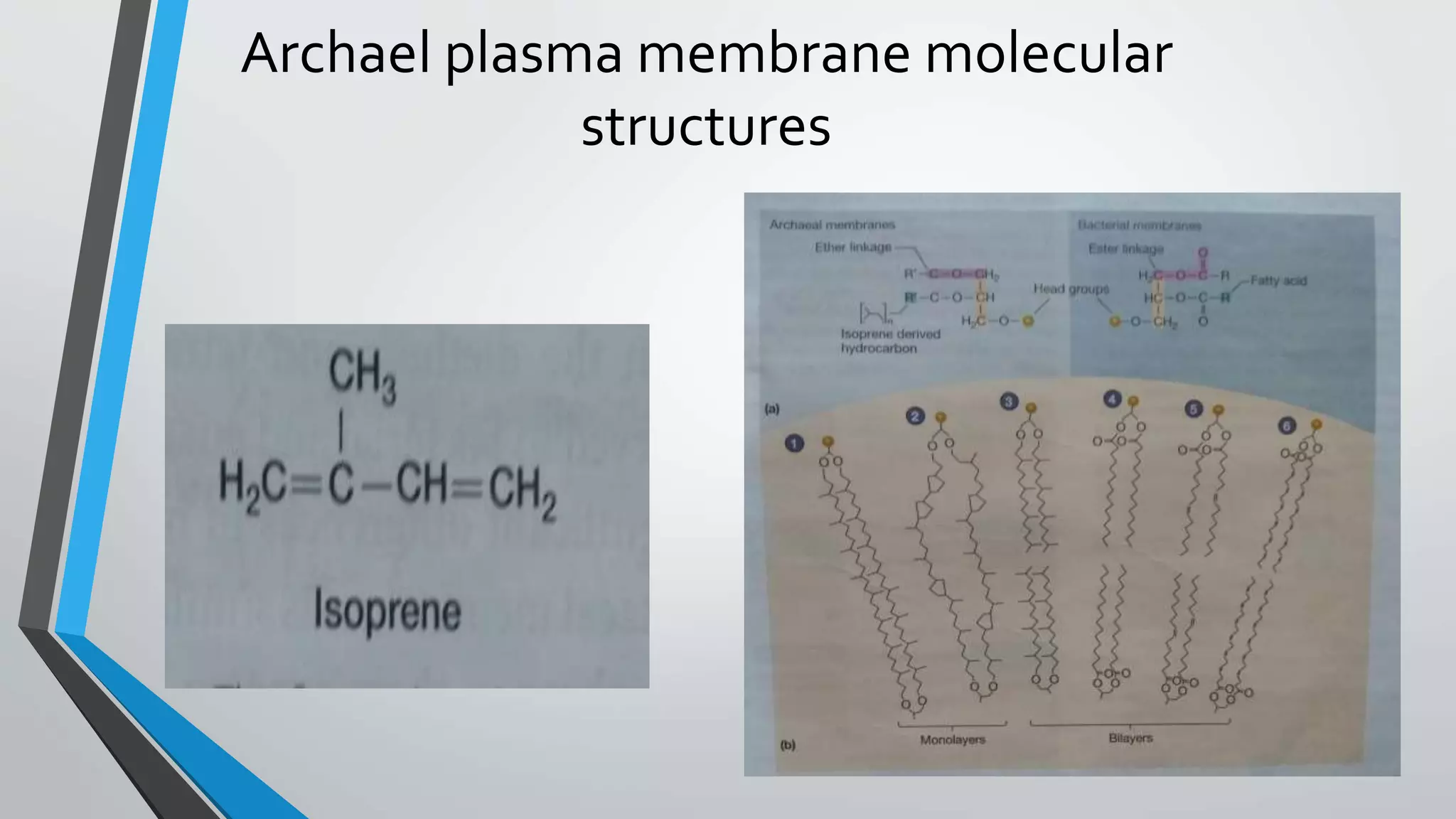
Archael plasma membrane molecular
structures
Monolayer and bilayers
Archael cell walls
• Archael species were characterised as being either gram positive or gram
negative based on their response to gram staining.
• Their cell wall lacks peptidoglycan.
• The most common type of archael cell wall is an S layer composed of either
glycoprotein or protein.the layer may be 20 to 40 nm.some methanogens ,salt
loving archaea(Holobacterium) and extreme thermophiles eg sulfolobus have S
layer walls.
• Other archaea have additional layer of material outside the S
layer.eg.Methanosarcina.
• In some archaea the S layer is outermost but separated from the plasma
membranes by a peptidoglycan like molecule called pseudomurein.
• The last type of cell wall consist of single,thick homogeneous layer resembling
that in gram positive bacteria.
Archael cell envelopes
Archael cytoplasm
•In archael cytoplasm polyhydroxyalkonates
,polyphosphates granules, glycogen granules ,gas
vacuoles,ribosomes,a Nucleoid and in cases plasmids
,cytoskeletol protens have also been identified including
Fts2 (tubulin homologue) Mre B (actin homologue) and
crenactin...
Nucleoid
• Thos irregular shaped region in the cytoplasm contains the cells
chromosome and numerous proteins.
• The chromosome of all known archaea are circular, double stranded
deoxyribonucleic acid.
• Some archaea are polyploid that is they they have multiple copies
of their chromosomes throughout their life cycles.
• Chromosomes are longer like the bacterial chromosomes and must
be compacted to fit in the cell.
• Many members of Euryarchaeota have histones associated with
their chromosomes these histones form nucleosomes.
Rribosomes
Ribosomes are 70 S type in size and constructed of a 50 S and 30 S
subunit..Both have ribosomal RNA molecules of similar size .16 S
in the small subunit and 23 S and 5S in the large subunit.
• The differences in nucleotide sequence of these molecules were
the initial basis for establishing the taxon archaea.
Pilli ,cannulae and hami
• Many archaea have Pilli but little is known about
their structural proteins.some archael pili are
cimposed of pilin proteins that are homologous
of bacterial type 4 pili proteins.central lumen is
present in pili.
• Cannulae are hollow ,tubelike structures
observed in the surface of thermophilic archaea
belonging to genus Pyrodictium. FUNCTIONS of
cannulae are unknown yet.
• Hami looks like tiny grappling hooks which
suggests that they might function ti attach cells
to surfaces..indeed archael cells that produce
hami are members of biofilm cimmunities
generally consists of a hamu producing
archaeon and a bacterium...
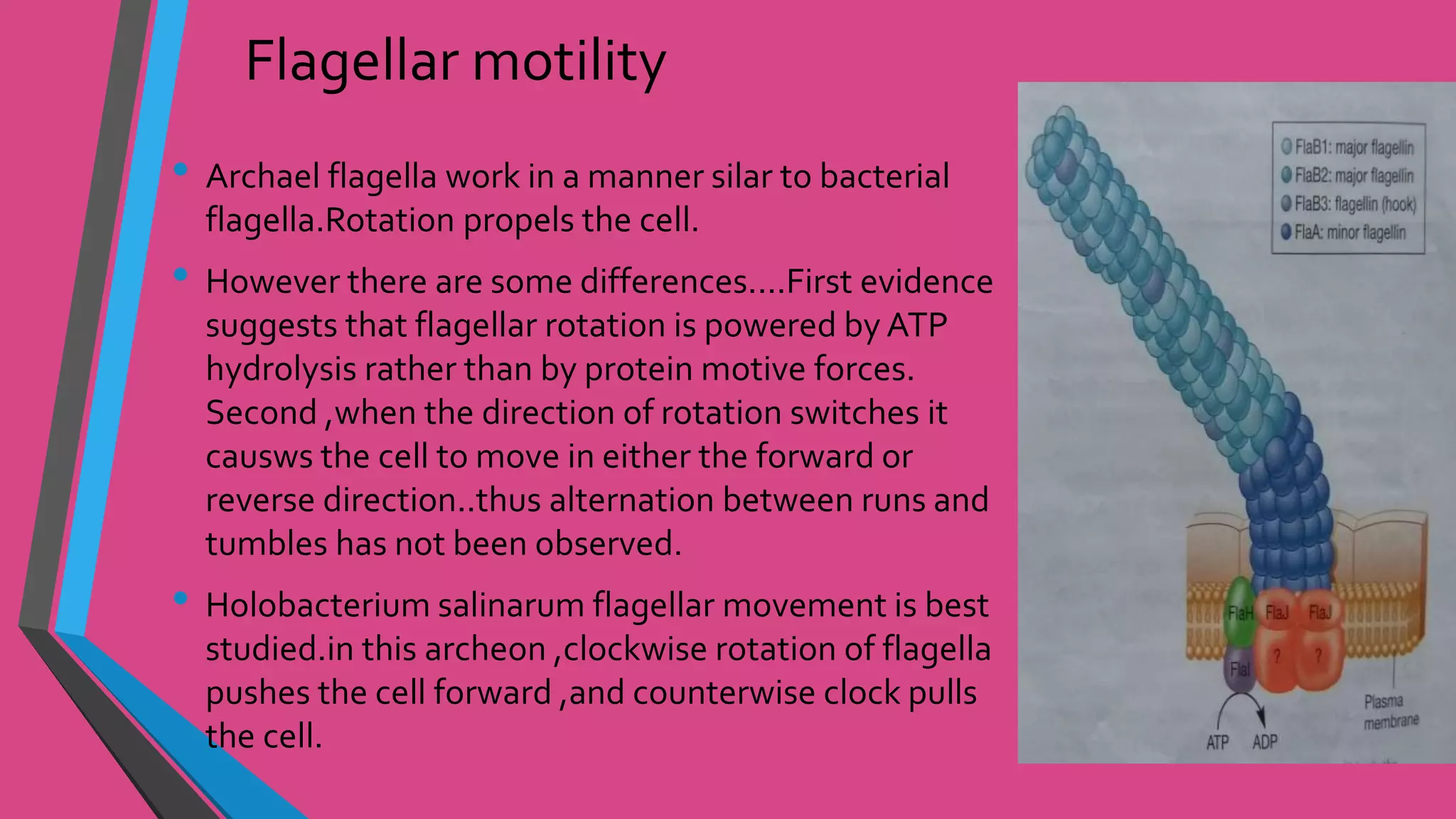
Archael flagella and motility
• Archael flagella are thinner than bacterial flagella (10 to 13 nm
rather than 20 nm.)and are composed of more than one type of
flagellin subunit.The flagellum is not hollow.
• Archael hooks are are difficult to distinguish from the filament.
• A basal body has not be identified.
• It is thought filament of archael flagellum increases in length as
flagellar subunits are added at the base rather than one tip.
Flagellar motility
• Archael flagella work in a manner silar to bacterial
flagella.Rotation propels the cell.
• However there are some differences....First evidence
suggests that flagellar rotation is powered by ATP
hydrolysis rather than by protein motive forces.
Second ,when the direction of rotation switches it
causws the cell to move in either the forward or
reverse direction..thus alternation between runs and
tumbles has not been observed.
• Holobacterium salinarum flagellar movement is best
studied.in this archeon ,clockwise rotation of flagella
pushes the cell forward ,and counterwise clock pulls
the cell.
Thank you...

Morphology and cell structure of Archea

  • 1.
    “ ” Morphology and cellstructure of archaea Chaudhary Devilal Universiry Sirsa A presentation
  • 2.
    Microbiology • Submitted by •SANJAY NAGAL • M.SC. BIOTECHNOLOGY (P) • REGD NO. 16145190002
  • 3.
    Introduction A typical archaelcell Recall that for many years archaea and bacteria had been lumped together and refferred to as prokaryotes.today archaea and bacteria are rrecognized as distinct taxa.archeal taxonomy is in a state of flux,but two phyla are Well established:Crenarchaetota and Euryarchaeota.....The separation of bacteria and archaea into distinct taxa corelates with the observations that each have unique and distinguishing .... Sulfolobus is an extremophile that is found in hot springs and thrives in acidic and sulphur-rich environments.... Methanosarcina rumen is anaerobic, and is found in places with little or no oxygen. It is a methane- producing organism that digests decaying organic matter. It is found in the rumen of a group of animals called ruminants such as cattle and sheep... Halococcus salifodinae is found in water with high concentrations of salt.These high salt concentrations would be deadly to most other forms of life, and so H. salifodinae is also known as an extremophile......
  • 4.
  • 5.
    Shape ,arrangement andsize • Aarchael cells exhibit a variety of shapes.Cocci and rods are common.but usually exhibit singly but some rods form chains.Curved rods ,spiral shapes and pleomorphic archaea have also been observed..To date, no spirochaeta like and mycelial archaea have been discovered.Some archaea exhibit unique shapes, such as the branched form ofThermoproteus tenax and flat postage stamp shaped Holoquadratum walsvyi.... • Archael cells vary in size as much as in shape.Typical rods are 1 to 2 micrometer to 5 micrometer long...cocci are typically 1 to 3 micrometer in diameter.Several free living acidophilic ,mine dwelling microbes measure a 0.2 to 0.4 micrometer in diameter.
  • 6.
    Structures in thearchael cells • Archael cell envelops • Archael plasma memberanes • Archael cell walls • Archael cytoplasms • Ribosomes • Nucleoid • External structures like pili ,cannulae ,hami. • Archael flagella and motility
  • 7.
  • 8.
    Cell structure ofarchaea • Cell organization • Archaea are phylogenetic distinct from bacteria. • Archael cell walls lacks peptidoglycan. • Capsules are not widespread. • Within the archael cytoplasma Nucleoid ribosomes and inclusions may be found. • Finally many archaea have flagella for locomotion
  • 9.
    Archael cell envelops •Microbiologist found some archaea have monolayer membranes that function as bilayers.This structural difference is due to presence of unique lipids in archael plasma membranes. For many archaea an S layer is the major and sometimes only component of cell wall.Finally capsules and slime layers Are relatively rare among archaea.
  • 10.
    Archael plasma membrane •Archael membranes are composed of lipids that differ from bacterial and eukaryotic lipids in two ways. • Firstly they contain hydrocarbon derived from isoprene units five carbon,branched molecules which in turn affects the fluidity and and permeability of membrane. • Second the Hydrocarbons are attached to glycerol by ether links rather than ester links... • Two major types of archael lipids have been identified, glycerol diethers and tetraethers ...
  • 11.
    Archael plasma membranes Thebasic design of archael membranes is similar to that of bacterial and eukaryotic membranes. • there are two hydrophilc surfaces and a hydrophobic core.wben C 20 diethers are used a typical bilayer membrane is formed.when the membrane is is constructed of C 40 tetraethers a monolayer membrane with more rigidity is formed. • The addition of pentacyclic rings further increases the rigidity. • Thermoplasma and sulfolobus which grow best at temperature over 85 degree are almost completely tetreether monolayers. • Archaea that live in hot environment have membranes containing some region with monolayers and some with bilayers.
  • 12.
    Archael plasma membranemolecular structures
  • 13.
  • 14.
    Archael cell walls •Archael species were characterised as being either gram positive or gram negative based on their response to gram staining. • Their cell wall lacks peptidoglycan. • The most common type of archael cell wall is an S layer composed of either glycoprotein or protein.the layer may be 20 to 40 nm.some methanogens ,salt loving archaea(Holobacterium) and extreme thermophiles eg sulfolobus have S layer walls. • Other archaea have additional layer of material outside the S layer.eg.Methanosarcina. • In some archaea the S layer is outermost but separated from the plasma membranes by a peptidoglycan like molecule called pseudomurein. • The last type of cell wall consist of single,thick homogeneous layer resembling that in gram positive bacteria.
  • 15.
  • 16.
    Archael cytoplasm •In archaelcytoplasm polyhydroxyalkonates ,polyphosphates granules, glycogen granules ,gas vacuoles,ribosomes,a Nucleoid and in cases plasmids ,cytoskeletol protens have also been identified including Fts2 (tubulin homologue) Mre B (actin homologue) and crenactin...
  • 17.
    Nucleoid • Thos irregularshaped region in the cytoplasm contains the cells chromosome and numerous proteins. • The chromosome of all known archaea are circular, double stranded deoxyribonucleic acid. • Some archaea are polyploid that is they they have multiple copies of their chromosomes throughout their life cycles. • Chromosomes are longer like the bacterial chromosomes and must be compacted to fit in the cell. • Many members of Euryarchaeota have histones associated with their chromosomes these histones form nucleosomes.
  • 18.
    Rribosomes Ribosomes are 70S type in size and constructed of a 50 S and 30 S subunit..Both have ribosomal RNA molecules of similar size .16 S in the small subunit and 23 S and 5S in the large subunit. • The differences in nucleotide sequence of these molecules were the initial basis for establishing the taxon archaea.
  • 19.
    Pilli ,cannulae andhami • Many archaea have Pilli but little is known about their structural proteins.some archael pili are cimposed of pilin proteins that are homologous of bacterial type 4 pili proteins.central lumen is present in pili. • Cannulae are hollow ,tubelike structures observed in the surface of thermophilic archaea belonging to genus Pyrodictium. FUNCTIONS of cannulae are unknown yet. • Hami looks like tiny grappling hooks which suggests that they might function ti attach cells to surfaces..indeed archael cells that produce hami are members of biofilm cimmunities generally consists of a hamu producing archaeon and a bacterium...
  • 20.
    Archael flagella andmotility • Archael flagella are thinner than bacterial flagella (10 to 13 nm rather than 20 nm.)and are composed of more than one type of flagellin subunit.The flagellum is not hollow. • Archael hooks are are difficult to distinguish from the filament. • A basal body has not be identified. • It is thought filament of archael flagellum increases in length as flagellar subunits are added at the base rather than one tip.
  • 21.
    Flagellar motility • Archaelflagella work in a manner silar to bacterial flagella.Rotation propels the cell. • However there are some differences....First evidence suggests that flagellar rotation is powered by ATP hydrolysis rather than by protein motive forces. Second ,when the direction of rotation switches it causws the cell to move in either the forward or reverse direction..thus alternation between runs and tumbles has not been observed. • Holobacterium salinarum flagellar movement is best studied.in this archeon ,clockwise rotation of flagella pushes the cell forward ,and counterwise clock pulls the cell.
  • 22.