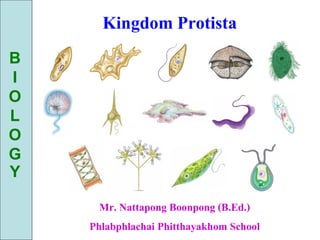
Kingdom Protista
B
I
O
L
O
G
Y

      Mr. Nattapong Boonpong (B.Ed.)
    Phlabphlachai Phitthayakhom School
Overview: A World in a Drop of Water
• Even a low-power microscope
   – Can reveal an astonishing menagerie of organisms
     in a drop of pond water


                    50 m
The Protozoa
Characteristic Protist
• These amazing organisms
   – Belong to the diverse kingdoms of mostly single-
     celled eukaryotes informally known as protists

• Advances in eukaryotic systematics
   – Have caused the classification of protists to change
     significantly.

• Protists are more diverse than all other eukaryotes
   – And are no longer classified in a single kingdom

• Most protists are unicellular
  – And some are colonial or multicellular
Characteristic Protist (Continuous)

• Protists, the most nutritionally diverse of all
  eukaryotes, include
   – Photoautotrophs, which contain chloroplasts
   – Heterotrophs, which absorb organic molecules or
     ingest larger food particles
   – Mixotrophs, which combine photosynthesis and
     heterotrophic nutrition

• Protist habitats are also diverse in habitat
      • And including freshwater and marine species
Habitat of Protist
Reproduction of Protist

• Reproduction and life cycles
  – Are also highly varied among protists, with both
     sexual and asexual species
A Sample of Protist Diversity
Protozoa
• Eukaryotic
• Unicellular
• Chemoheterotrophs
• Vegetative form is a
  trophozoite
• Asexual reproduction
  by fission, budding, or
  schizogony
• Sexual reproduction
  by conjugation
• Some produce cysts
I. Diplomonadida & Parabasala
•   No mitochondria, ER, golgi complex, & centriole
•   Multiple flagella
•   Are adapted to anaerobic environments
•   Lack plastids
Diplomonads & Parabasalids
• Diplomonads
  – Have two nuclei and multiple flagella


                                                         5 µm

             Giardia intestinalis, a diplomonad (colorized SEM)
Giardiasis; Giardia lamblia
Diplomonads & Parabasalids
• Parabasalids include trichomonads
   – Which move by means of flagella and an undulating
     part of the plasma membrane
   – Have parabasal body       Flagella


                       Undulating membrane                       5 µm

                     Trichomonas vaginalis, a parabasalid (colorized SEM)
Trichomoniasis; Trichomonas vaginalis
Diplomonads & Parabasalids
• Have one nucleus and
  multiple flagella
• Have parabasal body


                           Trichonympha sp., a parabasalid
II. Euglenozoa

• Move by flagella
• Photoautotrophs
   – Euglenoids
• Chemoheterotrophs
   – Trypanosoma
      • Undulating membrane, transmitted by vectors
   – Leishmania
      • Flagellated form in sand fly vector, ovoid form in
        vertebrate host
Euglenozoa
Euglenoids; Euglena
การเคลื่อนที่ของยูกลีนา
Kinetoplastids
• Kinetoplastids
   – Have a single, large
     mitochondrion that
     contains an organized
     mass of DNA called a
     kinetoplast
   – Include free-living
     consumers of bacteria in
     freshwater, marine, and
     moist terrestrial
     ecosystems
Kinetoplastids
Kinetoplastids
• The parasitic kinetoplastid Trypanosoma
   – Causes sleeping sickness in humans


                                            9 m
Kinetoplastids

Trypanosoma brucei gambiense
Trypanosoma brucei rhodesiense
Trypanosoma cruzi


Trypanosomiasis, African (African sleeping sickness)

   Trypanosomiasis, American (Chagas disease)
Trypanosoma
Trypanosomiasis (African Sleeping Sickness);
 T. brucei gambiense & T. brucei rhodesiense
Trypanosomiasis (American Chagas Disease)
III. Alveolata

• Alveolates have sacs beneath the plasma membrane
• Members of the clade Alveolata
   – Have membrane-bounded sacs (alveoli) just under
      the plasma membrane
                 0.2 µm               Alveoli
                          Flagellum
Alveolata: Dinoflagellate
• Dinoflagellates
• Cellulose in plasma
  membrane
• Unicellular
• Chlorophyll a and c,
  carotene, xanthins
• Store starch
• Some are symbionts in
  marine animals
• Neurotoxins cause
  paralytic shellfish
  poisoning
Alveolata: Dinoflagellate
Dinoflagellate: Red tide Bloom

      Dinoflagellate หลายชนิด เช่น Gymnodinium &
Trichodesmium จะทาให้เกิดปรากฏการณ์“red tide”ในทะเล
และมหาสมุทรบางแห่ง และสร้างสารพิษออกมา ทาให้สัตว์นา
ตายครังละมาก ๆ โดยจะออกฤทธิ์ที่ระบบประสาท นอกจากนี
Gymnodinium & Gonyaulax ยังสร้างพิษทาให้ปลาตายและ
มนุษย์ที่ได้รับสารพิษเข้าไปจะเสียชีวิตได้
Dinoflagellate


 Peridinium              Trichodesmium


Gymnodinium                   Gonyaulax
Alveolata: Apicomplexa

•   Nonmotile
•   Intracellular parasites
•   Complex life cycles
•   Plasmodium
               *   Plasmodium vivax
               *   Plasmodium malariae
               *   Plasmodium ovale
               *   Plasmodium falciparum
Alveolata: Apicomplexa; Plasmodium sp.
Sporozoites                                   1   Infected mosquito bites               2   Sporozoites
in salivary                                       human; sporozoites                        undergo
gland                                             migrate through                           schizogony in
                                                  bloodstream to                            liver cell;
                                                  liver of human                            merozoites
                                                                                            are produced
              9 Resulting sporozoites
                migrate to salivary glands
                of mosquito
                                                                                        3 Merozoites
                                  Sexual                                                  released into
                               reproduction                                               bloodsteam from
                                                                                          liver may infect
                                                                       Asexual            new red blood
                        8 In mosquito’s                                                   cells
Zygote                    digestive tract,                           reproduction
                          gametocytes
                          unite to form                             Intermediate host
Female
gametocyte                zygote
                                                                     4 Merozoite develops
Male                                                                   into ring stage in red
gametocyte                                                             blood cell

                                                                     Ring                   5 Ring stage
                                                                     stage                    grows and
                          Definitive host                                                     divides,
         7 Another mosquito bites                                                             producing
                                        6 Merozoites are released                             merozoites
           infected humnan and            when red blood cell
           ingests gametocytes            ruptures; some merozoites
                                          infect new red blood cells,
                                          and some develop into
                                          male and female
                                          gametocytes               Merozoites
Alveolata: Apicomplexa; Plasmodium sp.
Apicomlexa; Malaria
Alveolata: Ciliates

• Ciliates, a large varied group of protists
   – Are named for their use of cilia to move and feed
   – Have large macronuclei and small micronuclei
• The micronuclei
   – Function during conjugation, a sexual process that
       produces genetic variation
• Conjugation is separate from reproduction
   – Which generally occurs by binary fission
Alveolata: Ciliates
• Structure and Function in the Ciliate Paramecium caudatum
                                       FEEDING, WASTE REMOVAL, AND WATER BALANCE

             Paramecium, like other freshwater                         Contractile Vacuole   Paramecium feeds mainly on bacteria.
              protists, constantly takes in water                                            Rows of cilia along a funnel-shaped oral
   by osmosis from the hypotonic environment.                                                groove move food into the cell mouth,
   Bladderlike contractile vacuoles accumulate                                               where the food is engulfed into food
excess water from radial canals and periodically                                             vacuoles by phagocytosis.
        expel it through the plasma membrane.
                                                                                                       Oral groove
                                                                                                          Cell mouth


                                   Thousands of cilia cover
      50 µm                                                                                          Food vacuoles combine with
                                the surface of Paramecium.
                                                                                                     lysosomes. As the food is digested,
                                                                                                     the vacuoles follow a looping path
                                                        Micronucleus                                 through the cell.
                                                              Macronucleus


                                                                                              The undigested contents of food
                                                                                              vacuoles are released when the
                                                                                              vacuoles fuse with a specialized
                                                                                              region of the plasma membrane
                                                                                              that functions as an anal pore.
Alveolata: Ciliates
                                                                           CONJUGATION AND REPRODUCTION

                      1 Two cells of compatible                      2 Meiosis of micronuclei
                        mating strains align side                      produces four haploid                                             3 Three micronuclei in each cell
                        by side and partially fuse.                    micronuclei in each cell.                                           disintegrate. The remaining micro-
                                                                                                                                           nucleus in each cell divides by mitosis.


                                                                               MEIOSIS
                                                                                                                                                              4 The cells swap
                                                                                                                                                                one micronucleus.

                                                                            Macronucleus
                                                                                                         Haploid
                                                                                                         micronucleus
     Compatible                                                   Diploid
     mates                                                        micronucleus
                                                                                        Diploid
                                                                                        micronucleus


                                                                                                         MICRONUCLEAR
                                                                                                             FUSION


                                                                                                                                     5   The cells
                                                                                                                                         separate.


9 Two rounds of cytokinesis                     8 The original macro-                7 Three rounds of         6 Micronuclei fuse,
  partition one macronucleus                      nucleus disintegrates.               mitosis without           forming a diploid                        Key
  and one micronucleus                            Four micronuclei                     cytokinesis               micronucleus.
  into each of four daughter cells.               become macronuclei,                  produce eight                                                     Conjugation
                                                  while the other four                 micronuclei.
                                                  remain micronuclei.
                                                                                                                                                         Reproduction
Ciliates


Stentor              Paramecium
Ciliates


Stentor polymorphus     Stentor roeseli      Epistylis rotans


     Vorticella       Paramecium bursaria        Suctoria


   Strombidium        Trichodina pediculus       Euplotes
IV. Stramenopila (Algae)
• Stramenopiles have “hairy” and smooth flagella
• The clade Stramenopila
   - Includes several groups of heterotrophs as well as
       certain groups of algae
• Most stramenopiles
   - Have a “hairy” flagellum paired with a “smooth”
       flagellum


                                                     Hairy
                                                     flagellum

                                        Smooth
                                        flagellum


                   5 µm
Algae
Stramenopila: Brown algae (Phaeophyta)
      • Are the largest and most complex algae
      • Are all multicellular, and most are marine

• Brown algae (kelp)
• Cellulose + alginic acid cell
  walls
• Multicellular
• Chlorophyll a and c,
  xanthophylls; fucoxanthrin
• Store carbohydrates
• Harvested for algin
Stramenopila: Brown algae

• Kelps, or giant seaweeds
   – Live in deep parts of the ocean
Brown algae
  Laminaria saccharia - สกัดเอา algin มาทายา อาหาร เส้นใย ยาง สบู่ ฯลฯ
                       - ใช้ทาปุ๋ย K ได้
  Padina & Fucus -ใช้ทาปุ๋ย K ได้
  Sargassum (สาหร่ายทุ่น) - มีไอโอดีนสูง และยังให้ algin
  Laminaria & Sargassum - สามารถนามาตากแห้ง ต้มนาดื่มแก้ร้อนใน
                              คอพอก และฟอกเลือด
  Giant kelp         - สร้างสาร algin มาทายา อาหาร เส้นใย กระดาษ ยาง
                       สบู่ และเป็นสาหร่ายที่มีขนาดใหญ่ที่สุด เป็นที่อยู่อาศัย
                       หลบภัยและอาหารของสัตว์นานานาชนิดใต้ท้องทะเล


Laminaria                   Padina                           Fucus
Brown algae


Sargassum          Kelp
Brown algae
                                  (a) The seaweed is
                                  grown on nets in
                                  shallow coastal
                                  waters.


(b) A worker spreads
the harvested sea-
weed on bamboo
screens to dry.


                          (c) Paper-thin, glossy sheets
                          of nori make a mineral-rich wrap
                          for rice, seafood, and vegetables
                          in sushi.
Stramenopila: Diatoms (Bacillariophyta)
•   Diatoms
•   Pectin and silica cell walls
•   Unicellular
•   Chlorophyll a and c, carotene, xanthophylls
•   Store oil
•   Fossilized diatoms formed oil
•   Produce domoic acid
Diatomaceous earth
• Accumulations of fossilized diatom walls
   – Compose much of the sediments known as
     diatomaceous earth
Diatoms


    Pinnidaria      Navicular


   Asterionella   Melorista
V. Rhodophyta (Red algae)

• Red algae
• Cellulose cell walls
• Most multicellular
• No flagella stage
• Chlorophyll a and d,
  phycobiliproteins
  (phycocyanin &
  phycoerythrin)
• Store glucose polymer
• Harvested for agar and
  carrageenan
Rhodophyta (Red algae)
Red algae
Porphyra (จี่ฉ่าย)                         - ใส่แกงจืดเป็นอาหาร
Gracilaria (สาหร่ายผมนาง หรือ สาหร่ายวุ้น) - นามาสกัดวุ้นผสมในอาหารเลียงเชือจุลินทรีย์ (agar)
                                           - ใช้เพาะเลียงเนือเยื่อ
                                           - ทาแคปซูลยา ทายา ทาเครื่องสาอางค์ ครีมโกนหนวด ฯลฯ
              Chondrus Plumoria Andrus Corellina
                Polysiphinia Gelidium Grinnellia


          Porphyra                                       Polysiphinia
Red algae


Gelidium


                  Chodrus crispus
VI. Chlorophyta (Green algae)

•   Green algae
•   Cellulose cell walls
•   Unicellular, multicellular
    or colonial form
•   Chlorophyll a and b
•   Store glucose polymer
•   Gave rise to plants
•   Are named for their grass-green chloroplasts
•   Are divided into two main groups: chlorophytes
    and charophyceans
•   Are closely related to land plants
Chlorophyta (Green algae)


                    Spirogyra
Chlorophyta (Green algae)


 Micrasterias rotata           Cell division       Micrasterias fimbriata        Staurastrum


Hyalotheka dissilens           Closterium lunula     Staurodesmus convergens   Euastrum verrucosum


Volvox aureus          Draparnadia platyzonata      Mougeotia                   Pediastrum
Chlorophyta (Green algae)


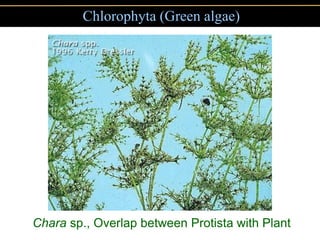
Chara sp., Overlap between Protista with Plant
VII. Mycetozoa (Slim Molds)


• Cellular slime molds       • Plasmodial slime molds
  – Resemble amoebas,           – Multinucleated large
    ingest bacteria by            cells
    phagocytosis                – Cytoplasm separates
  – Cells aggregate into          into stalked sporangia
    stalked fruiting body.      – Nuclei undergo
  – Some cells become             meiosis and form
    spores                        uninucleate haploid
                                  spores
Cellular Slim Molds
Plasmodial Slim Molds
Slim Molds
Slim Molds
Slim Molds
Slim Molds
Slim Molds
Slim Molds
Rhizopodium; Amoeba
Amoebiasis
Acanthamoeba spp. & Balamuthia mandrillaris
Entamoeba


• Entamoeba coli        - in Large intestine; colon
• Entamoeba gingivalis - in Mouth; teeth & gill
• Entamoeba histolytica - in Small intestine
Entamoeba histolytica
•   Entamoeba histolytica; Amoebic Dysentery
•   Amoeba feeds on RBCs and GI tract tissues
•   Diagnosis by observing trophozoites in feces
•   Treated with metronidazole
The End

Kingdom Protista

  • 1.
    Kingdom Protista B I O L O G Y Mr. Nattapong Boonpong (B.Ed.) Phlabphlachai Phitthayakhom School
  • 2.
    Overview: A Worldin a Drop of Water • Even a low-power microscope – Can reveal an astonishing menagerie of organisms in a drop of pond water 50 m
  • 3.
  • 4.
    Characteristic Protist • Theseamazing organisms – Belong to the diverse kingdoms of mostly single- celled eukaryotes informally known as protists • Advances in eukaryotic systematics – Have caused the classification of protists to change significantly. • Protists are more diverse than all other eukaryotes – And are no longer classified in a single kingdom • Most protists are unicellular – And some are colonial or multicellular
  • 5.
    Characteristic Protist (Continuous) •Protists, the most nutritionally diverse of all eukaryotes, include – Photoautotrophs, which contain chloroplasts – Heterotrophs, which absorb organic molecules or ingest larger food particles – Mixotrophs, which combine photosynthesis and heterotrophic nutrition • Protist habitats are also diverse in habitat • And including freshwater and marine species
  • 6.
  • 7.
    Reproduction of Protist •Reproduction and life cycles – Are also highly varied among protists, with both sexual and asexual species
  • 8.
    A Sample ofProtist Diversity
  • 9.
    Protozoa • Eukaryotic • Unicellular •Chemoheterotrophs • Vegetative form is a trophozoite • Asexual reproduction by fission, budding, or schizogony • Sexual reproduction by conjugation • Some produce cysts
  • 10.
    I. Diplomonadida &Parabasala • No mitochondria, ER, golgi complex, & centriole • Multiple flagella • Are adapted to anaerobic environments • Lack plastids
  • 11.
    Diplomonads & Parabasalids •Diplomonads – Have two nuclei and multiple flagella 5 µm Giardia intestinalis, a diplomonad (colorized SEM)
  • 12.
  • 13.
    Diplomonads & Parabasalids •Parabasalids include trichomonads – Which move by means of flagella and an undulating part of the plasma membrane – Have parabasal body Flagella Undulating membrane 5 µm Trichomonas vaginalis, a parabasalid (colorized SEM)
  • 14.
  • 15.
    Diplomonads & Parabasalids •Have one nucleus and multiple flagella • Have parabasal body Trichonympha sp., a parabasalid
  • 16.
    II. Euglenozoa • Moveby flagella • Photoautotrophs – Euglenoids • Chemoheterotrophs – Trypanosoma • Undulating membrane, transmitted by vectors – Leishmania • Flagellated form in sand fly vector, ovoid form in vertebrate host
  • 17.
  • 18.
  • 19.
    Kinetoplastids • Kinetoplastids – Have a single, large mitochondrion that contains an organized mass of DNA called a kinetoplast – Include free-living consumers of bacteria in freshwater, marine, and moist terrestrial ecosystems
  • 20.
  • 21.
    Kinetoplastids • The parasitickinetoplastid Trypanosoma – Causes sleeping sickness in humans 9 m
  • 22.
    Kinetoplastids Trypanosoma brucei gambiense Trypanosomabrucei rhodesiense Trypanosoma cruzi Trypanosomiasis, African (African sleeping sickness) Trypanosomiasis, American (Chagas disease)
  • 23.
  • 24.
    Trypanosomiasis (African SleepingSickness); T. brucei gambiense & T. brucei rhodesiense
  • 25.
  • 26.
    III. Alveolata • Alveolateshave sacs beneath the plasma membrane • Members of the clade Alveolata – Have membrane-bounded sacs (alveoli) just under the plasma membrane 0.2 µm Alveoli Flagellum
  • 27.
    Alveolata: Dinoflagellate • Dinoflagellates •Cellulose in plasma membrane • Unicellular • Chlorophyll a and c, carotene, xanthins • Store starch • Some are symbionts in marine animals • Neurotoxins cause paralytic shellfish poisoning
  • 28.
  • 29.
    Dinoflagellate: Red tideBloom Dinoflagellate หลายชนิด เช่น Gymnodinium & Trichodesmium จะทาให้เกิดปรากฏการณ์“red tide”ในทะเล และมหาสมุทรบางแห่ง และสร้างสารพิษออกมา ทาให้สัตว์นา ตายครังละมาก ๆ โดยจะออกฤทธิ์ที่ระบบประสาท นอกจากนี Gymnodinium & Gonyaulax ยังสร้างพิษทาให้ปลาตายและ มนุษย์ที่ได้รับสารพิษเข้าไปจะเสียชีวิตได้
  • 30.
    Dinoflagellate Peridinium Trichodesmium Gymnodinium Gonyaulax
  • 31.
    Alveolata: Apicomplexa • Nonmotile • Intracellular parasites • Complex life cycles • Plasmodium * Plasmodium vivax * Plasmodium malariae * Plasmodium ovale * Plasmodium falciparum
  • 32.
    Alveolata: Apicomplexa; Plasmodiumsp. Sporozoites 1 Infected mosquito bites 2 Sporozoites in salivary human; sporozoites undergo gland migrate through schizogony in bloodstream to liver cell; liver of human merozoites are produced 9 Resulting sporozoites migrate to salivary glands of mosquito 3 Merozoites Sexual released into reproduction bloodsteam from liver may infect Asexual new red blood 8 In mosquito’s cells Zygote digestive tract, reproduction gametocytes unite to form Intermediate host Female gametocyte zygote 4 Merozoite develops Male into ring stage in red gametocyte blood cell Ring 5 Ring stage stage grows and Definitive host divides, 7 Another mosquito bites producing 6 Merozoites are released merozoites infected humnan and when red blood cell ingests gametocytes ruptures; some merozoites infect new red blood cells, and some develop into male and female gametocytes Merozoites
  • 33.
  • 34.
  • 35.
    Alveolata: Ciliates • Ciliates,a large varied group of protists – Are named for their use of cilia to move and feed – Have large macronuclei and small micronuclei • The micronuclei – Function during conjugation, a sexual process that produces genetic variation • Conjugation is separate from reproduction – Which generally occurs by binary fission
  • 36.
    Alveolata: Ciliates • Structureand Function in the Ciliate Paramecium caudatum FEEDING, WASTE REMOVAL, AND WATER BALANCE Paramecium, like other freshwater Contractile Vacuole Paramecium feeds mainly on bacteria. protists, constantly takes in water Rows of cilia along a funnel-shaped oral by osmosis from the hypotonic environment. groove move food into the cell mouth, Bladderlike contractile vacuoles accumulate where the food is engulfed into food excess water from radial canals and periodically vacuoles by phagocytosis. expel it through the plasma membrane. Oral groove Cell mouth Thousands of cilia cover 50 µm Food vacuoles combine with the surface of Paramecium. lysosomes. As the food is digested, the vacuoles follow a looping path Micronucleus through the cell. Macronucleus The undigested contents of food vacuoles are released when the vacuoles fuse with a specialized region of the plasma membrane that functions as an anal pore.
  • 37.
    Alveolata: Ciliates CONJUGATION AND REPRODUCTION 1 Two cells of compatible 2 Meiosis of micronuclei mating strains align side produces four haploid 3 Three micronuclei in each cell by side and partially fuse. micronuclei in each cell. disintegrate. The remaining micro- nucleus in each cell divides by mitosis. MEIOSIS 4 The cells swap one micronucleus. Macronucleus Haploid micronucleus Compatible Diploid mates micronucleus Diploid micronucleus MICRONUCLEAR FUSION 5 The cells separate. 9 Two rounds of cytokinesis 8 The original macro- 7 Three rounds of 6 Micronuclei fuse, partition one macronucleus nucleus disintegrates. mitosis without forming a diploid Key and one micronucleus Four micronuclei cytokinesis micronucleus. into each of four daughter cells. become macronuclei, produce eight Conjugation while the other four micronuclei. remain micronuclei. Reproduction
  • 38.
  • 39.
    Ciliates Stentor polymorphus Stentor roeseli Epistylis rotans Vorticella Paramecium bursaria Suctoria Strombidium Trichodina pediculus Euplotes
  • 40.
    IV. Stramenopila (Algae) •Stramenopiles have “hairy” and smooth flagella • The clade Stramenopila - Includes several groups of heterotrophs as well as certain groups of algae • Most stramenopiles - Have a “hairy” flagellum paired with a “smooth” flagellum Hairy flagellum Smooth flagellum 5 µm
  • 41.
  • 42.
    Stramenopila: Brown algae(Phaeophyta) • Are the largest and most complex algae • Are all multicellular, and most are marine • Brown algae (kelp) • Cellulose + alginic acid cell walls • Multicellular • Chlorophyll a and c, xanthophylls; fucoxanthrin • Store carbohydrates • Harvested for algin
  • 43.
    Stramenopila: Brown algae •Kelps, or giant seaweeds – Live in deep parts of the ocean
  • 44.
    Brown algae Laminaria saccharia - สกัดเอา algin มาทายา อาหาร เส้นใย ยาง สบู่ ฯลฯ - ใช้ทาปุ๋ย K ได้ Padina & Fucus -ใช้ทาปุ๋ย K ได้ Sargassum (สาหร่ายทุ่น) - มีไอโอดีนสูง และยังให้ algin Laminaria & Sargassum - สามารถนามาตากแห้ง ต้มนาดื่มแก้ร้อนใน คอพอก และฟอกเลือด Giant kelp - สร้างสาร algin มาทายา อาหาร เส้นใย กระดาษ ยาง สบู่ และเป็นสาหร่ายที่มีขนาดใหญ่ที่สุด เป็นที่อยู่อาศัย หลบภัยและอาหารของสัตว์นานานาชนิดใต้ท้องทะเล Laminaria Padina Fucus
  • 45.
  • 46.
    Brown algae (a) The seaweed is grown on nets in shallow coastal waters. (b) A worker spreads the harvested sea- weed on bamboo screens to dry. (c) Paper-thin, glossy sheets of nori make a mineral-rich wrap for rice, seafood, and vegetables in sushi.
  • 47.
    Stramenopila: Diatoms (Bacillariophyta) • Diatoms • Pectin and silica cell walls • Unicellular • Chlorophyll a and c, carotene, xanthophylls • Store oil • Fossilized diatoms formed oil • Produce domoic acid
  • 48.
    Diatomaceous earth • Accumulationsof fossilized diatom walls – Compose much of the sediments known as diatomaceous earth
  • 49.
    Diatoms Pinnidaria Navicular Asterionella Melorista
  • 50.
    V. Rhodophyta (Redalgae) • Red algae • Cellulose cell walls • Most multicellular • No flagella stage • Chlorophyll a and d, phycobiliproteins (phycocyanin & phycoerythrin) • Store glucose polymer • Harvested for agar and carrageenan
  • 51.
  • 52.
    Red algae Porphyra (จี่ฉ่าย) - ใส่แกงจืดเป็นอาหาร Gracilaria (สาหร่ายผมนาง หรือ สาหร่ายวุ้น) - นามาสกัดวุ้นผสมในอาหารเลียงเชือจุลินทรีย์ (agar) - ใช้เพาะเลียงเนือเยื่อ - ทาแคปซูลยา ทายา ทาเครื่องสาอางค์ ครีมโกนหนวด ฯลฯ Chondrus Plumoria Andrus Corellina Polysiphinia Gelidium Grinnellia Porphyra Polysiphinia
  • 53.
    Red algae Gelidium Chodrus crispus
  • 54.
    VI. Chlorophyta (Greenalgae) • Green algae • Cellulose cell walls • Unicellular, multicellular or colonial form • Chlorophyll a and b • Store glucose polymer • Gave rise to plants • Are named for their grass-green chloroplasts • Are divided into two main groups: chlorophytes and charophyceans • Are closely related to land plants
  • 55.
  • 56.
  • 57.
  • 58.
  • 59.
    Chlorophyta (Green algae) Micrasterias rotata Cell division Micrasterias fimbriata Staurastrum Hyalotheka dissilens Closterium lunula Staurodesmus convergens Euastrum verrucosum Volvox aureus Draparnadia platyzonata Mougeotia Pediastrum
  • 60.
  • 61.
    Chlorophyta (Green algae) Charasp., Overlap between Protista with Plant
  • 62.
    VII. Mycetozoa (SlimMolds) • Cellular slime molds • Plasmodial slime molds – Resemble amoebas, – Multinucleated large ingest bacteria by cells phagocytosis – Cytoplasm separates – Cells aggregate into into stalked sporangia stalked fruiting body. – Nuclei undergo – Some cells become meiosis and form spores uninucleate haploid spores
  • 63.
  • 64.
  • 65.
  • 66.
  • 67.
  • 68.
  • 69.
  • 70.
  • 71.
  • 72.
  • 73.
    Acanthamoeba spp. &Balamuthia mandrillaris
  • 74.
    Entamoeba • Entamoeba coli - in Large intestine; colon • Entamoeba gingivalis - in Mouth; teeth & gill • Entamoeba histolytica - in Small intestine
  • 75.
    Entamoeba histolytica • Entamoeba histolytica; Amoebic Dysentery • Amoeba feeds on RBCs and GI tract tissues • Diagnosis by observing trophozoites in feces • Treated with metronidazole
  • 76.