Test
1. A. 1st person to actually see living microorganisms was
…………………………………
B. What term did he gave to the microorganisms?-
……………………………………………….
2. Who coined the term vaccine?- ……………………………………………….
3. Nucleoid is present in- ……………………………………………….
4. 5 Hallmarks of life.
5. Biologists consider viruses to be non-living because
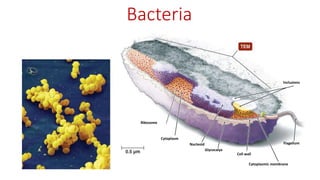
Bacteria
Ribosome
Cytoplasm
Nucleoid
Glycocalyx
Cell wall
Cytoplasmic membrane
Flagellum
Inclusions
Prokaryotes
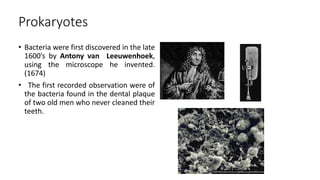
• Bacteria were first discovered in the late
1600’s by Antony van Leeuwenhoek,
using the microscope he invented.
(1674)
• The first recorded observation were of
the bacteria found in the dental plaque
of two old men who never cleaned their
teeth.
• Bacteria are prokaryotic microorganisms and are called as prokaryotes
• SIZE:
• 0.2 to 2.0 μm in diameter and from 2 to 8 μm in length.
• surface area/ volume ratio is exceedingly high favoring unusually high rate of growth and
metabolism of bacteria
• No circulatory mechanism is needed to distribute the nutrients that are taken in, due to
this high surface to volume ratio
Bacterial Morphology
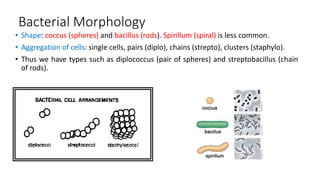
• Shape: coccus (spheres) and bacillus (rods). Spirillum (spiral) is less common.
• Aggregation of cells: single cells, pairs (diplo), chains (strepto), clusters (staphylo).
• Thus we have types such as diplococcus (pair of spheres) and streptobacillus (chain
of rods).
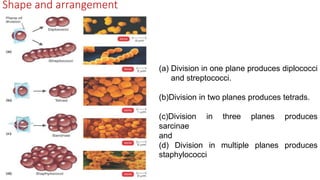
Shape and arrangement
(a) Division in one plane produces diplococci
and streptococci.
(b)Division in two planes produces tetrads.
(c)Division in three planes produces
sarcinae
and
(d) Division in multiple planes produces
staphylococci
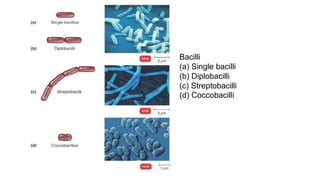
Bacilli
(a) Single bacilli
(b) Diplobacilli
(c) Streptobacilli
(d) Coccobacilli
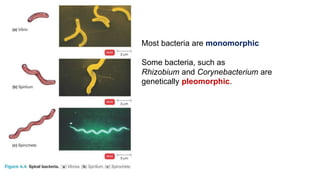
Most bacteria are monomorphic
Some bacteria, such as
Rhizobium and Corynebacterium are
genetically pleomorphic.
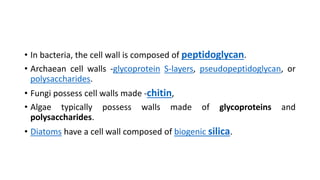
• In bacteria, the cell wall is composed of peptidoglycan.
• Archaean cell walls -glycoprotein S-layers, pseudopeptidoglycan, or
polysaccharides.
• Fungi possess cell walls made -chitin,
• Algae typically possess walls made of glycoproteins and
polysaccharides.
• Diatoms have a cell wall composed of biogenic silica.
Glycocalyx and capsule
• Many prokaryotes secrete on their surface a substance called glycocalyx
• If the substance is organized and is firmly attached to the cell wall , the
glycocalyx is described as a capsule
• It is termed a microcapsule if it is too thin to be seen by light microscopy
• The material is called “Slime” if the layer is abundant and many cells are
embedded in a common matrix
• Functions of capsule:
• In certain species, capsules are important in contributing to bacterial virulence (the
degree to which a pathogen causes disease)
• Protect pathogenic bacteria from phagocytosis by the cells of the host
• They may block attachment of bacteriophages
• They may provide protection against temporary drying by binding water molecule
• They may promote attachment of bacteria to surfaces
Flagella and motility
• hair like helical appendages
• protrude through the cell wall
• responsible for swimming motility
• Bacteria that lack flagella are referred to as atrichous
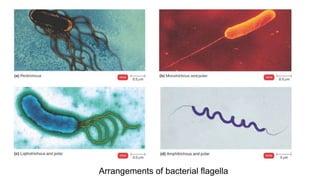
• Flagella may be
• peritrichous (distributed over the entire cell)
• polar (at one or both poles or ends of the cell)
• If polar, flagella may be monotrichous (a single flagellum at one pole)
• lophotrichous (a tuft of flagella coming from one pole)
• amphitrichous (flagella at both poles of the cell)
Arrangements of bacterial flagella
Parts of flagella
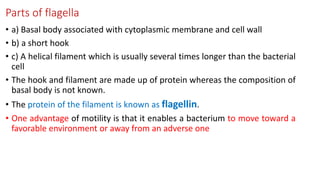
• a) Basal body associated with cytoplasmic membrane and cell wall
• b) a short hook
• c) A helical filament which is usually several times longer than the bacterial
cell
• The hook and filament are made up of protein whereas the composition of
basal body is not known.
• The protein of the filament is known as flagellin.
• One advantage of motility is that it enables a bacterium to move toward a
favorable environment or away from an adverse one
•Taxis.
• Chemotaxis and Phototaxis
• If the chemotactic signal is positive, called an attractant, the bacteria
move toward the stimulus
• If the chemotactic signal is negative, called a repellent, the bacteria move
away from the stimulus
Fimbriae and pili
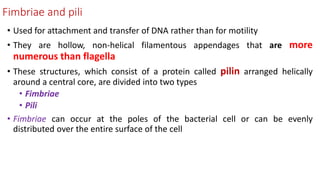
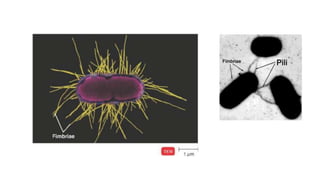
• Used for attachment and transfer of DNA rather than for motility
• They are hollow, non-helical filamentous appendages that are more
numerous than flagella
• These structures, which consist of a protein called pilin arranged helically
around a central core, are divided into two types
• Fimbriae
• Pili
• Fimbriae can occur at the poles of the bacterial cell or can be evenly
distributed over the entire surface of the cell
Pili
• Pili are usually longer than fimbriae and number only one or two per cell.
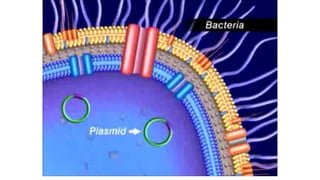
• Pili are involved mostly in DNA transfer.
• Conjugation sex pili (F Pili).
• The exchanged DNA can add a new function to the recipient cell, such as
antibiotic resistance or the ability to digest its medium more efficiently.
Sheaths
• Sheath is a hollow tube formed in some species of bacteria to enclose
chains of bacterial cells.
• Sheath is commonly found in the species from fresh water and,
marine environments
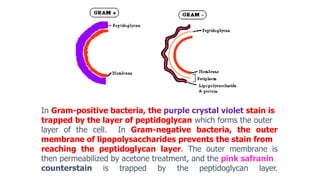
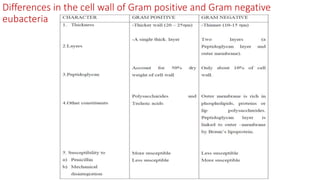
In Gram-positive bacteria, the purple crystal violet stain is
trapped by the layer of peptidoglycan which forms the outer
layer of the cell. In Gram-negative bacteria, the outer
membrane of lipopolysaccharides prevents the stain from
reaching the peptidoglycan layer. The outer membrane is
then permeabilized by acetone treatment, and the pink safranin
counterstain is trapped by the peptidoglycan layer.
Differences in the cell wall of Gram positive and Gram negative
eubacteria
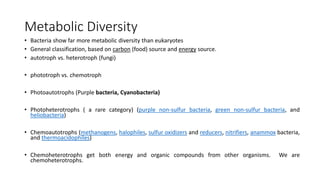
Metabolic Diversity
• Bacteria show far more metabolic diversity than eukaryotes
• General classification, based on carbon (food) source and energy source.
• autotroph vs. heterotroph (fungi)
• phototroph vs. chemotroph
• Photoautotrophs (Purple bacteria, Cyanobacteria)
• Photoheterotrophs ( a rare category) (purple non-sulfur bacteria, green non-sulfur bacteria, and
heliobacteria)
• Chemoautotrophs (methanogens, halophiles, sulfur oxidizers and reducers, nitrifiers, anammox bacteria,
and thermoacidophiles)
• Chemoheterotrophs get both energy and organic compounds from other organisms. We are
chemoheterotrophs.
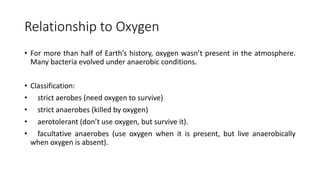
Relationship to Oxygen
• For more than half of Earth’s history, oxygen wasn’t present in the atmosphere.
Many bacteria evolved under anaerobic conditions.
• Classification:
• strict aerobes (need oxygen to survive)
• strict anaerobes (killed by oxygen)
• aerotolerant (don’t use oxygen, but survive it).
• facultative anaerobes (use oxygen when it is present, but live anaerobically
when oxygen is absent).
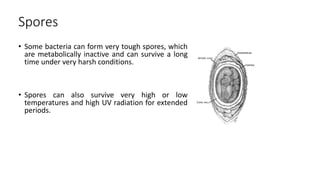
Spores
• Some bacteria can form very tough spores, which
are metabolically inactive and can survive a long
time under very harsh conditions.
• Spores can also survive very high or low
temperatures and high UV radiation for extended
periods.
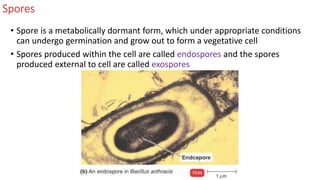
Spores
• Spore is a metabolically dormant form, which under appropriate conditions
can undergo germination and grow out to form a vegetative cell
• Spores produced within the cell are called endospores and the spores
produced external to cell are called exospores
Archaea
• Sometimes called “Archaebacteria”
• One distinguishing characteristic: cell membranes don’t contain fatty acids, but
instead use branched molecules called isoprenes.
• Three main type: methanogens, extreme halophiles, extreme thermophiles.
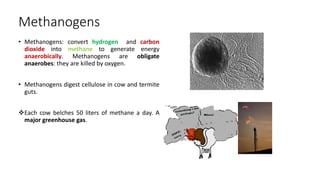
Methanogens
• Methanogens: convert hydrogen and carbon
dioxide into methane to generate energy
anaerobically. Methanogens are obligate
anaerobes: they are killed by oxygen.
• Methanogens digest cellulose in cow and termite
guts.
Each cow belches 50 liters of methane a day. A
major greenhouse gas.
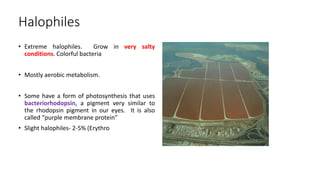
Halophiles
• Extreme halophiles. Grow in very salty
conditions. Colorful bacteria
• Mostly aerobic metabolism.
• Some have a form of photosynthesis that uses
bacteriorhodopsin, a pigment very similar to
the rhodopsin pigment in our eyes. It is also
called “purple membrane protein”
• Slight halophiles- 2-5% (Erythro
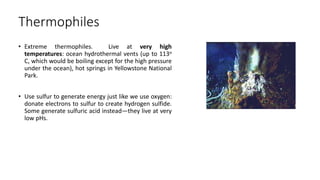
Thermophiles
• Extreme thermophiles. Live at very high
temperatures: ocean hydrothermal vents (up to 113o
C, which would be boiling except for the high pressure
under the ocean), hot springs in Yellowstone National
Park.
• Use sulfur to generate energy just like we use oxygen:
donate electrons to sulfur to create hydrogen sulfide.
Some generate sulfuric acid instead—they live at very
low pHs.
Eubacteria
• The most common types of bacteria
• Many categories: we will just look at a few of them.
• Enteric bacteria live in the digestive tracts of animals.
Enterics are facultative anaerobes.
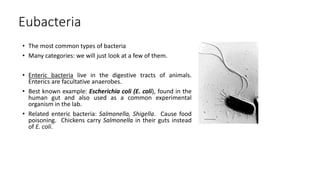
• Best known example: Escherichia coli (E. coli), found in the
human gut and also used as a common experimental
organism in the lab.
• Related enteric bacteria: Salmonella, Shigella. Cause food
poisoning. Chickens carry Salmonella in their guts instead
of E. coli.
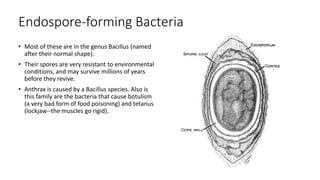
Endospore-forming Bacteria
• Most of these are in the genus Bacillus (named
after their normal shape).
• Their spores are very resistant to environmental
conditions, and may survive millions of years
before they revive.
• Anthrax is caused by a Bacillus species. Also is
this family are the bacteria that cause botulism
(a very bad form of food poisoning) and tetanus
(lockjaw--the muscles go rigid).
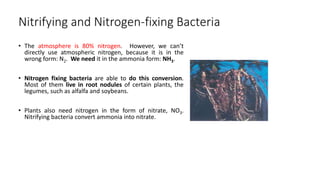
Nitrifying and Nitrogen-fixing Bacteria
• The atmosphere is 80% nitrogen. However, we can’t
directly use atmospheric nitrogen, because it is in the
wrong form: N2. We need it in the ammonia form: NH3.
• Nitrogen fixing bacteria are able to do this conversion.
Most of them live in root nodules of certain plants, the
legumes, such as alfalfa and soybeans.
• Plants also need nitrogen in the form of nitrate, NO3.
Nitrifying bacteria convert ammonia into nitrate.
Cyanobacteria
• A major group of photosynthetic bacteria
• The oceans contain large amounts of cyanobacteria (called
plankton), that produce much of Earth’s oxygen.
• Cyanobacteria are the source of chloroplasts in plant cells. They
also have a symbiotic relationship in lichens.
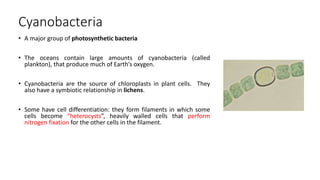
• Some have cell differentiation: they form filaments in which some
cells become “heterocysts”, heavily walled cells that perform
nitrogen fixation for the other cells in the filament.

Introduction to bacteria

  • 1.
    Test 1. A. 1stperson to actually see living microorganisms was ………………………………… B. What term did he gave to the microorganisms?- ………………………………………………. 2. Who coined the term vaccine?- ………………………………………………. 3. Nucleoid is present in- ………………………………………………. 4. 5 Hallmarks of life. 5. Biologists consider viruses to be non-living because
  • 2.
  • 3.
    Prokaryotes • Bacteria werefirst discovered in the late 1600’s by Antony van Leeuwenhoek, using the microscope he invented. (1674) • The first recorded observation were of the bacteria found in the dental plaque of two old men who never cleaned their teeth.
  • 4.
    • Bacteria areprokaryotic microorganisms and are called as prokaryotes • SIZE: • 0.2 to 2.0 μm in diameter and from 2 to 8 μm in length. • surface area/ volume ratio is exceedingly high favoring unusually high rate of growth and metabolism of bacteria • No circulatory mechanism is needed to distribute the nutrients that are taken in, due to this high surface to volume ratio
  • 5.
    Bacterial Morphology • Shape:coccus (spheres) and bacillus (rods). Spirillum (spiral) is less common. • Aggregation of cells: single cells, pairs (diplo), chains (strepto), clusters (staphylo). • Thus we have types such as diplococcus (pair of spheres) and streptobacillus (chain of rods).
  • 6.
    Shape and arrangement (a)Division in one plane produces diplococci and streptococci. (b)Division in two planes produces tetrads. (c)Division in three planes produces sarcinae and (d) Division in multiple planes produces staphylococci
  • 7.
    Bacilli (a) Single bacilli (b)Diplobacilli (c) Streptobacilli (d) Coccobacilli
  • 8.
    Most bacteria aremonomorphic Some bacteria, such as Rhizobium and Corynebacterium are genetically pleomorphic.
  • 9.
    • In bacteria,the cell wall is composed of peptidoglycan. • Archaean cell walls -glycoprotein S-layers, pseudopeptidoglycan, or polysaccharides. • Fungi possess cell walls made -chitin, • Algae typically possess walls made of glycoproteins and polysaccharides. • Diatoms have a cell wall composed of biogenic silica.
  • 10.
    Glycocalyx and capsule •Many prokaryotes secrete on their surface a substance called glycocalyx • If the substance is organized and is firmly attached to the cell wall , the glycocalyx is described as a capsule
  • 11.
    • It istermed a microcapsule if it is too thin to be seen by light microscopy • The material is called “Slime” if the layer is abundant and many cells are embedded in a common matrix • Functions of capsule: • In certain species, capsules are important in contributing to bacterial virulence (the degree to which a pathogen causes disease) • Protect pathogenic bacteria from phagocytosis by the cells of the host • They may block attachment of bacteriophages • They may provide protection against temporary drying by binding water molecule • They may promote attachment of bacteria to surfaces
  • 12.
    Flagella and motility •hair like helical appendages • protrude through the cell wall • responsible for swimming motility • Bacteria that lack flagella are referred to as atrichous • Flagella may be • peritrichous (distributed over the entire cell) • polar (at one or both poles or ends of the cell) • If polar, flagella may be monotrichous (a single flagellum at one pole) • lophotrichous (a tuft of flagella coming from one pole) • amphitrichous (flagella at both poles of the cell)
  • 13.
  • 14.
    Parts of flagella •a) Basal body associated with cytoplasmic membrane and cell wall • b) a short hook • c) A helical filament which is usually several times longer than the bacterial cell • The hook and filament are made up of protein whereas the composition of basal body is not known. • The protein of the filament is known as flagellin. • One advantage of motility is that it enables a bacterium to move toward a favorable environment or away from an adverse one
  • 15.
    •Taxis. • Chemotaxis andPhototaxis • If the chemotactic signal is positive, called an attractant, the bacteria move toward the stimulus • If the chemotactic signal is negative, called a repellent, the bacteria move away from the stimulus
  • 16.
    Fimbriae and pili •Used for attachment and transfer of DNA rather than for motility • They are hollow, non-helical filamentous appendages that are more numerous than flagella • These structures, which consist of a protein called pilin arranged helically around a central core, are divided into two types • Fimbriae • Pili • Fimbriae can occur at the poles of the bacterial cell or can be evenly distributed over the entire surface of the cell
  • 18.
    Pili • Pili areusually longer than fimbriae and number only one or two per cell. • Pili are involved mostly in DNA transfer. • Conjugation sex pili (F Pili). • The exchanged DNA can add a new function to the recipient cell, such as antibiotic resistance or the ability to digest its medium more efficiently.
  • 20.
    Sheaths • Sheath isa hollow tube formed in some species of bacteria to enclose chains of bacterial cells. • Sheath is commonly found in the species from fresh water and, marine environments
  • 21.
    In Gram-positive bacteria,the purple crystal violet stain is trapped by the layer of peptidoglycan which forms the outer layer of the cell. In Gram-negative bacteria, the outer membrane of lipopolysaccharides prevents the stain from reaching the peptidoglycan layer. The outer membrane is then permeabilized by acetone treatment, and the pink safranin counterstain is trapped by the peptidoglycan layer.
  • 22.
    Differences in thecell wall of Gram positive and Gram negative eubacteria
  • 23.
    Metabolic Diversity • Bacteriashow far more metabolic diversity than eukaryotes • General classification, based on carbon (food) source and energy source. • autotroph vs. heterotroph (fungi) • phototroph vs. chemotroph • Photoautotrophs (Purple bacteria, Cyanobacteria) • Photoheterotrophs ( a rare category) (purple non-sulfur bacteria, green non-sulfur bacteria, and heliobacteria) • Chemoautotrophs (methanogens, halophiles, sulfur oxidizers and reducers, nitrifiers, anammox bacteria, and thermoacidophiles) • Chemoheterotrophs get both energy and organic compounds from other organisms. We are chemoheterotrophs.
  • 24.
    Relationship to Oxygen •For more than half of Earth’s history, oxygen wasn’t present in the atmosphere. Many bacteria evolved under anaerobic conditions. • Classification: • strict aerobes (need oxygen to survive) • strict anaerobes (killed by oxygen) • aerotolerant (don’t use oxygen, but survive it). • facultative anaerobes (use oxygen when it is present, but live anaerobically when oxygen is absent).
  • 25.
    Spores • Some bacteriacan form very tough spores, which are metabolically inactive and can survive a long time under very harsh conditions. • Spores can also survive very high or low temperatures and high UV radiation for extended periods.
  • 26.
    Spores • Spore isa metabolically dormant form, which under appropriate conditions can undergo germination and grow out to form a vegetative cell • Spores produced within the cell are called endospores and the spores produced external to cell are called exospores
  • 28.
    Archaea • Sometimes called“Archaebacteria” • One distinguishing characteristic: cell membranes don’t contain fatty acids, but instead use branched molecules called isoprenes. • Three main type: methanogens, extreme halophiles, extreme thermophiles.
  • 29.
    Methanogens • Methanogens: converthydrogen and carbon dioxide into methane to generate energy anaerobically. Methanogens are obligate anaerobes: they are killed by oxygen. • Methanogens digest cellulose in cow and termite guts. Each cow belches 50 liters of methane a day. A major greenhouse gas.
  • 30.
    Halophiles • Extreme halophiles.Grow in very salty conditions. Colorful bacteria • Mostly aerobic metabolism. • Some have a form of photosynthesis that uses bacteriorhodopsin, a pigment very similar to the rhodopsin pigment in our eyes. It is also called “purple membrane protein” • Slight halophiles- 2-5% (Erythro
  • 31.
    Thermophiles • Extreme thermophiles.Live at very high temperatures: ocean hydrothermal vents (up to 113o C, which would be boiling except for the high pressure under the ocean), hot springs in Yellowstone National Park. • Use sulfur to generate energy just like we use oxygen: donate electrons to sulfur to create hydrogen sulfide. Some generate sulfuric acid instead—they live at very low pHs.
  • 33.
    Eubacteria • The mostcommon types of bacteria • Many categories: we will just look at a few of them. • Enteric bacteria live in the digestive tracts of animals. Enterics are facultative anaerobes. • Best known example: Escherichia coli (E. coli), found in the human gut and also used as a common experimental organism in the lab. • Related enteric bacteria: Salmonella, Shigella. Cause food poisoning. Chickens carry Salmonella in their guts instead of E. coli.
  • 34.
    Endospore-forming Bacteria • Mostof these are in the genus Bacillus (named after their normal shape). • Their spores are very resistant to environmental conditions, and may survive millions of years before they revive. • Anthrax is caused by a Bacillus species. Also is this family are the bacteria that cause botulism (a very bad form of food poisoning) and tetanus (lockjaw--the muscles go rigid).
  • 35.
    Nitrifying and Nitrogen-fixingBacteria • The atmosphere is 80% nitrogen. However, we can’t directly use atmospheric nitrogen, because it is in the wrong form: N2. We need it in the ammonia form: NH3. • Nitrogen fixing bacteria are able to do this conversion. Most of them live in root nodules of certain plants, the legumes, such as alfalfa and soybeans. • Plants also need nitrogen in the form of nitrate, NO3. Nitrifying bacteria convert ammonia into nitrate.
  • 36.
    Cyanobacteria • A majorgroup of photosynthetic bacteria • The oceans contain large amounts of cyanobacteria (called plankton), that produce much of Earth’s oxygen. • Cyanobacteria are the source of chloroplasts in plant cells. They also have a symbiotic relationship in lichens. • Some have cell differentiation: they form filaments in which some cells become “heterocysts”, heavily walled cells that perform nitrogen fixation for the other cells in the filament.

Editor's Notes

  • #5 With the aid of electron microscopy in 1940’s it was discovered that in some cells, for example typical bacteria, the nuclear substance was not enclosed by a nuclear membrane
  • #6 Bacteria only take a few basic shapes, which are found in many different groups. Bacterial cells don’t have internal cytoskeletons, so their shapes can’t be very elaborate.
  • #7 1. streptococcus pneumoniae 2. lactic acid bacilli, Aerococcus 3. Sarcina ventriculi, a variety found on the surface of cereal seeds, in soil, mud, and in the stomachs of humans, rabbits, and guinea pigs 4. staphylococcus aureus
  • #9 Most bacteria are monomorphic; ie., they maintain a single shape. Some bacteria, such as Rhizobium and Corynebacterium are genetically pleomorphic. which means they can have many shapes Mycoplasma
  • #10 Eukaryotic ribosome (80S) Inclusion bodies are nuclear or cytoplasmic aggregates of stainable substances, usually proteins. Inclusion bodies can also be hallmarks of genetic diseases, as in the case of Neuronal Inclusion bodies in disorders like Frontotemporal dementia and Parkinson's disease.
  • #11 The primary cell wall of land plants is composed of the polysaccharides cellulose, hemicellulose and pectin. Archaean cell walls have various compositions, and may be formed of glycoprotein S-layers, pseudopeptidoglycan, or polysaccharides. Fungi possess cell walls made of the glucosamine polymer chitin, and algae typically possess walls made of glycoproteins and polysaccharides. Diatoms have a cell wall composed of biogenic silica. Peptidoglycan, also known as murein, is a polymer consisting of sugars and amino acids that forms a mesh-like layer outside the plasma membrane of most bacteria, forming the cell wall. Glycoprotein any of a class of proteins which have carbohydrate groups attached to the polypeptide chain.
  • #12 The bacterial glycocalyx is a viscous (sticky), gelatinous polymer that is external to the cell wall and composed of polysaccharide, polypeptide, or both The glycocalyx is a glycoprotein-polysaccharide covering that surrounds the cell membranes of some bacteria, epithelia and other cells. Most animal epithelial cells have a fuzz-like coat on the external surface of their plasma membranes. Cell walls are present in plants, fungi and prokaryotic cells,
  • #14 cilia is an organelle found in eukaryotic cells. Bacterial flagella are hair like helical appendages that protrude through the cell wall and are responsible for swimming motility
  • #15 peritrichous (distributed over the entire cell) polar (at one or both poles or ends of the cell) If polar, flagella may be monotrichous (a single flagellum at one pole) lophotrichous (a tuft of flagella coming from one pole) amphitrichous (flagella at both poles of the cell)
  • #17 The movement of a bacterium toward or away from a particular stimulus is called taxis. Such stimuli include chemicals (chemotaxis) and light (phototaxis) Without external flagella some helical bacteria (spirochetes) exhibit swimming motility by means of Axial filaments/ Endoflagella (flagella like structures beneath the outer cell envelope).
  • #18 Many gram-negative bacteria contain hair-like appendages that are shorter, straighter, and thinner than flagella and are used for attachment and transfer of DNA rather than for motility The terms pilus and fimbria can be used interchangeably, although some researchers reserve the term pilus for the appendage required for bacterial conjugation.
  • #19 Fimbriae have a tendency to adhere to each other and to surfaces As a result, they are involved in forming biofilms and other aggregations on the surfaces of liquids, glass, and rocks Fimbriae can also help bacteria adhere to epithelial surfaces in the body
  • #20 Some pili are used to bring bacteria together allowing the transfer of DNA from one cell to another, a process called conjugation. Such pili are called conjugation sex pili (F Pili). In this process, the conjugation pilus of one bacterium called an F+ cell connects to receptors on the surface of another bacterium of its own species or a different species. The two cells make physical contact, and DNA from the F+ cell is transferred to the other cell.
  • #23 The peptidoglycan is present only in prokaryotes (In eukaryotes it is made up of polysaccharides (such as cellulose (a glucan)) or a variety of glycoproteins or chitin) Most of the bacteria retain their original cells even after subjected to very high pressure or severe physical conditions (bacteria are broadly distinguished into eubacteria and archaebacteria based on their ancestral relationships i.e., on evolution and genetic relatedness)
  • #25 Pseudomurein- Peptidoglycan-like polymer that has L-amino acids instead of D-amino acids in its cross-links, N-acetyltalosaminuronic acid instead of N-acetylmuramic acid (NAM), and β (1→3) glycosidic bonds instead of β (1→4) glycosidic
  • #26 Either acetone or ethyl alcohol can be used as the decolorizing agent. The alcohol dissolves lipids found in the outer cell membrane of Gram-negative bacteria, allowing the crystal violet-iodine complex to leak out of the thinner peptidoglycan layer.
  • #27 Braun’s lipoprotein – most abundant membrane protein.
  • #30 Autotrophs make their own food from non-organic sources (usually carbon dioxide). Heterotrophs use organic compounds from other organisms. Phototrophs get their energy from sunlight. Chemotrophs get their energy from chemical compounds. Photoautotrophs get energy from sunlight and synthesize their own food from scratch, like green plants. Photoheterotrophs ( a rare category) get energy from sunlight but need organic compounds made by other organisms. Chemoautotrophs compounds. get energy from chemicals such as hydrogen gas, hydrogen sulfide or ammonia, and they use carbon dioxide as the raw material for their organic Chemoheterotrophs get both energy and organic compounds from other organisms. We are chemoheterotrophs.
  • #32 Allegedly, some bacterial spores that were embedded in amber for 25 million years have been revived. Others, trapped in salt deposits for up to 250 million years, have also been revived. Hard, orangish yellow material
  • #33 Bacterias themselves usually have capsules - which make up their antigenic agent (which attack their hosts), and it is a part of a normal adult bacteria. While spores are similar to the embryos of animals - they bud out of bacterias and wait for the optimal environment where they will develop into an adult bacteria.
  • #35 Genetically different from Eubacteria. organic compound
  • #36 They make methane (natural gas) as a waste product. They are found in swamp sediments, sewage, and in buried landfills. Methanogens are also in swamps, wetlands, and garbage dumps.
  • #37 Colorful bacteria in seawater evaporation beds, Great Salt Lake. Large numbers of certain halophiles can turn these waters to dark pink. Halophiles are aerobes and perform aerobic respiration.
  • #38 Some can grow above the boiling temperature of water. They are anaerobes, performing anaerobic respiration. Thermophiles are interesting because they contain genes for heat-stable enzymes that may be of great value in industry and medicine. An example is taq polymerase, the gene for which was isolated from a collection of Thermus aquaticus in a Yellowstone Park hot spring. Taq polymerase is used to make large numbers of copies of DNA sequences in a DNA sample. It is invaluable to medicine, biotechnology, and biological research.
  • #40 Most E. coli strains are harmless, but a few pathogenic (disease-causing) strains exist, causing food poisoning. A common source is ground meat, but it gets on unwashed vegetables as well.
  • #41 Spores produced within the cell are called endospores and the spores produced external to cell are called exospores
  • #42 1. All proteins contain much nitrogen 2. Farmers plant these crops to enrich their soil by naturally adding ammonia to it.
  • #43 Lichen: a fungus and a cyanobacteria provide each other with shelter and food from photosynthesis. Cyanobacteria form cell walls to fossilize—among the oldest forms of life known.