SINGLE STRAND CONFORMATIONAL
POLYMORPHISM (SCP)
By
KAUSHAL KUMAR SAHU
Assistant Professor (Ad Hoc)
Department of Biotechnology
Govt. Digvijay Autonomous P. G. College
Raj-Nandgaon ( C. G. )
SYNOPSIS
INTRODUCTION
DEFINITION
PRINCIPLE
PROCEDURE
APPLICATION
LIMITATION
CONCLUSION
REFERENCE
INTRODUCTION
Single strand conformation polymorphism (SSCP) or single
strand chain polymorphism, is defined as conformational
difference of single stranded nucleotide sequence of identical
length as induced by difference in the sequence under
experimental condition.
This property allow to distinguish the sequence by means of
gel electrophoresis, with separate the different conformation.
Like restriction fragment length polymorphisms (RFLPs), SSCPs
are allelic variants of inherited, genetic traits that can be used as
genetic markers. Unlike RFLP analysis, however, SSCP analysis
can detect DNA polymorphisms and mutations at multiple places in
DNA fragments (Orita et al., 1989).
As a mutation scanning technique, though, SSCP is more often
used to analyze the polymorphisms at single loci, especially when
used for medical diagnoses (Sunnucks et al., 2000).
DEFINITION
• “SSCP is the electrophoretic separation of single-
stranded nucleic acids based on subtle
differences in sequence (often a single base pair) which
results in a different secondary structure and a
measurable difference in mobility through a gel.”
PRINCIPLE
The mobility of double-stranded DNA in gel electrophoresis is dependent
on strand size and length but is relatively independent of the particular
nucleotide sequence. The mobility of single strands, however, is noticeably
affected by very small changes in sequence, possibly one changed
nucleotide out of several hundred.
Small changes are noticeable because of the relatively unstable nature of
single-stranded DNA; in the absence of a complementary strand, the single
strand may experience intrastrand base pairing, resulting in loops and folds
that give the single strand a unique 3D structure, regardless of its length.
A single nucleotide change could dramatically affect the
strand's mobility through a gel by altering the intrastrand base
pairing and its resulting 3D conformation (Melcher, 2000).
Single-strand conformation polymorphism analysis takes
advantage of this quality of single-stranded DNA. First
announced in 1989 as a new means of detecting DNA
polymorphisms, or sequence variations, SSCP analysis offers
an inexpensive, convenient, and sensitive method for
determining genetic variation (Sunnucks et al., 2000).
PROCEDURE
The procedure used during the development of SSCP was as
follows:
digestion of genomic DNA with restriction endonucleases.
Denaturation in an alkaline (basic) solution.
electrophoresis on a neutral polyacrylamide gel.
transfer to a nylon membrane.
hybridization with either DNA fragments or more clearly with
RNA copies synthesized on each strands as probes.
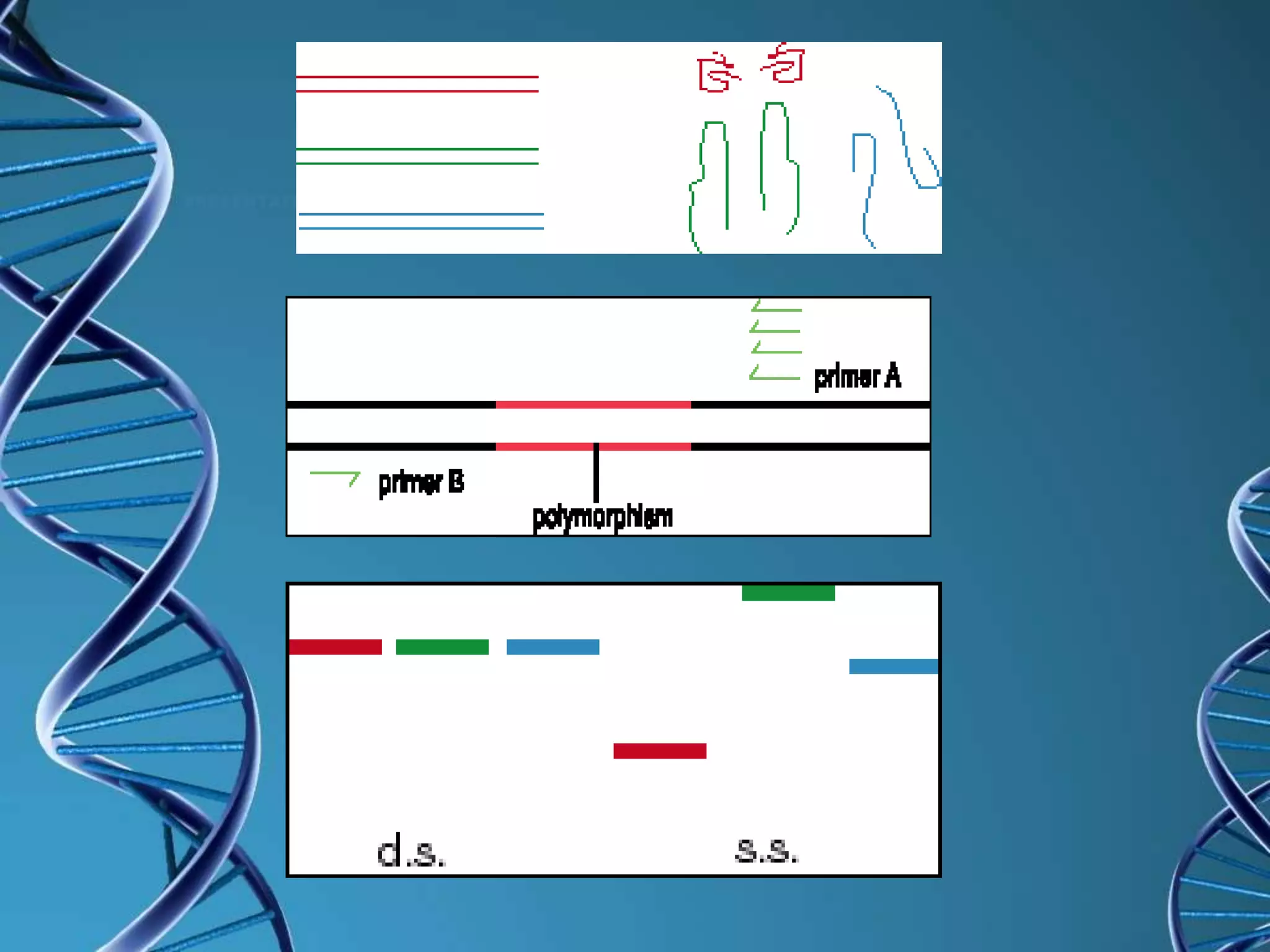
The three equal-length double-stranded DNA fragments
are shown with the corresponding single-stranded
structures, the red fragment folding into the smallest
molecule and the green the largest (Panel A).
The desired polymorphism is selected with PCR
primers; primer A is in excess to amplify only a single
strand (Panel B). Both the double-stranded and single-
stranded fragments are run through gel electrophoresis
(Panel C). If not for the color labels, there would be no
distinction between the double-stranded fragments.
The single-stranded fragments, however, show considerable
variation in mobility; the small red molecule migrates more
quickly through the gel than either the blue or the large green
molecule.
Using this SSCP result, it becomes clear that the different
lanes (red, blue, or green) contain strands with different
sequences; the more far apart the bands, the less similar the
nucleotide sequences.
APPLICATION
SSCP used to be a way to discover new DNA polymorphisms
apart from DNA sequencing, but is now being supplanted by
sequencing techniques on account of efficiency and accuracy.
These days, SSCP is most applicable as a diagnostic tool in
molecular biology. It can be used in genotyping to detect
homozygous individuals of different allelic states, as well as
heterozygous individuals that should each demonstrate distinct
patterns in an electrophoresis experiment
•
SSCP is also widely used in virology to detect variations in
different strains of a virus.
Single-stranded conformation polymorphism (SSCP) analysis is a
widely used screening method that allows you to identify different
genomic variants in a large number of samples and in a broad range
of organisms, from microorganisms to humans.
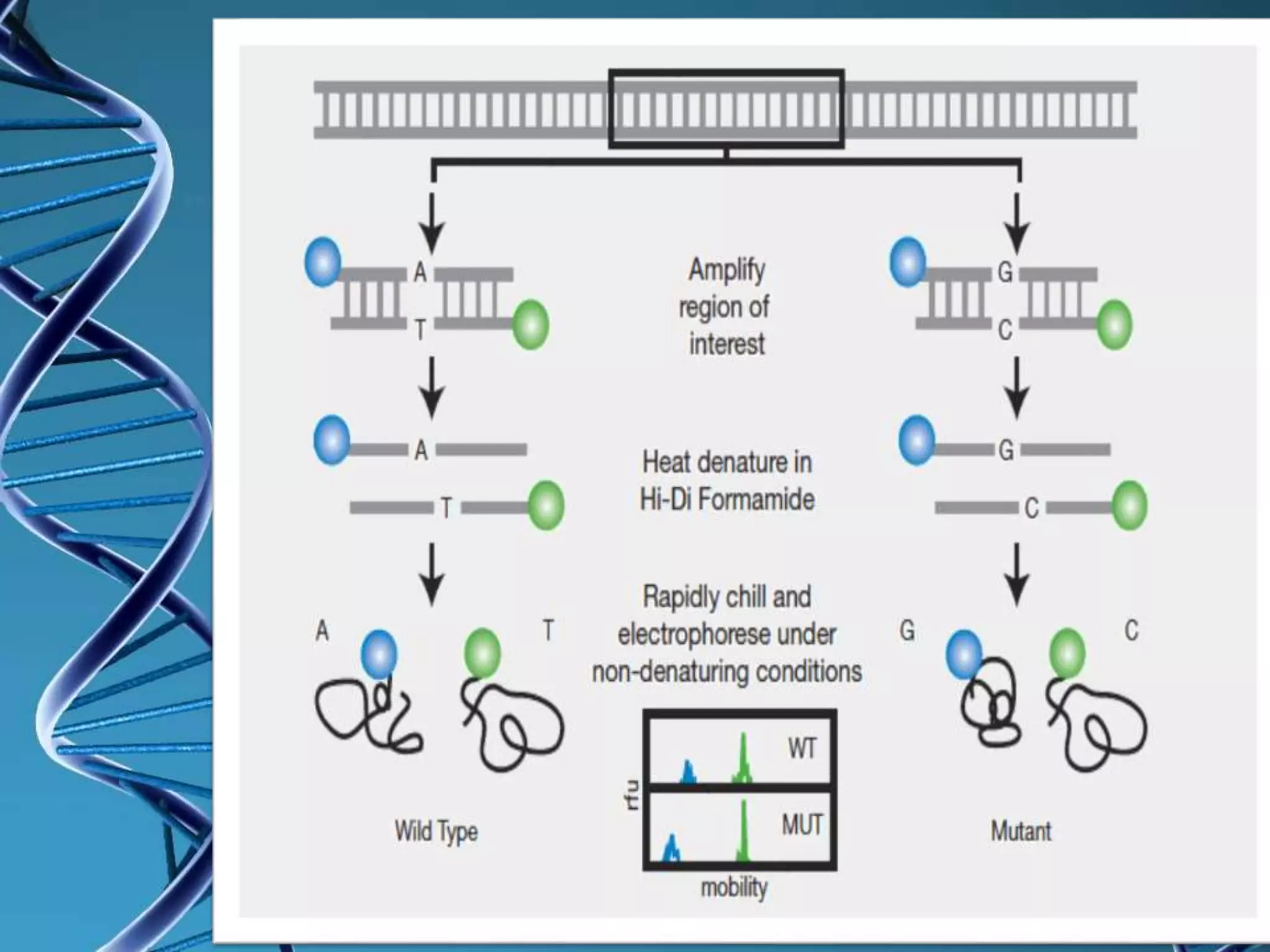
SSCP analysis detects sequence variations (single-point mutations
and other small-scale changes) through electrophoretic mobility
differences. DNA that contains a sequence mutation (even a single
base pair change) has a measurable mobility difference compared
to wild type DNA when subjected
LIMITATION
Single-stranded DNA mobilities are dependent on
temperature. For best results, gel electrophoresis must be
run in a constant temperature.
Sensitivity of SSCP is affected by pH. Double-stranded
DNA fragments are usually denatured by exposure to basic
conditions: a high pH.
Kukita et al. found that adding glycerol to the polyacrylamide
gel lowers the pH of the electrophoresis buffer--more
specifically, the Tris-borate buffer--and the result is
increased SSCP sensitivity and clearer data (1997).
Fragment length also affects SSCP analysis. For
optimal results, DNA fragment size should fall within the
range of 150 to 300 bp, although SSCP analysis of RNA
allows for a larger fragment size (Wagner, 2000).
Under optimal conditions, approximately 80 to 90% of
the potential base exchanges are detectable by SSCP
(Wagner, 2002).
S.
No.
BOOKS AUTHOR
1. Introduction to plant
biotechnology
H.S.Chawala
2. Biotechnology
expanding horizons
B.D.Singh
3. Cell and molecular
biology
P.K.Gupta
4. By internet
References

Molecular markr sscp

  • 1.
    SINGLE STRAND CONFORMATIONAL POLYMORPHISM(SCP) By KAUSHAL KUMAR SAHU Assistant Professor (Ad Hoc) Department of Biotechnology Govt. Digvijay Autonomous P. G. College Raj-Nandgaon ( C. G. )
  • 2.
  • 3.
    INTRODUCTION Single strand conformationpolymorphism (SSCP) or single strand chain polymorphism, is defined as conformational difference of single stranded nucleotide sequence of identical length as induced by difference in the sequence under experimental condition. This property allow to distinguish the sequence by means of gel electrophoresis, with separate the different conformation.
  • 4.
    Like restriction fragmentlength polymorphisms (RFLPs), SSCPs are allelic variants of inherited, genetic traits that can be used as genetic markers. Unlike RFLP analysis, however, SSCP analysis can detect DNA polymorphisms and mutations at multiple places in DNA fragments (Orita et al., 1989). As a mutation scanning technique, though, SSCP is more often used to analyze the polymorphisms at single loci, especially when used for medical diagnoses (Sunnucks et al., 2000).
  • 5.
    DEFINITION • “SSCP isthe electrophoretic separation of single- stranded nucleic acids based on subtle differences in sequence (often a single base pair) which results in a different secondary structure and a measurable difference in mobility through a gel.”
  • 6.
    PRINCIPLE The mobility ofdouble-stranded DNA in gel electrophoresis is dependent on strand size and length but is relatively independent of the particular nucleotide sequence. The mobility of single strands, however, is noticeably affected by very small changes in sequence, possibly one changed nucleotide out of several hundred. Small changes are noticeable because of the relatively unstable nature of single-stranded DNA; in the absence of a complementary strand, the single strand may experience intrastrand base pairing, resulting in loops and folds that give the single strand a unique 3D structure, regardless of its length.
  • 7.
    A single nucleotidechange could dramatically affect the strand's mobility through a gel by altering the intrastrand base pairing and its resulting 3D conformation (Melcher, 2000). Single-strand conformation polymorphism analysis takes advantage of this quality of single-stranded DNA. First announced in 1989 as a new means of detecting DNA polymorphisms, or sequence variations, SSCP analysis offers an inexpensive, convenient, and sensitive method for determining genetic variation (Sunnucks et al., 2000).
  • 8.
    PROCEDURE The procedure usedduring the development of SSCP was as follows: digestion of genomic DNA with restriction endonucleases. Denaturation in an alkaline (basic) solution. electrophoresis on a neutral polyacrylamide gel. transfer to a nylon membrane. hybridization with either DNA fragments or more clearly with RNA copies synthesized on each strands as probes.
  • 9.
    The three equal-lengthdouble-stranded DNA fragments are shown with the corresponding single-stranded structures, the red fragment folding into the smallest molecule and the green the largest (Panel A). The desired polymorphism is selected with PCR primers; primer A is in excess to amplify only a single strand (Panel B). Both the double-stranded and single- stranded fragments are run through gel electrophoresis (Panel C). If not for the color labels, there would be no distinction between the double-stranded fragments.
  • 10.
    The single-stranded fragments,however, show considerable variation in mobility; the small red molecule migrates more quickly through the gel than either the blue or the large green molecule. Using this SSCP result, it becomes clear that the different lanes (red, blue, or green) contain strands with different sequences; the more far apart the bands, the less similar the nucleotide sequences.
  • 12.
    APPLICATION SSCP used tobe a way to discover new DNA polymorphisms apart from DNA sequencing, but is now being supplanted by sequencing techniques on account of efficiency and accuracy. These days, SSCP is most applicable as a diagnostic tool in molecular biology. It can be used in genotyping to detect homozygous individuals of different allelic states, as well as heterozygous individuals that should each demonstrate distinct patterns in an electrophoresis experiment
  • 13.
    • SSCP is alsowidely used in virology to detect variations in different strains of a virus. Single-stranded conformation polymorphism (SSCP) analysis is a widely used screening method that allows you to identify different genomic variants in a large number of samples and in a broad range of organisms, from microorganisms to humans. SSCP analysis detects sequence variations (single-point mutations and other small-scale changes) through electrophoretic mobility differences. DNA that contains a sequence mutation (even a single base pair change) has a measurable mobility difference compared to wild type DNA when subjected
  • 15.
    LIMITATION Single-stranded DNA mobilitiesare dependent on temperature. For best results, gel electrophoresis must be run in a constant temperature. Sensitivity of SSCP is affected by pH. Double-stranded DNA fragments are usually denatured by exposure to basic conditions: a high pH. Kukita et al. found that adding glycerol to the polyacrylamide gel lowers the pH of the electrophoresis buffer--more specifically, the Tris-borate buffer--and the result is increased SSCP sensitivity and clearer data (1997).
  • 16.
    Fragment length alsoaffects SSCP analysis. For optimal results, DNA fragment size should fall within the range of 150 to 300 bp, although SSCP analysis of RNA allows for a larger fragment size (Wagner, 2000). Under optimal conditions, approximately 80 to 90% of the potential base exchanges are detectable by SSCP (Wagner, 2002).
  • 17.
    S. No. BOOKS AUTHOR 1. Introductionto plant biotechnology H.S.Chawala 2. Biotechnology expanding horizons B.D.Singh 3. Cell and molecular biology P.K.Gupta 4. By internet References