Single Nucleotide Polymorphism
Authors
FAZEEHA AMJAD
 AYESHA BUTT
AYESHA SADIQA
AROOJ SAEED
Department of Biotechnology
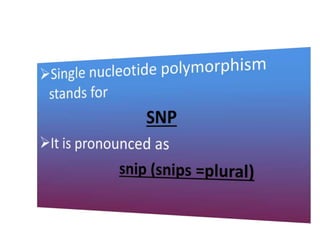
SINGLE NUCLEOTIDE POLYMORPHISM
• The variations in
DNA sequence that
occurs when single
nucleotide ( A, T G,
C) in the genome
sequence is altered,
is called single
nucleotide
polymorphism.
Frequency of SNPs
• ~ 1.5 million sites in the human genome
where SNPs could occur.
• ~ 3.8 million SNPs are catalogued in 270
individuals.
• ( ~ 1 SNP/ 1000 bases)
• ~ each person has ~3.5 million common SNPs
(inherited) and ~30 new mutations have
arisen (mutation rate of 10-8 /base/
generation)
Factors
Difference b/w mutation & SNP
SNP
persistence in a
population
Frequency more
than 1%
Mutation
Occurrence in
an individual
Frequency less
than 1%
SNP
Coding Region
Affect protein Structure
Synonymous
Same polypeptide
sequence produced
Non-synonymous
Different polypeptide
sequence produced
Non Coding Region
Don’t effect protein
structure
But act as promoter or
enhancer
Non-Sense
Premature stop codon
Missense
Leads to amino acid
sequence
Types
Of
SNP
Uses In Biotechnology
1) Genome mapping
2) Genome wide association studies of complex
diseases
3) specific genetic traits
4) classifying patients in clinical trials
5) genetic markers for other traits
6) pharmacogenomics
Applications
SNP discovery in crop species e,g
• corn
• soyabean
SNP in industrial yeast
In human genome project
Importance
• variation in population.
• Newer characteristic.
• In therapeutic purposes.
• In genealogical analysis of DNA
disadvantages
The non coding SNPs cause many
diseases in living organisms e.g
• Cancer
• Osteoporosis
• Rheumatoid arthritis
Analytic Techniques
•Reverse Dot Blots
•DNA Sequencing
•HPLC Genotyping
•TaqMan Assay
•Fluorescence Polarization (FP)
•Mass Spec
•Microchips
•Pyrosequencing
•Allele Specific Hybridization
•SNaPshot
DNA Sequencing
• Requirements
 template DNA
 free nucleotides (deoxy &
dideoxy)
Enzyme
primer
initiation
Formation of
complementary
strand &
termination
Gel Electropherosis
Microchip
• Two probes are introduces in
solution;ASO and LSO.
• LSO binds to 3’ and ASO to 5’
direction of SNP to hybridize;
1. LSO(locus specific nucleotide)-stops
before SNP
2. ASO(Allele specific nucleotide)-
contain base complimentary to SNP.
• Positive result: Last base of ASO
similar to SNP base-ligase binds LSO
and ASO.
• Negative result: Last base of ASO
dissimilar to SNP base-ligase doesn’t
bind two probes.
• Positive result detect the presence of
SNP.
• Amplify to study the region
Oligonucleotide ligation reaction
HPLC
• HPLC stands for High Performance Liquid
Chromatography
• HPLC is characterized by the use of high
pressure to push a
• mobile phase solution through a column of
stationary phase
• allowing separation of complex mixtures with
high resolution.
Separations
19
Separation in based upon differential
migration between the stationary and
mobile phases.
Stationary Phase - the phase which
remains fixed in the column, e.g. C18,
Silica
Mobile Phase - carries the sample
through the stationary phase as it
moves through the column.
Injector
Detector
Column
Solvents
Mixer
Pumps
High Performance Liquid Chromatograph
Waste
Separations
20
Injector
Detector
Column
Solvents
Mixer
Pumps
Chromatogram
Start Injection
mAU
time
High Performance Liquid Chromatograph
Separations
21
Injector
Detector
Column
Solvents
Mixer
Pumps
Chromatogram
Start Injection
mAU
time
Separations
22
Injector
Detector
Column
Solvents
Pumps
Mixer
Chromatogram
Start Injection
mAU
time
Separations
23
Injector
Detector
Column
Solvents
Pumps
Mixer
Chromatogram
Start Injection
mAU
time
Separations
24
Injector
Detector
Column
Solvents
Pumps
Mixer
Chromatogram
Start Injection
mAU
time
Separations
25
Injector
Detector
Column
Solvents
Pumps
Mixer
Chromatogram
Start Injection
mAU
time
Separations
26
Injector
Detector
Column
Solvents
Pumps
Mixer
Chromatogram
Start Injection
mAU
time
Separations
27
Injector
Detector
Column
Solvents
Pumps
Mixer
Chromatogram
Start Injection
mAU
time
Separations
28
Injector
Detector
Column
Solvents
Pumps
Mixer
Chromatogram
Start Injection
mAU
time
Separations
29
Injector
Detector
Column
Solvents
Pumps
Mixer
Chromatogram
Start Injection
mAU
time
Separations
30
Injector
Detector
Column
Solvents
Pumps
Mixer
Chromatogram
Start Injection
mAU
time
Separations
31
Injector
Detector
Column
Solvents
Pumps
Mixer
Chromatogram
Start Injection
mAU
time
Separations
32
Injector
Detector
Column
Solvents
Pumps
Mixer
Chromatogram
Start Injection
mAU
time
Separations
33
Injector
Detector
Column
Solvents
Pumps
Mixer
Chromatogram
Start Injection
mAU
time
Separations
34
Injector
Detector
Column
Solvents
Pumps
Mixer
Chromatogram
Start Injection
mAU
time
Separations
35
Injector
Detector
Column
Solvents
Pumps
Mixer
Chromatogram
Start Injection
mAU
time
Refferences
• http://biochem218.stanford.edu/16SNPs.pdf
• http://www.sciencedirect.com/science/article
• http://www.researchgate.net/post/What_is_the_diff
erence_between_a_SNP_and_a_mutation
Single Nucleotide Polymorphism

Single Nucleotide Polymorphism