PRESENTED BY
KOUSHIK DEB
ID NO-48101
What is Docking?
ultantructuralchangeught about by the interaction
 Prediction of the optimal physical configuration and
energy between two molecules
 The docking problem optimizes:
 Binding between two molecules such that their
orientation maximizes the interaction
 Evaluates the total energy of interaction such that for
the best binding configuration the binding energy is
the minimum
 The resultant structural changes brought about by the
interaction
1. Protein-Protein Docking:
 Both molecules are rigid
 Interaction produces no change in conformation
 Similar to lock-and key model
2. Protein-Ligand Docking:
 Ligand is flexible but the receptor protein is rigid
 Interaction produces conformational changes in
ligand
Categories of docking
The AutoDock Software
 Developed by AJ Olson’s group in 1990.
 AutoDock uses free energy of the docking molecules using 3D
potential-grids
 Uses heuristic search to minimize the energy.
 Search Algorithms used:
 Simulated Annealing
 Genetic Algorithm
 Lamarckian GA (GA+LS hybrid)
Docking Preparation – Protein
Add essential hydrogens
Load charges
Merge lone-pairs
Add solvation parameters
Write .pdbqs protein file
Docking Preparation – Ligand
Assign charges
Define rotatable bonds
Rename aromatic carbons
Merge non-polar hydrogens
Write .pdbq ligand file
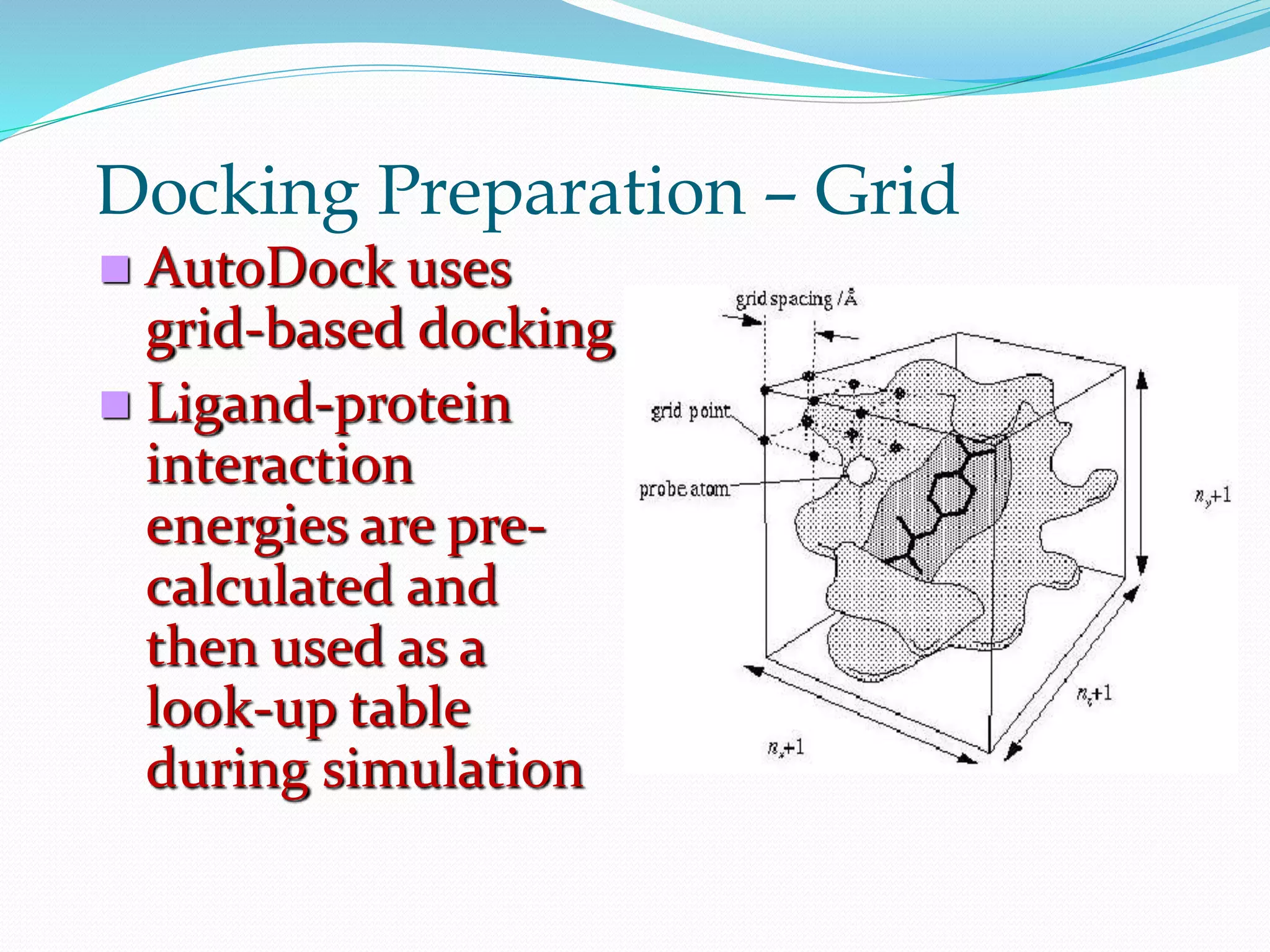
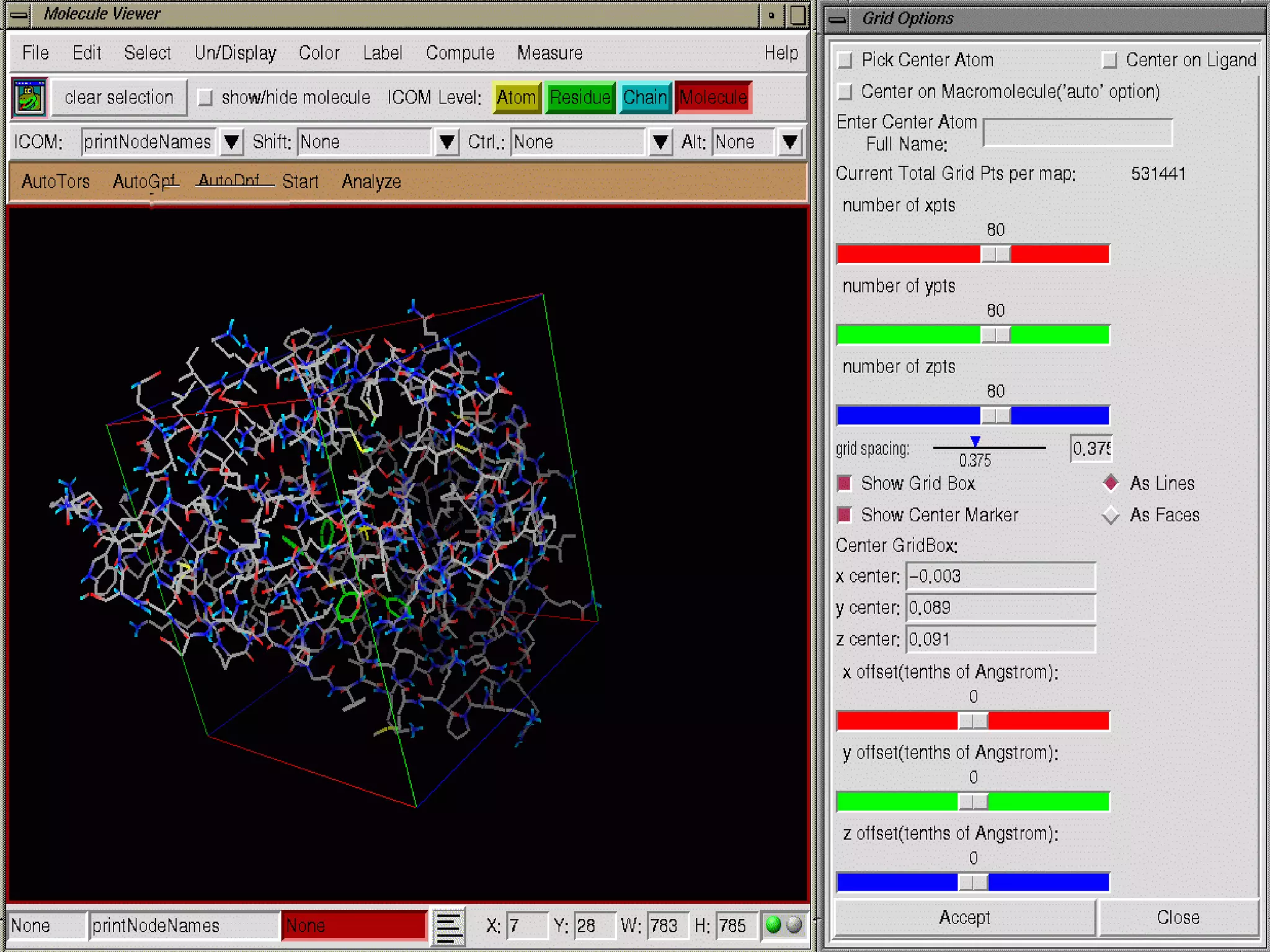
Docking Preparation – Grid
 AutoDock uses
grid-based docking
 Ligand-protein
interaction
energies are pre-
calculated and
then used as a
look-up table
during simulation
Other Docking programs
GOLD
Hammerhead
FLOG
FlexX
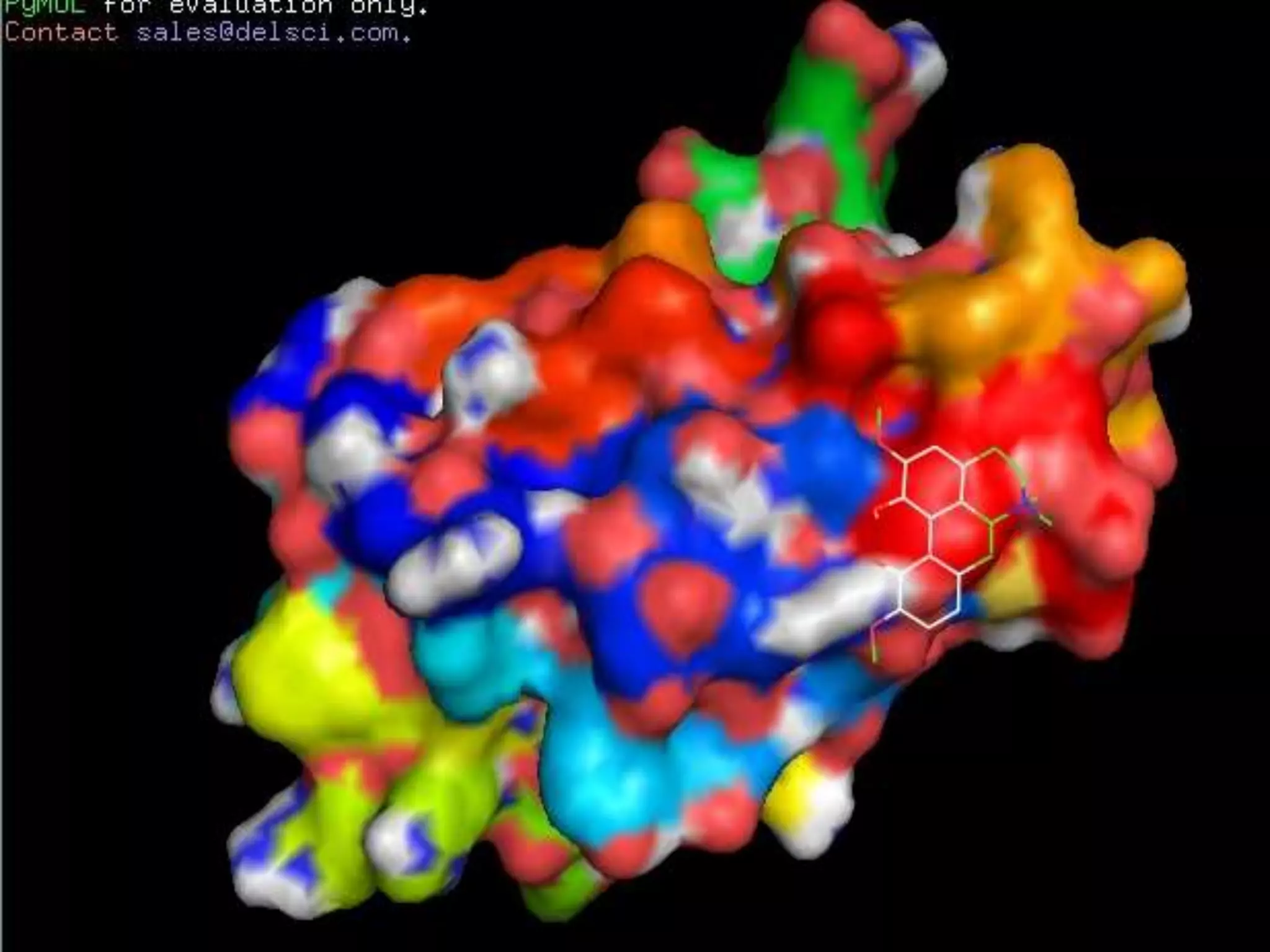
PROTIEN MOLECULE 1
Interleukin 10:-
Interleukin-10 (IL-10), also known as human cytokine
synthesis inhibitory factor (CSIF), is an anti-
inflammatorycytokine. In humans, IL-10 is encoded by
the IL10 gene.
IL-10 is a cytokine with multiple, pleiotropic, effects in
immunoregulation and inflammation. It
downregulates the expression of Th1 cytokines, MHC
class II antigens, and co-stimulatory molecules
on macrophages. It also enhances B cell survival,
proliferation, and antibody production.
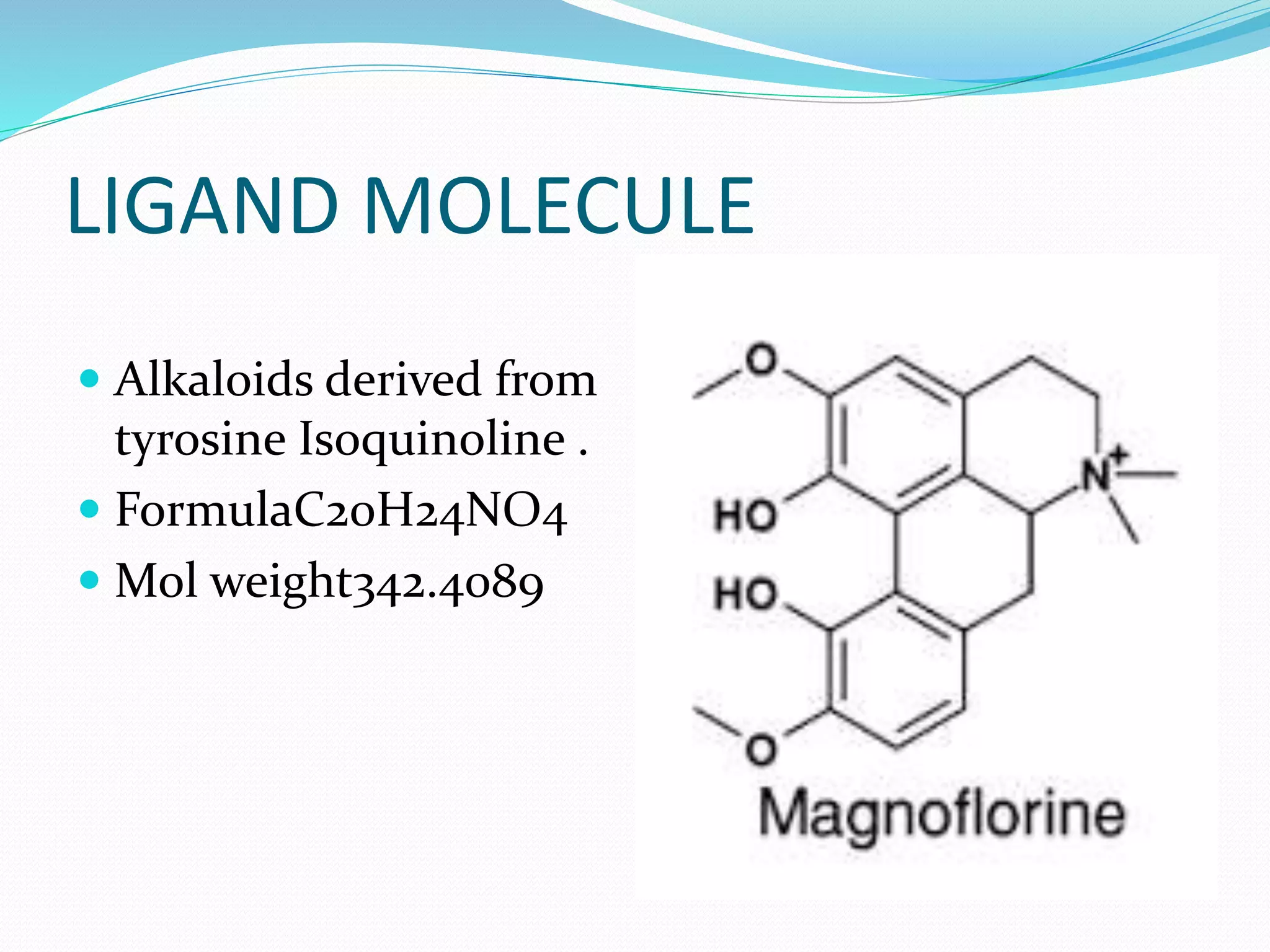
LIGAND MOLECULE
 Alkaloids derived from
tyrosine Isoquinoline .
 FormulaC20H24NO4
 Mol weight342.4089
ligand_out.pdbqt
Mode | affinity | dist from best mode
| (kcal/mol) | rmsd l.b.| rmsd u.b.
-----+------------+----------+----------
1 -7.0 0.000 0.000
2 -6.3 1.314 4.880
3 -6.2 31.170 33.266
4 -5.8 30.753 33.034
5 -5.7 45.037 47.694
6 -5.7 32.338 34.496
7 -5.6 39.335 42.475
8 -5.6 32.123 34.415
9 -5.5 38.760 41.802
Writing output ... done.
Protein molecule 2
Nuclear factor NF kappa bita is a
protein that control transcription
of DNA
mode| affinity | dist from best mode
|(kcal/mol)| rmsd l.b.| rmsd u.b.
-----+------------+----------+----------
1 -5.7 0.000 0.000
2 -5.4 7.456 10.004
3 -5.3 19.915 20.850
4 -5.1 6.875 9.619
5 -4.8 8.921 12.263
6 -4.8 7.974 10.961
7 -4.7 21.984 23.127
8 -4.7 9.137 12.067
9 -4.6 20.064 21.222
Which docking results should I consider as
likely to bind well to my target?
When the results are sorted by lowest energy found for
each compound, the compounds that bind as well as
your positive control or better can be considered as
potential hits. Remember to allow for the roughly 2.5
Kcal/mol standard error in the AutoDock scoring
function. If you do not have a positive control, consider
the compounds with the lowest energies as potential
hits.
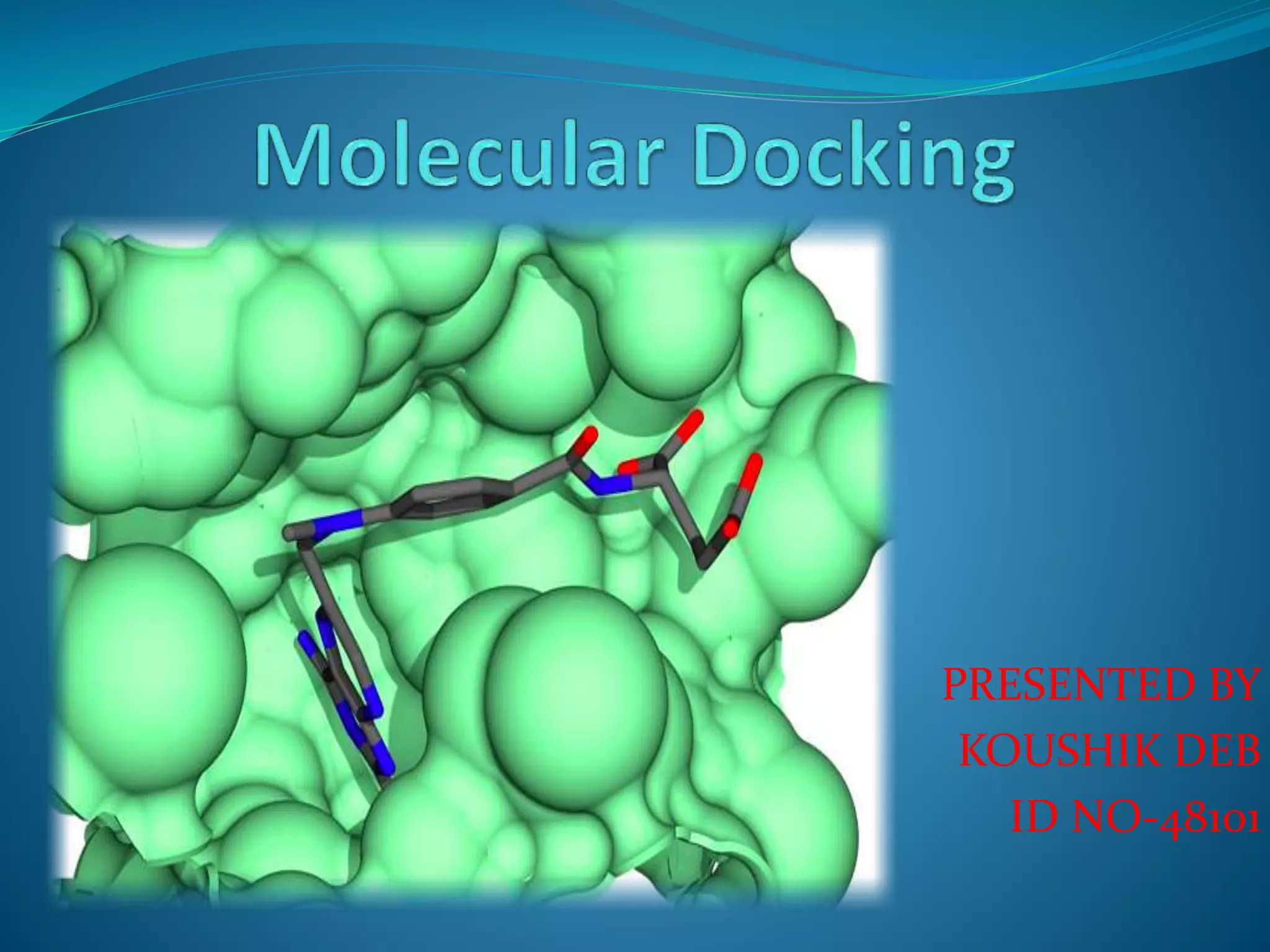
molecular docking

molecular docking

  • 1.
  • 2.
    What is Docking? ultantructuralchangeughtabout by the interaction  Prediction of the optimal physical configuration and energy between two molecules  The docking problem optimizes:  Binding between two molecules such that their orientation maximizes the interaction  Evaluates the total energy of interaction such that for the best binding configuration the binding energy is the minimum  The resultant structural changes brought about by the interaction
  • 3.
    1. Protein-Protein Docking: Both molecules are rigid  Interaction produces no change in conformation  Similar to lock-and key model 2. Protein-Ligand Docking:  Ligand is flexible but the receptor protein is rigid  Interaction produces conformational changes in ligand Categories of docking
  • 4.
    The AutoDock Software Developed by AJ Olson’s group in 1990.  AutoDock uses free energy of the docking molecules using 3D potential-grids  Uses heuristic search to minimize the energy.  Search Algorithms used:  Simulated Annealing  Genetic Algorithm  Lamarckian GA (GA+LS hybrid)
  • 5.
    Docking Preparation –Protein Add essential hydrogens Load charges Merge lone-pairs Add solvation parameters Write .pdbqs protein file
  • 6.
    Docking Preparation –Ligand Assign charges Define rotatable bonds Rename aromatic carbons Merge non-polar hydrogens Write .pdbq ligand file
  • 7.
    Docking Preparation –Grid  AutoDock uses grid-based docking  Ligand-protein interaction energies are pre- calculated and then used as a look-up table during simulation
  • 9.
  • 10.
    PROTIEN MOLECULE 1 Interleukin10:- Interleukin-10 (IL-10), also known as human cytokine synthesis inhibitory factor (CSIF), is an anti- inflammatorycytokine. In humans, IL-10 is encoded by the IL10 gene. IL-10 is a cytokine with multiple, pleiotropic, effects in immunoregulation and inflammation. It downregulates the expression of Th1 cytokines, MHC class II antigens, and co-stimulatory molecules on macrophages. It also enhances B cell survival, proliferation, and antibody production.
  • 11.
    LIGAND MOLECULE  Alkaloidsderived from tyrosine Isoquinoline .  FormulaC20H24NO4  Mol weight342.4089
  • 12.
    ligand_out.pdbqt Mode | affinity| dist from best mode | (kcal/mol) | rmsd l.b.| rmsd u.b. -----+------------+----------+---------- 1 -7.0 0.000 0.000 2 -6.3 1.314 4.880 3 -6.2 31.170 33.266 4 -5.8 30.753 33.034 5 -5.7 45.037 47.694 6 -5.7 32.338 34.496 7 -5.6 39.335 42.475 8 -5.6 32.123 34.415 9 -5.5 38.760 41.802 Writing output ... done.
  • 14.
    Protein molecule 2 Nuclearfactor NF kappa bita is a protein that control transcription of DNA
  • 15.
    mode| affinity |dist from best mode |(kcal/mol)| rmsd l.b.| rmsd u.b. -----+------------+----------+---------- 1 -5.7 0.000 0.000 2 -5.4 7.456 10.004 3 -5.3 19.915 20.850 4 -5.1 6.875 9.619 5 -4.8 8.921 12.263 6 -4.8 7.974 10.961 7 -4.7 21.984 23.127 8 -4.7 9.137 12.067 9 -4.6 20.064 21.222
  • 17.
    Which docking resultsshould I consider as likely to bind well to my target? When the results are sorted by lowest energy found for each compound, the compounds that bind as well as your positive control or better can be considered as potential hits. Remember to allow for the roughly 2.5 Kcal/mol standard error in the AutoDock scoring function. If you do not have a positive control, consider the compounds with the lowest energies as potential hits.