M.Sc. in Biotechnology/Microbiology
Paper: RDT & Genomics
Topic: Identification of the translational product
By
Dr. Vijay Kumar
Assistant Professor
Department of Biosciences,
Swami Rama Himalayan University
Learning objectives
At the end of this learning session a student of M.Sc.
Microbiology/Biotechnology –Semester-II should be
able to:
 Learn about major methods used to identify
translational products
 HRT method
 HART method
Identifying and studying the translation
product of a cloned gene
 Two techniques are used to identify the translation
product encoded by gene:
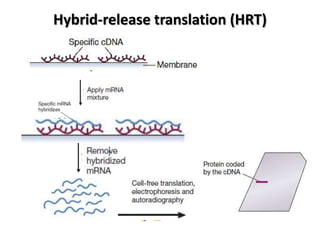
• Hybrid-release translation (HRT)
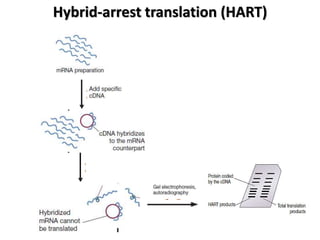
• hybrid-arrest translation(HART)
 Both depend on the ability of purified mRNA to direct
synthesis of proteins in cell-free translation systems.
 These are cell extracts, usually prepared from germinating
wheat seeds or from rabbit reticulocyte cells (both of
which are exceptionally active in protein synthesis) and
containing ribosomes, tRNAs, and all the other molecules
needed for protein synthesis.
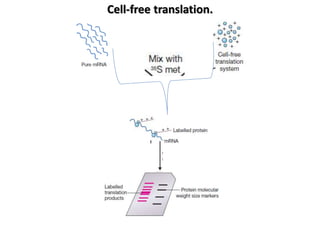
Cell-free translation.
The mRNA sample is added to the cell-free
translation system, along with a mixture of the 20
amino acids found in proteins, one of which is
labeled (often35S-methionine is used
The mRNA molecules are translated into a
mixture of radioactive proteins, which can be
separated by gel electrophoresis and visualized
by autoradiography.
Each band represents a single protein coded by
one of the mRNA molecules present in the
sample.
Hybrid-release translation (HRT)
Hybrid-arrest translation (HART)
Suggested readings
• Brown, T. A. (1990). Gene cloning (pp. 2-6).
Chapman and Hall.
• Old, R. W., & Primrose, S. B. (1981). Principles
of gene manipulation: an introduction to
genetic engineering (Vol. 2). Univ of California
Press.

Identifying and studying the translational product

  • 1.
    M.Sc. in Biotechnology/Microbiology Paper:RDT & Genomics Topic: Identification of the translational product By Dr. Vijay Kumar Assistant Professor Department of Biosciences, Swami Rama Himalayan University
  • 2.
    Learning objectives At theend of this learning session a student of M.Sc. Microbiology/Biotechnology –Semester-II should be able to:  Learn about major methods used to identify translational products  HRT method  HART method
  • 3.
    Identifying and studyingthe translation product of a cloned gene  Two techniques are used to identify the translation product encoded by gene: • Hybrid-release translation (HRT) • hybrid-arrest translation(HART)  Both depend on the ability of purified mRNA to direct synthesis of proteins in cell-free translation systems.  These are cell extracts, usually prepared from germinating wheat seeds or from rabbit reticulocyte cells (both of which are exceptionally active in protein synthesis) and containing ribosomes, tRNAs, and all the other molecules needed for protein synthesis.
  • 4.
  • 5.
    The mRNA sampleis added to the cell-free translation system, along with a mixture of the 20 amino acids found in proteins, one of which is labeled (often35S-methionine is used The mRNA molecules are translated into a mixture of radioactive proteins, which can be separated by gel electrophoresis and visualized by autoradiography. Each band represents a single protein coded by one of the mRNA molecules present in the sample.
  • 6.
  • 7.
  • 8.
    Suggested readings • Brown,T. A. (1990). Gene cloning (pp. 2-6). Chapman and Hall. • Old, R. W., & Primrose, S. B. (1981). Principles of gene manipulation: an introduction to genetic engineering (Vol. 2). Univ of California Press.