Optimizing In Situ Remediation
                   Using Advanced Diagnostics
                                Presented by: Matt Burns

Contact Information:

       WSP Environment & Energy
       300 Trade Center, Suite 4690
       Woburn, MA, 01801
       781/933-7340
       matt.burns@wspgroup.com
       http://www.linkedin.com/in/mattburns
       wsp


Introduction

In situ remediation has been widely applied
to address groundwater contamination over
the past 10 years. Unfortunately, the barrier
to applying the technology is low and poorly
conceived and planned applications are
affecting the credibility of the technology.

                        Successful selection and application of in situ technologies begins with
                        a conceptual model that is not biased by preconceived or irrelevant
                        factors and is tested analytically. The limitations of potential remedies
                        should be given as much consideration as their potential benefits,
                        keeping in mind the concepts of integrated site remediation that bundle
                        complementary technologies for sequential application.


Analytical Assessment Tools

Analytical testing of proposed in situ remedies is complicated
by two key facts:
    x The mechanisms of degradation are unseen and not
        well understood.
    x The physical effects of amendment application (e.g.,
        dilution and displacement) can affect concentration
        data in a manner similar to the desired reactive
        mechanism.
Until recently, analytical testing protocols to better understand in
situ degradation processes have been limited by cost, timeliness,
and data tangential what is really necessary:
    x Will the proposed amendment application destroy the
        contaminant or just push around and dilute it?
    x What is the mechanism of destruction and can it be
        monitored directly?

New cost-effective analytical tools are now commercially available to answer these questions.
Compound specific isotope analysis (CSIA) provides definitive information on contaminant
destruction that is not concentration related and molecular biological tools (MBTs) identify
microbial-mediated mechanisms of destruction. Proper use of these tools during remedy
selection and performance monitoring results in better application of technologies such as
monitored natural attenuation, bioremediation and in situ chemical oxidation and reduction.
These tools also have applications for environmental forensics that, for example, can segregate
comingled groundwater plumes or identify vapor intrusion sources as originating from above or
below the slab.

Compound Specific Isotope Analysis

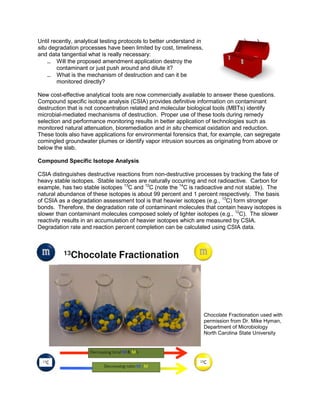
CSIA distinguishes destructive reactions from non-destructive processes by tracking the fate of
heavy stable isotopes. Stable isotopes are naturally occurring and not radioactive. Carbon for
example, has two stable isotopes 13C and 12C (note the 14C is radioactive and not stable). The
natural abundance of these isotopes is about 99 percent and 1 percent respectively. The basis
of CSIA as a degradation assessment tool is that heavier isotopes (e.g., 13C) form stronger
bonds. Therefore, the degradation rate of contaminant molecules that contain heavy isotopes is
slower than contaminant molecules composed solely of lighter isotopes (e.g., 12C). The slower
reactivity results in an accumulation of heavier isotopes which are measured by CSIA.
Degradation rate and reaction percent completion can be calculated using CSIA data.


                                                                       Chocolate Fractionation used with
                                                                       permission from Dr. Mike Hyman,
                                                                       Department of Microbiology
                                                                       North Carolina State University
CSIA measures the ratio of heavy isotopes to light isotopes. The analytically derived ratio is
normalized to an international standard and reported in units as part per thousand (per mil or
‰), expressed as the difference (del or δ) from the standard.


Key concepts of CSIA data
interpretation include:
    x parent compound fractionation is
        unequivocal proof of degradation
    x daughter product fractionation
        alone does not prove daughter
        product degradation
    x the non-degrading daughter
        product can get no heavier than
        the initial signature of the parent
    x daughter product isotopic
        signature greater than the initial
        signature of the parent
        compound indicates daughter
        product degradation


Molecular Biological Tools

MBTs quantify microbial populations and their activity by assessing unique nucleic acid based
or lipid based biomarkers. Many analytical techniques that quantify these biomarkers are
available with quantitative polymerase chain reaction (qPCR) and phospholipid fatty acid (PLFA)
being the most commonly used for environmental applications. MBTs can be used to answer
site specific questions to assess naturally occurring conditions directly or experimentally by
manipulating local conditions with proposed remediation amendments before their use.

                                                       MBT samples can be collected discretely
                                                       from extracted and filtered groundwater or
                                                       a time-integrated sample can be collected
                                                       using a growth matrix such as a bio-trap®
                                                       sampler (manufactured by Microseeps of
                                                       Rockford, Tennessee). Both sampling
                                                       methods are capable of collecting microbes
                                                       for MBT evaluation of existing conditions.
                                                       Bio-trap samplers have the added utility of
                                                       being amendable to test proposed remedial
                                                       strategies and answer site-specific
                                                       questions. Electron acceptors (e.g., ORC),
                                                       electron donors (e.g., HRC), microbial
                                                       augments (e.g., SDC-9), contaminant
                                                       analogs (e.g., trichlorofluroethene), and
                                                       isotopically labeled contaminants can be
incorporated within the bio-trap® matrix. Comparing amended bio-trap® data to non-amended
(i.e., control) bio-trap® data provides information on the potential success of field-scale
application of remediation amendments.
Amending specifically manufactured contaminants that contain isotopically enriched carbon (i.e.,
13
  C at a very high abundance) is referred to as stable isotope probing (SIP). SIP can provide
the most definitive evidence of attenuation available. The SIP technique involves tracking the
fate of the carbon that comprise the contaminant into biomass and/or dissolved inorganic
carbon. SIP is only applicable where the contaminant is used as a source of cellular synthesis
or for energy derivation.

Conclusions

Advanced diagnostic tools optimize in situ
remediation by definitively identifying
contaminant destruction and the
microbial-mediated mechanism of
destruction. The tools are versatile and
with proper experimental construction can
answer site questions. Overall,
incorporation of advanced diagnostics
within the remedial selection and remedy
performance process leads to better
decisions and increased success rates of
in situ technologies.


Additional Resources

                   A Guide for Assessing
                   Biodegradation and Source
                   Identification of Organic Ground
                   Water Contaminants using
                   Compound Specific Isotope
                   Analysis (CSIA) (December
                   2008).


                    Burns, M. and Myers, C. (2010),
                    Evolution of predictive tools for
                    in situ bioremediation and
                    natural attenuation evaluations.
                    Remediation Journal, 20: 5–16.
                    doi: 10.1002/rem.20259


    at WSP we help our clients with everything
    from building skyscrapers to using
    microbes to clean up hazardous waste

Advanced Diagnostics Seminar Handout

  • 1.
    Optimizing In SituRemediation Using Advanced Diagnostics Presented by: Matt Burns Contact Information: WSP Environment & Energy 300 Trade Center, Suite 4690 Woburn, MA, 01801 781/933-7340 matt.burns@wspgroup.com http://www.linkedin.com/in/mattburns wsp Introduction In situ remediation has been widely applied to address groundwater contamination over the past 10 years. Unfortunately, the barrier to applying the technology is low and poorly conceived and planned applications are affecting the credibility of the technology. Successful selection and application of in situ technologies begins with a conceptual model that is not biased by preconceived or irrelevant factors and is tested analytically. The limitations of potential remedies should be given as much consideration as their potential benefits, keeping in mind the concepts of integrated site remediation that bundle complementary technologies for sequential application. Analytical Assessment Tools Analytical testing of proposed in situ remedies is complicated by two key facts: x The mechanisms of degradation are unseen and not well understood. x The physical effects of amendment application (e.g., dilution and displacement) can affect concentration data in a manner similar to the desired reactive mechanism.
  • 2.
    Until recently, analyticaltesting protocols to better understand in situ degradation processes have been limited by cost, timeliness, and data tangential what is really necessary: x Will the proposed amendment application destroy the contaminant or just push around and dilute it? x What is the mechanism of destruction and can it be monitored directly? New cost-effective analytical tools are now commercially available to answer these questions. Compound specific isotope analysis (CSIA) provides definitive information on contaminant destruction that is not concentration related and molecular biological tools (MBTs) identify microbial-mediated mechanisms of destruction. Proper use of these tools during remedy selection and performance monitoring results in better application of technologies such as monitored natural attenuation, bioremediation and in situ chemical oxidation and reduction. These tools also have applications for environmental forensics that, for example, can segregate comingled groundwater plumes or identify vapor intrusion sources as originating from above or below the slab. Compound Specific Isotope Analysis CSIA distinguishes destructive reactions from non-destructive processes by tracking the fate of heavy stable isotopes. Stable isotopes are naturally occurring and not radioactive. Carbon for example, has two stable isotopes 13C and 12C (note the 14C is radioactive and not stable). The natural abundance of these isotopes is about 99 percent and 1 percent respectively. The basis of CSIA as a degradation assessment tool is that heavier isotopes (e.g., 13C) form stronger bonds. Therefore, the degradation rate of contaminant molecules that contain heavy isotopes is slower than contaminant molecules composed solely of lighter isotopes (e.g., 12C). The slower reactivity results in an accumulation of heavier isotopes which are measured by CSIA. Degradation rate and reaction percent completion can be calculated using CSIA data. Chocolate Fractionation used with permission from Dr. Mike Hyman, Department of Microbiology North Carolina State University
  • 3.
    CSIA measures theratio of heavy isotopes to light isotopes. The analytically derived ratio is normalized to an international standard and reported in units as part per thousand (per mil or ‰), expressed as the difference (del or δ) from the standard. Key concepts of CSIA data interpretation include: x parent compound fractionation is unequivocal proof of degradation x daughter product fractionation alone does not prove daughter product degradation x the non-degrading daughter product can get no heavier than the initial signature of the parent x daughter product isotopic signature greater than the initial signature of the parent compound indicates daughter product degradation Molecular Biological Tools MBTs quantify microbial populations and their activity by assessing unique nucleic acid based or lipid based biomarkers. Many analytical techniques that quantify these biomarkers are available with quantitative polymerase chain reaction (qPCR) and phospholipid fatty acid (PLFA) being the most commonly used for environmental applications. MBTs can be used to answer site specific questions to assess naturally occurring conditions directly or experimentally by manipulating local conditions with proposed remediation amendments before their use. MBT samples can be collected discretely from extracted and filtered groundwater or a time-integrated sample can be collected using a growth matrix such as a bio-trap® sampler (manufactured by Microseeps of Rockford, Tennessee). Both sampling methods are capable of collecting microbes for MBT evaluation of existing conditions. Bio-trap samplers have the added utility of being amendable to test proposed remedial strategies and answer site-specific questions. Electron acceptors (e.g., ORC), electron donors (e.g., HRC), microbial augments (e.g., SDC-9), contaminant analogs (e.g., trichlorofluroethene), and isotopically labeled contaminants can be incorporated within the bio-trap® matrix. Comparing amended bio-trap® data to non-amended (i.e., control) bio-trap® data provides information on the potential success of field-scale application of remediation amendments.
  • 4.
    Amending specifically manufacturedcontaminants that contain isotopically enriched carbon (i.e., 13 C at a very high abundance) is referred to as stable isotope probing (SIP). SIP can provide the most definitive evidence of attenuation available. The SIP technique involves tracking the fate of the carbon that comprise the contaminant into biomass and/or dissolved inorganic carbon. SIP is only applicable where the contaminant is used as a source of cellular synthesis or for energy derivation. Conclusions Advanced diagnostic tools optimize in situ remediation by definitively identifying contaminant destruction and the microbial-mediated mechanism of destruction. The tools are versatile and with proper experimental construction can answer site questions. Overall, incorporation of advanced diagnostics within the remedial selection and remedy performance process leads to better decisions and increased success rates of in situ technologies. Additional Resources A Guide for Assessing Biodegradation and Source Identification of Organic Ground Water Contaminants using Compound Specific Isotope Analysis (CSIA) (December 2008). Burns, M. and Myers, C. (2010), Evolution of predictive tools for in situ bioremediation and natural attenuation evaluations. Remediation Journal, 20: 5–16. doi: 10.1002/rem.20259 at WSP we help our clients with everything from building skyscrapers to using microbes to clean up hazardous waste