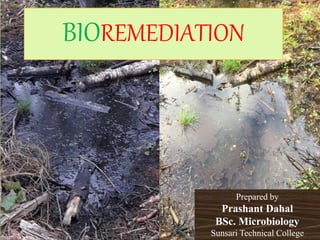
BIOREMEDIATION
Prepared by
Prashant Dahal
BSc. Microbiology
Sunsari Technical College
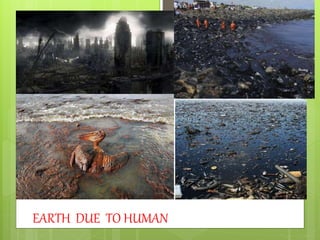
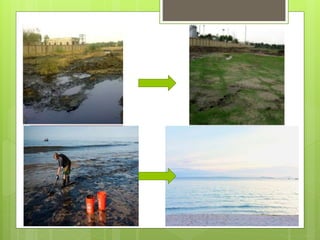
EARTH WITHOUT HUMAN
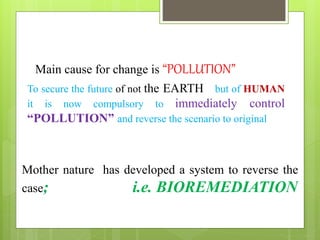
EARTH DUE TO HUMAN
Main cause for change is “POLLUTION”
To secure the future of not the EARTH but of HUMAN
it is now compulsory to immediately control
“POLLUTION” and reverse the scenario to original
Mother nature has developed a system to reverse the
case; i.e. BIOREMEDIATION
INTRODUCTION
BIOREMEDIATION
Grk. Bios = living Lt. Remedialis = Curing / healing
Simply, use of living organisms (microbes & plants)
to consume and break down env. pollutants, &
restoring or cleaning polluted sites
Biological catalysts acts on pollutants, thereby eliminating
contaminants present in environments
Principle
Based on principle of biodegradation. The process
utilize microbes (or plants) for pollutant degradation
inoculated via natural attenuation, bioaugmentation or
biostimualtion. The wates are degraded by
biodeterioration and biodegradation method.
 At favourable condition, microbes consume the
contaminants and convert them into harmless organic or
inorganic byproducts.
Broad category
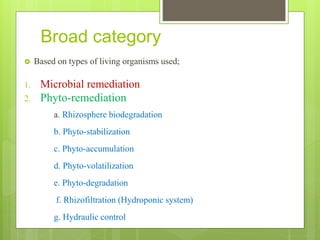
 Based on types of living organisms used;
1. Microbial remediation
2. Phyto-remediation
a. Rhizosphere biodegradation
b. Phyto-stabilization
c. Phyto-accumulation
d. Phyto-volatilization
e. Phyto-degradation
f. Rhizofiltration (Hydroponic system)
g. Hydraulic control
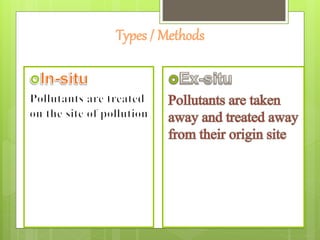
Types / Methods
Types:
1. Intrinsic in-situ
(naturally occuring
microbes are used)
2. Engineered
(accelerated) in-situ
(bio-engineered
microbes are introduced
and growth of microbes
are encouraged by
supplying growth
promoters)
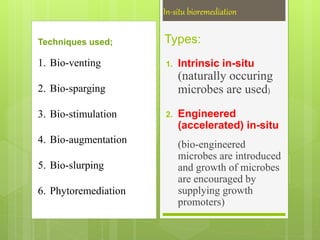
Techniques used;
1. Bio-venting
2. Bio-sparging
3. Bio-stimulation
4. Bio-augmentation
5. Bio-slurping
6. Phytoremediation
In-situ bioremediation
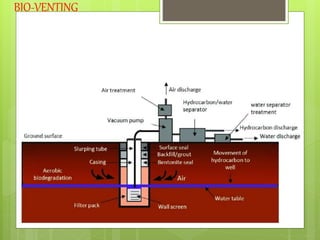
BIO-VENTING
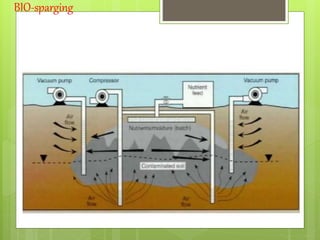
BIO-sparging
BIO-VENTING
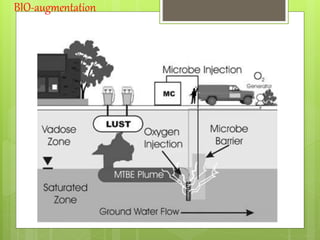
BIO-augmentation
Types:
1. Solid-phase (solid
organic wastes are used,
like: domestic &
agricultural waste,
industrial wastes,
sewage sludge,
municipal solid wastes)
2. Slurry-phase (liquid
suspensions are used, like:
sewage sludge, waste-
water, solids suspended on
water)
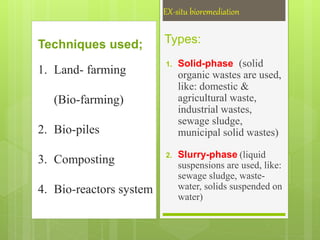
Techniques used;
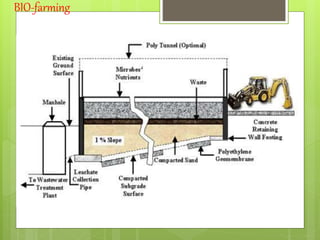
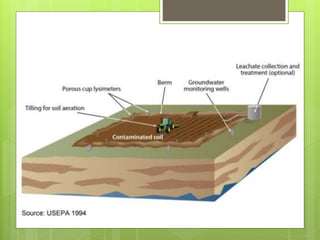
1. Land- farming
(Bio-farming)
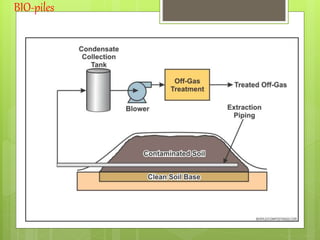
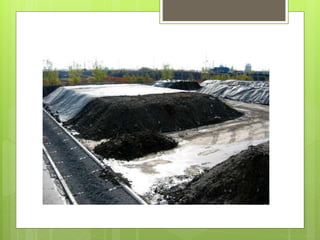
2. Bio-piles
3. Composting
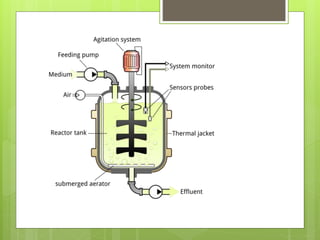
4. Bio-reactors system
EX-situ bioremediation
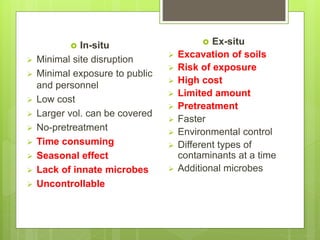
 In-situ
 Minimal site disruption
 Minimal exposure to public
and personnel
 Low cost
 Larger vol. can be covered
 No-pretreatment
 Time consuming
 Seasonal effect
 Lack of innate microbes
 Uncontrollable
 Ex-situ
 Excavation of soils
 Risk of exposure
 High cost
 Limited amount
 Pretreatment
 Faster
 Environmental control
 Different types of
contaminants at a time
 Additional microbes
BIO-farming
BIO-piles
BIO-reactor system
Aerated- lagoon
 Advantages
1. natural, eco-friendly
method
2. Stabilization & termination
of toxic pollutants
3. Control pollution effects
4. Cheaper, easier, faster
 Disadvantages
1. Limited to biodegradable
wastes
2. Specific processes
3. Ex-situ can disperse
pollutants
4. Toxicity and
bioavailability of
biodegradable products
are not always known

Bioremediation, principle and types

  • 1.
    BIOREMEDIATION Prepared by Prashant Dahal BSc.Microbiology Sunsari Technical College
  • 2.
  • 3.
  • 4.
    Main cause forchange is “POLLUTION” To secure the future of not the EARTH but of HUMAN it is now compulsory to immediately control “POLLUTION” and reverse the scenario to original Mother nature has developed a system to reverse the case; i.e. BIOREMEDIATION
  • 5.
    INTRODUCTION BIOREMEDIATION Grk. Bios =living Lt. Remedialis = Curing / healing Simply, use of living organisms (microbes & plants) to consume and break down env. pollutants, & restoring or cleaning polluted sites Biological catalysts acts on pollutants, thereby eliminating contaminants present in environments
  • 7.
    Principle Based on principleof biodegradation. The process utilize microbes (or plants) for pollutant degradation inoculated via natural attenuation, bioaugmentation or biostimualtion. The wates are degraded by biodeterioration and biodegradation method.  At favourable condition, microbes consume the contaminants and convert them into harmless organic or inorganic byproducts.
  • 8.
    Broad category  Basedon types of living organisms used; 1. Microbial remediation 2. Phyto-remediation a. Rhizosphere biodegradation b. Phyto-stabilization c. Phyto-accumulation d. Phyto-volatilization e. Phyto-degradation f. Rhizofiltration (Hydroponic system) g. Hydraulic control
  • 9.
  • 10.
    Types: 1. Intrinsic in-situ (naturallyoccuring microbes are used) 2. Engineered (accelerated) in-situ (bio-engineered microbes are introduced and growth of microbes are encouraged by supplying growth promoters) Techniques used; 1. Bio-venting 2. Bio-sparging 3. Bio-stimulation 4. Bio-augmentation 5. Bio-slurping 6. Phytoremediation In-situ bioremediation
  • 11.
  • 12.
  • 13.
  • 14.
  • 15.
    Types: 1. Solid-phase (solid organicwastes are used, like: domestic & agricultural waste, industrial wastes, sewage sludge, municipal solid wastes) 2. Slurry-phase (liquid suspensions are used, like: sewage sludge, waste- water, solids suspended on water) Techniques used; 1. Land- farming (Bio-farming) 2. Bio-piles 3. Composting 4. Bio-reactors system EX-situ bioremediation
  • 16.
     In-situ  Minimalsite disruption  Minimal exposure to public and personnel  Low cost  Larger vol. can be covered  No-pretreatment  Time consuming  Seasonal effect  Lack of innate microbes  Uncontrollable  Ex-situ  Excavation of soils  Risk of exposure  High cost  Limited amount  Pretreatment  Faster  Environmental control  Different types of contaminants at a time  Additional microbes
  • 17.
  • 19.
  • 21.
  • 23.
     Advantages 1. natural,eco-friendly method 2. Stabilization & termination of toxic pollutants 3. Control pollution effects 4. Cheaper, easier, faster  Disadvantages 1. Limited to biodegradable wastes 2. Specific processes 3. Ex-situ can disperse pollutants 4. Toxicity and bioavailability of biodegradable products are not always known