Course Title: Research Methods 
Course Credit Hrs.: 6 per week 
Level: A+B+C 
Program: Joint Supervision -Graduate Partnerships Program 
Term: Spring 2014/2015 
Module 3 
Instructor: Dr. Noora Al-Malki 
Credits of images and online content are to their original owners 
Copyright (a) noora malki 2014
Presentation Content 
- Learning Outcomes 
- Components of a proposal 
- Review of Literature 
- Quantitative Methods 
- Qualitative Methods 
- Questionnaire Design (e- 
Questionnaires) 
- Components of a Research Paper 
- Research Web Apps (Diigo, etc) 
- NEXT Week 
12/04/14 Dr. Noora Malki, al (c) all rights reserved 2
Learning Outcomes 
Upon completing this part of the module, students will be able to: 
•distinguish between qualitative and quantitative research methods 
•use select methods for their research proposals 
•Apply the knowledge presented in this module to write the methods section of their 
proposals 
12/04/14 Dr. Noora Malki, al (c) all rights reserved 3
Research Methods 
Qualitative research is characterised by its aims, which focus 
on understanding some aspects of social life. Methods used in 
such research generate descriptive data in the form of words 
whether oral or written, rather than numbers. Quantitative 
methods, on the other hand, aim to measure something (such 
as the percentage of people with a particular disease in a 
community), the aims and methods of qualitative research 
can seem imprecise. 
12/04/14 Dr. Noora Malki, al (c) all rights reserved 4
Research Methods 
Common criticisms of Qualitative Research include: 
Small Samples, 
Samples not reprsetative of population, 
Cannot generalise results, 
Findings are biased. 
12/04/14 Dr. Noora Malki, al (c) all rights reserved 5
Qualitative Methods 
Qualitative methods generally aim to answer questions about 
the ‘what’, ‘how’ or ‘why’ of a phenomenon rather than ‘how 
many’ or ‘how much’, which are answered by quantitative 
methods. 
12/04/14 Dr. Noora Malki, al (c) all rights reserved 6
Qualitative Methods 
12/04/14 Dr. Noora Malki, al (c) all rights reserved 7
Qualitative Methods 
Examples of topics that qualitative methodologies can address 
include: People’s experiences of health needs, health care, 
accessing care and keeping healthy. Understanding different 
perspectives, such as those of professionals and patients. How 
experiences, attitudes and life circumstances affect health 
needs and behaviours. 
12/04/14 Dr. Noora Malki, al (c) all rights reserved 8
Qualitative Methods 
Two key ethical issues that should be considered in any 
project are consent and confidentiality. 
12/04/14 Dr. Noora Malki, al (c) all rights reserved 9
Qualitative Methods 
(i) Consent 
Everyone who participates in your study should have freely 
consented to participation, without being coerced or unfairly 
pressurised. This means they should be well-informed about 
what participation entails, and reassured that declining will 
not affect any services they receive. While written consent 
may in some situations frighten the individuals you are talking 
to, you should at the very least obtain verbal consent. 
12/04/14 Dr. Noora Malki, al (c) all rights reserved 10
Qualitative Methods 
(ii) Confidentiality 
It is not always easy or even possible to measure the dangers 
of a certain context to a given population, let alone to 
individuals. It is therefore essential to protect the identity of 
the person from whom you gather information. If collected, 
the identity of the participants must be protected at all times 
and not be left lying around in notebooks or un-protected 
computer files. 
12/04/14 Dr. Noora Malki, al (c) all rights reserved 11
Qualitative Methods 
(iii) A word on sampling 
It is important to select your sample in a systematic way so as 
to ensure that the community/users/external actors see it as a 
credible and indicative sample. However, statistical 
representativeness is not the aim. Instead, samples in 
qualitative research are usually purposive. This means 
participants are selected because they are likely to generate 
useful data for the project. 
12/04/14 Dr. Noora Malki, al (c) all rights reserved 12
Qualitative Methods: Interview 
Interviews enable face to face discussion with human 
subjects. If you are going to use interviews you will have to 
decide whether you will take notes (distracting), tape the 
interview (accurate but time consuming) rely on your memory 
(foolish) or write in their answers (can lead to closed 
questioning for time’s sake). 
12/04/14 Dr. Noora Malki, al (c) all rights reserved 13
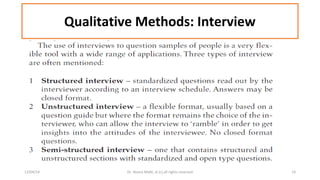
Qualitative Methods: Interview 
12/04/14 Dr. Noora Malki, al (c) all rights reserved 14
Qualitative Methods: Interview 
If you decide to interview you will need to draw up an 
interview schedule of questions which can be either closed or 
open questions, or a mixture of these. Closed questions tend 
to be used for asking for and receiving answers about fixed 
facts such as name, numbers, and so on. They do not require 
speculation and they tend to produce short answers. 
12/04/14 Dr. Noora Malki, al (c) all rights reserved 15
Qualitative Methods: Interview 
With closed questions you could even give your interviewees a small selection of 
possible answers from which to choose. If you do this you will be able to manage 
the data and quantify the responses quite easily. If you ask open questions such as 
‘what do you think about the increase in traffic?’ you could elicit an almost endless 
number of responses. This would give you a very good idea of the variety of ideas 
and feelings people have, it would enable them to think and talk for longer and so 
show their feelings and views more fully. But it is very difficult to quantify these 
results. You will find that you will need to read all the comments through and to 
categorise them after you have received them, or merely report them in their 
diversity and make general statements, or pick out particular comments if they 
seem to fit your purpose. 
12/04/14 Dr. Noora Malki, al (c) all rights reserved 16
Qualitative Methods: Interview 
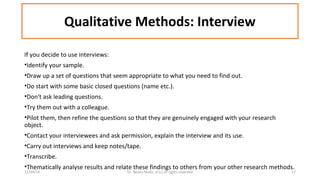
If you decide to use interviews: 
•Identify your sample. 
•Draw up a set of questions that seem appropriate to what you need to find out. 
•Do start with some basic closed questions (name etc.). 
•Don't ask leading questions. 
•Try them out with a colleague. 
•Pilot them, then refine the questions so that they are genuinely engaged with your research 
object. 
•Contact your interviewees and ask permission, explain the interview and its use. 
•Carry out interviews and keep notes/tape. 
•Transcribe. 
•Thematically analyse results and relate these findings to others from your other research methods. 
12/04/14 Dr. Noora Malki, al (c) all rights reserved 17
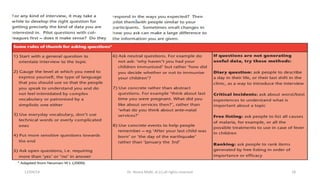
12/04/14 Dr. Noora Malki, al (c) all rights reserved 18
Quantitative Methods 
1. Your goal in conducting quantitative research study is to determine the relationship between one 
thing [an independent variable] and another [a dependent or outcome variable] within a 
population. Quantitative research designs are either descriptive [subjects usually measured 
once] or experimental [subjects measured before and after a treatment]. A descriptive study 
establishes only associations between variables; an experimental study establishes causality. 
2. Quantitative research deals in numbers, logic, and an objective stance. Quantitative research 
focuses on numberic and unchanging data and detailed, convergent reasoning rather than 
divergent reasoning [i.e., the generation of a variety of ideas about a research problem in a 
spontaneous, free-flowing manner]. 
12/04/14 Dr. Noora Malki, al (c) all rights reserved 19
Quantitative Methods 
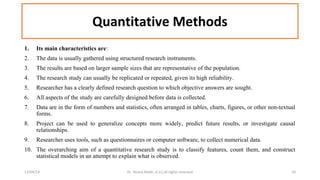
1. Its main characteristics are: 
2. The data is usually gathered using structured research instruments. 
3. The results are based on larger sample sizes that are representative of the population. 
4. The research study can usually be replicated or repeated, given its high reliability. 
5. Researcher has a clearly defined research question to which objective answers are sought. 
6. All aspects of the study are carefully designed before data is collected. 
7. Data are in the form of numbers and statistics, often arranged in tables, charts, figures, or other non-textual 
forms. 
8. Project can be used to generalize concepts more widely, predict future results, or investigate causal 
relationships. 
9. Researcher uses tools, such as questionnaires or computer software, to collect numerical data. 
10. The overarching aim of a quantitative research study is to classify features, count them, and construct 
statistical models in an attempt to explain what is observed. 
12/04/14 Dr. Noora Malki, al (c) all rights reserved 20
Quantitative Methods 
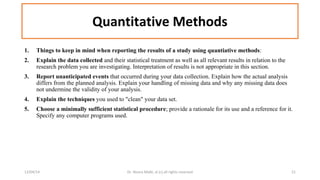
1. Things to keep in mind when reporting the results of a study using quantiative methods: 
2. Explain the data collected and their statistical treatment as well as all relevant results in relation to the 
research problem you are investigating. Interpretation of results is not appropriate in this section. 
3. Report unanticipated events that occurred during your data collection. Explain how the actual analysis 
differs from the planned analysis. Explain your handling of missing data and why any missing data does 
not undermine the validity of your analysis. 
4. Explain the techniques you used to "clean" your data set. 
5. Choose a minimally sufficient statistical procedure; provide a rationale for its use and a reference for it. 
Specify any computer programs used. 
12/04/14 Dr. Noora Malki, al (c) all rights reserved 21
Quantitative Methods 
1. Describe the assumptions for each procedure and the steps you took to ensure that they were not violated. 
2. When using inferential statistics, provide the descriptive statistics, confidence intervals, and sample sizes 
for each variable as well as the value of the test statistic, its direction, the degrees of freedom, and the 
significance level [report the actual pvalue]. 
3. Avoid inferring causality, particularly in nonrandomized designs or without further experimentation. 
4. Use tables to provide exact values; use figures to convey global effects. Keep figures small in size; 
include graphic representations of confidence intervals whenever possible. 
5. Always tell the reader what to look for in tables and figures. 
12/04/14 Dr. Noora Malki, al (c) all rights reserved 22
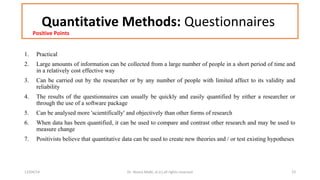
Quantitative Methods: Questionnaires 
Positive Points 
1. Practical 
2. Large amounts of information can be collected from a large number of people in a short period of time and 
in a relatively cost effective way 
3. Can be carried out by the researcher or by any number of people with limited affect to its validity and 
reliability 
4. The results of the questionnaires can usually be quickly and easily quantified by either a researcher or 
through the use of a software package 
5. Can be analysed more 'scientifically' and objectively than other forms of research 
6. When data has been quantified, it can be used to compare and contrast other research and may be used to 
measure change 
7. Positivists believe that quantitative data can be used to create new theories and / or test existing hypotheses 
12/04/14 Dr. Noora Malki, al (c) all rights reserved 23
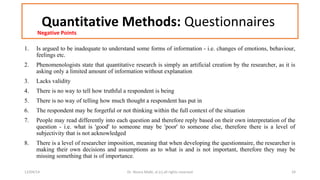
Quantitative Methods: Questionnaires 
Negative Points 
1. Is argued to be inadequate to understand some forms of information - i.e. changes of emotions, behaviour, 
feelings etc. 
2. Phenomenologists state that quantitative research is simply an artificial creation by the researcher, as it is 
asking only a limited amount of information without explanation 
3. Lacks validity 
4. There is no way to tell how truthful a respondent is being 
5. There is no way of telling how much thought a respondent has put in 
6. The respondent may be forgetful or not thinking within the full context of the situation 
7. People may read differently into each question and therefore reply based on their own interpretation of the 
question - i.e. what is 'good' to someone may be 'poor' to someone else, therefore there is a level of 
subjectivity that is not acknowledged 
8. There is a level of researcher imposition, meaning that when developing the questionnaire, the researcher is 
making their own decisions and assumptions as to what is and is not important, therefore they may be 
missing something that is of importance. 
12/04/14 Dr. Noora Malki, al (c) all rights reserved 24
Have a super day…. 
12/04/14 Dr. Noora Malki, al (c) all rights reserved 25

Module Three (part 2)

  • 1.
    Course Title: ResearchMethods Course Credit Hrs.: 6 per week Level: A+B+C Program: Joint Supervision -Graduate Partnerships Program Term: Spring 2014/2015 Module 3 Instructor: Dr. Noora Al-Malki Credits of images and online content are to their original owners Copyright (a) noora malki 2014
  • 2.
    Presentation Content -Learning Outcomes - Components of a proposal - Review of Literature - Quantitative Methods - Qualitative Methods - Questionnaire Design (e- Questionnaires) - Components of a Research Paper - Research Web Apps (Diigo, etc) - NEXT Week 12/04/14 Dr. Noora Malki, al (c) all rights reserved 2
  • 3.
    Learning Outcomes Uponcompleting this part of the module, students will be able to: •distinguish between qualitative and quantitative research methods •use select methods for their research proposals •Apply the knowledge presented in this module to write the methods section of their proposals 12/04/14 Dr. Noora Malki, al (c) all rights reserved 3
  • 4.
    Research Methods Qualitativeresearch is characterised by its aims, which focus on understanding some aspects of social life. Methods used in such research generate descriptive data in the form of words whether oral or written, rather than numbers. Quantitative methods, on the other hand, aim to measure something (such as the percentage of people with a particular disease in a community), the aims and methods of qualitative research can seem imprecise. 12/04/14 Dr. Noora Malki, al (c) all rights reserved 4
  • 5.
    Research Methods Commoncriticisms of Qualitative Research include: Small Samples, Samples not reprsetative of population, Cannot generalise results, Findings are biased. 12/04/14 Dr. Noora Malki, al (c) all rights reserved 5
  • 6.
    Qualitative Methods Qualitativemethods generally aim to answer questions about the ‘what’, ‘how’ or ‘why’ of a phenomenon rather than ‘how many’ or ‘how much’, which are answered by quantitative methods. 12/04/14 Dr. Noora Malki, al (c) all rights reserved 6
  • 7.
    Qualitative Methods 12/04/14Dr. Noora Malki, al (c) all rights reserved 7
  • 8.
    Qualitative Methods Examplesof topics that qualitative methodologies can address include: People’s experiences of health needs, health care, accessing care and keeping healthy. Understanding different perspectives, such as those of professionals and patients. How experiences, attitudes and life circumstances affect health needs and behaviours. 12/04/14 Dr. Noora Malki, al (c) all rights reserved 8
  • 9.
    Qualitative Methods Twokey ethical issues that should be considered in any project are consent and confidentiality. 12/04/14 Dr. Noora Malki, al (c) all rights reserved 9
  • 10.
    Qualitative Methods (i)Consent Everyone who participates in your study should have freely consented to participation, without being coerced or unfairly pressurised. This means they should be well-informed about what participation entails, and reassured that declining will not affect any services they receive. While written consent may in some situations frighten the individuals you are talking to, you should at the very least obtain verbal consent. 12/04/14 Dr. Noora Malki, al (c) all rights reserved 10
  • 11.
    Qualitative Methods (ii)Confidentiality It is not always easy or even possible to measure the dangers of a certain context to a given population, let alone to individuals. It is therefore essential to protect the identity of the person from whom you gather information. If collected, the identity of the participants must be protected at all times and not be left lying around in notebooks or un-protected computer files. 12/04/14 Dr. Noora Malki, al (c) all rights reserved 11
  • 12.
    Qualitative Methods (iii)A word on sampling It is important to select your sample in a systematic way so as to ensure that the community/users/external actors see it as a credible and indicative sample. However, statistical representativeness is not the aim. Instead, samples in qualitative research are usually purposive. This means participants are selected because they are likely to generate useful data for the project. 12/04/14 Dr. Noora Malki, al (c) all rights reserved 12
  • 13.
    Qualitative Methods: Interview Interviews enable face to face discussion with human subjects. If you are going to use interviews you will have to decide whether you will take notes (distracting), tape the interview (accurate but time consuming) rely on your memory (foolish) or write in their answers (can lead to closed questioning for time’s sake). 12/04/14 Dr. Noora Malki, al (c) all rights reserved 13
  • 14.
    Qualitative Methods: Interview 12/04/14 Dr. Noora Malki, al (c) all rights reserved 14
  • 15.
    Qualitative Methods: Interview If you decide to interview you will need to draw up an interview schedule of questions which can be either closed or open questions, or a mixture of these. Closed questions tend to be used for asking for and receiving answers about fixed facts such as name, numbers, and so on. They do not require speculation and they tend to produce short answers. 12/04/14 Dr. Noora Malki, al (c) all rights reserved 15
  • 16.
    Qualitative Methods: Interview With closed questions you could even give your interviewees a small selection of possible answers from which to choose. If you do this you will be able to manage the data and quantify the responses quite easily. If you ask open questions such as ‘what do you think about the increase in traffic?’ you could elicit an almost endless number of responses. This would give you a very good idea of the variety of ideas and feelings people have, it would enable them to think and talk for longer and so show their feelings and views more fully. But it is very difficult to quantify these results. You will find that you will need to read all the comments through and to categorise them after you have received them, or merely report them in their diversity and make general statements, or pick out particular comments if they seem to fit your purpose. 12/04/14 Dr. Noora Malki, al (c) all rights reserved 16
  • 17.
    Qualitative Methods: Interview If you decide to use interviews: •Identify your sample. •Draw up a set of questions that seem appropriate to what you need to find out. •Do start with some basic closed questions (name etc.). •Don't ask leading questions. •Try them out with a colleague. •Pilot them, then refine the questions so that they are genuinely engaged with your research object. •Contact your interviewees and ask permission, explain the interview and its use. •Carry out interviews and keep notes/tape. •Transcribe. •Thematically analyse results and relate these findings to others from your other research methods. 12/04/14 Dr. Noora Malki, al (c) all rights reserved 17
  • 18.
    12/04/14 Dr. NooraMalki, al (c) all rights reserved 18
  • 19.
    Quantitative Methods 1.Your goal in conducting quantitative research study is to determine the relationship between one thing [an independent variable] and another [a dependent or outcome variable] within a population. Quantitative research designs are either descriptive [subjects usually measured once] or experimental [subjects measured before and after a treatment]. A descriptive study establishes only associations between variables; an experimental study establishes causality. 2. Quantitative research deals in numbers, logic, and an objective stance. Quantitative research focuses on numberic and unchanging data and detailed, convergent reasoning rather than divergent reasoning [i.e., the generation of a variety of ideas about a research problem in a spontaneous, free-flowing manner]. 12/04/14 Dr. Noora Malki, al (c) all rights reserved 19
  • 20.
    Quantitative Methods 1.Its main characteristics are: 2. The data is usually gathered using structured research instruments. 3. The results are based on larger sample sizes that are representative of the population. 4. The research study can usually be replicated or repeated, given its high reliability. 5. Researcher has a clearly defined research question to which objective answers are sought. 6. All aspects of the study are carefully designed before data is collected. 7. Data are in the form of numbers and statistics, often arranged in tables, charts, figures, or other non-textual forms. 8. Project can be used to generalize concepts more widely, predict future results, or investigate causal relationships. 9. Researcher uses tools, such as questionnaires or computer software, to collect numerical data. 10. The overarching aim of a quantitative research study is to classify features, count them, and construct statistical models in an attempt to explain what is observed. 12/04/14 Dr. Noora Malki, al (c) all rights reserved 20
  • 21.
    Quantitative Methods 1.Things to keep in mind when reporting the results of a study using quantiative methods: 2. Explain the data collected and their statistical treatment as well as all relevant results in relation to the research problem you are investigating. Interpretation of results is not appropriate in this section. 3. Report unanticipated events that occurred during your data collection. Explain how the actual analysis differs from the planned analysis. Explain your handling of missing data and why any missing data does not undermine the validity of your analysis. 4. Explain the techniques you used to "clean" your data set. 5. Choose a minimally sufficient statistical procedure; provide a rationale for its use and a reference for it. Specify any computer programs used. 12/04/14 Dr. Noora Malki, al (c) all rights reserved 21
  • 22.
    Quantitative Methods 1.Describe the assumptions for each procedure and the steps you took to ensure that they were not violated. 2. When using inferential statistics, provide the descriptive statistics, confidence intervals, and sample sizes for each variable as well as the value of the test statistic, its direction, the degrees of freedom, and the significance level [report the actual pvalue]. 3. Avoid inferring causality, particularly in nonrandomized designs or without further experimentation. 4. Use tables to provide exact values; use figures to convey global effects. Keep figures small in size; include graphic representations of confidence intervals whenever possible. 5. Always tell the reader what to look for in tables and figures. 12/04/14 Dr. Noora Malki, al (c) all rights reserved 22
  • 23.
    Quantitative Methods: Questionnaires Positive Points 1. Practical 2. Large amounts of information can be collected from a large number of people in a short period of time and in a relatively cost effective way 3. Can be carried out by the researcher or by any number of people with limited affect to its validity and reliability 4. The results of the questionnaires can usually be quickly and easily quantified by either a researcher or through the use of a software package 5. Can be analysed more 'scientifically' and objectively than other forms of research 6. When data has been quantified, it can be used to compare and contrast other research and may be used to measure change 7. Positivists believe that quantitative data can be used to create new theories and / or test existing hypotheses 12/04/14 Dr. Noora Malki, al (c) all rights reserved 23
  • 24.
    Quantitative Methods: Questionnaires Negative Points 1. Is argued to be inadequate to understand some forms of information - i.e. changes of emotions, behaviour, feelings etc. 2. Phenomenologists state that quantitative research is simply an artificial creation by the researcher, as it is asking only a limited amount of information without explanation 3. Lacks validity 4. There is no way to tell how truthful a respondent is being 5. There is no way of telling how much thought a respondent has put in 6. The respondent may be forgetful or not thinking within the full context of the situation 7. People may read differently into each question and therefore reply based on their own interpretation of the question - i.e. what is 'good' to someone may be 'poor' to someone else, therefore there is a level of subjectivity that is not acknowledged 8. There is a level of researcher imposition, meaning that when developing the questionnaire, the researcher is making their own decisions and assumptions as to what is and is not important, therefore they may be missing something that is of importance. 12/04/14 Dr. Noora Malki, al (c) all rights reserved 24
  • 25.
    Have a superday…. 12/04/14 Dr. Noora Malki, al (c) all rights reserved 25