Differentiation between qualitative
and quantitative nursing research
Introduction
• Researchers usually work within a paradigm
that is consistent with their world view, and
that gives rise to the types of question that
excite their curiosity.
• The maturity of the concept of interest also
may lead to one or the other paradigm: when
little is known about a topic, a qualitative
approach is often more fruitful than a
quantitative one
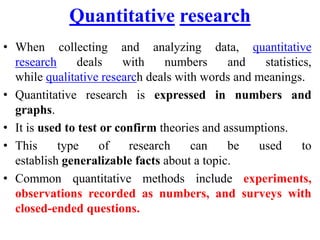
Quantitative research
• When collecting and analyzing data, quantitative
research deals with numbers and statistics,
while qualitative research deals with words and meanings.
• Quantitative research is expressed in numbers and
graphs.
• It is used to test or confirm theories and assumptions.
• This type of research can be used to
establish generalizable facts about a topic.
• Common quantitative methods include experiments,
observations recorded as numbers, and surveys with
closed-ended questions.
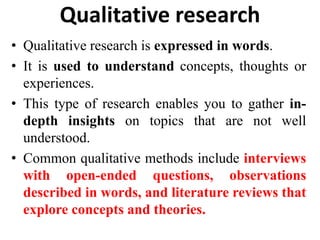
Qualitative research
• Qualitative research is expressed in words.
• It is used to understand concepts, thoughts or
experiences.
• This type of research enables you to gather in-
depth insights on topics that are not well
understood.
• Common qualitative methods include interviews
with open-ended questions, observations
described in words, and literature reviews that
explore concepts and theories.
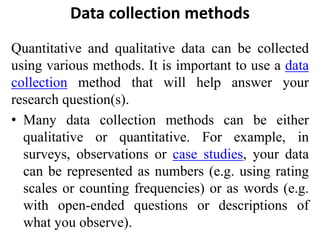
Data collection methods
Quantitative and qualitative data can be collected
using various methods. It is important to use a data
collection method that will help answer your
research question(s).
• Many data collection methods can be either
qualitative or quantitative. For example, in
surveys, observations or case studies, your data
can be represented as numbers (e.g. using rating
scales or counting frequencies) or as words (e.g.
with open-ended questions or descriptions of
what you observe).
Quantitative data collection methods
• Surveys: List of closed or multiple choice
questions that is distributed to
a sample (online, in person, or over the phone).
• Experiments: Situation in which variables are
controlled and manipulated to establish cause-
and-effect relationships.
• Observations: Observing subjects in a natural
environment where variables can’t be
controlled.
Qualitative data collection methods
• Interviews: Asking open-ended questions
verbally to respondents.
• Focus groups: Discussion among a group of
people about a topic to gather opinions that can
be used for further research.
• Ethnography: Participating in a community or
organization for an extended period of time to
closely observe culture and behavior.
• Literature review: Survey of published works
by other authors.
When to use qualitative vs. quantitative
research
A rule of thumb for deciding whether to use
qualitative or quantitative data is:
• Use quantitative research if you want to confirm
or test something (a theory or hypothesis)
• Use qualitative research if you want
to understand something (concepts, thoughts,
experiences)
Research question
How satisfied are students with their studies?
Quantitative research approach
• You survey 300 students at your university and
ask them questions such as: “on a scale from 1-
5, how satisfied are your with your professors?”
• You can perform statistical analysis on the data
and draw conclusions such as: “on average
students rated their professors 4.4”.
Research question
Qualitative research approach
• You conduct in-depth interviews with 15 students
and ask them open-ended questions such as: “How
satisfied are you with your studies?”, “What is the
most positive aspect of your study program?” and
“What can be done to improve the study
program?”
• Based on the answers you get you can ask follow-
up questions to clarify things. You transcribe all
interviews using transcription software and try to
find commonalities and patterns.
Research question
Mixed methods approach
• You conduct interviews to find out how satisfied
students are with their studies. Through open-
ended questions you learn things you never
thought about before and gain new insights. Later,
you use a survey to test these insights on a larger
scale.
• It’s also possible to start with a survey to find out
the overall trends, followed by interviews to
better understand the reasons behind the trends.
How to analyze qualitative and
quantitative data
• Qualitative or quantitative data by
itself can’t prove or demonstrate
anything, but has to be analyzed to
show its meaning in relation to the
research questions.
• The method of analysis differs for
each type of data.
Analyzing quantitative data
• Quantitative data is based on numbers. Simple math
or more advanced statistical analysis is used to
discover commonalities or patterns in the data. The
results are often reported in graphs and tables.
• Applications such as Excel, and SPSS, can be used to
calculate things like:
1. Average scores
2. The number of times a particular answer was given
3. The correlation or causation between two or more
variables
4. The reliability and validity of the results
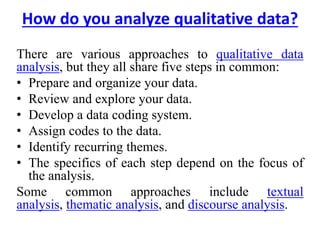
How do you analyze qualitative data?
There are various approaches to qualitative data
analysis, but they all share five steps in common:
• Prepare and organize your data.
• Review and explore your data.
• Develop a data coding system.
• Assign codes to the data.
• Identify recurring themes.
• The specifics of each step depend on the focus of
the analysis.
Some common approaches include textual
analysis, thematic analysis, and discourse analysis.
References
• Polit, Denise F., and Cheryl Tatano
Beck. Nursing research: Principles and
methods. Lippincott Williams & Wilkins, 2004.
• https://www.scribbr.com/methodology/qualit
ative-quantitative-research/
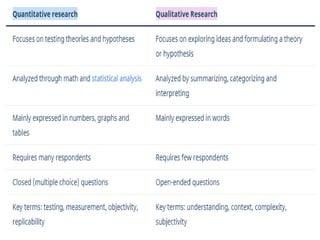
Difference between quantitative and qualitative research

Difference between quantitative and qualitative research

  • 2.
    Differentiation between qualitative andquantitative nursing research
  • 3.
    Introduction • Researchers usuallywork within a paradigm that is consistent with their world view, and that gives rise to the types of question that excite their curiosity. • The maturity of the concept of interest also may lead to one or the other paradigm: when little is known about a topic, a qualitative approach is often more fruitful than a quantitative one
  • 4.
    Quantitative research • Whencollecting and analyzing data, quantitative research deals with numbers and statistics, while qualitative research deals with words and meanings. • Quantitative research is expressed in numbers and graphs. • It is used to test or confirm theories and assumptions. • This type of research can be used to establish generalizable facts about a topic. • Common quantitative methods include experiments, observations recorded as numbers, and surveys with closed-ended questions.
  • 5.
    Qualitative research • Qualitativeresearch is expressed in words. • It is used to understand concepts, thoughts or experiences. • This type of research enables you to gather in- depth insights on topics that are not well understood. • Common qualitative methods include interviews with open-ended questions, observations described in words, and literature reviews that explore concepts and theories.
  • 7.
    Data collection methods Quantitativeand qualitative data can be collected using various methods. It is important to use a data collection method that will help answer your research question(s). • Many data collection methods can be either qualitative or quantitative. For example, in surveys, observations or case studies, your data can be represented as numbers (e.g. using rating scales or counting frequencies) or as words (e.g. with open-ended questions or descriptions of what you observe).
  • 8.
    Quantitative data collectionmethods • Surveys: List of closed or multiple choice questions that is distributed to a sample (online, in person, or over the phone). • Experiments: Situation in which variables are controlled and manipulated to establish cause- and-effect relationships. • Observations: Observing subjects in a natural environment where variables can’t be controlled.
  • 9.
    Qualitative data collectionmethods • Interviews: Asking open-ended questions verbally to respondents. • Focus groups: Discussion among a group of people about a topic to gather opinions that can be used for further research. • Ethnography: Participating in a community or organization for an extended period of time to closely observe culture and behavior. • Literature review: Survey of published works by other authors.
  • 10.
    When to usequalitative vs. quantitative research A rule of thumb for deciding whether to use qualitative or quantitative data is: • Use quantitative research if you want to confirm or test something (a theory or hypothesis) • Use qualitative research if you want to understand something (concepts, thoughts, experiences)
  • 11.
    Research question How satisfiedare students with their studies? Quantitative research approach • You survey 300 students at your university and ask them questions such as: “on a scale from 1- 5, how satisfied are your with your professors?” • You can perform statistical analysis on the data and draw conclusions such as: “on average students rated their professors 4.4”.
  • 12.
    Research question Qualitative researchapproach • You conduct in-depth interviews with 15 students and ask them open-ended questions such as: “How satisfied are you with your studies?”, “What is the most positive aspect of your study program?” and “What can be done to improve the study program?” • Based on the answers you get you can ask follow- up questions to clarify things. You transcribe all interviews using transcription software and try to find commonalities and patterns.
  • 13.
    Research question Mixed methodsapproach • You conduct interviews to find out how satisfied students are with their studies. Through open- ended questions you learn things you never thought about before and gain new insights. Later, you use a survey to test these insights on a larger scale. • It’s also possible to start with a survey to find out the overall trends, followed by interviews to better understand the reasons behind the trends.
  • 14.
    How to analyzequalitative and quantitative data • Qualitative or quantitative data by itself can’t prove or demonstrate anything, but has to be analyzed to show its meaning in relation to the research questions. • The method of analysis differs for each type of data.
  • 15.
    Analyzing quantitative data •Quantitative data is based on numbers. Simple math or more advanced statistical analysis is used to discover commonalities or patterns in the data. The results are often reported in graphs and tables. • Applications such as Excel, and SPSS, can be used to calculate things like: 1. Average scores 2. The number of times a particular answer was given 3. The correlation or causation between two or more variables 4. The reliability and validity of the results
  • 16.
    How do youanalyze qualitative data? There are various approaches to qualitative data analysis, but they all share five steps in common: • Prepare and organize your data. • Review and explore your data. • Develop a data coding system. • Assign codes to the data. • Identify recurring themes. • The specifics of each step depend on the focus of the analysis. Some common approaches include textual analysis, thematic analysis, and discourse analysis.
  • 20.
    References • Polit, DeniseF., and Cheryl Tatano Beck. Nursing research: Principles and methods. Lippincott Williams & Wilkins, 2004. • https://www.scribbr.com/methodology/qualit ative-quantitative-research/