QUALITATIVE
RESEARCH
DR STEFI M S, 1ST
-YEAR
POSTGRADUATE
STUDENT
DR SURENDRA BABU,
ASSISTANT PROFESSOR
DEPT OF COMMUNITY
MEDICINE
ESIC MC
1
2
LEARNING OBJECTIVES
Learn about qualitative research
Compare qualitative and quantitative research
Applications of qualitative research
Steps in qualitative research
3
OUTLINE
Introduction 4-7
Comparison between qualitative
and quantitative study
8
Applications of qualitative
research
9
Steps and general workflow 10-46
Reporting of the qualitative
study
47-48
Take home message 49-50
References 51-54
4
INTRODUCTION
• Redman and Mory in their book Romance of the research
define research as a “systematized effort to gain new
knowledge”
5
INTRODUCTION
• OBJECTIVES OF RESEARCH:
• To gain familiarity with a phenomenon or to achieve new
insights into it
• To portray accurately the characteristics of a particular
individual, situation or a group
• To determine the frequency with which something occurs or with
which it is associated with something else
• To test a hypothesis of a causal relationship between variables
6
INTRODUCTION
• Qualitative research :
• Defined as “an interpretative approach to data collection and
analysis that is concerned with meanings people attach to their
experiences of the social world and how people make sense of
that world” by Catherine Pope and Nicholas Mays in their book
Qualitative Research in health care.
7
INTRODUCTION
• Qualitative studies help us understand why promising clinical
interventions do not always work in the real world
• How patients experience care
• How practitioners think.
• Tries to interpret social phenomena such as interactions, behaviours
and communications in terms of the meaning people bring to them.
• Particularly suited to studying people in their day-to-day setting.
• Explore and explain the complex relations between the healthcare
system and the outside world.
8
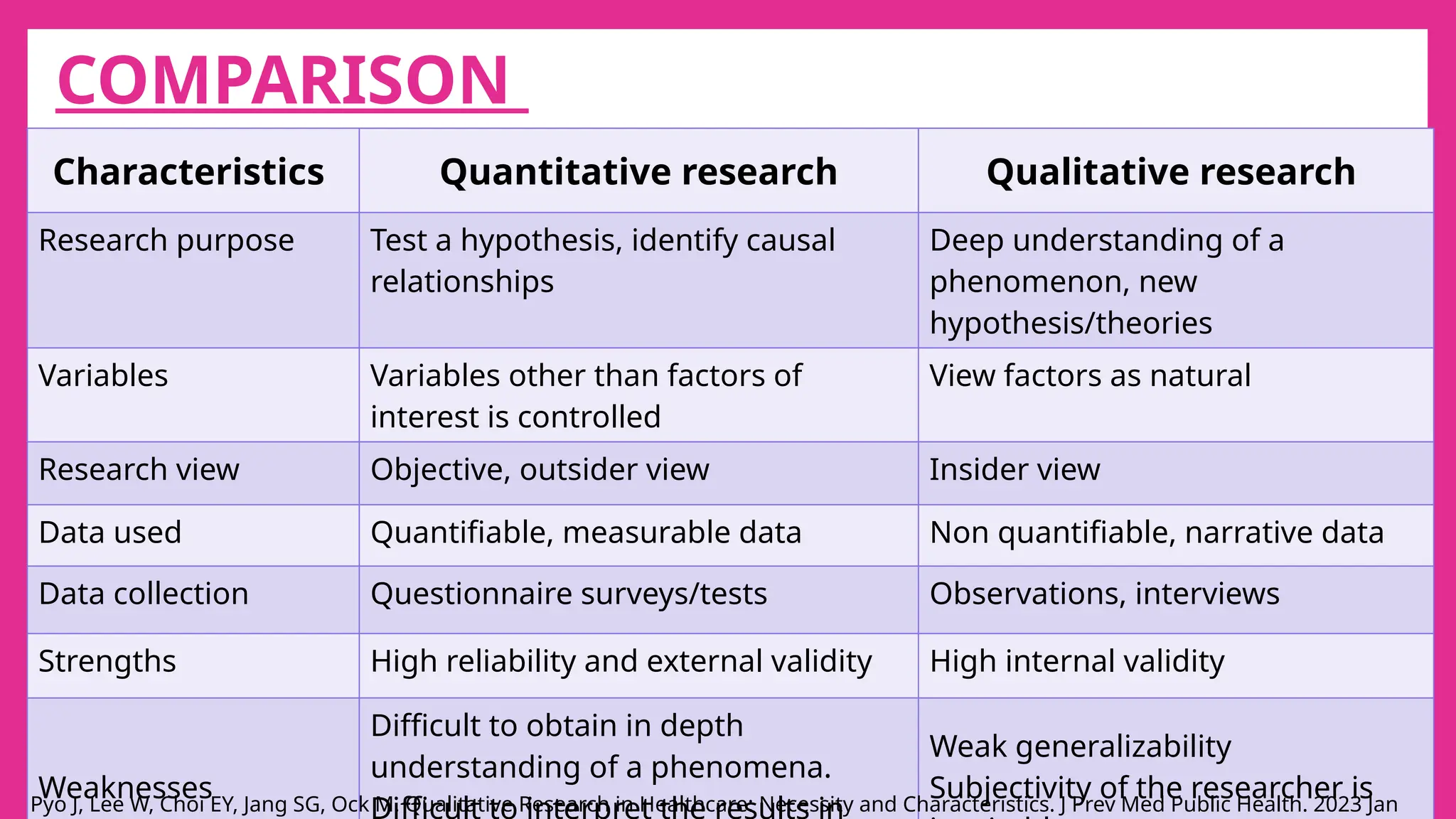
COMPARISON
Characteristics Quantitative research Qualitative research
Research purpose Test a hypothesis, identify causal
relationships
Deep understanding of a
phenomenon, new
hypothesis/theories
Variables Variables other than factors of
interest is controlled
View factors as natural
Research view Objective, outsider view Insider view
Data used Quantifiable, measurable data Non quantifiable, narrative data
Data collection Questionnaire surveys/tests Observations, interviews
Strengths High reliability and external validity High internal validity
Weaknesses
Difficult to obtain in depth
understanding of a phenomena.
Difficult to interpret the results in
Weak generalizability
Subjectivity of the researcher is
Pyo J, Lee W, Choi EY, Jang SG, Ock M. Qualitative Research in Healthcare: Necessity and Characteristics. J Prev Med Public Health. 2023 Jan
9
APPLICATIONS
• Exploratory approach is required on not so well known topic.
• Something cannot be explained fully with quantitative research.
• When it is necessary to present a specific view on a research topic.
• When presenting the rationale or theoretical proposition for designing
hypotheses is inappropriate, as in quantitative research.
• Research that requires detailed descriptive writing with literary expressions.
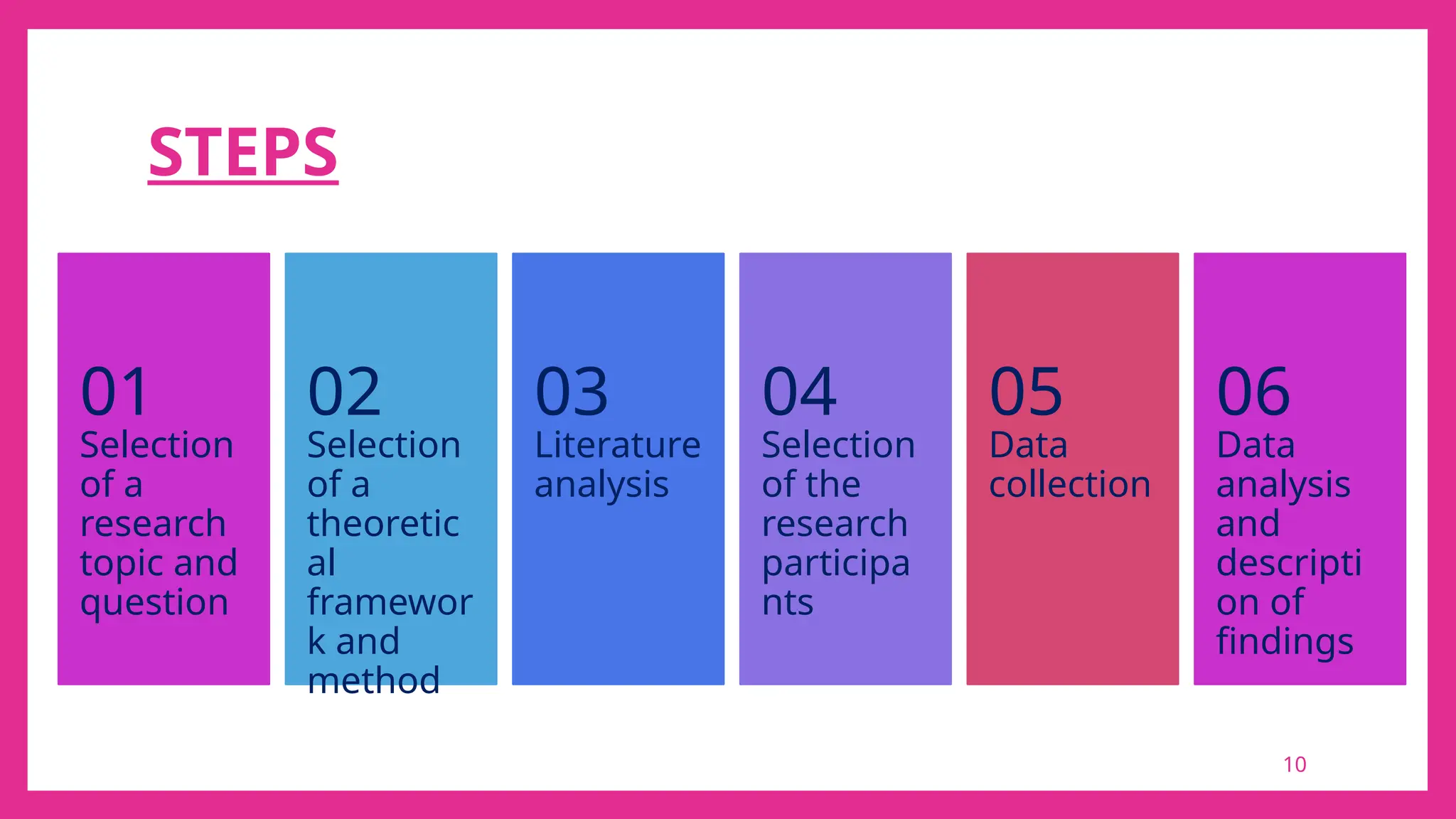
STEPS
10
Selection
of a
research
topic and
question
01
Selection
of a
theoretic
al
framewor
k and
method
02
Literature
analysis
03
Selection
of the
research
participa
nts
04
Data
collection
05
Data
analysis
and
descripti
on of
findings
06
11
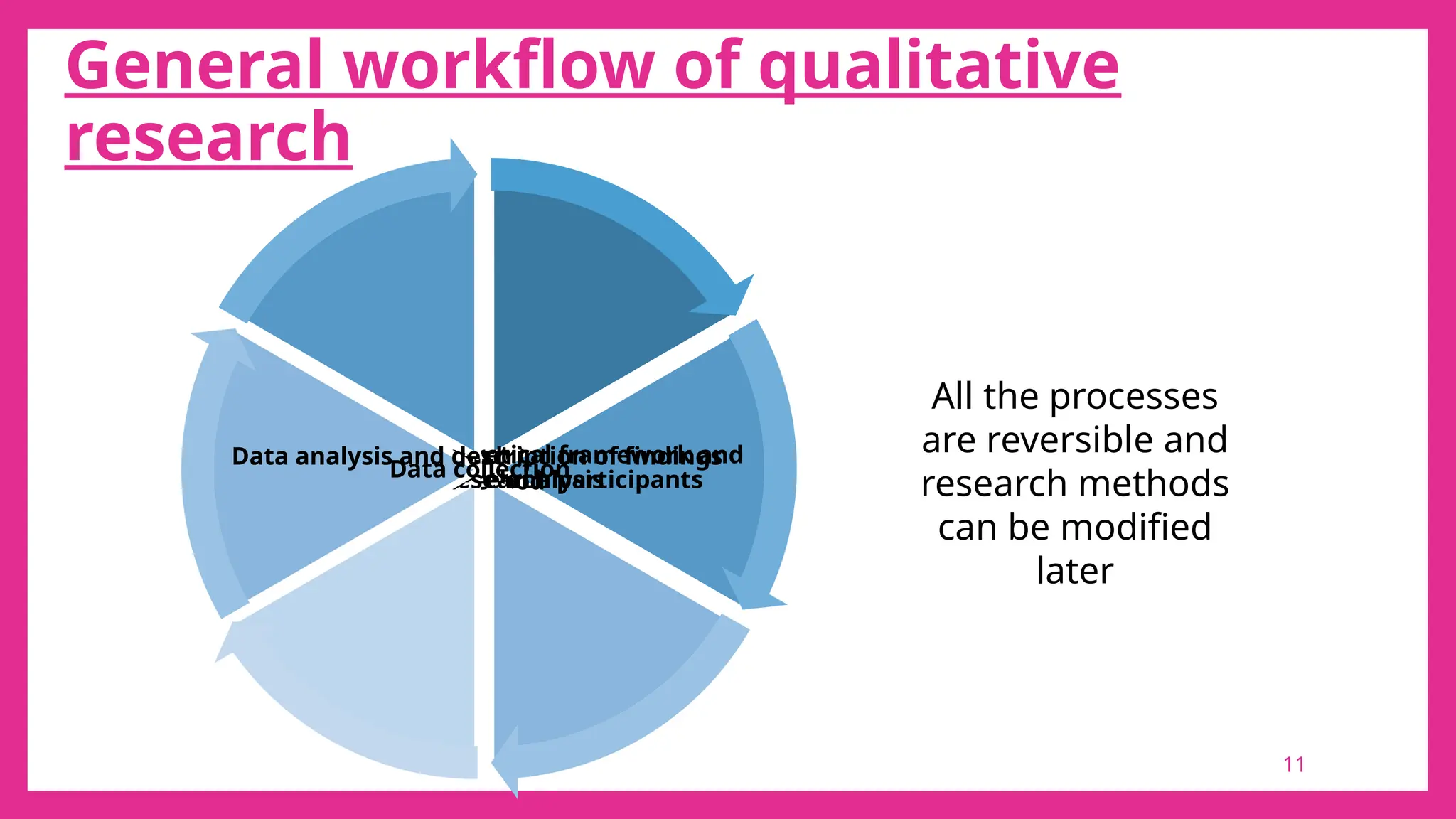
General workflow of qualitative
research
Selection of a research topic and question
Selection of a theoretical framework and
method
Literature analysis
Selection of the research participants
Data collection
Data analysis and description of findings
All the processes
are reversible and
research methods
can be modified
later
12
Selection Of Research Topic And
Question
• Research topic:
• Based on interests from daily life
• Interests in issues within the healthcare field
• Ideas from literature.
• Research question:
• More specific aspects of the research topic
• Is it executable?
• Research topic and research question worth researching?
13
Selection of theoretical
framework and methods
• A theoretical framework:
Thoughts or attitudes that a researcher has about the
phenomenon being researched.
14
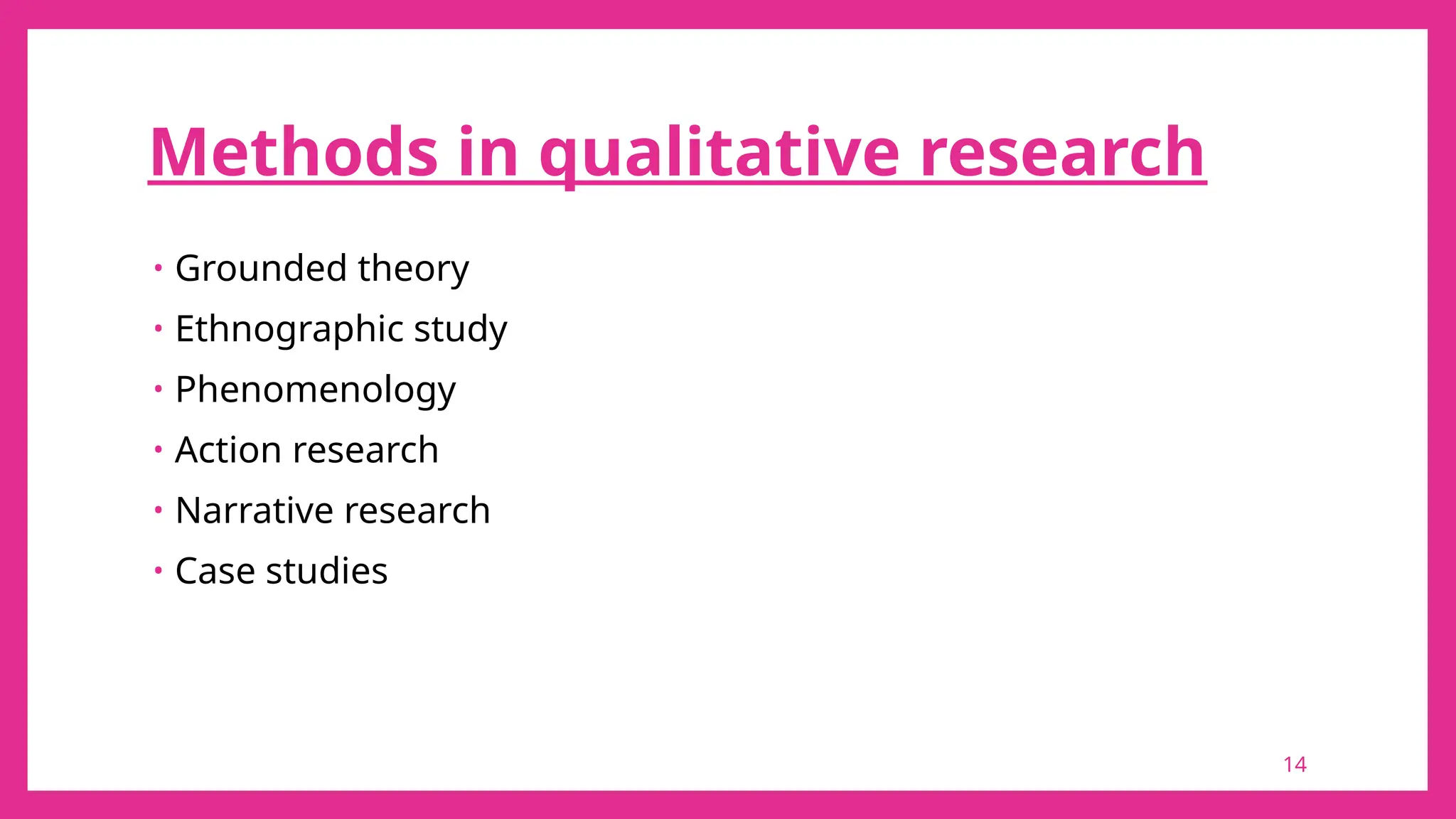
Methods in qualitative research
• Grounded theory
• Ethnographic study
• Phenomenology
• Action research
• Narrative research
• Case studies
15
Grounded theory
• Suitable for achieving the goal of developing a theory that can explain
the process involved in the phenomenon being researched
16
Ethnographic study
• Suitable for research topics that attempt to identify and interpret the
culture of a specific group.
17
Phenomenology
• Suitable for research topics that attempt to identify the nature of
research participants’ experiences or the phenomenon being researched.
18
Action research
• Suitable for research that aims to find solutions to problems faced by the
research participants
19
Narrative research
• Suitable for research that attempt to interpret the entire life or individual
experience contained within the stories of the research participants
20
Literature analysis
• Helps in selecting research problem, theoretical framework and research method.
• Helps to contemplate the new knowledge that the researcher will add to the field
• Since the research process is cyclical literature review can be done at any time.
• Some researchers point out that a literature review may introduce bias.
• Ethical review and approval are required
• Therefore the research protocol must be created and submitted for approval.
• Some degree of review is required to create the research protocol
21
Selection of research participants
• Subjects are humans
• Research participants should have sufficient knowledge, experience,
and attitudes to provide the most appropriate answer to the research
question.
• Participants who can best describe and demonstrate the
phenomenon of interest
22
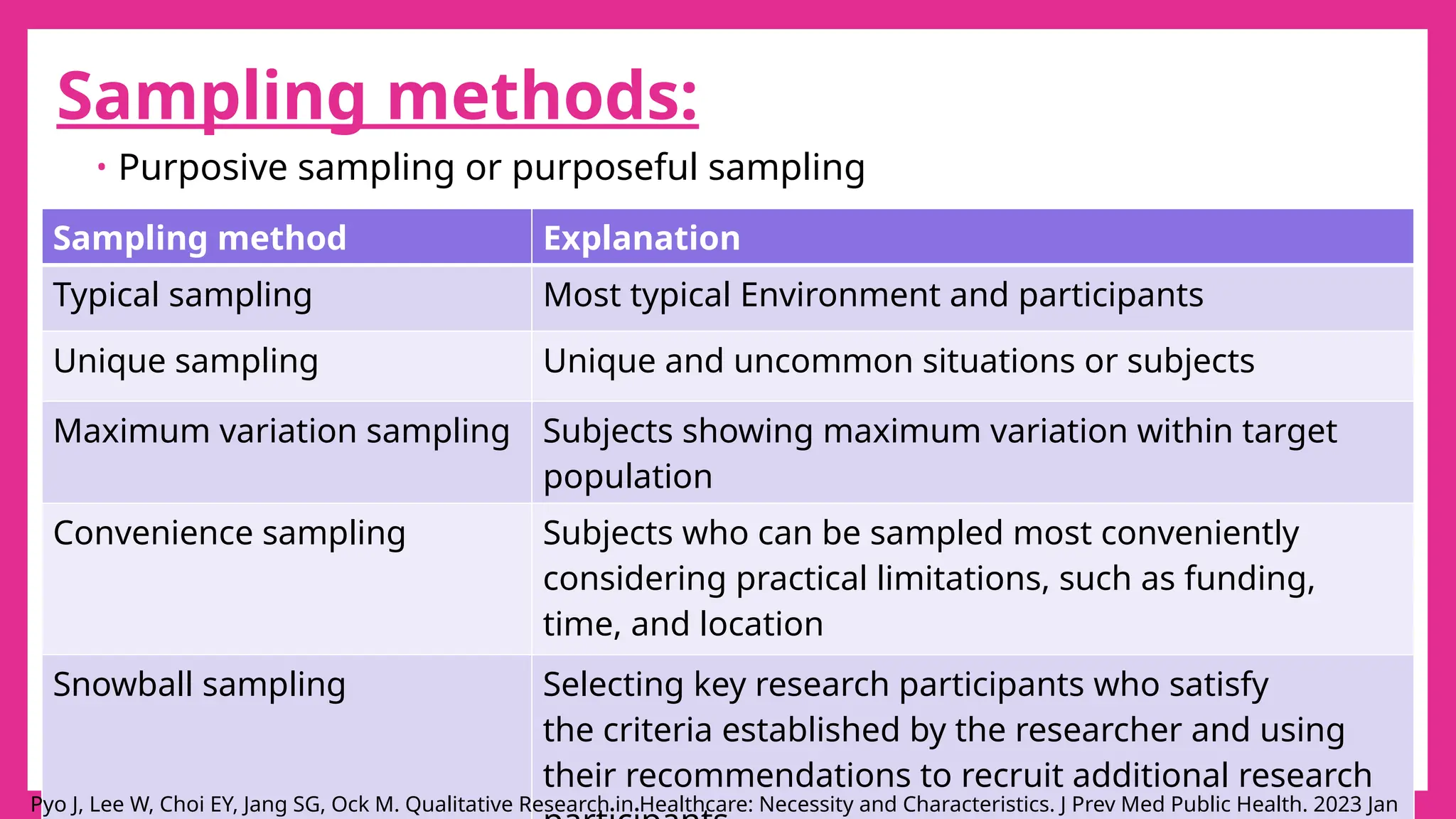
Sampling methods:
• Purposive sampling or purposeful sampling
Sampling method Explanation
Typical sampling Most typical Environment and participants
Unique sampling Unique and uncommon situations or subjects
Maximum variation sampling Subjects showing maximum variation within target
population
Convenience sampling Subjects who can be sampled most conveniently
considering practical limitations, such as funding,
time, and location
Snowball sampling Selecting key research participants who satisfy
the criteria established by the researcher and using
their recommendations to recruit additional research
Pyo J, Lee W, Choi EY, Jang SG, Ock M. Qualitative Research in Healthcare: Necessity and Characteristics. J Prev Med Public Health. 2023 Jan
23
Sample size calculation
• Typically relies on the concept of “saturation,” or the point at which no new
information or themes are observed in the data.
• Also ensure variability of data
• Guest et al in their article “How Many Interviews Are Enough?” concludes that after 12
interviews, data saturation was attained.
Guest G, Bunce A, Johnson L. How Many Interviews Are Enough?: An Experiment with Data Saturation and
Variability. Field Methods. 2006 Feb 1;18(1):59–82.
24
Data types/data source
• Interview data
• Observational data
• Documented data
• Image data
25
Interview data
• “Interview” : communication that takes place based on a clear sense of
purpose of acquiring certain information.
• Level of data will depend upon the interviewer’s abilities and knowledge.
26
Interview data
• Level of structurization
• Structured interview
• Semi-structured interview
• Unstructured interview
• Size
• One-on-one in-depth interview
• Focus group discussion
• Interview method
• Face to face
• Non-face to face
27
Level of structurization
Structured interview:
Data is collected by asking closed questions in the order provided by
highly specific interview guidelines
28
Level of structurization
Semi-structured interview
Interview guidelines are set but the questions are not strictly set.
Most widely used
Allows flexibility
Researcher bias
29
Level of structurization
Unstructured interview
Interview like a regular conversation
Can obtain rich and realistic meaning and experiences of participants
The quality of information and length of the interview varies according to
the interviewer’s competency
30
Size
• One-on-one in-depth interview
• A single participant discusses the research topic with the researcher
• Sometimes there is a need for a guardian present (children, elderly
frail patients)
31
Size
• Focus group discussion
• At least 2 participants discuss the research topic
during a session led by the researcher
• Generally 4-6 participants
• More effective with adolescents and children
• Richer data obtained by promoting interaction within
group.
• Some participants may feel left out or not share the
opinion
32
Interview method
• Face-to-face interview
• Interviewer personally meets the participant to conduct the interview
• Easy to build rapport
• Can respond properly to the interview by identifying nonverbal messages
• Non-face-to-face interview
• Telephone, videoconferencing or email
• Suitable for research topics which are political or intimate personal matters
• Email interviews give enough time for the participants to think before responding.
• Difficult to build rapport and obtain honest experiences
• Possibility of misinterpreting the responses
33
Observational data
• Systematically examining the appearances and behaviours of research
participants that take place in natural situations.
• Participative and non participative observations.
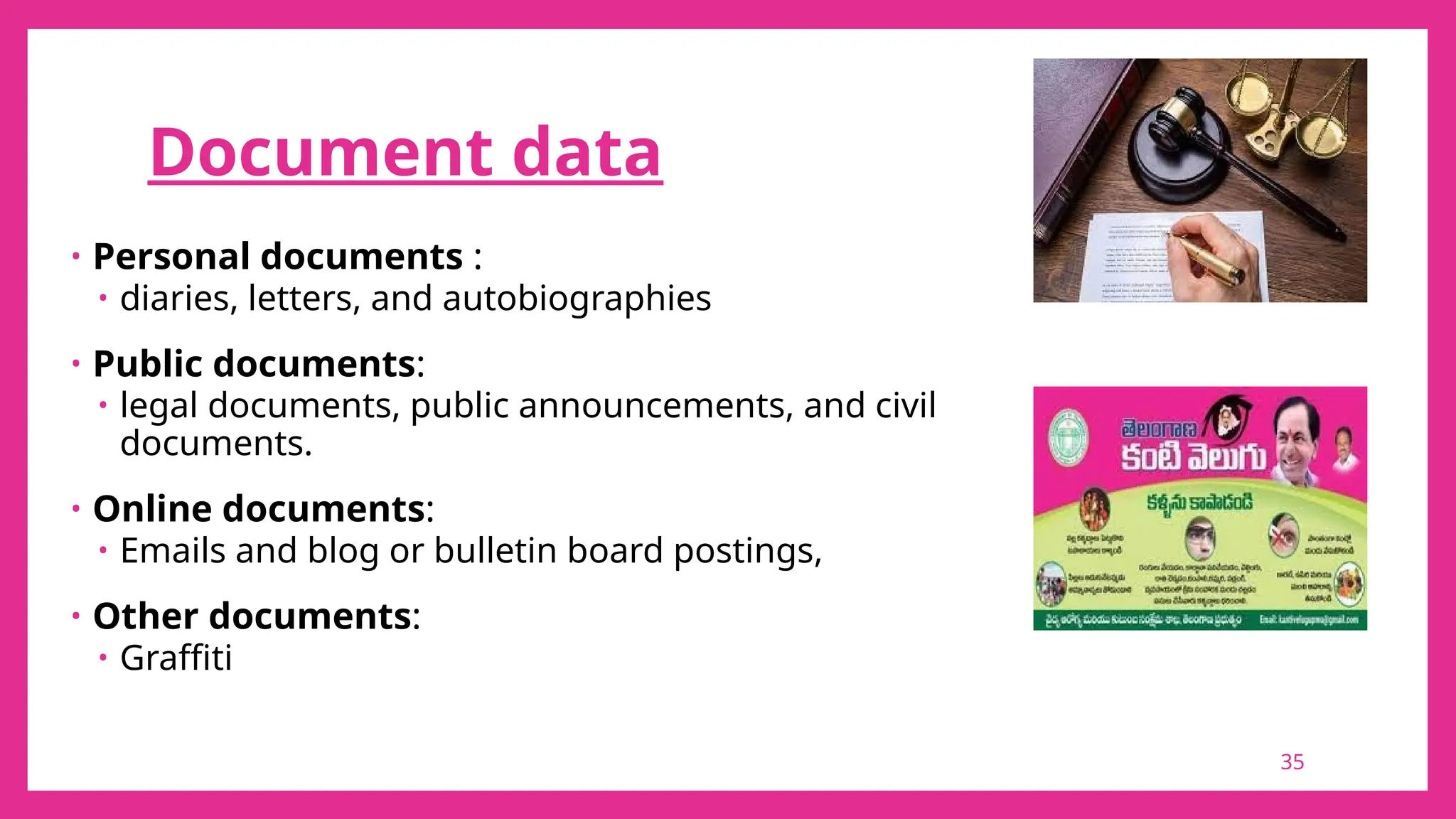
Document data
• Personal documents :
• diaries, letters, and autobiographies
• Public documents:
• legal documents, public announcements, and civil
documents.
• Online documents:
• Emails and blog or bulletin board postings,
• Other documents:
• Graffiti
34
Document data
• Personal documents :
• diaries, letters, and autobiographies
• Public documents:
• legal documents, public announcements, and civil
documents.
• Online documents:
• Emails and blog or bulletin board postings,
• Other documents:
• Graffiti
35
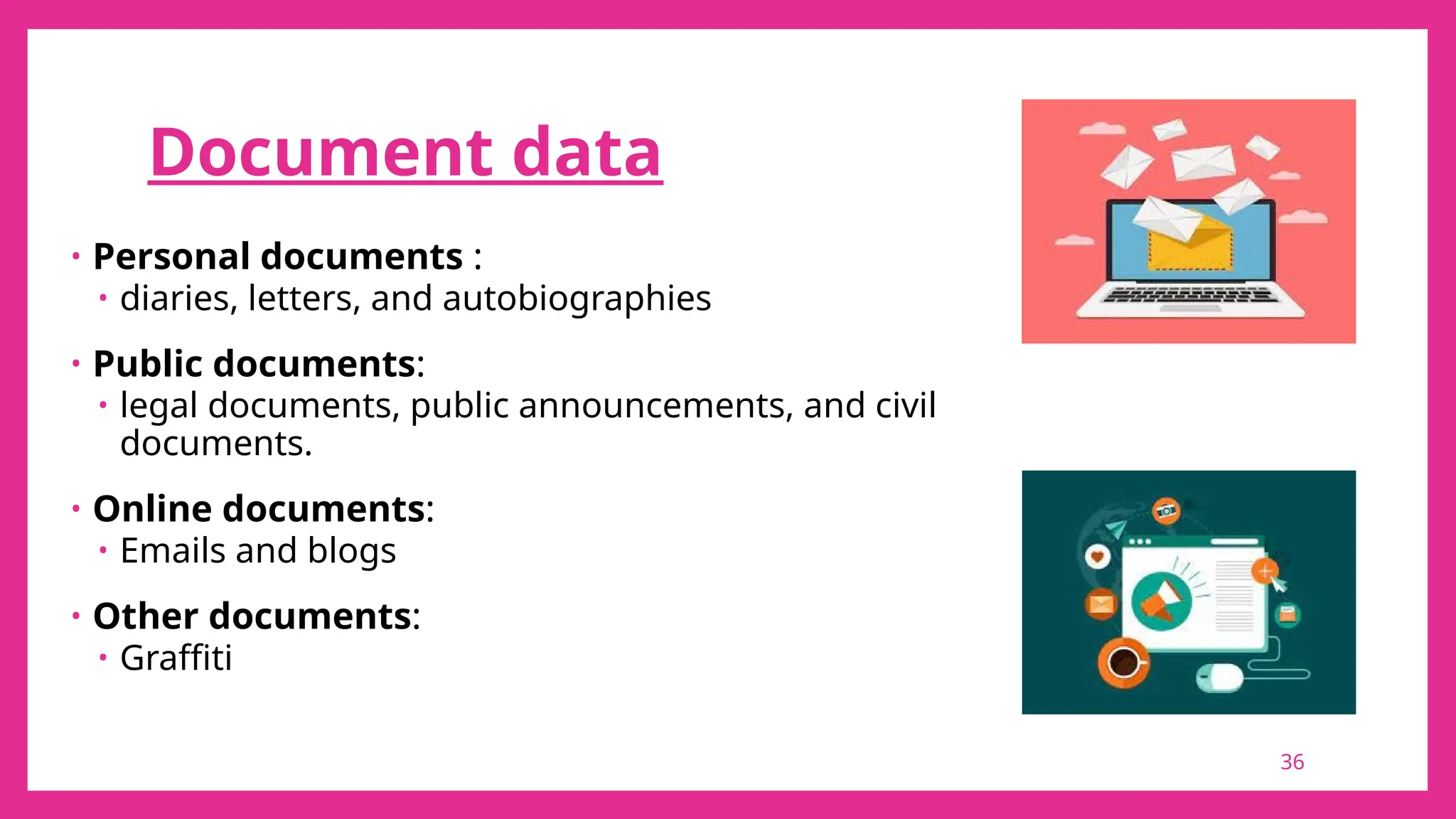
Document data
• Personal documents :
• diaries, letters, and autobiographies
• Public documents:
• legal documents, public announcements, and civil
documents.
• Online documents:
• Emails and blogs
• Other documents:
• Graffiti
36
37
Image data
• Acquired by the participant or researcher
• Photographs and videos
• Easily accessible, while they contain a significant amount of qualitative
meaning.
• Low acquisition cost.
• Data collected for the research may not have been orginally produced for
research.
• Researcher must verify the accuracy and authenticity of the data source
38
Data analysis
• Data analysis in qualitative research is defined as the process of
systematically searching and arranging the interview transcripts,
observation notes, or other non-textual materials that were collected by
the researcher to increase the understanding of the phenomenon.
• Inductive analysis.
• Qualitative research yields mainly unstructured text-based data.
• Some data may be multimedia.
Wong, L. (2008). Data Analysis in Qualitative Research: A Brief Guide to Using Nvivo. Malaysian Family
Physician : The Official Journal of the Academy of Family Physicians of Malaysia, 3(1), 14-20.
39
Data analysis
• Transcription:
• The first step in qualitative analysis is to transcribe the data, which
involves converting audio or video recordings of interviews, focus
groups, or other data sources into written form. This can be done
manually or with the help of software.
40
Data analysis
• Data coding or data categorization:
• Making sense of huge amounts of data by reducing the volume of raw information,
followed by identifying significant patterns, and finally drawing meaning from data.
• Identify the main themes, ideas, and concepts in the data and assign codes to them.
• Can be done using software.
• Users still have to create the categories, code, decide what to collate, identify the
patterns and draw meaning from the data.
• The programme merely takes over the marking, cutting, and sorting tasks.
41
Qualitative Data Analysis
Softwares(QDAS)
• Newly developed QDAS are called Computer Assisted QDAS(CAQDAS)
• NVivo 14
• ATLAS.ti
• MAXQDA
42
43
44
45
46
Data analysis
• Data interpretation:
• Identify themes and patterns that emerge from the data
• Link these themes to create a hypothesis or to provide an interpretation
of data.
47
Reporting of qualitative study
• COREQ (COnsolidated criteria for REporting Qualitative research) Checklist
• 32 item checklist
• Divided into 3 domains
• 1st
domain: Research team and reflexivity
• 2nd
domain : Study design
• 3rd
domain: analysis and findings
• COREQ_Checklist
48
49
Take Home Message
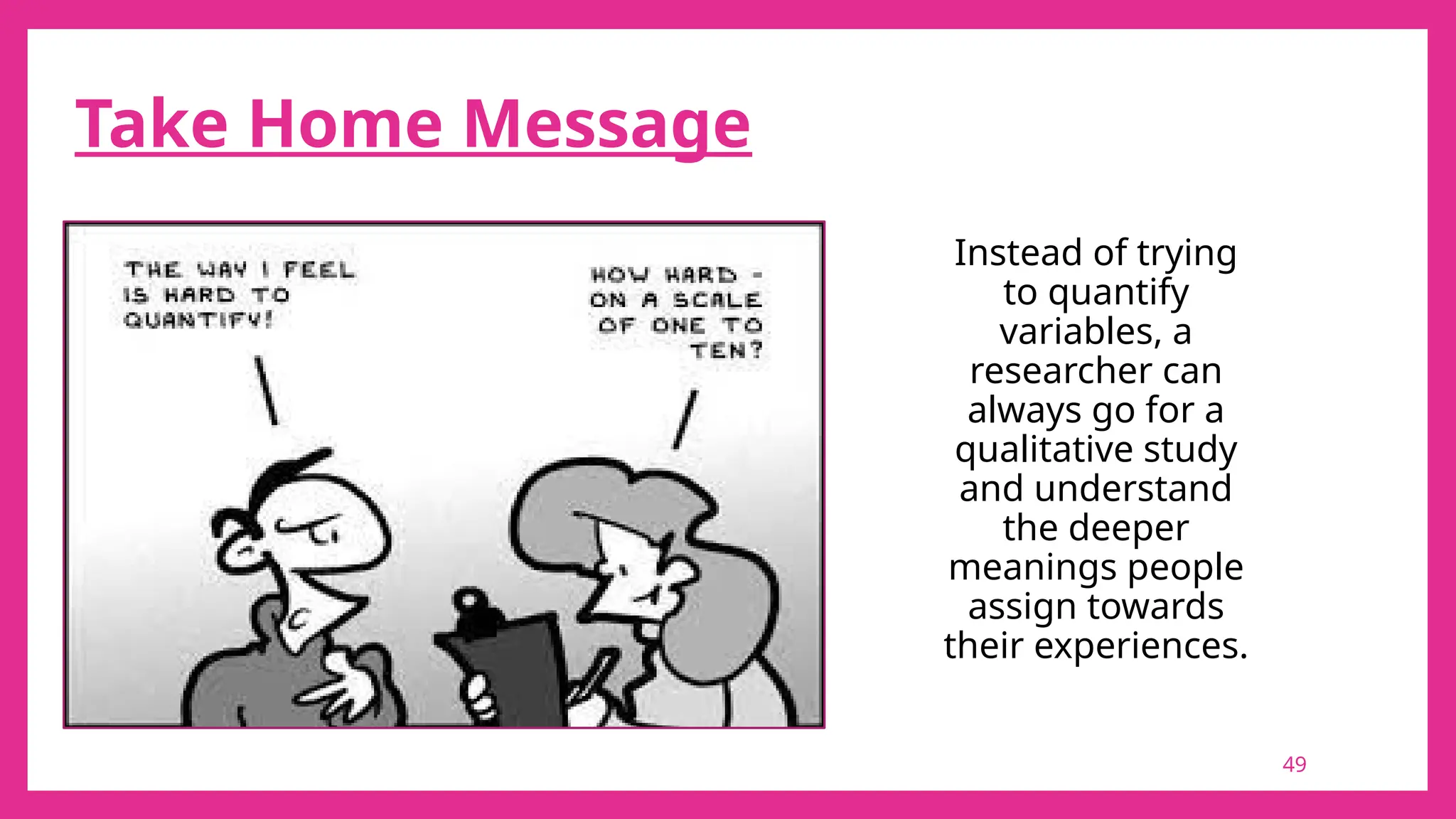
Instead of trying
to quantify
variables, a
researcher can
always go for a
qualitative study
and understand
the deeper
meanings people
assign towards
their experiences.
50
Take Home Message
• Qualitative and quantitative research use different ways of
exploring various health issues.
• Applying these two methods in combination - Mixed Method
Study.
• Synergistic effect
• More accurate understanding of a phenomenon
• Enhance the validity of the research
51
REFERENCES
1. Redman L. V, Mory A. V. H. The romance of research. 1st ed. Baltimore: The Williams & Wilkins
Company;1933.
2. Pope C, Mays N. Qualitative Research in Health Care. John Wiley & Sons; 2019. 218 p.
3. Pyo J, Lee W, Choi EY, Jang SG, Ock M. Qualitative Research in Healthcare: Necessity and Characteristics. J
Prev Med Pub Health. 2023 Jan 10;56(1):12–20.
4. Bogdan RC, Biklen SK. Qualitative research for education: An introduction to theory an methods
[Internet]. 3rd ed. Boston: Allyn and Bacon; [cited 2023 Mar 16]. Available from:
http://math.buffalostate.edu/dwilson/MED595/Qualitative_intro.pdf
5. introduction_to_qualitative_research.pdf [Internet]. [cited 2023 Mar 15]. Available from:
https://stu.westga.edu/~bthibau1/MEDT%208484-%20Baylen/introduction_to_qualitative_research/
introduction_to_qualitative_research.pdf
52
REFERENCES
6. Aksoy ME. A Qualitative Study on the Reasons for Social Media Addiction. Eur J Educ Res. 2018 Oct
15;7(4):861–5.
7. Vizeshfar F, Momennasab M, Yektatalab S, Iman MT. Empowering health volunteer’s through
participatory action research in a comprehensive healthcare center. BMC Public Health. 2021 May
10;21(1):889.
8. Strong KA, Lagerwey MD, Shadden BB. More Than a Story: My Life Came Back to Life. Am J Speech Lang
Pathol. 2018 Mar 1;27(1S):464–76.
9. Guest G, Bunce A, Johnson L. How Many Interviews Are Enough?: An Experiment with Data Saturation and
Variability. Field Methods. 2006 Feb 1;18(1):59–82.
10. Data analysis in qualitative research | Evidence-Based Nursing [Internet]. [cited 2023 Mar 16]. Available
from: https://ebn.bmj.com/content/3/3/68.short
53
REFERENCES
11. Wong L. Data Analysis in Qualitative Research: A Brief Guide to Using Nvivo. Malays Fam Physician Off J
Acad Fam Physicians Malays. 2008 Apr 30;3(1):14–20.
12. Kalpokas N, Radivojevic I. Bridging the Gap Between Methodology and Qualitative Data Analysis
Software: A Practical Guide for Educators and Qualitative Researchers. Sociol Res Online. 2022
Jun;27(2):313–41.
13. Thorne S. Data analysis in qualitative research. Evid Based Nurs. 2000 Jul 1;3(3):68–70.
14. AlYahmady HH, Al Abri SS. Using Nvivo for Data Analysis in Qualitative Research. Int Interdiscip J Educ.
2013 Feb;2(2):181–6.
15. A T, P S, J C. Consolidated criteria for reporting qualitative research (COREQ): a 32-item checklist for
interviews and focus groups. Int J Qual Health Care J Int Soc Qual Health Care [Internet]. 2007 Dec [cited
2023 Mar 17];19(6). Available from: https://pubmed.ncbi.nlm.nih.gov/17872937/
54
THANKYOU

a short review of Qualitative research in medical field

  • 1.
    QUALITATIVE RESEARCH DR STEFI MS, 1ST -YEAR POSTGRADUATE STUDENT DR SURENDRA BABU, ASSISTANT PROFESSOR DEPT OF COMMUNITY MEDICINE ESIC MC 1
  • 2.
    2 LEARNING OBJECTIVES Learn aboutqualitative research Compare qualitative and quantitative research Applications of qualitative research Steps in qualitative research
  • 3.
    3 OUTLINE Introduction 4-7 Comparison betweenqualitative and quantitative study 8 Applications of qualitative research 9 Steps and general workflow 10-46 Reporting of the qualitative study 47-48 Take home message 49-50 References 51-54
  • 4.
    4 INTRODUCTION • Redman andMory in their book Romance of the research define research as a “systematized effort to gain new knowledge”
  • 5.
    5 INTRODUCTION • OBJECTIVES OFRESEARCH: • To gain familiarity with a phenomenon or to achieve new insights into it • To portray accurately the characteristics of a particular individual, situation or a group • To determine the frequency with which something occurs or with which it is associated with something else • To test a hypothesis of a causal relationship between variables
  • 6.
    6 INTRODUCTION • Qualitative research: • Defined as “an interpretative approach to data collection and analysis that is concerned with meanings people attach to their experiences of the social world and how people make sense of that world” by Catherine Pope and Nicholas Mays in their book Qualitative Research in health care.
  • 7.
    7 INTRODUCTION • Qualitative studieshelp us understand why promising clinical interventions do not always work in the real world • How patients experience care • How practitioners think. • Tries to interpret social phenomena such as interactions, behaviours and communications in terms of the meaning people bring to them. • Particularly suited to studying people in their day-to-day setting. • Explore and explain the complex relations between the healthcare system and the outside world.
  • 8.
    8 COMPARISON Characteristics Quantitative researchQualitative research Research purpose Test a hypothesis, identify causal relationships Deep understanding of a phenomenon, new hypothesis/theories Variables Variables other than factors of interest is controlled View factors as natural Research view Objective, outsider view Insider view Data used Quantifiable, measurable data Non quantifiable, narrative data Data collection Questionnaire surveys/tests Observations, interviews Strengths High reliability and external validity High internal validity Weaknesses Difficult to obtain in depth understanding of a phenomena. Difficult to interpret the results in Weak generalizability Subjectivity of the researcher is Pyo J, Lee W, Choi EY, Jang SG, Ock M. Qualitative Research in Healthcare: Necessity and Characteristics. J Prev Med Public Health. 2023 Jan
  • 9.
    9 APPLICATIONS • Exploratory approachis required on not so well known topic. • Something cannot be explained fully with quantitative research. • When it is necessary to present a specific view on a research topic. • When presenting the rationale or theoretical proposition for designing hypotheses is inappropriate, as in quantitative research. • Research that requires detailed descriptive writing with literary expressions.
  • 10.
    STEPS 10 Selection of a research topic and question 01 Selection ofa theoretic al framewor k and method 02 Literature analysis 03 Selection of the research participa nts 04 Data collection 05 Data analysis and descripti on of findings 06
  • 11.
    11 General workflow ofqualitative research Selection of a research topic and question Selection of a theoretical framework and method Literature analysis Selection of the research participants Data collection Data analysis and description of findings All the processes are reversible and research methods can be modified later
  • 12.
    12 Selection Of ResearchTopic And Question • Research topic: • Based on interests from daily life • Interests in issues within the healthcare field • Ideas from literature. • Research question: • More specific aspects of the research topic • Is it executable? • Research topic and research question worth researching?
  • 13.
    13 Selection of theoretical frameworkand methods • A theoretical framework: Thoughts or attitudes that a researcher has about the phenomenon being researched.
  • 14.
    14 Methods in qualitativeresearch • Grounded theory • Ethnographic study • Phenomenology • Action research • Narrative research • Case studies
  • 15.
    15 Grounded theory • Suitablefor achieving the goal of developing a theory that can explain the process involved in the phenomenon being researched
  • 16.
    16 Ethnographic study • Suitablefor research topics that attempt to identify and interpret the culture of a specific group.
  • 17.
    17 Phenomenology • Suitable forresearch topics that attempt to identify the nature of research participants’ experiences or the phenomenon being researched.
  • 18.
    18 Action research • Suitablefor research that aims to find solutions to problems faced by the research participants
  • 19.
    19 Narrative research • Suitablefor research that attempt to interpret the entire life or individual experience contained within the stories of the research participants
  • 20.
    20 Literature analysis • Helpsin selecting research problem, theoretical framework and research method. • Helps to contemplate the new knowledge that the researcher will add to the field • Since the research process is cyclical literature review can be done at any time. • Some researchers point out that a literature review may introduce bias. • Ethical review and approval are required • Therefore the research protocol must be created and submitted for approval. • Some degree of review is required to create the research protocol
  • 21.
    21 Selection of researchparticipants • Subjects are humans • Research participants should have sufficient knowledge, experience, and attitudes to provide the most appropriate answer to the research question. • Participants who can best describe and demonstrate the phenomenon of interest
  • 22.
    22 Sampling methods: • Purposivesampling or purposeful sampling Sampling method Explanation Typical sampling Most typical Environment and participants Unique sampling Unique and uncommon situations or subjects Maximum variation sampling Subjects showing maximum variation within target population Convenience sampling Subjects who can be sampled most conveniently considering practical limitations, such as funding, time, and location Snowball sampling Selecting key research participants who satisfy the criteria established by the researcher and using their recommendations to recruit additional research Pyo J, Lee W, Choi EY, Jang SG, Ock M. Qualitative Research in Healthcare: Necessity and Characteristics. J Prev Med Public Health. 2023 Jan
  • 23.
    23 Sample size calculation •Typically relies on the concept of “saturation,” or the point at which no new information or themes are observed in the data. • Also ensure variability of data • Guest et al in their article “How Many Interviews Are Enough?” concludes that after 12 interviews, data saturation was attained. Guest G, Bunce A, Johnson L. How Many Interviews Are Enough?: An Experiment with Data Saturation and Variability. Field Methods. 2006 Feb 1;18(1):59–82.
  • 24.
    24 Data types/data source •Interview data • Observational data • Documented data • Image data
  • 25.
    25 Interview data • “Interview”: communication that takes place based on a clear sense of purpose of acquiring certain information. • Level of data will depend upon the interviewer’s abilities and knowledge.
  • 26.
    26 Interview data • Levelof structurization • Structured interview • Semi-structured interview • Unstructured interview • Size • One-on-one in-depth interview • Focus group discussion • Interview method • Face to face • Non-face to face
  • 27.
    27 Level of structurization Structuredinterview: Data is collected by asking closed questions in the order provided by highly specific interview guidelines
  • 28.
    28 Level of structurization Semi-structuredinterview Interview guidelines are set but the questions are not strictly set. Most widely used Allows flexibility Researcher bias
  • 29.
    29 Level of structurization Unstructuredinterview Interview like a regular conversation Can obtain rich and realistic meaning and experiences of participants The quality of information and length of the interview varies according to the interviewer’s competency
  • 30.
    30 Size • One-on-one in-depthinterview • A single participant discusses the research topic with the researcher • Sometimes there is a need for a guardian present (children, elderly frail patients)
  • 31.
    31 Size • Focus groupdiscussion • At least 2 participants discuss the research topic during a session led by the researcher • Generally 4-6 participants • More effective with adolescents and children • Richer data obtained by promoting interaction within group. • Some participants may feel left out or not share the opinion
  • 32.
    32 Interview method • Face-to-faceinterview • Interviewer personally meets the participant to conduct the interview • Easy to build rapport • Can respond properly to the interview by identifying nonverbal messages • Non-face-to-face interview • Telephone, videoconferencing or email • Suitable for research topics which are political or intimate personal matters • Email interviews give enough time for the participants to think before responding. • Difficult to build rapport and obtain honest experiences • Possibility of misinterpreting the responses
  • 33.
    33 Observational data • Systematicallyexamining the appearances and behaviours of research participants that take place in natural situations. • Participative and non participative observations.
  • 34.
    Document data • Personaldocuments : • diaries, letters, and autobiographies • Public documents: • legal documents, public announcements, and civil documents. • Online documents: • Emails and blog or bulletin board postings, • Other documents: • Graffiti 34
  • 35.
    Document data • Personaldocuments : • diaries, letters, and autobiographies • Public documents: • legal documents, public announcements, and civil documents. • Online documents: • Emails and blog or bulletin board postings, • Other documents: • Graffiti 35
  • 36.
    Document data • Personaldocuments : • diaries, letters, and autobiographies • Public documents: • legal documents, public announcements, and civil documents. • Online documents: • Emails and blogs • Other documents: • Graffiti 36
  • 37.
    37 Image data • Acquiredby the participant or researcher • Photographs and videos • Easily accessible, while they contain a significant amount of qualitative meaning. • Low acquisition cost. • Data collected for the research may not have been orginally produced for research. • Researcher must verify the accuracy and authenticity of the data source
  • 38.
    38 Data analysis • Dataanalysis in qualitative research is defined as the process of systematically searching and arranging the interview transcripts, observation notes, or other non-textual materials that were collected by the researcher to increase the understanding of the phenomenon. • Inductive analysis. • Qualitative research yields mainly unstructured text-based data. • Some data may be multimedia. Wong, L. (2008). Data Analysis in Qualitative Research: A Brief Guide to Using Nvivo. Malaysian Family Physician : The Official Journal of the Academy of Family Physicians of Malaysia, 3(1), 14-20.
  • 39.
    39 Data analysis • Transcription: •The first step in qualitative analysis is to transcribe the data, which involves converting audio or video recordings of interviews, focus groups, or other data sources into written form. This can be done manually or with the help of software.
  • 40.
    40 Data analysis • Datacoding or data categorization: • Making sense of huge amounts of data by reducing the volume of raw information, followed by identifying significant patterns, and finally drawing meaning from data. • Identify the main themes, ideas, and concepts in the data and assign codes to them. • Can be done using software. • Users still have to create the categories, code, decide what to collate, identify the patterns and draw meaning from the data. • The programme merely takes over the marking, cutting, and sorting tasks.
  • 41.
    41 Qualitative Data Analysis Softwares(QDAS) •Newly developed QDAS are called Computer Assisted QDAS(CAQDAS) • NVivo 14 • ATLAS.ti • MAXQDA
  • 42.
  • 43.
  • 44.
  • 45.
  • 46.
    46 Data analysis • Datainterpretation: • Identify themes and patterns that emerge from the data • Link these themes to create a hypothesis or to provide an interpretation of data.
  • 47.
    47 Reporting of qualitativestudy • COREQ (COnsolidated criteria for REporting Qualitative research) Checklist • 32 item checklist • Divided into 3 domains • 1st domain: Research team and reflexivity • 2nd domain : Study design • 3rd domain: analysis and findings • COREQ_Checklist
  • 48.
  • 49.
    49 Take Home Message Insteadof trying to quantify variables, a researcher can always go for a qualitative study and understand the deeper meanings people assign towards their experiences.
  • 50.
    50 Take Home Message •Qualitative and quantitative research use different ways of exploring various health issues. • Applying these two methods in combination - Mixed Method Study. • Synergistic effect • More accurate understanding of a phenomenon • Enhance the validity of the research
  • 51.
    51 REFERENCES 1. Redman L.V, Mory A. V. H. The romance of research. 1st ed. Baltimore: The Williams & Wilkins Company;1933. 2. Pope C, Mays N. Qualitative Research in Health Care. John Wiley & Sons; 2019. 218 p. 3. Pyo J, Lee W, Choi EY, Jang SG, Ock M. Qualitative Research in Healthcare: Necessity and Characteristics. J Prev Med Pub Health. 2023 Jan 10;56(1):12–20. 4. Bogdan RC, Biklen SK. Qualitative research for education: An introduction to theory an methods [Internet]. 3rd ed. Boston: Allyn and Bacon; [cited 2023 Mar 16]. Available from: http://math.buffalostate.edu/dwilson/MED595/Qualitative_intro.pdf 5. introduction_to_qualitative_research.pdf [Internet]. [cited 2023 Mar 15]. Available from: https://stu.westga.edu/~bthibau1/MEDT%208484-%20Baylen/introduction_to_qualitative_research/ introduction_to_qualitative_research.pdf
  • 52.
    52 REFERENCES 6. Aksoy ME.A Qualitative Study on the Reasons for Social Media Addiction. Eur J Educ Res. 2018 Oct 15;7(4):861–5. 7. Vizeshfar F, Momennasab M, Yektatalab S, Iman MT. Empowering health volunteer’s through participatory action research in a comprehensive healthcare center. BMC Public Health. 2021 May 10;21(1):889. 8. Strong KA, Lagerwey MD, Shadden BB. More Than a Story: My Life Came Back to Life. Am J Speech Lang Pathol. 2018 Mar 1;27(1S):464–76. 9. Guest G, Bunce A, Johnson L. How Many Interviews Are Enough?: An Experiment with Data Saturation and Variability. Field Methods. 2006 Feb 1;18(1):59–82. 10. Data analysis in qualitative research | Evidence-Based Nursing [Internet]. [cited 2023 Mar 16]. Available from: https://ebn.bmj.com/content/3/3/68.short
  • 53.
    53 REFERENCES 11. Wong L.Data Analysis in Qualitative Research: A Brief Guide to Using Nvivo. Malays Fam Physician Off J Acad Fam Physicians Malays. 2008 Apr 30;3(1):14–20. 12. Kalpokas N, Radivojevic I. Bridging the Gap Between Methodology and Qualitative Data Analysis Software: A Practical Guide for Educators and Qualitative Researchers. Sociol Res Online. 2022 Jun;27(2):313–41. 13. Thorne S. Data analysis in qualitative research. Evid Based Nurs. 2000 Jul 1;3(3):68–70. 14. AlYahmady HH, Al Abri SS. Using Nvivo for Data Analysis in Qualitative Research. Int Interdiscip J Educ. 2013 Feb;2(2):181–6. 15. A T, P S, J C. Consolidated criteria for reporting qualitative research (COREQ): a 32-item checklist for interviews and focus groups. Int J Qual Health Care J Int Soc Qual Health Care [Internet]. 2007 Dec [cited 2023 Mar 17];19(6). Available from: https://pubmed.ncbi.nlm.nih.gov/17872937/
  • 54.

Editor's Notes

  • #6 Interpretative : interpreting and making meaning of the data collected. In simple terms qualitative research involves the interpretation of people’s experience, behaviours, their views on what is happening around them.
  • #8 Narrative data is data that can be expressed as words or images.in depth understanding which cannot be expressed by numbers alone.
  • #9 Who is a non binary person? what are the living experiences of a non binary person? For example in a cross sectional study to find the factors affecting the compliance of ifa.most leading cause was forgetfulness...but study didn’t give any insights regarding why there is forgetfulness, is it because they were not emphasised about the importance or because they are too busy with household works or if they face any psychological stress, there could be lots of subjective reasons, which was not included in the study. Here there is an application of qualitative study. Usually for qualitative studies, we need to have a research question, a hypothesis, whereas qualitative researches is mostly open ended.if a researcher wants to know what doctors think about differences in gender. there is no hypothesis, no testing of hypothesis. In a research on “how prayer relieves pain” more than numbers we need literary expressions to completely express our results, so that’s another application of qualitative study.
  • #11 A quantitative research is mostly unidirectional.
  • #13 Theoretical framework: idea or plan on “which methods and proceedings to use for the research”….next is selecting method for study…so what are the methods in qualitative study
  • #14 Case study is in detailed description of a particular event or case
  • #20 Contemplate= THINK ABOUT
  • #21 In quantitative research it can be ecosystems, plants , animals, abstract concepts.. in quantitative research, we want the sample population to be representative of the study population.
  • #22 Purposeful sampling is a non-probability sampling technique, to identify and select participants who are most likely to provide rich and meaningful data that can help answer the research question or achieve the research objectives…Diversified sample population: eg, women’s perception of hormonal contraceptives , itll be good to have samples who are totally against using and those who have very high opinions about hormonal contraceptives. Sometimes this is not possible, if due to some limitations we could only take women of urban area not rural area.so it is convenience sampling.
  • #23 variability refers to the diversity or range of responses, experiences, or perspectives within a sample or population.
  • #24 Theres use of multiple data sources in qualitative study.
  • #25 Interview data is obtained from interviews
  • #26 Interview data is obtained from interviews
  • #27 Flexibility depending on the characteristics and responses of the participants.interviewers’ competency such as conversational skills and reasoning ability
  • #28 Flexibility depending on the characteristics and responses of the participants. interviewers’ competency such as conversational skills and reasoning ability
  • #31 Richer experiences and opinions can be obtained by promoting interaction within the group. If 1-2 people are dominating the discussion
  • #38 Deductive analysis: well have a hypothesis and data or observation are used to test this hypothesis. Inductive analysis: observations or data are used to develop a hypothesis
  • #40 For example a researcher wants to study about stress in pg life, planning as a phenomenological study.many pgs will have different opinions about stress in pg life, some people might talk about reasons of stress, some people might talk about effect of stress, in reasons of stress, lack of work life balance, lack of personal time, I can only think about work, i am not able to do my hobby, I don’t have time to cook, I am not able to spend time with my family.
  • #46 For example in previous study, researcher started as a phenomenology , but while analysis data , we are seeing the theme of lack of worklife balance linked to theme of stress during pg life, our method of study is becoming a grounded theory, so as to find reason behind stress during pg life.this also denotes the cyclical nature of the qualitative framework.our interpretation could be lack of worklife balance as main reason behind stress in pg life.
  • #48 Tong et al…summariseing main difference between quantitative and qualitative is the type of data, collection of data, how samples are selected, analysis.