1
By :
Parinda Rajapaksha
Samudra Herath
Isuri Udayangi
Najini Harischandra
Roadmap
 Introduction
 Scientific Method
 How related to Computer Science?
 Modeling
 Theoretical Computer Science
 Experimental Computer Science
 Computer Simulation
 Pros & Cons
2
What is Science ?
 A systematic and logical approach to discovering how
things in the universe work.
 It aims for measurable results through testing and analysis.
 It is not meant to prove theories, but rule out alternative
explanations until a likely conclusion is reached
3
What is Science Cont…
 Science consists simply of the formulation and testing of
hypotheses based on observational evidence.
 Science is useful and ongoing.
4
How related to Computer Science?
 Study of phenomena related to computers.
 Computing encompasses,
- Computer Science
- Computer Engineering
- Software Engineering
- Information Systems
 The purpose of Computing is the systematic study of
algorithmic processes that describe and transform
information their theory, analysis, design, efficiency and
implementation
5
Scientific Method
 In 19th century.
 scientific method is the logical scheme used by scientists
searching for answers to the questions
 It is used to produce scientific theories..
 When conducting a research, scientists observe the scientific
method to collect measurable, empirical evidence in an
experiment related to a hypothesis.
6
Scientific Method Cont…
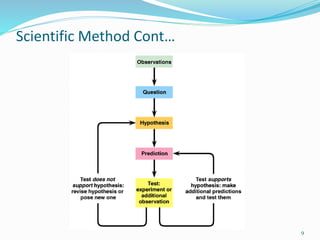
The steps of the scientific method :
1. Pose the question in the context of existing knowledge
(theory & observations)
2. Formulate a hypothesis as a tentative answer
3. Deduce consequences and make predictions
4. Test the hypothesis in a specific experiment/theory field
•In case the hypothesis leads to contradictions and demands a
radical change in the existing theoretical background, it has to be
tested carefully
7
Scientific Method Cont…
Rule:
• loop 2-3-4 is repeated with modifications of the hypothesis until
the agreement is obtained, which leads to 5.
• If major discrepancies are found the process must start from the
beginning, 1.
5. When consistency is obtained the hypothesis becomes a
theory and provides a coherent set of propositions that
define a new class of phenomena or a new theoretical
concept
6. A theory is then becoming a framework within which
observations/theoretical facts are explained and predictions
are made
8
Scientific Method Cont…
9
Scientific Method Cont…
Some key underpinnings to the scientific method:
 The hypothesis must be testable and falsifiable
 Deductive reasoning is the process of using true
premises to reach a logical true conclusion
 dependent variable and an independent variable
 experimental group and a control group.
10
What is Computer Science?
11
Many definitions
 Study of algorithmic processes that describe and transform
information
 Study of phenomena related to computers
 Study of information structures
 Study and management of complexity
 Mechanization of abstraction
12
Mixture of
 Engineering
 Mathematics
 Logic
 Management
Generally CS is,
Information theory concerned on transformation and
interpretation of information
13
 Computer science encompasses abstract mathematical
thinking and includes an element of engineering.
 Finding solutions
 Designing skills
14
Sub-areas of Computer Science
1. Discrete Structures
2. Programming Fundamentals
3. Algorithms and Complexity
4. Programming Languages
5. Architecture and Organization
6. Operating Systems & etc..
15
List expands as computer science
develops..
16
 CS Objectives change with time
 Development of theories
 Practical experience in usage
17
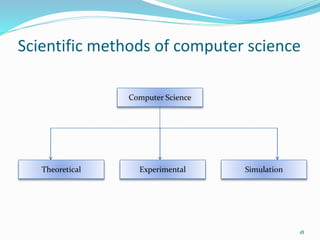
Scientific methods of computer science
Computer Science
Theoretical Experimental Simulation
18
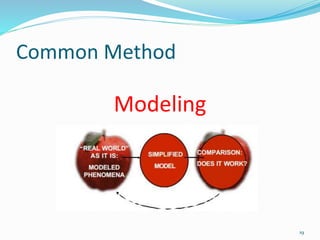
Common Method
Modeling
19
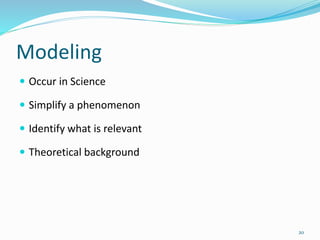
Modeling
 Occur in Science
 Simplify a phenomenon
 Identify what is relevant
 Theoretical background
20
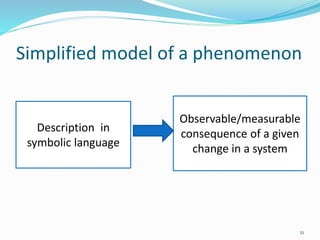
Simplified model of a phenomenon
Description in
symbolic language
Observable/measurable
consequence of a given
change in a system
21
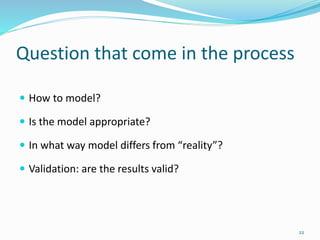
Question that come in the process
 How to model?
 Is the model appropriate?
 In what way model differs from “reality”?
 Validation: are the results valid?
22
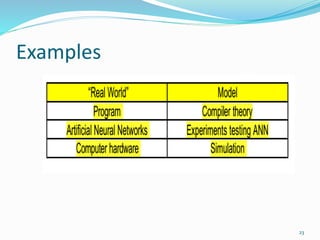
Examples
23
 Modeling process scheme follows the general scheme of
scientific method presented before
 Theory, experiment and simulation are all about models
of phenomena.
24
What is theoretical computer
Science?
 Subset of general computer science and mathematics
 focus on more abstract or mathematical aspects of computing
 Includes the theory of computation
 Follows a very classical methodology of building theories with
rigid definitions of
 Objects
 operations
25
Key recurring ideas of computing
 Conceptual and formal models
 Different levels of abstraction
 Efficiency
26
Data models
 Use to formulate different mathematical concepts
 CS data model – two aspects
 Values they can assume
 Operations on data
27
Typical data model examples
 Tree data model
 List data model
 Set data model
 Relational data model
 Graph data model
 Patterns, automata and regular expression
28
Physical science and computer
science
 Do not compete with each other on which better explains
the fundamental nature of information
 No new theories develop to reconcile theory with
experimental results reveal unexpected phenomena
 No history of critical experiments that decide the validity
of various theories
29
Design and analysis
 Methods are developed for algorithm design
 Measures are defined for computational resources
 Trade offs are explored
 Upper and lower resource bounds are proved
30
Main methodological themes
 Iteration – performing sequence of operations repeatedly
 Iterative constructs such as for /while statements
 Recursion – call themselves directly or indirectly
 Induction – definitions and proofs use basis and inductive
step to encompass all possible cases.
31
Experimental Computer Science
32
What is experimental computer
science?
 Three components define experimental science
 Observation
 Hypothesis testing
 Reproducibility
33
 Experimental computer science
 Mathematical modeling of the behavior of computer
systems
34
Fields of computer science use
experiments
 Search
 Automatic theorem proving
 Planning
 NP complete problems
 Natural language
 Vision
 Games
 Machine learning
35
Computer Simulation
36
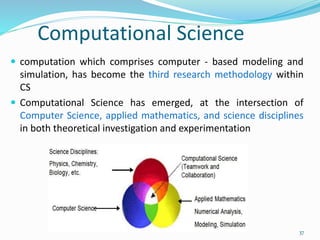
 computation which comprises computer - based modeling and
simulation, has become the third research methodology within
CS
 Computational Science has emerged, at the intersection of
Computer Science, applied mathematics, and science disciplines
in both theoretical investigation and experimentation
Computational Science
37
Computational Science Cont…
Tools
 modeling with 3D visualization and computer simulation
 efficient handling of large data sets
 ability to access a variety of distributed resources
 collaborate with other experts over the Internet
38
Computational Science Cont…
 Computational science involves the use of computers
(''supercomputers'') for visualization and simulation of
complex and large-scale phenomena.
 If Computer Science has its basis in computability theory,
then computational science has its basis in computer
simulation
39
Computer Simulation
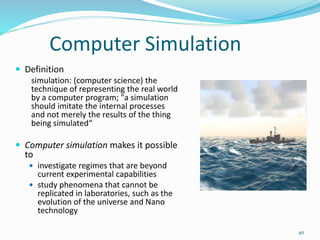
 Definition
simulation: (computer science) the
technique of representing the real world
by a computer program; "a simulation
should imitate the internal processes
and not merely the results of the thing
being simulated“
 Computer simulation makes it possible
to
 investigate regimes that are beyond
current experimental capabilities
 study phenomena that cannot be
replicated in laboratories, such as the
evolution of the universe and Nano
technology
40
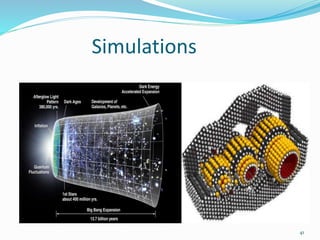
Simulations
41
Key Areas
 Chaos and Complex Systems
 Virtual Reality
 Artificial Life
 Physically Based Modeling and Computer
Animation
42
Advantages and Disadvantages
 Advantage
 You can test in many different ways, and the more times
you test, the more accurate your results will be
 Disadvantage
 You can come up with different results which can disprove
your hypothesis, and this leads to inconsistent conclusions
43
Wrap-Up
 Introduction
 Scientific Method
 How related to Computer Science?
 Modeling
 Theoretical Computer Science
 Experimental Computer Science
 Computer Simulation
 Pros & Cons
44
References
1. Some definitions of Science :
http://www.gly.uga.edu/railsback/1122sciencedefns.html
2. Computing as a Discipline, Denning, P.J. et al. Commun. ACM
32, 1 (January 1989), 9
3. What is computer science ? :
http://www.cs.mtu.edu/~john/whatiscs.html
45

Scientific methods in computer science

  • 1.
    1 By : Parinda Rajapaksha SamudraHerath Isuri Udayangi Najini Harischandra
  • 2.
    Roadmap  Introduction  ScientificMethod  How related to Computer Science?  Modeling  Theoretical Computer Science  Experimental Computer Science  Computer Simulation  Pros & Cons 2
  • 3.
    What is Science?  A systematic and logical approach to discovering how things in the universe work.  It aims for measurable results through testing and analysis.  It is not meant to prove theories, but rule out alternative explanations until a likely conclusion is reached 3
  • 4.
    What is ScienceCont…  Science consists simply of the formulation and testing of hypotheses based on observational evidence.  Science is useful and ongoing. 4
  • 5.
    How related toComputer Science?  Study of phenomena related to computers.  Computing encompasses, - Computer Science - Computer Engineering - Software Engineering - Information Systems  The purpose of Computing is the systematic study of algorithmic processes that describe and transform information their theory, analysis, design, efficiency and implementation 5
  • 6.
    Scientific Method  In19th century.  scientific method is the logical scheme used by scientists searching for answers to the questions  It is used to produce scientific theories..  When conducting a research, scientists observe the scientific method to collect measurable, empirical evidence in an experiment related to a hypothesis. 6
  • 7.
    Scientific Method Cont… Thesteps of the scientific method : 1. Pose the question in the context of existing knowledge (theory & observations) 2. Formulate a hypothesis as a tentative answer 3. Deduce consequences and make predictions 4. Test the hypothesis in a specific experiment/theory field •In case the hypothesis leads to contradictions and demands a radical change in the existing theoretical background, it has to be tested carefully 7
  • 8.
    Scientific Method Cont… Rule: •loop 2-3-4 is repeated with modifications of the hypothesis until the agreement is obtained, which leads to 5. • If major discrepancies are found the process must start from the beginning, 1. 5. When consistency is obtained the hypothesis becomes a theory and provides a coherent set of propositions that define a new class of phenomena or a new theoretical concept 6. A theory is then becoming a framework within which observations/theoretical facts are explained and predictions are made 8
  • 9.
  • 10.
    Scientific Method Cont… Somekey underpinnings to the scientific method:  The hypothesis must be testable and falsifiable  Deductive reasoning is the process of using true premises to reach a logical true conclusion  dependent variable and an independent variable  experimental group and a control group. 10
  • 11.
    What is ComputerScience? 11
  • 12.
    Many definitions  Studyof algorithmic processes that describe and transform information  Study of phenomena related to computers  Study of information structures  Study and management of complexity  Mechanization of abstraction 12
  • 13.
    Mixture of  Engineering Mathematics  Logic  Management Generally CS is, Information theory concerned on transformation and interpretation of information 13
  • 14.
     Computer scienceencompasses abstract mathematical thinking and includes an element of engineering.  Finding solutions  Designing skills 14
  • 15.
    Sub-areas of ComputerScience 1. Discrete Structures 2. Programming Fundamentals 3. Algorithms and Complexity 4. Programming Languages 5. Architecture and Organization 6. Operating Systems & etc.. 15
  • 16.
    List expands ascomputer science develops.. 16
  • 17.
     CS Objectiveschange with time  Development of theories  Practical experience in usage 17
  • 18.
    Scientific methods ofcomputer science Computer Science Theoretical Experimental Simulation 18
  • 19.
  • 20.
    Modeling  Occur inScience  Simplify a phenomenon  Identify what is relevant  Theoretical background 20
  • 21.
    Simplified model ofa phenomenon Description in symbolic language Observable/measurable consequence of a given change in a system 21
  • 22.
    Question that comein the process  How to model?  Is the model appropriate?  In what way model differs from “reality”?  Validation: are the results valid? 22
  • 23.
  • 24.
     Modeling processscheme follows the general scheme of scientific method presented before  Theory, experiment and simulation are all about models of phenomena. 24
  • 25.
    What is theoreticalcomputer Science?  Subset of general computer science and mathematics  focus on more abstract or mathematical aspects of computing  Includes the theory of computation  Follows a very classical methodology of building theories with rigid definitions of  Objects  operations 25
  • 26.
    Key recurring ideasof computing  Conceptual and formal models  Different levels of abstraction  Efficiency 26
  • 27.
    Data models  Useto formulate different mathematical concepts  CS data model – two aspects  Values they can assume  Operations on data 27
  • 28.
    Typical data modelexamples  Tree data model  List data model  Set data model  Relational data model  Graph data model  Patterns, automata and regular expression 28
  • 29.
    Physical science andcomputer science  Do not compete with each other on which better explains the fundamental nature of information  No new theories develop to reconcile theory with experimental results reveal unexpected phenomena  No history of critical experiments that decide the validity of various theories 29
  • 30.
    Design and analysis Methods are developed for algorithm design  Measures are defined for computational resources  Trade offs are explored  Upper and lower resource bounds are proved 30
  • 31.
    Main methodological themes Iteration – performing sequence of operations repeatedly  Iterative constructs such as for /while statements  Recursion – call themselves directly or indirectly  Induction – definitions and proofs use basis and inductive step to encompass all possible cases. 31
  • 32.
  • 33.
    What is experimentalcomputer science?  Three components define experimental science  Observation  Hypothesis testing  Reproducibility 33
  • 34.
     Experimental computerscience  Mathematical modeling of the behavior of computer systems 34
  • 35.
    Fields of computerscience use experiments  Search  Automatic theorem proving  Planning  NP complete problems  Natural language  Vision  Games  Machine learning 35
  • 36.
  • 37.
     computation whichcomprises computer - based modeling and simulation, has become the third research methodology within CS  Computational Science has emerged, at the intersection of Computer Science, applied mathematics, and science disciplines in both theoretical investigation and experimentation Computational Science 37
  • 38.
    Computational Science Cont… Tools modeling with 3D visualization and computer simulation  efficient handling of large data sets  ability to access a variety of distributed resources  collaborate with other experts over the Internet 38
  • 39.
    Computational Science Cont… Computational science involves the use of computers (''supercomputers'') for visualization and simulation of complex and large-scale phenomena.  If Computer Science has its basis in computability theory, then computational science has its basis in computer simulation 39
  • 40.
    Computer Simulation  Definition simulation:(computer science) the technique of representing the real world by a computer program; "a simulation should imitate the internal processes and not merely the results of the thing being simulated“  Computer simulation makes it possible to  investigate regimes that are beyond current experimental capabilities  study phenomena that cannot be replicated in laboratories, such as the evolution of the universe and Nano technology 40
  • 41.
  • 42.
    Key Areas  Chaosand Complex Systems  Virtual Reality  Artificial Life  Physically Based Modeling and Computer Animation 42
  • 43.
    Advantages and Disadvantages Advantage  You can test in many different ways, and the more times you test, the more accurate your results will be  Disadvantage  You can come up with different results which can disprove your hypothesis, and this leads to inconsistent conclusions 43
  • 44.
    Wrap-Up  Introduction  ScientificMethod  How related to Computer Science?  Modeling  Theoretical Computer Science  Experimental Computer Science  Computer Simulation  Pros & Cons 44
  • 45.
    References 1. Some definitionsof Science : http://www.gly.uga.edu/railsback/1122sciencedefns.html 2. Computing as a Discipline, Denning, P.J. et al. Commun. ACM 32, 1 (January 1989), 9 3. What is computer science ? : http://www.cs.mtu.edu/~john/whatiscs.html 45