41
MSN Entry test preparation
2nd
session Research
Prepared by Mr. Adeel Nouman , M.Phil. Biostatistics
Ms. Shehla Bano, BSN(Gold medalist), M.SN, MSC Psychology
It is important to recognize that systematic observationand testing can be accomplished using
a wide variety of methods. Many people think of scientific inquiry strictly in terms of
laboratory experimentation. However, it is neither possible nor desirable to study all
phenomena of interest under controlled laboratory conditions.
The design of any study begins with the selection of a topic and a research methodology.
These initial decisions reflect assumptions about the social world, how science should be
conducted, and what constitutes legitimate problems, solutions, and criteria of "proof."
Different approaches to research encompass both theory and method. Two general
approaches are widely recognized: quantitative research and qualitative research.
Quantitative research is an inquiry into an identified problem, based on testing a theory,
measured with numbers, and analyzed using statistical techniques. The goal of quantitative
methods is to determine whether the predictive generalizations of a theory hold true.
Learning Objectives
Upon completion of this chapter, the reader should be able to:
Understand the differences between quantitative and qualitative research,
including:
the differing assumptions underlying the two approaches;
the methods typical of each approach; and
Understand and discuss how these two approaches to research differentially
influence the scientific questions asked, the methodologies employed, and the
conclusions drawn, and why this is important to consider.
By contrast, a study based upon a qualitative process of inquiry has the goal of
understanding a social or human problem from multiple perspectives. Qualitative research
is conducted in a natural setting and involves a process of building a complex and holistic
picture of the phenomenon of interest.
The selection of which research approach is appropriate in a given study should be based
upon the problemofinterest, resources available, the skills and training ofthe researcher, and
the audience for the research. Although some research mayincorporate bothquantitative and
qualitative methodologies, in their ‘pure’ form there are significant differences in the
assumptions underlying these approaches, as well as in the data collection and analysis
procedures used.
Quantitative Methods
Why is the distinction between quantitative and qualitative research important?
It is important to be able to identify and understand the research approach underlying any given
study because the selection of a research approach influencesthe questionsasked, the methods
chosen, the statistical analysesused, the inferencesmade, and the ultimate goal of the research.
When critically reviewing scientific research, the questions asked, and the answers given, will
differ depending upon whether the research is quantitative or qualitative.
Assumptions Underlying Quantitative Methods
reality is objective, “out there,” and independent of the researcher -- therefore reality is
something that can be studied objectively;
the researcher should remain distant and independent of what is being researched;
the values of the researcher do not interfere with, or become part of, the research --
research is value-free;
research is based primarily on deductive forms of logic and theories and hypotheses are
tested in a cause-effect order; and
the goal isto develop generalizationsthat contribute to theory that enable the researcher
to predict, explain, and understand some phenomenon.
43
Three general types of quantitative methods:
1. Experiments True experiments are characterized by random assignment of
subjects to experimental conditions and the use of experimental controls.
2. Quasi-Experiments Quasi-experimental studies share almost all the features of
experimentaldesigns except that they involve non-randomized assignment ofsubjects
to experimental conditions.
3. Surveys Surveys include cross-sectional and longitudinal studies using
questionnaires or interviews for data collection with the intent of estimating the
characteristics of a large population of interest based on a smaller sample from that
population.
Qualitative Methods
Three general types of qualitative methods:
1. Case Studies In a case study the researcher explores a single entity or phenomenon
(‘the case’) bounded by time and activity (e.g., a program, event, institution, or
socialgroup) and collects detailed information througha varietyofdata
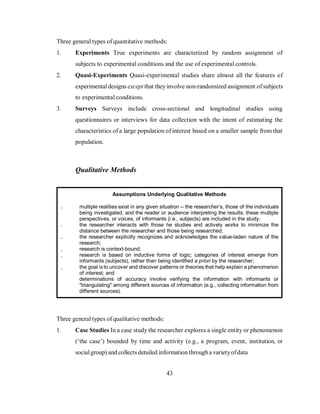
Assumptions Underlying Qualitative Methods
multiple realities exist in any given situation -- the researcher’s, those of the individuals
being investigated, and the reader or audience interpreting the results; these multiple
perspectives, or voices, of informants (i.e., subjects) are included in the study;
the researcher interacts with those he studies and actively works to minimize the
distance between the researcher and those being researched;
the researcher explicitly recognizes and acknowledges the value-laden nature of the
research;
research is context-bound;
research is based on inductive forms of logic; categories of interest emerge from
informants (subjects), rather than being identified a priori by the researcher;
the goal isto uncover and discover patterns or theories that help explain a phenomenon
of interest; and
determinations of accuracy involve verifying the information with informants or
"triangulating" among different sources of information (e.g., collecting information from
different sources).
collection procedures over a sustained period of time. The case study is a descriptive
record of an individual's experiences and/or behaviors kept by an outside observer.
2. Ethnographic Studies In ethnographic research the researcher studies an intact
culturalgroup in a naturalsetting over a specific period oftime. A culturalgroup can
be anygroup ofindividuals who share a common socialexperience, location, or other
social characteristic of interest -- this could range from an ethnographic study of
rape victims in crisis shelters, to children in foster care, to a studyof a cultural group
in Africa.
3. Phenomenological Studies In a phenomenological study, human experiences are
examined through the detailed description of the people being studied -- the goal is
to understand the ‘lived experience’ of the individuals being studied. This approach
involves researching a small group of people intensively over a long period of time.
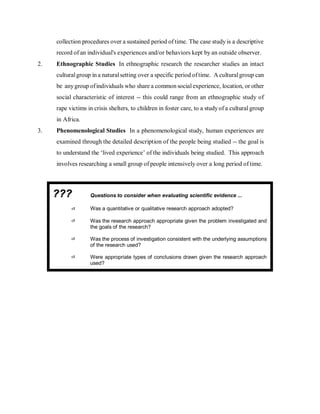
??? Questions to consider when evaluating scientific evidence ...
Was a quantitative or qualitative research approach adopted?
Was the research approach appropriate given the problem investigated and
the goals of the research?
Was the process of investigation consistent with the underlying assumptions
of the research used?
Were appropriate types of conclusions drawn given the research approach
used?
45
Here's a brief overview of the key differences between qualitative and quantitative
research:
Research Focus:
Qualitative Research: Focuses on exploring and understanding the underlying
meanings, motivations, attitudes, and behaviors of individuals or groups. It often
involves open-ended questions and is more concerned with the richness and depth of
data.
Quantitative Research: Focuses on collecting numerical data and using statistical
methods to analyze patterns, relationships, and trends. It aims to quantify variables
and generalize findings to a larger population.
Data Collection:
Qualitative Research: Involves methods such as interviews, focus groups,
observations, and content analysis. Data is often in the form of non-numerical
information, such as words, images, or narratives.
Quantitative Research: Relies on structured data collection methods, such as surveys,
experiments, and measurements. Data is typically in numerical form and can be
analyzed using statistical techniques.
Sample Size:
Qualitative Research: Involves smaller, purposeful samples, as the emphasis is on in-
depth exploration rather than generalization to a larger population.
Quantitative Research: Involves larger, representative samples to ensure statistical
significance and generalizability of findings to the broader population.
Analysis:
Qualitative Research: Analysis is often subjective and interpretative. It involves
identifying themes, patterns, and relationships within the data.
Quantitative Research: Analysis is objective and relies on statistical methods to test
hypotheses, determine relationships, and draw conclusions based on numerical data.
Results and Generalization:
Qualitative Research: Findings are context-specific and may not be easily
generalizable. They provide insights into the depth and complexity of a particular
phenomenon.
Quantitative Research: Aims for generalizability. Results can be applied to a larger
population if the study has been conducted with a representative sample.
Hypothesis Testing:
Qualitative Research: Often exploratory in nature and may not start with a predefined
hypothesis. Instead, it allows hypotheses to emerge from the data.
Quantitative Research: Typically starts with a predefined hypothesis, and statistical
tests are used to either confirm or reject these hypotheses.
Both qualitative and quantitative research have their strengths and limitations, and
the choice between them depends on the research question, objectives, and the nature
of the phenomenon being studied. In some cases, researchers may use a mixed-
methods approach, combining both qualitative and quantitative elements to gain a
more comprehensive understanding of a research problem.
47
case studies the researcher explores a single entity or phenomenon
("the case") bounded bytime and activity (e.g., a program,
event, process, institution, or social group) and collects
detailed information through a variety of data collection
procedures overa sustained period of time
ethnographic studies the researcher studies an intact cultural group in a
natural setting over a specific period of time; a cultural
group can be any group of individuals who share a
common social experience, location, or other social
characteristic of interest
experimental studies characterized by random assignment of subjects to
experimental conditions and the use of experimental
controls
phenomenological human experiences are examined through the
detailed description of the people studies being studied -- the goal is to
understand the "lived experience" of the individualsbeing studied; involves
studying a small group of people intensively over a long
period of time
qualitative research a process of inquiry with the goal of understanding a
social or human problem from multiple perspectives;
conducted in a natural setting with a goal of building a
complex and holistic picture of the phenomenon of interest
quantitative research an inquiry into an identified problem, based on testing
a theory composed of variables, measured with numbers,
and analyzed using statistical techniques; the goal is to
determine whether the predictive generalizations of a
theory hold true
quasi-experimental share almost all the features of experimental designs except
that they involve non-
studies randomized assignment of subjects to experimental conditions
random assignment all subjects have an equal change of being assigned to
a given experimental condition; a procedure used to ensure
that experimental conditions do not differ significantly
from each other
survey questionnaires or interviews for data collection with the
intent of generalizing from a sample population to a larger
population of interest
Multiple-Choice Questions
What is the primary focus of qualitative research?
A) Quantifying variables
B) Exploring underlying meanings
C) Statistical analysis
D) Large sample sizes
Key: B
Which of the following is a common data collection method in qualitative research?
A) Surveys
B) Experiments
C) Observations
D) Statistical tests
Key: C
How is data typically represented in qualitative research?
A) Numerical values
B) Pie charts
C) Words, images, or narratives
D) Histograms
Key: C
What is the usual sample size in qualitative research?
49
A) Small and purposeful
B) Large and representative
C) Medium-sized
D) Variable, depending on the study
Key: A
Which term best describes the analysis in qualitative research?
A) Statistical analysis
B) Objective
C) Subjective and interpretative
D) Hypothesis testing
Key: C
What is the primary goal of quantitative research?
A) Exploring underlying meanings
B) Understanding attitudes
C) Quantifying variables and relationships
D) Subjective interpretation
Key: C
Which data collection method is commonly used in quantitative research?
A) Observations
B) Interviews
C) Surveys
D) Content analysis
Key: C
How is data represented in quantitative research?
A) Words, images, or narratives
B) Numerical values
C) Descriptive text
D) Case studies
Key: B
What is the typical sample size in quantitative research?
A) Small and purposeful
B) Large and representative
C) Medium-sized
D) Variable, depending on the study
Key: B
Which term best describes the analysis in quantitative research?
A) Subjective and interpretative
B) Hypothesis testing
C) Exploratory
D) Context-specific
Key: B
Which of the following is a key characteristic of qualitative research?
A) Emphasis on statistical analysis
B) Focus on objectivity
C) In-depth exploration
D) Large sample sizes
Key: C
What is the role of the researcher in qualitative research?
A) Maintain objectivity
B) Minimize interaction with participants
C) Actively engage with participants
D) Use only closed-ended questions
Key: C
In qualitative research, what is a common technique for analyzing data and identifying patterns?
A) Statistical tests
B) Hypothesis testing
C) Content analysis
D) Surveys
Key: C
Which of the following is a potential limitation of qualitative research?
A) Difficulty in generalizing findings
B) Large sample sizes
C) Emphasis on numerical data
D) Rigidity in data collection
Key: A
What is the primary purpose of using open-ended questions in qualitative interviews?
A) To limit participant responses
B) To gather numerical data
C) To encourage participants to share their perspectives
D) To expedite the interview process
Key: C
Which term is commonly associated with the precision of measurement in quantitative research?
A) Reliability
B) Validity
C) Subjectivity
D) Ethnography
Key: A
What type of data is typically collected in quantitative research?
A) Non-numerical data
51
B) Qualitative data
C) Numerical data
D) Descriptive data
Key: C
In quantitative research, what is the purpose of statistical analysis?
A) Exploring underlying meanings
B) Generalizing findings to a population
C) Subjective interpretation
D) Encouraging open-ended responses
Key: B
Which of the following is a strength of quantitative research?
A) Richness of data
B) Subjective interpretation
C) Generalizability
D) Small sample sizes
Key: C
What is a common feature of closed-ended questions in quantitative surveys?
A) Encourages detailed responses
B) Allows for exploration of participant perspectives
C) Provides predetermined response options
D) Requires in-depth interviews
Key: C
Which of the following is a common sampling technique in qualitative research?
A) Random sampling
B) Convenience sampling
C) Stratified sampling
D) Cluster sampling
Key: B
What is the role of reflexivity in qualitative research?
A) Minimizing bias in data collection
B) Maintaining objectivity
C) Keeping the research process closed
D) Ignoring the influence of the researcher
Key: A
Which of the following best describes the time orientation in qualitative research?
A) Longitudinal
B) Cross-sectional
C) Retrospective
D) Experimental
Key: A
What is the primary aim of grounded theory in qualitative research?
A) Confirming existing theories
B) Developing new theories from data
C) Applying statistical tests
D) Generalizing findings
Key: B
In qualitative research, what is the purpose of member checking?
A) Checking the credentials of participants
B) Validating findings with participants
C) Conducting interviews with members of the research team
D) Exploring participant demographics
Key: B
What is the key characteristic of experimental research in the context of quantitative research?
A) Observing natural behaviors
B) Manipulating variables
C) Exploring attitudes and beliefs
D) Using open-ended questions
Key: B
Which statistical measure is commonly used to describe the central tendency in quantitative data?
A) Range
B) Mean
C) Mode
D) Interquartile range
Key: B
In quantitative research, what is the purpose of a control group?
A) To receive the experimental treatment
B) To establish a baseline for comparison
C) To manipulate variables
D) To conduct surveys
Key: B
Which of the following is a potential limitation of self-report measures in quantitative research?
A) Objectivity
B) Social desirability bias
C) Random sampling
D) Longitudinal design
Key: B
What is the main advantage of using inferential statistics in quantitative research?
A) Describing central tendencies
B) Exploring underlying meanings
53
C) Making predictions and inferences about populations
D) Emphasizing participant perspectives
Key: C
Quantitative and Qualitative_Research.pdf

Quantitative and Qualitative_Research.pdf

  • 1.
    41 MSN Entry testpreparation 2nd session Research Prepared by Mr. Adeel Nouman , M.Phil. Biostatistics Ms. Shehla Bano, BSN(Gold medalist), M.SN, MSC Psychology It is important to recognize that systematic observationand testing can be accomplished using a wide variety of methods. Many people think of scientific inquiry strictly in terms of laboratory experimentation. However, it is neither possible nor desirable to study all phenomena of interest under controlled laboratory conditions. The design of any study begins with the selection of a topic and a research methodology. These initial decisions reflect assumptions about the social world, how science should be conducted, and what constitutes legitimate problems, solutions, and criteria of "proof." Different approaches to research encompass both theory and method. Two general approaches are widely recognized: quantitative research and qualitative research. Quantitative research is an inquiry into an identified problem, based on testing a theory, measured with numbers, and analyzed using statistical techniques. The goal of quantitative methods is to determine whether the predictive generalizations of a theory hold true. Learning Objectives Upon completion of this chapter, the reader should be able to: Understand the differences between quantitative and qualitative research, including: the differing assumptions underlying the two approaches; the methods typical of each approach; and Understand and discuss how these two approaches to research differentially influence the scientific questions asked, the methodologies employed, and the conclusions drawn, and why this is important to consider.
  • 2.
    By contrast, astudy based upon a qualitative process of inquiry has the goal of understanding a social or human problem from multiple perspectives. Qualitative research is conducted in a natural setting and involves a process of building a complex and holistic picture of the phenomenon of interest. The selection of which research approach is appropriate in a given study should be based upon the problemofinterest, resources available, the skills and training ofthe researcher, and the audience for the research. Although some research mayincorporate bothquantitative and qualitative methodologies, in their ‘pure’ form there are significant differences in the assumptions underlying these approaches, as well as in the data collection and analysis procedures used. Quantitative Methods Why is the distinction between quantitative and qualitative research important? It is important to be able to identify and understand the research approach underlying any given study because the selection of a research approach influencesthe questionsasked, the methods chosen, the statistical analysesused, the inferencesmade, and the ultimate goal of the research. When critically reviewing scientific research, the questions asked, and the answers given, will differ depending upon whether the research is quantitative or qualitative. Assumptions Underlying Quantitative Methods reality is objective, “out there,” and independent of the researcher -- therefore reality is something that can be studied objectively; the researcher should remain distant and independent of what is being researched; the values of the researcher do not interfere with, or become part of, the research -- research is value-free; research is based primarily on deductive forms of logic and theories and hypotheses are tested in a cause-effect order; and the goal isto develop generalizationsthat contribute to theory that enable the researcher to predict, explain, and understand some phenomenon.
  • 3.
    43 Three general typesof quantitative methods: 1. Experiments True experiments are characterized by random assignment of subjects to experimental conditions and the use of experimental controls. 2. Quasi-Experiments Quasi-experimental studies share almost all the features of experimentaldesigns except that they involve non-randomized assignment ofsubjects to experimental conditions. 3. Surveys Surveys include cross-sectional and longitudinal studies using questionnaires or interviews for data collection with the intent of estimating the characteristics of a large population of interest based on a smaller sample from that population. Qualitative Methods Three general types of qualitative methods: 1. Case Studies In a case study the researcher explores a single entity or phenomenon (‘the case’) bounded by time and activity (e.g., a program, event, institution, or socialgroup) and collects detailed information througha varietyofdata Assumptions Underlying Qualitative Methods multiple realities exist in any given situation -- the researcher’s, those of the individuals being investigated, and the reader or audience interpreting the results; these multiple perspectives, or voices, of informants (i.e., subjects) are included in the study; the researcher interacts with those he studies and actively works to minimize the distance between the researcher and those being researched; the researcher explicitly recognizes and acknowledges the value-laden nature of the research; research is context-bound; research is based on inductive forms of logic; categories of interest emerge from informants (subjects), rather than being identified a priori by the researcher; the goal isto uncover and discover patterns or theories that help explain a phenomenon of interest; and determinations of accuracy involve verifying the information with informants or "triangulating" among different sources of information (e.g., collecting information from different sources).
  • 4.
    collection procedures overa sustained period of time. The case study is a descriptive record of an individual's experiences and/or behaviors kept by an outside observer. 2. Ethnographic Studies In ethnographic research the researcher studies an intact culturalgroup in a naturalsetting over a specific period oftime. A culturalgroup can be anygroup ofindividuals who share a common socialexperience, location, or other social characteristic of interest -- this could range from an ethnographic study of rape victims in crisis shelters, to children in foster care, to a studyof a cultural group in Africa. 3. Phenomenological Studies In a phenomenological study, human experiences are examined through the detailed description of the people being studied -- the goal is to understand the ‘lived experience’ of the individuals being studied. This approach involves researching a small group of people intensively over a long period of time. ??? Questions to consider when evaluating scientific evidence ... Was a quantitative or qualitative research approach adopted? Was the research approach appropriate given the problem investigated and the goals of the research? Was the process of investigation consistent with the underlying assumptions of the research used? Were appropriate types of conclusions drawn given the research approach used?
  • 5.
    45 Here's a briefoverview of the key differences between qualitative and quantitative research: Research Focus: Qualitative Research: Focuses on exploring and understanding the underlying meanings, motivations, attitudes, and behaviors of individuals or groups. It often involves open-ended questions and is more concerned with the richness and depth of data. Quantitative Research: Focuses on collecting numerical data and using statistical methods to analyze patterns, relationships, and trends. It aims to quantify variables and generalize findings to a larger population. Data Collection: Qualitative Research: Involves methods such as interviews, focus groups, observations, and content analysis. Data is often in the form of non-numerical information, such as words, images, or narratives. Quantitative Research: Relies on structured data collection methods, such as surveys, experiments, and measurements. Data is typically in numerical form and can be analyzed using statistical techniques. Sample Size: Qualitative Research: Involves smaller, purposeful samples, as the emphasis is on in- depth exploration rather than generalization to a larger population. Quantitative Research: Involves larger, representative samples to ensure statistical significance and generalizability of findings to the broader population. Analysis: Qualitative Research: Analysis is often subjective and interpretative. It involves identifying themes, patterns, and relationships within the data. Quantitative Research: Analysis is objective and relies on statistical methods to test hypotheses, determine relationships, and draw conclusions based on numerical data. Results and Generalization: Qualitative Research: Findings are context-specific and may not be easily generalizable. They provide insights into the depth and complexity of a particular phenomenon. Quantitative Research: Aims for generalizability. Results can be applied to a larger population if the study has been conducted with a representative sample. Hypothesis Testing:
  • 6.
    Qualitative Research: Oftenexploratory in nature and may not start with a predefined hypothesis. Instead, it allows hypotheses to emerge from the data. Quantitative Research: Typically starts with a predefined hypothesis, and statistical tests are used to either confirm or reject these hypotheses. Both qualitative and quantitative research have their strengths and limitations, and the choice between them depends on the research question, objectives, and the nature of the phenomenon being studied. In some cases, researchers may use a mixed- methods approach, combining both qualitative and quantitative elements to gain a more comprehensive understanding of a research problem.
  • 7.
    47 case studies theresearcher explores a single entity or phenomenon ("the case") bounded bytime and activity (e.g., a program, event, process, institution, or social group) and collects detailed information through a variety of data collection procedures overa sustained period of time ethnographic studies the researcher studies an intact cultural group in a natural setting over a specific period of time; a cultural group can be any group of individuals who share a common social experience, location, or other social characteristic of interest experimental studies characterized by random assignment of subjects to experimental conditions and the use of experimental controls phenomenological human experiences are examined through the detailed description of the people studies being studied -- the goal is to understand the "lived experience" of the individualsbeing studied; involves studying a small group of people intensively over a long period of time qualitative research a process of inquiry with the goal of understanding a social or human problem from multiple perspectives; conducted in a natural setting with a goal of building a complex and holistic picture of the phenomenon of interest quantitative research an inquiry into an identified problem, based on testing a theory composed of variables, measured with numbers, and analyzed using statistical techniques; the goal is to determine whether the predictive generalizations of a theory hold true quasi-experimental share almost all the features of experimental designs except that they involve non- studies randomized assignment of subjects to experimental conditions
  • 8.
    random assignment allsubjects have an equal change of being assigned to a given experimental condition; a procedure used to ensure that experimental conditions do not differ significantly from each other survey questionnaires or interviews for data collection with the intent of generalizing from a sample population to a larger population of interest Multiple-Choice Questions What is the primary focus of qualitative research? A) Quantifying variables B) Exploring underlying meanings C) Statistical analysis D) Large sample sizes Key: B Which of the following is a common data collection method in qualitative research? A) Surveys B) Experiments C) Observations D) Statistical tests Key: C How is data typically represented in qualitative research? A) Numerical values B) Pie charts C) Words, images, or narratives D) Histograms Key: C What is the usual sample size in qualitative research?
  • 9.
    49 A) Small andpurposeful B) Large and representative C) Medium-sized D) Variable, depending on the study Key: A Which term best describes the analysis in qualitative research? A) Statistical analysis B) Objective C) Subjective and interpretative D) Hypothesis testing Key: C What is the primary goal of quantitative research? A) Exploring underlying meanings B) Understanding attitudes C) Quantifying variables and relationships D) Subjective interpretation Key: C Which data collection method is commonly used in quantitative research? A) Observations B) Interviews C) Surveys D) Content analysis Key: C How is data represented in quantitative research? A) Words, images, or narratives B) Numerical values C) Descriptive text D) Case studies Key: B What is the typical sample size in quantitative research? A) Small and purposeful B) Large and representative C) Medium-sized D) Variable, depending on the study Key: B Which term best describes the analysis in quantitative research? A) Subjective and interpretative B) Hypothesis testing C) Exploratory D) Context-specific
  • 10.
    Key: B Which ofthe following is a key characteristic of qualitative research? A) Emphasis on statistical analysis B) Focus on objectivity C) In-depth exploration D) Large sample sizes Key: C What is the role of the researcher in qualitative research? A) Maintain objectivity B) Minimize interaction with participants C) Actively engage with participants D) Use only closed-ended questions Key: C In qualitative research, what is a common technique for analyzing data and identifying patterns? A) Statistical tests B) Hypothesis testing C) Content analysis D) Surveys Key: C Which of the following is a potential limitation of qualitative research? A) Difficulty in generalizing findings B) Large sample sizes C) Emphasis on numerical data D) Rigidity in data collection Key: A What is the primary purpose of using open-ended questions in qualitative interviews? A) To limit participant responses B) To gather numerical data C) To encourage participants to share their perspectives D) To expedite the interview process Key: C Which term is commonly associated with the precision of measurement in quantitative research? A) Reliability B) Validity C) Subjectivity D) Ethnography Key: A What type of data is typically collected in quantitative research? A) Non-numerical data
  • 11.
    51 B) Qualitative data C)Numerical data D) Descriptive data Key: C In quantitative research, what is the purpose of statistical analysis? A) Exploring underlying meanings B) Generalizing findings to a population C) Subjective interpretation D) Encouraging open-ended responses Key: B Which of the following is a strength of quantitative research? A) Richness of data B) Subjective interpretation C) Generalizability D) Small sample sizes Key: C What is a common feature of closed-ended questions in quantitative surveys? A) Encourages detailed responses B) Allows for exploration of participant perspectives C) Provides predetermined response options D) Requires in-depth interviews Key: C Which of the following is a common sampling technique in qualitative research? A) Random sampling B) Convenience sampling C) Stratified sampling D) Cluster sampling Key: B What is the role of reflexivity in qualitative research? A) Minimizing bias in data collection B) Maintaining objectivity C) Keeping the research process closed D) Ignoring the influence of the researcher Key: A Which of the following best describes the time orientation in qualitative research? A) Longitudinal B) Cross-sectional C) Retrospective D) Experimental Key: A
  • 12.
    What is theprimary aim of grounded theory in qualitative research? A) Confirming existing theories B) Developing new theories from data C) Applying statistical tests D) Generalizing findings Key: B In qualitative research, what is the purpose of member checking? A) Checking the credentials of participants B) Validating findings with participants C) Conducting interviews with members of the research team D) Exploring participant demographics Key: B What is the key characteristic of experimental research in the context of quantitative research? A) Observing natural behaviors B) Manipulating variables C) Exploring attitudes and beliefs D) Using open-ended questions Key: B Which statistical measure is commonly used to describe the central tendency in quantitative data? A) Range B) Mean C) Mode D) Interquartile range Key: B In quantitative research, what is the purpose of a control group? A) To receive the experimental treatment B) To establish a baseline for comparison C) To manipulate variables D) To conduct surveys Key: B Which of the following is a potential limitation of self-report measures in quantitative research? A) Objectivity B) Social desirability bias C) Random sampling D) Longitudinal design Key: B What is the main advantage of using inferential statistics in quantitative research? A) Describing central tendencies B) Exploring underlying meanings
  • 13.
    53 C) Making predictionsand inferences about populations D) Emphasizing participant perspectives Key: C