Introduction to
Qualitative Research Methodology
BY: DR. M ISMAIL ZUBAIR MD, MSC
Objectives and Discussion Points:
• What is qualitative research?
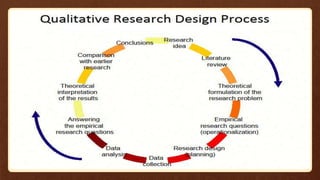
• Why/How to develop qualitative research design?
• Comparison of different research methodologies
• How to generate data?
• Data Management and Analysis
2
What is qualitative research?
3
What is qualitative research?
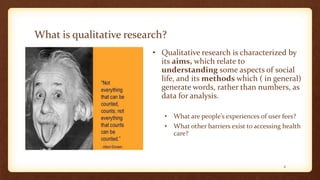
• Qualitative research is characterized by
its aims, which relate to
understanding some aspects of social
life, and its methods which ( in general)
generate words, rather than numbers, as
data for analysis.
• What are people’s experiences of user fees?
• What other barriers exist to accessing health
care?
4
What can qualitative methods achieve?
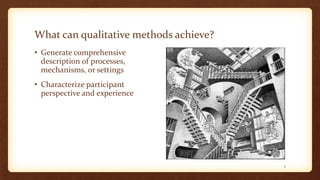
• Generate comprehensive
description of processes,
mechanisms, or settings
• Characterize participant
perspective and experience
5
What is qualitative research?
• A form of social inquiry that focuses on the way people interpret and make
sense of their experiences and the world in which they live
• It is an ‘umbrella term’ and many approaches come under it (Atkinson et al.
2001)
• Systematic collection, organization and interpretation of textual
information (also images/video)
• It explores the behavior, perspectives, feelings and experiences of people
• Ethnographers focus on culture and customs
• Grounded theories investigate social process and interaction
• Phenomenologists consider the meaning of experience
• Inductive approach to generating novel insights into phenomena that are
difficult to quantify
6
Cont…
• The methodology centers on the way in which human beings make
sense of their subjective reality and attach meaning to it.
• Qualitative research claim that the experiences of people are essentially
context-bound, that is, they cannot be free from time and location.
7
Cont…
• Complete objectivity and neutrality are impossible to achieve; the
values of researchers and participants can become an integral part of
the research (Smith, 1983)
• Qualitative methodology is not completely specific, because human
beings do not always act logically or predictably.
• Qualitative research is famous in sociology, education and healthcare
fields.
• Although there are differences between qualitative approaches, It is
sometime difficult to find clear distinctions between them ( Creswell,
1998)
8
When to use qualitative methods?
9
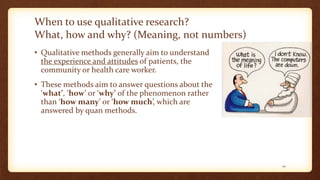
When to use qualitative research?
What, how and why? (Meaning, not numbers)
• Qualitative methods generally aim to understand
the experience and attitudes of patients, the
community or health care worker.
• These methods aim to answer questions about the
‘what’, ‘how’ or ‘why’ of the phenomenon rather
than ‘how many’ or ‘how much’, which are
answered by quan methods.
10
Cont…
• Examples:
• People’s experiences of health needs, health care, accessing care and keeping
healthy.
• Understanding different perspective, such as those of professionals and patients
• How experiences, attitudes and life circumstances affect health needs and
behaviors.
11
Scenarios where qualitative research could help
• An NGO has distributed bed nets to villagers, but it appears that they
are not being used. Household interviews…
• You are planning a health promotion campaign about hand washing, to
reduce diarrheal disease…
• MoPH decided to improve EPI coverage among citizens….
12
Features of qualitative research
• Meaning, not numbers
• No single answer
• Context is important
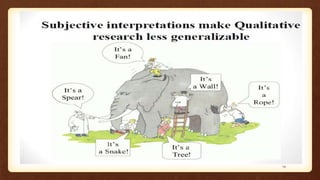
• All sort of data
• Subjectivity and reflexivity
13
14
The characteristics and aims of qualitative research
• The data have primacy; the theoretical framework is not
predetermined but derives directly from the data
• Qualitative research is context-bound, and researchers must be context
sensitive
• Researchers immerse themselves in the natural setting of the people
whose thoughts and feelings they wish to explore
15
Comparison of different research
methodologies
16
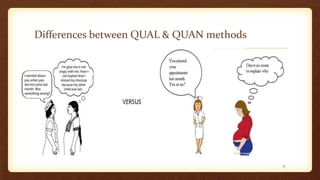
Differences between QUAL & QUAN methods
17
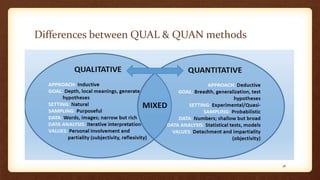
Differences between QUAL & QUAN methods
18
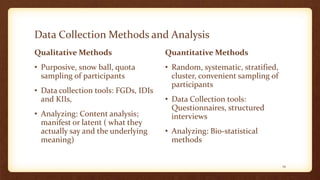
Data Collection Methods and Analysis
Qualitative Methods
• Purposive, snow ball, quota
sampling of participants
• Data collection tools: FGDs, IDIs
and KIIs,
• Analyzing: Content analysis;
manifest or latent ( what they
actually say and the underlying
meaning)
Quantitative Methods
• Random, systematic, stratified,
cluster, convenient sampling of
participants
• Data Collection tools:
Questionnaires, structured
interviews
• Analyzing: Bio-statistical
methods
19
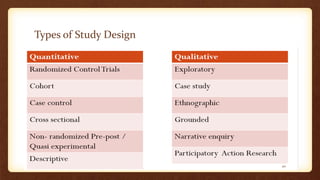
Types of Study Design
20
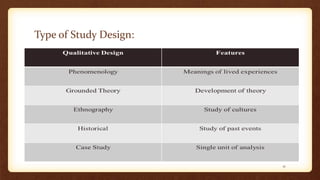
Type of Study Design:
21
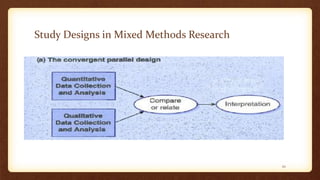
Study Designs in Mixed Methods Research
22
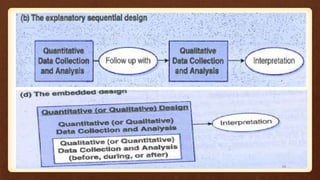
Cont…
23
24
Ethical issues
Four Principles of Tom Beauchamp
and Jim Childress (1983)
• Autonomy; respect the rights of the
individuals
• Beneficence; doing good
• Non-maleficience; not doing harm
• Justice; particularly equity
Two key ethical issues should be
considered
• Consent
• Confidentiality
25
How to generate data?
26
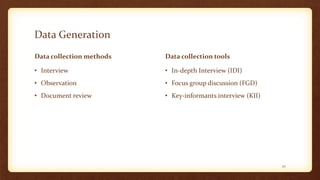
Data Generation
Data collection methods
• Interview
• Observation
• Document review
Data collection tools
• In-depth Interview (IDI)
• Focus group discussion (FGD)
• Key-informants interview (KII)
27
Key issues for interview:
• Access
• Ethical Issue
• Setting
• Rapport
• Managing Expectation
28
Some things to bear in mind
• Is eye contact acceptable?
• Is sitting in certain positions
disrespectful
• Do not interrupt- allow silences
• Do not give your opinion or disagree.
• Check whether you have understood
respondents
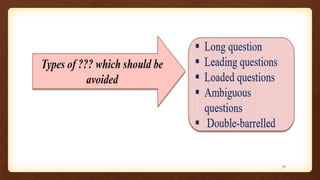
Some things to avoid while
interviewing:
• Competing distractions
• Asking interviewee
embarrassing/awkward questions
• Asking leading questions
• Jumping too quickly from one subject to
another
• Having more than one idea per questions
• Teaching, giving medical advice
• Counselling,
• Presenting your own perspective
29
30
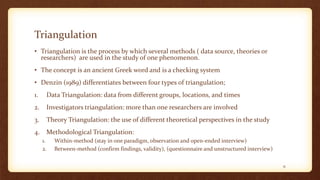
Triangulation
• Triangulation is the process by which several methods ( data source, theories or
researchers) are used in the study of one phenomenon.
• The concept is an ancient Greek word and is a checking system
• Denzin (1989) differentiates between four types of triangulation;
1. Data Triangulation: data from different groups, locations, and times
2. Investigators triangulation: more than one researchers are involved
3. Theory Triangulation: the use of different theoretical perspectives in the study
4. Methodological Triangulation:
1. Within-method (stay in one paradigm, observation and open-ended interview)
2. Between-method (confirm findings, validity), (questionnaire and unstructured interview)
31
Cont…
• Data triangulation is different from mixing methods,
• In triangulation, the researcher approach the same problem in
different ways or from different angles
• In the mixed methods, they look at different problems in the same
research study using different approaches
32
Data Management and Analysis
33
Data Management: Some Practical Issues
• Confidentiality and
security issues
• Consider safety of
participants
• Think of stigmatization,
humiliation, additional
trauma, victimization
• Chose a good interpreter
• Appropriate interview setting
• Don’t leave transcripts lying
around
• Write Identification in code
• Use safe lockers
• Translation
• Translate yourself or choose
appropriate translator
• Brief the translator
• Insist to give you literal
sentence by sentence
translation
• S/he should not ask the
question himself
• Not have eye contact with
translator when asking
question but always with the
interviewee
34
Cont…
Recording/transcribing interviews
• Write note during interview or have a
transcriber do this or write notes
afterwards
• The best method is generally to ask a
transcriber to take notes and ask
him/her to go through the notes
afterwards and checking with the
recording
• If the an audiotape is going to be used,
the respondent’s prior permission must
be sought
35
Data Analysis:
• The analysis of qualitative data
is often seen as the most
difficult part of the exercise
• There are many different ways
to analyses qualitative data,
thematic, descriptive
approach, or more in-depth
methods
• For most applied projects,
thematic analysis is sufficient
36
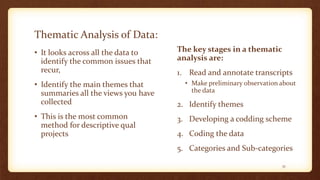
Thematic Analysis of Data:
• It looks across all the data to
identify the common issues that
recur,
• Identify the main themes that
summaries all the views you have
collected
• This is the most common
method for descriptive qual
projects
The key stages in a thematic
analysis are:
1. Read and annotate transcripts
• Make preliminary observation about
the data
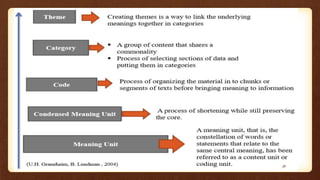
2. Identify themes
3. Developing a codding scheme
4. Coding the data
5. Categories and Sub-categories
37
38
39
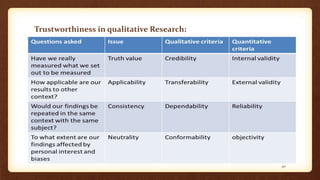
Trustworthiness in qualitative Research:
40
References:
• Atkinson, P. (1995) Some perils of paradigms. Qualitative Health Research, 5 (1) 117-
124.
• Hutchinson, S. & Webb, R (1991) Teaching qualitative research: perennial problems
and possible solutions. In Qualitative Research for Health
• Hudelson, P.M. (1994) Qualitative Research for Health Programs. Geneva, World
Health Organization.
• Leininger, M. (19985) Qualitative Research Methods in Nursing. New York, Grune and
Stratton.
• Bowling A (2002) Research methods in health- Investigating health and health
services, Open University Press
• Green J and Thorogood N (2004) Qualitative Methods for Health Research, London:
Sage.
• Morse, J.M. (re,) (1994) Critical Issues in Qualitative Research, Thousand Oaks, Sage.
41
Resources:
• Overview of the Qualitative Research Methods:
https://www.youtube.com/watch?v=IsAUNs-IoSQ
• Types of Data Collection and its’ Advantages and Disadvantages:
https://www.youtube.com/watch?v=IsAUNs-IoSQ
42
43

Introduction qualitative research_methodology_with_animation_fmic

  • 1.
    Introduction to Qualitative ResearchMethodology BY: DR. M ISMAIL ZUBAIR MD, MSC
  • 2.
    Objectives and DiscussionPoints: • What is qualitative research? • Why/How to develop qualitative research design? • Comparison of different research methodologies • How to generate data? • Data Management and Analysis 2
  • 3.
  • 4.
    What is qualitativeresearch? • Qualitative research is characterized by its aims, which relate to understanding some aspects of social life, and its methods which ( in general) generate words, rather than numbers, as data for analysis. • What are people’s experiences of user fees? • What other barriers exist to accessing health care? 4
  • 5.
    What can qualitativemethods achieve? • Generate comprehensive description of processes, mechanisms, or settings • Characterize participant perspective and experience 5
  • 6.
    What is qualitativeresearch? • A form of social inquiry that focuses on the way people interpret and make sense of their experiences and the world in which they live • It is an ‘umbrella term’ and many approaches come under it (Atkinson et al. 2001) • Systematic collection, organization and interpretation of textual information (also images/video) • It explores the behavior, perspectives, feelings and experiences of people • Ethnographers focus on culture and customs • Grounded theories investigate social process and interaction • Phenomenologists consider the meaning of experience • Inductive approach to generating novel insights into phenomena that are difficult to quantify 6
  • 7.
    Cont… • The methodologycenters on the way in which human beings make sense of their subjective reality and attach meaning to it. • Qualitative research claim that the experiences of people are essentially context-bound, that is, they cannot be free from time and location. 7
  • 8.
    Cont… • Complete objectivityand neutrality are impossible to achieve; the values of researchers and participants can become an integral part of the research (Smith, 1983) • Qualitative methodology is not completely specific, because human beings do not always act logically or predictably. • Qualitative research is famous in sociology, education and healthcare fields. • Although there are differences between qualitative approaches, It is sometime difficult to find clear distinctions between them ( Creswell, 1998) 8
  • 9.
    When to usequalitative methods? 9
  • 10.
    When to usequalitative research? What, how and why? (Meaning, not numbers) • Qualitative methods generally aim to understand the experience and attitudes of patients, the community or health care worker. • These methods aim to answer questions about the ‘what’, ‘how’ or ‘why’ of the phenomenon rather than ‘how many’ or ‘how much’, which are answered by quan methods. 10
  • 11.
    Cont… • Examples: • People’sexperiences of health needs, health care, accessing care and keeping healthy. • Understanding different perspective, such as those of professionals and patients • How experiences, attitudes and life circumstances affect health needs and behaviors. 11
  • 12.
    Scenarios where qualitativeresearch could help • An NGO has distributed bed nets to villagers, but it appears that they are not being used. Household interviews… • You are planning a health promotion campaign about hand washing, to reduce diarrheal disease… • MoPH decided to improve EPI coverage among citizens…. 12
  • 13.
    Features of qualitativeresearch • Meaning, not numbers • No single answer • Context is important • All sort of data • Subjectivity and reflexivity 13
  • 14.
  • 15.
    The characteristics andaims of qualitative research • The data have primacy; the theoretical framework is not predetermined but derives directly from the data • Qualitative research is context-bound, and researchers must be context sensitive • Researchers immerse themselves in the natural setting of the people whose thoughts and feelings they wish to explore 15
  • 16.
    Comparison of differentresearch methodologies 16
  • 17.
    Differences between QUAL& QUAN methods 17
  • 18.
    Differences between QUAL& QUAN methods 18
  • 19.
    Data Collection Methodsand Analysis Qualitative Methods • Purposive, snow ball, quota sampling of participants • Data collection tools: FGDs, IDIs and KIIs, • Analyzing: Content analysis; manifest or latent ( what they actually say and the underlying meaning) Quantitative Methods • Random, systematic, stratified, cluster, convenient sampling of participants • Data Collection tools: Questionnaires, structured interviews • Analyzing: Bio-statistical methods 19
  • 20.
    Types of StudyDesign 20
  • 21.
    Type of StudyDesign: 21
  • 22.
    Study Designs inMixed Methods Research 22
  • 23.
  • 24.
  • 25.
    Ethical issues Four Principlesof Tom Beauchamp and Jim Childress (1983) • Autonomy; respect the rights of the individuals • Beneficence; doing good • Non-maleficience; not doing harm • Justice; particularly equity Two key ethical issues should be considered • Consent • Confidentiality 25
  • 26.
  • 27.
    Data Generation Data collectionmethods • Interview • Observation • Document review Data collection tools • In-depth Interview (IDI) • Focus group discussion (FGD) • Key-informants interview (KII) 27
  • 28.
    Key issues forinterview: • Access • Ethical Issue • Setting • Rapport • Managing Expectation 28
  • 29.
    Some things tobear in mind • Is eye contact acceptable? • Is sitting in certain positions disrespectful • Do not interrupt- allow silences • Do not give your opinion or disagree. • Check whether you have understood respondents Some things to avoid while interviewing: • Competing distractions • Asking interviewee embarrassing/awkward questions • Asking leading questions • Jumping too quickly from one subject to another • Having more than one idea per questions • Teaching, giving medical advice • Counselling, • Presenting your own perspective 29
  • 30.
  • 31.
    Triangulation • Triangulation isthe process by which several methods ( data source, theories or researchers) are used in the study of one phenomenon. • The concept is an ancient Greek word and is a checking system • Denzin (1989) differentiates between four types of triangulation; 1. Data Triangulation: data from different groups, locations, and times 2. Investigators triangulation: more than one researchers are involved 3. Theory Triangulation: the use of different theoretical perspectives in the study 4. Methodological Triangulation: 1. Within-method (stay in one paradigm, observation and open-ended interview) 2. Between-method (confirm findings, validity), (questionnaire and unstructured interview) 31
  • 32.
    Cont… • Data triangulationis different from mixing methods, • In triangulation, the researcher approach the same problem in different ways or from different angles • In the mixed methods, they look at different problems in the same research study using different approaches 32
  • 33.
  • 34.
    Data Management: SomePractical Issues • Confidentiality and security issues • Consider safety of participants • Think of stigmatization, humiliation, additional trauma, victimization • Chose a good interpreter • Appropriate interview setting • Don’t leave transcripts lying around • Write Identification in code • Use safe lockers • Translation • Translate yourself or choose appropriate translator • Brief the translator • Insist to give you literal sentence by sentence translation • S/he should not ask the question himself • Not have eye contact with translator when asking question but always with the interviewee 34
  • 35.
    Cont… Recording/transcribing interviews • Writenote during interview or have a transcriber do this or write notes afterwards • The best method is generally to ask a transcriber to take notes and ask him/her to go through the notes afterwards and checking with the recording • If the an audiotape is going to be used, the respondent’s prior permission must be sought 35
  • 36.
    Data Analysis: • Theanalysis of qualitative data is often seen as the most difficult part of the exercise • There are many different ways to analyses qualitative data, thematic, descriptive approach, or more in-depth methods • For most applied projects, thematic analysis is sufficient 36
  • 37.
    Thematic Analysis ofData: • It looks across all the data to identify the common issues that recur, • Identify the main themes that summaries all the views you have collected • This is the most common method for descriptive qual projects The key stages in a thematic analysis are: 1. Read and annotate transcripts • Make preliminary observation about the data 2. Identify themes 3. Developing a codding scheme 4. Coding the data 5. Categories and Sub-categories 37
  • 38.
  • 39.
  • 40.
  • 41.
    References: • Atkinson, P.(1995) Some perils of paradigms. Qualitative Health Research, 5 (1) 117- 124. • Hutchinson, S. & Webb, R (1991) Teaching qualitative research: perennial problems and possible solutions. In Qualitative Research for Health • Hudelson, P.M. (1994) Qualitative Research for Health Programs. Geneva, World Health Organization. • Leininger, M. (19985) Qualitative Research Methods in Nursing. New York, Grune and Stratton. • Bowling A (2002) Research methods in health- Investigating health and health services, Open University Press • Green J and Thorogood N (2004) Qualitative Methods for Health Research, London: Sage. • Morse, J.M. (re,) (1994) Critical Issues in Qualitative Research, Thousand Oaks, Sage. 41
  • 42.
    Resources: • Overview ofthe Qualitative Research Methods: https://www.youtube.com/watch?v=IsAUNs-IoSQ • Types of Data Collection and its’ Advantages and Disadvantages: https://www.youtube.com/watch?v=IsAUNs-IoSQ 42
  • 43.

Editor's Notes

  • #14 Subjectivity: researchers and particiapants bring their own histories, assumptions, values , perspectives, politics into the research Reflexivity: process of critically reflecting on the knowledge we produce and our role in producing this knowledge.