Course Title: Research Methods 
Course Credit Hrs.: 6 per week 
Level: A+B+C 
Program: Joint Supervision -Graduate Partnerships Program 
Term: Spring 2014/2015 
Week I 
Instructor: Dr. Noora Al-Malki 
Credits of images and online content are to their original owners 
Copyright (a) noora malki 2014
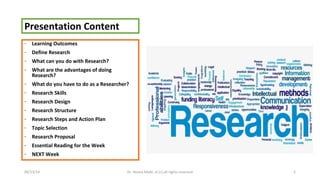
Presentation Content 
- Learning Outcomes 
- Define Research 
- What can you do with Research? 
- What are the advantages of doing 
Research? 
- What do you have to do as a Researcher? 
- Research Skills 
- Research Design 
- Research Structure 
- Research Steps and Action Plan 
- Topic Selection 
- Research Proposal 
- Essential Reading for the Week 
- NEXT Week 
09/13/14 Dr. Noora Malki, al (c) all rights reserved 2
Learning Outcomes 
Upon completing the 6-hour session in the first week, students will be able to: 
1-define research and describe the research process and research methods. 
2-describe the processes and requirements for conducting successful research at KAU (or 
their college) 
3-complete the following e-tivities: 
a. Introduce themselves and their research interests in the "Join Us for a Cuppa" Forum in 
the Discussions Area (obligatory but not graded) 
b. Complete the learner profile survey ( obligatory but not graded) 
c. Forum Brain Storming Session (1) (5 points) 
d. Group Blog Entry (1) “KAU research” for both Teams A+B (5 points) 
09/13/14 Dr. Noora Malki, al (c) all rights reserved 3
Define Research! 
A research paper is your opinion on a 
topic, informed by research you have 
done. It is not a summary of others’ 
thoughts, a personal essay or a review or 
critique. 
09/13/14 Dr. Noora Malki, al (c) all rights reserved 4
Define Research! 
 Research is an activity 
 Research Methods are techniques 
Chapter 1 "Research Basics" from Walliman's Research Methods (pgs. 7-14) 
09/13/14 Dr. Noora Malki, al (c) all rights reserved 5
What can you do with Research? 
1. Categorize 
2. Describe 
3. Explain 
4. Evaluate 
5. Compare 
6. Correlate 
7. Predict 
8. Control 
Chapter 1 "Research Basics" from Walliman's Research Methods (pgs. 7-14) 
09/13/14 Dr. Noora Malki, al (c) all rights reserved 6
What are the advantages of doing 
Research? 
1. Help you learn about a topic (in which you are interested). 
2. Teach you to forge a mishmash of researched opinions into a 
single, coherent viewpoint. 
3. Teaches you the conventions of scholarly writing. 
4. Equip you with skills and competences which are essential to 
your academic and professional development (like time 
management, etc.): It “is an exercise in logic, imagination, and 
common sense” 
Chapters 1 & 2 from Winkler's and Metherell's Writing The Research Paper (pgs. 3-17) 
09/13/14 Dr. Noora Malki, al (c) all rights reserved 7
What do you have to do as researcher? 
1)develop professional working relationships 
with your supervisor and colleagues, 
2)meet deadlines, 
3)communicate results using a variety of 
methods. 
4)Manage your research project 
5)Mange motivation. 
6)Observe ethics 
09/13/14 Dr. Noora Malki, al (c) all rights reserved 8
Research Skills 
1) Independence 
2) Critical thinking 
3) Problem solving 
4) Contributing as a professional 
5) Initiative 
09/13/14 Dr. Noora Malki, al (c) all rights reserved 9
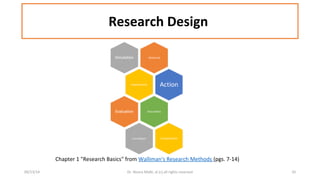
Research Design 
Chapter 1 "Research Basics" from Walliman's Research Methods (pgs. 7-14) 
09/13/14 Dr. Noora Malki, al (c) all rights reserved 10
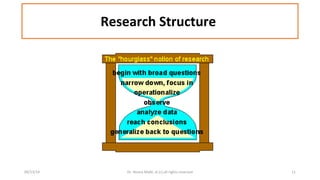
Research Structure 
09/13/14 Dr. Noora Malki, al (c) all rights reserved 11
Research Structure 
Checklists 
Discussion 
09/13/14 Dr. Noora Malki, al (c) all rights reserved 12
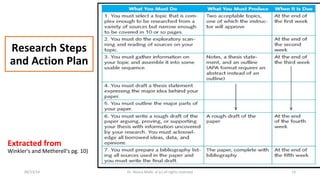
Research Steps 
and Action Plan 
Extracted from 
Winkler's and Metherell's pg. 10) 
09/13/14 Dr. Noora Malki, al (c) all rights reserved 13
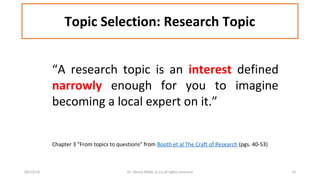
Topic Selection: Research Topic 
“A research topic is an interest defined 
narrowly enough for you to imagine 
becoming a local expert on it.” 
Chapter 3 "From topics to questions" from Booth et al The Craft of Research (pgs. 40-53) 
09/13/14 Dr. Noora Malki, al (c) all rights reserved 14
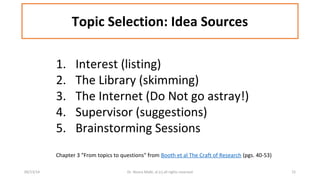
Topic Selection: Idea Sources 
1. Interest (listing) 
2. The Library (skimming) 
3. The Internet (Do Not go astray!) 
4. Supervisor (suggestions) 
5. Brainstorming Sessions 
Chapter 3 "From topics to questions" from Booth et al The Craft of Research (pgs. 40-53) 
09/13/14 Dr. Noora Malki, al (c) all rights reserved 15
Topic Selection: Topics to avoid! 
1. Broad topics 
2. Single-source topics 
3. Trivial topics 
4. Hot topics 
5. Exhausted topics 
Chapters 1 & 2 from Winkler's and Metherell's Writing The Research Paper (pgs. 3-17) 
09/13/14 Dr. Noora Malki, al (c) all rights reserved 16
Topic Selection: Narrow it down! 
1. Break it down 
2. Ask questions 
3. Mind mapping 
09/13/14 Dr. Noora Malki, al (c) all rights reserved 17
Research Proposal 
1. Nottingham University Guidelines for Research Proposals 
2. Leister University Guidelines for Research Proposals 
3. Exeter University Guidelines for Research Proposals 
09/13/14 Dr. Noora Malki, al (c) all rights reserved 18
Week One Essential Readings 
For this week's three sessions, you are supposed to read the following: 
1.Chapter 1 "Research Basics" from Walliman's Research Methods (pgs. 7-14) 
2.Chapters 1 & 2 from Winkler's and Metherell's Writing The Research Paper (pgs. 3-17) 
3.Chapter 3 "From topics to questions" from Booth et al The Craft of Research (pgs. 40-53) 
09/13/14 Dr. Noora Malki, al (c) all rights reserved 19
NEXT Lecture 
Topic 
Components of a research paper, Research organization, research resources, 
research ethics & reliability, internet resources, writing a bibliography & 
documentation styles 
09/13/14 Dr. Noora Malki, al (c) all rights reserved 20
Have a super day…. 
09/13/14 Dr. Noora Malki, al (c) all rights reserved 21

Jsp 1 Research Methods

  • 1.
    Course Title: ResearchMethods Course Credit Hrs.: 6 per week Level: A+B+C Program: Joint Supervision -Graduate Partnerships Program Term: Spring 2014/2015 Week I Instructor: Dr. Noora Al-Malki Credits of images and online content are to their original owners Copyright (a) noora malki 2014
  • 2.
    Presentation Content -Learning Outcomes - Define Research - What can you do with Research? - What are the advantages of doing Research? - What do you have to do as a Researcher? - Research Skills - Research Design - Research Structure - Research Steps and Action Plan - Topic Selection - Research Proposal - Essential Reading for the Week - NEXT Week 09/13/14 Dr. Noora Malki, al (c) all rights reserved 2
  • 3.
    Learning Outcomes Uponcompleting the 6-hour session in the first week, students will be able to: 1-define research and describe the research process and research methods. 2-describe the processes and requirements for conducting successful research at KAU (or their college) 3-complete the following e-tivities: a. Introduce themselves and their research interests in the "Join Us for a Cuppa" Forum in the Discussions Area (obligatory but not graded) b. Complete the learner profile survey ( obligatory but not graded) c. Forum Brain Storming Session (1) (5 points) d. Group Blog Entry (1) “KAU research” for both Teams A+B (5 points) 09/13/14 Dr. Noora Malki, al (c) all rights reserved 3
  • 4.
    Define Research! Aresearch paper is your opinion on a topic, informed by research you have done. It is not a summary of others’ thoughts, a personal essay or a review or critique. 09/13/14 Dr. Noora Malki, al (c) all rights reserved 4
  • 5.
    Define Research! Research is an activity  Research Methods are techniques Chapter 1 "Research Basics" from Walliman's Research Methods (pgs. 7-14) 09/13/14 Dr. Noora Malki, al (c) all rights reserved 5
  • 6.
    What can youdo with Research? 1. Categorize 2. Describe 3. Explain 4. Evaluate 5. Compare 6. Correlate 7. Predict 8. Control Chapter 1 "Research Basics" from Walliman's Research Methods (pgs. 7-14) 09/13/14 Dr. Noora Malki, al (c) all rights reserved 6
  • 7.
    What are theadvantages of doing Research? 1. Help you learn about a topic (in which you are interested). 2. Teach you to forge a mishmash of researched opinions into a single, coherent viewpoint. 3. Teaches you the conventions of scholarly writing. 4. Equip you with skills and competences which are essential to your academic and professional development (like time management, etc.): It “is an exercise in logic, imagination, and common sense” Chapters 1 & 2 from Winkler's and Metherell's Writing The Research Paper (pgs. 3-17) 09/13/14 Dr. Noora Malki, al (c) all rights reserved 7
  • 8.
    What do youhave to do as researcher? 1)develop professional working relationships with your supervisor and colleagues, 2)meet deadlines, 3)communicate results using a variety of methods. 4)Manage your research project 5)Mange motivation. 6)Observe ethics 09/13/14 Dr. Noora Malki, al (c) all rights reserved 8
  • 9.
    Research Skills 1)Independence 2) Critical thinking 3) Problem solving 4) Contributing as a professional 5) Initiative 09/13/14 Dr. Noora Malki, al (c) all rights reserved 9
  • 10.
    Research Design Chapter1 "Research Basics" from Walliman's Research Methods (pgs. 7-14) 09/13/14 Dr. Noora Malki, al (c) all rights reserved 10
  • 11.
    Research Structure 09/13/14Dr. Noora Malki, al (c) all rights reserved 11
  • 12.
    Research Structure Checklists Discussion 09/13/14 Dr. Noora Malki, al (c) all rights reserved 12
  • 13.
    Research Steps andAction Plan Extracted from Winkler's and Metherell's pg. 10) 09/13/14 Dr. Noora Malki, al (c) all rights reserved 13
  • 14.
    Topic Selection: ResearchTopic “A research topic is an interest defined narrowly enough for you to imagine becoming a local expert on it.” Chapter 3 "From topics to questions" from Booth et al The Craft of Research (pgs. 40-53) 09/13/14 Dr. Noora Malki, al (c) all rights reserved 14
  • 15.
    Topic Selection: IdeaSources 1. Interest (listing) 2. The Library (skimming) 3. The Internet (Do Not go astray!) 4. Supervisor (suggestions) 5. Brainstorming Sessions Chapter 3 "From topics to questions" from Booth et al The Craft of Research (pgs. 40-53) 09/13/14 Dr. Noora Malki, al (c) all rights reserved 15
  • 16.
    Topic Selection: Topicsto avoid! 1. Broad topics 2. Single-source topics 3. Trivial topics 4. Hot topics 5. Exhausted topics Chapters 1 & 2 from Winkler's and Metherell's Writing The Research Paper (pgs. 3-17) 09/13/14 Dr. Noora Malki, al (c) all rights reserved 16
  • 17.
    Topic Selection: Narrowit down! 1. Break it down 2. Ask questions 3. Mind mapping 09/13/14 Dr. Noora Malki, al (c) all rights reserved 17
  • 18.
    Research Proposal 1.Nottingham University Guidelines for Research Proposals 2. Leister University Guidelines for Research Proposals 3. Exeter University Guidelines for Research Proposals 09/13/14 Dr. Noora Malki, al (c) all rights reserved 18
  • 19.
    Week One EssentialReadings For this week's three sessions, you are supposed to read the following: 1.Chapter 1 "Research Basics" from Walliman's Research Methods (pgs. 7-14) 2.Chapters 1 & 2 from Winkler's and Metherell's Writing The Research Paper (pgs. 3-17) 3.Chapter 3 "From topics to questions" from Booth et al The Craft of Research (pgs. 40-53) 09/13/14 Dr. Noora Malki, al (c) all rights reserved 19
  • 20.
    NEXT Lecture Topic Components of a research paper, Research organization, research resources, research ethics & reliability, internet resources, writing a bibliography & documentation styles 09/13/14 Dr. Noora Malki, al (c) all rights reserved 20
  • 21.
    Have a superday…. 09/13/14 Dr. Noora Malki, al (c) all rights reserved 21