Academic
Writing
Dr. Nora Almalki
Assistant professor of European Languages
Head of Development (DELDE)
2
Learning outcomes:
Discuss considerations involved in successful academic writing
(positioning)
Use patterns of expository prose (movement from general to
specific, movement from problem to solution)
Write well-structured summaries and critiques
Write detailed and comprehensive comments on research data
2018Almalki
3
I. What is academic writing?
Audience Purpose Organization Style
Flow Presentation Positioning
2018Almalki
4
Academic Writing
Academic writing refers to a style of expression that researchers use to
define the intellectual boundaries of their disciplines and their specific
areas of expertise. Characteristics of academic writing include a formal
tone, use of the third-person rather than first-person perspective
(usually), a clear focus on the research problem under investigation, and
precise word choice.
2018Almalki
5
II. Patterns of writing
1. writing general-specific texts (GS)
3 contexts to use this pattern:
o An answer to an examination question
o An opening paragraph of an assignment
o A background (scene-setting) paragraph to an analysis or discussion.
GS texts usually begin with one of the following:

o A short or extended definition
o A contrastive or comparative definition
o A generalisation or purpose statement, or
o A statement of fact
2018Almalki
6
General-specific texts (GS): Definitions
1 Definitions are a common way of getting started (hooks)
e.g. ‘defined as’ instead of
‘known as’
‘refer to’ for terminological
explanations
2018Almalki
7
General-specific texts (GS): Types of Definitions
Extended
 details on features, process analysis …
Competing
 lack of agreement, competing perspectives…
 Useful strategy: acknowledge some of the different definitions then make clear to the
reader which one(s) you will adopt
Contrastive
 When you need to make a clear distinction between two (or more) related terms:
e.g. postcolonial literature and postcolonial theory
Comparative
 Two approaches: 1. present a historical account of how a concept has changed
(developed) over time
2. present an overview of how various expert today view a concept differently. Good
comparative definitions contain elements of each approach.
2018Almalki
8
II. Patterns of writing
2. Problem-solution
General-Specific Problem-solution
Passages tend to be
Descriptive & expository
Passages tend to be
Argumentative &
evaluative
Position yourself as being
informed and organised
Position yourself as being
questioning and
perceptive
2018Almalki
9
II. Patterns of writing
2. Problem-solution
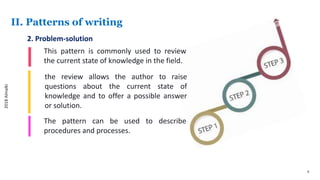
This pattern is commonly used to review
the current state of knowledge in the field.
the review allows the author to raise
questions about the current state of
knowledge and to offer a possible answer
or solution.
The pattern can be used to describe
procedures and processes.
2018Almalki
10
Problem-solution: Tips: (by + process)
1 By + human agent is uncommon except when describing the
history of the field Or when the agent is important to
mention:
The theory of transformational
grammar was developed by
Noam Chomsky.
2018Almalki
11
Problem-solution: Tips: (by + process)
2 Use Passive voice for by + nonhuman agents/ by + process:
o Bactria found in meat can
be killed by radiation
o Cultures are partly
preserved by rituals.
2018Almalki
12
Problem-solution: Useful techniques
1 Highlighting causes and effects
An increase in demand is likely
to cause a rise in prices.
2018Almalki
13
Problem-solution: Useful techniques
2 Formulation indirect questions
Until such time, nonnative
speakers of English remain
uncertain about how effective
their publications are in their
own languages.
2018Almalki
14
Problem-solution: Useful techniques
3 Introducing the solution
Recently, researchers have
made significant progress in
overcoming this difficulty by
……
2018Almalki
15
III. Data Commentary
Discussion of data presented in graphs, tables, …
How? The art of the matter is to find the right
strength of a claim (most significant OR least
significant data)
The data might come from a source or the
results of your own.
Remember: Don’t offer description but
commentary
2018Almalki
16
III. Data Commentary: Structure
1 Location elements and/or summary statements
e.g. Table 5 shows/ gives/ suggests/
provides/ demonstrates
As shown in Fig. 6, ……
2018Almalki
17
III. Data Commentary: Structure
2 Highlighting statements (significant observations)
o You can spot trends and
regularities in the data
o You can separate more important
data from less important data
o You can make claims of
appropriate strength
2018Almalki
18
III. Data Commentary: Structure
3 Discussions of implications, problems, exceptions,
recommendations, etc
o Useful comparisons
o Concluding a commentary requires original
thinking
o Explanation and/or implications
o Dealing with unexpected results or
unsatisfactory data
o Possible further research or future predictions
2018Almalki
19
III. Data Commentary: Task (1)
2018Almalki
20
IV. Writing Summaries and Critiques: Summaries
A good summary has three main requirements:
It should condense the source material and be
presented in the summary writer’s own words.
It should be focused on the relevant aspects of
the source text.
It should represent the source material
accurately.
2018Almalki
21
1 Guidelines for good summaries
Always try to use your own words except for technical terms
Include enough supporting details
Do not try to paraphrase specialised vocabulary or technical terms
Focus on the content of the original
Make sure the summary reads smoothly (use transition devices)
Identify the source in a summary
Most summaries begin with a sentence including the source and the
main idea.
According to Bradley et al. (2004), meeting tourism can
have an enormous effect on the economy of a city.
2018Almalki
IV. Writing Summaries and Critiques: Summaries
22
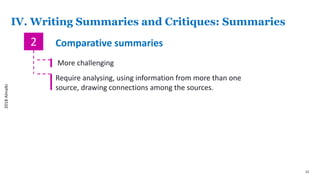
2 Comparative summaries
More challenging
Require analysing, using information from more than one
source, drawing connections among the sources.
2018Almalki
IV. Writing Summaries and Critiques: Summaries
23
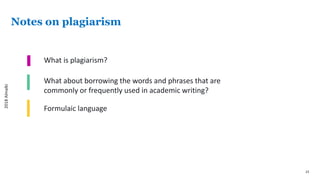
Notes on plagiarism
What is plagiarism?
What about borrowing the words and phrases that are
commonly or frequently used in academic writing?
Formulaic language
2018Almalki
24
IV. Writing Summaries and Critiques: Critiques
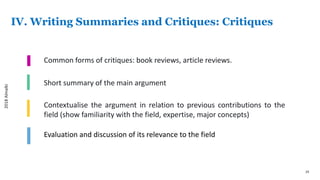
Common forms of critiques: book reviews, article reviews.
Evaluation and discussion of its relevance to the field
Short summary of the main argument
Contextualise the argument in relation to previous contributions to the
field (show familiarity with the field, expertise, major concepts)
2018Almalki
25
1 Typical topics for praise or criticism
Degree of originality
Coherence of an argument
Readability/ style
Extent or relevance of references
2018Almalki
IV. Writing Summaries and Critiques: Critiques
26
2 Typical topics for praise or criticism
Who is the audience?
What is the purpose of the article?
What research question(s) is (are) being addressed in the article?
What conclusions does the author draw from the research?
What kind of evidence is offered in support of the conclusions? Is there
any evidence that could or should have been included but was not?
How good is the evidence?
Are the author’s conclusions valid or plausible based on the evidence? Why and why not?
Are there any important assumptions underlying the article?
Does the research make an original contribution to the field? Why and why
not?
2018Almalki
IV. Writing Summaries and Critiques: Critiques
27
3 Beginning the critique: Examples of opening sentences
………. present a plausible case…..
………..has written an important and timely article on…
………presents a compelling argument on……., however..
2018Almalki
IV. Writing Summaries and Critiques: Critiques
28
Scare quotes
In critiques, the use of scare quotes is a useful way to signal that you are not
necessarily committed to the author’s position.
e.g. The authors’ position regarding English “dominance” in academia….
The scare quotes indicate that you have doubts about the validity of the
author’s position.
2018Almalki
29
Remember
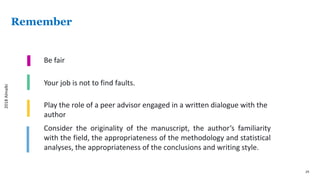
Be fair
Your job is not to find faults.
Play the role of a peer advisor engaged in a written dialogue with the
author
Consider the originality of the manuscript, the author’s familiarity
with the field, the appropriateness of the methodology and statistical
analyses, the appropriateness of the conclusions and writing style.
2018Almalki
30
Some useful tips
2018Almalki
31
Avoid polemic
2018Almalki
32
Titles
Clarity
Accuracy
Precision
o A common format
o Dividing the title into two components separated by a colon (:). These
components consists of:
 a main title outlining the general area of the research
 a supplement that includes more specific information
Example:
Motivation in the workplace: A Case study of full-time and part-time employees in a
department store in Aberdeen
2018Almalki
33
Narrating your Literature Review
Your review of literature should be a piece of discursive prose not just a
descriptive list or a set of summaries, but an evaluation of the scholarship
already produced that provides a context to your writing.
It is therefore a bad sign to see every paragraph opening with the name of
the researcher. Neither is it the objective to find as many works as possible-
so avoid trying to read everything.
The literature review should be written in the form of a narrative
synthesis, telling the story of your research topic from what others
have done to what your project will do.
Use signposts to help readers follow the narrative.
2018Almalki
34
Check your Quotes
2018Almalki
35
Keep an abstract
Keep focus
2018Almalki
36
Always proofread
2018Almalki
37
Q&A
2018Almalki
38
Swales, John M. and Christine B. Feak. Academic
Writing for Graduate Students: Essential Tasks and
Skills. Michigan: University of Michigan Press, 2009.
References
2018Almalki

Phd prez 2018

  • 1.
    Academic Writing Dr. Nora Almalki Assistantprofessor of European Languages Head of Development (DELDE)
  • 2.
    2 Learning outcomes: Discuss considerationsinvolved in successful academic writing (positioning) Use patterns of expository prose (movement from general to specific, movement from problem to solution) Write well-structured summaries and critiques Write detailed and comprehensive comments on research data 2018Almalki
  • 3.
    3 I. What isacademic writing? Audience Purpose Organization Style Flow Presentation Positioning 2018Almalki
  • 4.
    4 Academic Writing Academic writingrefers to a style of expression that researchers use to define the intellectual boundaries of their disciplines and their specific areas of expertise. Characteristics of academic writing include a formal tone, use of the third-person rather than first-person perspective (usually), a clear focus on the research problem under investigation, and precise word choice. 2018Almalki
  • 5.
    5 II. Patterns ofwriting 1. writing general-specific texts (GS) 3 contexts to use this pattern: o An answer to an examination question o An opening paragraph of an assignment o A background (scene-setting) paragraph to an analysis or discussion. GS texts usually begin with one of the following: o A short or extended definition o A contrastive or comparative definition o A generalisation or purpose statement, or o A statement of fact 2018Almalki
  • 6.
    6 General-specific texts (GS):Definitions 1 Definitions are a common way of getting started (hooks) e.g. ‘defined as’ instead of ‘known as’ ‘refer to’ for terminological explanations 2018Almalki
  • 7.
    7 General-specific texts (GS):Types of Definitions Extended  details on features, process analysis … Competing  lack of agreement, competing perspectives…  Useful strategy: acknowledge some of the different definitions then make clear to the reader which one(s) you will adopt Contrastive  When you need to make a clear distinction between two (or more) related terms: e.g. postcolonial literature and postcolonial theory Comparative  Two approaches: 1. present a historical account of how a concept has changed (developed) over time 2. present an overview of how various expert today view a concept differently. Good comparative definitions contain elements of each approach. 2018Almalki
  • 8.
    8 II. Patterns ofwriting 2. Problem-solution General-Specific Problem-solution Passages tend to be Descriptive & expository Passages tend to be Argumentative & evaluative Position yourself as being informed and organised Position yourself as being questioning and perceptive 2018Almalki
  • 9.
    9 II. Patterns ofwriting 2. Problem-solution This pattern is commonly used to review the current state of knowledge in the field. the review allows the author to raise questions about the current state of knowledge and to offer a possible answer or solution. The pattern can be used to describe procedures and processes. 2018Almalki
  • 10.
    10 Problem-solution: Tips: (by+ process) 1 By + human agent is uncommon except when describing the history of the field Or when the agent is important to mention: The theory of transformational grammar was developed by Noam Chomsky. 2018Almalki
  • 11.
    11 Problem-solution: Tips: (by+ process) 2 Use Passive voice for by + nonhuman agents/ by + process: o Bactria found in meat can be killed by radiation o Cultures are partly preserved by rituals. 2018Almalki
  • 12.
    12 Problem-solution: Useful techniques 1Highlighting causes and effects An increase in demand is likely to cause a rise in prices. 2018Almalki
  • 13.
    13 Problem-solution: Useful techniques 2Formulation indirect questions Until such time, nonnative speakers of English remain uncertain about how effective their publications are in their own languages. 2018Almalki
  • 14.
    14 Problem-solution: Useful techniques 3Introducing the solution Recently, researchers have made significant progress in overcoming this difficulty by …… 2018Almalki
  • 15.
    15 III. Data Commentary Discussionof data presented in graphs, tables, … How? The art of the matter is to find the right strength of a claim (most significant OR least significant data) The data might come from a source or the results of your own. Remember: Don’t offer description but commentary 2018Almalki
  • 16.
    16 III. Data Commentary:Structure 1 Location elements and/or summary statements e.g. Table 5 shows/ gives/ suggests/ provides/ demonstrates As shown in Fig. 6, …… 2018Almalki
  • 17.
    17 III. Data Commentary:Structure 2 Highlighting statements (significant observations) o You can spot trends and regularities in the data o You can separate more important data from less important data o You can make claims of appropriate strength 2018Almalki
  • 18.
    18 III. Data Commentary:Structure 3 Discussions of implications, problems, exceptions, recommendations, etc o Useful comparisons o Concluding a commentary requires original thinking o Explanation and/or implications o Dealing with unexpected results or unsatisfactory data o Possible further research or future predictions 2018Almalki
  • 19.
    19 III. Data Commentary:Task (1) 2018Almalki
  • 20.
    20 IV. Writing Summariesand Critiques: Summaries A good summary has three main requirements: It should condense the source material and be presented in the summary writer’s own words. It should be focused on the relevant aspects of the source text. It should represent the source material accurately. 2018Almalki
  • 21.
    21 1 Guidelines forgood summaries Always try to use your own words except for technical terms Include enough supporting details Do not try to paraphrase specialised vocabulary or technical terms Focus on the content of the original Make sure the summary reads smoothly (use transition devices) Identify the source in a summary Most summaries begin with a sentence including the source and the main idea. According to Bradley et al. (2004), meeting tourism can have an enormous effect on the economy of a city. 2018Almalki IV. Writing Summaries and Critiques: Summaries
  • 22.
    22 2 Comparative summaries Morechallenging Require analysing, using information from more than one source, drawing connections among the sources. 2018Almalki IV. Writing Summaries and Critiques: Summaries
  • 23.
    23 Notes on plagiarism Whatis plagiarism? What about borrowing the words and phrases that are commonly or frequently used in academic writing? Formulaic language 2018Almalki
  • 24.
    24 IV. Writing Summariesand Critiques: Critiques Common forms of critiques: book reviews, article reviews. Evaluation and discussion of its relevance to the field Short summary of the main argument Contextualise the argument in relation to previous contributions to the field (show familiarity with the field, expertise, major concepts) 2018Almalki
  • 25.
    25 1 Typical topicsfor praise or criticism Degree of originality Coherence of an argument Readability/ style Extent or relevance of references 2018Almalki IV. Writing Summaries and Critiques: Critiques
  • 26.
    26 2 Typical topicsfor praise or criticism Who is the audience? What is the purpose of the article? What research question(s) is (are) being addressed in the article? What conclusions does the author draw from the research? What kind of evidence is offered in support of the conclusions? Is there any evidence that could or should have been included but was not? How good is the evidence? Are the author’s conclusions valid or plausible based on the evidence? Why and why not? Are there any important assumptions underlying the article? Does the research make an original contribution to the field? Why and why not? 2018Almalki IV. Writing Summaries and Critiques: Critiques
  • 27.
    27 3 Beginning thecritique: Examples of opening sentences ………. present a plausible case….. ………..has written an important and timely article on… ………presents a compelling argument on……., however.. 2018Almalki IV. Writing Summaries and Critiques: Critiques
  • 28.
    28 Scare quotes In critiques,the use of scare quotes is a useful way to signal that you are not necessarily committed to the author’s position. e.g. The authors’ position regarding English “dominance” in academia…. The scare quotes indicate that you have doubts about the validity of the author’s position. 2018Almalki
  • 29.
    29 Remember Be fair Your jobis not to find faults. Play the role of a peer advisor engaged in a written dialogue with the author Consider the originality of the manuscript, the author’s familiarity with the field, the appropriateness of the methodology and statistical analyses, the appropriateness of the conclusions and writing style. 2018Almalki
  • 30.
  • 31.
  • 32.
    32 Titles Clarity Accuracy Precision o A commonformat o Dividing the title into two components separated by a colon (:). These components consists of:  a main title outlining the general area of the research  a supplement that includes more specific information Example: Motivation in the workplace: A Case study of full-time and part-time employees in a department store in Aberdeen 2018Almalki
  • 33.
    33 Narrating your LiteratureReview Your review of literature should be a piece of discursive prose not just a descriptive list or a set of summaries, but an evaluation of the scholarship already produced that provides a context to your writing. It is therefore a bad sign to see every paragraph opening with the name of the researcher. Neither is it the objective to find as many works as possible- so avoid trying to read everything. The literature review should be written in the form of a narrative synthesis, telling the story of your research topic from what others have done to what your project will do. Use signposts to help readers follow the narrative. 2018Almalki
  • 34.
  • 35.
    35 Keep an abstract Keepfocus 2018Almalki
  • 36.
  • 37.
  • 38.
    38 Swales, John M.and Christine B. Feak. Academic Writing for Graduate Students: Essential Tasks and Skills. Michigan: University of Michigan Press, 2009. References 2018Almalki

Editor's Notes

  • #38 خمس دقائق فقط
  • #39 خمس دقائق فقط