Co-funded by the
Erasmus+ Programme
of the European Union
Module 8 – Sensory Analysis and
Consumer Testing
This programme has been funded with support from the European Commission. The author is
solely responsible for this publication (communication) and the Commission accepts no
responsibility for any use that may be made of the information contained therein
2020-1-DE02-KA202-007612
Innovating
food
for
seniors
SENSES
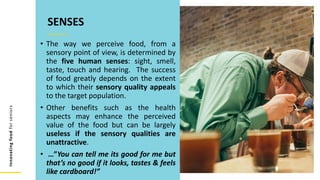
• The way we perceive food, from a
sensory point of view, is determined by
the five human senses: sight, smell,
taste, touch and hearing. The success
of food greatly depends on the extent
to which their sensory quality appeals
to the target population.
• Other benefits such as the health
aspects may enhance the perceived
value of the food but can be largely
useless if the sensory qualities are
unattractive.
• …”You can tell me its good for me but
that’s no good if it looks, tastes & feels
like cardboard!”
Education Infographics
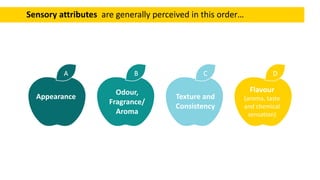
A B C D
Appearance
Sensory attributes are generally perceived in this order…
Flavour
(aroma, taste
and chemical
sensation)
Texture and
Consistency
Odour,
Fragrance/
Aroma
Innovating food for seniors
Food Variables…
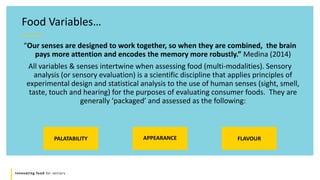
“Our senses are designed to work together, so when they are combined, the brain
pays more attention and encodes the memory more robustly.” Medina (2014)
All variables & senses intertwine when assessing food (multi-modalities). Sensory
analysis (or sensory evaluation) is a scientific discipline that applies principles of
experimental design and statistical analysis to the use of human senses (sight, smell,
taste, touch and hearing) for the purposes of evaluating consumer foods. They are
generally ‘packaged’ and assessed as the following:
PALATABILITY APPEARANCE FLAVOUR
Innovating food for seniors
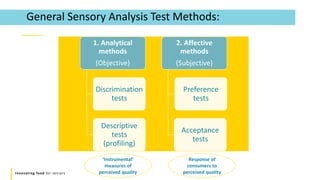
General Sensory Analysis Test Methods:
1. Analytical
methods
(Objective)
Discrimination
tests
Descriptive
tests
(profiling)
2. Affective
methods
(Subjective)
Preference
tests
Acceptance
tests
‘Instrumental’
measures of
perceived quality
Response of
consumers to
perceived quality
Innovating food for seniors
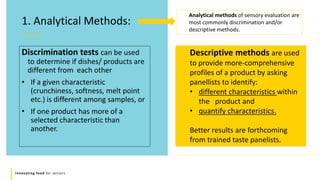
Discrimination tests can be used
to determine if dishes/ products are
different from each other
• If a given characteristic
(crunchiness, softness, melt point
etc.) is different among samples, or
• If one product has more of a
selected characteristic than
another.
1. Analytical Methods:
Descriptive methods are used
to provide more-comprehensive
profiles of a product by asking
panellists to identify:
• different characteristics within
the product and
• quantify characteristics.
Better results are forthcoming
from trained taste panelists.
Analytical methods of sensory evaluation are
most commonly discrimination and/or
descriptive methods.
Innovating food for seniors
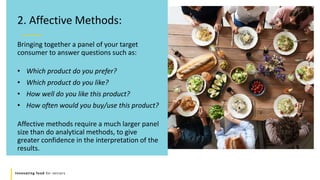
2. Affective Methods:
Bringing together a panel of your target
consumer to answer questions such as:
• Which product do you prefer?
• Which product do you like?
• How well do you like this product?
• How often would you buy/use this product?
Affective methods require a much larger panel
size than do analytical methods, to give
greater confidence in the interpretation of the
results.
Innovating food for seniors
Food Variables: Appearance should also be Considered…
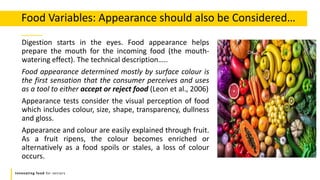
Digestion starts in the eyes. Food appearance helps
prepare the mouth for the incoming food (the mouth-
watering effect). The technical description…..
Food appearance determined mostly by surface colour is
the first sensation that the consumer perceives and uses
as a tool to either accept or reject food (Leon et al., 2006)
Appearance tests consider the visual perception of food
which includes colour, size, shape, transparency, dullness
and gloss.
Appearance and colour are easily explained through fruit.
As a fruit ripens, the colour becomes enriched or
alternatively as a food spoils or stales, a loss of colour
occurs.
Refers to a good or service being
offered by a company.
Innovating food for seniors
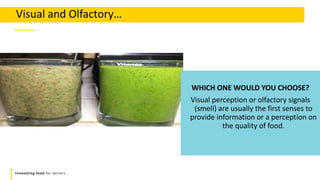
Visual and Olfactory…
WHICH ONE WOULD YOU CHOOSE?
Visual perception or olfactory signals
(smell) are usually the first senses to
provide information or a perception on
the quality of food.
Innovating food for seniors
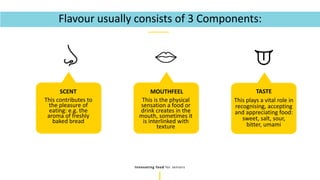
Flavour usually consists of 3 Components:
This contributes to
the pleasure of
eating: e.g. the
aroma of freshly
baked bread
SCENT
This is the physical
sensation a food or
drink creates in the
mouth, sometimes it
is interlinked with
texture
MOUTHFEEL
This plays a vital role in
recognising, accepting
and appreciating food:
sweet, salt, sour,
bitter, umami
TASTE
Innovating
food
for
seniors
• To provide a detailed specification of a
single product (a retailer might ask for).
A basic description often contains:
aroma/taste; appearance, flavour;
mouthfeel/trigeminal; aftertaste
• To compare products (e.g. quality
attribute sheets- normally for a large
company)
• To aid in determining the Shelf-life
• For NPD: target matching (with the
market need/preferences)
• To resolve or as part of trouble shooting
customer complaints
Why use descriptive
Analysis?
Innovating food for seniors
How Our Senses Interact
Leatherhead Food Research published an
excellent research paper to help us
understand how the senses operate
together.
Over 7 pages, it shares fascinating
investigations such as the physical
(tactile/taste) interactions. It is a powerful
tool for food product developers and
marketing professionals.
READ: White-Paper-How-Our-Senses-Interact.pdf
(leatherheadfood.com)
Innovating food for seniors
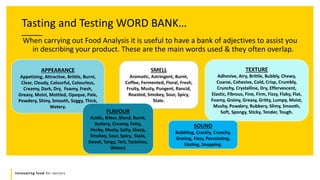
Tasting and Testing WORD BANK…
When carrying out Food Analysis it is useful to have a bank of adjectives to assist you
in describing your product. These are the main words used & they often overlap.
APPEARANCE
Appetising, Attractive, Brittle, Burnt,
Clear, Cloudy, Colourful, Colourless,
Creamy, Dark, Dry, Foamy, Fresh,
Greasy, Moist, Mottled, Opaque, Pale,
Powdery, Shiny, Smooth, Soggy, Thick,
Watery.
SMELL
Aromatic, Astringent, Burnt,
Coffee, Fermented, Floral, Fresh,
Fruity, Musty, Pungent, Rancid,
Roasted, Smokey, Sour, Spicy,
Stale.
TEXTURE
Adhesive, Airy, Brittle, Bubbly, Chewy,
Coarse, Cohesive, Cold, Crisp, Crumbly,
Crunchy, Crystalline, Dry, Effervescent,
Elastic, Fibrous, Fine, Firm, Fizzy, Flaky, Flat,
Foamy, Grainy, Greasy, Gritty, Lumpy, Moist,
Mushy, Powdery, Rubbery, Slimy, Smooth,
Soft, Spongy, Sticky, Tender, Tough.
FLAVOUR
Acidic, Bitter, Bland, Burnt,
Buttery, Creamy, Fatty,
Herby, Musty, Salty, Sharp,
Smokey, Sour, Spicy, Stale,
Sweet, Tangy, Tart, Tasteless,
Watery
SOUND
Bubbling, Crackly, Crunchy,
Grating, Fizzy, Percolating,
Sizzling, Snapping.
Refers to a good or service being
offered by a company.
Innovating food for seniors
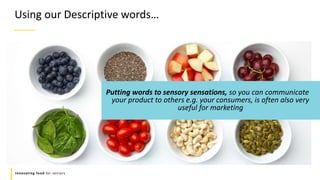
Putting words to sensory sensations, so you can communicate
your product to others e.g. your consumers, is often also very
useful for marketing
Using our Descriptive words…
Innovating food for seniors
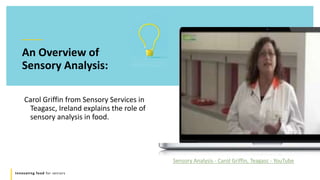
An Overview of
Sensory Analysis:
Carol Griffin from Sensory Services in
Teagasc, Ireland explains the role of
sensory analysis in food.
Sensory Analysis - Carol Griffin, Teagasc - YouTube
Innovating food for seniors
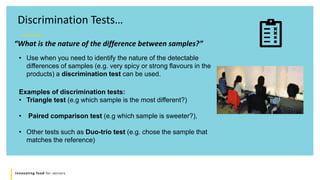
Discrimination Tests…
“What is the nature of the difference between samples?”
• Use when you need to identify the nature of the detectable
differences of samples (e.g. very spicy or strong flavours in the
products) a discrimination test can be used.
Examples of discrimination tests:
• Triangle test (e.g which sample is the most different?)
• Paired comparison test (e.g which sample is sweeter?),
• Other tests such as Duo-trio test (e.g. chose the sample that
matches the reference)
Innovating food for seniors
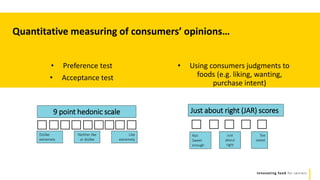
Quantitative measuring of consumers’ opinions…
• Preference test
• Acceptance test
• Using consumers judgments to
foods (e.g. liking, wanting,
purchase intent)
9 point hedonic scale
Dislike
extremely
Neither like
or dislike
Like
extremely
Just about right (JAR) scores
Not
Sweet
enough
Just
about
right
Too
sweet
Innovating food for seniors
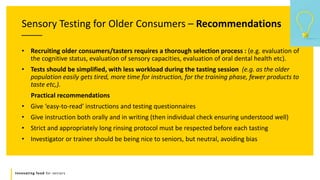
Sensory Testing for Older Consumers – Recommendations
• Recruiting older consumers/tasters requires a thorough selection process : (e.g. evaluation of
the cognitive status, evaluation of sensory capacities, evaluation of oral dental health etc).
• Tests should be simplified, with less workload during the tasting session (e.g. as the older
population easily gets tired, more time for instruction, for the training phase, fewer products to
taste etc,).
Practical recommendations
• Give ‘easy-to-read’ instructions and testing questionnaires
• Give instruction both orally and in writing (then individual check ensuring understood well)
• Strict and appropriately long rinsing protocol must be respected before each tasting
• Investigator or trainer should be being nice to seniors, but neutral, avoiding bias
Innovating
food
for
seniors
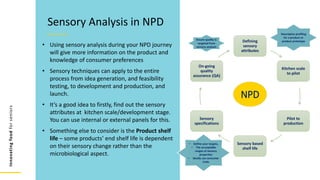
• Using sensory analysis during your NPD journey
will give more information on the product and
knowledge of consumer preferences
• Sensory techniques can apply to the entire
process from idea generation, and feasibility
testing, to development and production, and
launch.
• It’s a good idea to firstly, find out the sensory
attributes at kitchen scale/development stage.
You can use internal or external panels for this.
• Something else to consider is the Product shelf
life – some products’ end shelf life is dependent
on their sensory change rather than the
microbiological aspect.
Sensory Analysis in NPD
Defining
sensory
attributes
Kitchen scale
to pilot
Pilot to
production
Sensory based
shelf life
Sensory
specifications
On-going
quality
assurance (QA)
Ensure quality is
targeted from
sensory analysis
Descriptive profiling
for a product or
product prototype
• Define your targets,
• The accceptable
ranges of sensory
properties
• ideally use consumer
trials
NPD
Innovating
food
for
seniors
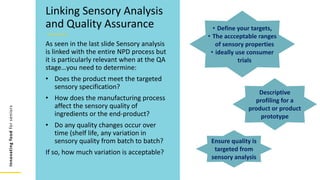
As seen in the last slide Sensory analysis
is linked with the entire NPD process but
it is particularly relevant when at the QA
stage…you need to determine:
• Does the product meet the targeted
sensory specification?
• How does the manufacturing process
affect the sensory quality of
ingredients or the end-product?
• Do any quality changes occur over
time (shelf life, any variation in
sensory quality from batch to batch?
If so, how much variation is acceptable?
Linking Sensory Analysis
and Quality Assurance
Ensure quality is
targeted from
sensory analysis
Descriptive
profiling for a
product or product
prototype
• Define your targets,
• The accceptable ranges
of sensory properties
• ideally use consumer
trials
Innovating food for seniors
Further Reading
Case studies for functional foods targeting older adults
• https://www.ilc-alliance.org/wp-content/uploads/publication-pdfs/functi_foods.pdf
• https://www.kerry.com/insights/kerrydigest/2020/immune-support-aging
• Functional ingredients - paving the way from fiction to facts (newfoodmagazine.com)
Relevant Books/ reports
• Jim Smith, Edward Charter. (2010). Functional Food Product Development. Published: Blackwell
Publishing Ltd.
• https://onlinelibrary.wiley.com/doi/book/10.1002/9781444323351
• Monique Raats, Lisette de Groot and Wija van Staveren. 2009. Foods for the ageing population. First
published: Woodhead Publishing Limited and CRC Press LLC.
Innovating food for seniors
Further Reading
Further reading: the definitions of functional foods and the functional food products
guidance and examples, as well as the relevance of functional foods for health ageing:
• Functional-Foods-For-Healthy-Aging-TOOLKIT-January.aspx (cfdr.ca)
• Considerations for developing functional foods for older population
• The development of fruit‐based functional foods targeting the health and wellness market:
a review - Sun‐Waterhouse - 2011 - International Journal of Food Science &
Technology - Wiley Online Library
EU law on Food information for consumers:
• Food information to consumers - legislation (europa.eu)
Innovating food for seniors
• Kemp, Hollowood and Hort (2009) Sensory Evaluation; A Practical Handbook.
(Wiley Blackwell)
• Meilgaard, Civille and Carr (2007) Affective Tests: Consumer Tests and In-House
Panel Acceptance Tests in Sensory Evaluation Techniques (CRC Press, 4th Ed)
• Resurreccion (1998) Consumer Sensory Testing for Product Development (Aspen
Pub Inc)
• Lawless and Heymann (1999) Acceptance and Preference Testing and Qualitative
Consumer Research methods In Sensory Evaluation of Food (Aspen Pub Inc)
Sensory analysis – some useful reference for further reading
Innovating
food
for
seniors
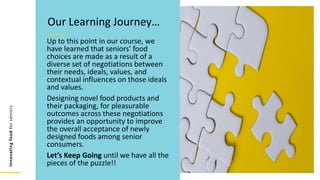
Up to this point in our course, we
have learned that seniors’ food
choices are made as a result of a
diverse set of negotiations between
their needs, ideals, values, and
contextual influences on those ideals
and values.
Designing novel food products and
their packaging, for pleasurable
outcomes across these negotiations
provides an opportunity to improve
the overall acceptance of newly
designed foods among senior
consumers.
Let’s Keep Going until we have all the
pieces of the puzzle!!
Our Learning Journey…
Co-funded by the
Erasmus+ Programme
of the European Union
Innovating
food
for
seniors
www. innovatingfoodforseniors.eu
Well Done!
You have completed
Module 8.
The final piece of our
puzzle in the Food Specific
Section is to understand
Seniors Unique Barriers &
Needs as discussed in
Module 9

Module 8 Sensory Analysis and Consumer Testing.pptx

  • 1.
    Co-funded by the Erasmus+Programme of the European Union Module 8 – Sensory Analysis and Consumer Testing This programme has been funded with support from the European Commission. The author is solely responsible for this publication (communication) and the Commission accepts no responsibility for any use that may be made of the information contained therein 2020-1-DE02-KA202-007612
  • 2.
    Innovating food for seniors SENSES • The waywe perceive food, from a sensory point of view, is determined by the five human senses: sight, smell, taste, touch and hearing. The success of food greatly depends on the extent to which their sensory quality appeals to the target population. • Other benefits such as the health aspects may enhance the perceived value of the food but can be largely useless if the sensory qualities are unattractive. • …”You can tell me its good for me but that’s no good if it looks, tastes & feels like cardboard!”
  • 3.
    Education Infographics A BC D Appearance Sensory attributes are generally perceived in this order… Flavour (aroma, taste and chemical sensation) Texture and Consistency Odour, Fragrance/ Aroma
  • 4.
    Innovating food forseniors Food Variables… “Our senses are designed to work together, so when they are combined, the brain pays more attention and encodes the memory more robustly.” Medina (2014) All variables & senses intertwine when assessing food (multi-modalities). Sensory analysis (or sensory evaluation) is a scientific discipline that applies principles of experimental design and statistical analysis to the use of human senses (sight, smell, taste, touch and hearing) for the purposes of evaluating consumer foods. They are generally ‘packaged’ and assessed as the following: PALATABILITY APPEARANCE FLAVOUR
  • 5.
    Innovating food forseniors General Sensory Analysis Test Methods: 1. Analytical methods (Objective) Discrimination tests Descriptive tests (profiling) 2. Affective methods (Subjective) Preference tests Acceptance tests ‘Instrumental’ measures of perceived quality Response of consumers to perceived quality
  • 6.
    Innovating food forseniors Discrimination tests can be used to determine if dishes/ products are different from each other • If a given characteristic (crunchiness, softness, melt point etc.) is different among samples, or • If one product has more of a selected characteristic than another. 1. Analytical Methods: Descriptive methods are used to provide more-comprehensive profiles of a product by asking panellists to identify: • different characteristics within the product and • quantify characteristics. Better results are forthcoming from trained taste panelists. Analytical methods of sensory evaluation are most commonly discrimination and/or descriptive methods.
  • 7.
    Innovating food forseniors 2. Affective Methods: Bringing together a panel of your target consumer to answer questions such as: • Which product do you prefer? • Which product do you like? • How well do you like this product? • How often would you buy/use this product? Affective methods require a much larger panel size than do analytical methods, to give greater confidence in the interpretation of the results.
  • 8.
    Innovating food forseniors Food Variables: Appearance should also be Considered… Digestion starts in the eyes. Food appearance helps prepare the mouth for the incoming food (the mouth- watering effect). The technical description….. Food appearance determined mostly by surface colour is the first sensation that the consumer perceives and uses as a tool to either accept or reject food (Leon et al., 2006) Appearance tests consider the visual perception of food which includes colour, size, shape, transparency, dullness and gloss. Appearance and colour are easily explained through fruit. As a fruit ripens, the colour becomes enriched or alternatively as a food spoils or stales, a loss of colour occurs.
  • 9.
    Refers to agood or service being offered by a company. Innovating food for seniors Visual and Olfactory… WHICH ONE WOULD YOU CHOOSE? Visual perception or olfactory signals (smell) are usually the first senses to provide information or a perception on the quality of food.
  • 10.
    Innovating food forseniors Flavour usually consists of 3 Components: This contributes to the pleasure of eating: e.g. the aroma of freshly baked bread SCENT This is the physical sensation a food or drink creates in the mouth, sometimes it is interlinked with texture MOUTHFEEL This plays a vital role in recognising, accepting and appreciating food: sweet, salt, sour, bitter, umami TASTE
  • 11.
    Innovating food for seniors • To providea detailed specification of a single product (a retailer might ask for). A basic description often contains: aroma/taste; appearance, flavour; mouthfeel/trigeminal; aftertaste • To compare products (e.g. quality attribute sheets- normally for a large company) • To aid in determining the Shelf-life • For NPD: target matching (with the market need/preferences) • To resolve or as part of trouble shooting customer complaints Why use descriptive Analysis?
  • 12.
    Innovating food forseniors How Our Senses Interact Leatherhead Food Research published an excellent research paper to help us understand how the senses operate together. Over 7 pages, it shares fascinating investigations such as the physical (tactile/taste) interactions. It is a powerful tool for food product developers and marketing professionals. READ: White-Paper-How-Our-Senses-Interact.pdf (leatherheadfood.com)
  • 13.
    Innovating food forseniors Tasting and Testing WORD BANK… When carrying out Food Analysis it is useful to have a bank of adjectives to assist you in describing your product. These are the main words used & they often overlap. APPEARANCE Appetising, Attractive, Brittle, Burnt, Clear, Cloudy, Colourful, Colourless, Creamy, Dark, Dry, Foamy, Fresh, Greasy, Moist, Mottled, Opaque, Pale, Powdery, Shiny, Smooth, Soggy, Thick, Watery. SMELL Aromatic, Astringent, Burnt, Coffee, Fermented, Floral, Fresh, Fruity, Musty, Pungent, Rancid, Roasted, Smokey, Sour, Spicy, Stale. TEXTURE Adhesive, Airy, Brittle, Bubbly, Chewy, Coarse, Cohesive, Cold, Crisp, Crumbly, Crunchy, Crystalline, Dry, Effervescent, Elastic, Fibrous, Fine, Firm, Fizzy, Flaky, Flat, Foamy, Grainy, Greasy, Gritty, Lumpy, Moist, Mushy, Powdery, Rubbery, Slimy, Smooth, Soft, Spongy, Sticky, Tender, Tough. FLAVOUR Acidic, Bitter, Bland, Burnt, Buttery, Creamy, Fatty, Herby, Musty, Salty, Sharp, Smokey, Sour, Spicy, Stale, Sweet, Tangy, Tart, Tasteless, Watery SOUND Bubbling, Crackly, Crunchy, Grating, Fizzy, Percolating, Sizzling, Snapping.
  • 14.
    Refers to agood or service being offered by a company. Innovating food for seniors Putting words to sensory sensations, so you can communicate your product to others e.g. your consumers, is often also very useful for marketing Using our Descriptive words…
  • 15.
    Innovating food forseniors An Overview of Sensory Analysis: Carol Griffin from Sensory Services in Teagasc, Ireland explains the role of sensory analysis in food. Sensory Analysis - Carol Griffin, Teagasc - YouTube
  • 16.
    Innovating food forseniors Discrimination Tests… “What is the nature of the difference between samples?” • Use when you need to identify the nature of the detectable differences of samples (e.g. very spicy or strong flavours in the products) a discrimination test can be used. Examples of discrimination tests: • Triangle test (e.g which sample is the most different?) • Paired comparison test (e.g which sample is sweeter?), • Other tests such as Duo-trio test (e.g. chose the sample that matches the reference)
  • 17.
    Innovating food forseniors Quantitative measuring of consumers’ opinions… • Preference test • Acceptance test • Using consumers judgments to foods (e.g. liking, wanting, purchase intent) 9 point hedonic scale Dislike extremely Neither like or dislike Like extremely Just about right (JAR) scores Not Sweet enough Just about right Too sweet
  • 18.
    Innovating food forseniors Sensory Testing for Older Consumers – Recommendations • Recruiting older consumers/tasters requires a thorough selection process : (e.g. evaluation of the cognitive status, evaluation of sensory capacities, evaluation of oral dental health etc). • Tests should be simplified, with less workload during the tasting session (e.g. as the older population easily gets tired, more time for instruction, for the training phase, fewer products to taste etc,). Practical recommendations • Give ‘easy-to-read’ instructions and testing questionnaires • Give instruction both orally and in writing (then individual check ensuring understood well) • Strict and appropriately long rinsing protocol must be respected before each tasting • Investigator or trainer should be being nice to seniors, but neutral, avoiding bias
  • 19.
    Innovating food for seniors • Using sensoryanalysis during your NPD journey will give more information on the product and knowledge of consumer preferences • Sensory techniques can apply to the entire process from idea generation, and feasibility testing, to development and production, and launch. • It’s a good idea to firstly, find out the sensory attributes at kitchen scale/development stage. You can use internal or external panels for this. • Something else to consider is the Product shelf life – some products’ end shelf life is dependent on their sensory change rather than the microbiological aspect. Sensory Analysis in NPD Defining sensory attributes Kitchen scale to pilot Pilot to production Sensory based shelf life Sensory specifications On-going quality assurance (QA) Ensure quality is targeted from sensory analysis Descriptive profiling for a product or product prototype • Define your targets, • The accceptable ranges of sensory properties • ideally use consumer trials NPD
  • 20.
    Innovating food for seniors As seen inthe last slide Sensory analysis is linked with the entire NPD process but it is particularly relevant when at the QA stage…you need to determine: • Does the product meet the targeted sensory specification? • How does the manufacturing process affect the sensory quality of ingredients or the end-product? • Do any quality changes occur over time (shelf life, any variation in sensory quality from batch to batch? If so, how much variation is acceptable? Linking Sensory Analysis and Quality Assurance Ensure quality is targeted from sensory analysis Descriptive profiling for a product or product prototype • Define your targets, • The accceptable ranges of sensory properties • ideally use consumer trials
  • 21.
    Innovating food forseniors Further Reading Case studies for functional foods targeting older adults • https://www.ilc-alliance.org/wp-content/uploads/publication-pdfs/functi_foods.pdf • https://www.kerry.com/insights/kerrydigest/2020/immune-support-aging • Functional ingredients - paving the way from fiction to facts (newfoodmagazine.com) Relevant Books/ reports • Jim Smith, Edward Charter. (2010). Functional Food Product Development. Published: Blackwell Publishing Ltd. • https://onlinelibrary.wiley.com/doi/book/10.1002/9781444323351 • Monique Raats, Lisette de Groot and Wija van Staveren. 2009. Foods for the ageing population. First published: Woodhead Publishing Limited and CRC Press LLC.
  • 22.
    Innovating food forseniors Further Reading Further reading: the definitions of functional foods and the functional food products guidance and examples, as well as the relevance of functional foods for health ageing: • Functional-Foods-For-Healthy-Aging-TOOLKIT-January.aspx (cfdr.ca) • Considerations for developing functional foods for older population • The development of fruit‐based functional foods targeting the health and wellness market: a review - Sun‐Waterhouse - 2011 - International Journal of Food Science & Technology - Wiley Online Library EU law on Food information for consumers: • Food information to consumers - legislation (europa.eu)
  • 23.
    Innovating food forseniors • Kemp, Hollowood and Hort (2009) Sensory Evaluation; A Practical Handbook. (Wiley Blackwell) • Meilgaard, Civille and Carr (2007) Affective Tests: Consumer Tests and In-House Panel Acceptance Tests in Sensory Evaluation Techniques (CRC Press, 4th Ed) • Resurreccion (1998) Consumer Sensory Testing for Product Development (Aspen Pub Inc) • Lawless and Heymann (1999) Acceptance and Preference Testing and Qualitative Consumer Research methods In Sensory Evaluation of Food (Aspen Pub Inc) Sensory analysis – some useful reference for further reading
  • 24.
    Innovating food for seniors Up to thispoint in our course, we have learned that seniors’ food choices are made as a result of a diverse set of negotiations between their needs, ideals, values, and contextual influences on those ideals and values. Designing novel food products and their packaging, for pleasurable outcomes across these negotiations provides an opportunity to improve the overall acceptance of newly designed foods among senior consumers. Let’s Keep Going until we have all the pieces of the puzzle!! Our Learning Journey…
  • 25.
    Co-funded by the Erasmus+Programme of the European Union Innovating food for seniors www. innovatingfoodforseniors.eu Well Done! You have completed Module 8. The final piece of our puzzle in the Food Specific Section is to understand Seniors Unique Barriers & Needs as discussed in Module 9