PRESENTED BY:
Chhavi(M)
Himanshi (M)
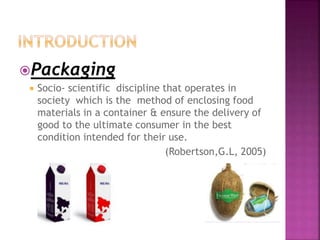
Packaging
 Socio- scientific discipline that operates in
society which is the method of enclosing food
materials in a container & ensure the delivery of
good to the ultimate consumer in the best
condition intended for their use.
(Robertson,G.L, 2005)
 FATHER OF NANO TECHNOLOGY: Richard Feynman(1954)
 NANO SCIENCE:
 Study of phenomenon & manipulation of materials atomic,
molecular & macromolecular scales.
 NANO TECHNOLOGY:
 Involves the characterisation , fabrication & or manipulation
of structures , devices or materials that have at least one
dimension is approx 1-100 nm in length.
There is a large amount of research underway in both academia and
industry to improve the performance of packaging materials made from
renewable resources, although commercial use of these materials for the
packaging of food is still in its early stages.
CHHAVI (M)
 ‘Novel’ type of packaging
 Incorporating certain components into
packaging systems
 Components release/absorb substances from
food/environment surrounding food
(interact)
 Aim is to extend shelf life by
improving/maintaining optimum conditions
 Sensory attributes (color, aroma) also
preserved
SACHETS &
PADS
PACKAGING
MATERIALS
 Elevated O2 levels lead to microbial
growth, off-flavor, nutritional losses
 Ascorbic acid & Iron Powder (common)
 Reduce oxygen concentration in package
 Available as sachets & films
 Applications: Cured Meat, Poultry, Egg
Powders, Fish etc
 Water accumulates as a result of drip losses, temp
fluctuations etc
 It leads to growth of molds & bacteria & fogging of films
 Hydrosorbent polymers (either coated or sachet) can
absorb much more moisture than their weight, located
b/w two plastic layers (PP/HDPE)
 Eg: Polyacrylate salts, CMC (carboxy methyl cellulose)
 Applications: Fish, Meat, Poultry, Snack foods
 Ethylene can also have negative effects on fresh produce
Eg: increase in respiration rate leading to softening of fruit
tissue
 KMnO4 with activated carbon commercially used to arrest
post-harvest changes
 3C2H4+12KMnO4→12MnO2+12KOH + 6CO2
 KMnO4 is toxic, so can’t be integrated into packaging films
 Applications: Horticultural produce
 Fresh roasted coffee releases CO2, causing
swelling/bursting of package
 Chemical absorbents like Ca(OH)2 or Mg(OH)2
 CO2+Ca(OH)2→CaCO3
 Sachets absorbing CO2 & O2 carved a niche in commercial
space
 CO2 emitting pouches to chicken alternative to MAP
extends shelf life
 Applications: Coffee, Fish, Meat, Nuts
 Major Brands:
 CO2 Fresh Pads (CO2
Technologies, Iowa)
 Verifrais (France)
 Consumer demand for ‘preservative –free’ foods
 Reduces/inhibits growth of microbes
 Incorporated/immobilized onto packaging material
 Eg: Ethanol, Enzymes, Organic acids, Bacteriocins
 Nisin coated films reduce S. typhimurium on drumstick
surface
 Applications: Cheese, Drumsticks
 Self-heating cans commercially developed
(Japan)
 For tea, coffee, sake & ready meals
 Some plastic trays (6 layer PP-EVOH copolymer)
with CaO underlayer
 FRH(flameless ration heater) based on reaction
b/w Mg & water (electrochemical process)
 Mg+2H2O→Mg(OH)2+H2+heat
 Food placed in FRH(Mg & NaCl in fibreboard box)
& water is added
 Major Brands: SCALDOPACK
 Heat source is exothermic reaction initiated
by a trigger
 Food containing inner chamber surrounded
by chemicals in outer chamber
 Outer chamber separated from water by thin
membrane
 CaO(s)+ H2O(l) → Ca(OH)2(s)
 Anhydrous CaCl2 used (heat of solution)
ADVANTAGES DISADVANTAGES
 Without heating
equipment
 Natural disasters
 Armed forces
 Expensive
 Consume space
 Uneven heating
 Overall acceptability
 Smart packaging
 Internal/external indicator to provide info about
quality/safety/shelf life of food
 3 classes:
 Quality Indicators: TTI’s, gas sensors
 Convenience: During cooking (microwave
doneness)
 Protection: Theft & Tampering
 Based on detecting volatile metabolites such as amines,
diacetyl, H2S etc
 Indicators to assess fruit ripeness developed
 Responds to complex volatile mix that fruit produces as it
ripens
 Color changes for unripe (crisp) to very ripe (juicy)
 Good co-relation b/w volatile composition & fruit
softening
 Initially tried on Pears
 RIPESENSE
(New Zealand)
 Temp sensitive inks printed onto containers
 Specify ideal temperature of product
 Hidden messages such as ‘HOT’, ‘DON’T
DRINK’ only visible at specific temperatures
 Major Brand: Food Sentinel System™(SIRA
Technologies California)
 Integrate exposure to temperature over time
accumulating effect of such exposures in form of
color change
 Small tag/label showing time-temp history to
which product been exposed
 Temp sensitive ink turns lighter as time
passes/ambient temp rises
 Length & temp sensitivity can be controlled by
type of ink(chemical)
 Major Brands:
 Fresh-Check® TTI from Temptime (formerly
LifeLines)
 MonitorMark™ TTI from 3M
 Sensing element of biological origin
integrated with transducer
 To detect microbes & enzymes
 Real-time analysis: identifying spoilage
microflora at early stage
 Chemical contaminants: Antibiotics,
pesticides
 Food-borne toxins: Mycotoxins
 Intensive R & D on nanosensors
 Tampering major concern for the industry
 Intensive R & D
 Not been commercialized yet
 Technologies being developed based on
seals which are transparent until package
is opened/tampered with
 Then messages or color changes visible
BY:
HIMANSHI
M
Definition:
 An edible film or coating is simply defined as
thin continuous layer of edible material formed
on, placed on, or between the foods or food
components.
 Package is an integral part of food, which can
be eaten as a part of the whole food products.
 Although bio based packaging materials may be
biodegradable, this is not the main driving force
behind their development. Rather, it is driven
by the ambition to replace non renewable
with renewable resources, thus leading to a
more sustainable packaging industry.
 Edible packaging consists of edible
films, sheets, coatings and pouches.
 Edible films (thickness <254 μm) or
sheets (thickness >254 μm) are stand-
alone structures that are preformed
separately from the food and then
placed on or between food components
or sealed into edible pouches .
 Whereas edible coatings are thin layers
of edible materials formed directly onto
the surface of the food.
 A variety of polysaccharides, proteins
and lipids derived from plants and
animals have been utilized, either alone
or in mixtures, to produce edible films
and coatings.
from the public’s point of
view, the main drivers for
the development of bio
based packaging are:
to offer a selective barrier to retard:
the migration of moisture(wax coating
on fruits & vegetables),
gas transport,
oil and fat migration and
solute transport;
improve the mechanical handling
properties of foods;
improve the mechanical integrity or
handling characteristics of the food;
retain volatile flavor compounds and
carry food additives such as
antioxidants and antimicrobials.
Can enhance nutritive value of food.
Function of
Edible
Packaging :
1Environment friendly as fully consumed or biodegradable.
2. enhance the organoleptic properties of packaged foods such as
flavors, colors and sweeteness.
can supplement the nutritional value of foods (this is particularly
true for films made from proteins).
4.Can be used as
interface between the
layers of
heterogenous foods to
prevent deterioration.
5. They can be used
for individual
packaging of small
portions of food,
particularly products
that currently are not
individually packaged
for practical reasons
such as peas, beans,
nuts and strawberries.
Edible fruits &
vegetables wraps
that enhances
nutrition for food
make healthy
food more
attractive to
consumers.
Fruits & vegetable
films could be used
to cover left over for
short term storage in
refrigerator.
Could
provide new
flavor
combinations
IDEAS FOR FUTURE:
7. They can
function as
carriers for
antimicrobial and
antioxidant
agents
8. They can be
very conveniently
used for micro
encapsulation of
food flavoring
and leavening
agents.
9. They could be
used in multilayer
food packaging
materials
together with
inedible films, in
which case the
edible films
would be the
inner layer(s) in
direct contact
with the food.
Reduces cost of
utilising by
products.
Eg:whey
 Cohesive forces between
polymers molecules:
 Here cohesive forces
between same polymer
molecules are responsible
for barrier properties of
films.
 Adhesive forces between
film & substrate:
 Formation of intact.
 APPLICATIONS
 Edible collagen casings
for meat products such
as sausages and sugar
or chocolate coatings for
confectionery products
are both currently used
commercially.
Simple co-acervation:
• In this a hydrocolloid
dispersed in water is
precipitated or undergoes a
phase change after solvent
evaporation(drying), after
addition of hydrosoluble
non- electrolyte in which
the hydrocolloid is
insoluble.
Complex Co-
acervation:
• In this two
hydrocolloid solutions
with opposite
electron charges are
mixed & thus causing
interaction &
precipitation of the
polymer complex.
Gelation & thermal
coagulation:
• Heating of
macromolecules leads
to denaturation
followed by gelation
or precipitation or
even cooling of
hydrocolloid dispersion
causes gelation.
 Material useful:
 Protein based:gluten, soy,
collagen, casein, zein etc
 Polysaccharide based:
cellulose, starch, pectin etc
 Lipid based: waxes, fatty
acids, acyl glycerols.
 In addition to them some
antimicrobial agents ,
thickening agents &
plasticizers are also used.
 CONSIDERATION
REQUIREMENTS & SAFETY
ISSUES:
 Should be generally
recognised as safe(GRAS) by
the FDA.
 Type of material used
should be declared.
 Coating must adhere to the
product not stick & should
melt in mouth.
BY
HIMANSHI
M
 Bio nano composites are mixture of
biopolymers with nano sized inorganic or
organic fillers with particular size,
geometry and surface chemistry properties
(Chivrac et al., 2009).
 Following on from the extraordinary
success of the nano composite concept in
the area of synthetic polymers
considerable research on nano composites
based on edible polymers has been
reported.
 The use of bionanocomposite materials for
edible packaging promises to improve barrier
and mechanical properties (Rhim and Ng,
2007; Sorrentino et al., 2007; Azeredo et
al.,2009; De Moura et al., 2009).
 Additionally, nano particles can be used as
carriers of antimicrobials and additives.
The beneficial
effects of
inorganic nano
fillers on
edible
materials
include :
• improved
retention of flavor,
acids, sugars,
texture and color;
• increased stability
during shipping
and storage;
• improved
appearance and
reduced spoilage.
 The commercial use of films based
on biopolymers has been limited
because of their generally poor
mechanical and barrier properties
when compared to petrochemical-
based polymers.
 The use of nano composites
promises to expand the use of
biobased packaging.
 However, the magnitude of the
enhancements strongly depends on
the structure of the
nanocomposites.
 A uniform dispersion of nano fillers
leads to a very large matrix/filler
interfacial area, which changes the
molecular mobility and the
consequent thermal and mechanical
properties of the material.
 High aspect ratio fillers such as nano
fibers are particularly interesting because
of their high specific surface area,
providing better reinforcing effects.
 Several bionanocomposites have
been developed by adding
reinforcing compounds (nano
fillers) to biopolymers, improving
their properties and enhancing
their cost-price efficiency .
Bio nanocomposites exhibit dramatic
enhancements of various material
properties including:
mechanical and flexural
properties,
heat distortion
temperature and
O2 permeability.
Provides barrier properties :
• O2
• Light
• Moisture
• UV rays
Provides excellent mechanical properties
• Strength
• Elasticity
• Durability
Thermal stability
Flammability reduction
Lighter in weight
 Bionanocomposites are based on nanoclay and polysaccharides, namely
starch and its derivatives, cellulose, chitosan and pectin; these
nanocomposite films show improved mechanical properties.
 Ray and Bousmina (2005) have reviewed the use of biodegradable
polymers in polymer-clay nanocomposites (PCNs).
 Basically montomorillonites (MMT) has been used.
 Poly lactic acid(PLA)+MMT= Increased thermal resistance
 PVC+MMT=improved optical resistance
 PE+MMT/SiO2 =improved durability
 Polyamide + multi wall carbon nano tubes=significant flame resistance.
 OTHERS:
 Nanofibres: barrier & mechanical properties, higher transparancy.
 Sillica nano particles:improve mechanical or barrier properties of composites.
 Starch nano crystals: mechanical properties
 Titanium dioxide nano particulate: block UV light & provide long shelf life for
food.
At the present time, bio based materials are being used for short shelf life foods
stored at chill temeratures, due to the fact that the materials are biodegradable.
Potential applications include fast food packaging of salads, egg cartons, fresh or
minimally processed fruits and vegetables, dairy products such as yoghurt and
organically grown foods.
The high CO2:O2 permeability ratio of certain bio based packaging materials
suggests that they could find application in the packaging of respiring foods such as
fruits and vegetables, although conflicting perm selectivity ratios have been
reported.
The relatively poor water vapour barrier of PLA has been shown to be a factor
limiting the shelf life of moist foods. For example, semi-hard cheese packaged in
PLA lost moisture, and surface drying was observed after 56 days due to the high
WVTR of the PLA; cheese packaged in conventional materials had a shelf life of 84
days (Holm, 2010).
Other current uses include thermoformed packaging for bakery products and bags
for bread, fresh pasta and salads.
 Numerous factors including political and legislative changes, as well as global
demand for foods and energy resources, will influence the development and
success of biobased packaging materials.
 Major supermarket chains are already leading the way by encouraging their
suppliers to use biobased packaging materials and this trend is likely to
accelerate.
 Future biobased food packaging materials are likely to be blends of polymers
and nanoclays (so-called bio nanocomposites) in order to achieve the desired
barrier and mechanical properties demanded by the food industry.
 Already, important research has been undertaken in this area with some small
commercialization; the next decade will see significant production of bio
nanocomposites for food industry use.
 Cost is undoubtedly a limitation to the widespread adoption of bio based
packaging materials but as production capacity increases, costs will fall.
 One barrier to reducing costs is the increase in the production of bio fuels that
in many cases are competing for the same raw materials (sugarcane, corn and
maize) as biobased packaging, putting upward pressure on raw material costs.
 Using the figure from the Pira (2010) report, the market for biobased plastics
will grow to 884,000 tonnes in 2020.
 Source times of india
 Apr 26 2016
 MARKET PLAYERS OF
EDIBLE PACKAGING:
 WikiCells: David
Edwards (harvard
professor)
 develop encases handling
liqud food in them).
 MonoSol (indian
company)
 gives vivo films(can hold hot
chocolate powder or instant
coffee or oatmeal or whey
protein drinks).
 Food Packaging Principles & Practice by G.L. Robertson
 m.timesofindia.com
 thenewsminute.com
 slideshare.net

Trends in food packaging

  • 1.
  • 2.
    Packaging  Socio- scientificdiscipline that operates in society which is the method of enclosing food materials in a container & ensure the delivery of good to the ultimate consumer in the best condition intended for their use. (Robertson,G.L, 2005)
  • 4.
     FATHER OFNANO TECHNOLOGY: Richard Feynman(1954)  NANO SCIENCE:  Study of phenomenon & manipulation of materials atomic, molecular & macromolecular scales.  NANO TECHNOLOGY:  Involves the characterisation , fabrication & or manipulation of structures , devices or materials that have at least one dimension is approx 1-100 nm in length. There is a large amount of research underway in both academia and industry to improve the performance of packaging materials made from renewable resources, although commercial use of these materials for the packaging of food is still in its early stages.
  • 5.
  • 6.
     ‘Novel’ typeof packaging  Incorporating certain components into packaging systems  Components release/absorb substances from food/environment surrounding food (interact)  Aim is to extend shelf life by improving/maintaining optimum conditions  Sensory attributes (color, aroma) also preserved
  • 7.
  • 9.
     Elevated O2levels lead to microbial growth, off-flavor, nutritional losses  Ascorbic acid & Iron Powder (common)  Reduce oxygen concentration in package  Available as sachets & films  Applications: Cured Meat, Poultry, Egg Powders, Fish etc
  • 10.
     Water accumulatesas a result of drip losses, temp fluctuations etc  It leads to growth of molds & bacteria & fogging of films  Hydrosorbent polymers (either coated or sachet) can absorb much more moisture than their weight, located b/w two plastic layers (PP/HDPE)  Eg: Polyacrylate salts, CMC (carboxy methyl cellulose)  Applications: Fish, Meat, Poultry, Snack foods
  • 11.
     Ethylene canalso have negative effects on fresh produce Eg: increase in respiration rate leading to softening of fruit tissue  KMnO4 with activated carbon commercially used to arrest post-harvest changes  3C2H4+12KMnO4→12MnO2+12KOH + 6CO2  KMnO4 is toxic, so can’t be integrated into packaging films  Applications: Horticultural produce
  • 12.
     Fresh roastedcoffee releases CO2, causing swelling/bursting of package  Chemical absorbents like Ca(OH)2 or Mg(OH)2  CO2+Ca(OH)2→CaCO3  Sachets absorbing CO2 & O2 carved a niche in commercial space  CO2 emitting pouches to chicken alternative to MAP extends shelf life  Applications: Coffee, Fish, Meat, Nuts  Major Brands:  CO2 Fresh Pads (CO2 Technologies, Iowa)  Verifrais (France)
  • 13.
     Consumer demandfor ‘preservative –free’ foods  Reduces/inhibits growth of microbes  Incorporated/immobilized onto packaging material  Eg: Ethanol, Enzymes, Organic acids, Bacteriocins  Nisin coated films reduce S. typhimurium on drumstick surface  Applications: Cheese, Drumsticks
  • 14.
     Self-heating canscommercially developed (Japan)  For tea, coffee, sake & ready meals  Some plastic trays (6 layer PP-EVOH copolymer) with CaO underlayer  FRH(flameless ration heater) based on reaction b/w Mg & water (electrochemical process)  Mg+2H2O→Mg(OH)2+H2+heat  Food placed in FRH(Mg & NaCl in fibreboard box) & water is added  Major Brands: SCALDOPACK
  • 15.
     Heat sourceis exothermic reaction initiated by a trigger  Food containing inner chamber surrounded by chemicals in outer chamber  Outer chamber separated from water by thin membrane  CaO(s)+ H2O(l) → Ca(OH)2(s)  Anhydrous CaCl2 used (heat of solution)
  • 16.
    ADVANTAGES DISADVANTAGES  Withoutheating equipment  Natural disasters  Armed forces  Expensive  Consume space  Uneven heating  Overall acceptability
  • 17.
     Smart packaging Internal/external indicator to provide info about quality/safety/shelf life of food  3 classes:  Quality Indicators: TTI’s, gas sensors  Convenience: During cooking (microwave doneness)  Protection: Theft & Tampering
  • 18.
     Based ondetecting volatile metabolites such as amines, diacetyl, H2S etc  Indicators to assess fruit ripeness developed  Responds to complex volatile mix that fruit produces as it ripens  Color changes for unripe (crisp) to very ripe (juicy)  Good co-relation b/w volatile composition & fruit softening  Initially tried on Pears  RIPESENSE (New Zealand)
  • 19.
     Temp sensitiveinks printed onto containers  Specify ideal temperature of product  Hidden messages such as ‘HOT’, ‘DON’T DRINK’ only visible at specific temperatures  Major Brand: Food Sentinel System™(SIRA Technologies California)
  • 20.
     Integrate exposureto temperature over time accumulating effect of such exposures in form of color change  Small tag/label showing time-temp history to which product been exposed  Temp sensitive ink turns lighter as time passes/ambient temp rises  Length & temp sensitivity can be controlled by type of ink(chemical)  Major Brands:  Fresh-Check® TTI from Temptime (formerly LifeLines)  MonitorMark™ TTI from 3M
  • 21.
     Sensing elementof biological origin integrated with transducer  To detect microbes & enzymes  Real-time analysis: identifying spoilage microflora at early stage  Chemical contaminants: Antibiotics, pesticides  Food-borne toxins: Mycotoxins  Intensive R & D on nanosensors
  • 22.
     Tampering majorconcern for the industry  Intensive R & D  Not been commercialized yet  Technologies being developed based on seals which are transparent until package is opened/tampered with  Then messages or color changes visible
  • 23.
  • 24.
    Definition:  An ediblefilm or coating is simply defined as thin continuous layer of edible material formed on, placed on, or between the foods or food components.  Package is an integral part of food, which can be eaten as a part of the whole food products.
  • 25.
     Although biobased packaging materials may be biodegradable, this is not the main driving force behind their development. Rather, it is driven by the ambition to replace non renewable with renewable resources, thus leading to a more sustainable packaging industry.
  • 26.
     Edible packagingconsists of edible films, sheets, coatings and pouches.  Edible films (thickness <254 μm) or sheets (thickness >254 μm) are stand- alone structures that are preformed separately from the food and then placed on or between food components or sealed into edible pouches .  Whereas edible coatings are thin layers of edible materials formed directly onto the surface of the food.  A variety of polysaccharides, proteins and lipids derived from plants and animals have been utilized, either alone or in mixtures, to produce edible films and coatings. from the public’s point of view, the main drivers for the development of bio based packaging are:
  • 27.
    to offer aselective barrier to retard: the migration of moisture(wax coating on fruits & vegetables), gas transport, oil and fat migration and solute transport; improve the mechanical handling properties of foods; improve the mechanical integrity or handling characteristics of the food; retain volatile flavor compounds and carry food additives such as antioxidants and antimicrobials. Can enhance nutritive value of food. Function of Edible Packaging :
  • 28.
    1Environment friendly asfully consumed or biodegradable. 2. enhance the organoleptic properties of packaged foods such as flavors, colors and sweeteness. can supplement the nutritional value of foods (this is particularly true for films made from proteins).
  • 29.
    4.Can be usedas interface between the layers of heterogenous foods to prevent deterioration. 5. They can be used for individual packaging of small portions of food, particularly products that currently are not individually packaged for practical reasons such as peas, beans, nuts and strawberries. Edible fruits & vegetables wraps that enhances nutrition for food make healthy food more attractive to consumers. Fruits & vegetable films could be used to cover left over for short term storage in refrigerator. Could provide new flavor combinations IDEAS FOR FUTURE:
  • 30.
    7. They can functionas carriers for antimicrobial and antioxidant agents 8. They can be very conveniently used for micro encapsulation of food flavoring and leavening agents. 9. They could be used in multilayer food packaging materials together with inedible films, in which case the edible films would be the inner layer(s) in direct contact with the food. Reduces cost of utilising by products. Eg:whey
  • 31.
     Cohesive forcesbetween polymers molecules:  Here cohesive forces between same polymer molecules are responsible for barrier properties of films.  Adhesive forces between film & substrate:  Formation of intact.  APPLICATIONS  Edible collagen casings for meat products such as sausages and sugar or chocolate coatings for confectionery products are both currently used commercially.
  • 32.
    Simple co-acervation: • Inthis a hydrocolloid dispersed in water is precipitated or undergoes a phase change after solvent evaporation(drying), after addition of hydrosoluble non- electrolyte in which the hydrocolloid is insoluble. Complex Co- acervation: • In this two hydrocolloid solutions with opposite electron charges are mixed & thus causing interaction & precipitation of the polymer complex. Gelation & thermal coagulation: • Heating of macromolecules leads to denaturation followed by gelation or precipitation or even cooling of hydrocolloid dispersion causes gelation.
  • 33.
     Material useful: Protein based:gluten, soy, collagen, casein, zein etc  Polysaccharide based: cellulose, starch, pectin etc  Lipid based: waxes, fatty acids, acyl glycerols.  In addition to them some antimicrobial agents , thickening agents & plasticizers are also used.  CONSIDERATION REQUIREMENTS & SAFETY ISSUES:  Should be generally recognised as safe(GRAS) by the FDA.  Type of material used should be declared.  Coating must adhere to the product not stick & should melt in mouth.
  • 34.
  • 35.
     Bio nanocomposites are mixture of biopolymers with nano sized inorganic or organic fillers with particular size, geometry and surface chemistry properties (Chivrac et al., 2009).  Following on from the extraordinary success of the nano composite concept in the area of synthetic polymers considerable research on nano composites based on edible polymers has been reported.  The use of bionanocomposite materials for edible packaging promises to improve barrier and mechanical properties (Rhim and Ng, 2007; Sorrentino et al., 2007; Azeredo et al.,2009; De Moura et al., 2009).  Additionally, nano particles can be used as carriers of antimicrobials and additives. The beneficial effects of inorganic nano fillers on edible materials include : • improved retention of flavor, acids, sugars, texture and color; • increased stability during shipping and storage; • improved appearance and reduced spoilage.
  • 36.
     The commercialuse of films based on biopolymers has been limited because of their generally poor mechanical and barrier properties when compared to petrochemical- based polymers.  The use of nano composites promises to expand the use of biobased packaging.  However, the magnitude of the enhancements strongly depends on the structure of the nanocomposites.  A uniform dispersion of nano fillers leads to a very large matrix/filler interfacial area, which changes the molecular mobility and the consequent thermal and mechanical properties of the material.  High aspect ratio fillers such as nano fibers are particularly interesting because of their high specific surface area, providing better reinforcing effects.  Several bionanocomposites have been developed by adding reinforcing compounds (nano fillers) to biopolymers, improving their properties and enhancing their cost-price efficiency . Bio nanocomposites exhibit dramatic enhancements of various material properties including: mechanical and flexural properties, heat distortion temperature and O2 permeability.
  • 37.
    Provides barrier properties: • O2 • Light • Moisture • UV rays Provides excellent mechanical properties • Strength • Elasticity • Durability Thermal stability Flammability reduction Lighter in weight
  • 38.
     Bionanocomposites arebased on nanoclay and polysaccharides, namely starch and its derivatives, cellulose, chitosan and pectin; these nanocomposite films show improved mechanical properties.  Ray and Bousmina (2005) have reviewed the use of biodegradable polymers in polymer-clay nanocomposites (PCNs).  Basically montomorillonites (MMT) has been used.  Poly lactic acid(PLA)+MMT= Increased thermal resistance  PVC+MMT=improved optical resistance  PE+MMT/SiO2 =improved durability  Polyamide + multi wall carbon nano tubes=significant flame resistance.  OTHERS:  Nanofibres: barrier & mechanical properties, higher transparancy.  Sillica nano particles:improve mechanical or barrier properties of composites.  Starch nano crystals: mechanical properties  Titanium dioxide nano particulate: block UV light & provide long shelf life for food.
  • 39.
    At the presenttime, bio based materials are being used for short shelf life foods stored at chill temeratures, due to the fact that the materials are biodegradable. Potential applications include fast food packaging of salads, egg cartons, fresh or minimally processed fruits and vegetables, dairy products such as yoghurt and organically grown foods. The high CO2:O2 permeability ratio of certain bio based packaging materials suggests that they could find application in the packaging of respiring foods such as fruits and vegetables, although conflicting perm selectivity ratios have been reported. The relatively poor water vapour barrier of PLA has been shown to be a factor limiting the shelf life of moist foods. For example, semi-hard cheese packaged in PLA lost moisture, and surface drying was observed after 56 days due to the high WVTR of the PLA; cheese packaged in conventional materials had a shelf life of 84 days (Holm, 2010). Other current uses include thermoformed packaging for bakery products and bags for bread, fresh pasta and salads.
  • 40.
     Numerous factorsincluding political and legislative changes, as well as global demand for foods and energy resources, will influence the development and success of biobased packaging materials.  Major supermarket chains are already leading the way by encouraging their suppliers to use biobased packaging materials and this trend is likely to accelerate.  Future biobased food packaging materials are likely to be blends of polymers and nanoclays (so-called bio nanocomposites) in order to achieve the desired barrier and mechanical properties demanded by the food industry.  Already, important research has been undertaken in this area with some small commercialization; the next decade will see significant production of bio nanocomposites for food industry use.  Cost is undoubtedly a limitation to the widespread adoption of bio based packaging materials but as production capacity increases, costs will fall.  One barrier to reducing costs is the increase in the production of bio fuels that in many cases are competing for the same raw materials (sugarcane, corn and maize) as biobased packaging, putting upward pressure on raw material costs.  Using the figure from the Pira (2010) report, the market for biobased plastics will grow to 884,000 tonnes in 2020.
  • 41.
     Source timesof india  Apr 26 2016
  • 42.
     MARKET PLAYERSOF EDIBLE PACKAGING:  WikiCells: David Edwards (harvard professor)  develop encases handling liqud food in them).  MonoSol (indian company)  gives vivo films(can hold hot chocolate powder or instant coffee or oatmeal or whey protein drinks).
  • 44.
     Food PackagingPrinciples & Practice by G.L. Robertson  m.timesofindia.com  thenewsminute.com  slideshare.net