By Dr. M. A. BADR Prof Internal Med.Univer Alex. Depart of Diabetes & Metabolism Consultant Mouwasat Hospital FAT   REPLACEMENTS FAT  SUBSTITUTES FAT  REPLACERS
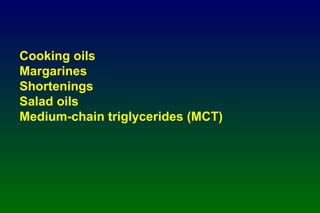
Cooking oils Margarines Shortenings Salad oils Medium-chain triglycerides (MCT)
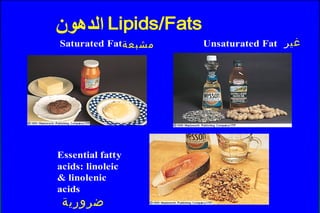
الدهون   مشبعة   غي ر ضرورية
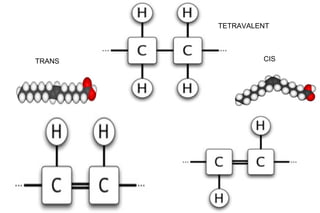
CIS TRANS TETRAVALENT
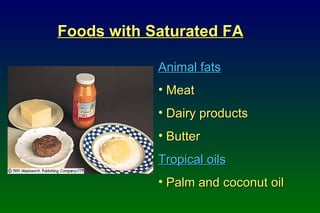
Foods with Saturated FA Animal fats Meat Dairy products Butter Tropical oils Palm and coconut oil
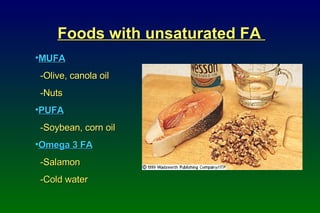
Foods with unsaturated FA  MUFA -Olive, canola oil  -Nuts PUFA -Soybean, corn oil Omega 3 FA   -Salamon  -Cold water
Nobel laureate Paul Sabatier  worked in the 1890s to develop the chemistry of  hydrogenation  which enabled the margarine, oil hydrogenation, and synthetic methanol industries. While  Sabatier  only considered hydrogenation of vapours, the German chemist Wilhelm  Normann  showed in 1901 that liquid oils could be hydrogenated and patented the process in 1902. In 1909, Procter & Gamble acquired the US rights to the Normann patent; in 1911, they began marketing the first hydrogenated shortening,  Crisco  (composed largely of partially hydrogenated cottonseed oil )..
 
Walt Disney Company  will begin getting rid of trans fats in meals at US theme parks ( Disneyland ,  Walt Disney World , etc.) by the end of  2007 , and will stop the inclusion of trans fats in licensed or promotional products by  2008 .
The EFSA Journal (2004) 81, 1-49 Opinion of the Scientific Panel on Dietetic Products, Nutrition and Allergies on a request from the Commission related to  the presence of trans fatty acids in foods and  the effect on human health of the consumption of trans fatty acids  (Request N° EFSA-Q-2003-022)  (adopted on 8 July 2004)   Trans-fat
 
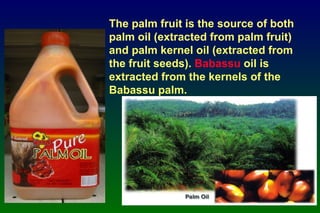
The palm fruit is the source of both palm oil (extracted from palm fruit) and palm kernel oil (extracted from the fruit seeds).  Babassu  oil  is extracted from the kernels of the Babassu palm.
The oil palm gives its name to the 16 carbon saturated fatty acid  palmitic  acid  found in palm oil; monounsaturated oleic acid is also a constituent of palm oil while palm kernel oil contains mainly  lauric   acid .
Palm oil became a highly sought-after commodity by  British  traders, the oil being used as industrial  lubricant  for the machines of Britain's ongoing  Industrial Revolution , as well as forming the basis for different brands of  soap  such as  Palmolive . By c.1870, palm oil constituted the primary export of some West African states such as Ghana and Nigeria.
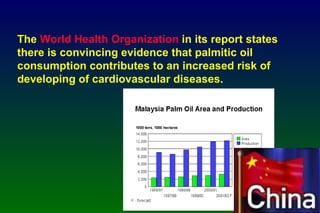
The  World Health Organization  in its report states there is convincing evidence that palmitic oil consumption contributes to an increased risk of developing of cardiovascular diseases.
 
 
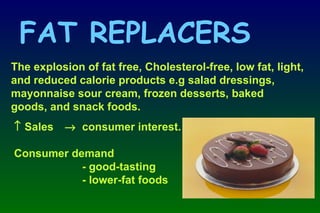
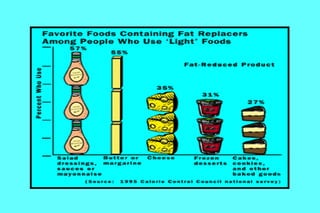
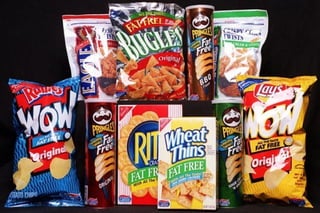
The explosion of fat free, Cholesterol-free, low fat, light, and reduced calorie products e.g salad dressings, mayonnaise sour cream, frozen desserts, baked goods, and snack foods.    Sales    consumer interest. Consumer demand - good-tasting - lower-fat foods FAT REPLACERS
 
 
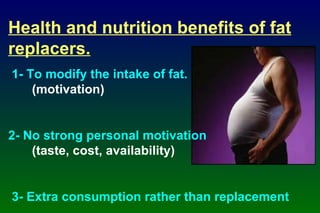
Health and nutrition benefits of fat replacers. 1- To modify the intake of fat.  (motivation) 2- No strong personal motivation (taste, cost, availability) 3- Extra consumption rather than replacement
Definition Fat replacers * Safe compounds * Has all the functional and organoleptic properties (taste & appearance) of  fat * Significantly fewer calories
Classification 1- Carbohydrate - based 2- Protein - based 3- Fat- based
Carbohydrate – based * Carbohydrate polymers * Hydrocolloids * Polyols  (sugar alcohols or bulking ingredients)
Carbohydrate - based * Carbohydrate polymers Consists of  - Modified food starches - Dextrin - Maltodextrins Created from :  Cereals, grains, and / or starches   such as corn, potato, & Tapioca. NB: Polydextrose is also included.
CHO based Fat Replacers -  CHO Polymers (continue) Refining    Modified food starches provide specific attribute e.g  anti - staling for baked goods * CHO polymer needs more liquid to be added. A gelling reaction occurs that provides a  thick, creamy mouth - feel.
CHO based Fat Replacers -  Hydrocolloids Gums, gels and fibers * Provide thickness * Stabilizing, emulsifying and/or providing    structure to foods. * Some products, like pectin and bran * 2 common foods, apple sauce and pureed    prunes (add bulk and flavor in baking)
CHO based Fat Replacers   Polyols  (sugar alcohols bulking ingredients) * Provide volume or bulk * Sorbitol, isomalt, lactitol maltitol, mannitol, xylitol &    hydrogenated starch hydrolysates * Familiar in low - calorie diet in diabetics, high intensity    sweeteners as aspartame, saccharin and acesulfame-K
Polyols- basic sugar + H    Polyols Sucrose Glucose Strach based syrup Strach based syrup + H   H ydrogenated  S trach  H ydrolysate   (H S H)
Characteristics of polyols *  Sweeteners * Crystallization * Viscosity   * Moisture * Extreme heat * < 4 K cal/g * Laxative
Protein-based Fat Replacers Microparticulated protein is created by heating and blending protein at high temperature to develop microscopic particles that are said to float over the tongue to provide the creamy mouth - feel of fat. Origin  : egg white or whey protein
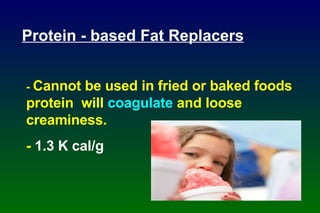
-  Cannot be used in fried or baked foods protein  will  coagulate  and loose creaminess. -  1.3 K cal/g Protein - based Fat Replacers
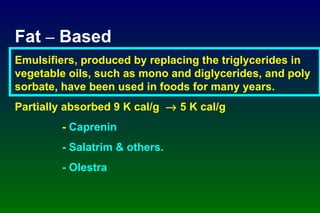
Fat  –  Based Emulsifiers, produced by replacing the triglycerides in vegetable oils, such as mono and diglycerides, and poly sorbate, have been used in foods for many years. Partially absorbed 9 K cal/g    5 K cal/g -  Caprenin - Salatrim & others. - Olestra
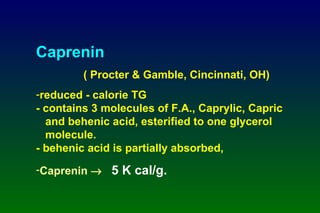
Caprenin ( Procter & Gamble, Cincinnati, OH) reduced - calorie TG - contains 3 molecules of F.A., Caprylic, Capric    and behenic acid, esterified to one glycerol    molecule. - behenic acid is partially absorbed,  Caprenin     5 K cal/g.
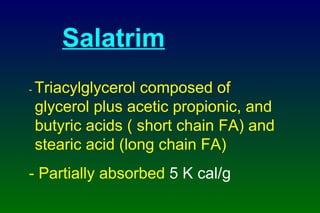
-  Triacylglycerol composed of glycerol plus acetic propionic, and butyric acids ( short chain FA) and stearic acid (long chain FA) - Partially absorbed  5 K cal/g Salatrim
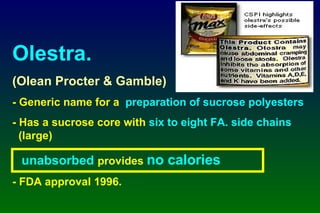
Olestra. (Olean Procter & Gamble) - Generic name for a  preparation of sucrose polyesters - Has a sucrose core with  six to eight FA. side chains     (large) unabsorbed  provides  no calories - FDA approval 1996.
-  Used in prepackaged ready to eat savory (not sweet), snacks such as potato, corn, chips and crackers For frying or baking, in dough conditioners, in sprays, in filling ingredients, or in flavors  ( replace 100% of fat). Olestra
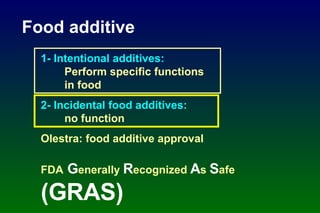
Food additive 1- Intentional additives: Perform specific functions in food 2- Incidental food additives: no function Olestra: food additive approval FDA   G enerally  R ecognized  A s  S afe  (GRAS)
Microparticulated Protein  (Simplesse®) Modified Whey Protein Concentrate  (Dairy-Lo®)   Other  (K-Blazer® , ULTRA-BAKETM, ULTRA-FREEZETM, Lita®)   PROTEIN-BASED FAT REPLACERS   CARBOHYDRATE-BASED FAT REPLACERS Cellulose  (Avicel® cellulose gel, MethocelTM, Solka-Floc®)   Dextrins  (Amylum, N-Oil®) Gums  (KELCOGEL®, KELTROL®, SlendidTM)   Inulin  (Raftiline®, Fruitafit®, Fibruline®)   Nu-Trim   Oatrim  [Hydrolyzed oat flour] (Beta-TrimTM, TrimChoice)   Polydextrose  (Litesse®, Sta-LiteTM)   Polyols  (many brands available)   Starch and Modified Food Starch  (Amalean®I & II, FairnexTMVA15, & VA20, Instant StellarTM, N-Lite, OptaGrade®#, PerfectamylTMAC, AX-1, & AX-2, PURE-GEL®, STA-SLIMTM) Z-Trim
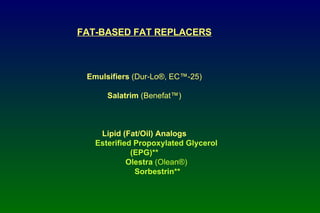
FAT-BASED FAT REPLACERS Emulsifiers  (Dur-Lo®, EC™-25) Salatrim  (Benefat™) Lipid (Fat/Oil) Analogs Esterified Propoxylated Glycerol   (EPG)** Olestra  (Olean®) Sorbestrin**
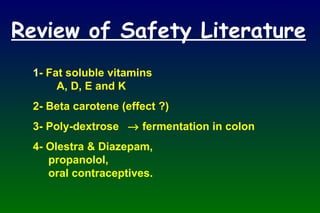
Review of Safety Literature 1 - Fat soluble vitamins A, D, E and K 2- Beta carotene (effect ?) 3- Poly-dextrose   fermentation in colon 4- Olestra & Diazepam,   propanolol,   oral contraceptives.
Question ? Are there health and nutrition benefits. * Energy * Lipids * Diabetics
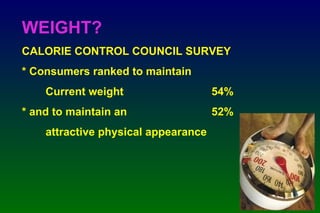
WEIGHT? CALORIE CONTROL COUNCIL SURVEY * Consumers ranked to maintain Current weight 54% * and to maintain an  52% attractive physical appearance
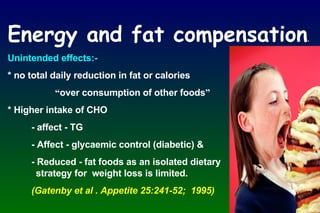
Energy and fat compensation . Unintended effects:- * no total daily reduction in fat or calories “ over consumption of other foods ” * Higher intake of CHO - affect - TG - Affect - glycaemic control (diabetic) & - Reduced - fat foods as an isolated dietary    strategy for  weight loss is limited. (Gatenby et al . Appetite 25:241-52;  1995)
Effect on Lipids Olestra  (Fat-based) reduces LDL cholesterol, appeared to be due to    of intestinal absorption of cholesterol, not through effects on bile acid excretion (Glueck et al) Clin Nutr  33 : 2177-81,1980 Am J Cllin Nutrition  37 : 347-54,  1983 41 : 1-12,  1985 37 : 347-354, 1983
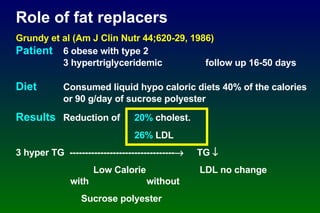
Role of fat replacers Grundy et al (Am J Clin Nutr 44;620-29, 1986) Patient   6 obese with type 2 3 hypertriglyceridemic  follow up 16-50 days Diet   Consumed liquid hypo caloric diets 40% of the calories  or 90 g/day of sucrose polyester Results Reduction of  20%  cholest.   26%  LDL 3 hyper TG  ----------------------------------    TG     Low Calorie    LDL no change   with    without   Sucrose polyester
The  use of fat-replaced foods alone should not be expected to produce spontaneous improvements. Such improvements will still be dependent on long term behavioral changes that include not only modifications in fat, but also modifications in overall energy intake and increases in energy expenditure .  Miller and Rolls. Fat substitute Handbook. Roller S, Ed.
Bias of scientific fact Healthy
Thank  You

Fat Replacer

  • 1.
  • 2.
    By Dr. M.A. BADR Prof Internal Med.Univer Alex. Depart of Diabetes & Metabolism Consultant Mouwasat Hospital FAT REPLACEMENTS FAT SUBSTITUTES FAT REPLACERS
  • 3.
    Cooking oils MargarinesShortenings Salad oils Medium-chain triglycerides (MCT)
  • 4.
    الدهون مشبعة غي ر ضرورية
  • 5.
  • 6.
    Foods with SaturatedFA Animal fats Meat Dairy products Butter Tropical oils Palm and coconut oil
  • 7.
    Foods with unsaturatedFA MUFA -Olive, canola oil -Nuts PUFA -Soybean, corn oil Omega 3 FA -Salamon -Cold water
  • 8.
    Nobel laureate PaulSabatier worked in the 1890s to develop the chemistry of hydrogenation which enabled the margarine, oil hydrogenation, and synthetic methanol industries. While Sabatier only considered hydrogenation of vapours, the German chemist Wilhelm Normann showed in 1901 that liquid oils could be hydrogenated and patented the process in 1902. In 1909, Procter & Gamble acquired the US rights to the Normann patent; in 1911, they began marketing the first hydrogenated shortening, Crisco (composed largely of partially hydrogenated cottonseed oil )..
  • 9.
  • 10.
    Walt Disney Company will begin getting rid of trans fats in meals at US theme parks ( Disneyland , Walt Disney World , etc.) by the end of 2007 , and will stop the inclusion of trans fats in licensed or promotional products by 2008 .
  • 11.
    The EFSA Journal(2004) 81, 1-49 Opinion of the Scientific Panel on Dietetic Products, Nutrition and Allergies on a request from the Commission related to the presence of trans fatty acids in foods and the effect on human health of the consumption of trans fatty acids (Request N° EFSA-Q-2003-022) (adopted on 8 July 2004) Trans-fat
  • 12.
  • 13.
    The palm fruitis the source of both palm oil (extracted from palm fruit) and palm kernel oil (extracted from the fruit seeds). Babassu oil is extracted from the kernels of the Babassu palm.
  • 14.
    The oil palmgives its name to the 16 carbon saturated fatty acid palmitic acid found in palm oil; monounsaturated oleic acid is also a constituent of palm oil while palm kernel oil contains mainly lauric acid .
  • 15.
    Palm oil becamea highly sought-after commodity by British traders, the oil being used as industrial lubricant for the machines of Britain's ongoing Industrial Revolution , as well as forming the basis for different brands of soap such as Palmolive . By c.1870, palm oil constituted the primary export of some West African states such as Ghana and Nigeria.
  • 16.
    The WorldHealth Organization in its report states there is convincing evidence that palmitic oil consumption contributes to an increased risk of developing of cardiovascular diseases.
  • 17.
  • 18.
  • 19.
    The explosion offat free, Cholesterol-free, low fat, light, and reduced calorie products e.g salad dressings, mayonnaise sour cream, frozen desserts, baked goods, and snack foods.  Sales  consumer interest. Consumer demand - good-tasting - lower-fat foods FAT REPLACERS
  • 20.
  • 21.
  • 22.
    Health and nutritionbenefits of fat replacers. 1- To modify the intake of fat. (motivation) 2- No strong personal motivation (taste, cost, availability) 3- Extra consumption rather than replacement
  • 23.
    Definition Fat replacers* Safe compounds * Has all the functional and organoleptic properties (taste & appearance) of fat * Significantly fewer calories
  • 24.
    Classification 1- Carbohydrate- based 2- Protein - based 3- Fat- based
  • 25.
    Carbohydrate – based* Carbohydrate polymers * Hydrocolloids * Polyols (sugar alcohols or bulking ingredients)
  • 26.
    Carbohydrate - based* Carbohydrate polymers Consists of - Modified food starches - Dextrin - Maltodextrins Created from : Cereals, grains, and / or starches such as corn, potato, & Tapioca. NB: Polydextrose is also included.
  • 27.
    CHO based FatReplacers - CHO Polymers (continue) Refining  Modified food starches provide specific attribute e.g anti - staling for baked goods * CHO polymer needs more liquid to be added. A gelling reaction occurs that provides a thick, creamy mouth - feel.
  • 28.
    CHO based FatReplacers - Hydrocolloids Gums, gels and fibers * Provide thickness * Stabilizing, emulsifying and/or providing structure to foods. * Some products, like pectin and bran * 2 common foods, apple sauce and pureed prunes (add bulk and flavor in baking)
  • 29.
    CHO based FatReplacers Polyols (sugar alcohols bulking ingredients) * Provide volume or bulk * Sorbitol, isomalt, lactitol maltitol, mannitol, xylitol & hydrogenated starch hydrolysates * Familiar in low - calorie diet in diabetics, high intensity sweeteners as aspartame, saccharin and acesulfame-K
  • 30.
    Polyols- basic sugar+ H  Polyols Sucrose Glucose Strach based syrup Strach based syrup + H  H ydrogenated S trach H ydrolysate (H S H)
  • 31.
    Characteristics of polyols* Sweeteners * Crystallization * Viscosity * Moisture * Extreme heat * < 4 K cal/g * Laxative
  • 32.
    Protein-based Fat ReplacersMicroparticulated protein is created by heating and blending protein at high temperature to develop microscopic particles that are said to float over the tongue to provide the creamy mouth - feel of fat. Origin : egg white or whey protein
  • 33.
    - Cannotbe used in fried or baked foods protein will coagulate and loose creaminess. - 1.3 K cal/g Protein - based Fat Replacers
  • 34.
    Fat – Based Emulsifiers, produced by replacing the triglycerides in vegetable oils, such as mono and diglycerides, and poly sorbate, have been used in foods for many years. Partially absorbed 9 K cal/g  5 K cal/g - Caprenin - Salatrim & others. - Olestra
  • 35.
    Caprenin ( Procter& Gamble, Cincinnati, OH) reduced - calorie TG - contains 3 molecules of F.A., Caprylic, Capric and behenic acid, esterified to one glycerol molecule. - behenic acid is partially absorbed, Caprenin  5 K cal/g.
  • 36.
    - Triacylglycerolcomposed of glycerol plus acetic propionic, and butyric acids ( short chain FA) and stearic acid (long chain FA) - Partially absorbed 5 K cal/g Salatrim
  • 37.
    Olestra. (Olean Procter& Gamble) - Generic name for a preparation of sucrose polyesters - Has a sucrose core with six to eight FA. side chains (large) unabsorbed provides no calories - FDA approval 1996.
  • 38.
    - Usedin prepackaged ready to eat savory (not sweet), snacks such as potato, corn, chips and crackers For frying or baking, in dough conditioners, in sprays, in filling ingredients, or in flavors ( replace 100% of fat). Olestra
  • 39.
    Food additive 1-Intentional additives: Perform specific functions in food 2- Incidental food additives: no function Olestra: food additive approval FDA G enerally R ecognized A s S afe (GRAS)
  • 40.
    Microparticulated Protein (Simplesse®) Modified Whey Protein Concentrate (Dairy-Lo®) Other (K-Blazer® , ULTRA-BAKETM, ULTRA-FREEZETM, Lita®) PROTEIN-BASED FAT REPLACERS CARBOHYDRATE-BASED FAT REPLACERS Cellulose (Avicel® cellulose gel, MethocelTM, Solka-Floc®) Dextrins (Amylum, N-Oil®) Gums (KELCOGEL®, KELTROL®, SlendidTM) Inulin (Raftiline®, Fruitafit®, Fibruline®) Nu-Trim Oatrim [Hydrolyzed oat flour] (Beta-TrimTM, TrimChoice) Polydextrose (Litesse®, Sta-LiteTM) Polyols (many brands available) Starch and Modified Food Starch (Amalean®I & II, FairnexTMVA15, & VA20, Instant StellarTM, N-Lite, OptaGrade®#, PerfectamylTMAC, AX-1, & AX-2, PURE-GEL®, STA-SLIMTM) Z-Trim
  • 41.
    FAT-BASED FAT REPLACERSEmulsifiers (Dur-Lo®, EC™-25) Salatrim (Benefat™) Lipid (Fat/Oil) Analogs Esterified Propoxylated Glycerol (EPG)** Olestra (Olean®) Sorbestrin**
  • 42.
    Review of SafetyLiterature 1 - Fat soluble vitamins A, D, E and K 2- Beta carotene (effect ?) 3- Poly-dextrose  fermentation in colon 4- Olestra & Diazepam, propanolol, oral contraceptives.
  • 43.
    Question ? Arethere health and nutrition benefits. * Energy * Lipids * Diabetics
  • 44.
    WEIGHT? CALORIE CONTROLCOUNCIL SURVEY * Consumers ranked to maintain Current weight 54% * and to maintain an 52% attractive physical appearance
  • 45.
    Energy and fatcompensation . Unintended effects:- * no total daily reduction in fat or calories “ over consumption of other foods ” * Higher intake of CHO - affect - TG - Affect - glycaemic control (diabetic) & - Reduced - fat foods as an isolated dietary strategy for weight loss is limited. (Gatenby et al . Appetite 25:241-52; 1995)
  • 46.
    Effect on LipidsOlestra (Fat-based) reduces LDL cholesterol, appeared to be due to  of intestinal absorption of cholesterol, not through effects on bile acid excretion (Glueck et al) Clin Nutr 33 : 2177-81,1980 Am J Cllin Nutrition 37 : 347-54, 1983 41 : 1-12, 1985 37 : 347-354, 1983
  • 47.
    Role of fatreplacers Grundy et al (Am J Clin Nutr 44;620-29, 1986) Patient 6 obese with type 2 3 hypertriglyceridemic follow up 16-50 days Diet Consumed liquid hypo caloric diets 40% of the calories or 90 g/day of sucrose polyester Results Reduction of 20% cholest. 26% LDL 3 hyper TG ----------------------------------  TG  Low Calorie LDL no change with without Sucrose polyester
  • 48.
    The useof fat-replaced foods alone should not be expected to produce spontaneous improvements. Such improvements will still be dependent on long term behavioral changes that include not only modifications in fat, but also modifications in overall energy intake and increases in energy expenditure . Miller and Rolls. Fat substitute Handbook. Roller S, Ed.
  • 49.
    Bias of scientificfact Healthy
  • 50.