
Model
Selection and
Evaluation
This course content is being actively
developed by Delta Analytics, a 501(c)3
Bay Area nonprofit that aims to
empower communities to leverage their
data for good.
Please reach out with any questions or
feedback to inquiry@deltanalytics.org.
Find out more about our mission here.
Delta Analytics builds technical capacity
around the world.
Module 4: Model
Selection and Evaluation
In the last module, we went through the nuts and bolts of
linear regressions. In this module, we will step back and
explain how to select, evaluate, and validate a model.
This is a very important module: as a researcher, you must
consider which model to use and why, and whether or not its
results are significant.
Let’s get started!
Model evaluation:
Let’s recap the
performance measures in
module 3.
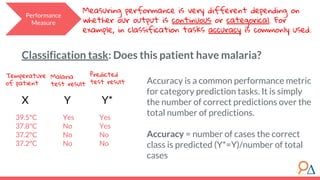
Classification task: Does this patient have malaria?
Yes
No
No
No
Performance
Measure
Measuring performance is very different depending on
whether our output is continuous or categorical. For
example, in classification tasks accuracy is commonly used.
Predicted
test result
X Y Y*
39.5°C
37.8°C
37.2°C
37.2°C
Temperature
of patient
Malaria
test result
Yes
Yes
No
No
Accuracy is a common performance metric
for category prediction tasks. It is simply
the number of correct predictions over the
total number of predictions.
Accuracy = number of cases the correct
class is predicted (Y*=Y)/number of total
cases
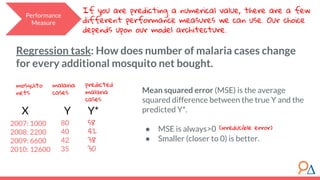
Regression task: How does number of malaria cases change
for every additional mosquito net bought.
Performance
Measure
If you are predicting a numerical value, there are a few
different performance measures we can use. Our choice
depends upon our model architecture.
malaria
cases
80
40
42
35
predicted
malaria
cases
58
42
38
30
mosquito
nets
2007: 1000
2008: 2200
2009: 6600
2010: 12600
Mean squared error (MSE) is the average
squared difference between the true Y and the
predicted Y*.
● MSE is always>0
● Smaller (closer to 0) is better.
X Y Y*
(irreducible error)
Y:
# people
w/malaria
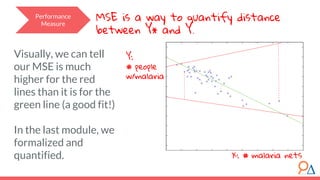
Visually, we can tell
our MSE is much
higher for the red
lines than it is for the
green line (a good fit!)
In the last module, we
formalized and
quantified. X: # malaria nets
MSE is a way to quantify distance
between Y* and Y.
Performance
Measure
Performance
Measure
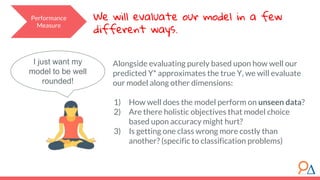
We will evaluate our model in a few
different ways.
Alongside evaluating purely based upon how well our
predicted Y* approximates the true Y, we will evaluate
our model along other dimensions:
1) How well does the model perform on unseen data?
2) Are there holistic objectives that model choice
based upon accuracy might hurt?
3) Is getting one class wrong more costly than
another? (specific to classification problems)
I just want my
model to be well
rounded!
Performance
Measure
1) Unseen data: Recall that measuring how
well the model performs on unseen data
is extremely important!
We already know that how your model performs on unseen data is
the most important metric we will evaluate our models by.
If we have high predictive power on our training data but low
predictive power in the real world, what use is our model?
Our model is naturally highly optimized for the data it was trained
on. However, the ultimate impact of our model depends upon its
ability to generalize (“extrapolate”) to unseen data.
In this module, we will go over what this means using real-life
examples of model evaluation on Kiva data.
Performance
Measure
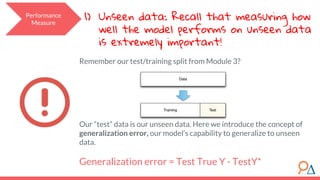
1) Unseen data: Recall that measuring how
well the model performs on unseen data
is extremely important!
Remember our test/training split from Module 3?
Our “test” data is our unseen data. Here we introduce the concept of
generalization error, our model’s capability to generalize to unseen
data.
Generalization error = Test True Y - TestY*
Performance
Measure
2) Are there holistic objectives that model
choice based upon accuracy might hurt?
Choosing a model to deploy based purely on predictive
power may pose ethical problems. Some examples:
● A risk score algorithm that predicts whether someone
will commit a future crime, used by US courts,
discriminated based upon race. It was clear the model
relied heavily on race as a feature. [Link]
● Carnegie Mellon found that women were less likely
than men to be shown ads by Google for high paying
jobs. [Link]
● Orbitz, a travel site, was showing Mac users higher
priced travel services than PC users. [Link]
We have values
as a society
that are not
captured by
optimizing for
accuracy.
Performance
Measure
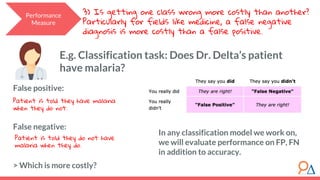
3) Is getting one class wrong more costly than another?
Particularly for fields like medicine, a false negative
diagnosis is more costly than a false positive.
False positive:
False negative:
> Which is more costly?
Patient is told they have malaria
when they do not.
Patient is told they do not have
malaria when they do.
In any classification model we work on,
we will evaluate performance on FP, FN
in addition to accuracy.
E.g. Classification task: Does Dr. Delta’s patient
have malaria?
Performance
Measure
3) Is getting one class wrong more costly than another?
Particularly for fields like medicine, a false negative
diagnosis is more costly than a false positive.
False positive:
False negative:
Patient is told they have malaria
when they do not.
Patient is told they do not have
malaria when they do.
E.g. Classification task: Does Dr. Delta’s patient
have malaria?
Thinking about false positives and negatives is
extremely important. In our example, if Dr. Delta’s
model incorrectly classifies a patient, it could
have disastrous consequences.
What should Dr. Delta do in this scenario?
Because the stakes are so high, Dr. Delta should not only use
caution in selecting an algorithm, but also in interpreting and
presenting her results.
The algorithm may say that a patient is 60% likely to have malaria,
but Dr. Delta cannot use this result to conclude that the patient
definitely has malaria. Rather, Dr. Delta should present the result
as a starting point for additional research.
This is a key tenet of machine learning ethics: transparency.
OLS Regression:
Model development
and evaluation
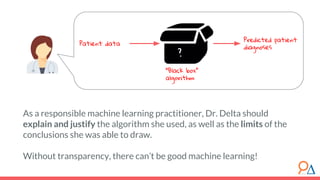
As a responsible machine learning practitioner, Dr. Delta should
explain and justify the algorithm she used, as well as the limits of the
conclusions she was able to draw.
Without transparency, there can’t be good machine learning!
Patient data
Predicted patient
diagnoses
“Black box”
algorithm
?
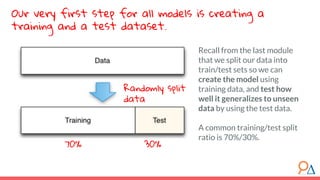
Our very first step for all models is creating a
training and a test dataset.
Recall from the last module
that we split our data into
train/test sets so we can
create the model using
training data, and test how
well it generalizes to unseen
data by using the test data.
A common training/test split
ratio is 70%/30%.
70% 30%
Randomly split
data
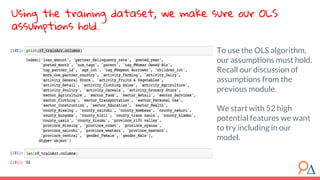
Using the training dataset, we make sure our OLS
assumptions hold.
To use the OLS algorithm,
our assumptions must hold.
Recall our discussion of
assumptions from the
previous module.
We start with 52 high
potential features we want
to try including in our
model.
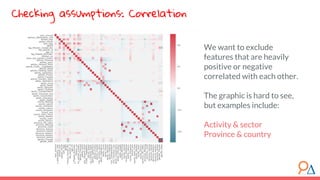
Checking assumptions: Correlation
We want to exclude
features that are heavily
positive or negative
correlated with each other.
The graphic is hard to see,
but examples include:
Activity & sector
Province & country
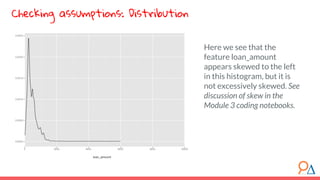
Checking assumptions: Distribution
Here we see that the
feature loan_amount
appears skewed to the left
in this histogram, but it is
not excessively skewed. See
discussion of skew in the
Module 3 coding notebooks.
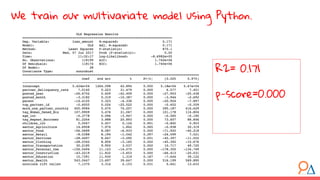
We train our multivariate model using Python.
R2= 0.171
p-score=0.000
Now we have a model derived from our training data, let’s see
how well the model generalizes to the real world (make sure it
is not over or underfit).
To understand the concepts of underfitting and overfitting,
let’s take a look at a more intuitive example.
Performance
Ability to
generalize to
unseen data
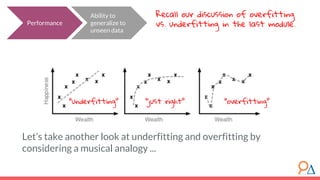
Recall our discussion of overfitting
vs. underfitting in the last module.
“underfitting” “overfitting”“just right”
Let’s take another look at underfitting and overfitting by
considering a musical analogy ...
Performance
Ability to
generalize to
unseen data
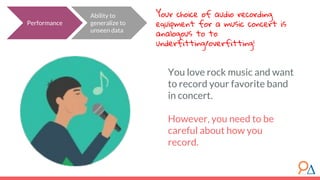
You love rock music and want
to record your favorite band
in concert.
However, you need to be
careful about how you
record.
Your choice of audio recording
equipment for a music concert is
analogous to to
underfitting/overfitting!
Performance
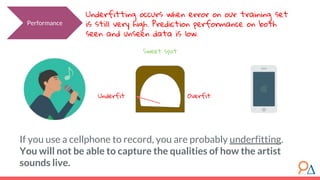
Underfitting occurs when error on our training set
is still very high. Prediction performance on both
seen and unseen data is low.
If you use a cellphone to record, you are probably underfitting.
You will not be able to capture the qualities of how the artist
sounds live.
Underfit Overfit
Sweet spot
Performance
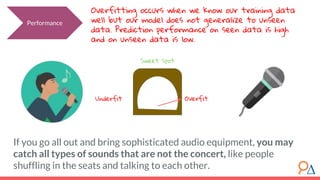
Overfitting occurs when we know our training data
well but our model does not generalize to unseen
data. Prediction performance on seen data is high
and on unseen data is low.
If you go all out and bring sophisticated audio equipment, you may
catch all types of sounds that are not the concert, like people
shuffling in the seats and talking to each other.
Underfit Overfit
Sweet spot
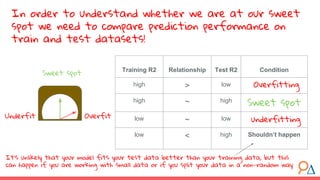
In order to understand whether we are at our sweet
spot we need to compare prediction performance on
train and test datasets!
Underfit Overfit
Sweet spot
Training R2 Relationship Test R2 Condition
high > low
high ~ high
Sweet spot
low ~ low
low < high Shouldn’t happen
Overfitting
underfitting
It’s unlikely that your model fits your test data better than your training data, but this
can happen if you are working with small data or if you split your data in a non-random way
Performance
How do we
measure
underfitting/
overfitting?
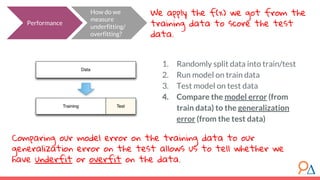
We apply the f(x) we got from the
training data to score the test
data.
Comparing our model error on the training data to our
generalization error on the test allows us to tell whether we
have underfit or overfit on the data.
1. Randomly split data into train/test
2. Run model on train data
3. Test model on test data
4. Compare the model error (from
train data) to the generalization
error (from the test data)
Training data Test data
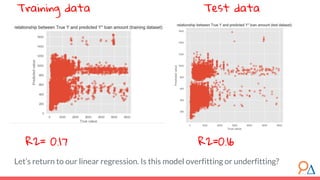
R2= 0.17 R2=0.16
Let’s return to our linear regression. Is this model overfitting or underfitting?
Training Test
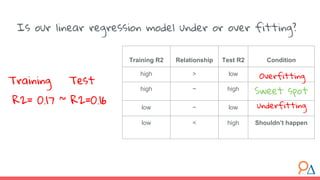
R2= 0.17 ~ R2=0.16
Training R2 Relationship Test R2 Condition
high > low
high ~ high
Sweet spot
low ~ low
low < high Shouldn’t happen
Overfitting
underfitting
Is our linear regression model under or over fitting?
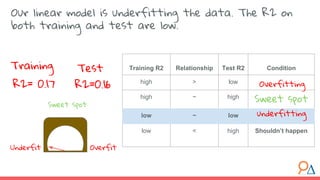
Training Test
R2= 0.17 R2=0.16
Training R2 Relationship Test R2 Condition
high > low
high ~ high
Sweet spot
low ~ low
low < high Shouldn’t happen
Overfitting
underfitting
Underfit Overfit
Sweet spot
Our linear model is underfitting the data. The R2 on
both training and test are low.
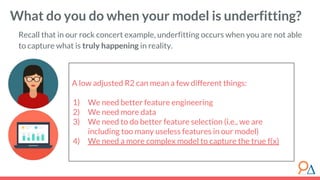
A low adjusted R2 can mean a few different things:
1) We need better feature engineering
2) We need more data
3) We need to do better feature selection (i.e., we are
including too many useless features in our model)
4) We need a more complex model to capture the true f(x)
What do you do when your model is underfitting?
Recall that in our rock concert example, underfitting occurs when you are not able
to capture what is truly happening in reality.
We can test this by checking performance
with a more complex model and seeing if
the fit improves.
It is possible our model is underfitting because
linear regression is not complex enough to capture
the relationship that maps x to true Y.
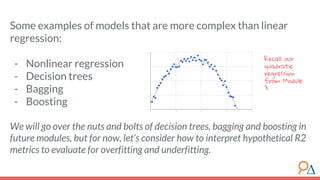
Some examples of models that are more complex than linear
regression:
- Nonlinear regression
- Decision trees
- Bagging
- Boosting
We will go over the nuts and bolts of decision trees, bagging and boosting in
future modules, but for now, let’s consider how to interpret hypothetical R2
metrics to evaluate for overfitting and underfitting.
Recall our
quadratic
regression
from Module
3.
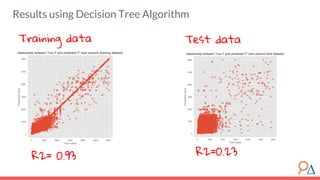
Training data Test data
R2= 0.93 R2=0.23
Results using Decision Tree Algorithm
Training Test
R2= 0.93 ~ R2=0.23
Training R2 Relationship Test R2 Condition
high > low
high ~ high
Sweet spot
low ~ low
low < high Shouldn’t happen
Overfitting
underfitting
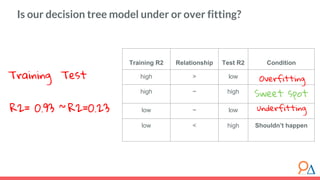
Is our decision tree model under or over fitting?
Training Test
R2= 0.93 R2=0.23
Training R2 Relationship Test R2 Condition
high > low
high ~ high
Sweet spot
low ~ low
low < high Shouldn’t happen
Overfitting
underfitting
Underfit Overfit
Sweet spot
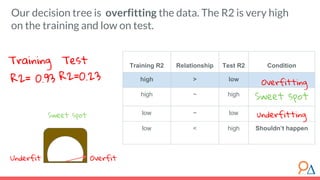
Our decision tree is overfitting the data. The R2 is very high
on the training and low on test.
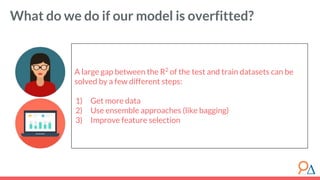
A large gap between the R2
of the test and train datasets can be
solved by a few different steps:
1) Get more data
2) Use ensemble approaches (like bagging)

3) Improve feature selection
What do we do if our model is overfitted?
We can all agree that more data is better.
Imagine instead of running a single ML algorithm on a single
dataset, you could run 100 different algorithms on 100
datasets! By leveraging “the power of the crowd,” bagging
approaches can reduce generalization error.
Ensemble approaches are a powerful way to
address overfitting!
Bagging
We will do a deep dive into
bagging regressions in the
next lectures, but here is a
teaser of how it improves
results for our Kiva data.
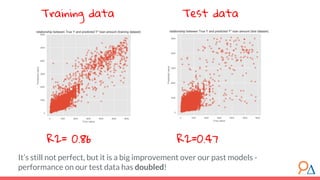
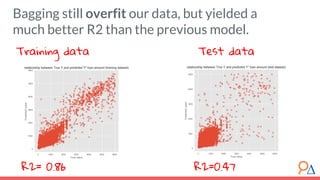
Training data Test data
R2= 0.86 R2=0.47
It’s still not perfect, but it is a big improvement over our past models -
performance on our test data has doubled!
Let’s take a step back
and review...
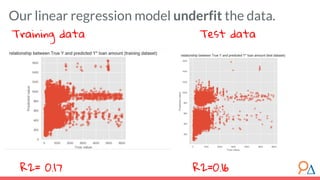
Training data Test data
R2= 0.17 R2=0.16
Our linear regression model underfit the data.
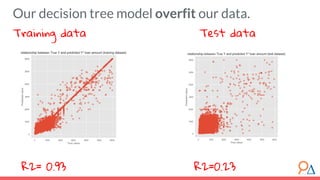
Training data Test data
R2= 0.93 R2=0.23
Our decision tree model overfit our data.
Bagging still overfit our data, but yielded a
much better R2 than the previous model.
Training data Test data
R2= 0.86 R2=0.47
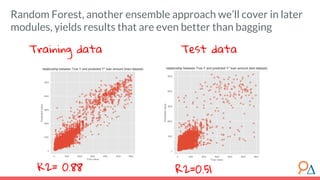
Training data Test data
R2= 0.88 R2=0.51
Random Forest, another ensemble approach we’ll cover in later
modules, yields results that are even better than bagging
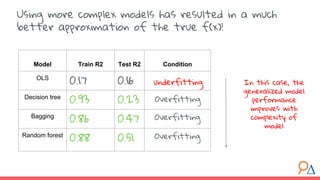
Model Train R2 Test R2 Condition
OLS
0.17 0.16
Decision tree
0.93 0.23
Bagging
0.86 0.47 Overfitting
Random forest
0.88 0.51 Overfitting
Overfitting
underfitting
Using more complex models has resulted in a much
better approximation of the true f(x)!
In this case, the
generalized model
performance
improves with
complexity of
model
● Feature selection
● Find more data
● Hyperparameter optimization
Let’s talk about feature selection.
However, even after choosing more complex
representations of f(x), we are still overfitting.
What else can we do to narrow the gap?
Feature selection
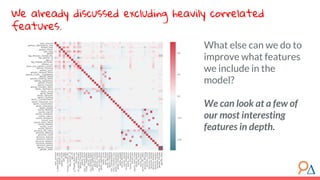
We already discussed excluding heavily correlated
features.
What else can we do to
improve what features
we include in the
model?
We can look at a few of
our most interesting
features in depth.
Feature investigation:
repeat borrower
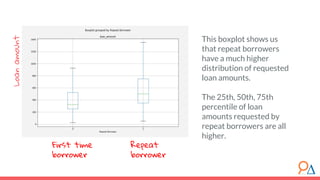
This boxplot shows us
that repeat borrowers
have a much higher
distribution of requested
loan amounts.
The 25th, 50th, 75th
percentile of loan
amounts requested by
repeat borrowers are all
higher.
Loanamount
First time
borrower
Repeat
borrower
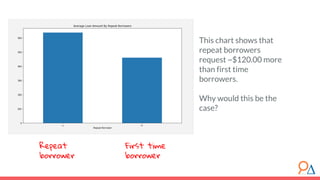
This chart shows that
repeat borrowers
request ~$120.00 more
than first time
borrowers.
Why would this be the
case?
First time
borrower
Repeat
borrower
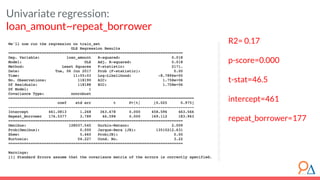
R2= 0.17
p-score=0.000
t-stat=46.5
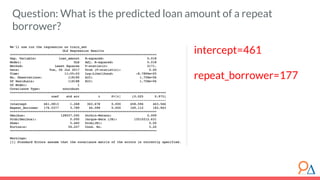
intercept=461
repeat_borrower=177
Univariate regression:
loan_amount~repeat_borrower
Question: What is the predicted loan amount of a repeat
borrower?
intercept=461
repeat_borrower=177
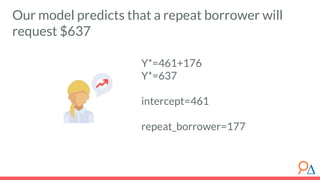
Our model predicts that a repeat borrower will
request $637
Y*=461+176
Y*=637
intercept=461
repeat_borrower=177
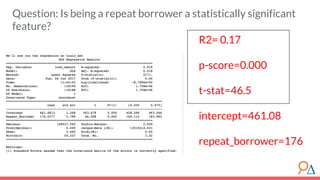
Question: Is being a repeat borrower a statistically significant
feature?
R2= 0.17
p-score=0.000
t-stat=46.5
intercept=461.08
repeat_borrower=176
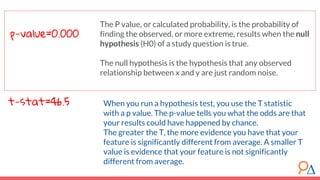
p-value=0.000
t-stat=46.5
The P value, or calculated probability, is the probability of
finding the observed, or more extreme, results when the null
hypothesis (H0) of a study question is true.
The null hypothesis is the hypothesis that any observed
relationship between x and y are just random noise.
When you run a hypothesis test, you use the T statistic
with a p value. The p-value tells you what the odds are that
your results could have happened by chance.
The greater the T, the more evidence you have that your
feature is significantly different from average. A smaller T
value is evidence that your feature is not significantly
different from average.
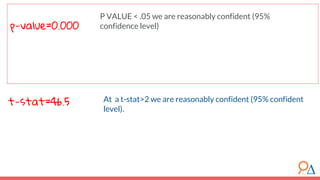
p-value=0.000
P VALUE < .05 we are reasonably confident (95%
confidence level)
t-stat=46.5 At a t-stat>2 we are reasonably confident (95% confident
level).
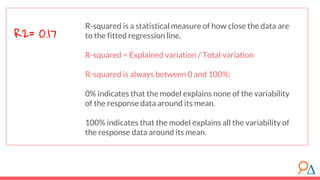
R2= 0.17
R-squared is a statistical measure of how close the data are
to the fitted regression line.
R-squared = Explained variation / Total variation
R-squared is always between 0 and 100%:
0% indicates that the model explains none of the variability
of the response data around its mean.
100% indicates that the model explains all the variability of
the response data around its mean.
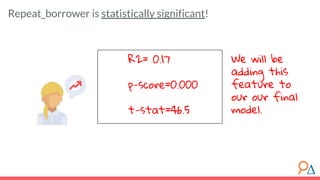
We will be
adding this
feature to
our our final
model.
Repeat_borrower is statistically significant!
R2= 0.17
p-score=0.000
t-stat=46.5
Feature investigation:
woman-owned business
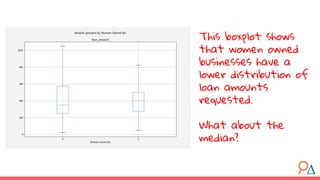
This boxplot shows
that women owned
businesses have a
lower distribution of
loan amounts
requested.
What about the
median?
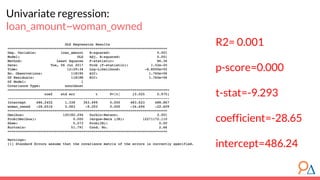
R2= 0.001
p-score=0.000
t-stat=-9.293
coefficient=-28.65
intercept=486.24
Univariate regression:
loan_amount~woman_owned
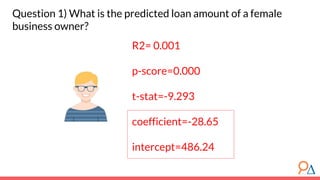
Question 1) What is the predicted loan amount of a female
business owner?
R2= 0.001
p-score=0.000
t-stat=-9.293
coefficient=-28.65
intercept=486.24
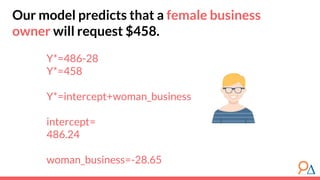
Our model predicts that a female business
owner will request $458.
Y*=486-28
Y*=458
Y*=intercept+woman_business
intercept=
486.24
woman_business=-28.65
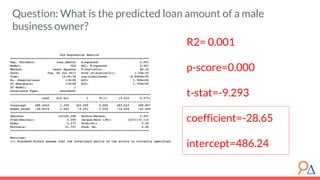
Question: What is the predicted loan amount of a male
business owner?
R2= 0.001
p-score=0.000
t-stat=-9.293
coefficient=-28.65
intercept=486.24
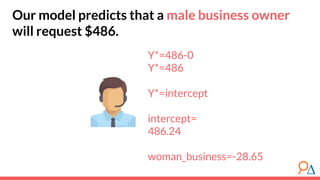
Our model predicts that a male business owner
will request $486.
Y*=486-0
Y*=486
Y*=intercept
intercept=
486.24
woman_business=-28.65
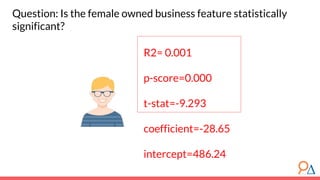
Question: Is the female owned business feature statistically
significant?
R2= 0.001
p-score=0.000
t-stat=-9.293
coefficient=-28.65
intercept=486.24
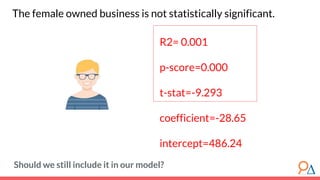
The female owned business is not statistically significant.
R2= 0.001
p-score=0.000
t-stat=-9.293
coefficient=-28.65
intercept=486.24
Should we still include it in our model?
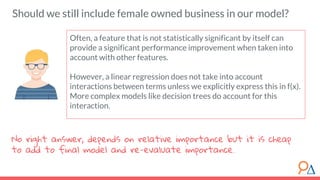
Should we still include female owned business in our model?
Often, a feature that is not statistically significant by itself can
provide a significant performance improvement when taken into
account with other features.
However, a linear regression does not take into account
interactions between terms unless we explicitly express this in f(x).
More complex models like decision trees do account for this
interaction.
No right answer, depends on relative importance but it is cheap
to add to final model and re-evaluate importance.
Now that you know generally how to evaluate and
validate a model, we can dive deep into the nuts and bolts
of other algorithms.
Our next module will cover decision trees.
You are on fire! Go straight to the
next module here.
Need to slow down and digest? Take a
minute to write us an email about
what you thought about the course. All
feedback small or large welcome!
Email: sara@deltanalytics.org
Congrats! You finished
module 4!
Find out more about
Delta’s machine
learning for good
mission here.

Module 4: Model Selection and Evaluation

  • 1.
  • 2.
    This course contentis being actively developed by Delta Analytics, a 501(c)3 Bay Area nonprofit that aims to empower communities to leverage their data for good. Please reach out with any questions or feedback to inquiry@deltanalytics.org. Find out more about our mission here. Delta Analytics builds technical capacity around the world.
  • 3.
  • 4.
    In the lastmodule, we went through the nuts and bolts of linear regressions. In this module, we will step back and explain how to select, evaluate, and validate a model. This is a very important module: as a researcher, you must consider which model to use and why, and whether or not its results are significant. Let’s get started!
  • 5.
    Model evaluation: Let’s recapthe performance measures in module 3.
  • 6.
    Classification task: Doesthis patient have malaria? Yes No No No Performance Measure Measuring performance is very different depending on whether our output is continuous or categorical. For example, in classification tasks accuracy is commonly used. Predicted test result X Y Y* 39.5°C 37.8°C 37.2°C 37.2°C Temperature of patient Malaria test result Yes Yes No No Accuracy is a common performance metric for category prediction tasks. It is simply the number of correct predictions over the total number of predictions. Accuracy = number of cases the correct class is predicted (Y*=Y)/number of total cases
  • 7.
    Regression task: Howdoes number of malaria cases change for every additional mosquito net bought. Performance Measure If you are predicting a numerical value, there are a few different performance measures we can use. Our choice depends upon our model architecture. malaria cases 80 40 42 35 predicted malaria cases 58 42 38 30 mosquito nets 2007: 1000 2008: 2200 2009: 6600 2010: 12600 Mean squared error (MSE) is the average squared difference between the true Y and the predicted Y*. ● MSE is always>0 ● Smaller (closer to 0) is better. X Y Y* (irreducible error)
  • 8.
    Y: # people w/malaria Visually, wecan tell our MSE is much higher for the red lines than it is for the green line (a good fit!) In the last module, we formalized and quantified. X: # malaria nets MSE is a way to quantify distance between Y* and Y. Performance Measure
  • 9.
    Performance Measure We will evaluateour model in a few different ways. Alongside evaluating purely based upon how well our predicted Y* approximates the true Y, we will evaluate our model along other dimensions: 1) How well does the model perform on unseen data? 2) Are there holistic objectives that model choice based upon accuracy might hurt? 3) Is getting one class wrong more costly than another? (specific to classification problems) I just want my model to be well rounded!
  • 10.
    Performance Measure 1) Unseen data:Recall that measuring how well the model performs on unseen data is extremely important! We already know that how your model performs on unseen data is the most important metric we will evaluate our models by. If we have high predictive power on our training data but low predictive power in the real world, what use is our model? Our model is naturally highly optimized for the data it was trained on. However, the ultimate impact of our model depends upon its ability to generalize (“extrapolate”) to unseen data. In this module, we will go over what this means using real-life examples of model evaluation on Kiva data.
  • 11.
    Performance Measure 1) Unseen data:Recall that measuring how well the model performs on unseen data is extremely important! Remember our test/training split from Module 3? Our “test” data is our unseen data. Here we introduce the concept of generalization error, our model’s capability to generalize to unseen data. Generalization error = Test True Y - TestY*
  • 12.
    Performance Measure 2) Are thereholistic objectives that model choice based upon accuracy might hurt? Choosing a model to deploy based purely on predictive power may pose ethical problems. Some examples: ● A risk score algorithm that predicts whether someone will commit a future crime, used by US courts, discriminated based upon race. It was clear the model relied heavily on race as a feature. [Link] ● Carnegie Mellon found that women were less likely than men to be shown ads by Google for high paying jobs. [Link] ● Orbitz, a travel site, was showing Mac users higher priced travel services than PC users. [Link] We have values as a society that are not captured by optimizing for accuracy.
  • 13.
    Performance Measure 3) Is gettingone class wrong more costly than another? Particularly for fields like medicine, a false negative diagnosis is more costly than a false positive. False positive: False negative: > Which is more costly? Patient is told they have malaria when they do not. Patient is told they do not have malaria when they do. In any classification model we work on, we will evaluate performance on FP, FN in addition to accuracy. E.g. Classification task: Does Dr. Delta’s patient have malaria?
  • 14.
    Performance Measure 3) Is gettingone class wrong more costly than another? Particularly for fields like medicine, a false negative diagnosis is more costly than a false positive. False positive: False negative: Patient is told they have malaria when they do not. Patient is told they do not have malaria when they do. E.g. Classification task: Does Dr. Delta’s patient have malaria? Thinking about false positives and negatives is extremely important. In our example, if Dr. Delta’s model incorrectly classifies a patient, it could have disastrous consequences. What should Dr. Delta do in this scenario?
  • 15.
    Because the stakesare so high, Dr. Delta should not only use caution in selecting an algorithm, but also in interpreting and presenting her results. The algorithm may say that a patient is 60% likely to have malaria, but Dr. Delta cannot use this result to conclude that the patient definitely has malaria. Rather, Dr. Delta should present the result as a starting point for additional research. This is a key tenet of machine learning ethics: transparency.
  • 16.
  • 17.
    As a responsiblemachine learning practitioner, Dr. Delta should explain and justify the algorithm she used, as well as the limits of the conclusions she was able to draw. Without transparency, there can’t be good machine learning! Patient data Predicted patient diagnoses “Black box” algorithm ?
  • 18.
    Our very firststep for all models is creating a training and a test dataset. Recall from the last module that we split our data into train/test sets so we can create the model using training data, and test how well it generalizes to unseen data by using the test data. A common training/test split ratio is 70%/30%. 70% 30% Randomly split data
  • 19.
    Using the trainingdataset, we make sure our OLS assumptions hold. To use the OLS algorithm, our assumptions must hold. Recall our discussion of assumptions from the previous module. We start with 52 high potential features we want to try including in our model.
  • 20.
    Checking assumptions: Correlation Wewant to exclude features that are heavily positive or negative correlated with each other. The graphic is hard to see, but examples include: Activity & sector Province & country
  • 21.
    Checking assumptions: Distribution Herewe see that the feature loan_amount appears skewed to the left in this histogram, but it is not excessively skewed. See discussion of skew in the Module 3 coding notebooks.
  • 22.
    We train ourmultivariate model using Python. R2= 0.171 p-score=0.000
  • 23.
    Now we havea model derived from our training data, let’s see how well the model generalizes to the real world (make sure it is not over or underfit). To understand the concepts of underfitting and overfitting, let’s take a look at a more intuitive example.
  • 24.
    Performance Ability to generalize to unseendata Recall our discussion of overfitting vs. underfitting in the last module. “underfitting” “overfitting”“just right” Let’s take another look at underfitting and overfitting by considering a musical analogy ...
  • 25.
    Performance Ability to generalize to unseendata You love rock music and want to record your favorite band in concert. However, you need to be careful about how you record. Your choice of audio recording equipment for a music concert is analogous to to underfitting/overfitting!
  • 26.
    Performance Underfitting occurs whenerror on our training set is still very high. Prediction performance on both seen and unseen data is low. If you use a cellphone to record, you are probably underfitting. You will not be able to capture the qualities of how the artist sounds live. Underfit Overfit Sweet spot
  • 27.
    Performance Overfitting occurs whenwe know our training data well but our model does not generalize to unseen data. Prediction performance on seen data is high and on unseen data is low. If you go all out and bring sophisticated audio equipment, you may catch all types of sounds that are not the concert, like people shuffling in the seats and talking to each other. Underfit Overfit Sweet spot
  • 28.
    In order tounderstand whether we are at our sweet spot we need to compare prediction performance on train and test datasets! Underfit Overfit Sweet spot Training R2 Relationship Test R2 Condition high > low high ~ high Sweet spot low ~ low low < high Shouldn’t happen Overfitting underfitting It’s unlikely that your model fits your test data better than your training data, but this can happen if you are working with small data or if you split your data in a non-random way
  • 29.
    Performance How do we measure underfitting/ overfitting? Weapply the f(x) we got from the training data to score the test data. Comparing our model error on the training data to our generalization error on the test allows us to tell whether we have underfit or overfit on the data. 1. Randomly split data into train/test 2. Run model on train data 3. Test model on test data 4. Compare the model error (from train data) to the generalization error (from the test data)
  • 30.
    Training data Testdata R2= 0.17 R2=0.16 Let’s return to our linear regression. Is this model overfitting or underfitting?
  • 31.
    Training Test R2= 0.17~ R2=0.16 Training R2 Relationship Test R2 Condition high > low high ~ high Sweet spot low ~ low low < high Shouldn’t happen Overfitting underfitting Is our linear regression model under or over fitting?
  • 32.
    Training Test R2= 0.17R2=0.16 Training R2 Relationship Test R2 Condition high > low high ~ high Sweet spot low ~ low low < high Shouldn’t happen Overfitting underfitting Underfit Overfit Sweet spot Our linear model is underfitting the data. The R2 on both training and test are low.
  • 33.
    A low adjustedR2 can mean a few different things: 1) We need better feature engineering 2) We need more data 3) We need to do better feature selection (i.e., we are including too many useless features in our model) 4) We need a more complex model to capture the true f(x) What do you do when your model is underfitting? Recall that in our rock concert example, underfitting occurs when you are not able to capture what is truly happening in reality.
  • 34.
    We can testthis by checking performance with a more complex model and seeing if the fit improves. It is possible our model is underfitting because linear regression is not complex enough to capture the relationship that maps x to true Y.
  • 35.
    Some examples ofmodels that are more complex than linear regression: - Nonlinear regression - Decision trees - Bagging - Boosting We will go over the nuts and bolts of decision trees, bagging and boosting in future modules, but for now, let’s consider how to interpret hypothetical R2 metrics to evaluate for overfitting and underfitting. Recall our quadratic regression from Module 3.
  • 36.
    Training data Testdata R2= 0.93 R2=0.23 Results using Decision Tree Algorithm
  • 37.
    Training Test R2= 0.93~ R2=0.23 Training R2 Relationship Test R2 Condition high > low high ~ high Sweet spot low ~ low low < high Shouldn’t happen Overfitting underfitting Is our decision tree model under or over fitting?
  • 38.
    Training Test R2= 0.93R2=0.23 Training R2 Relationship Test R2 Condition high > low high ~ high Sweet spot low ~ low low < high Shouldn’t happen Overfitting underfitting Underfit Overfit Sweet spot Our decision tree is overfitting the data. The R2 is very high on the training and low on test.
  • 39.
    A large gapbetween the R2 of the test and train datasets can be solved by a few different steps: 1) Get more data 2) Use ensemble approaches (like bagging) 3) Improve feature selection What do we do if our model is overfitted?
  • 40.
    We can allagree that more data is better. Imagine instead of running a single ML algorithm on a single dataset, you could run 100 different algorithms on 100 datasets! By leveraging “the power of the crowd,” bagging approaches can reduce generalization error. Ensemble approaches are a powerful way to address overfitting!
  • 41.
    Bagging We will doa deep dive into bagging regressions in the next lectures, but here is a teaser of how it improves results for our Kiva data.
  • 42.
    Training data Testdata R2= 0.86 R2=0.47 It’s still not perfect, but it is a big improvement over our past models - performance on our test data has doubled!
  • 43.
    Let’s take astep back and review...
  • 44.
    Training data Testdata R2= 0.17 R2=0.16 Our linear regression model underfit the data.
  • 45.
    Training data Testdata R2= 0.93 R2=0.23 Our decision tree model overfit our data.
  • 46.
    Bagging still overfitour data, but yielded a much better R2 than the previous model. Training data Test data R2= 0.86 R2=0.47
  • 47.
    Training data Testdata R2= 0.88 R2=0.51 Random Forest, another ensemble approach we’ll cover in later modules, yields results that are even better than bagging
  • 48.
    Model Train R2Test R2 Condition OLS 0.17 0.16 Decision tree 0.93 0.23 Bagging 0.86 0.47 Overfitting Random forest 0.88 0.51 Overfitting Overfitting underfitting Using more complex models has resulted in a much better approximation of the true f(x)! In this case, the generalized model performance improves with complexity of model
  • 49.
    ● Feature selection ●Find more data ● Hyperparameter optimization Let’s talk about feature selection. However, even after choosing more complex representations of f(x), we are still overfitting. What else can we do to narrow the gap?
  • 50.
  • 51.
    We already discussedexcluding heavily correlated features. What else can we do to improve what features we include in the model? We can look at a few of our most interesting features in depth.
  • 52.
  • 53.
    This boxplot showsus that repeat borrowers have a much higher distribution of requested loan amounts. The 25th, 50th, 75th percentile of loan amounts requested by repeat borrowers are all higher. Loanamount First time borrower Repeat borrower
  • 54.
    This chart showsthat repeat borrowers request ~$120.00 more than first time borrowers. Why would this be the case? First time borrower Repeat borrower
  • 55.
  • 56.
    Question: What isthe predicted loan amount of a repeat borrower? intercept=461 repeat_borrower=177
  • 57.
    Our model predictsthat a repeat borrower will request $637 Y*=461+176 Y*=637 intercept=461 repeat_borrower=177
  • 58.
    Question: Is beinga repeat borrower a statistically significant feature? R2= 0.17 p-score=0.000 t-stat=46.5 intercept=461.08 repeat_borrower=176
  • 59.
    p-value=0.000 t-stat=46.5 The P value,or calculated probability, is the probability of finding the observed, or more extreme, results when the null hypothesis (H0) of a study question is true. The null hypothesis is the hypothesis that any observed relationship between x and y are just random noise. When you run a hypothesis test, you use the T statistic with a p value. The p-value tells you what the odds are that your results could have happened by chance. The greater the T, the more evidence you have that your feature is significantly different from average. A smaller T value is evidence that your feature is not significantly different from average.
  • 60.
    p-value=0.000 P VALUE <.05 we are reasonably confident (95% confidence level) t-stat=46.5 At a t-stat>2 we are reasonably confident (95% confident level).
  • 61.
    R2= 0.17 R-squared isa statistical measure of how close the data are to the fitted regression line. R-squared = Explained variation / Total variation R-squared is always between 0 and 100%: 0% indicates that the model explains none of the variability of the response data around its mean. 100% indicates that the model explains all the variability of the response data around its mean.
  • 62.
    We will be addingthis feature to our our final model. Repeat_borrower is statistically significant! R2= 0.17 p-score=0.000 t-stat=46.5
  • 63.
  • 64.
    This boxplot shows thatwomen owned businesses have a lower distribution of loan amounts requested. What about the median?
  • 65.
  • 66.
    Question 1) Whatis the predicted loan amount of a female business owner? R2= 0.001 p-score=0.000 t-stat=-9.293 coefficient=-28.65 intercept=486.24
  • 67.
    Our model predictsthat a female business owner will request $458. Y*=486-28 Y*=458 Y*=intercept+woman_business intercept= 486.24 woman_business=-28.65
  • 68.
    Question: What isthe predicted loan amount of a male business owner? R2= 0.001 p-score=0.000 t-stat=-9.293 coefficient=-28.65 intercept=486.24
  • 69.
    Our model predictsthat a male business owner will request $486. Y*=486-0 Y*=486 Y*=intercept intercept= 486.24 woman_business=-28.65
  • 70.
    Question: Is thefemale owned business feature statistically significant? R2= 0.001 p-score=0.000 t-stat=-9.293 coefficient=-28.65 intercept=486.24
  • 71.
    The female ownedbusiness is not statistically significant. R2= 0.001 p-score=0.000 t-stat=-9.293 coefficient=-28.65 intercept=486.24 Should we still include it in our model?
  • 72.
    Should we stillinclude female owned business in our model? Often, a feature that is not statistically significant by itself can provide a significant performance improvement when taken into account with other features. However, a linear regression does not take into account interactions between terms unless we explicitly express this in f(x). More complex models like decision trees do account for this interaction. No right answer, depends on relative importance but it is cheap to add to final model and re-evaluate importance.
  • 73.
    Now that youknow generally how to evaluate and validate a model, we can dive deep into the nuts and bolts of other algorithms. Our next module will cover decision trees.
  • 74.
    You are onfire! Go straight to the next module here. Need to slow down and digest? Take a minute to write us an email about what you thought about the course. All feedback small or large welcome! Email: sara@deltanalytics.org
  • 75.
    Congrats! You finished module4! Find out more about Delta’s machine learning for good mission here.