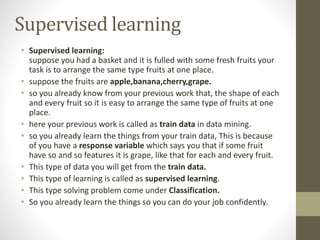
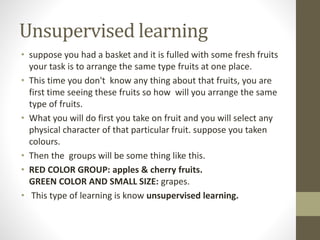
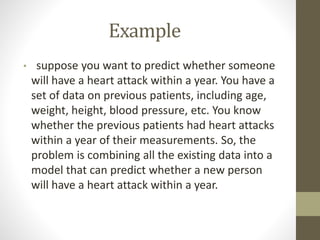
This document discusses and provides examples of supervised and unsupervised learning. Supervised learning involves using labeled training data to learn relationships between inputs and outputs and make predictions. An example is using data on patients' attributes to predict the likelihood of a heart attack. Unsupervised learning involves discovering hidden patterns in unlabeled data by grouping or clustering items with similar attributes, like grouping fruits by color without labels. The goal of supervised learning is to build models that can make predictions when new examples are presented.