Introduction to
Machine
Learning
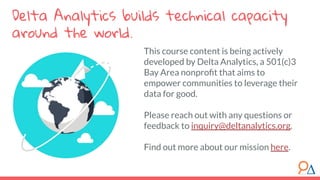
This course content is being actively
developed by Delta Analytics, a 501(c)3
Bay Area nonprofit that aims to
empower communities to leverage their
data for good.
Please reach out with any questions or
feedback to inquiry@deltanalytics.org.
Find out more about our mission here.
Delta Analytics builds technical capacity
around the world.
Course overview:
Now let’s turn to the data we will be using...
✓ Module 1: Introduction to Machine Learning
❏ Module 2: Machine Learning Deep Dive
❏ Module 3: Model Selection and Evaluation
❏ Module 4: Linear Regression
❏ Module 5: Decision Trees
❏ Module 6: Ensemble Algorithms
❏ Module 7: Unsupervised Learning Algorithms
❏ Module 8: Natural Language Processing Part 1
❏ Module 9: Natural Language Processing Part 2
Module 1:
Introduction to
Machine Learning
✓ What is machine learning?
❏ How do you define a research question?
❏ What are observations?
❏ What are features?
❏ What are outcome variables?
❏ Introduction to KIVA data
Module Checklist
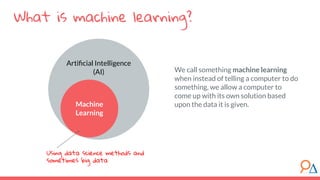
What is machine learning?
Artificial Intelligence
(AI)
Machine
Learning
Using data science methods and
sometimes big data
We call something machine learning
when instead of telling a computer to do
something, we allow a computer to
come up with its own solution based
upon the data it is given.
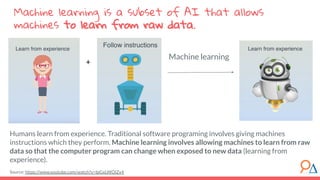
Machine learning is a subset of AI that allows
machines to learn from raw data.
Humans learn from experience. Traditional software programing involves giving machines
instructions which they perform. Machine learning involves allowing machines to learn from raw
data so that the computer program can change when exposed to new data (learning from
experience).
Source: https://www.youtube.com/watch?v=IpGxLWOIZy4
Machine learning
+
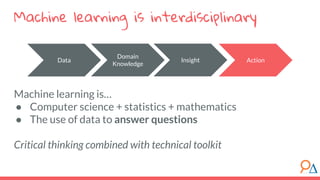
Machine learning is…
● Computer science + statistics + mathematics
● The use of data to answer questions
Critical thinking combined with technical toolkit
Machine learning is interdisciplinary
Data
Domain
Knowledge
Insight Action
There is a growing need for machine
learning
Sources:
[1] “What is Big Data,” IBM,
● There are huge amounts of data generated
every day.
● Previously impossible problems are now
solvable.
● Companies are increasingly demanding
quantitative solutions.
“Every day, we create 2.5 quintillion bytes of data
— so much that 90% of the data in the world today
has been created in the last two years alone.” [1]
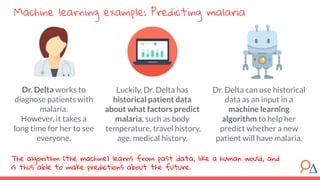
Dr. Delta works to
diagnose patients with
malaria.
However, it takes a
long time for her to see
everyone.
Machine learning example: Predicting malaria
Luckily, Dr. Delta has
historical patient data
about what factors predict
malaria, such as body
temperature, travel history,
age, medical history.
Dr. Delta can use historical
data as an input in a
machine learning
algorithm to help her
predict whether a new
patient will have malaria.
The algorithm (the machine) learns from past data, like a human would, and
is thus able to make predictions about the future.
Machine learning is a powerful tool; it can…
Determine your credit
rating based upon cell
phone usage.
Determine the topic of a piece of
text.
Recognize your
face in a photo.
Recommend
movies you
will like.
Machine learning helps
us answer questions.
How do we define the
question?
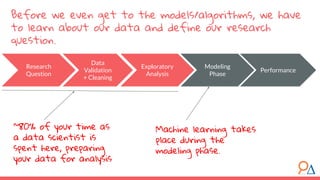
Before we even get to the models/algorithms, we have
to learn about our data and define our research
question.
Research
Question
Exploratory
Analysis
Modeling
Phase
Performance
Data
Validation
+ Cleaning
Machine learning takes
place during the
modeling phase.
~80% of your time as
a data scientist is
spent here, preparing
your data for analysis
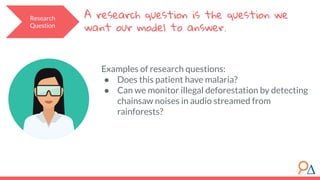
Examples of research questions:
● Does this patient have malaria?
● Can we monitor illegal deforestation by detecting
chainsaw noises in audio streamed from
rainforests?
A research question is the question we
want our model to answer.
Research
Question
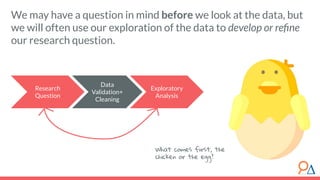
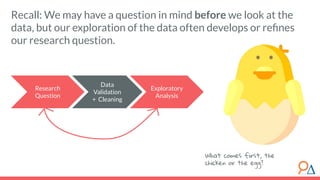
We may have a question in mind before we look at the data, but
we will often use our exploration of the data to develop or refine
our research question.
Research
Question
Exploratory
Analysis
Data
Validation+
Cleaning
What comes first, the
chicken or the egg?
Data Validation and
Cleaning
Data
Cleaning
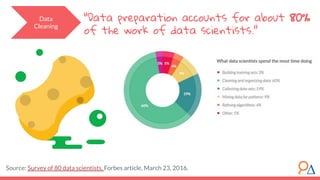
Source: Survey of 80 data scientists. Forbes article, March 23, 2016.
“Data preparation accounts for about 80%
of the work of data scientists.”
Data
Cleaning
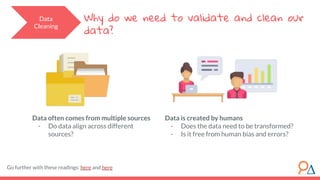
Why do we need to validate and clean our
data?
Data often comes from multiple sources
- Do data align across different
sources?
Data is created by humans
- Does the data need to be transformed?
- Is it free from human bias and errors?
Go further with these readings: here and here
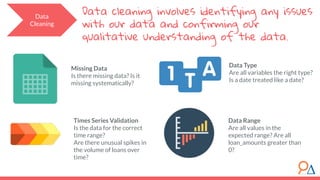
Data cleaning involves identifying any issues
with our data and confirming our
qualitative understanding of the data.
Data
Cleaning
Missing Data
Is there missing data? Is it
missing systematically?
Times Series Validation
Is the data for the correct
time range?
Are there unusual spikes in
the volume of loans over
time?
Data Type
Are all variables the right type?
Is a date treated like a date?
Data Range
Are all values in the
expected range? Are all
loan_amounts greater than
0?
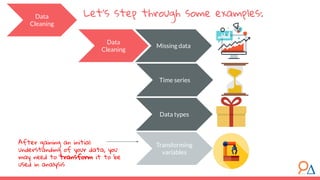
Let’s step through some examples:
Data
Cleaning
Missing data
Time series
Data types
Data
Cleaning
Transforming
variables
After gaining an initial
understanding of your data, you
may need to transform it to be
used in analysis
Data
Cleaning
Is there missing data? Is data
missing at random or systematically?
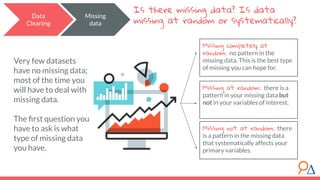
Very few datasets
have no missing data;
most of the time you
will have to deal with
missing data.
The first question you
have to ask is what
type of missing data
you have.
Missing completely at
random: no pattern in the
missing data. This is the best type
of missing you can hope for.
Missing at random: there is a
pattern in your missing data but
not in your variables of interest.
Missing not at random: there
is a pattern in the missing data
that systematically affects your
primary variables.
Missing
data
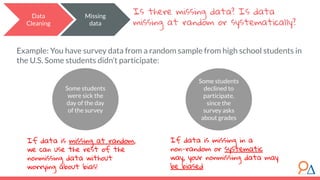
Example: You have survey data from a random sample from high school students in
the U.S. Some students didn’t participate:
Data
Cleaning
Missing
data
If data is missing at random,
we can use the rest of the
nonmissing data without
worrying about bias!
If data is missing in a
non-random or systematic
way, your nonmissing data may
be biased
Some students
were sick the
day of the day
of the survey
Some students
declined to
participate,
since the
survey asks
about grades
Is there missing data? Is data
missing at random or systematically?
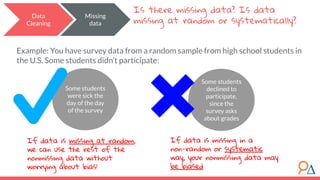
Example: You have survey data from a random sample from high school students in
the U.S. Some students didn’t participate:
Data
Cleaning
Missing
data
If data is missing at random,
we can use the rest of the
nonmissing data without
worrying about bias!
If data is missing in a
non-random or systematic
way, your nonmissing data may
be biased
Some students
were sick the
day of the day
of the survey
Some students
declined to
participate,
since the
survey asks
about grades
Is there missing data? Is data
missing at random or systematically?
Data
Cleaning
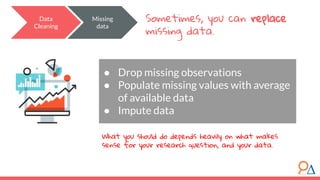
Sometimes, you can replace
missing data.
● Drop missing observations
● Populate missing values with average
of available data
● Impute data
Missing
data
What you should do depends heavily on what makes
sense for your research question, and your data.
Data
Cleaning
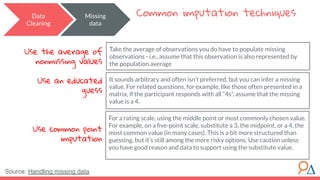
Common imputation techniques
Take the average of observations you do have to populate missing
observations - i.e., assume that this observation is also represented by
the population average
Missing
data
Use the average of
nonmissing values
Use an educated
guess
Use common point
imputation
It sounds arbitrary and often isn’t preferred, but you can infer a missing
value. For related questions, for example, like those often presented in a
matrix, if the participant responds with all “4s”, assume that the missing
value is a 4.
For a rating scale, using the middle point or most commonly chosen value.
For example, on a five-point scale, substitute a 3, the midpoint, or a 4, the
most common value (in many cases). This is a bit more structured than
guessing, but it’s still among the more risky options. Use caution unless
you have good reason and data to support using the substitute value.
Source: Handling missing data
Data
Cleaning
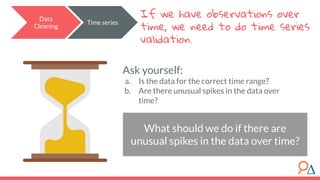
If we have observations over
time, we need to do time series
validation.
Ask yourself:
a. Is the data for the correct time range?
b. Are there unusual spikes in the data over
time?
What should we do if there are
unusual spikes in the data over time?
Time series
Data
Cleaning
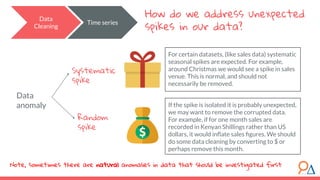
How do we address unexpected
spikes in our data?
Data
anomaly
For certain datasets, (like sales data) systematic
seasonal spikes are expected. For example,
around Christmas we would see a spike in sales
venue. This is normal, and should not
necessarily be removed.
Time series
Systematic
spike
Random
spike
If the spike is isolated it is probably unexpected,
we may want to remove the corrupted data.
For example, if for one month sales are
recorded in Kenyan Shillings rather than US
dollars, it would inflate sales figures. We should
do some data cleaning by converting to $ or
perhaps remove this month.
Note, sometimes there are natural anomalies in data that should be investigated first
Data
Cleaning
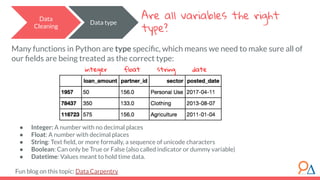
Are all variables the right
type?
● Integer: A number with no decimal places
● Float: A number with decimal places
● String: Text field, or more formally, a sequence of unicode characters
● Boolean: Can only be True or False (also called indicator or dummy variable)
● Datetime: Values meant to hold time data.
Fun blog on this topic: Data Carpentry
Many functions in Python are type specific, which means we need to make sure all of
our fields are being treated as the correct type:
integer float string date
Data type
As you explore the data, some questions arise…
Data cleaning quiz!
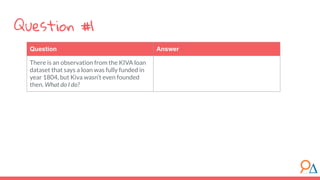
Question Answer
There is an observation from the KIVA loan
dataset that says a loan was fully funded in
year 1804, but Kiva wasn’t even founded
then. What do I do?
Question #1
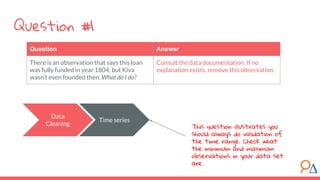
Question Answer
There is an observation that says this loan
was fully funded in year 1804, but Kiva
wasn’t even founded then. What do I do?
Consult the data documentation. If no
explanation exists, remove this observation.
Data
Cleaning
Time series
This question illustrates you
should always do validation of
the time range. Check what
the minimum and maximum
observations in your data set
are.
Question #1
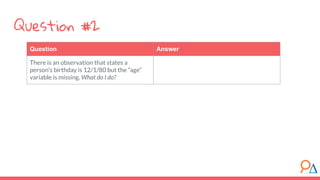
Question Answer
There is an observation that states a
person’s birthday is 12/1/80 but the “age”
variable is missing. What do I do?
Question #2
Data
Cleaning
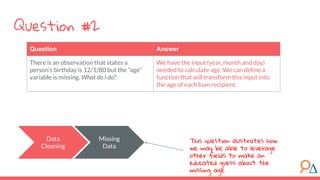
This question illustrates how
we may be able to leverage
other fields to make an
educated guess about the
missing age.
Missing
Data
Question Answer
There is an observation that states a
person’s birthday is 12/1/80 but the “age”
variable is missing. What do I do?
We have the input (year, month and day)
needed to calculate age. We can define a
function that will transform this input into
the age of each loan recipient.
Question #2
Question Answer
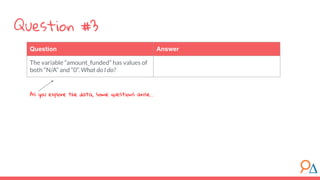
The variable “amount_funded” has values of
both “N/A” and “0”. What do I do?
Question #3
As you explore the data, some questions arise…
Question Answer
The variable “amount_funded” has values of
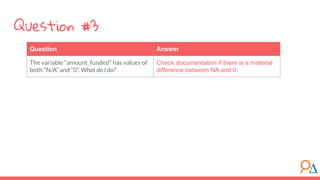
both “N/A” and “0”. What do I do?
Check documentation if there is a material
difference between NA and 0.
Question #3
Question Answer
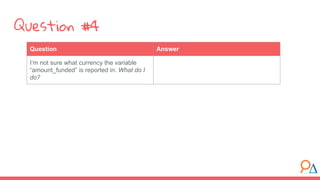
I’m not sure what currency the variable
“amount_funded” is reported in. What do I
do?
Question #4
Question Answer
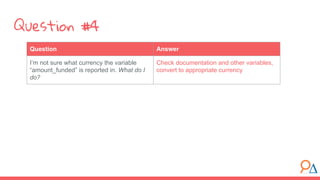
I’m not sure what currency the variable
“amount_funded” is reported in. What do I
do?
Check documentation and other variables,
convert to appropriate currency
Question #4
A final note…
Data
Cleaning
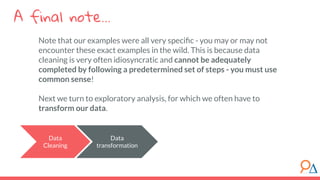
Note that our examples were all very specific - you may or may not
encounter these exact examples in the wild. This is because data
cleaning is very often idiosyncratic and cannot be adequately
completed by following a predetermined set of steps - you must use
common sense!
Next we turn to exploratory analysis, for which we often have to
transform our data.
Data
transformation
Exploratory Analysis
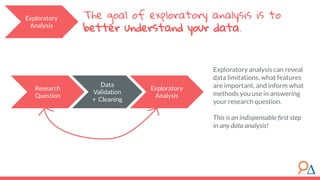
The goal of exploratory analysis is to
better understand your data.
Research
Question
Exploratory
Analysis
Data
Validation
+ Cleaning
Exploratory
Analysis
Exploratory analysis can reveal
data limitations, what features
are important, and inform what
methods you use in answering
your research question.
This is an indispensable first step
in any data analysis!
Let’s explore our data!
Exploratory
Analysis
Scatter plots
Correlation
Box plots
Summary
statistics
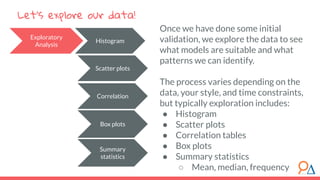
Once we have done some initial
validation, we explore the data to see
what models are suitable and what
patterns we can identify.
The process varies depending on the
data, your style, and time constraints,
but typically exploration includes:
● Histogram
● Scatter plots
● Correlation tables
● Box plots
● Summary statistics
○ Mean, median, frequency
Histogram
Exploratory
Analysis
Histogram
Histograms tell us about the
distribution of the feature.
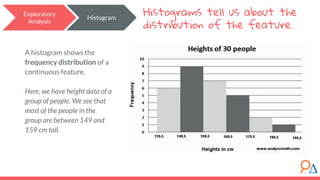
A histogram shows the
frequency distribution of a
continuous feature.
Here, we have height data of a
group of people. We see that
most of the people in the
group are between 149 and
159 cm tall.
Exploratory
Analysis
Scatter Plots
Scatter plots provide insight
about the relationship between
two features.
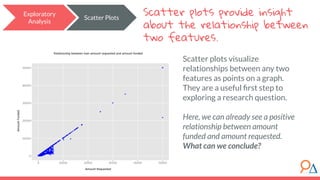
Scatter plots visualize
relationships between any two
features as points on a graph.
They are a useful first step to
exploring a research question.
Here, we can already see a positive
relationship between amount
funded and amount requested.
What can we conclude?
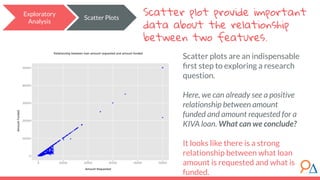
Scatter plots are an indispensable
first step to exploring a research
question.
Here, we can already see a positive
relationship between amount
funded and amount requested for a
KIVA loan. What can we conclude?
It looks like there is a strong
relationship between what loan
amount is requested and what is
funded.
Exploratory
Analysis
Scatter Plots
Scatter plot provide important
data about the relationship
between two features.
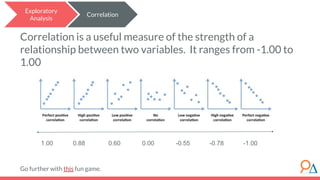
Correlation is a useful measure of the strength of a
relationship between two variables. It ranges from -1.00 to
1.00
Go further with this fun game.
1.00 0.88 0.60 0.00 -0.55 -0.78 -1.00
Exploratory
Analysis
Correlation
Correlation does not equal
causation
Exploratory
Analysis
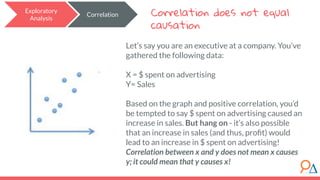
Let’s say you are an executive at a company. You’ve
gathered the following data:
X = $ spent on advertising
Y= Sales
Based on the graph and positive correlation, you’d
be tempted to say $ spent on advertising caused an
increase in sales. But hang on - it’s also possible
that an increase in sales (and thus, profit) would
lead to an increase in $ spent on advertising!
Correlation between x and y does not mean x causes
y; it could mean that y causes x!
Correlation
Kiva example: Correlation
does not equal causation
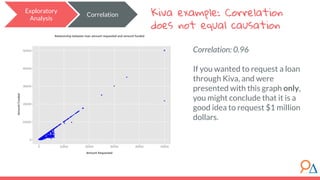
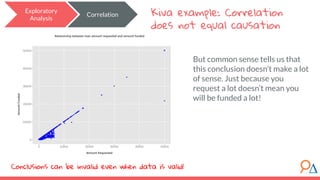
Correlation: 0.96
If you wanted to request a loan
through Kiva, and were
presented with this graph only,
you might conclude that it is a
good idea to request $1 million
dollars.
Exploratory
Analysis
Correlation
Kiva example: Correlation
does not equal causation
Conclusions can be invalid even when data is valid!
But common sense tells us that
this conclusion doesn’t make a lot
of sense. Just because you
request a lot doesn’t mean you
will be funded a lot!
Exploratory
Analysis
Correlation
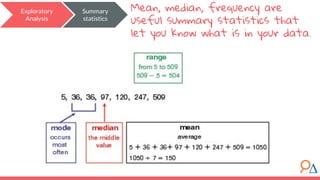
Mean, median, frequency are
useful summary statistics that
let you know what is in your data.
Exploratory
Analysis
Summary
statistics
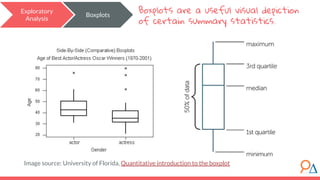
Image source: University of Florida, Quantitative introduction to the boxplot
Exploratory
Analysis
Boxplots
Boxplots are a useful visual depiction
of certain summary statistics.
Forming a
research question
Recall: We may have a question in mind before we look at the
data, but our exploration of the data often develops or refines
our research question.
Research
Question
Exploratory
Analysis
Data
Validation
+ Cleaning
What comes first, the
chicken or the egg?
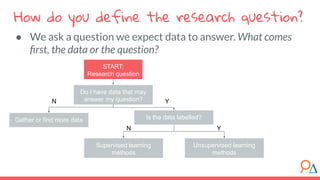
● We ask a question we expect data to answer. What comes
first, the data or the question?
How do you define the research question?
START:
Research question
Do I have data that may
answer my question?
Gather or find more data Is the data labelled?
Supervised learning
methods
Unsupervised learning
methods
YN
YN
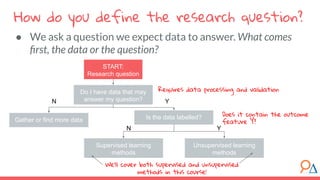
● We ask a question we expect data to answer. What comes
first, the data or the question?
How do you define the research question?
START:
Research question
Do I have data that may
answer my question?
Gather or find more data Is the data labelled?
Supervised learning
methods
Unsupervised learning
methods
Requires data processing and validation
YN
YN
Does it contain the outcome
feature Y?
We’ll cover both supervised and unsupervised
methods in this course!
Research
Question
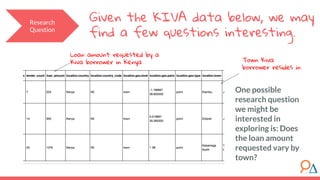
Given the KIVA data below, we may
find a few questions interesting.
Loan amount requested by a
Kiva borrower in Kenya Town Kiva
borrower resides in.
One possible
research question
we might be
interested in
exploring is: Does
the loan amount
requested vary by
town?
Research
Question
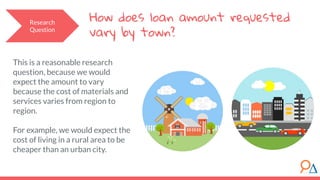
How does loan amount requested
vary by town?
This is a reasonable research
question, because we would
expect the amount to vary
because the cost of materials and
services varies from region to
region.
For example, we would expect the
cost of living in a rural area to be
cheaper than an urban city.
Looking ahead:
Modeling
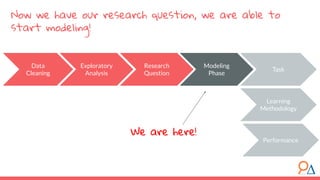
Now we have our research question, we are able to
start modeling!
Research
Question
Exploratory
Analysis
Modeling
Phase
Performance
Data
Cleaning
We are here!
Learning
Methodology
Task
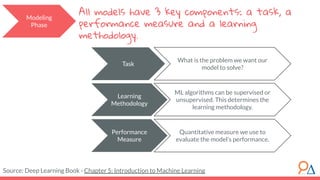
Task
What is the problem we want our
model to solve?
Performance
Measure
Quantitative measure we use to
evaluate the model’s performance.
Learning
Methodology
ML algorithms can be supervised or
unsupervised. This determines the
learning methodology.
All models have 3 key components: a task, a
performance measure and a learning
methodology.
Source: Deep Learning Book - Chapter 5: Introduction to Machine Learning
Modeling
Phase
We will go over the machine
learning task and learning
methodology in the next lesson.
✓ What is machine learning?
✓ How do you define a research question?
✓ What are observations?
✓ What are features?
✓ What are outcome variables?
✓ Introduction to KIVA data
You covered this today:
You are on fire! Go straight to the
next module here.
Need to slow down and digest? Take a
minute to write us an email about
what you thought about the course. All
feedback small or large welcome!
Email: sara@deltanalytics.org
Find out more about
Delta’s machine
learning for good
mission here.

Module 1 introduction to machine learning

  • 1.
  • 2.
    This course contentis being actively developed by Delta Analytics, a 501(c)3 Bay Area nonprofit that aims to empower communities to leverage their data for good. Please reach out with any questions or feedback to inquiry@deltanalytics.org. Find out more about our mission here. Delta Analytics builds technical capacity around the world.
  • 3.
    Course overview: Now let’sturn to the data we will be using... ✓ Module 1: Introduction to Machine Learning ❏ Module 2: Machine Learning Deep Dive ❏ Module 3: Model Selection and Evaluation ❏ Module 4: Linear Regression ❏ Module 5: Decision Trees ❏ Module 6: Ensemble Algorithms ❏ Module 7: Unsupervised Learning Algorithms ❏ Module 8: Natural Language Processing Part 1 ❏ Module 9: Natural Language Processing Part 2
  • 4.
  • 5.
    ✓ What ismachine learning? ❏ How do you define a research question? ❏ What are observations? ❏ What are features? ❏ What are outcome variables? ❏ Introduction to KIVA data Module Checklist
  • 6.
    What is machinelearning?
  • 7.
    What is machinelearning? Artificial Intelligence (AI) Machine Learning Using data science methods and sometimes big data We call something machine learning when instead of telling a computer to do something, we allow a computer to come up with its own solution based upon the data it is given.
  • 8.
    Machine learning isa subset of AI that allows machines to learn from raw data. Humans learn from experience. Traditional software programing involves giving machines instructions which they perform. Machine learning involves allowing machines to learn from raw data so that the computer program can change when exposed to new data (learning from experience). Source: https://www.youtube.com/watch?v=IpGxLWOIZy4 Machine learning +
  • 9.
    Machine learning is… ●Computer science + statistics + mathematics ● The use of data to answer questions Critical thinking combined with technical toolkit Machine learning is interdisciplinary Data Domain Knowledge Insight Action
  • 10.
    There is agrowing need for machine learning Sources: [1] “What is Big Data,” IBM, ● There are huge amounts of data generated every day. ● Previously impossible problems are now solvable. ● Companies are increasingly demanding quantitative solutions. “Every day, we create 2.5 quintillion bytes of data — so much that 90% of the data in the world today has been created in the last two years alone.” [1]
  • 11.
    Dr. Delta worksto diagnose patients with malaria. However, it takes a long time for her to see everyone. Machine learning example: Predicting malaria Luckily, Dr. Delta has historical patient data about what factors predict malaria, such as body temperature, travel history, age, medical history. Dr. Delta can use historical data as an input in a machine learning algorithm to help her predict whether a new patient will have malaria. The algorithm (the machine) learns from past data, like a human would, and is thus able to make predictions about the future.
  • 12.
    Machine learning isa powerful tool; it can… Determine your credit rating based upon cell phone usage. Determine the topic of a piece of text. Recognize your face in a photo. Recommend movies you will like.
  • 13.
    Machine learning helps usanswer questions. How do we define the question?
  • 14.
    Before we evenget to the models/algorithms, we have to learn about our data and define our research question. Research Question Exploratory Analysis Modeling Phase Performance Data Validation + Cleaning Machine learning takes place during the modeling phase. ~80% of your time as a data scientist is spent here, preparing your data for analysis
  • 15.
    Examples of researchquestions: ● Does this patient have malaria? ● Can we monitor illegal deforestation by detecting chainsaw noises in audio streamed from rainforests? A research question is the question we want our model to answer. Research Question
  • 16.
    We may havea question in mind before we look at the data, but we will often use our exploration of the data to develop or refine our research question. Research Question Exploratory Analysis Data Validation+ Cleaning What comes first, the chicken or the egg?
  • 17.
  • 18.
    Data Cleaning Source: Survey of80 data scientists. Forbes article, March 23, 2016. “Data preparation accounts for about 80% of the work of data scientists.”
  • 19.
    Data Cleaning Why do weneed to validate and clean our data? Data often comes from multiple sources - Do data align across different sources? Data is created by humans - Does the data need to be transformed? - Is it free from human bias and errors? Go further with these readings: here and here
  • 20.
    Data cleaning involvesidentifying any issues with our data and confirming our qualitative understanding of the data. Data Cleaning Missing Data Is there missing data? Is it missing systematically? Times Series Validation Is the data for the correct time range? Are there unusual spikes in the volume of loans over time? Data Type Are all variables the right type? Is a date treated like a date? Data Range Are all values in the expected range? Are all loan_amounts greater than 0?
  • 21.
    Let’s step throughsome examples: Data Cleaning Missing data Time series Data types Data Cleaning Transforming variables After gaining an initial understanding of your data, you may need to transform it to be used in analysis
  • 22.
    Data Cleaning Is there missingdata? Is data missing at random or systematically? Very few datasets have no missing data; most of the time you will have to deal with missing data. The first question you have to ask is what type of missing data you have. Missing completely at random: no pattern in the missing data. This is the best type of missing you can hope for. Missing at random: there is a pattern in your missing data but not in your variables of interest. Missing not at random: there is a pattern in the missing data that systematically affects your primary variables. Missing data
  • 23.
    Example: You havesurvey data from a random sample from high school students in the U.S. Some students didn’t participate: Data Cleaning Missing data If data is missing at random, we can use the rest of the nonmissing data without worrying about bias! If data is missing in a non-random or systematic way, your nonmissing data may be biased Some students were sick the day of the day of the survey Some students declined to participate, since the survey asks about grades Is there missing data? Is data missing at random or systematically?
  • 24.
    Example: You havesurvey data from a random sample from high school students in the U.S. Some students didn’t participate: Data Cleaning Missing data If data is missing at random, we can use the rest of the nonmissing data without worrying about bias! If data is missing in a non-random or systematic way, your nonmissing data may be biased Some students were sick the day of the day of the survey Some students declined to participate, since the survey asks about grades Is there missing data? Is data missing at random or systematically?
  • 25.
    Data Cleaning Sometimes, you canreplace missing data. ● Drop missing observations ● Populate missing values with average of available data ● Impute data Missing data What you should do depends heavily on what makes sense for your research question, and your data.
  • 26.
    Data Cleaning Common imputation techniques Takethe average of observations you do have to populate missing observations - i.e., assume that this observation is also represented by the population average Missing data Use the average of nonmissing values Use an educated guess Use common point imputation It sounds arbitrary and often isn’t preferred, but you can infer a missing value. For related questions, for example, like those often presented in a matrix, if the participant responds with all “4s”, assume that the missing value is a 4. For a rating scale, using the middle point or most commonly chosen value. For example, on a five-point scale, substitute a 3, the midpoint, or a 4, the most common value (in many cases). This is a bit more structured than guessing, but it’s still among the more risky options. Use caution unless you have good reason and data to support using the substitute value. Source: Handling missing data
  • 27.
    Data Cleaning If we haveobservations over time, we need to do time series validation. Ask yourself: a. Is the data for the correct time range? b. Are there unusual spikes in the data over time? What should we do if there are unusual spikes in the data over time? Time series
  • 28.
    Data Cleaning How do weaddress unexpected spikes in our data? Data anomaly For certain datasets, (like sales data) systematic seasonal spikes are expected. For example, around Christmas we would see a spike in sales venue. This is normal, and should not necessarily be removed. Time series Systematic spike Random spike If the spike is isolated it is probably unexpected, we may want to remove the corrupted data. For example, if for one month sales are recorded in Kenyan Shillings rather than US dollars, it would inflate sales figures. We should do some data cleaning by converting to $ or perhaps remove this month. Note, sometimes there are natural anomalies in data that should be investigated first
  • 29.
    Data Cleaning Are all variablesthe right type? ● Integer: A number with no decimal places ● Float: A number with decimal places ● String: Text field, or more formally, a sequence of unicode characters ● Boolean: Can only be True or False (also called indicator or dummy variable) ● Datetime: Values meant to hold time data. Fun blog on this topic: Data Carpentry Many functions in Python are type specific, which means we need to make sure all of our fields are being treated as the correct type: integer float string date Data type
  • 30.
    As you explorethe data, some questions arise… Data cleaning quiz!
  • 31.
    Question Answer There isan observation from the KIVA loan dataset that says a loan was fully funded in year 1804, but Kiva wasn’t even founded then. What do I do? Question #1
  • 32.
    Question Answer There isan observation that says this loan was fully funded in year 1804, but Kiva wasn’t even founded then. What do I do? Consult the data documentation. If no explanation exists, remove this observation. Data Cleaning Time series This question illustrates you should always do validation of the time range. Check what the minimum and maximum observations in your data set are. Question #1
  • 33.
    Question Answer There isan observation that states a person’s birthday is 12/1/80 but the “age” variable is missing. What do I do? Question #2
  • 34.
    Data Cleaning This question illustrateshow we may be able to leverage other fields to make an educated guess about the missing age. Missing Data Question Answer There is an observation that states a person’s birthday is 12/1/80 but the “age” variable is missing. What do I do? We have the input (year, month and day) needed to calculate age. We can define a function that will transform this input into the age of each loan recipient. Question #2
  • 35.
    Question Answer The variable“amount_funded” has values of both “N/A” and “0”. What do I do? Question #3 As you explore the data, some questions arise…
  • 36.
    Question Answer The variable“amount_funded” has values of both “N/A” and “0”. What do I do? Check documentation if there is a material difference between NA and 0. Question #3
  • 37.
    Question Answer I’m notsure what currency the variable “amount_funded” is reported in. What do I do? Question #4
  • 38.
    Question Answer I’m notsure what currency the variable “amount_funded” is reported in. What do I do? Check documentation and other variables, convert to appropriate currency Question #4
  • 39.
    A final note… Data Cleaning Notethat our examples were all very specific - you may or may not encounter these exact examples in the wild. This is because data cleaning is very often idiosyncratic and cannot be adequately completed by following a predetermined set of steps - you must use common sense! Next we turn to exploratory analysis, for which we often have to transform our data. Data transformation
  • 40.
  • 41.
    The goal ofexploratory analysis is to better understand your data. Research Question Exploratory Analysis Data Validation + Cleaning Exploratory Analysis Exploratory analysis can reveal data limitations, what features are important, and inform what methods you use in answering your research question. This is an indispensable first step in any data analysis!
  • 42.
    Let’s explore ourdata! Exploratory Analysis Scatter plots Correlation Box plots Summary statistics Once we have done some initial validation, we explore the data to see what models are suitable and what patterns we can identify. The process varies depending on the data, your style, and time constraints, but typically exploration includes: ● Histogram ● Scatter plots ● Correlation tables ● Box plots ● Summary statistics ○ Mean, median, frequency Histogram
  • 43.
    Exploratory Analysis Histogram Histograms tell usabout the distribution of the feature. A histogram shows the frequency distribution of a continuous feature. Here, we have height data of a group of people. We see that most of the people in the group are between 149 and 159 cm tall.
  • 44.
    Exploratory Analysis Scatter Plots Scatter plotsprovide insight about the relationship between two features. Scatter plots visualize relationships between any two features as points on a graph. They are a useful first step to exploring a research question. Here, we can already see a positive relationship between amount funded and amount requested. What can we conclude?
  • 45.
    Scatter plots arean indispensable first step to exploring a research question. Here, we can already see a positive relationship between amount funded and amount requested for a KIVA loan. What can we conclude? It looks like there is a strong relationship between what loan amount is requested and what is funded. Exploratory Analysis Scatter Plots Scatter plot provide important data about the relationship between two features.
  • 46.
    Correlation is auseful measure of the strength of a relationship between two variables. It ranges from -1.00 to 1.00 Go further with this fun game. 1.00 0.88 0.60 0.00 -0.55 -0.78 -1.00 Exploratory Analysis Correlation
  • 47.
    Correlation does notequal causation Exploratory Analysis Let’s say you are an executive at a company. You’ve gathered the following data: X = $ spent on advertising Y= Sales Based on the graph and positive correlation, you’d be tempted to say $ spent on advertising caused an increase in sales. But hang on - it’s also possible that an increase in sales (and thus, profit) would lead to an increase in $ spent on advertising! Correlation between x and y does not mean x causes y; it could mean that y causes x! Correlation
  • 48.
    Kiva example: Correlation doesnot equal causation Correlation: 0.96 If you wanted to request a loan through Kiva, and were presented with this graph only, you might conclude that it is a good idea to request $1 million dollars. Exploratory Analysis Correlation
  • 49.
    Kiva example: Correlation doesnot equal causation Conclusions can be invalid even when data is valid! But common sense tells us that this conclusion doesn’t make a lot of sense. Just because you request a lot doesn’t mean you will be funded a lot! Exploratory Analysis Correlation
  • 50.
    Mean, median, frequencyare useful summary statistics that let you know what is in your data. Exploratory Analysis Summary statistics
  • 51.
    Image source: Universityof Florida, Quantitative introduction to the boxplot Exploratory Analysis Boxplots Boxplots are a useful visual depiction of certain summary statistics.
  • 52.
  • 53.
    Recall: We mayhave a question in mind before we look at the data, but our exploration of the data often develops or refines our research question. Research Question Exploratory Analysis Data Validation + Cleaning What comes first, the chicken or the egg?
  • 54.
    ● We aska question we expect data to answer. What comes first, the data or the question? How do you define the research question? START: Research question Do I have data that may answer my question? Gather or find more data Is the data labelled? Supervised learning methods Unsupervised learning methods YN YN
  • 55.
    ● We aska question we expect data to answer. What comes first, the data or the question? How do you define the research question? START: Research question Do I have data that may answer my question? Gather or find more data Is the data labelled? Supervised learning methods Unsupervised learning methods Requires data processing and validation YN YN Does it contain the outcome feature Y? We’ll cover both supervised and unsupervised methods in this course!
  • 56.
    Research Question Given the KIVAdata below, we may find a few questions interesting. Loan amount requested by a Kiva borrower in Kenya Town Kiva borrower resides in. One possible research question we might be interested in exploring is: Does the loan amount requested vary by town?
  • 57.
    Research Question How does loanamount requested vary by town? This is a reasonable research question, because we would expect the amount to vary because the cost of materials and services varies from region to region. For example, we would expect the cost of living in a rural area to be cheaper than an urban city.
  • 58.
  • 59.
    Now we haveour research question, we are able to start modeling! Research Question Exploratory Analysis Modeling Phase Performance Data Cleaning We are here! Learning Methodology Task
  • 60.
    Task What is theproblem we want our model to solve? Performance Measure Quantitative measure we use to evaluate the model’s performance. Learning Methodology ML algorithms can be supervised or unsupervised. This determines the learning methodology. All models have 3 key components: a task, a performance measure and a learning methodology. Source: Deep Learning Book - Chapter 5: Introduction to Machine Learning Modeling Phase
  • 61.
    We will goover the machine learning task and learning methodology in the next lesson.
  • 62.
    ✓ What ismachine learning? ✓ How do you define a research question? ✓ What are observations? ✓ What are features? ✓ What are outcome variables? ✓ Introduction to KIVA data You covered this today:
  • 63.
    You are onfire! Go straight to the next module here. Need to slow down and digest? Take a minute to write us an email about what you thought about the course. All feedback small or large welcome! Email: sara@deltanalytics.org
  • 64.
    Find out moreabout Delta’s machine learning for good mission here.