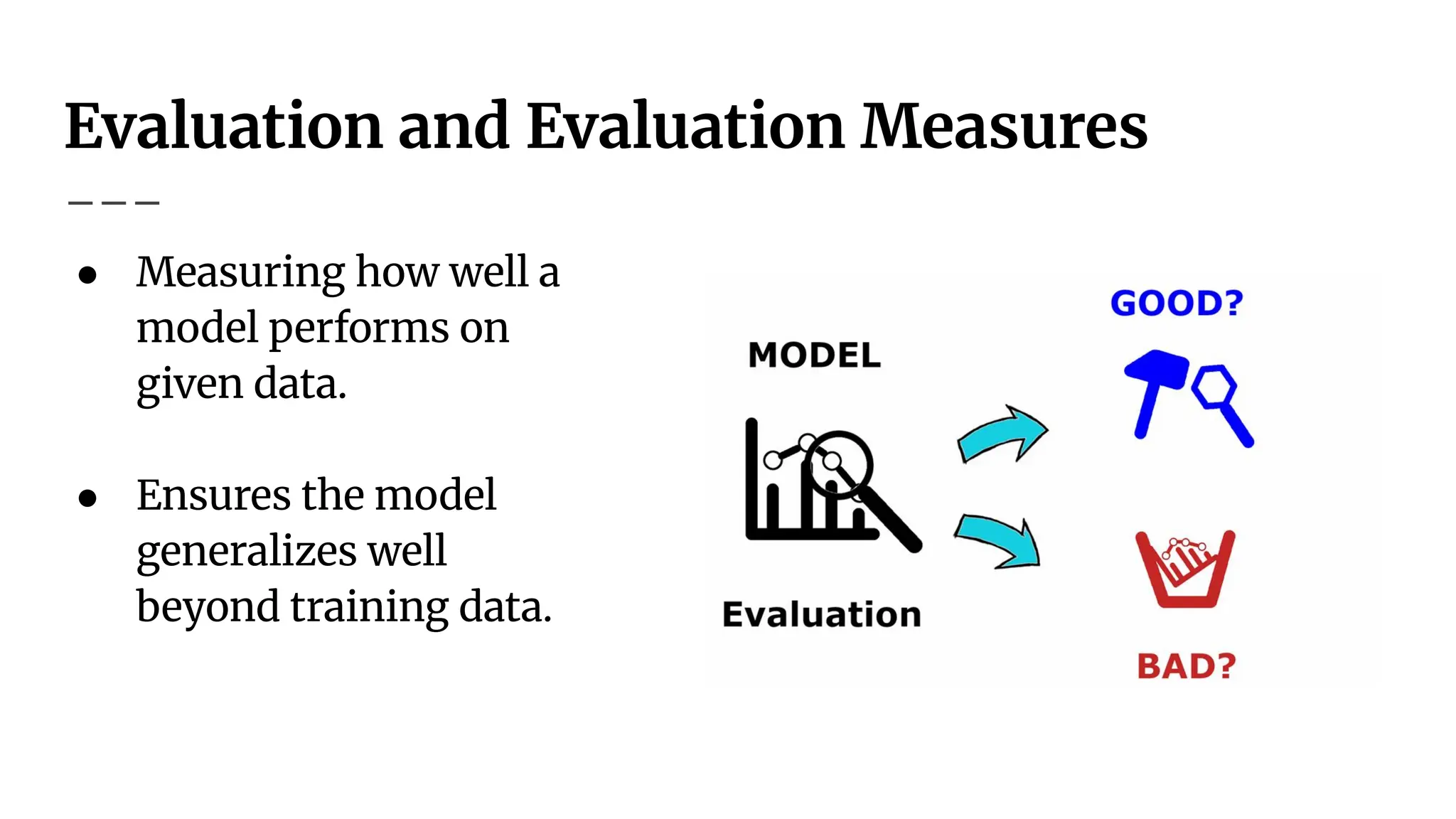
Evaluation and EvaluationMeasures
● Measuring how well a
model performs on
given data.
● Ensures the model
generalizes well
beyond training data.
4.
Common Classification EvaluationMeasures
● Misclassification Error (0-1 Loss)
Fraction of incorrect predictions.
● Cross-Entropy Loss
Measures how different the predicted probabilities are
from actual labels.
● Accuracy
(Correct Predictions) / (Total Predictions).
5.
Regression Evaluation Measures
●Mean Squared Error (MSE)
Penalizes larger errors more.
● Root Mean Squared Error (RMSE)
Square root of MSE, interpretable in original units.
● Mean Absolute Error (MAE)
Average of absolute differences between predictions and
actual values.
6.
Evaluating the Classifier’sPerformance
● Goal: Measure performance on the entire data
distribution.
● We don’t know the full data distribution, only have
samples.
● Use training and test data to estimate true performance.
7.
Train-Test Split andBias
● Train-Test Split:
○ Training set: Used for learning model parameters.
○ Test set: Used for final evaluation.
● Potential Issues:
○ Test data may not be independent of training data.
○ Training data may be biased (not representative of
real-world distribution).
8.
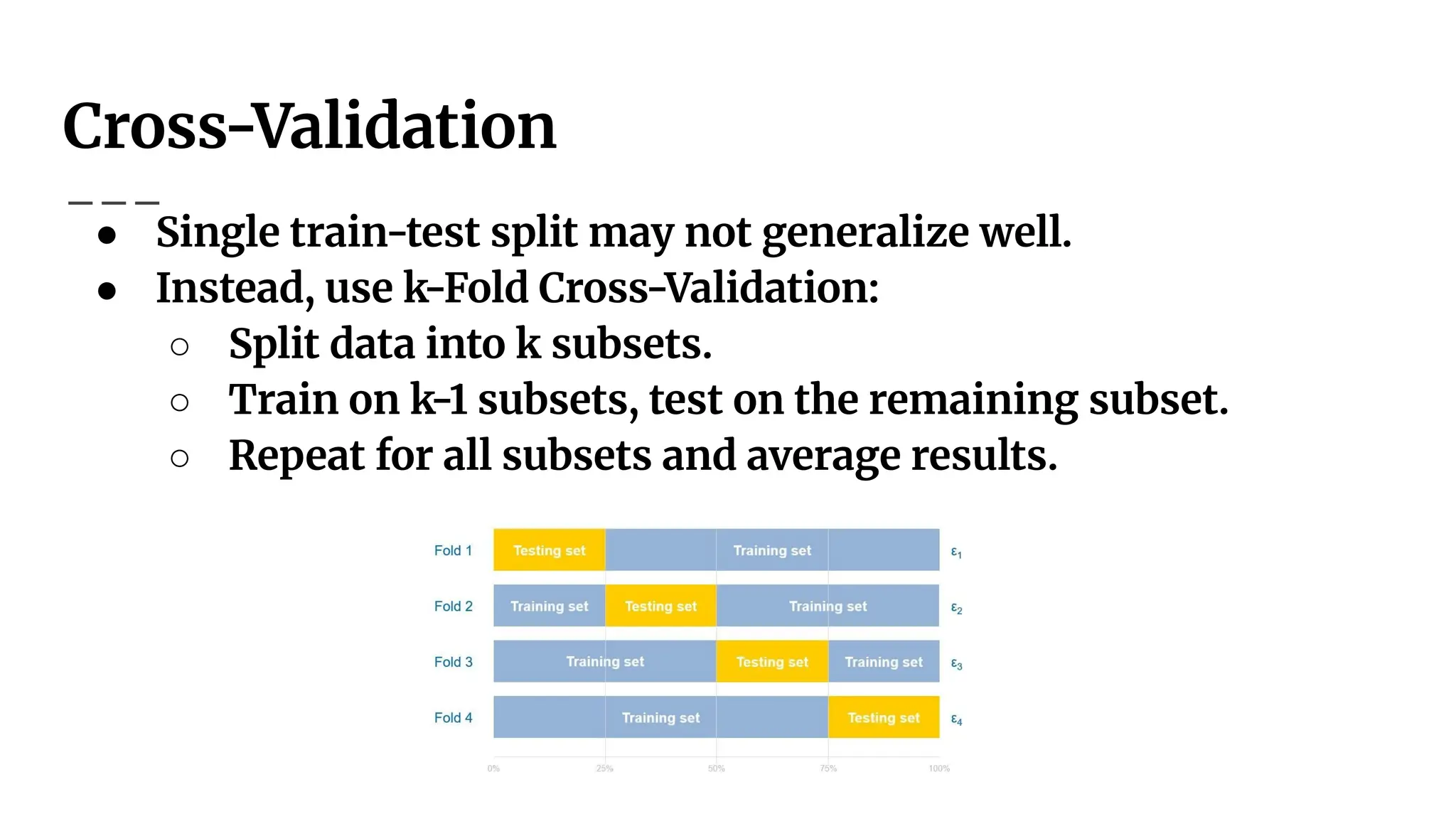
Cross-Validation
● Single train-testsplit may not generalize well.
● Instead, use k-Fold Cross-Validation:
○ Split data into k subsets.
○ Train on k-1 subsets, test on the remaining subset.
○ Repeat for all subsets and average results.
9.
Overfitting and Generalization
●Overfitting: Model performs well on training data but poorly
on unseen data.
● Regularization techniques:
○ L1/L2 Regularization.
○ Data augmentation.
○ Dropout (for deep learning).
10.
Active Learning
● WhenTraining Data is Not Representative:
○ Sample additional data from regions with high
uncertainty.
○ Model actively queries for more samples in
critical areas.
○ Helps reduce bias in data.
11.
Ensemble Learning &Weak Classifiers
● Weak Classifiers:
○ Classifiers slightly better than random (e.g.,
51% accuracy in a binary task).
● Boosting (e.g., AdaBoost):
○ Combines weak classifiers to form a strong
model.
● Bagging (e.g., Random Forests):
○ Reduces variance by averaging multiple models.
12.
Bootstrap and Cross-Validation
●Why do we need sampling methods?
● The goal: Estimating performance metrics accurately
● Two popular techniques: Bootstrap & Cross-Validation
13.
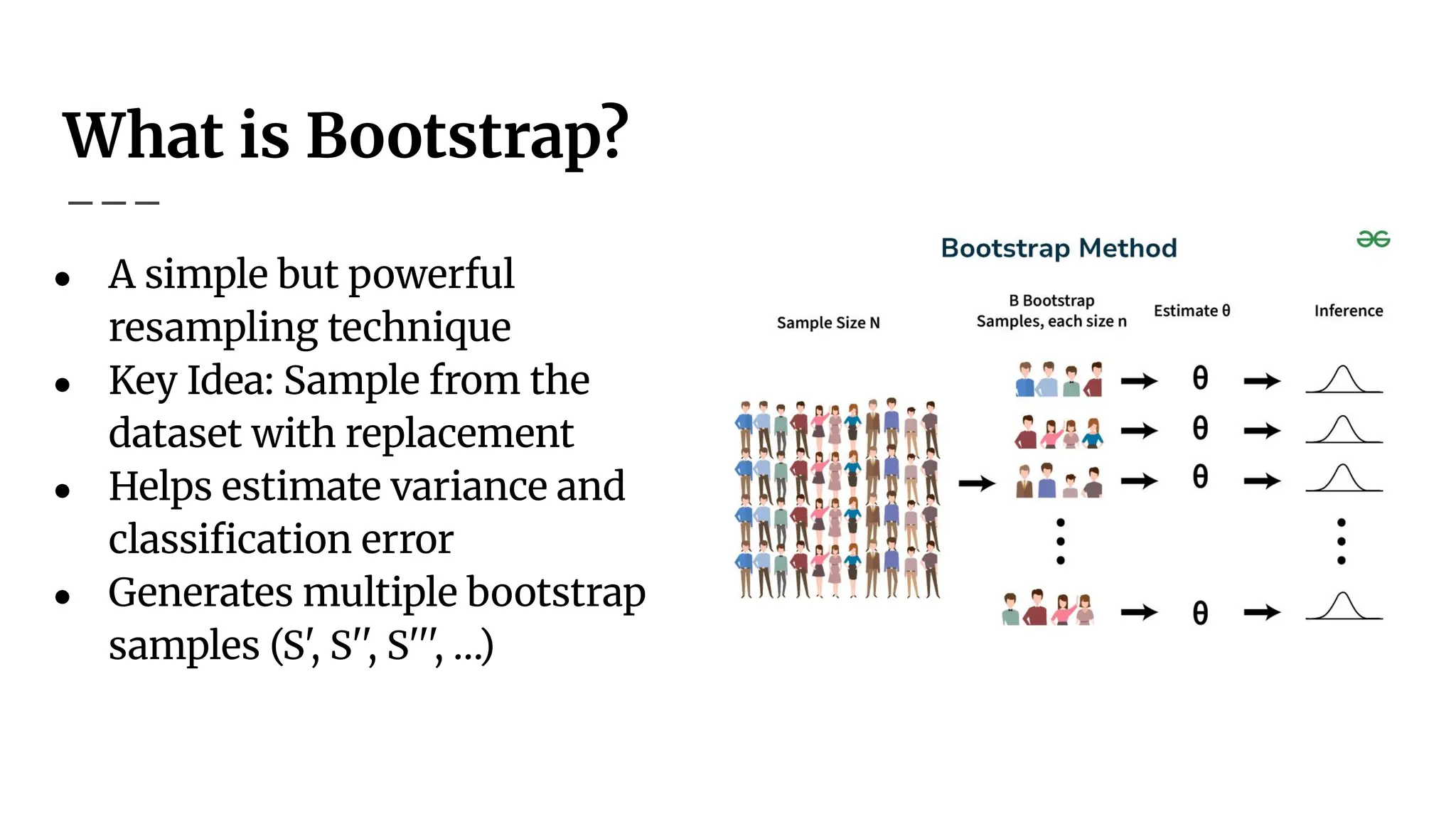
What is Bootstrap?
●A simple but powerful
resampling technique
● Key Idea: Sample from the
dataset with replacement
● Helps estimate variance and
classification error
● Generates multiple bootstrap
samples (S', S'', S''', …)
14.
Bootstrap Sampling Process
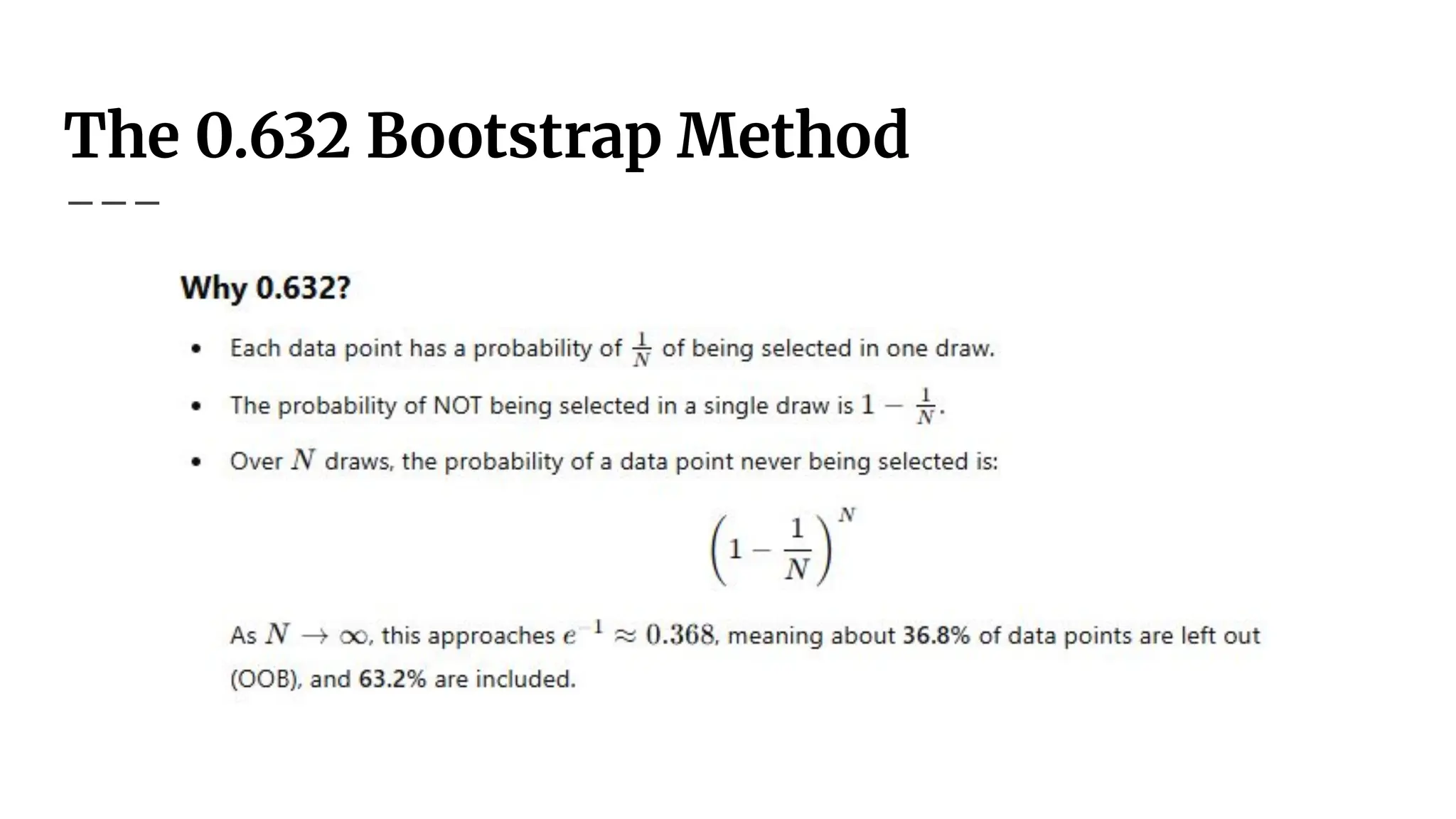
●Start with a dataset of size N
● Sample N elements with replacement → S'
● Repeat the process L times to create multiple bootstrap
samples
● Use S' for training, and the remaining data for testing
● Average the results → Bootstrap estimate
15.
Why Use Bootstrap?
●Reduces variance in error estimation
● Works well with large datasets
● Provides a better approximation of the underlying
distribution
● Used for performance estimation, variance reduction, and
parameter estimation
16.
Bootstrap Error Estimation
●Train on S', test on S - S'
● Repeat for multiple bootstrap samples
● Take the average error estimate
● Lower variance compared to random train-test splits
17.
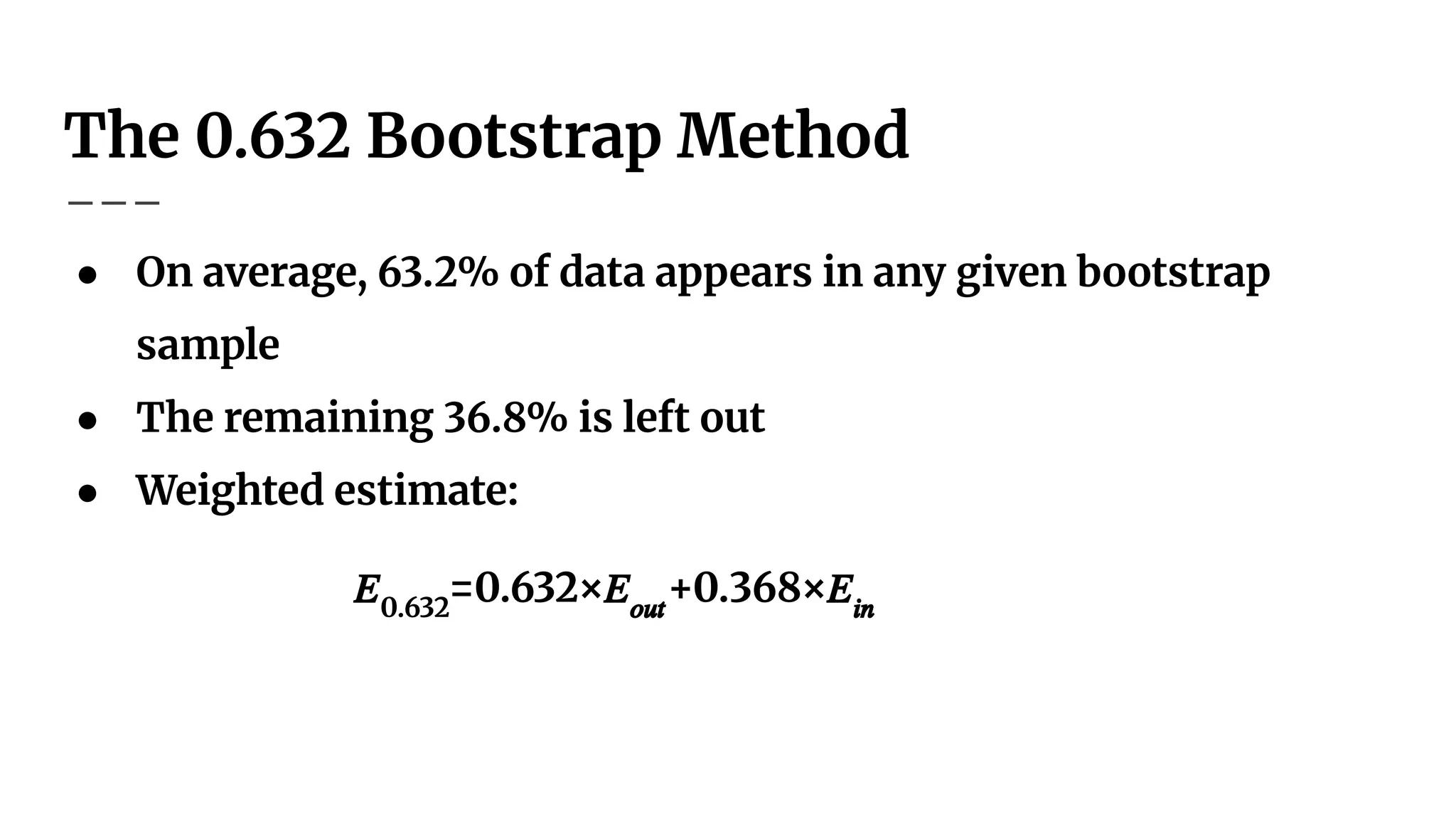
The 0.632 BootstrapMethod
● On average, 63.2% of data appears in any given bootstrap
sample
● The remaining 36.8% is left out
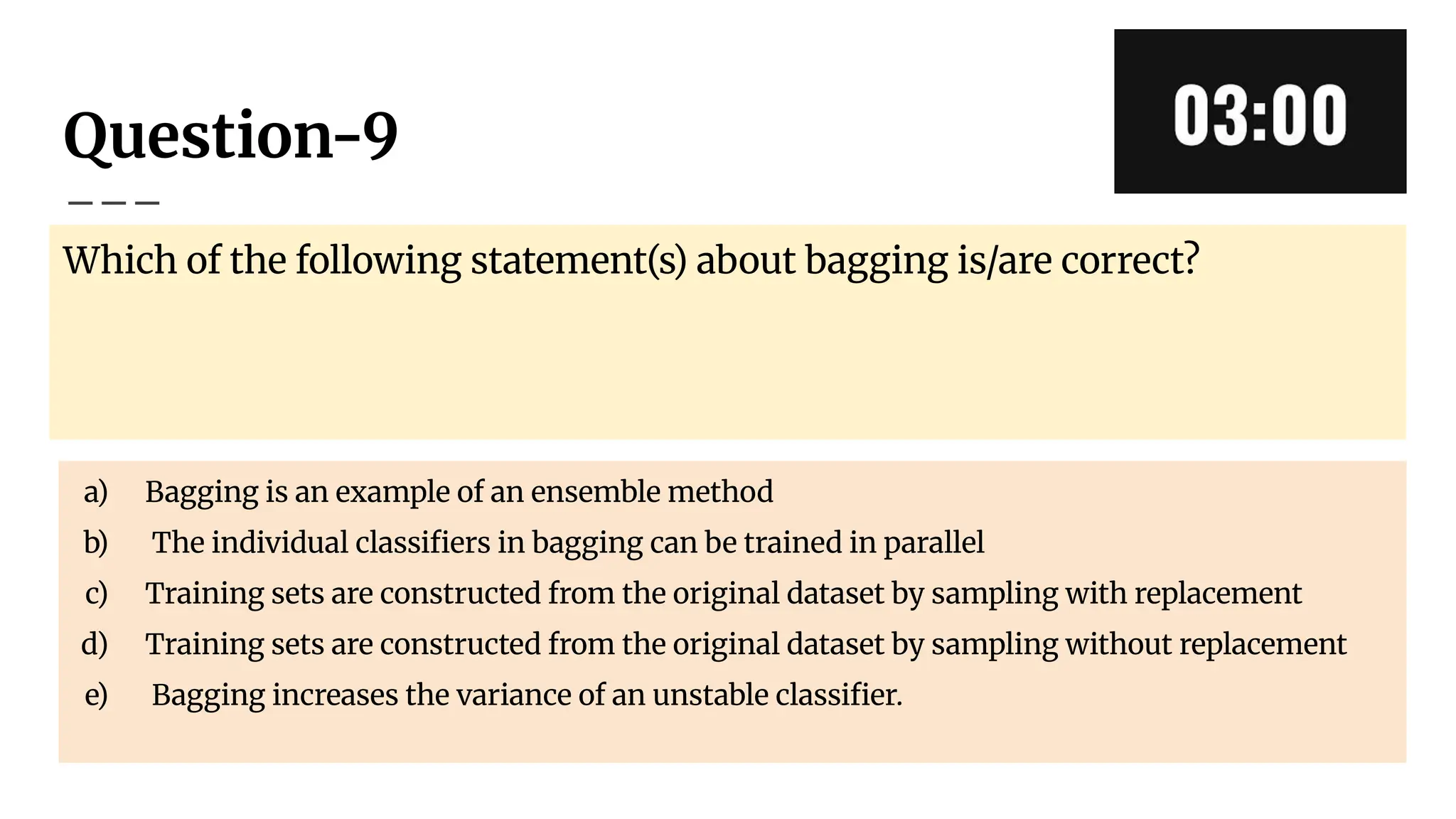
● Weighted estimate:
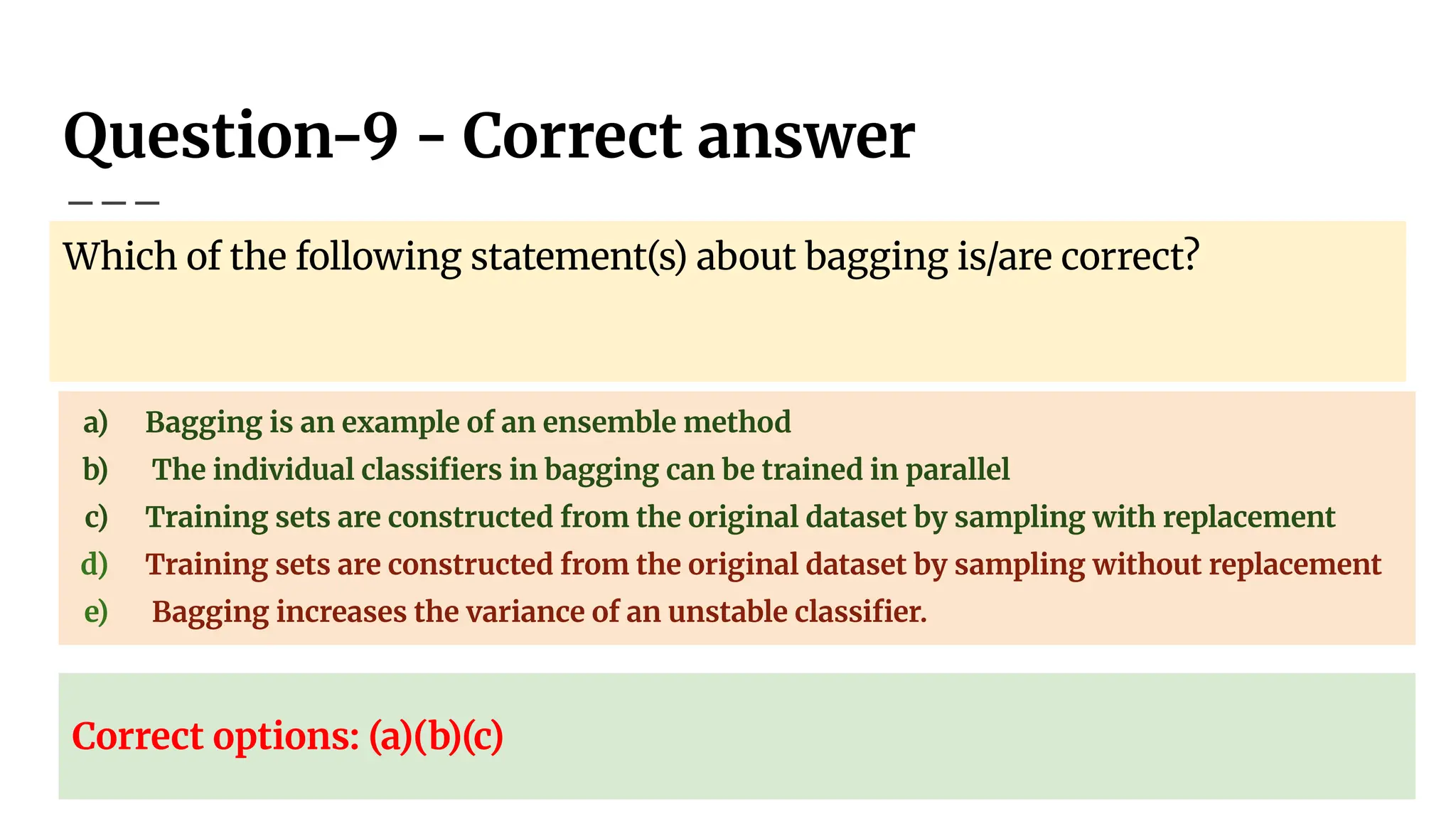
𝐸0.632
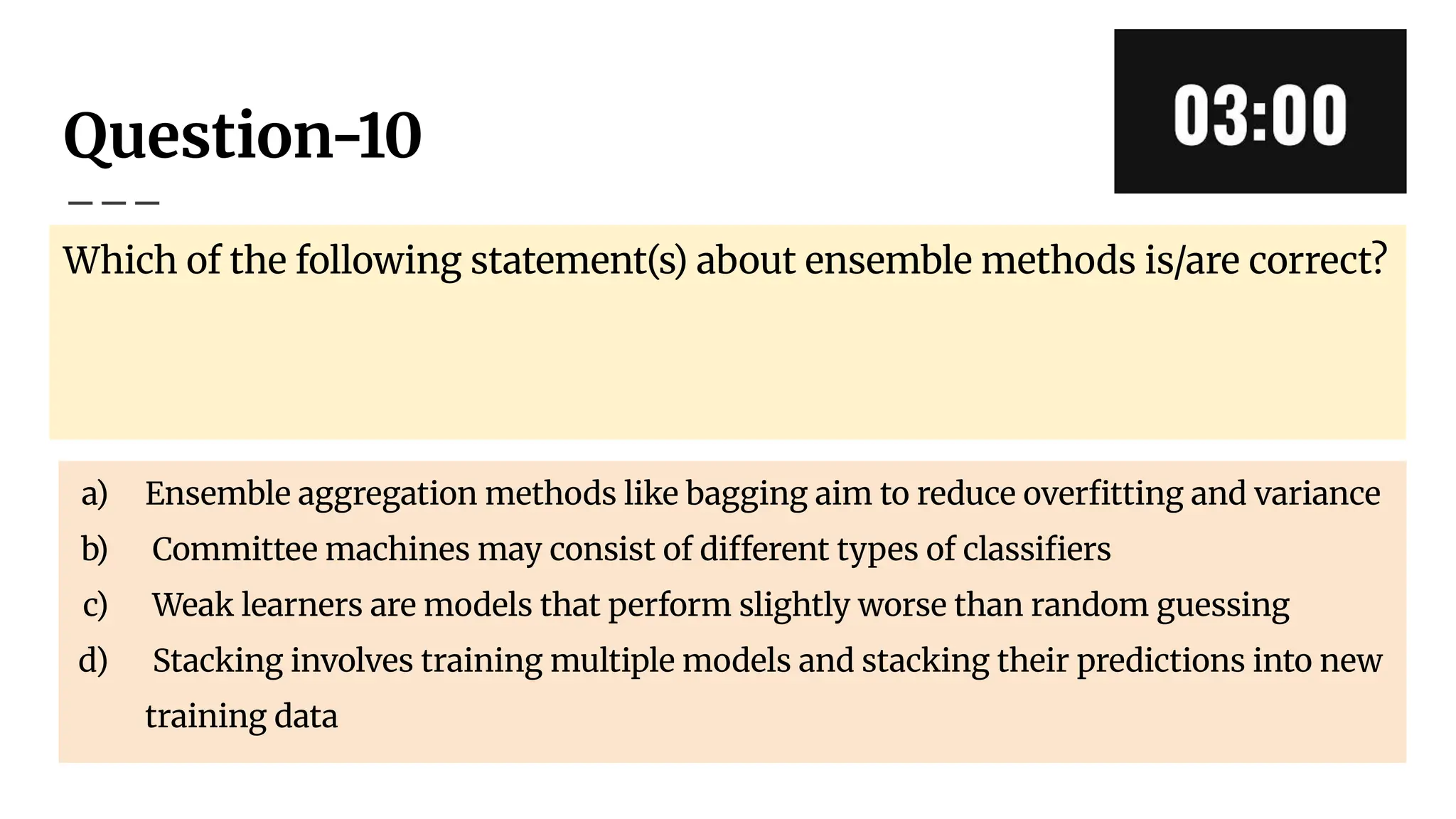
=0.632×𝐸𝑜𝑢𝑡
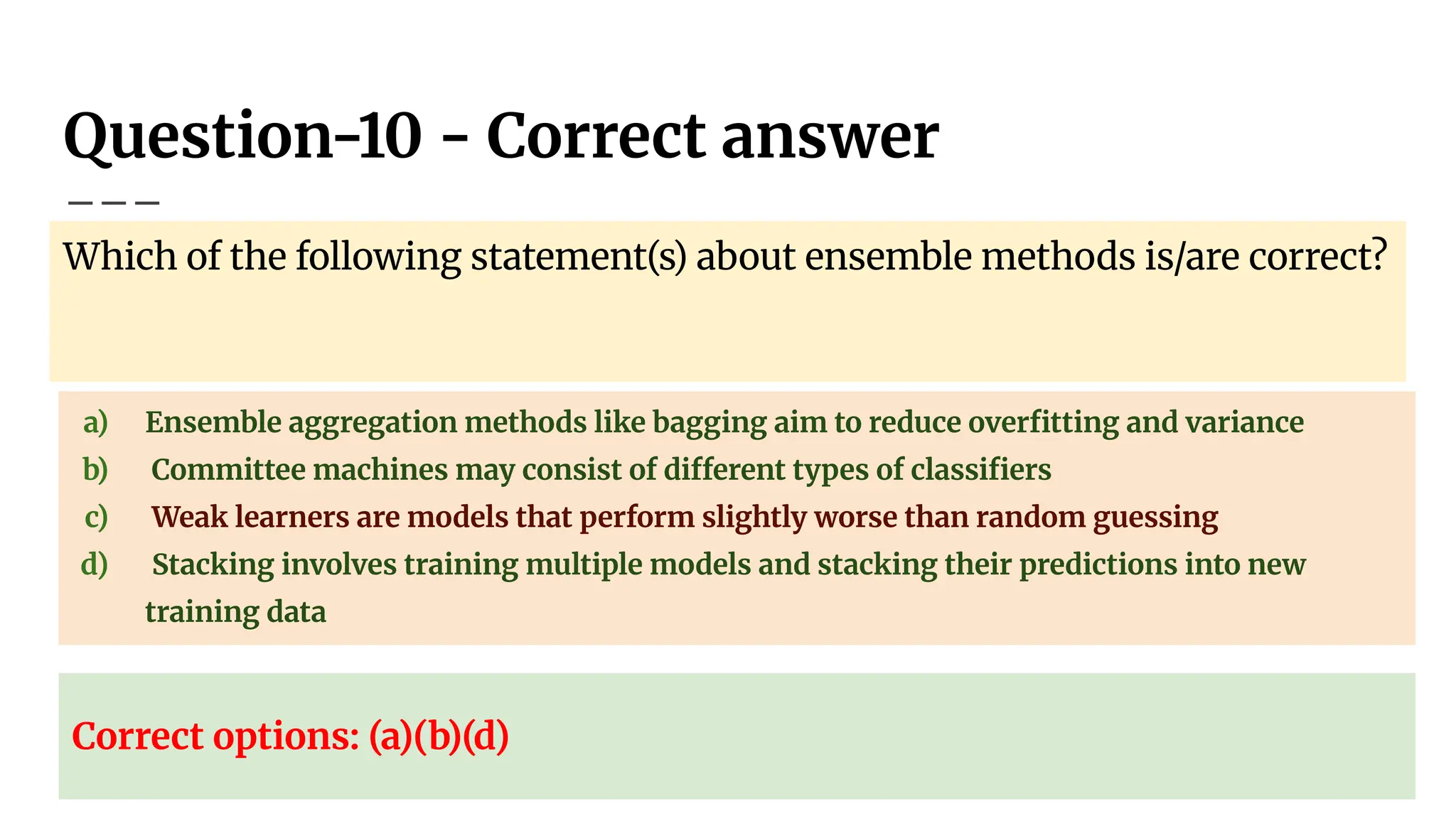
+0.368×𝐸𝑖𝑛
What is Cross-Validation?
●A method to evaluate model performance
● Used when data is limited
● K-Fold Cross-Validation:
○ Split data into K equal parts
○ Train on K-1 parts, test on the remaining 1 part
○ Repeat for all K parts and average results
20.
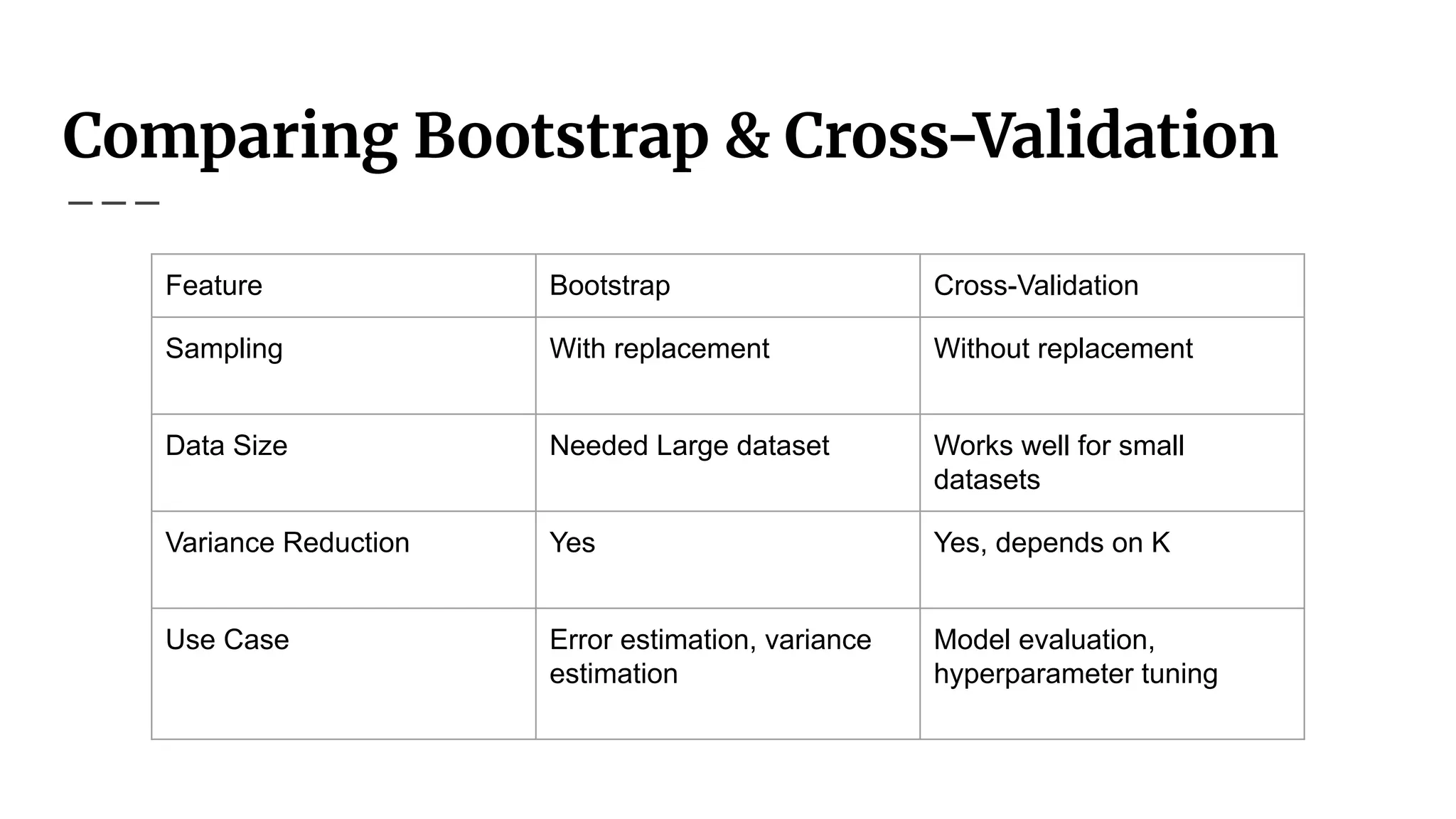
Comparing Bootstrap &Cross-Validation
Feature Bootstrap Cross-Validation
Sampling With replacement Without replacement
Data Size Needed Large dataset Works well for small
datasets
Variance Reduction Yes Yes, depends on K
Use Case Error estimation, variance
estimation
Model evaluation,
hyperparameter tuning
21.
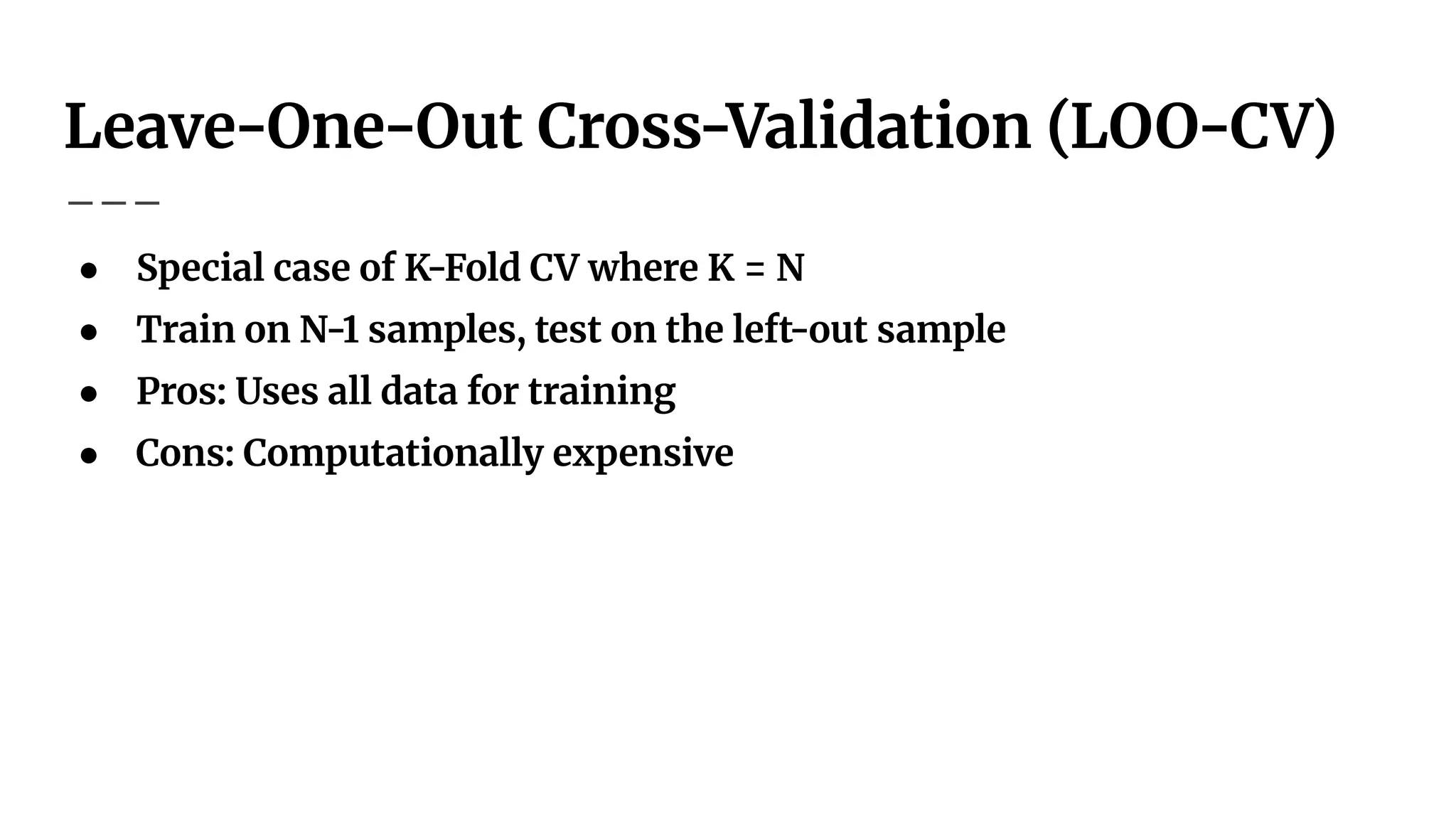
Leave-One-Out Cross-Validation (LOO-CV)
●Special case of K-Fold CV where K = N
● Train on N-1 samples, test on the left-out sample
● Pros: Uses all data for training
● Cons: Computationally expensive
22.
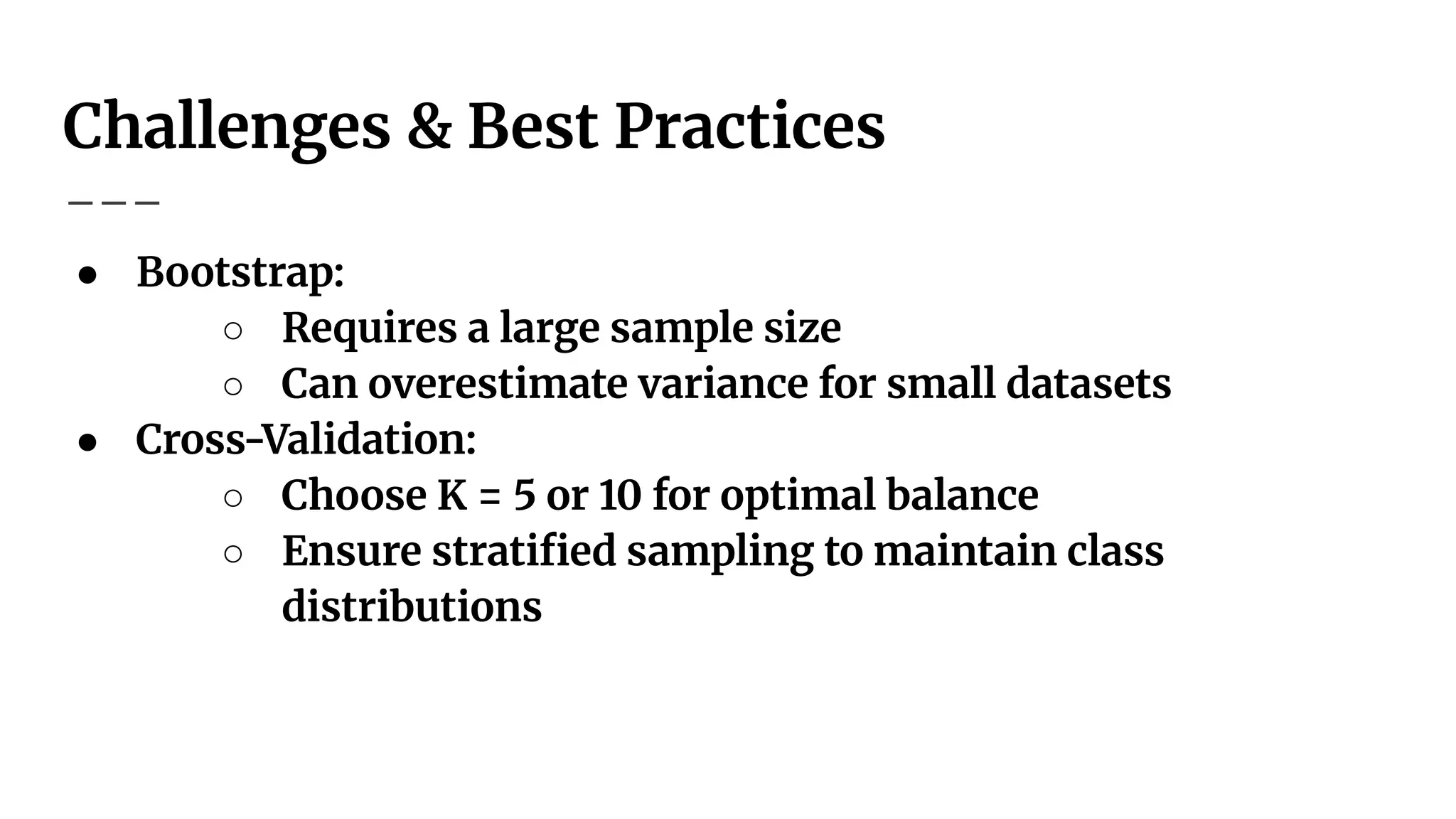
Challenges & BestPractices
● Bootstrap:
○ Requires a large sample size
○ Can overestimate variance for small datasets
● Cross-Validation:
○ Choose K = 5 or 10 for optimal balance
○ Ensure stratified sampling to maintain class
distributions
23.
2-Class Evaluation Measures
●Classification is a fundamental task in machine learning.
● We focus on two-class (binary) classification problems.
● Many multiclass metrics are extensions of these.
24.
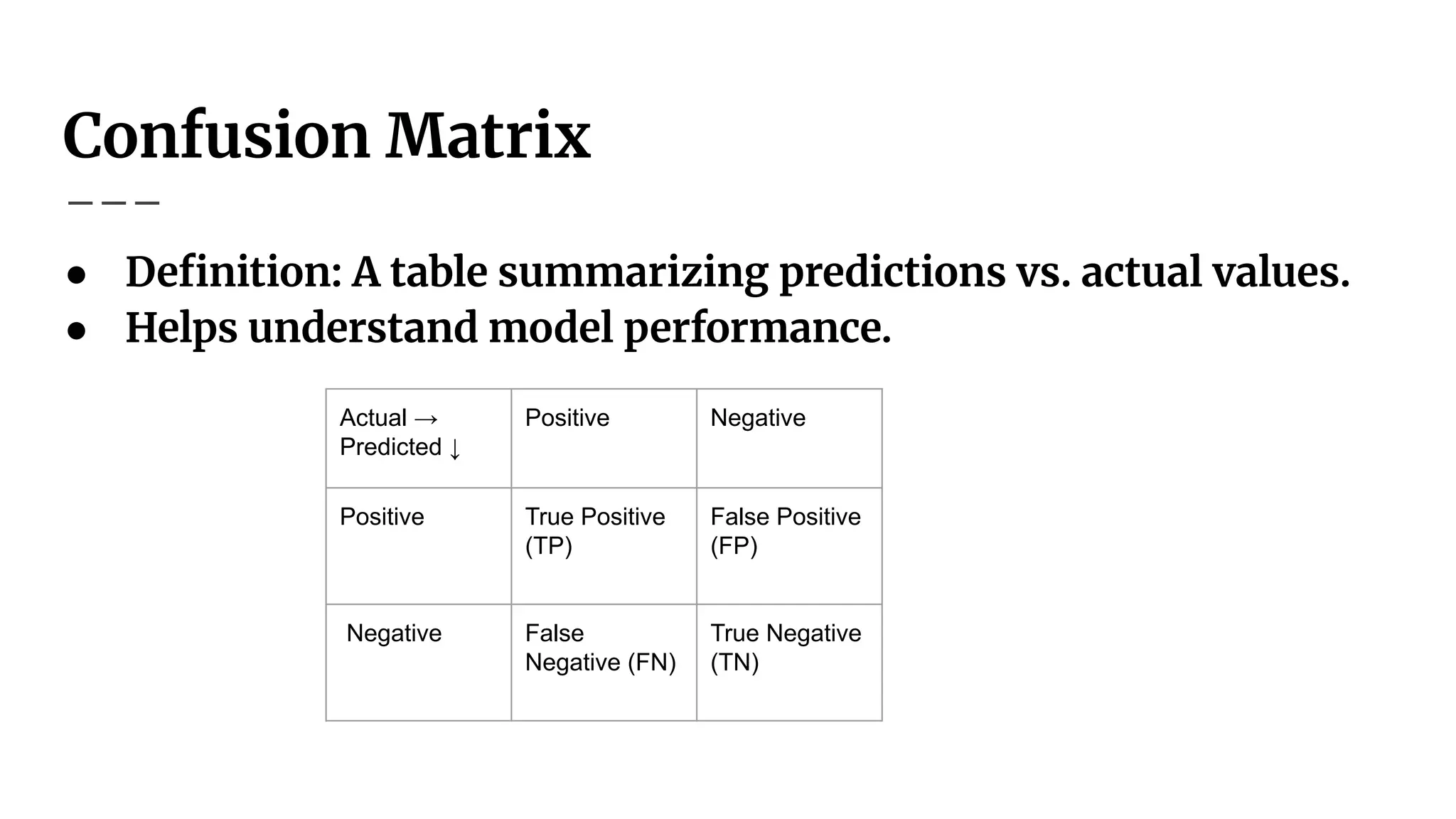
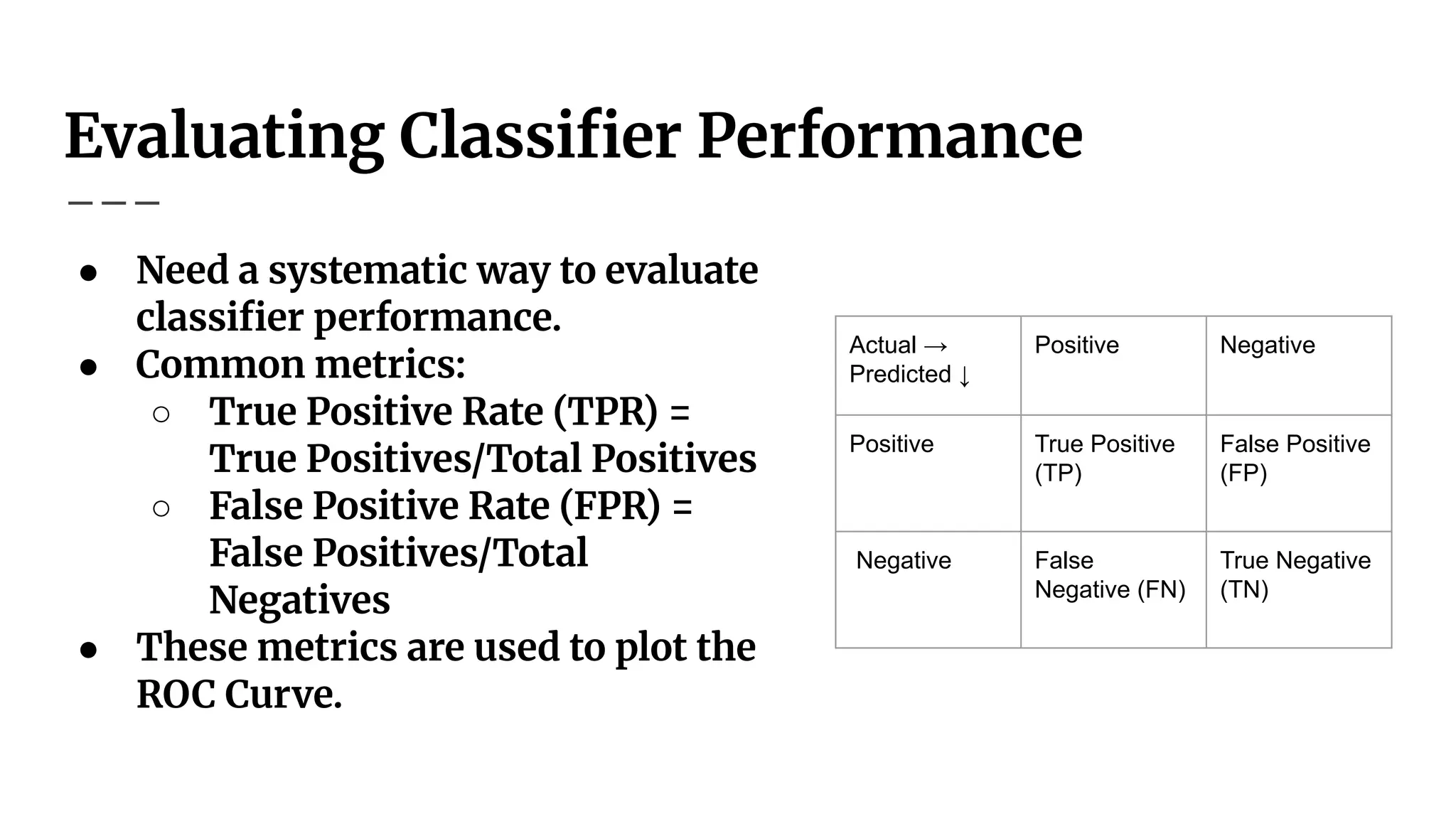
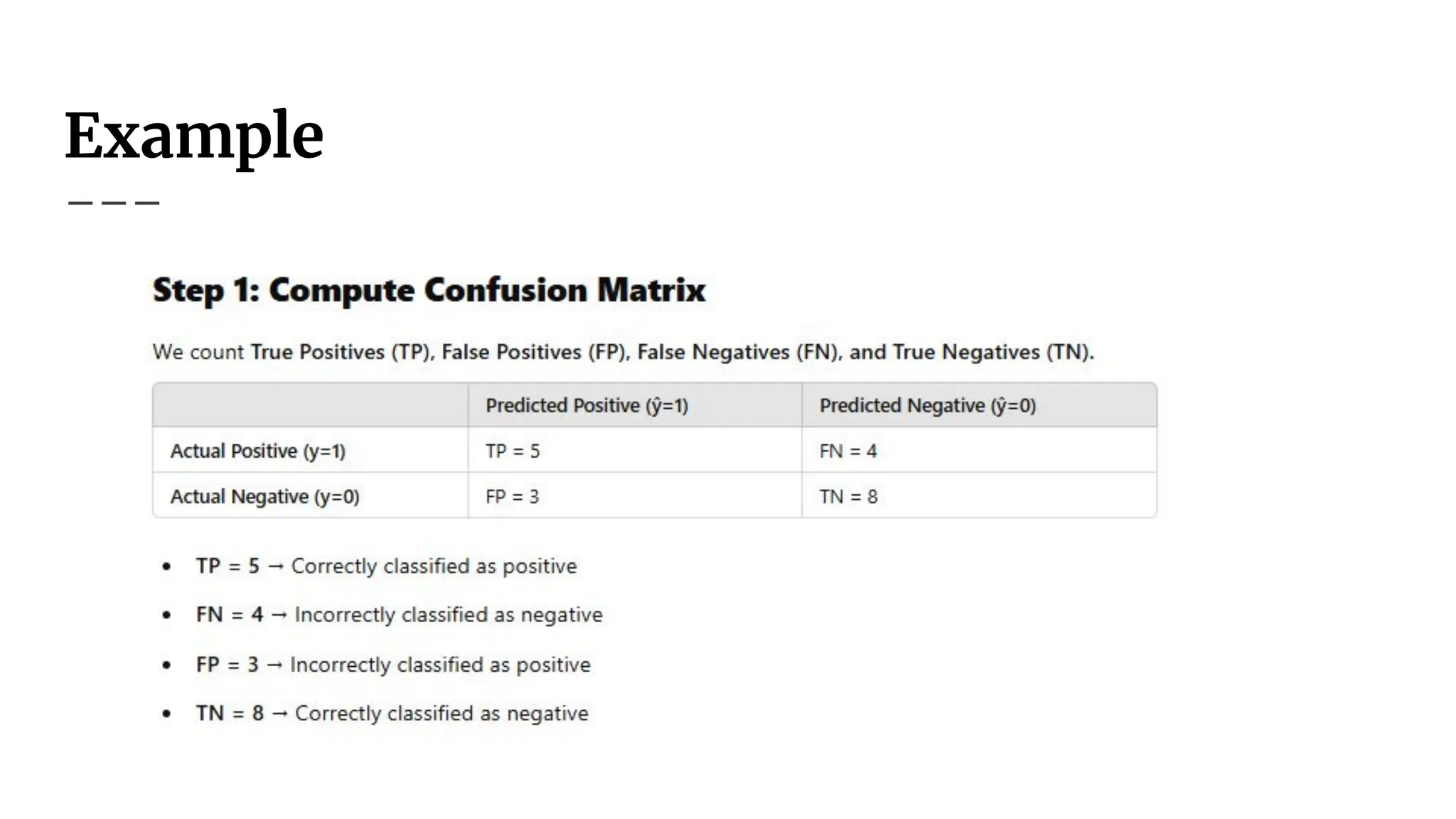
Confusion Matrix
● Definition:A table summarizing predictions vs. actual values.
● Helps understand model performance.
Actual →
Predicted ↓
Positive Negative
Positive True Positive
(TP)
False Positive
(FP)
Negative False
Negative (FN)
True Negative
(TN)
25.
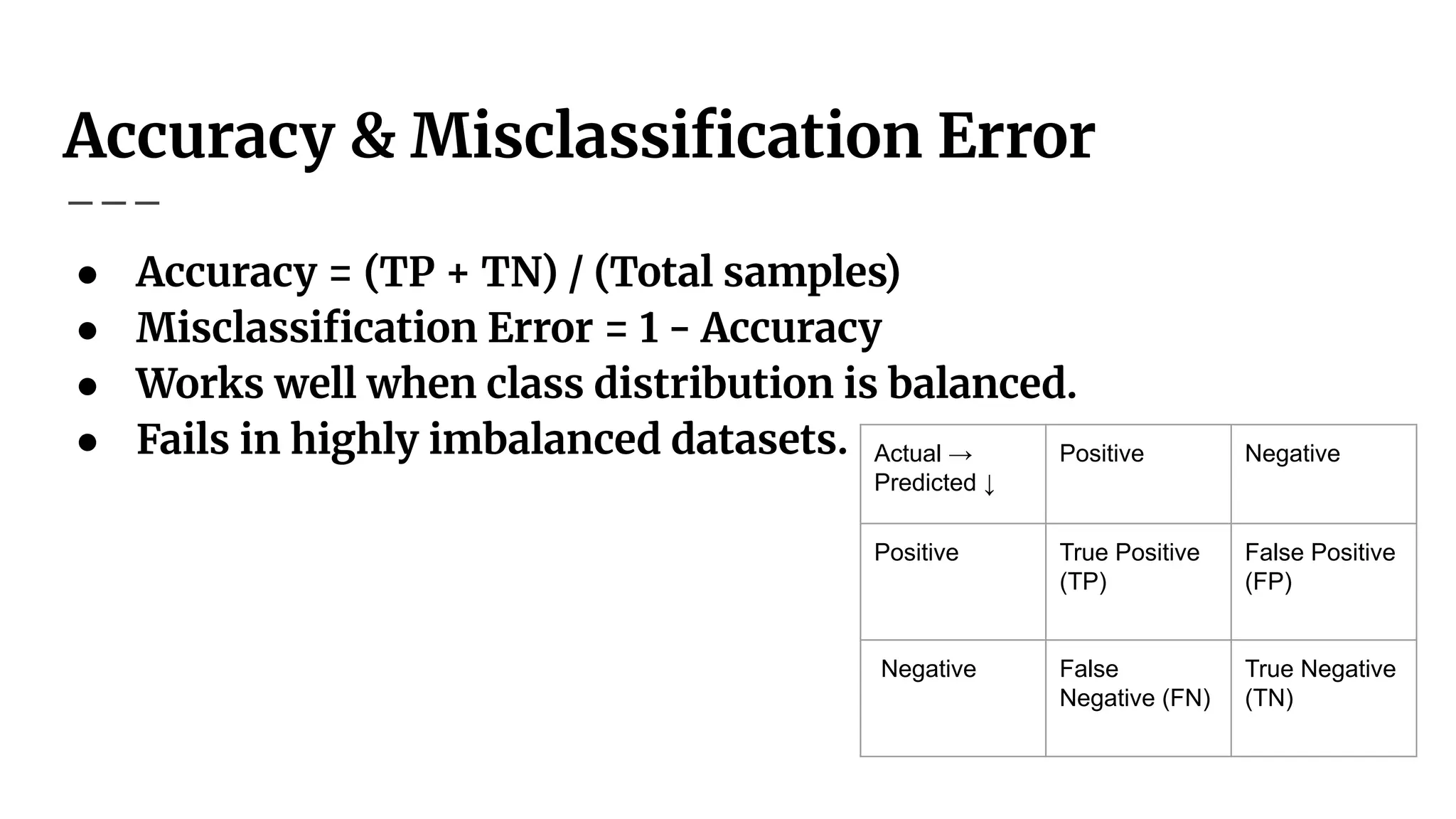
Accuracy & MisclassificationError
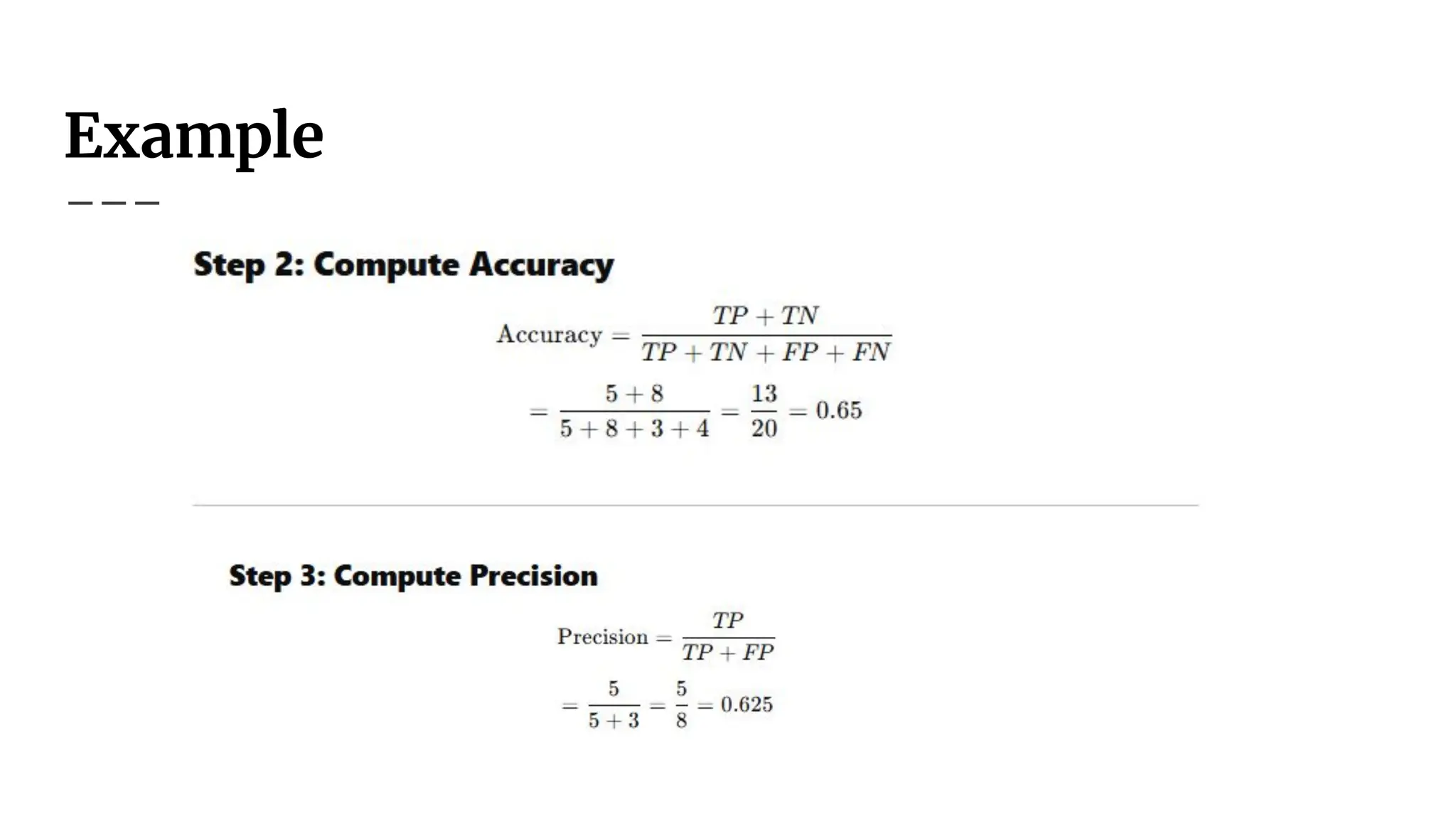
● Accuracy = (TP + TN) / (Total samples)
● Misclassification Error = 1 - Accuracy
● Works well when class distribution is balanced.
● Fails in highly imbalanced datasets. Actual →
Predicted ↓
Positive Negative
Positive True Positive
(TP)
False Positive
(FP)
Negative False
Negative (FN)
True Negative
(TN)
26.
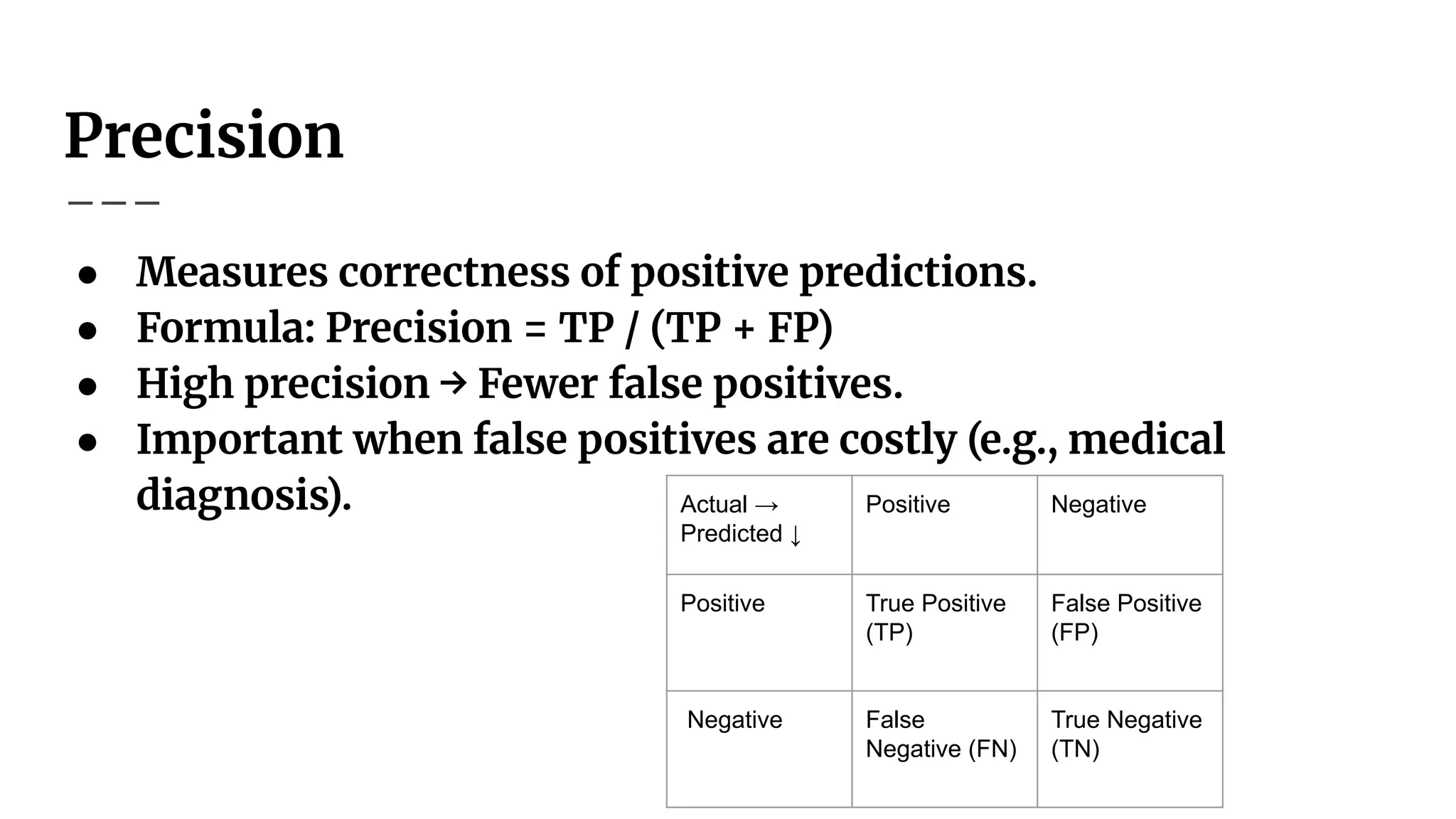
Precision
● Measures correctnessof positive predictions.
● Formula: Precision = TP / (TP + FP)
● High precision → Fewer false positives.
● Important when false positives are costly (e.g., medical
diagnosis). Actual →
Predicted ↓
Positive Negative
Positive True Positive
(TP)
False Positive
(FP)
Negative False
Negative (FN)
True Negative
(TN)
27.
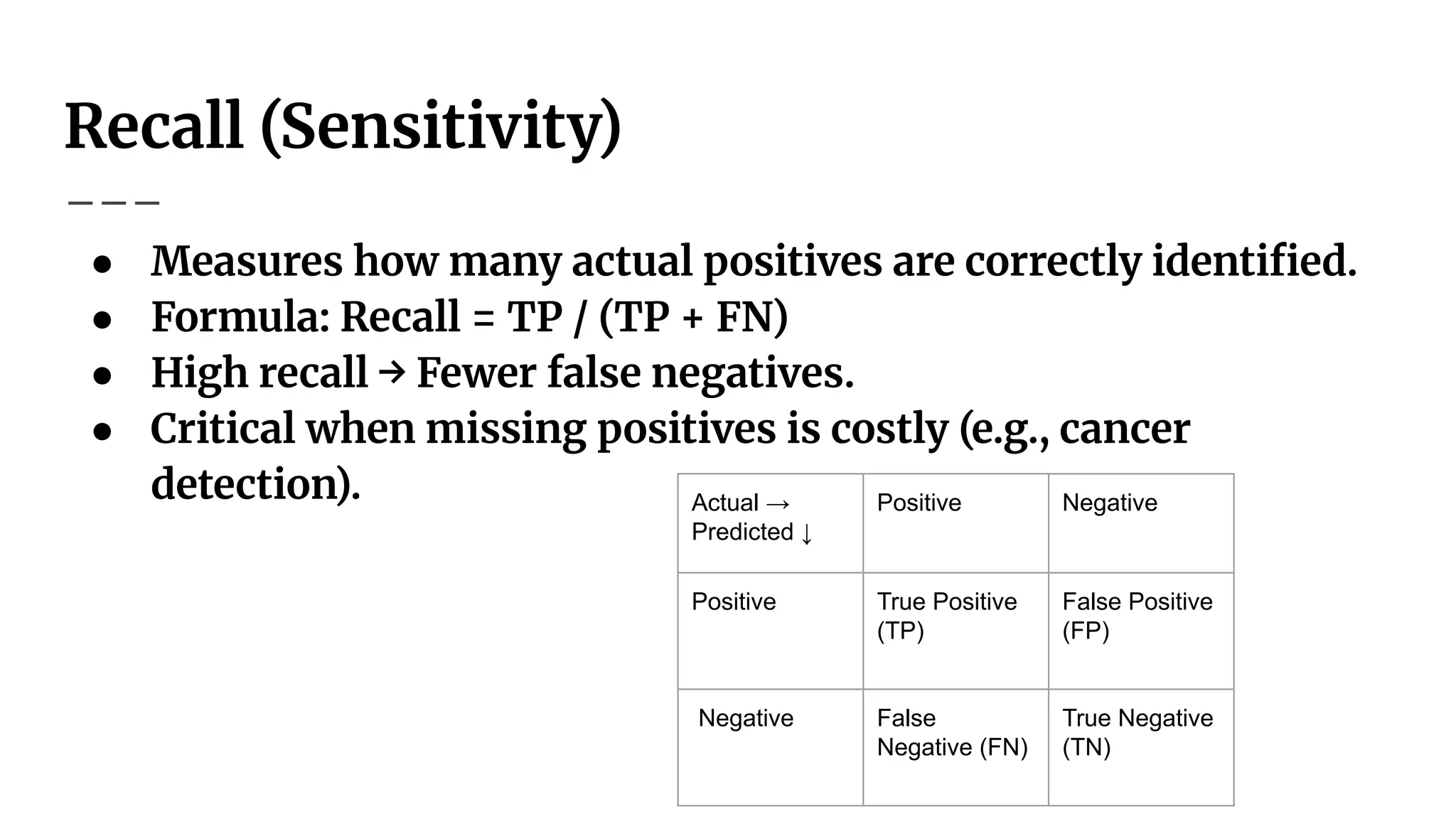
Recall (Sensitivity)
● Measureshow many actual positives are correctly identified.
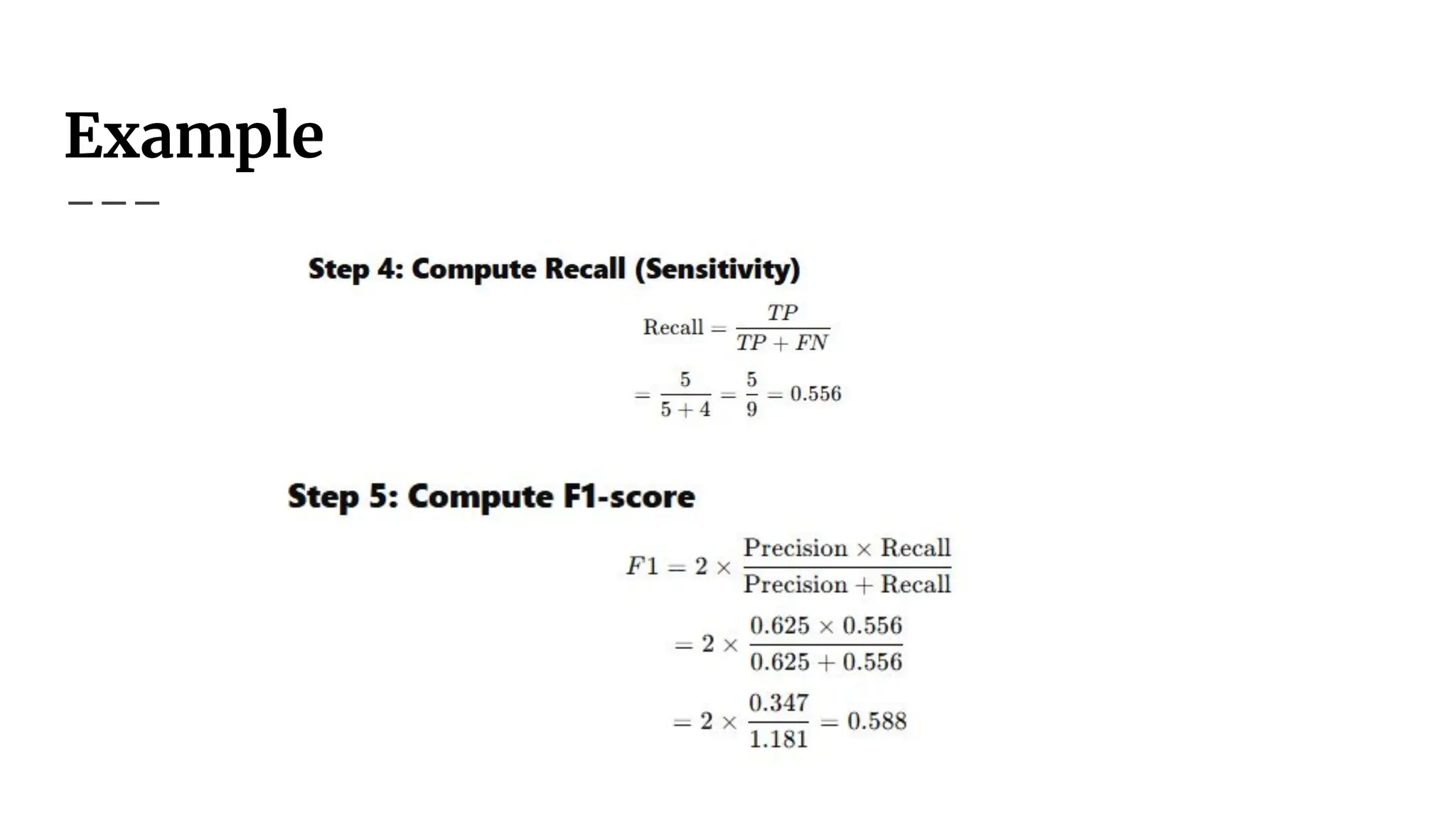
● Formula: Recall = TP / (TP + FN)
● High recall → Fewer false negatives.
● Critical when missing positives is costly (e.g., cancer
detection). Actual →
Predicted ↓
Positive Negative
Positive True Positive
(TP)
False Positive
(FP)
Negative False
Negative (FN)
True Negative
(TN)
F1-Score (Harmonic Meanof Precision & Recall)
● Formula: F1 = 2 × (Precision × Recall) / (Precision + Recall)
● Balances precision and recall.
● Useful for imbalanced datasets.
30.
Why Accuracy Failsin Imbalanced Data
● Example: 99% negative class, 1% positive class.
● Predicting all negatives → 99% accuracy but useless model.
● Use precision, recall, and F1-score instead.
31.
Summary
Confusion Matrix: Coreperformance table.
Accuracy: Good for balanced classes.
Precision & Recall: Useful for imbalanced classes.
F1-Score: Tradeoff metric.
Choose the right metric for your application!
32.
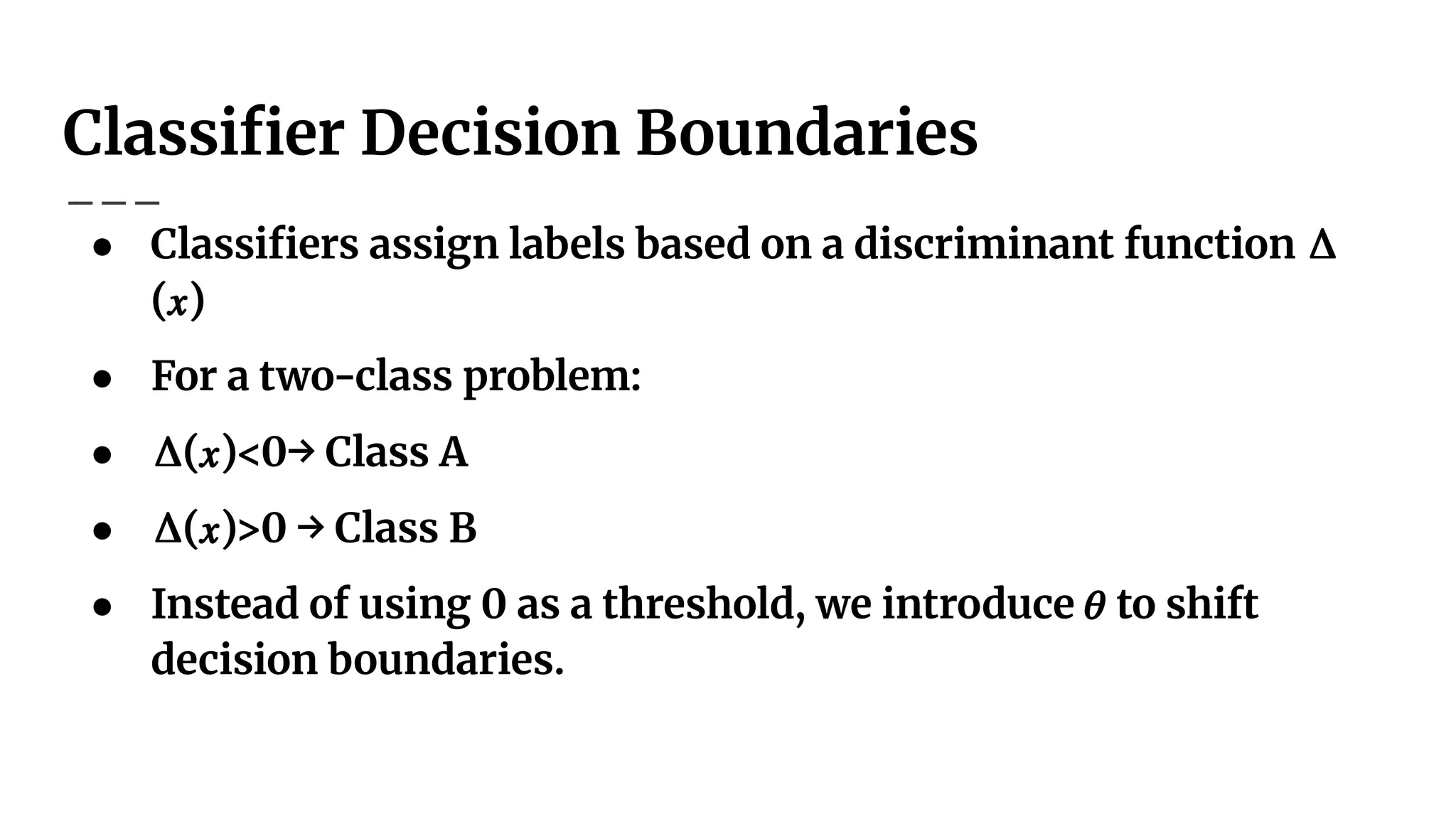
Classifier Decision Boundaries
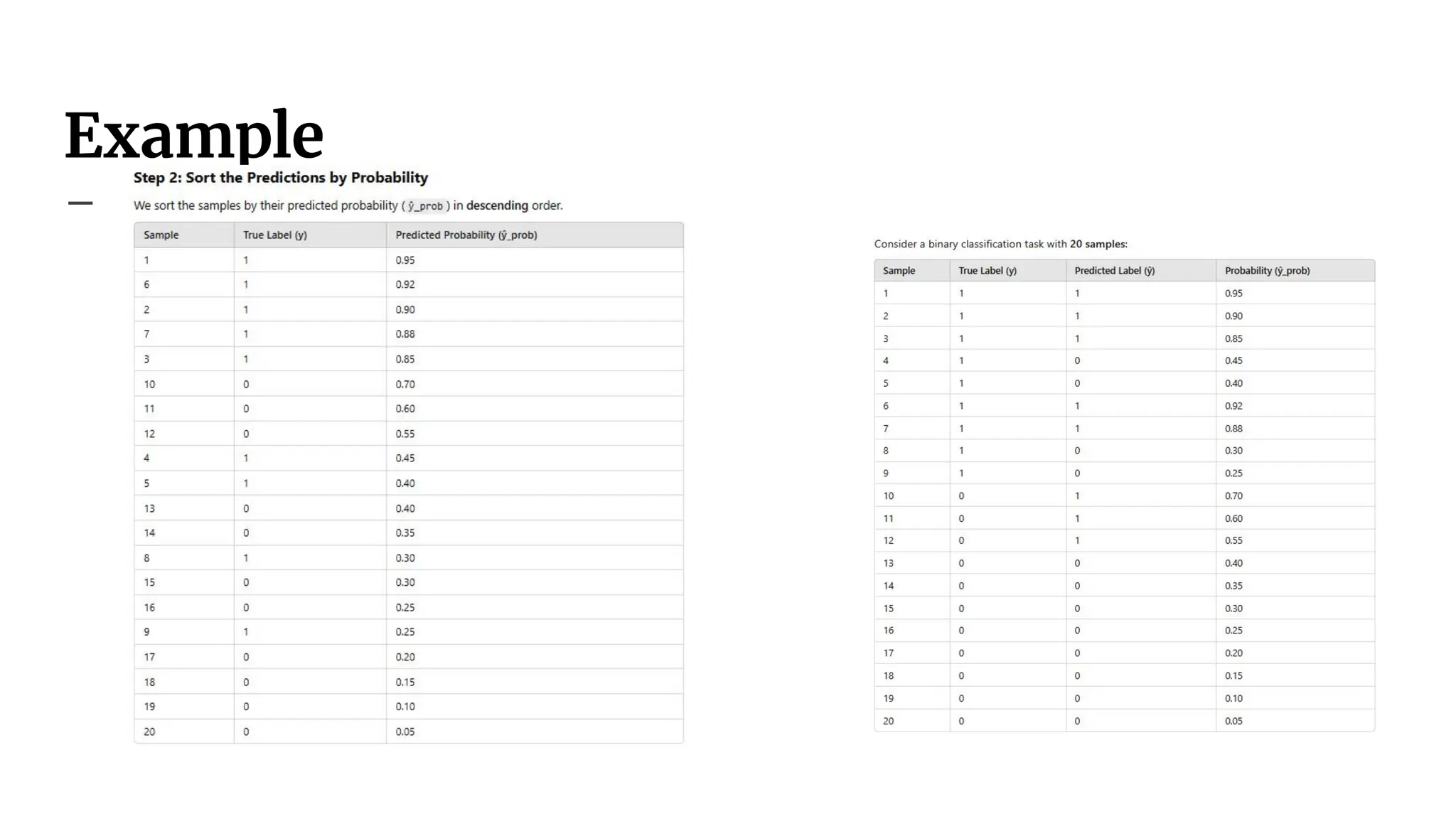
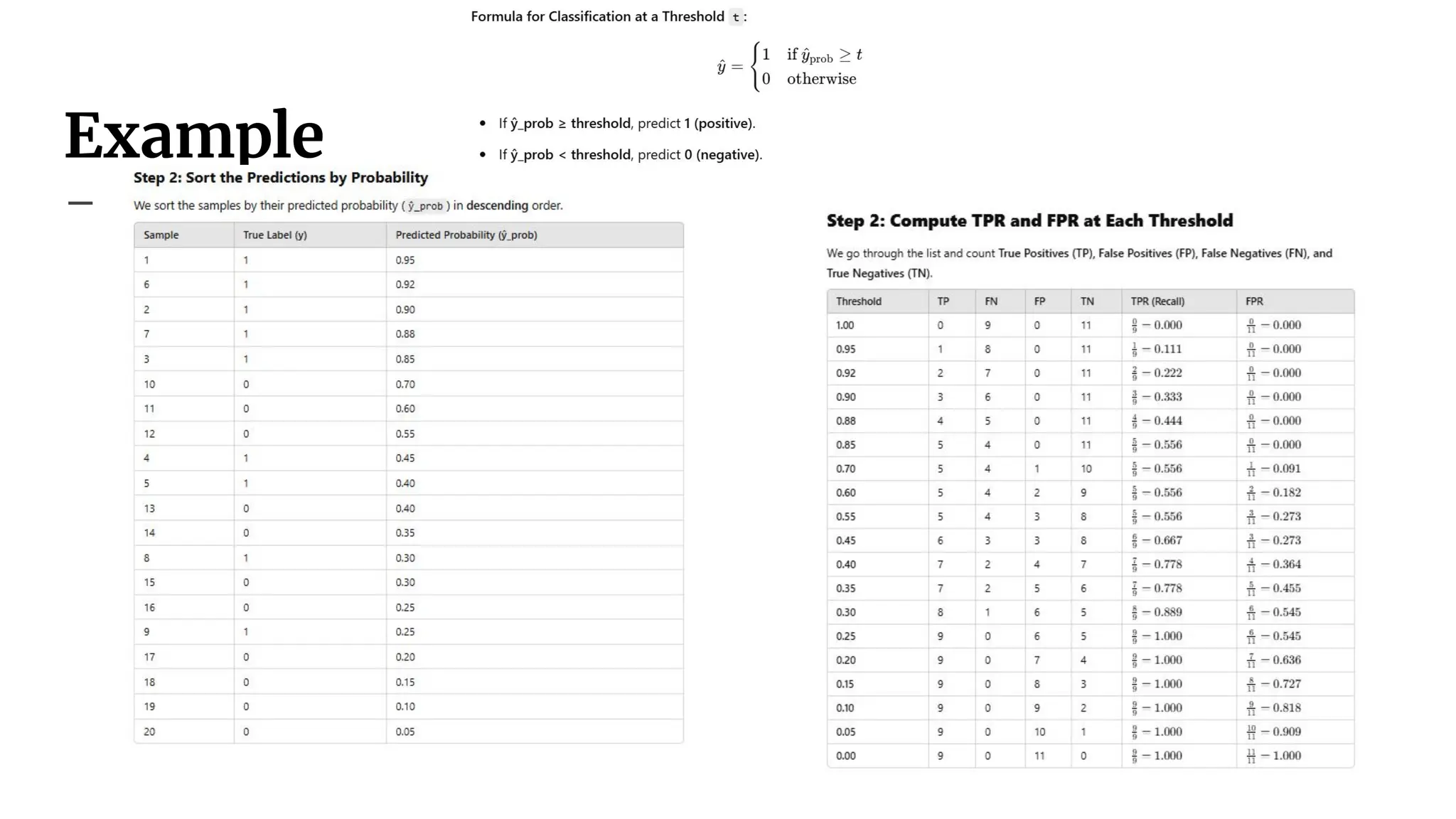
●Classifiers assign labels based on a discriminant function Δ
(𝑥)
● For a two-class problem:
● Δ(𝑥)<0→ Class A
● Δ(𝑥)>0 → Class B
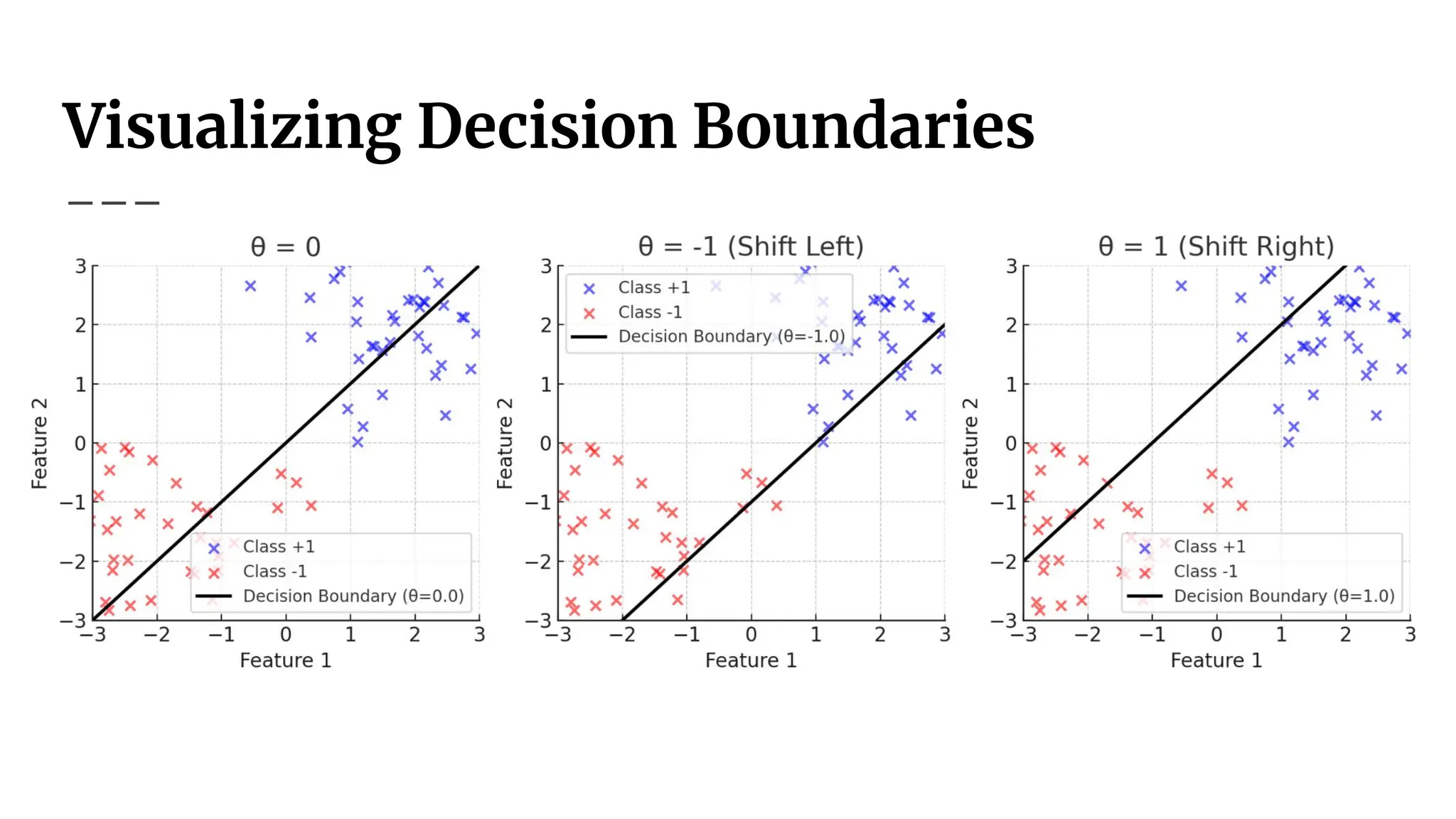
● Instead of using 0 as a threshold, we introduce 𝜃 to shift
decision boundaries.
33.
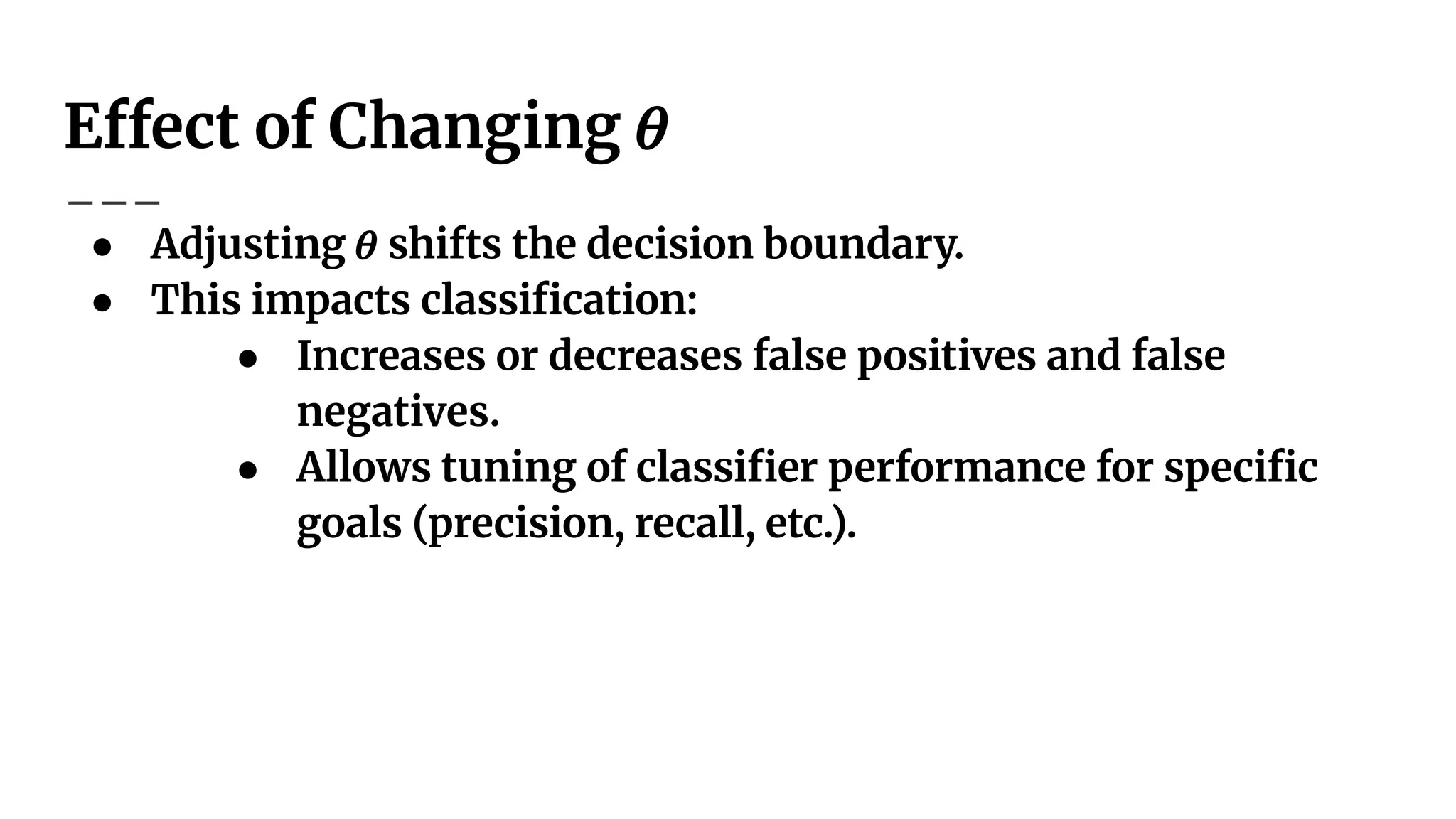
Effect of Changing𝜃
● Adjusting 𝜃 shifts the decision boundary.
● This impacts classification:
● Increases or decreases false positives and false
negatives.
● Allows tuning of classifier performance for specific
goals (precision, recall, etc.).
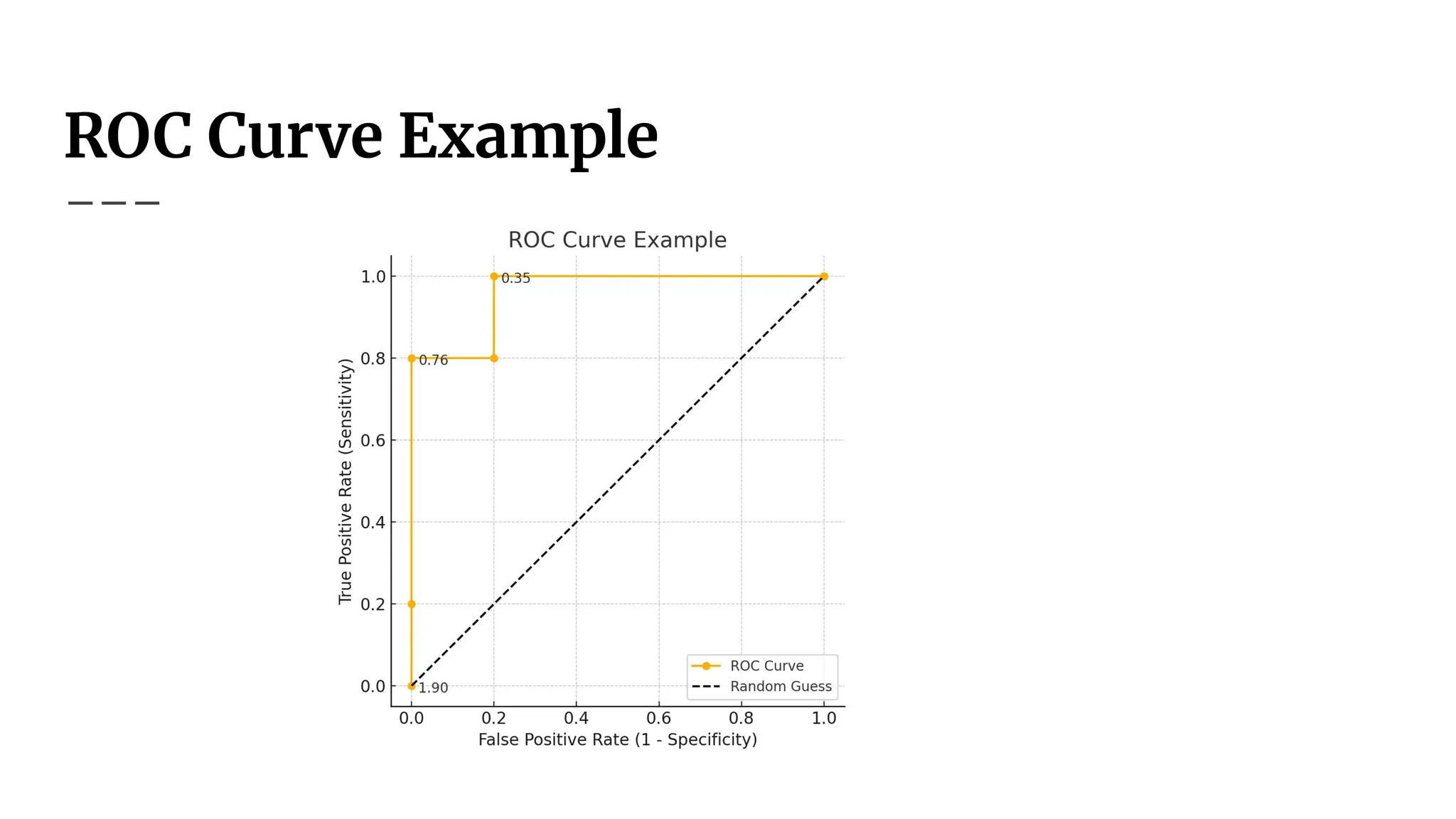
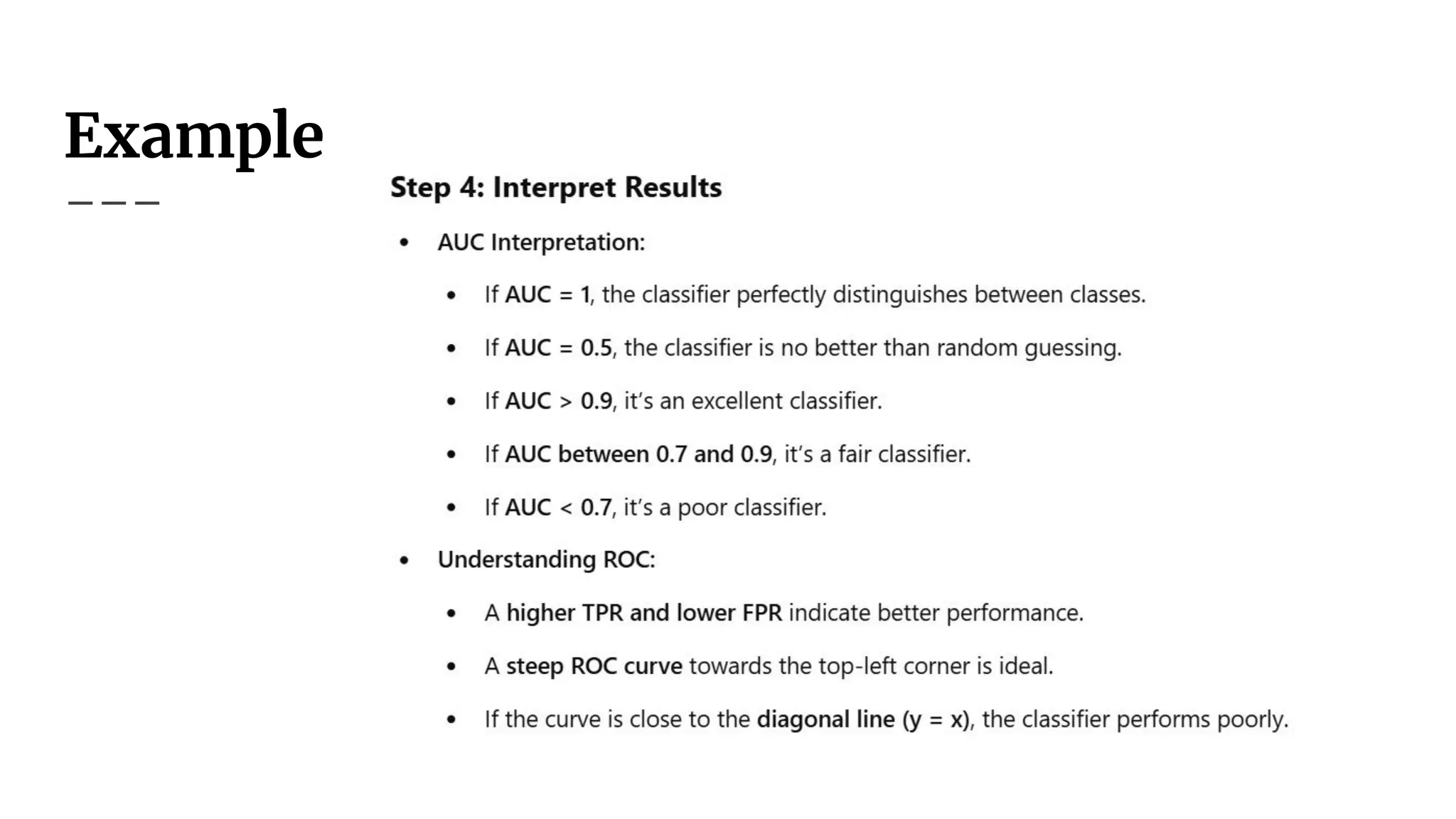
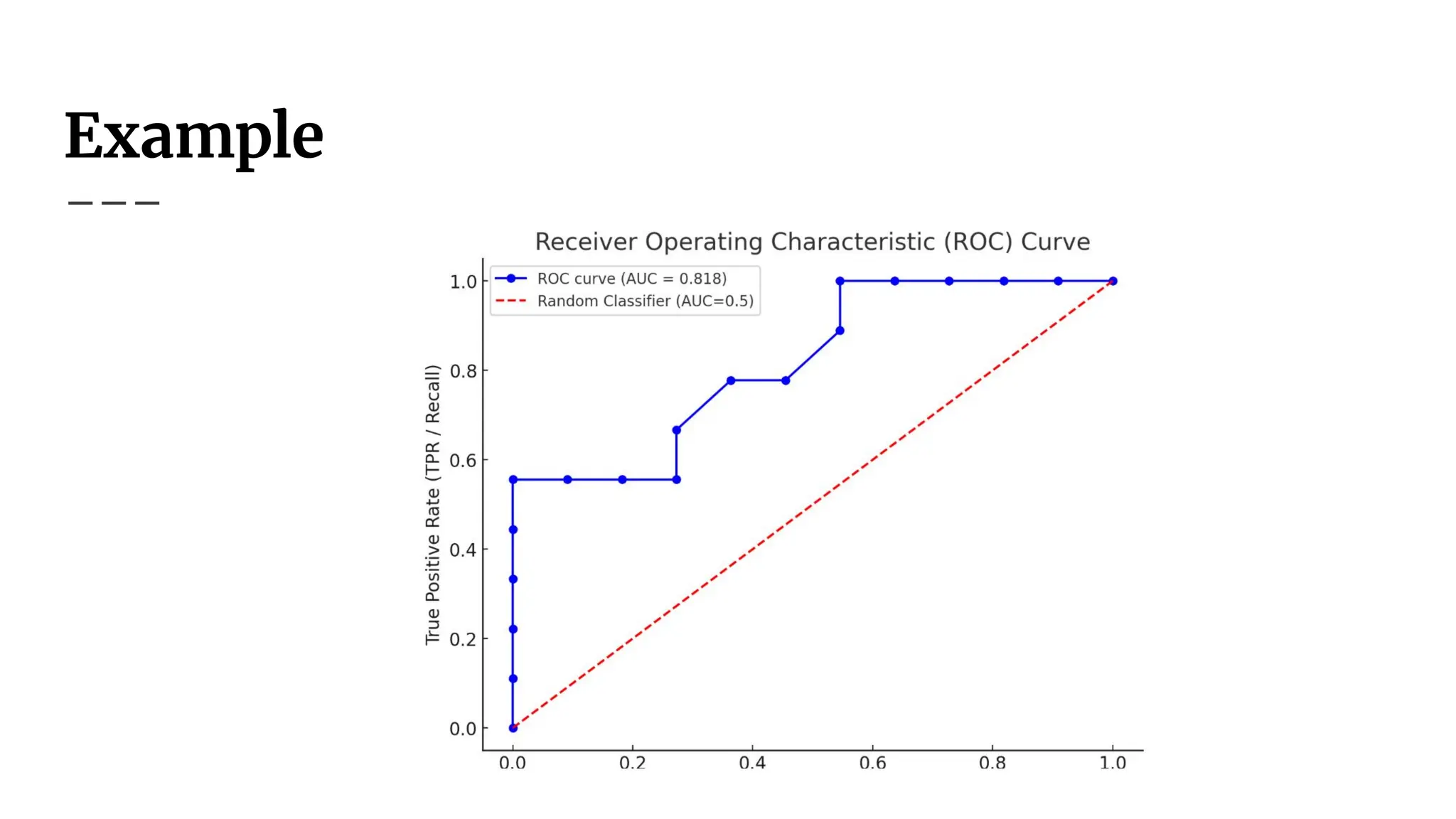
Interpreting the ROCCurve
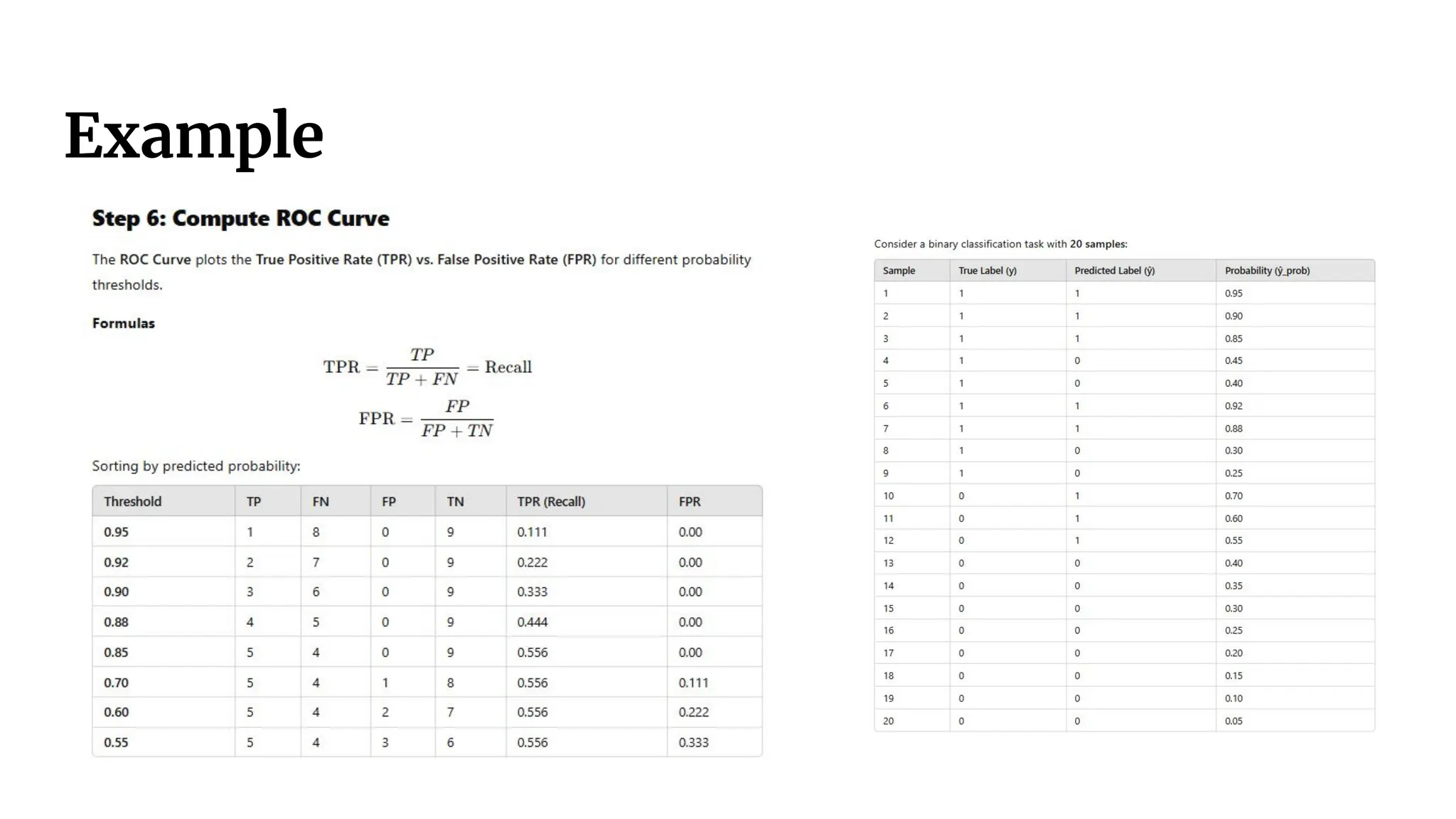
● Ideal classifier: Steep rise towards (0,1), then flattens.
● Random classifier: Diagonal line (random guessing).
● Higher ROC curve = better classifier.
● ROC curves help choose optimal decision thresholds.
39.
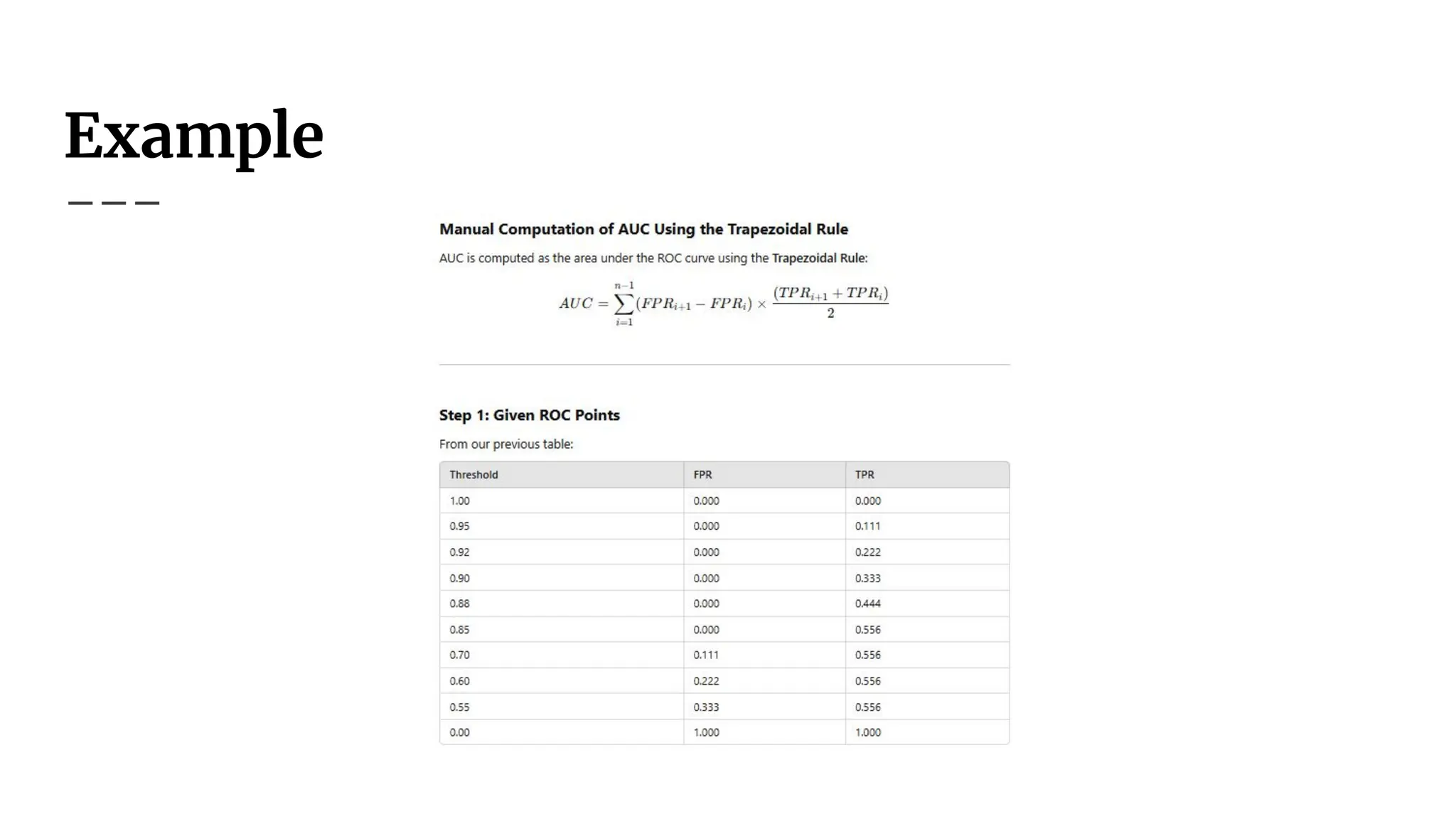
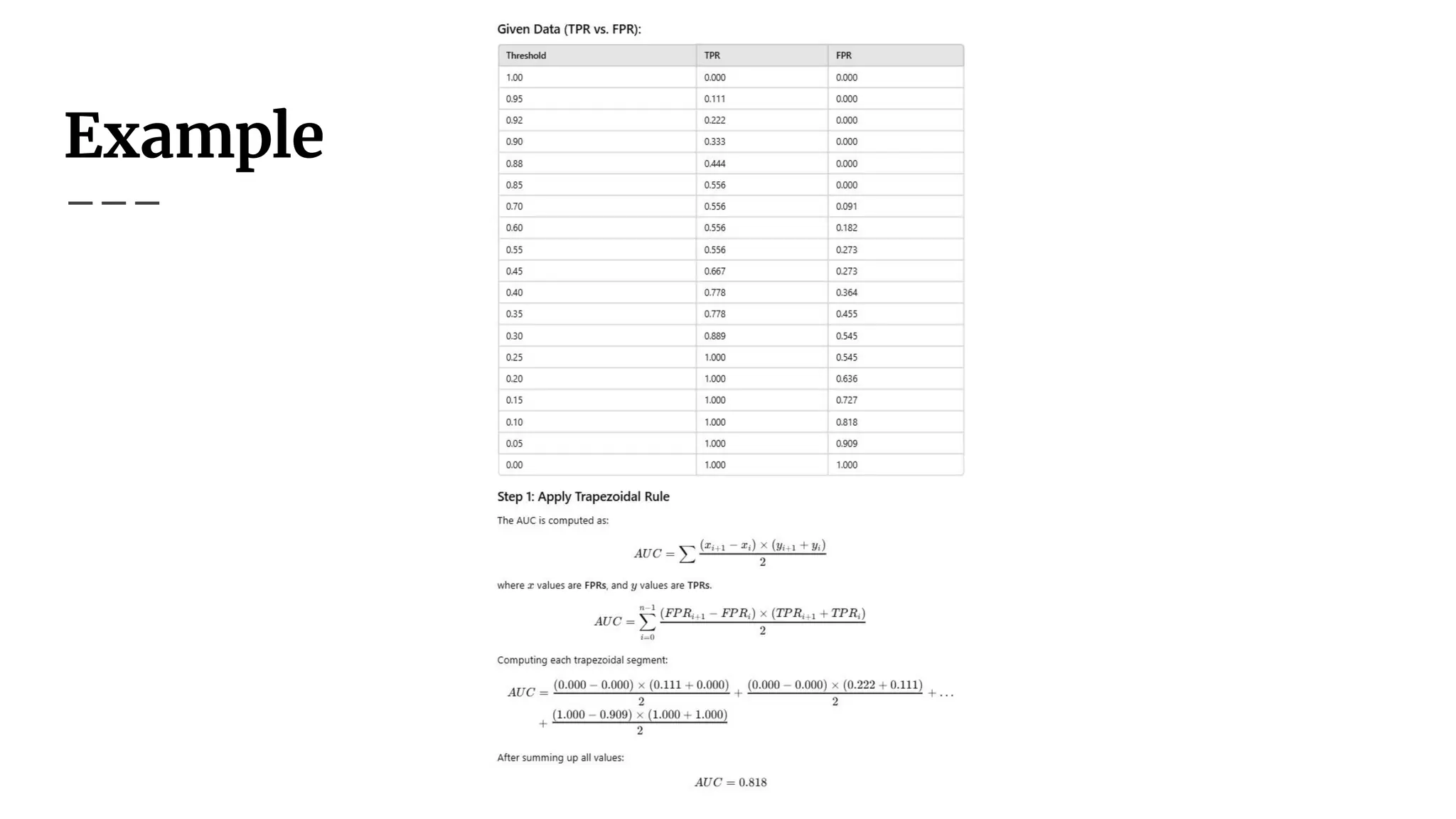
Area Under Curve(AUC)
● AUC (Area Under the Curve) quantifies classifier
performance.
● Ranges from 0.5 (random) to 1.0 (perfect).
● Higher AUC = better classifier performance.
40.
Practical Use ofROC & AUC
● ROC and AUC help compare multiple classifiers.
● Used in medical diagnosis, fraud detection, image
classification, etc.
● Key takeaway: Choose the right threshold 𝜃 based on
application needs.
Introduction to MDL
●The Minimum Description Length (MDL) principle is based
on the idea that the best model is the one that requires the
fewest bits to describe while maintaining good
performance.
● It provides a way to balance model complexity and error
rate.
53.
MDL and ModelComplexity
● Complex models (e.g., deep neural networks, decision trees
with many branches, SVMs with many support vectors)
require more bits to describe.
● Simpler models require fewer bits but may have higher error
rates.
● The goal is to trade-off between model complexity and
classification error.
54.
Example – SupportVector Machines
(SVMs)
● In SVM, a model is defined by its support vectors and α
coefficients.
● The more support vectors, the more bits needed to describe
the classifier.
● Kernel-based SVMs add additional complexity because they
involve inner product calculations.
55.
The Trade-off inMDL
● More complex models → More bits to describe, fewer errors
● Simpler models → Fewer bits to describe, more errors
● The optimal model minimizes the total description length
(model + errors).
56.
MDL as aBayesian Approach
● MDL is closely related to Bayesian learning.
● It can be derived from Maximum A Posteriori (MAP)
estimates.
● Used for complexity and performance evaluation in machine
learning.
57.
Introduction to ExploratoryData Analysis (EDA)
● EDA is the first step in machine learning before model selection.
● Helps in understanding:
○ Data distribution
○ Feature importance
○ Missing values & outliers
58.
Why is EDAImportant?
Helps avoid blindly applying models.
Ensures data is clean and ready for training.
Prevents unexpected biases and errors in modeling.
Experimental Approaches inML
● Observation-based experiments: Identify correlations and
associations.
● Manipulation experiments: Test causal hypotheses by
controlling variables.
● Example: Comparing two ML models (Algorithm A vs.
Algorithm B) under different conditions.
61.
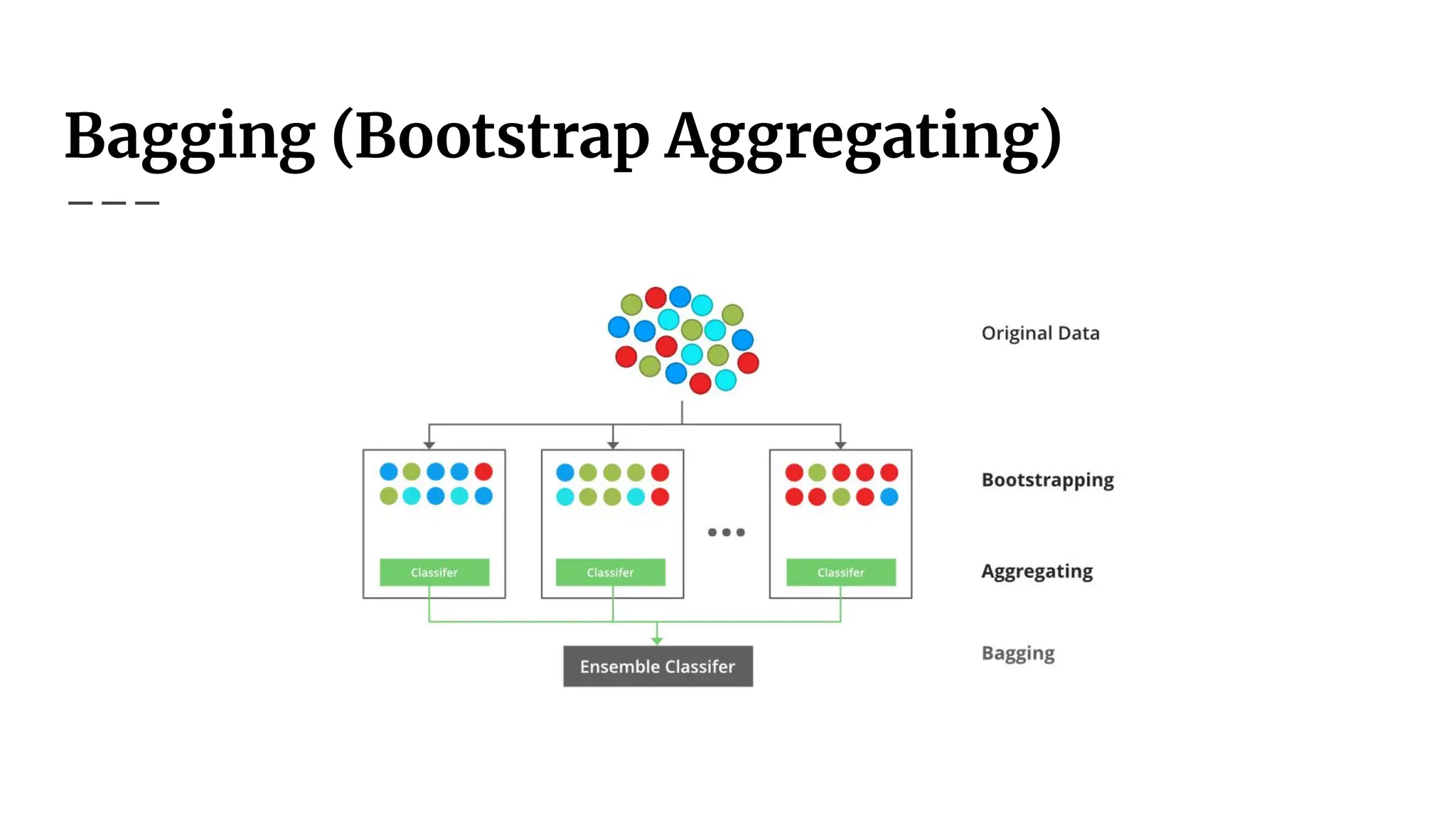
Bagging (Bootstrap Aggregating)
Usesbootstrap sampling: multiple training sets created by sampling with
replacement.
Trains multiple classifiers (same type) on different bootstrap samples.
Reduces variance and stabilizes predictions.
Combines results via:
Majority voting (for classification).
Averaging predictions (for regression).
Works well with unstable models like decision trees (e.g., Random Forests).
Committee Machines
Uses differentclassifiers (SVM, neural networks, decision trees,
etc.).
Trains them on the same dataset.
Averages predictions or assigns equal weights to each model.
Simple but lacks optimal weighting.
64.
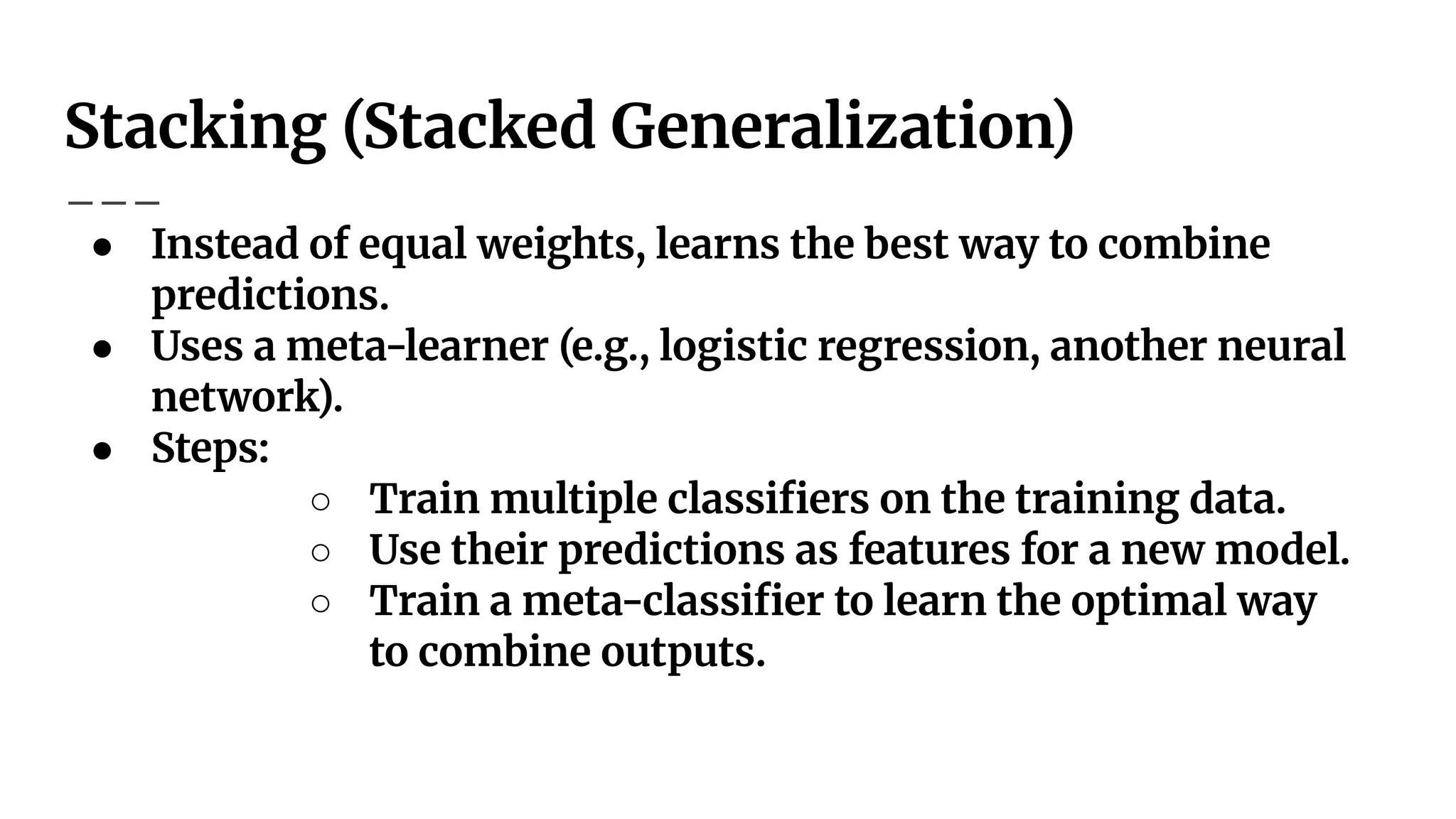
Stacking (Stacked Generalization)
●Instead of equal weights, learns the best way to combine
predictions.
● Uses a meta-learner (e.g., logistic regression, another neural
network).
● Steps:
○ Train multiple classifiers on the training data.
○ Use their predictions as features for a new model.
○ Train a meta-classifier to learn the optimal way
to combine outputs.
65.
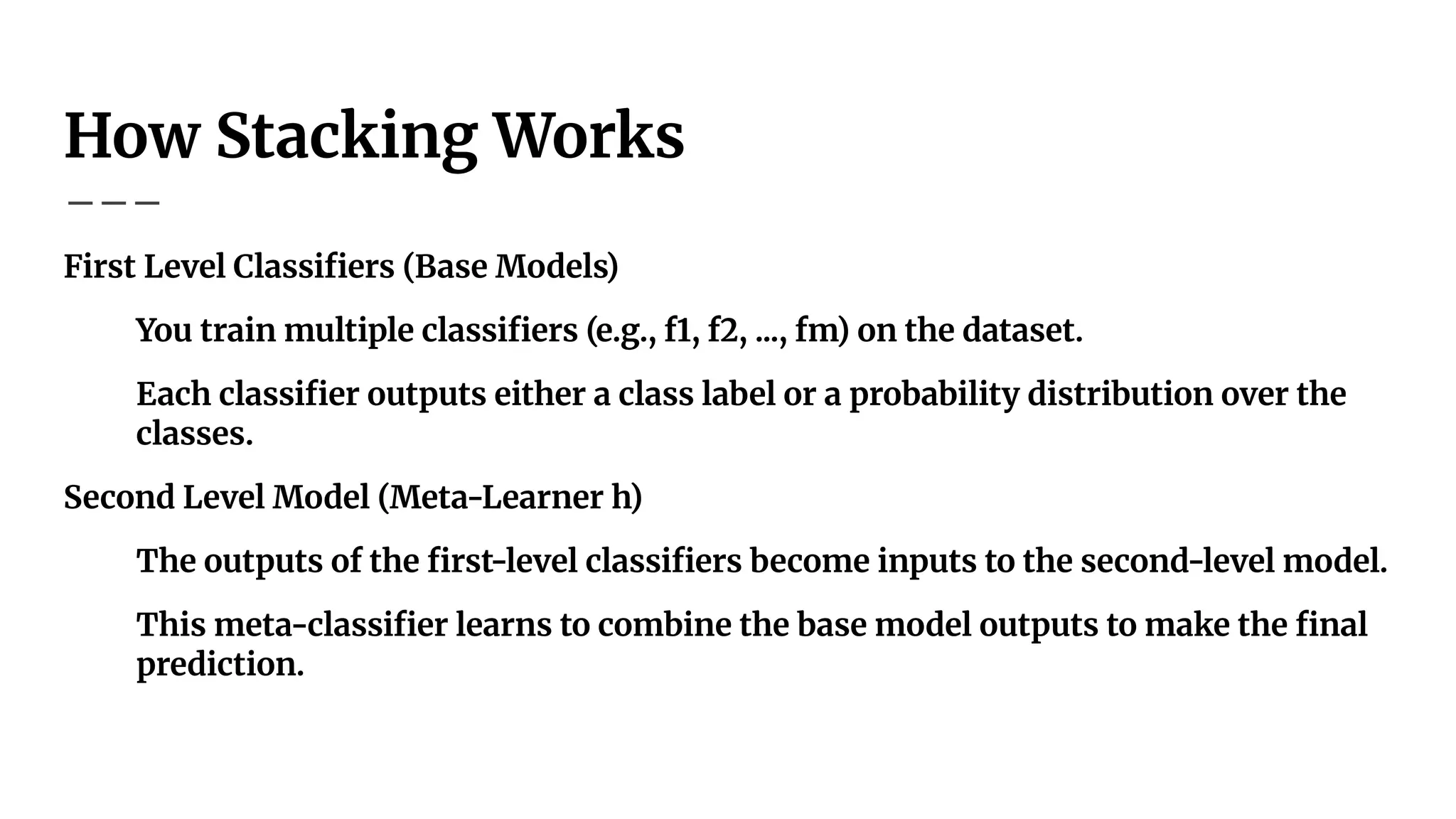
How Stacking Works
FirstLevel Classifiers (Base Models)
You train multiple classifiers (e.g., f1, f2, ..., fm) on the dataset.
Each classifier outputs either a class label or a probability distribution over the
classes.
Second Level Model (Meta-Learner h)
The outputs of the first-level classifiers become inputs to the second-level model.
This meta-classifier learns to combine the base model outputs to make the final
prediction.
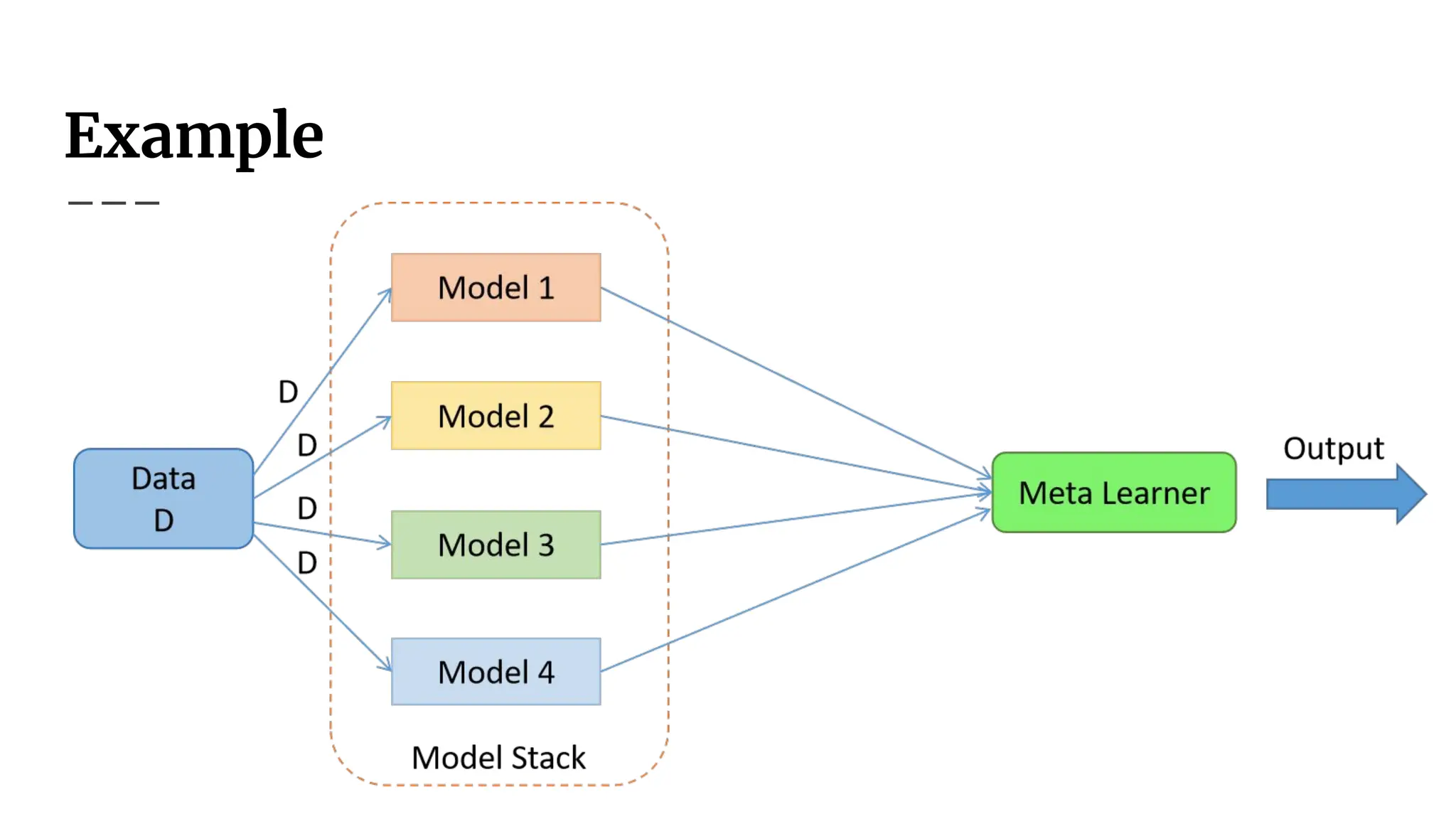
Example
Suppose we classifyan image using three different models:
Classifier 1 → predicts "Class 1"
Classifier 2 → predicts "Class 2"
Classifier 3 → predicts "Class 1"
Instead of choosing one arbitrarily, we pass [Class 1, Class 2, Class 1] as input to a
meta-classifier (h) that learns how to weigh these predictions.
68.
Why Stacking?
● Itcaptures diverse classifier biases
○ Different classifiers learn different decision boundaries.
○ Stacking helps by leveraging their strengths and reducing their
weaknesses.
● It can model complex functions better
○ If the decision function is complex, a single classifier may not be enough.
○ Stacking allows simpler classifiers to be combined for more powerful
predictions.
● It can improve generalization
○ Instead of overfitting on a single model, stacking learns a robust
combination.
69.
Choosing the Meta-Learner
Thefunction h that combines classifiers' outputs can be:
Linear (weighted sum of classifier outputs)
Non-linear (neural networks, decision trees, etc.)
Bayesian (assigning probabilities based on likelihood)
70.
Extending Stacking
Dynamic Weights:Instead of fixed weights, the meta-classifier can
learn to trust certain classifiers more in specific regions of input
space.
Multi-level Stacking: Instead of a single meta-layer, multiple layers
of classifiers can be stacked.
71.
Real-World Uses
Kaggle competitionsoften use stacking to improve model
performance.
Financial forecasting, medical diagnosis, and image classification
often benefit from stacked models.
72.
Boosting
Boosting was initiallystudied in theoretical computer science,
rather than empirical machine learning.
The fundamental idea is that if you have a weak classifier (one that
is slightly better than random, say accuracy 0.5 + ε), you can
combine many such classifiers to form a strong classifier with
accuracy arbitrarily close to 1.
73.
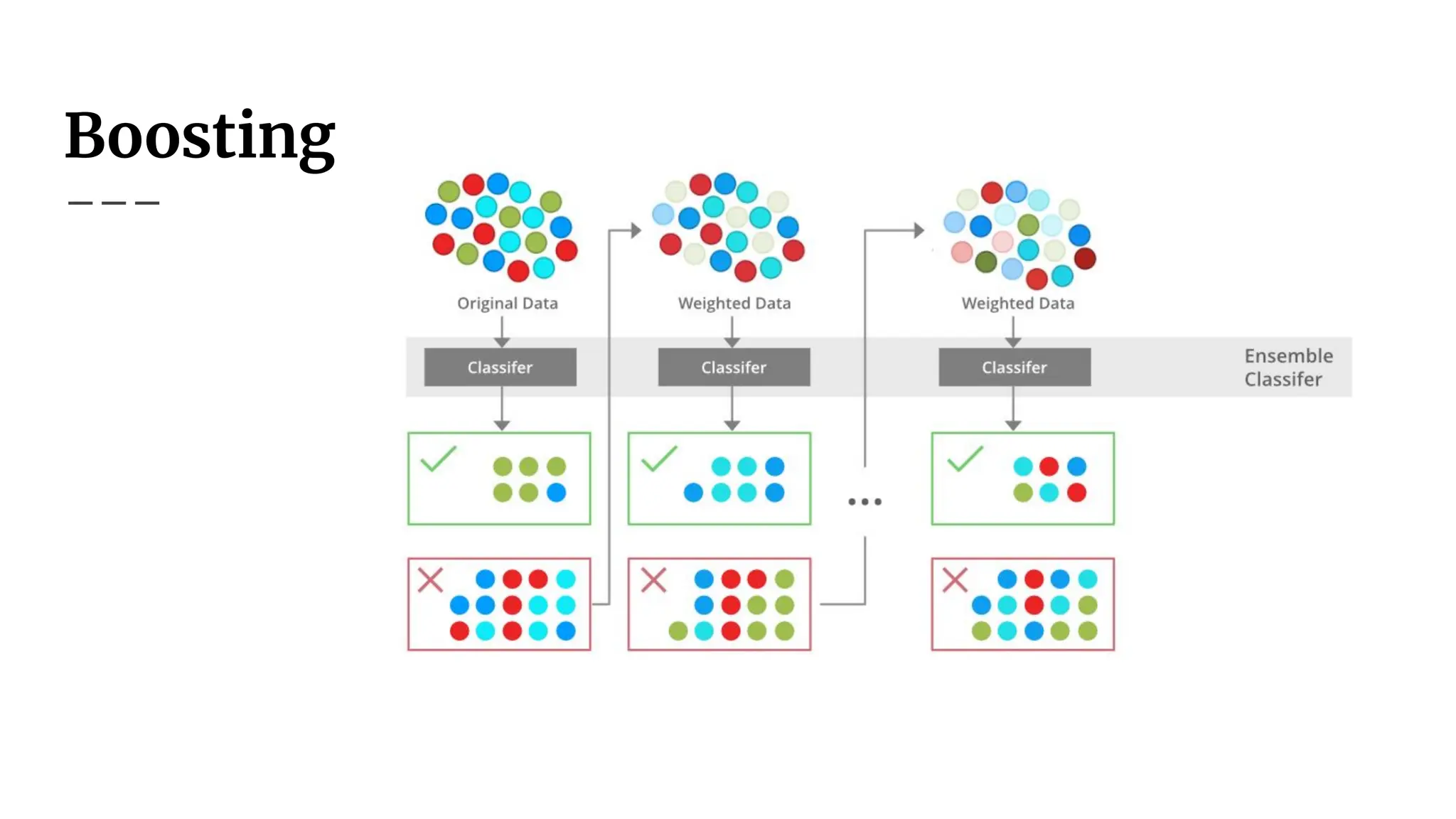
Boosting is aSequential Process
Unlike traditional ensemble methods (like bagging, where
classifiers are trained independently), boosting builds classifiers
incrementally.
At each stage, a new classifier is added to correct errors made by the
previous ones.
The goal is not just to add models but to ensure each new model
reduces the error from previous models.
How AdaBoost Works
AdaBoostassigns weights to training samples.
Initially, all samples have equal weight.
After training each weak classifier, misclassified samples get higher
weights, so the next classifier focuses more on them.
Final prediction is a weighted sum of all weak classifiers, where
better classifiers get higher weights.
76.
Loss Function inAdaBoost
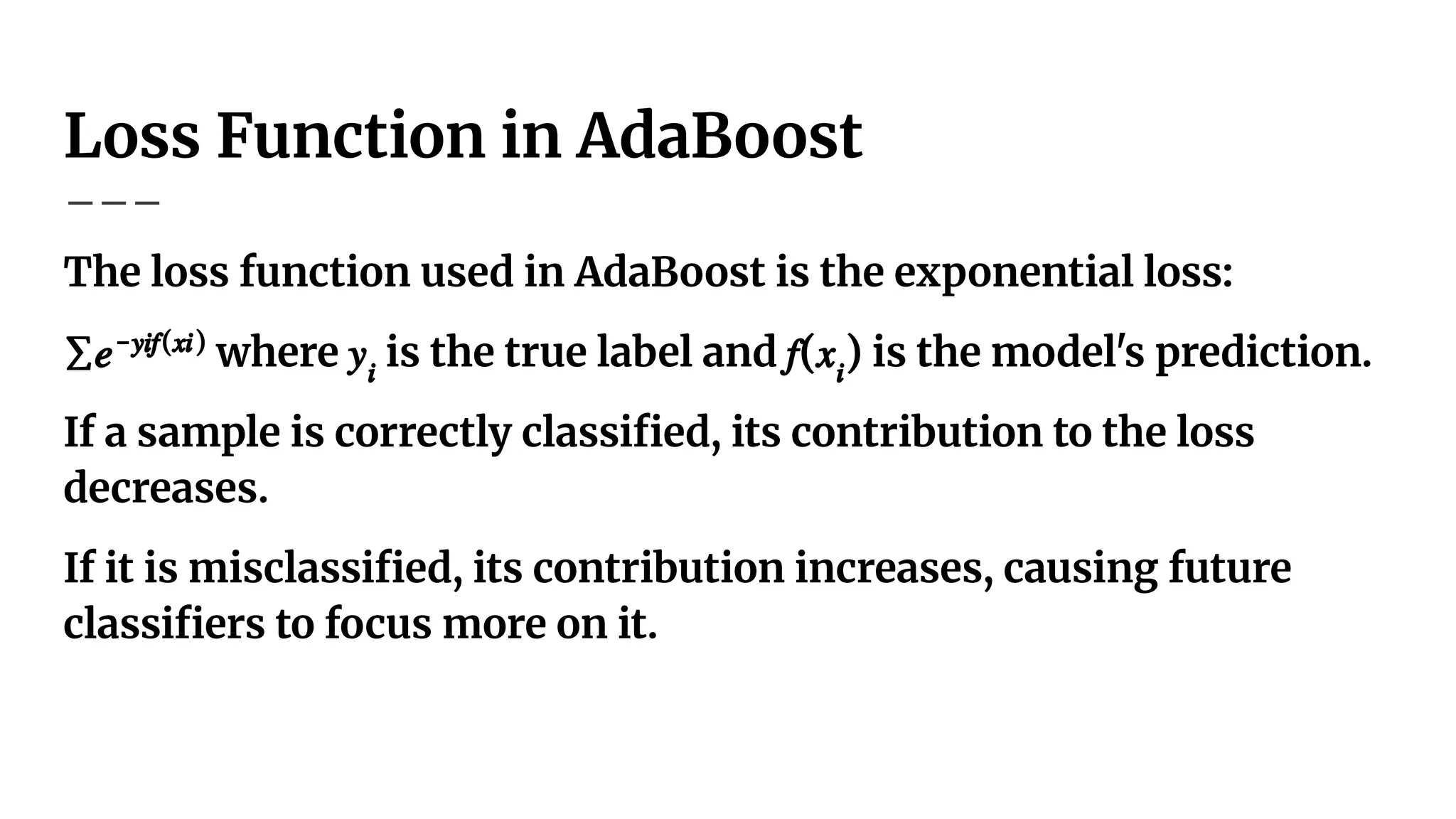
The loss function used in AdaBoost is the exponential loss:
∑𝑒−𝑦𝑖𝑓(𝑥𝑖)
where 𝑦𝑖
is the true label and 𝑓(𝑥𝑖
) is the model's prediction.
If a sample is correctly classified, its contribution to the loss
decreases.
If it is misclassified, its contribution increases, causing future
classifiers to focus more on it.
77.
Training Weak Classifiers
Eachweak classifier is trained on the weighted dataset.
The classifier minimizes the weighted error.
The final classifier is a weighted sum of all weak classifiers.
78.
Key Insight
Boosting focuseson hard-to-classify samples.
It does not just train multiple models independently—it adapts
based on previous mistakes.
The final ensemble can achieve very high accuracy even though
individual classifiers are weak.
79.
Comparison with OtherEnsemble Methods
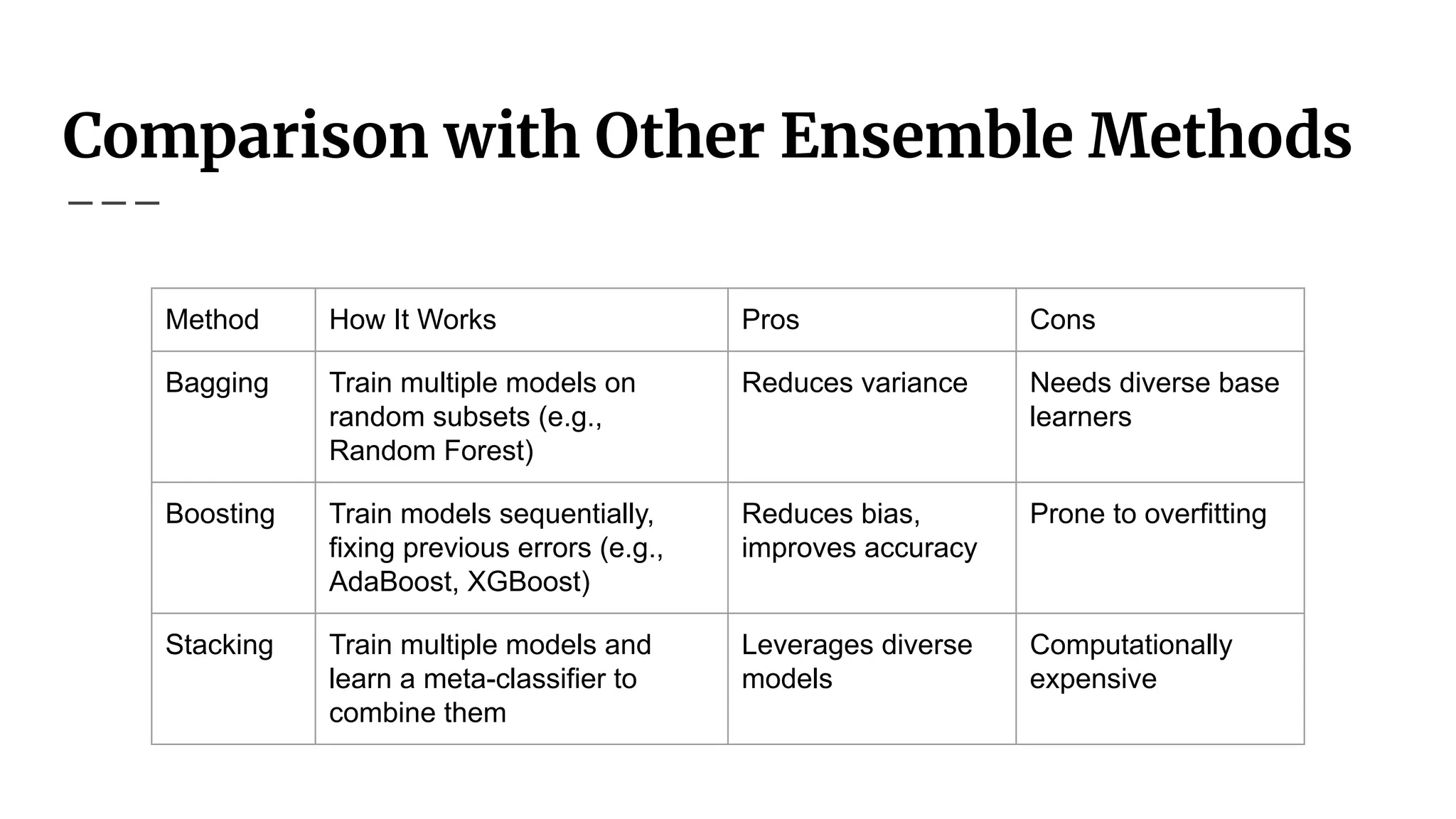
Method How It Works Pros Cons
Bagging Train multiple models on
random subsets (e.g.,
Random Forest)
Reduces variance Needs diverse base
learners
Boosting Train models sequentially,
fixing previous errors (e.g.,
AdaBoost, XGBoost)
Reduces bias,
improves accuracy
Prone to overfitting
Stacking Train multiple models and
learn a meta-classifier to
combine them
Leverages diverse
models
Computationally
expensive
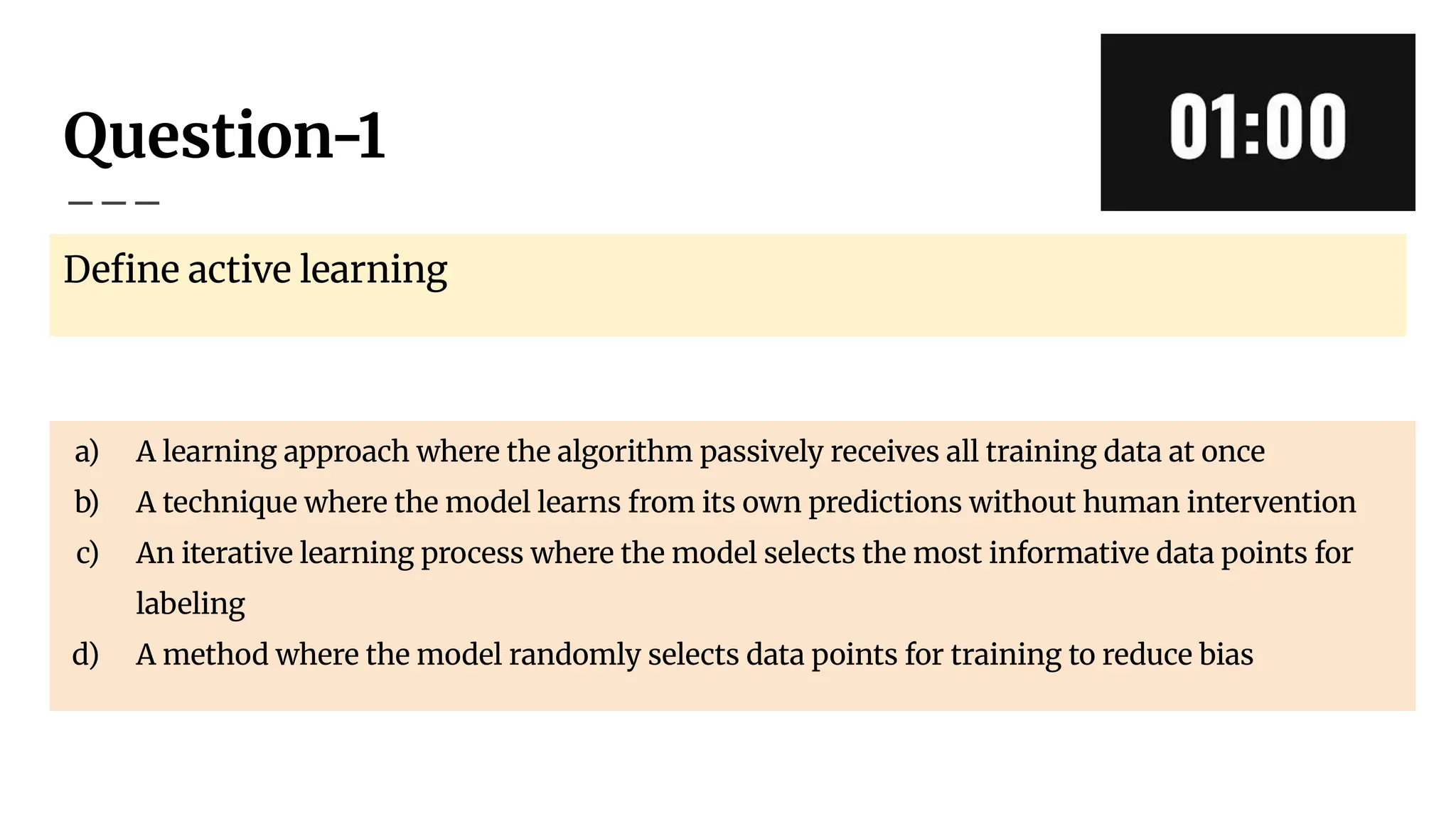
Question-1
Define active learning
a)A learning approach where the algorithm passively receives all training data at once
b) A technique where the model learns from its own predictions without human intervention
c) An iterative learning process where the model selects the most informative data points for
labeling
d) A method where the model randomly selects data points for training to reduce bias
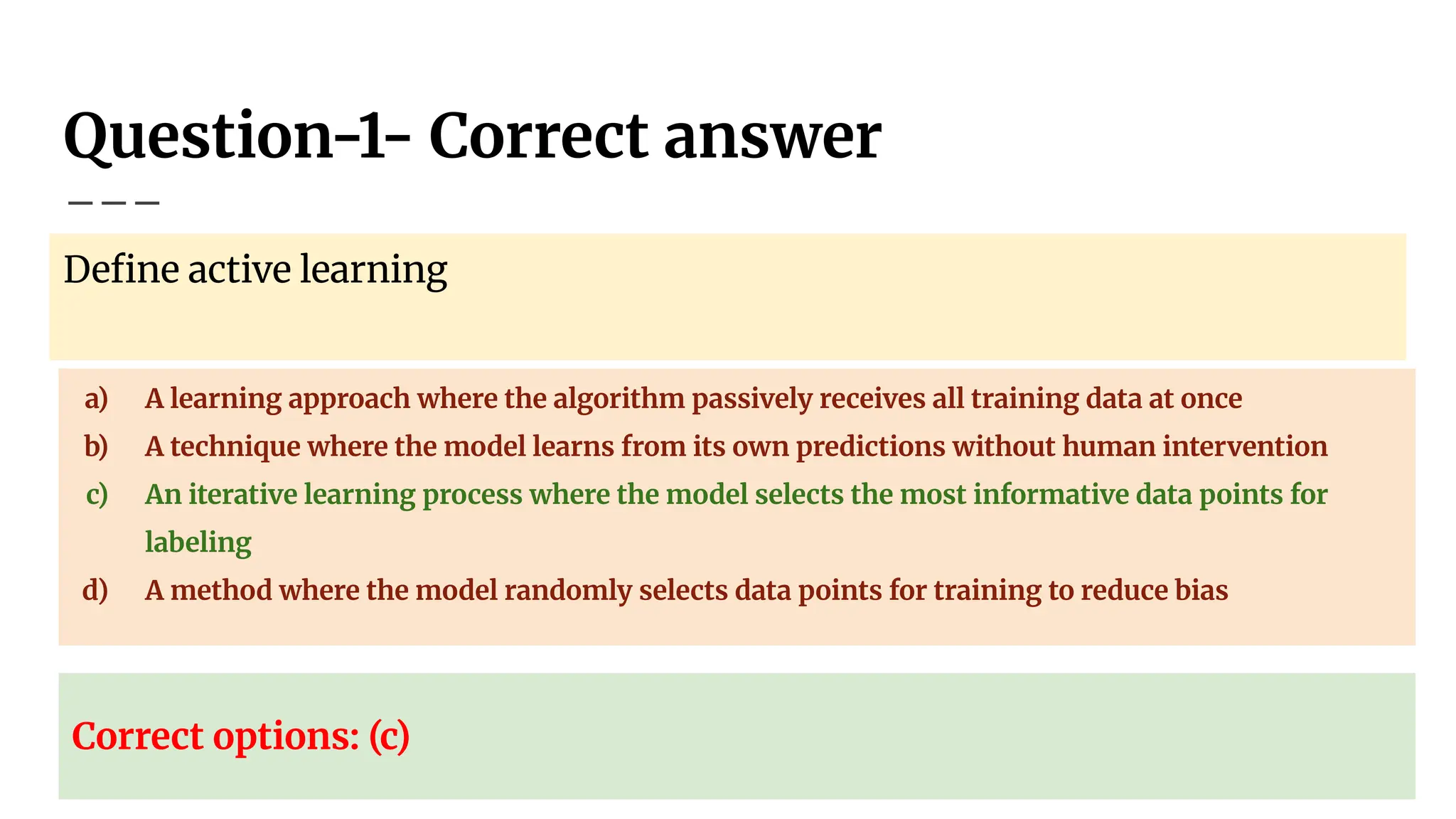
82.
Question-1- Correct answer
Defineactive learning
a) A learning approach where the algorithm passively receives all training data at once
b) A technique where the model learns from its own predictions without human intervention
c) An iterative learning process where the model selects the most informative data points for
labeling
d) A method where the model randomly selects data points for training to reduce bias
Correct options: (c)
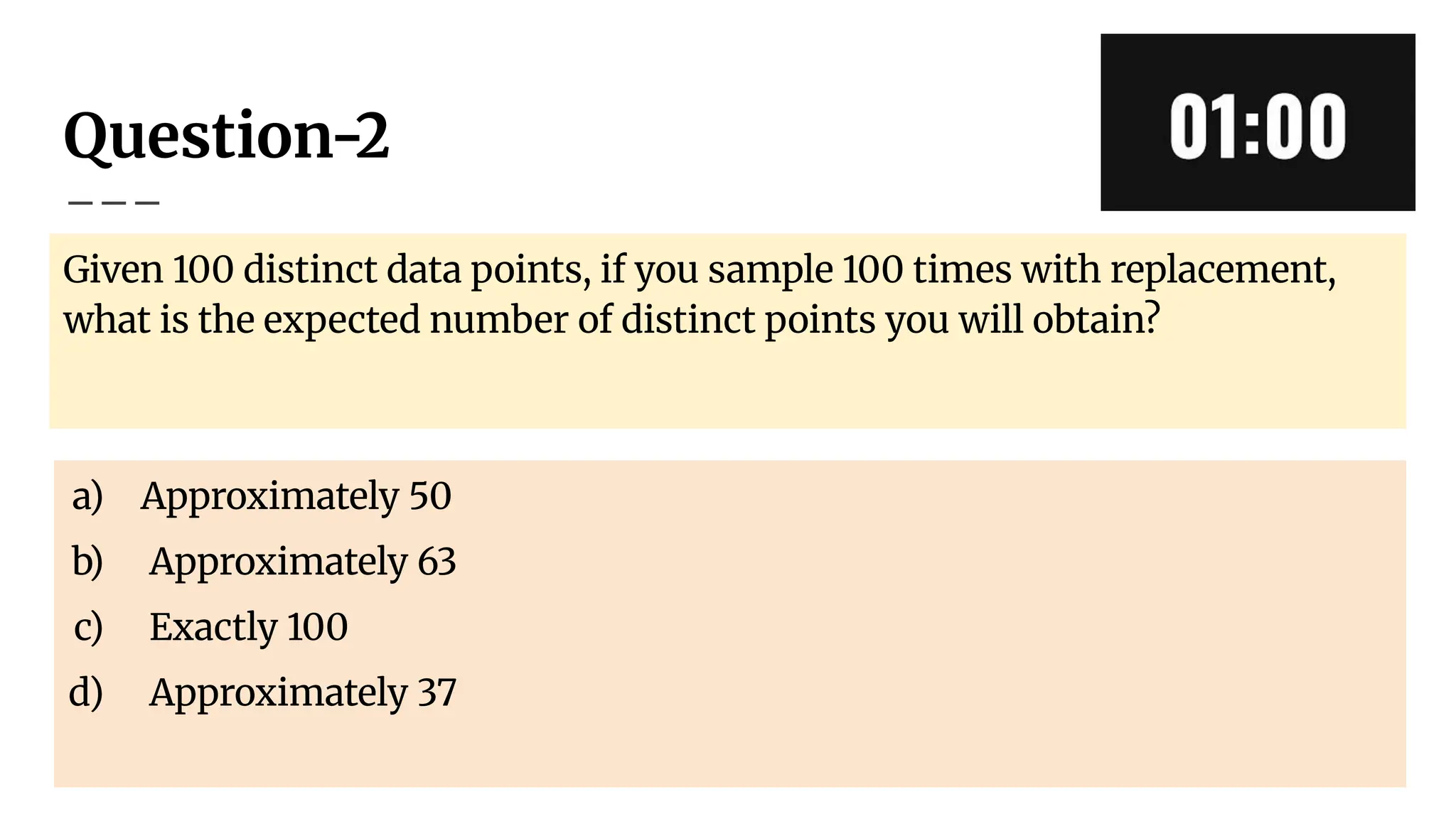
83.
Question-2
Given 100 distinctdata points, if you sample 100 times with replacement,
what is the expected number of distinct points you will obtain?
a) Approximately 50
b) Approximately 63
c) Exactly 100
d) Approximately 37
84.
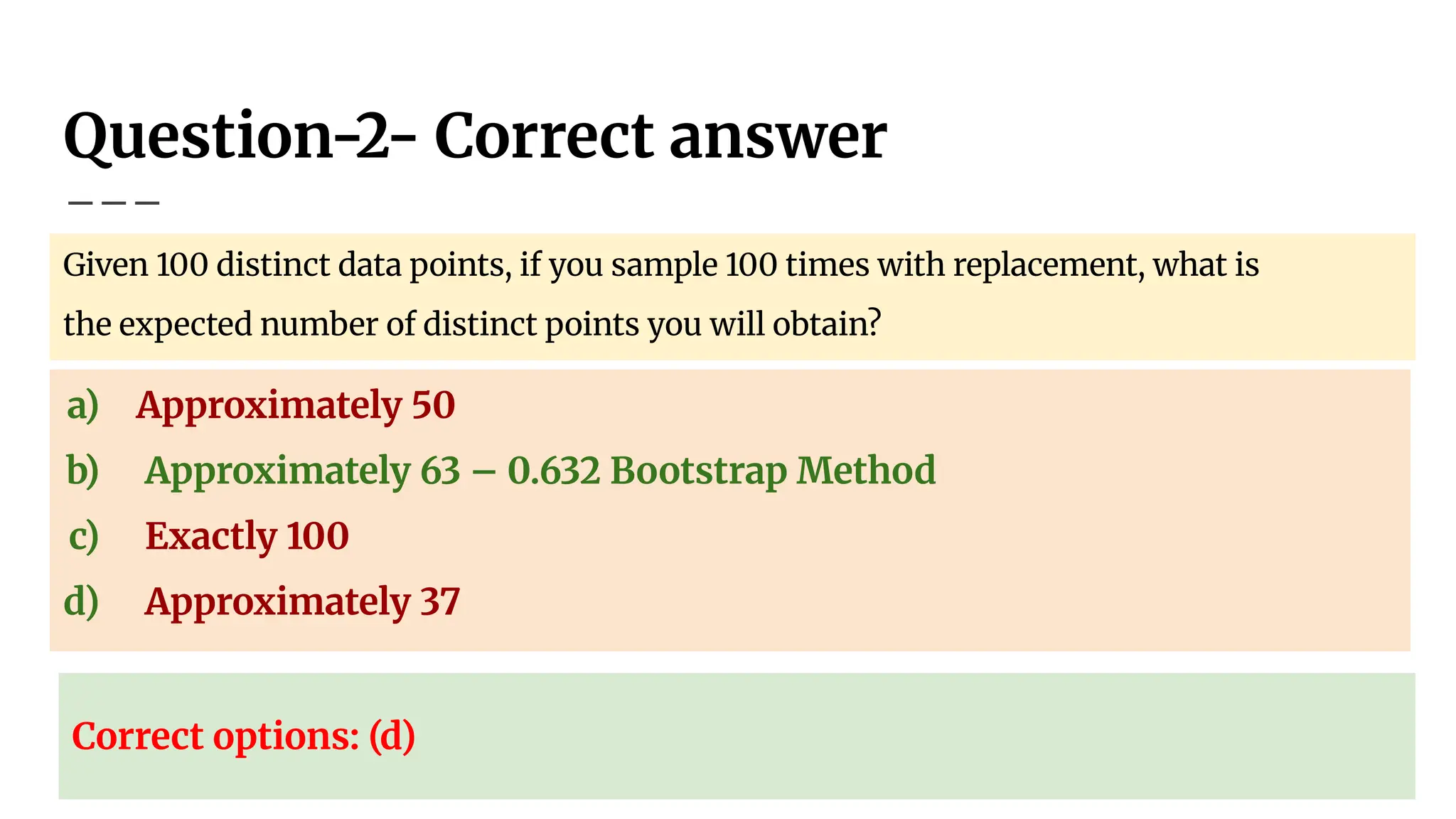
Question-2- Correct answer
Given100 distinct data points, if you sample 100 times with replacement, what is
the expected number of distinct points you will obtain?
a) Approximately 50
b) Approximately 63 – 0.632 Bootstrap Method
c) Exactly 100
d) Approximately 37
Correct options: (d)
85.
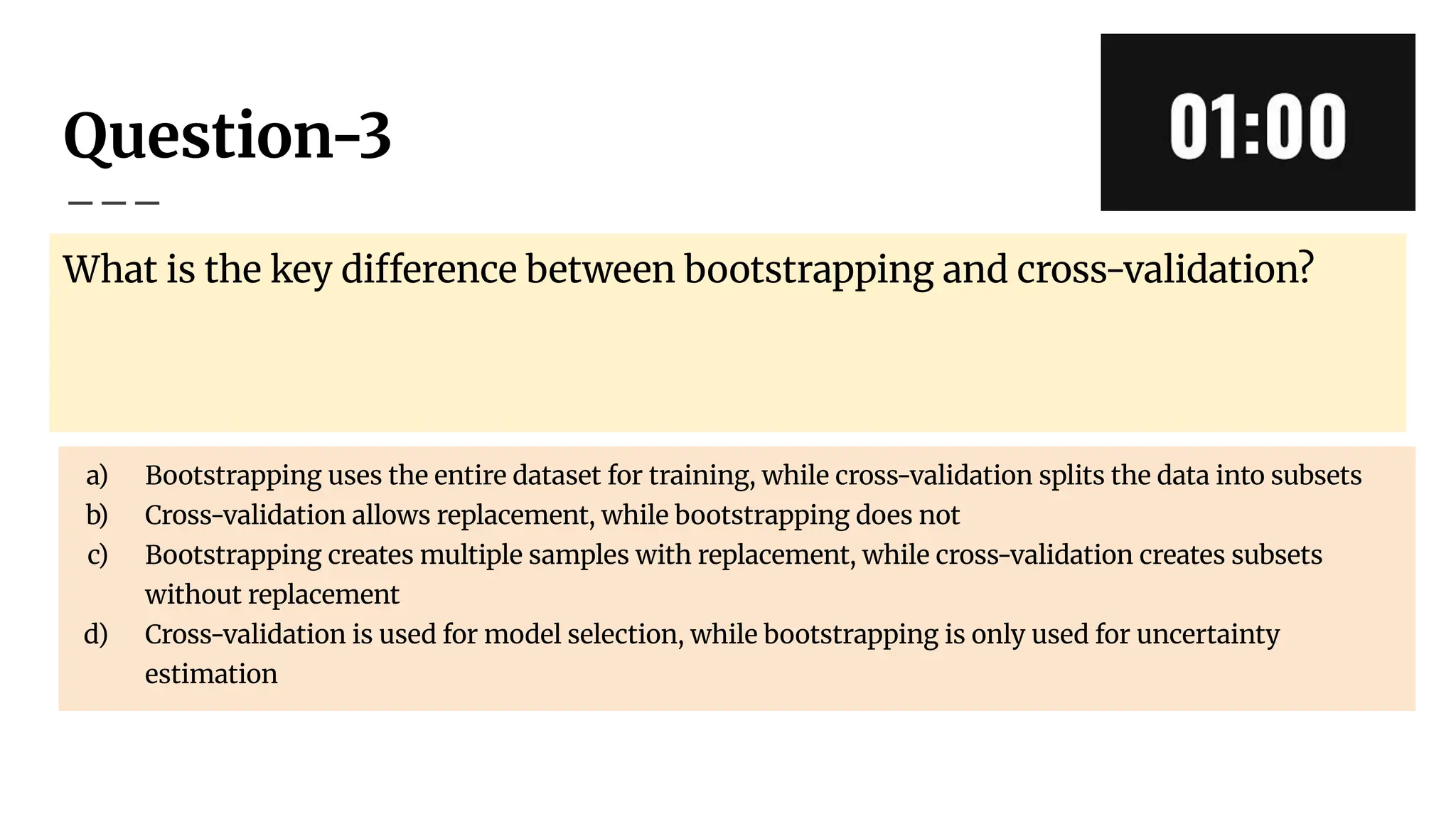
Question-3
What is thekey difference between bootstrapping and cross-validation?
a) Bootstrapping uses the entire dataset for training, while cross-validation splits the data into subsets
b) Cross-validation allows replacement, while bootstrapping does not
c) Bootstrapping creates multiple samples with replacement, while cross-validation creates subsets
without replacement
d) Cross-validation is used for model selection, while bootstrapping is only used for uncertainty
estimation
86.
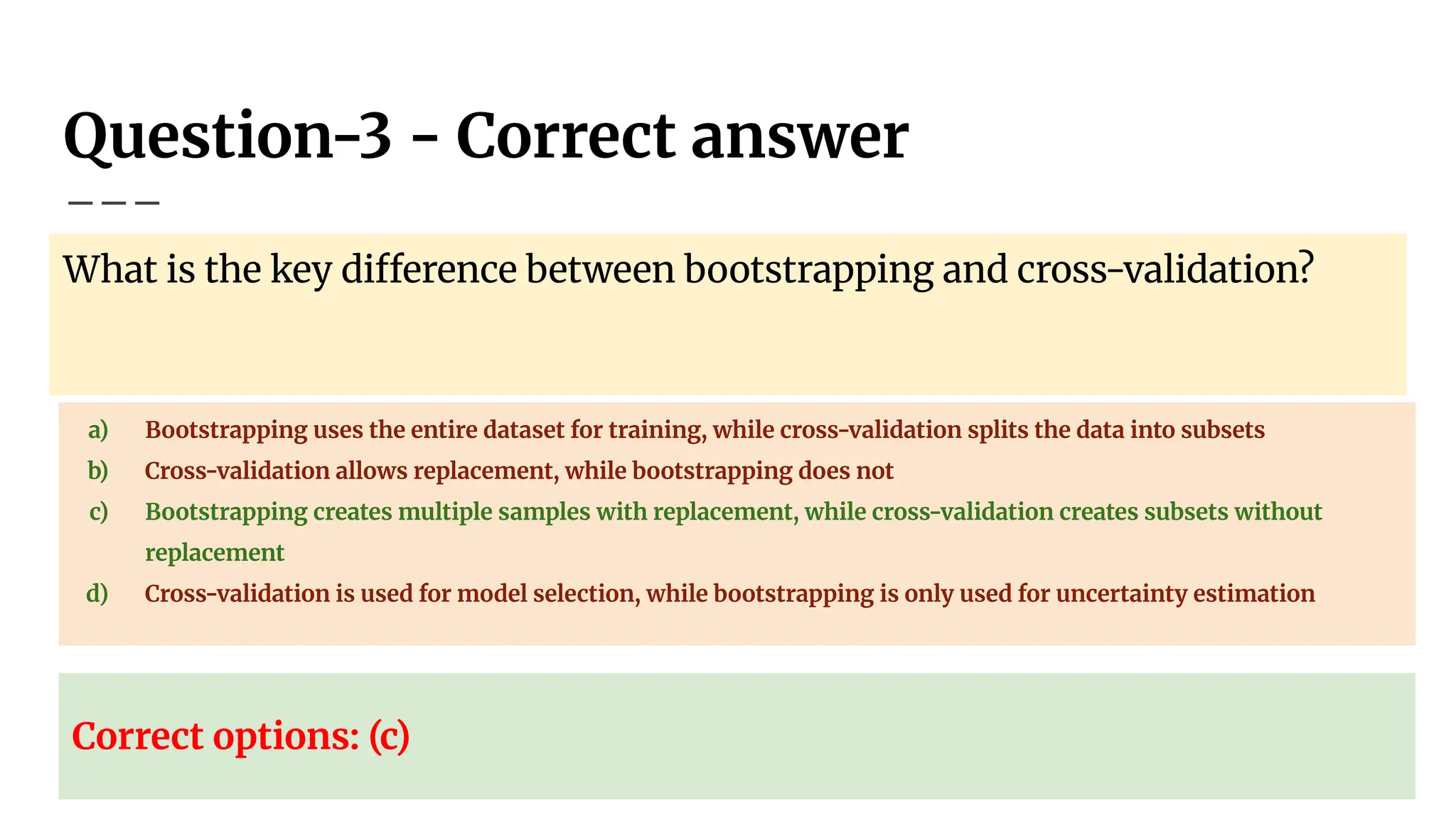
Question-3 - Correctanswer
What is the key difference between bootstrapping and cross-validation?
a) Bootstrapping uses the entire dataset for training, while cross-validation splits the data into subsets
b) Cross-validation allows replacement, while bootstrapping does not
c) Bootstrapping creates multiple samples with replacement, while cross-validation creates subsets without
replacement
d) Cross-validation is used for model selection, while bootstrapping is only used for uncertainty estimation
Correct options: (c)
87.
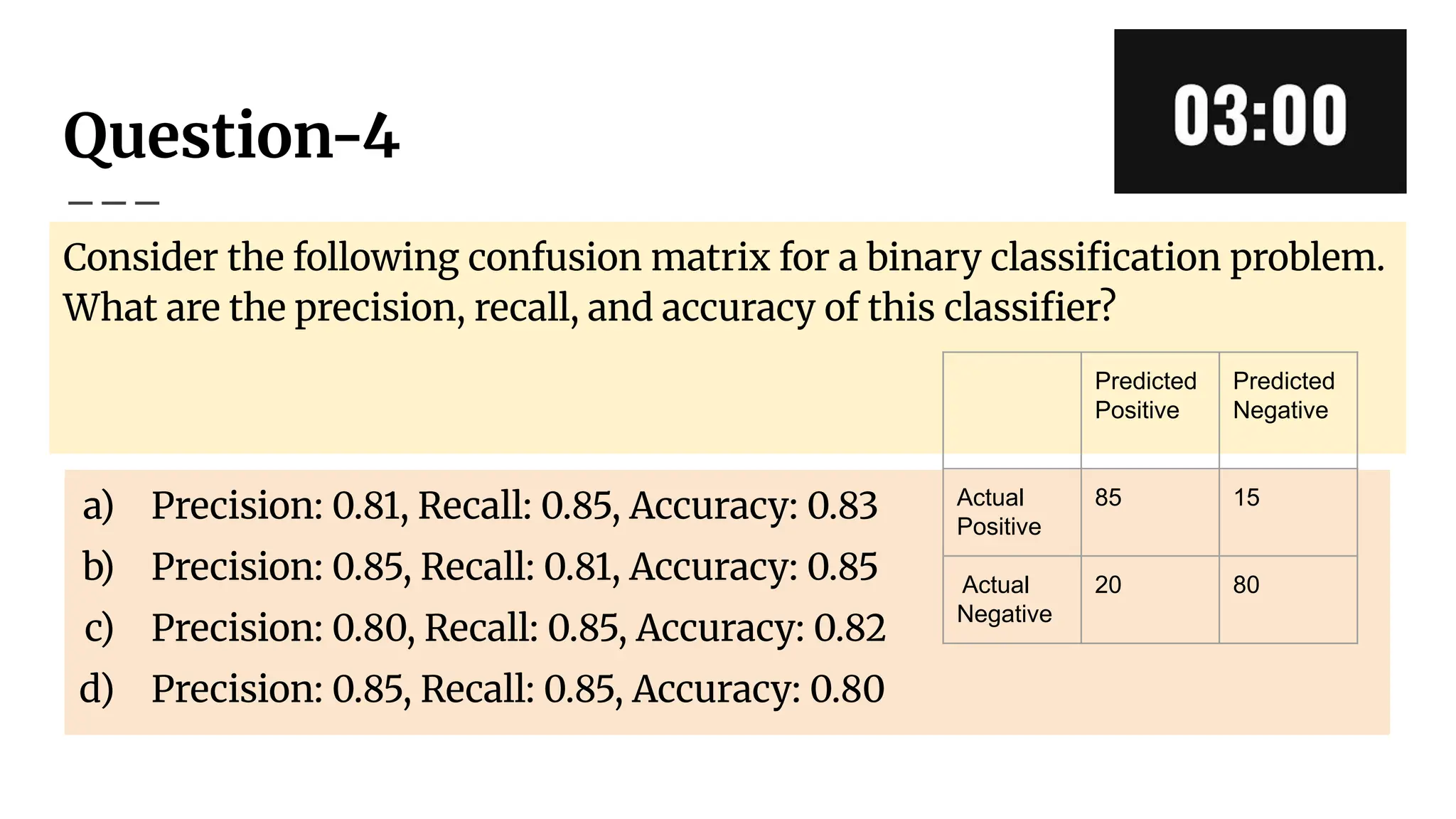
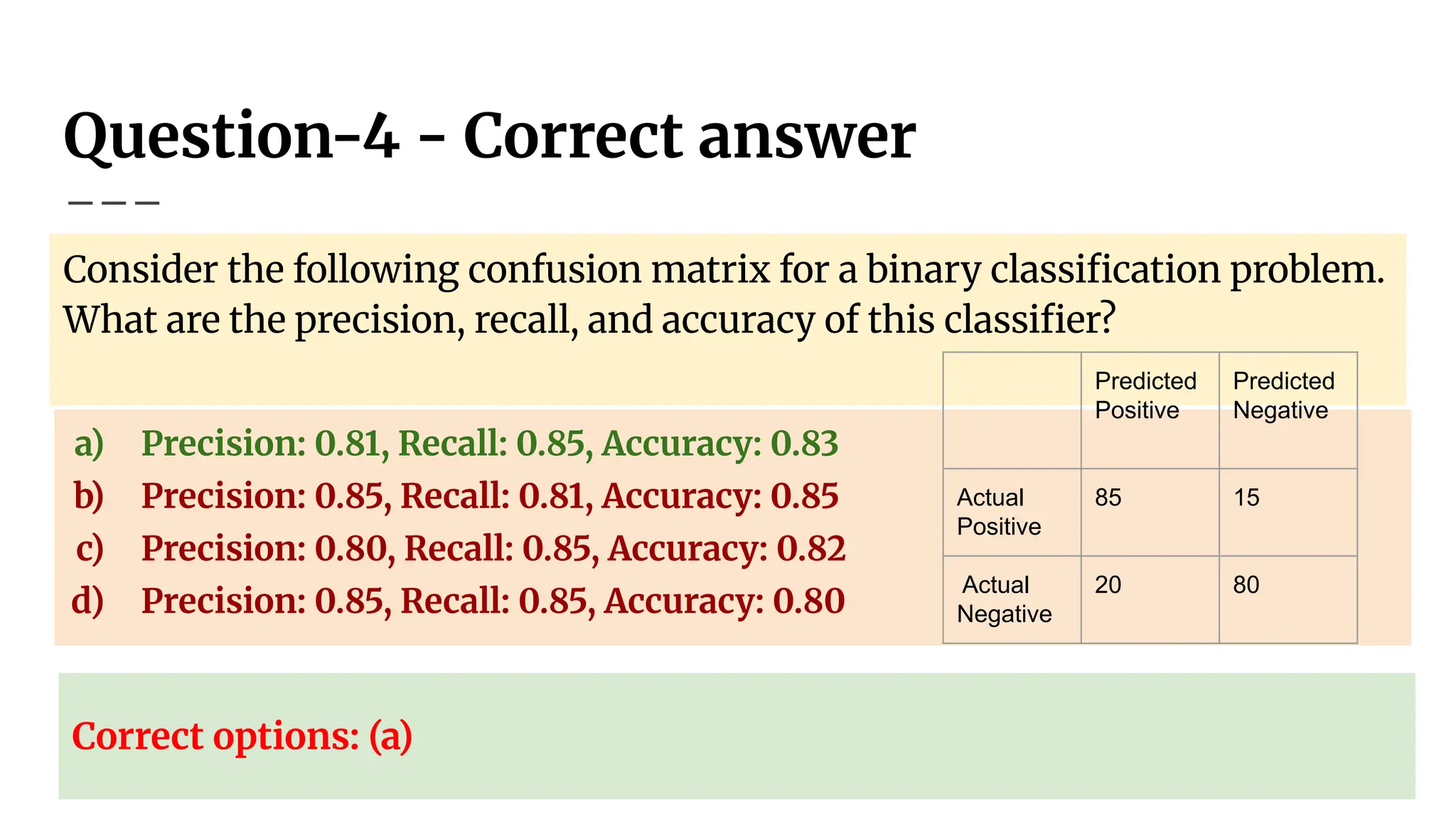
Question-4
Consider the followingconfusion matrix for a binary classification problem.
What are the precision, recall, and accuracy of this classifier?
a) Precision: 0.81, Recall: 0.85, Accuracy: 0.83
b) Precision: 0.85, Recall: 0.81, Accuracy: 0.85
c) Precision: 0.80, Recall: 0.85, Accuracy: 0.82
d) Precision: 0.85, Recall: 0.85, Accuracy: 0.80
Predicted
Positive
Predicted
Negative
Actual
Positive
85 15
Actual
Negative
20 80
88.
Question-4 - Correctanswer
Consider the following confusion matrix for a binary classification problem.
What are the precision, recall, and accuracy of this classifier?
a) Precision: 0.81, Recall: 0.85, Accuracy: 0.83
b) Precision: 0.85, Recall: 0.81, Accuracy: 0.85
c) Precision: 0.80, Recall: 0.85, Accuracy: 0.82
d) Precision: 0.85, Recall: 0.85, Accuracy: 0.80
Correct options: (a)
Predicted
Positive
Predicted
Negative
Actual
Positive
85 15
Actual
Negative
20 80
89.
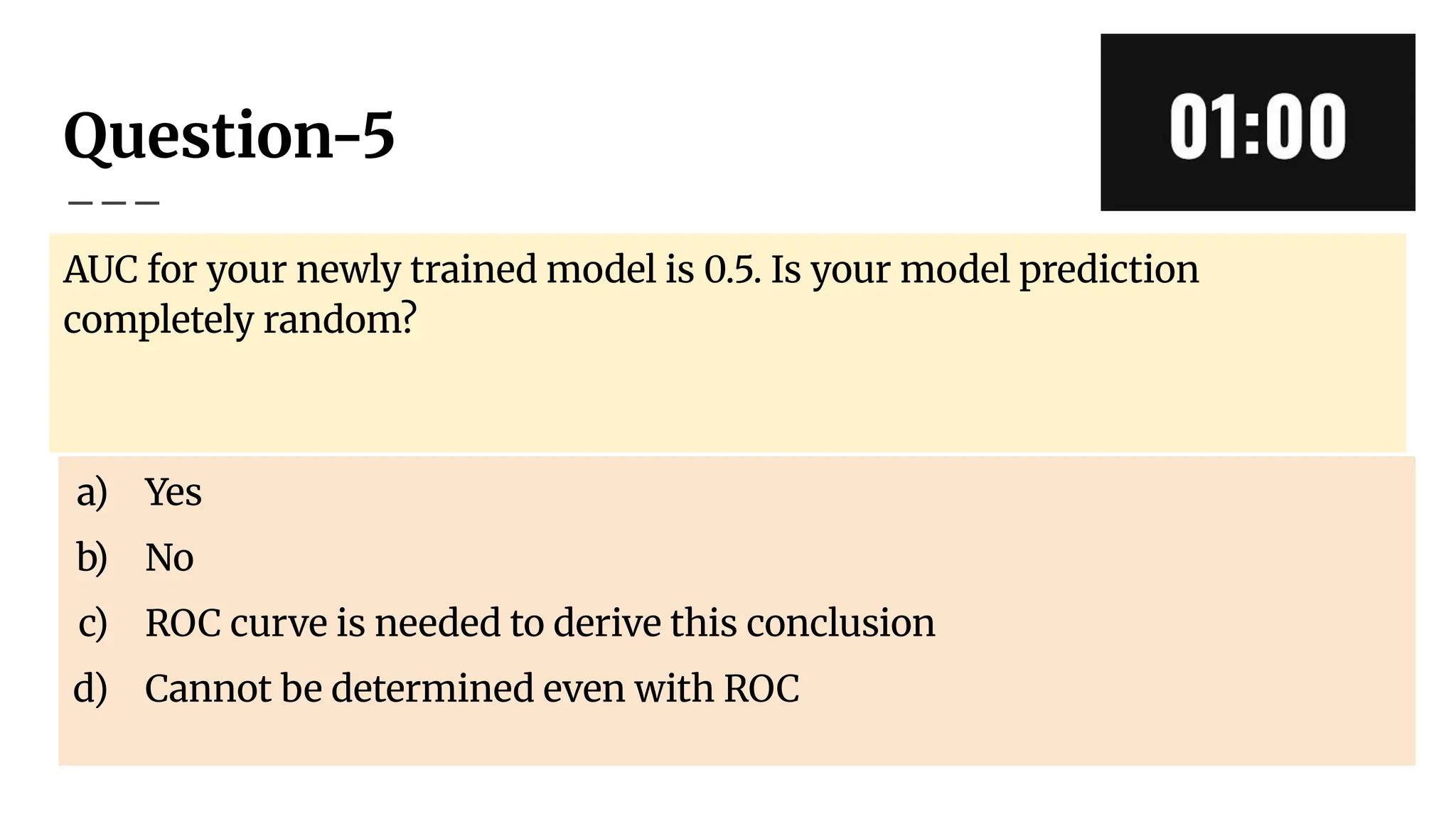
Question-5
AUC for yournewly trained model is 0.5. Is your model prediction
completely random?
a) Yes
b) No
c) ROC curve is needed to derive this conclusion
d) Cannot be determined even with ROC
90.
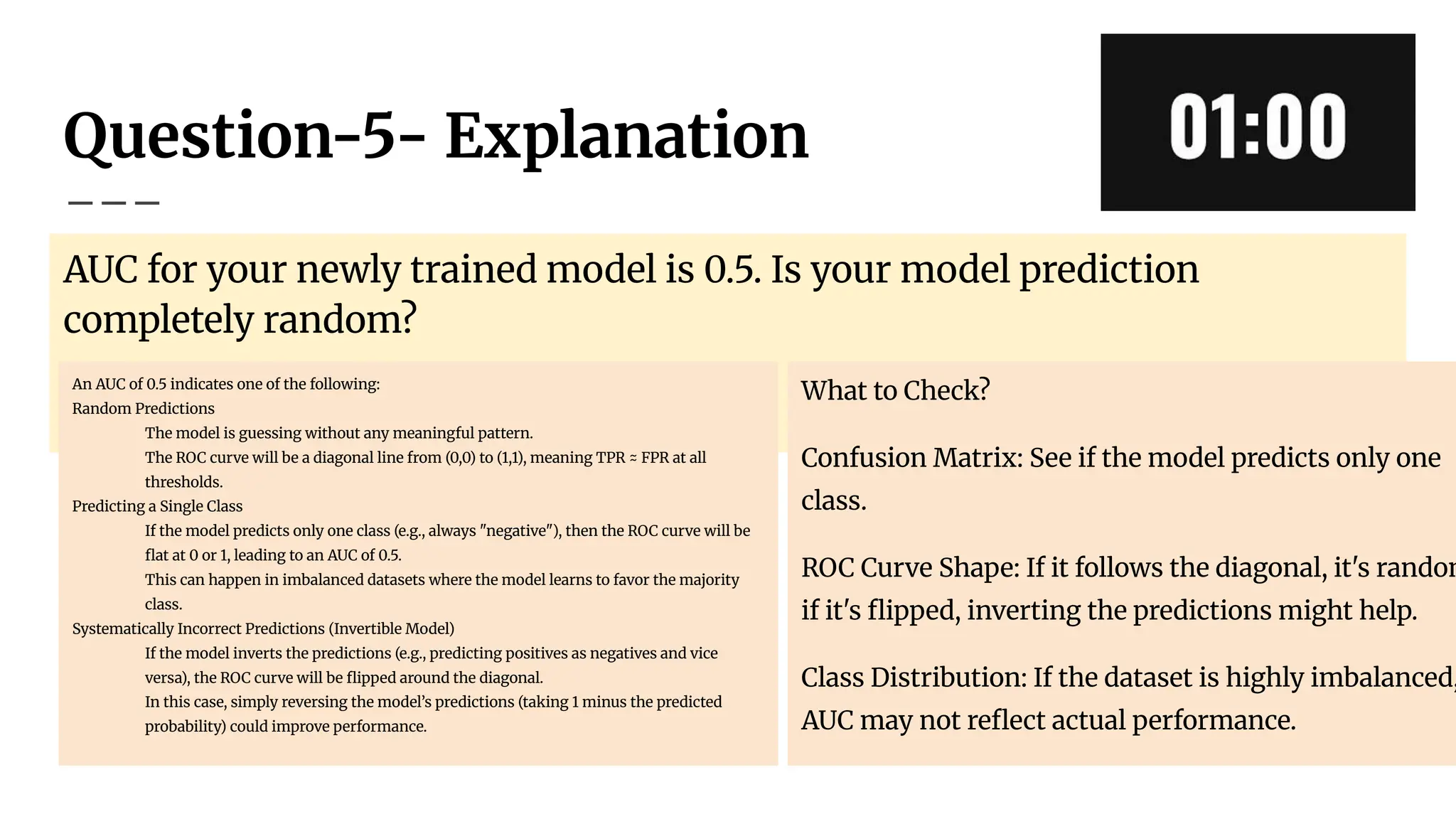
Question-5- Explanation
AUC foryour newly trained model is 0.5. Is your model prediction
completely random?
An AUC of 0.5 indicates one of the following:
Random Predictions
The model is guessing without any meaningful pattern.
The ROC curve will be a diagonal line from (0,0) to (1,1), meaning TPR ≈ FPR at all
thresholds.
Predicting a Single Class
If the model predicts only one class (e.g., always "negative"), then the ROC curve will be
flat at 0 or 1, leading to an AUC of 0.5.
This can happen in imbalanced datasets where the model learns to favor the majority
class.
Systematically Incorrect Predictions (Invertible Model)
If the model inverts the predictions (e.g., predicting positives as negatives and vice
versa), the ROC curve will be flipped around the diagonal.
In this case, simply reversing the model’s predictions (taking 1 minus the predicted
probability) could improve performance.
What to Check?
Confusion Matrix: See if the model predicts only one
class.
ROC Curve Shape: If it follows the diagonal, it's random
if it's flipped, inverting the predictions might help.
Class Distribution: If the dataset is highly imbalanced,
AUC may not reflect actual performance.
91.
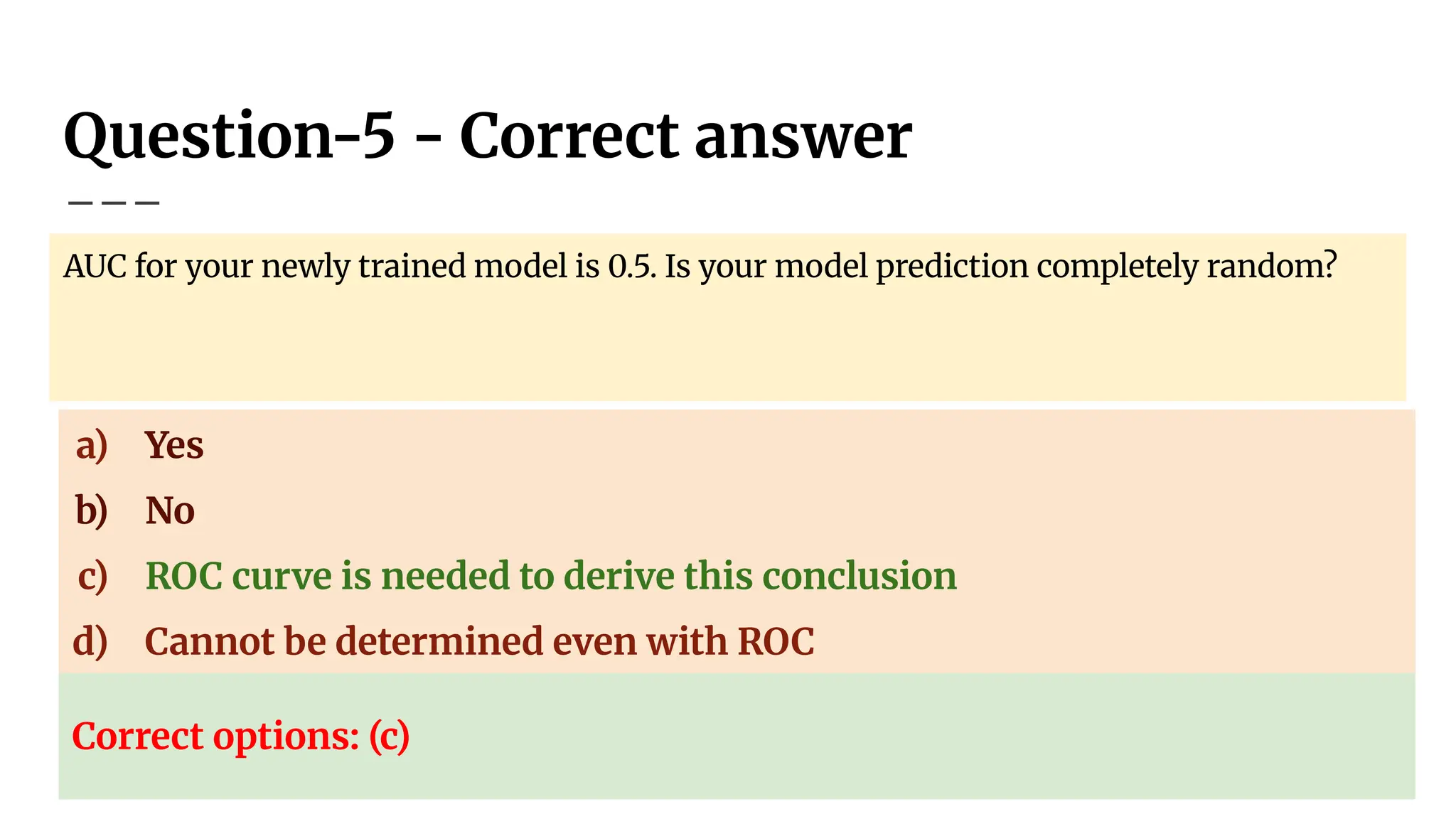
Question-5 - Correctanswer
AUC for your newly trained model is 0.5. Is your model prediction completely random?
a) Yes
b) No
c) ROC curve is needed to derive this conclusion
d) Cannot be determined even with ROC
Correct options: (c)
92.
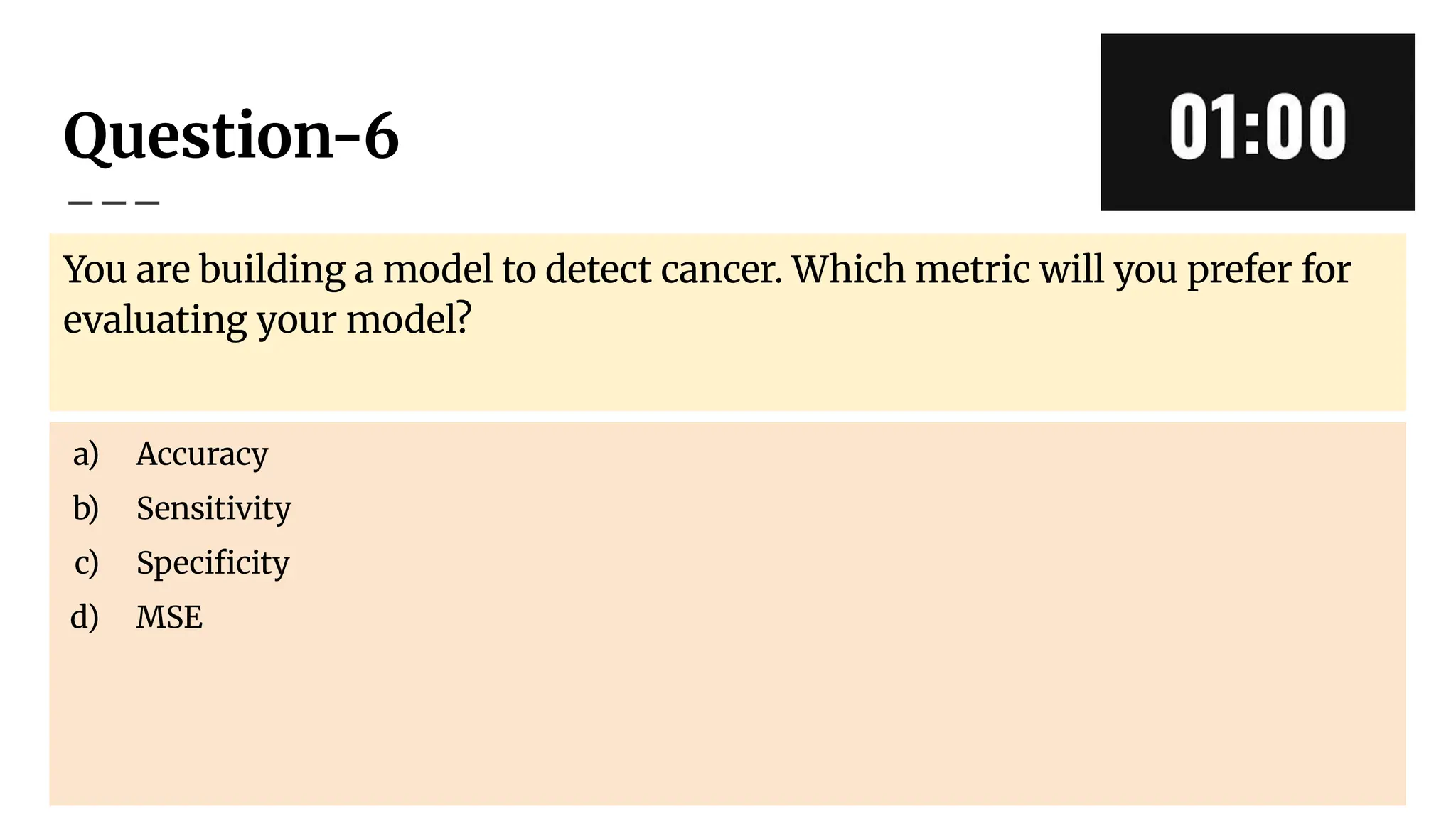
Question-6
You are buildinga model to detect cancer. Which metric will you prefer for
evaluating your model?
a) Accuracy
b) Sensitivity
c) Specificity
d) MSE
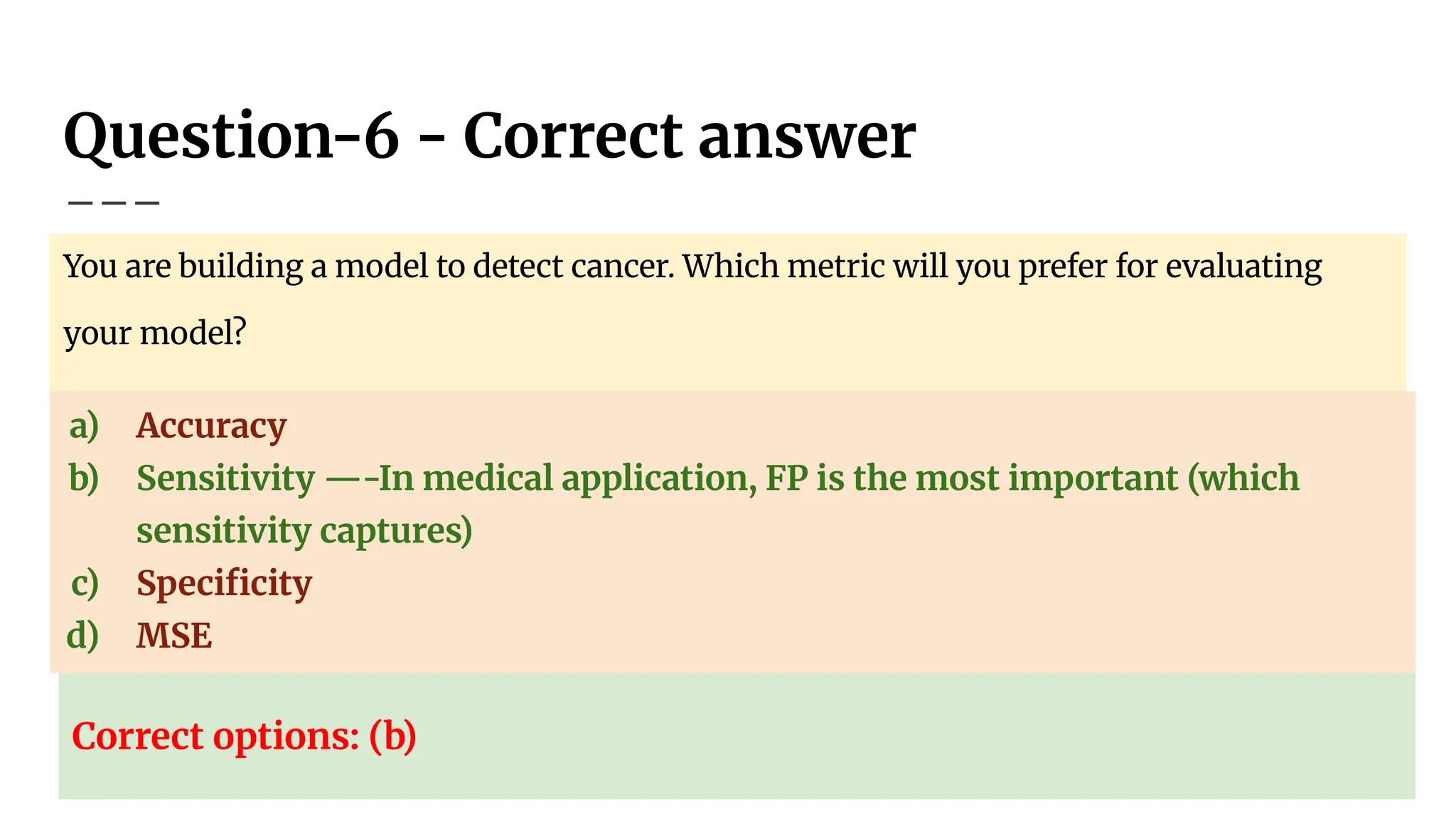
93.
Question-6 - Correctanswer
You are building a model to detect cancer. Which metric will you prefer for evaluating
your model?
a) Accuracy
b) Sensitivity —-In medical application, FP is the most important (which
sensitivity captures)
c) Specificity
d) MSE
Correct options: (b)
94.
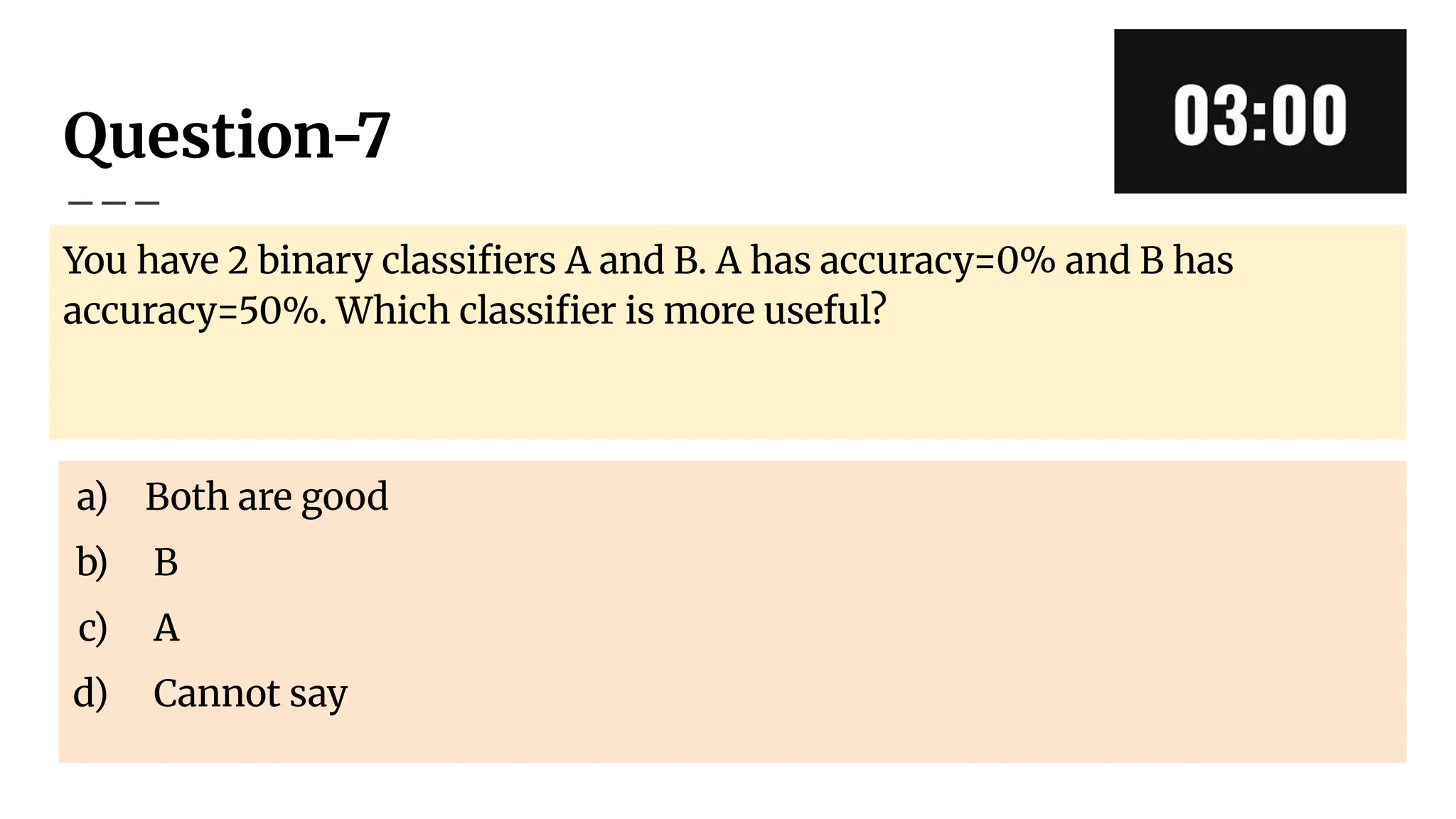
Question-7
You have 2binary classifiers A and B. A has accuracy=0% and B has
accuracy=50%. Which classifier is more useful?
a) Both are good
b) B
c) A
d) Cannot say
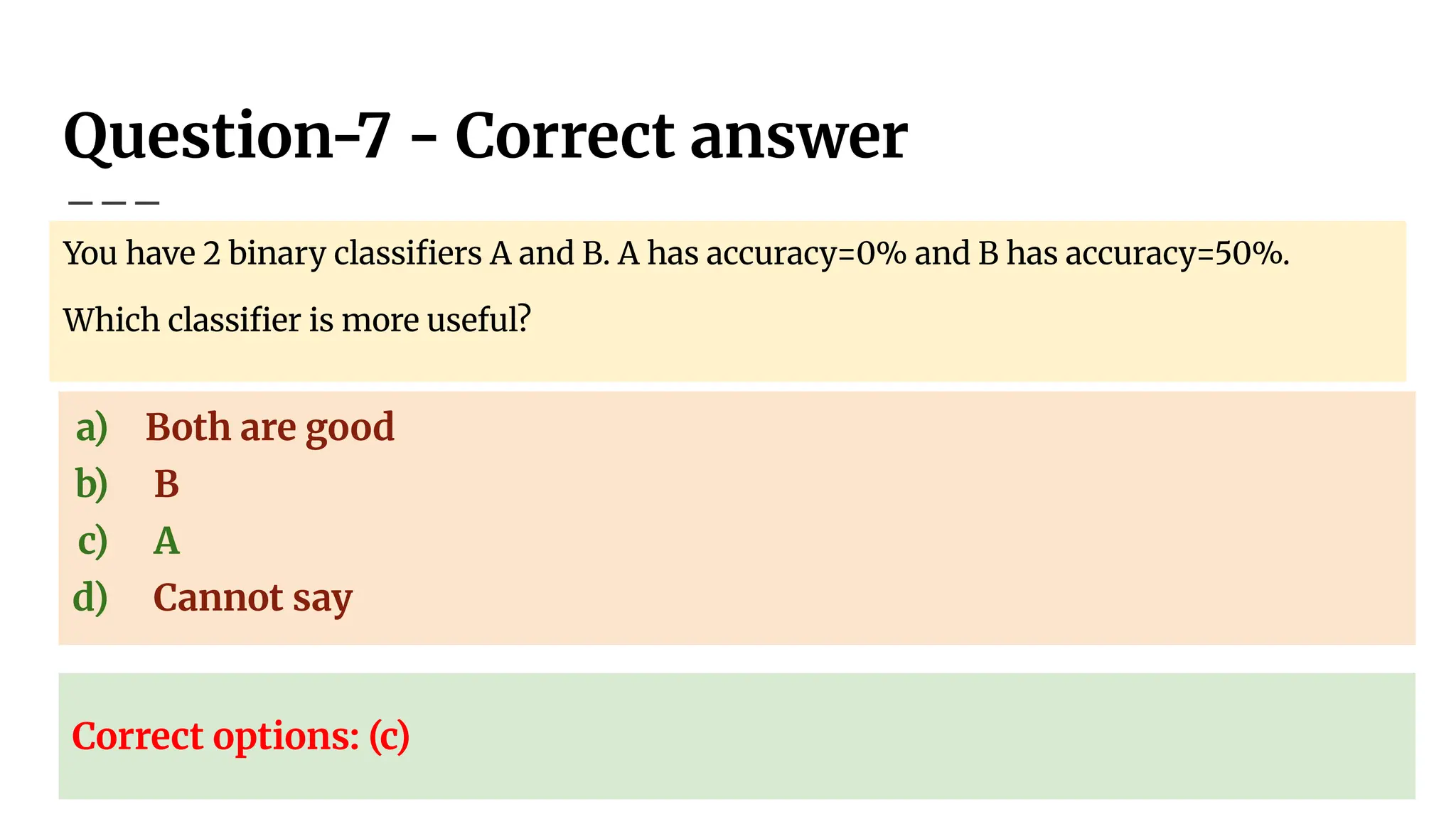
95.
Question-7 - Correctanswer
You have 2 binary classifiers A and B. A has accuracy=0% and B has accuracy=50%.
Which classifier is more useful?
a) Both are good
b) B
c) A
d) Cannot say
Correct options: (c)
96.
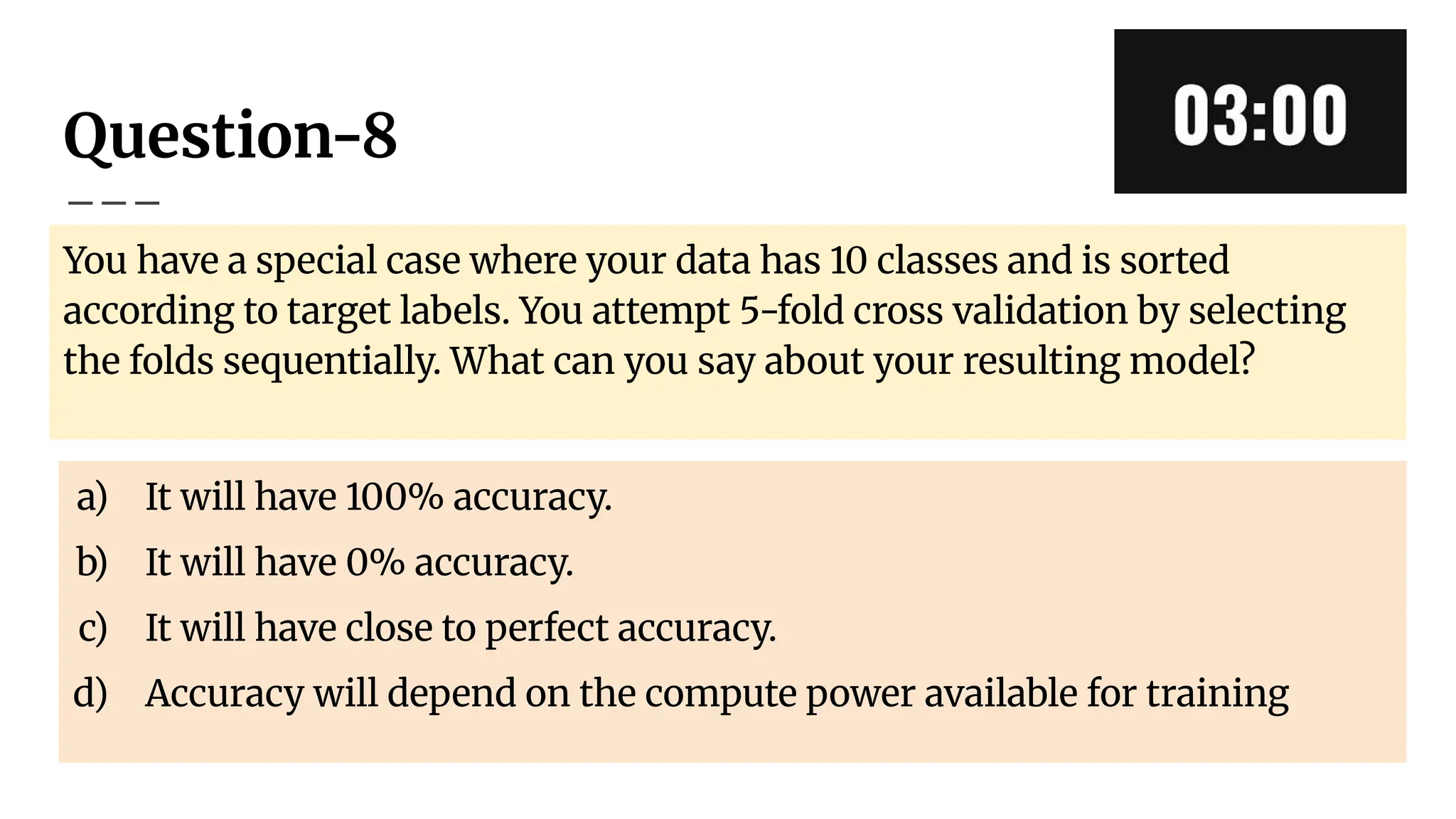
Question-8
You have aspecial case where your data has 10 classes and is sorted
according to target labels. You attempt 5-fold cross validation by selecting
the folds sequentially. What can you say about your resulting model?
a) It will have 100% accuracy.
b) It will have 0% accuracy.
c) It will have close to perfect accuracy.
d) Accuracy will depend on the compute power available for training
97.
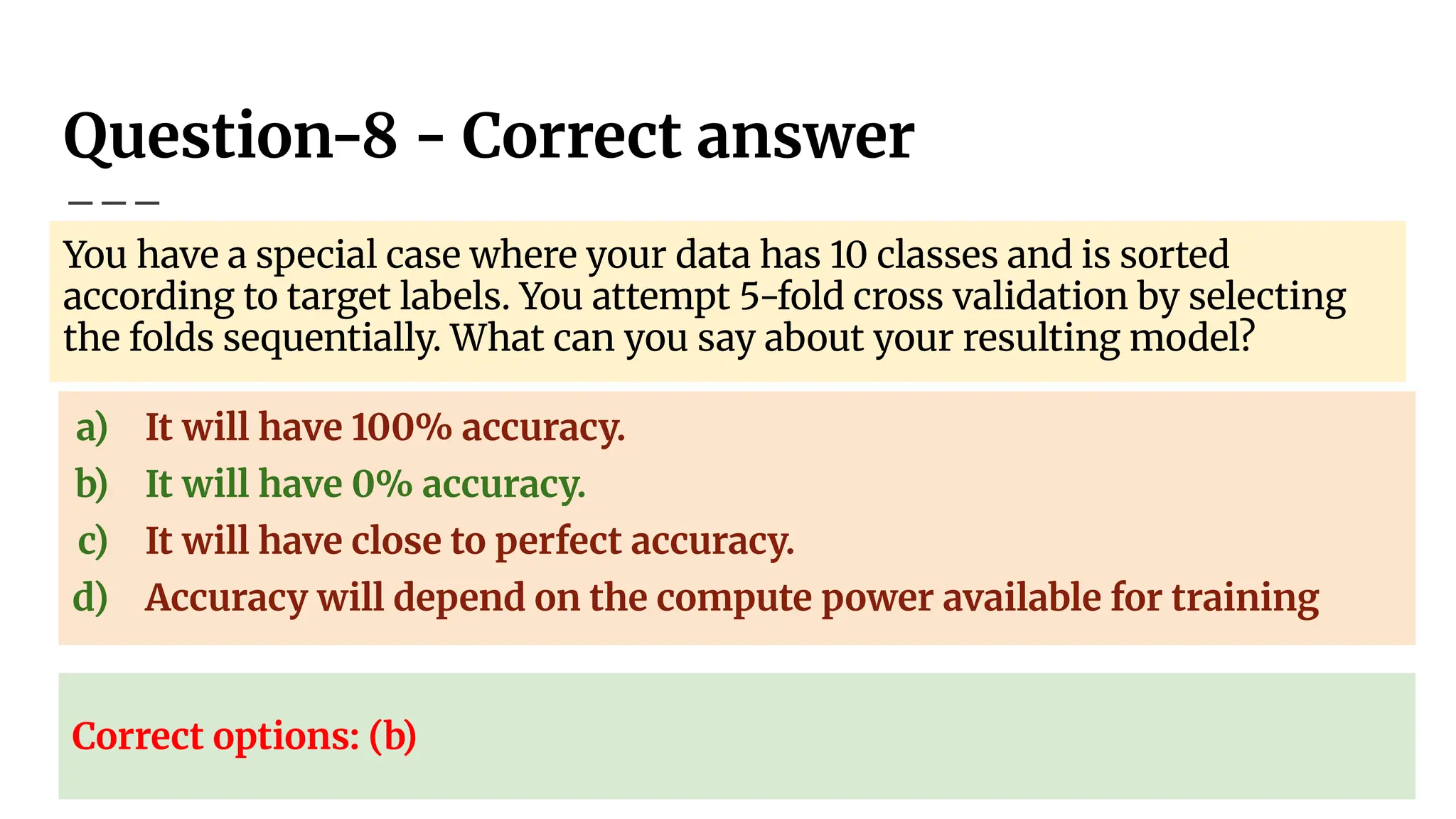
Question-8 - Correctanswer
You have a special case where your data has 10 classes and is sorted
according to target labels. You attempt 5-fold cross validation by selecting
the folds sequentially. What can you say about your resulting model?
a) It will have 100% accuracy.
b) It will have 0% accuracy.
c) It will have close to perfect accuracy.
d) Accuracy will depend on the compute power available for training
Correct options: (b)
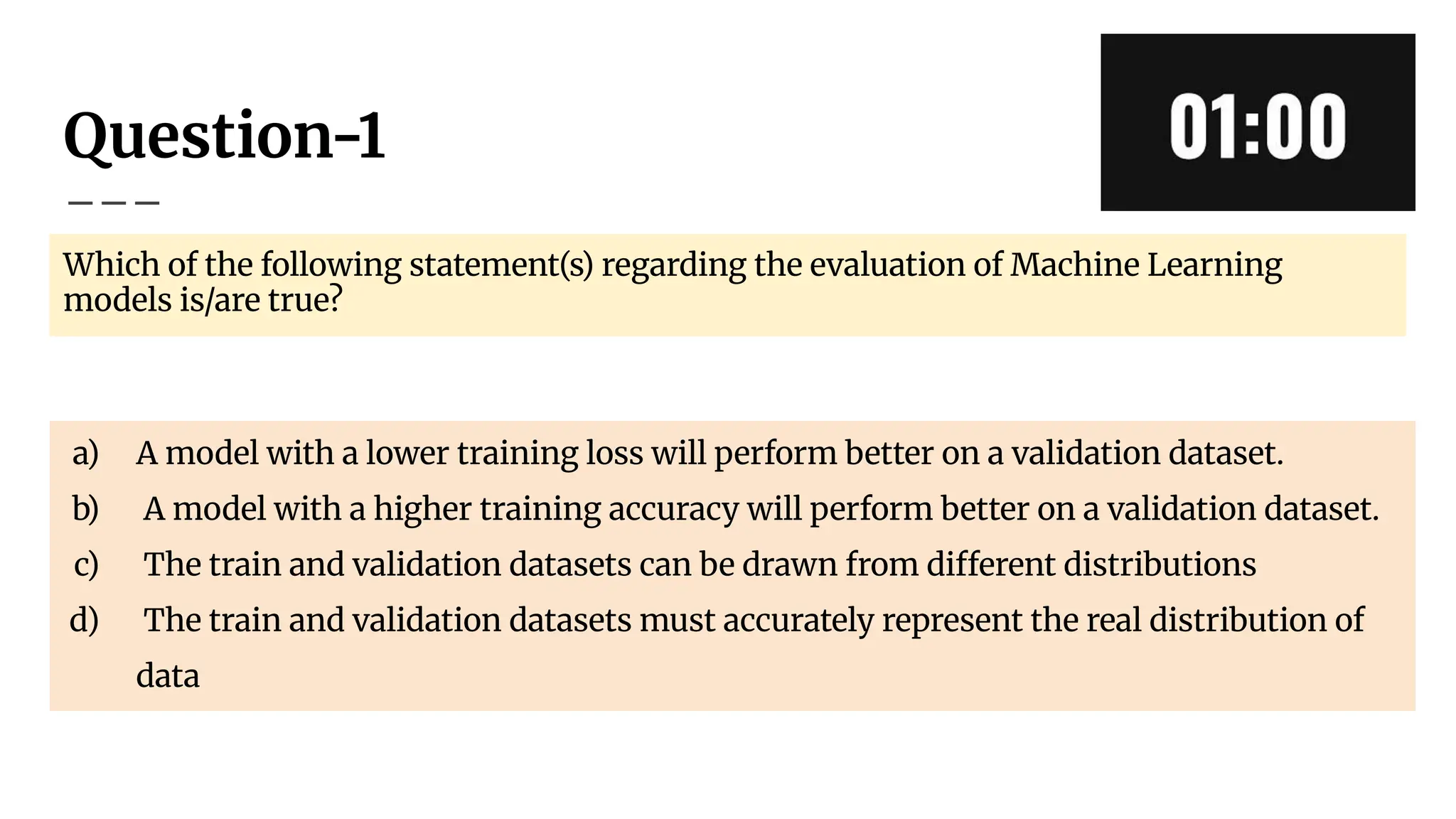
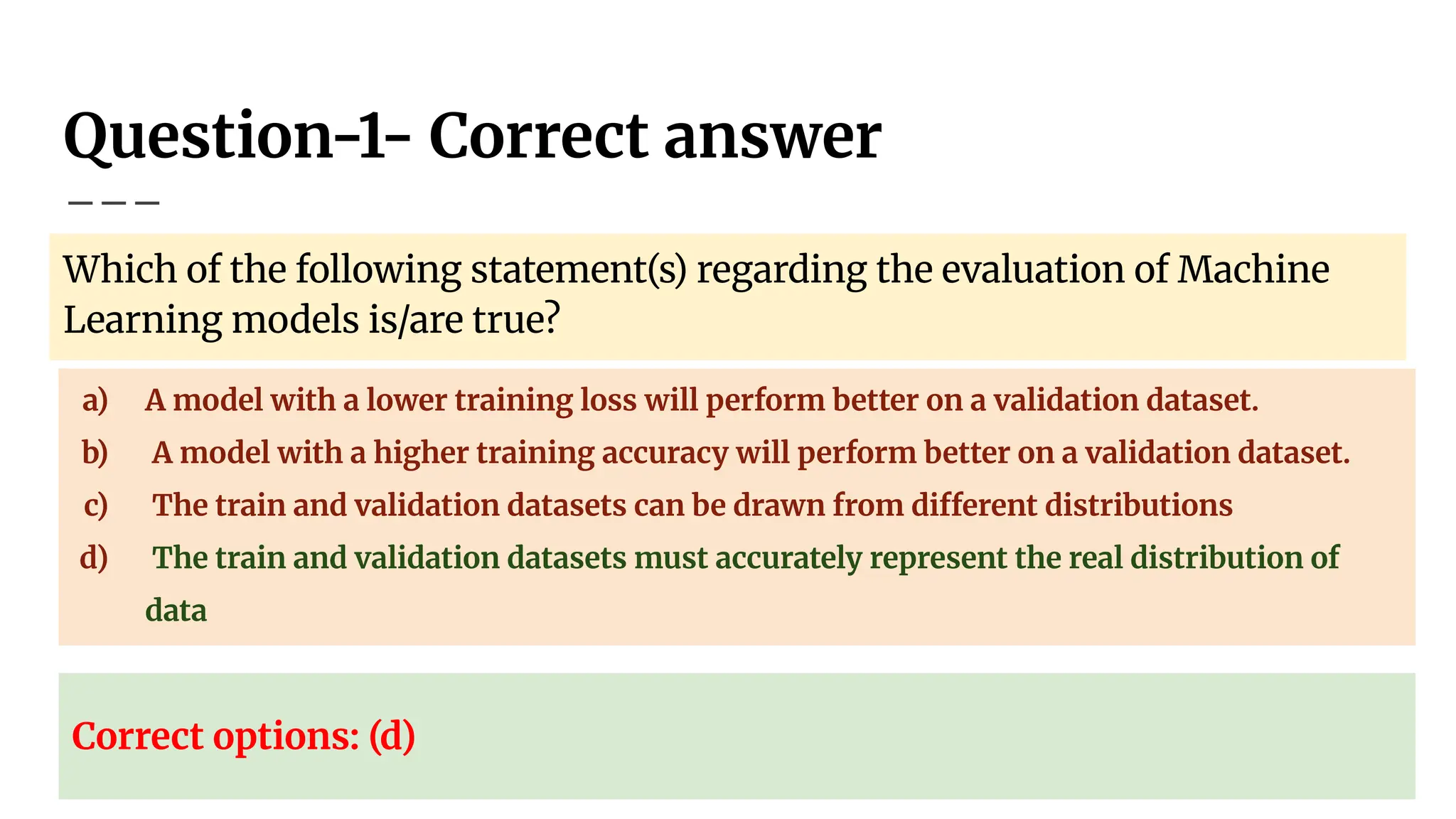
Question-1
Which of thefollowing statement(s) regarding the evaluation of Machine Learning
models is/are true?
a) A model with a lower training loss will perform better on a validation dataset.
b) A model with a higher training accuracy will perform better on a validation dataset.
c) The train and validation datasets can be drawn from different distributions
d) The train and validation datasets must accurately represent the real distribution of
data
100.
Question-1- Correct answer
Whichof the following statement(s) regarding the evaluation of Machine
Learning models is/are true?
a) A model with a lower training loss will perform better on a validation dataset.
b) A model with a higher training accuracy will perform better on a validation dataset.
c) The train and validation datasets can be drawn from different distributions
d) The train and validation datasets must accurately represent the real distribution of
data
Correct options: (d)
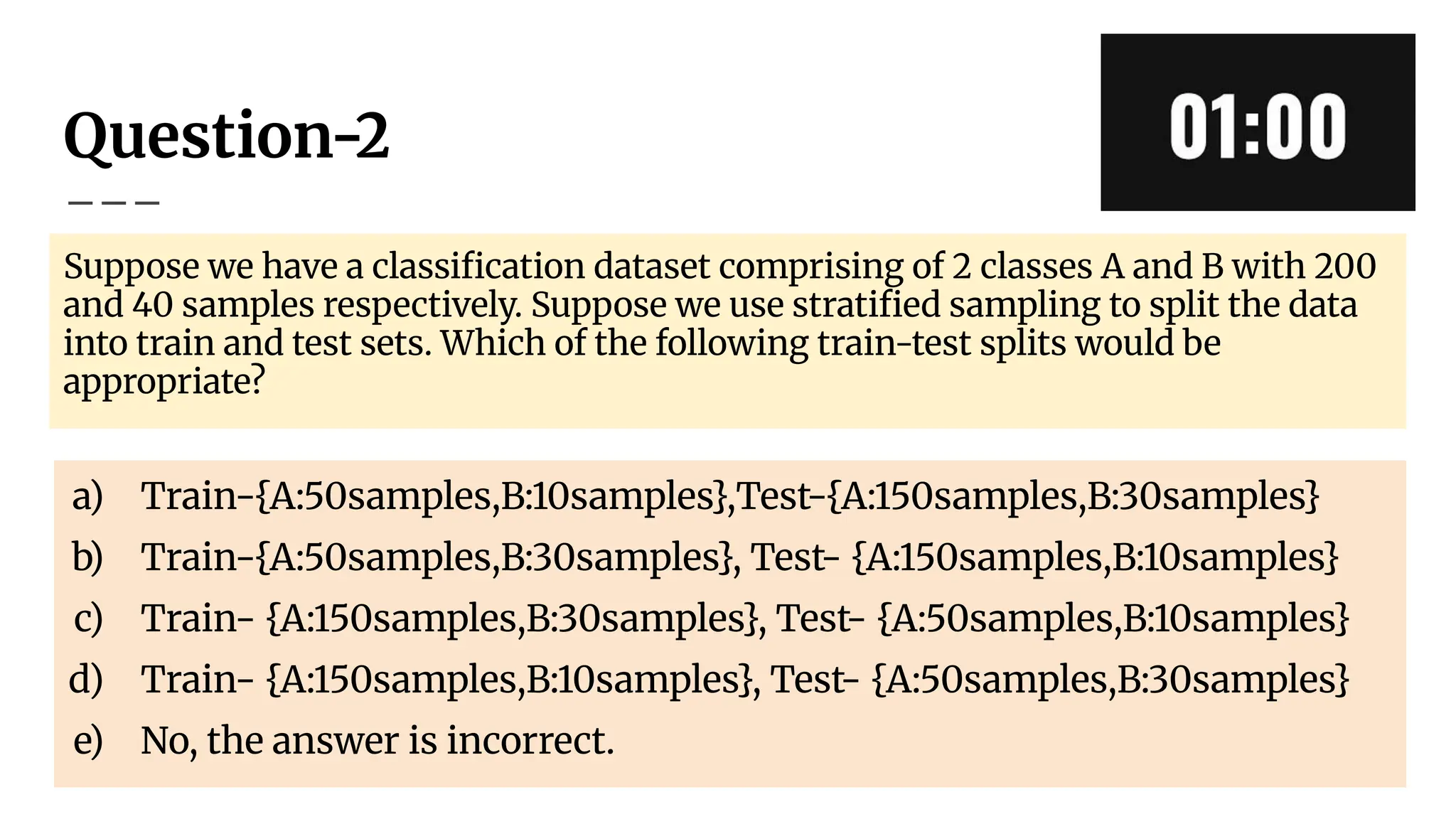
101.
Question-2
Suppose we havea classification dataset comprising of 2 classes A and B with 200
and 40 samples respectively. Suppose we use stratified sampling to split the data
into train and test sets. Which of the following train-test splits would be
appropriate?
a) Train-{A:50samples,B:10samples},Test-{A:150samples,B:30samples}
b) Train-{A:50samples,B:30samples}, Test- {A:150samples,B:10samples}
c) Train- {A:150samples,B:30samples}, Test- {A:50samples,B:10samples}
d) Train- {A:150samples,B:10samples}, Test- {A:50samples,B:30samples}
e) No, the answer is incorrect.
102.
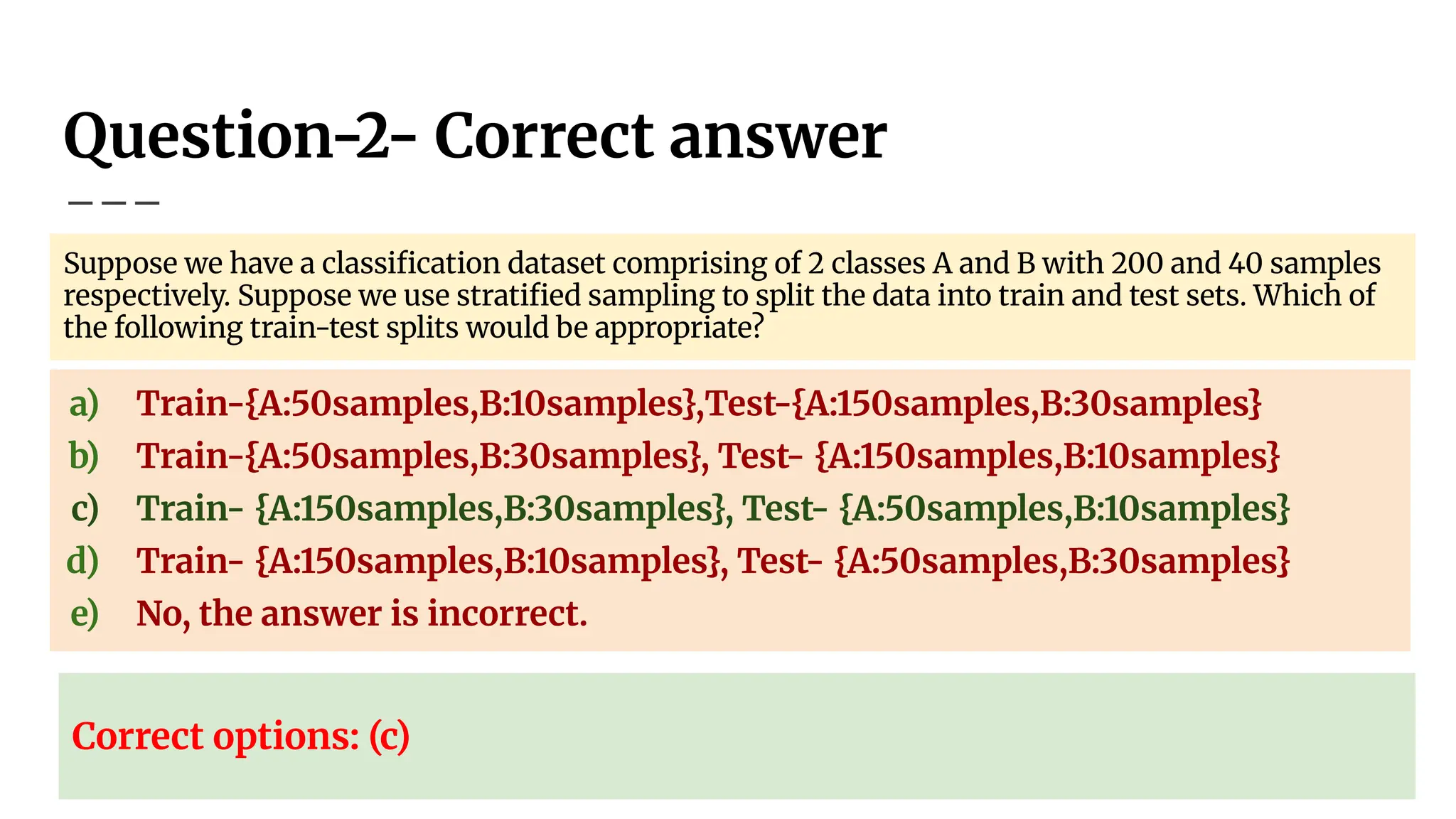
Question-2- Correct answer
Supposewe have a classification dataset comprising of 2 classes A and B with 200 and 40 samples
respectively. Suppose we use stratified sampling to split the data into train and test sets. Which of
the following train-test splits would be appropriate?
a) Train-{A:50samples,B:10samples},Test-{A:150samples,B:30samples}
b) Train-{A:50samples,B:30samples}, Test- {A:150samples,B:10samples}
c) Train- {A:150samples,B:30samples}, Test- {A:50samples,B:10samples}
d) Train- {A:150samples,B:10samples}, Test- {A:50samples,B:30samples}
e) No, the answer is incorrect.
Correct options: (c)
103.
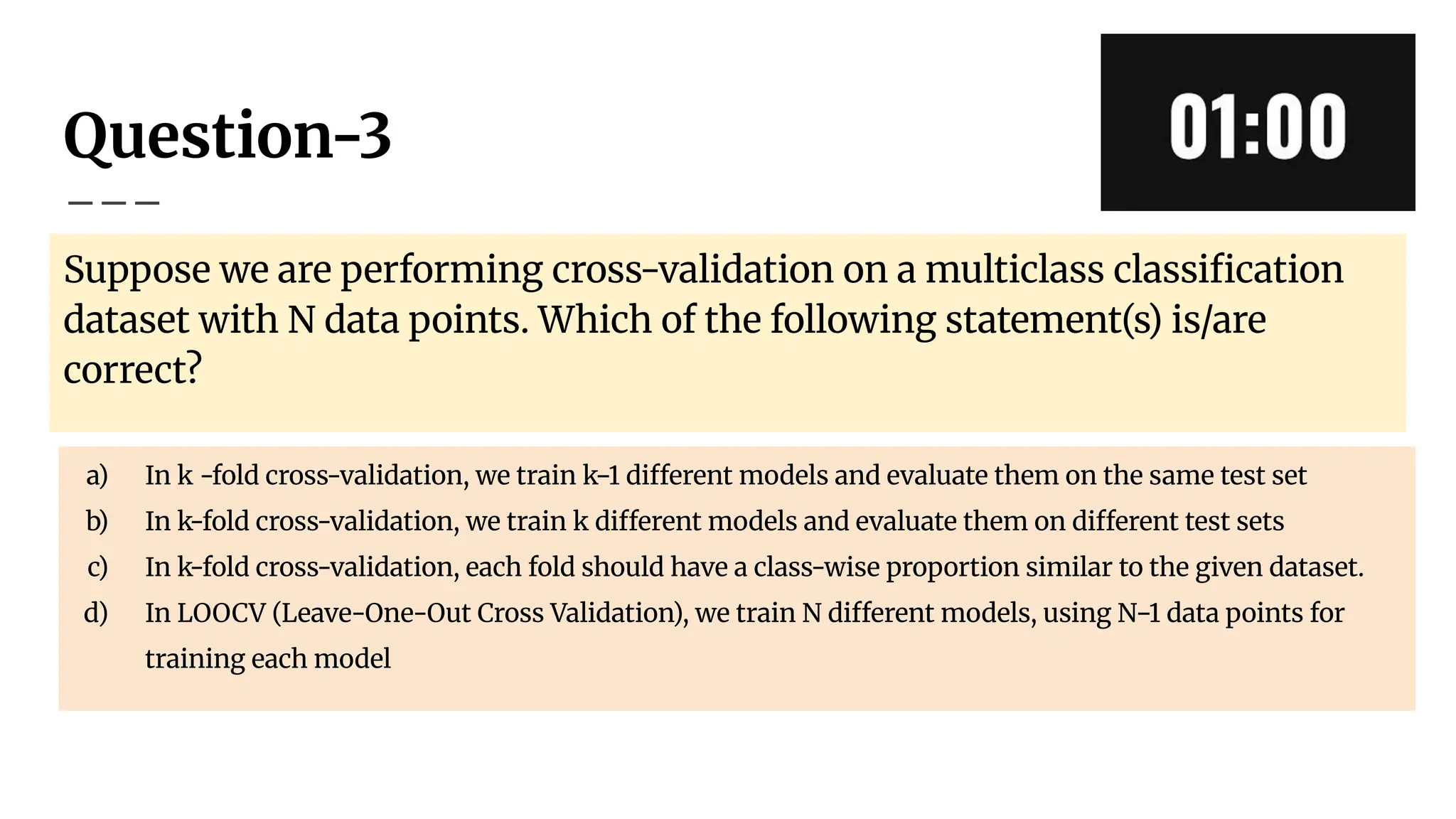
Question-3
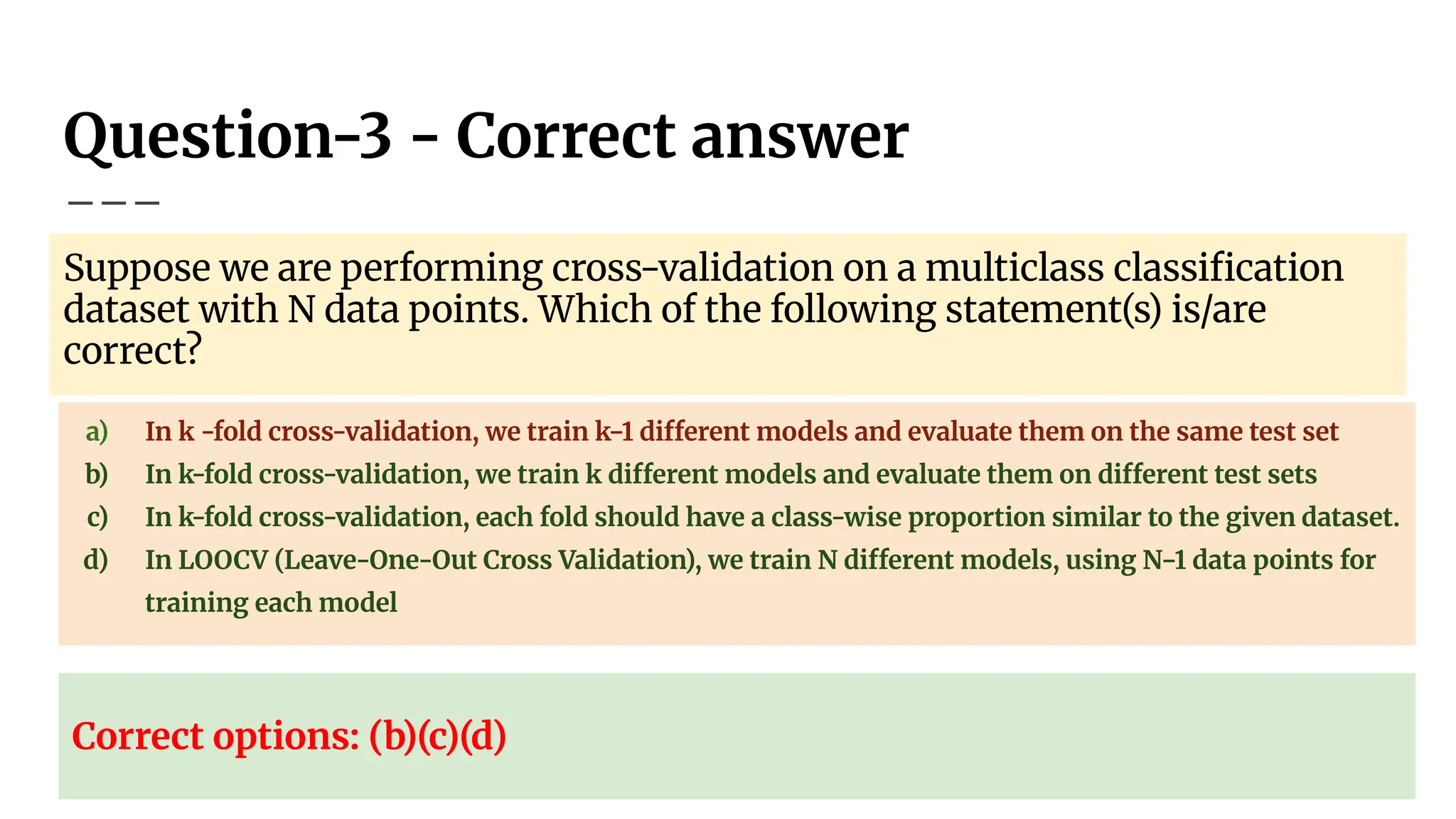
Suppose we areperforming cross-validation on a multiclass classification
dataset with N data points. Which of the following statement(s) is/are
correct?
a) In k -fold cross-validation, we train k−1 different models and evaluate them on the same test set
b) In k-fold cross-validation, we train k different models and evaluate them on different test sets
c) In k-fold cross-validation, each fold should have a class-wise proportion similar to the given dataset.
d) In LOOCV (Leave-One-Out Cross Validation), we train N different models, using N−1 data points for
training each model
104.
Question-3 - Correctanswer
Suppose we are performing cross-validation on a multiclass classification
dataset with N data points. Which of the following statement(s) is/are
correct?
a) In k -fold cross-validation, we train k−1 different models and evaluate them on the same test set
b) In k-fold cross-validation, we train k different models and evaluate them on different test sets
c) In k-fold cross-validation, each fold should have a class-wise proportion similar to the given dataset.
d) In LOOCV (Leave-One-Out Cross Validation), we train N different models, using N−1 data points for
training each model
Correct options: (b)(c)(d)
105.
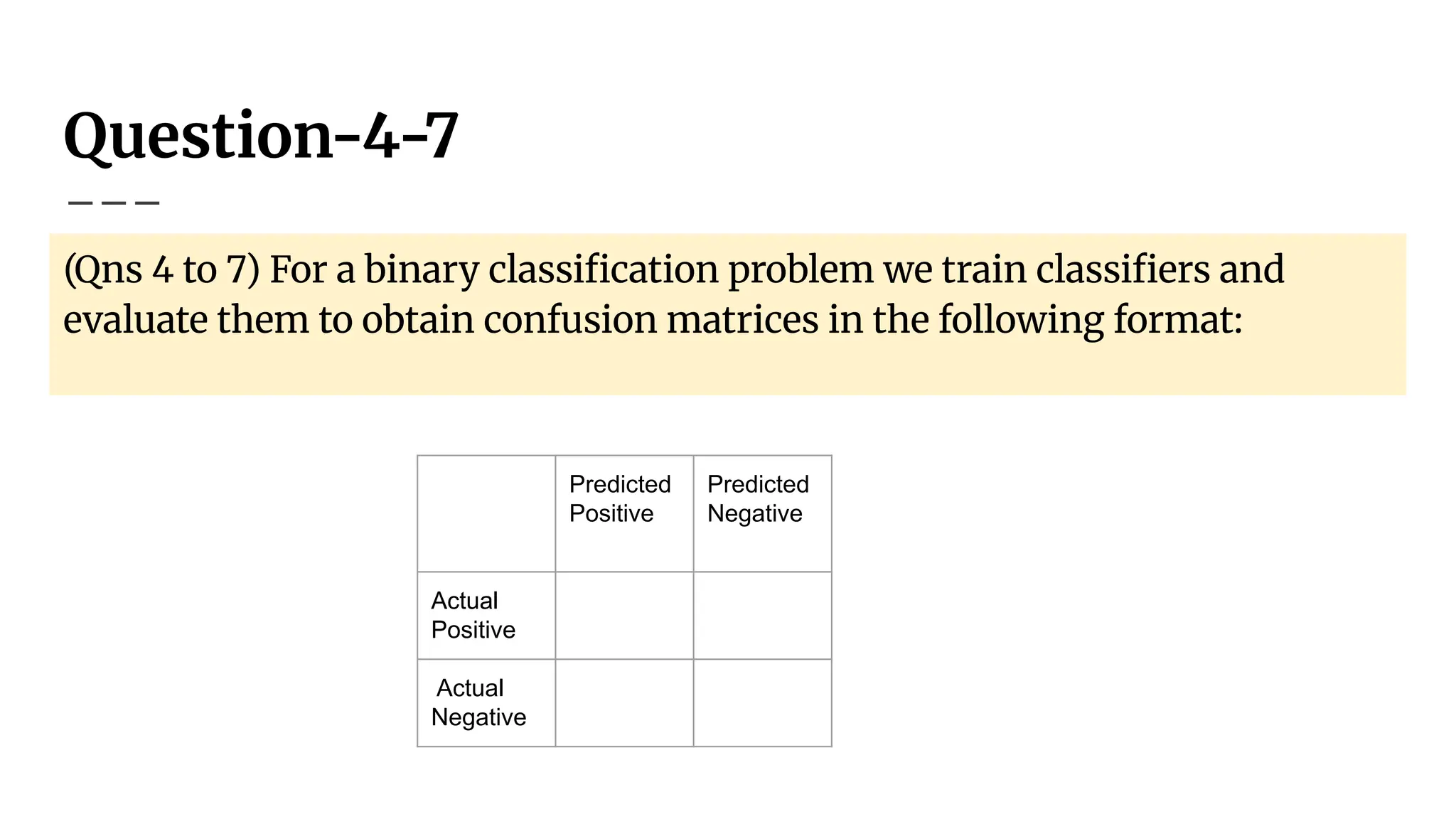
Question-4-7
(Qns 4 to7) For a binary classification problem we train classifiers and
evaluate them to obtain confusion matrices in the following format:
Predicted
Positive
Predicted
Negative
Actual
Positive
Actual
Negative
106.
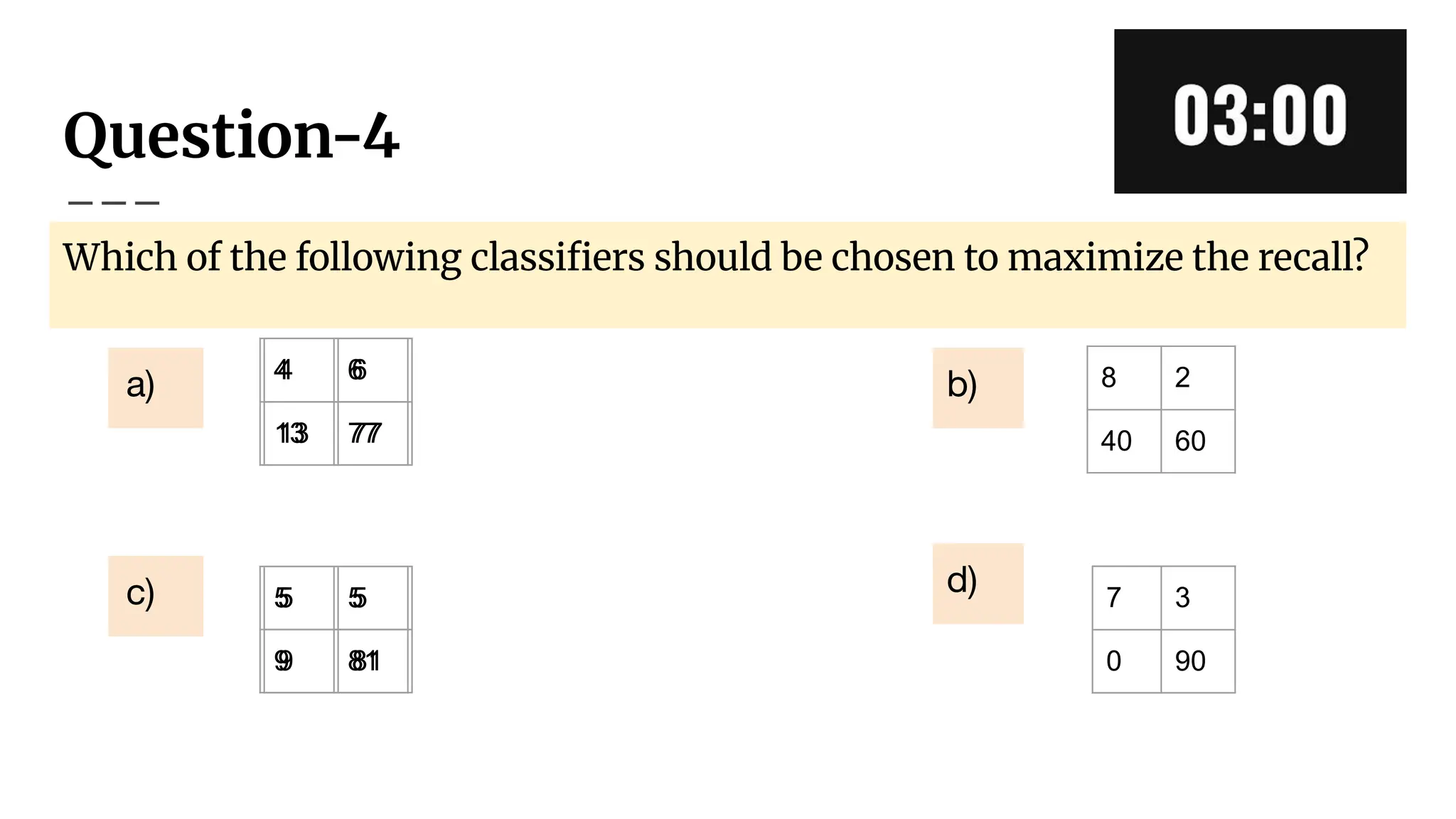
Question-4
Which of thefollowing classifiers should be chosen to maximize the recall?
4 6
13 77
a)
5 5
9 81
8 2
40 60
7 3
0 90
c)
b)
d)
4 6
13 77
a)
5 5
9 81
c)
107.
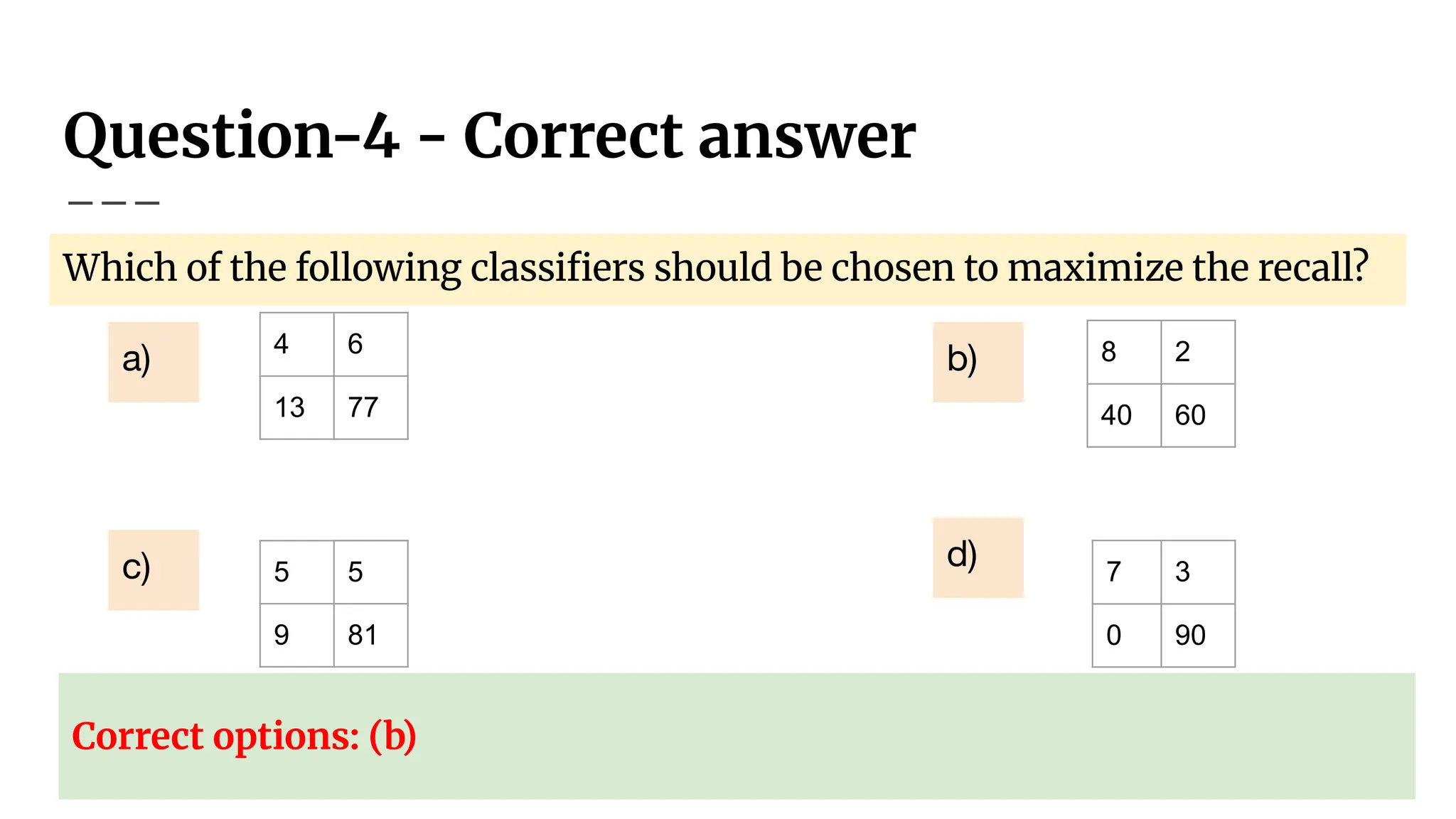
Question-4 - Correctanswer
Which of the following classifiers should be chosen to maximize the recall?
Correct options: (b)
4 6
13 77
a)
5 5
9 81
8 2
40 60
7 3
0 90
c)
b)
d)
108.
Question-5
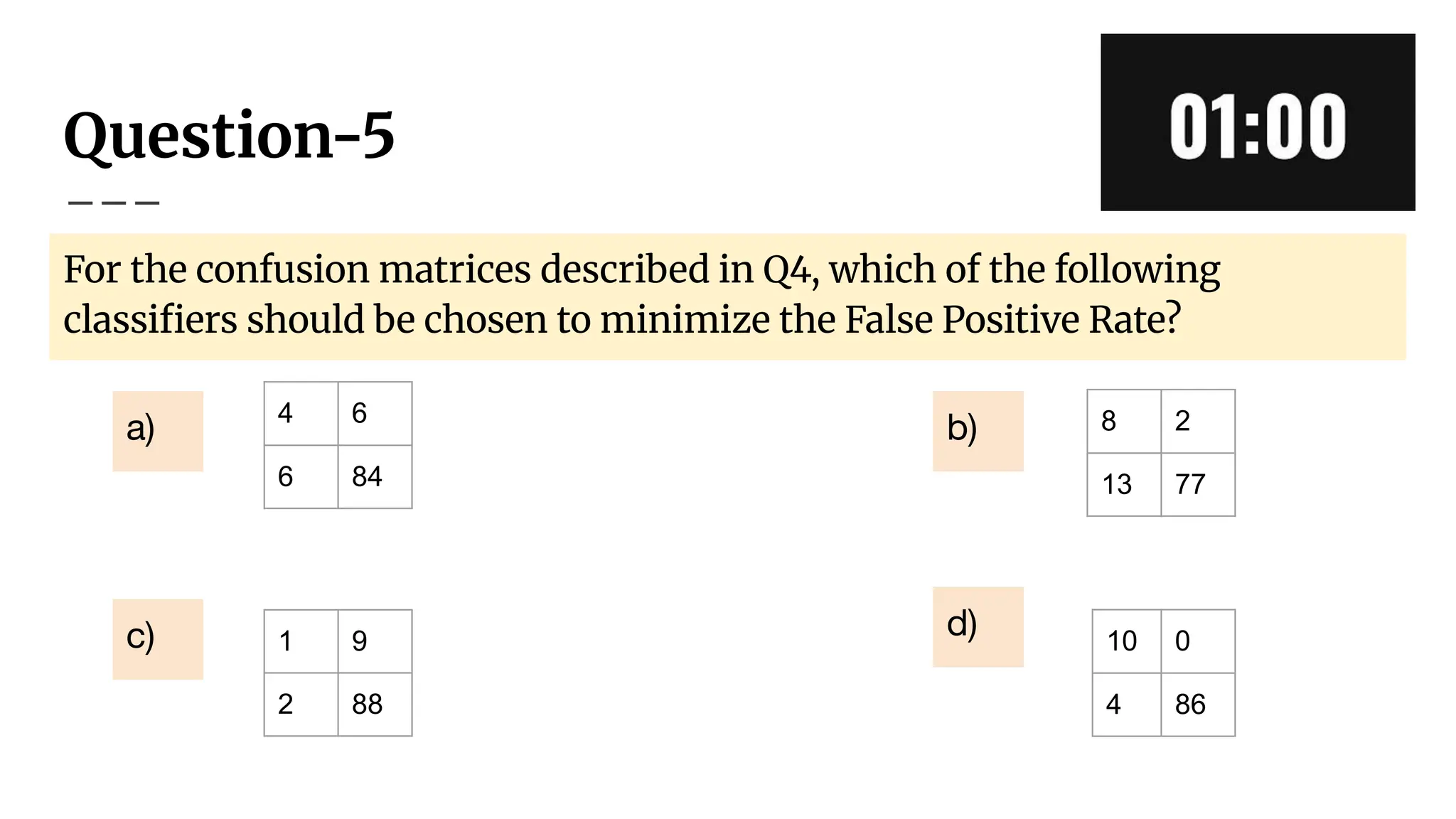
For the confusionmatrices described in Q4, which of the following
classifiers should be chosen to minimize the False Positive Rate?
8 2
13 77
10 0
4 86
b)
d)
4 6
6 84
a)
1 9
2 88
c)
109.
Question-5 - Correctanswer
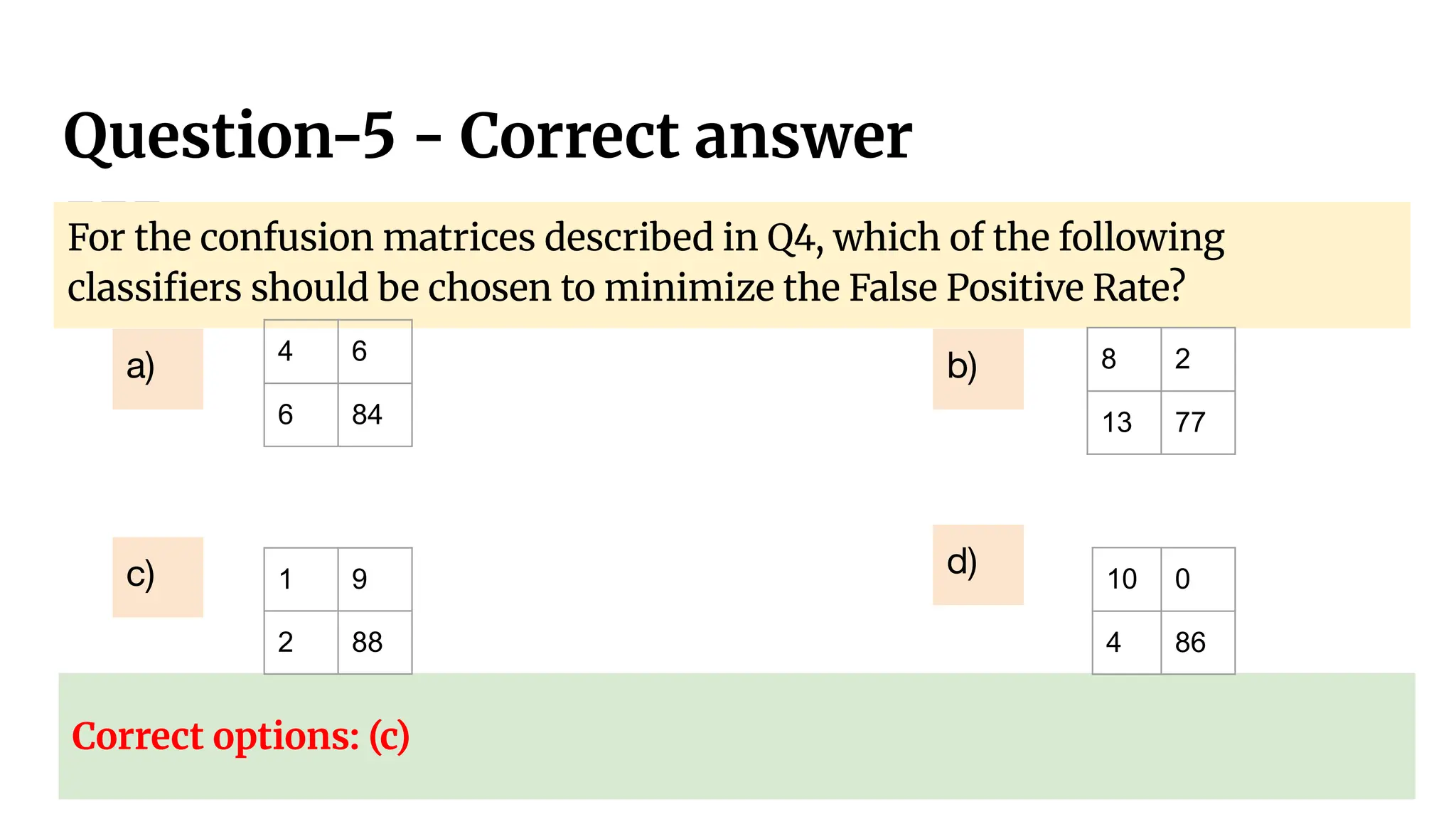
For the confusion matrices described in Q4, which of the following
classifiers should be chosen to minimize the False Positive Rate?
Correct options: (c)
8 2
13 77
10 0
4 86
b)
d)
4 6
6 84
a)
1 9
2 88
c)
110.
Question-6
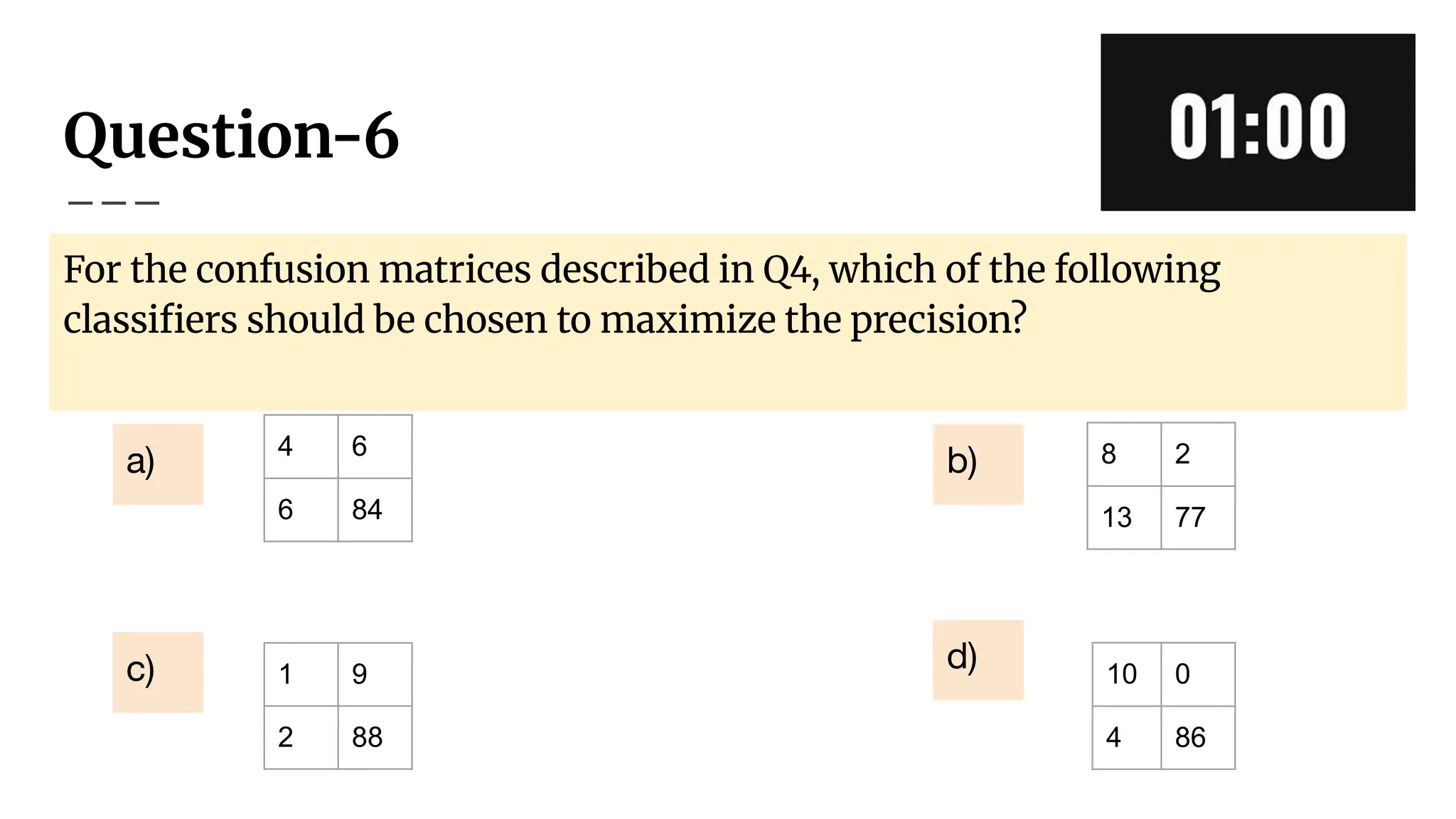
For the confusionmatrices described in Q4, which of the following
classifiers should be chosen to maximize the precision?
8 2
13 77
10 0
4 86
b)
d)
4 6
6 84
a)
1 9
2 88
c)
111.
Question-6 - Correctanswer
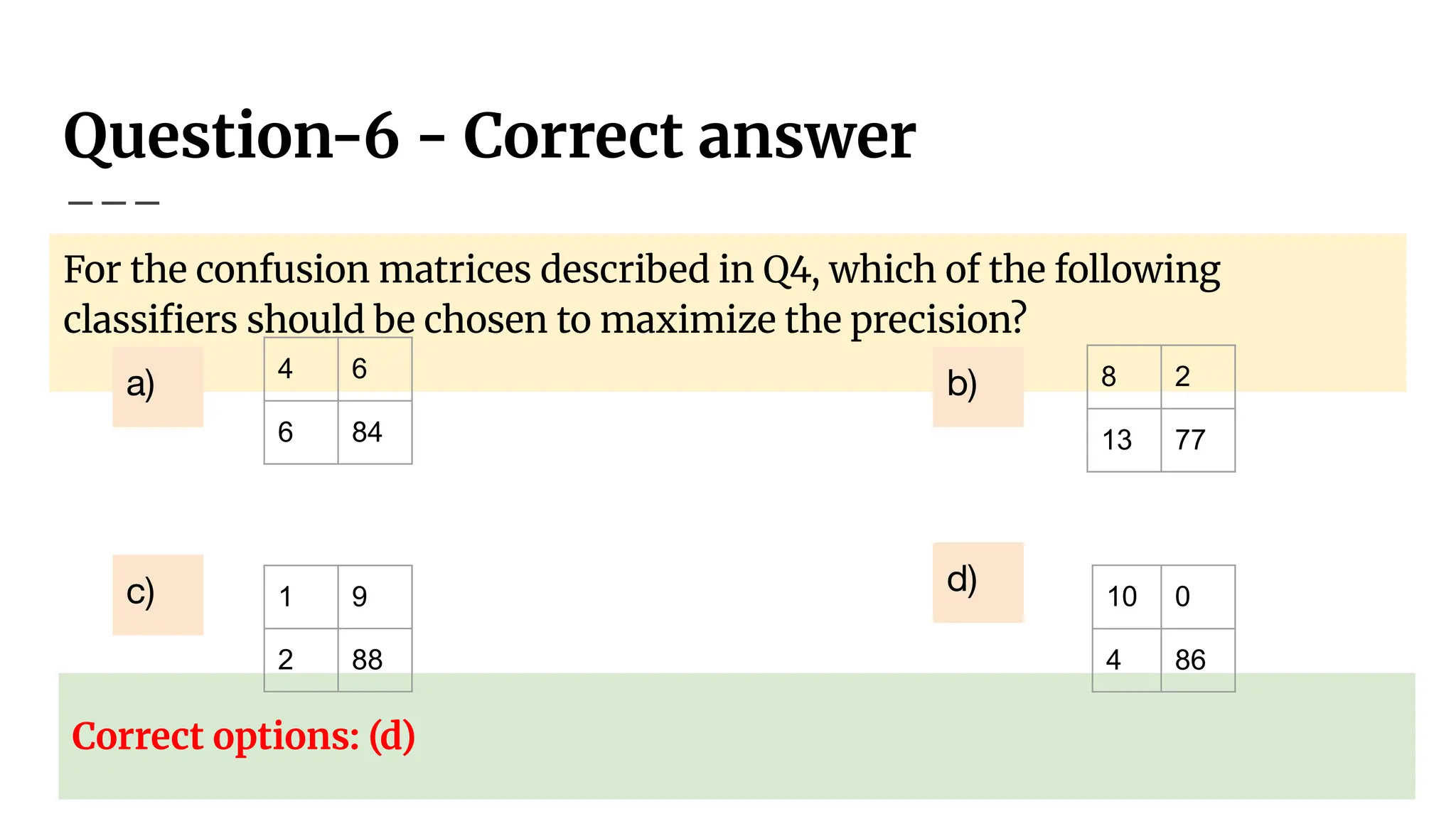
For the confusion matrices described in Q4, which of the following
classifiers should be chosen to maximize the precision?
Correct options: (d)
8 2
13 77
10 0
4 86
b)
d)
4 6
6 84
a)
1 9
2 88
c)
112.
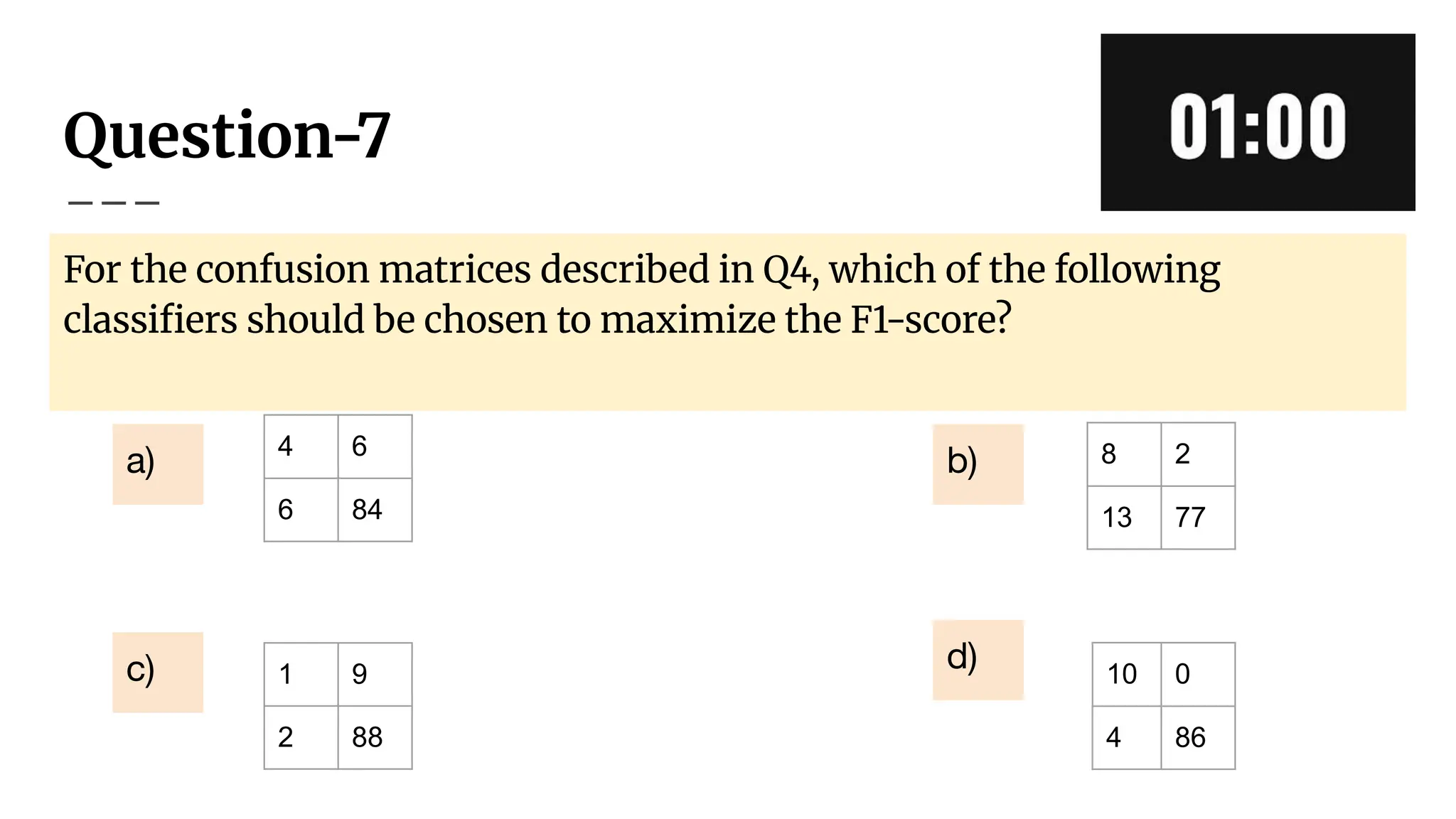
Question-7
For the confusionmatrices described in Q4, which of the following
classifiers should be chosen to maximize the F1-score?
8 2
13 77
10 0
4 86
b)
d)
4 6
6 84
a)
1 9
2 88
c)
113.
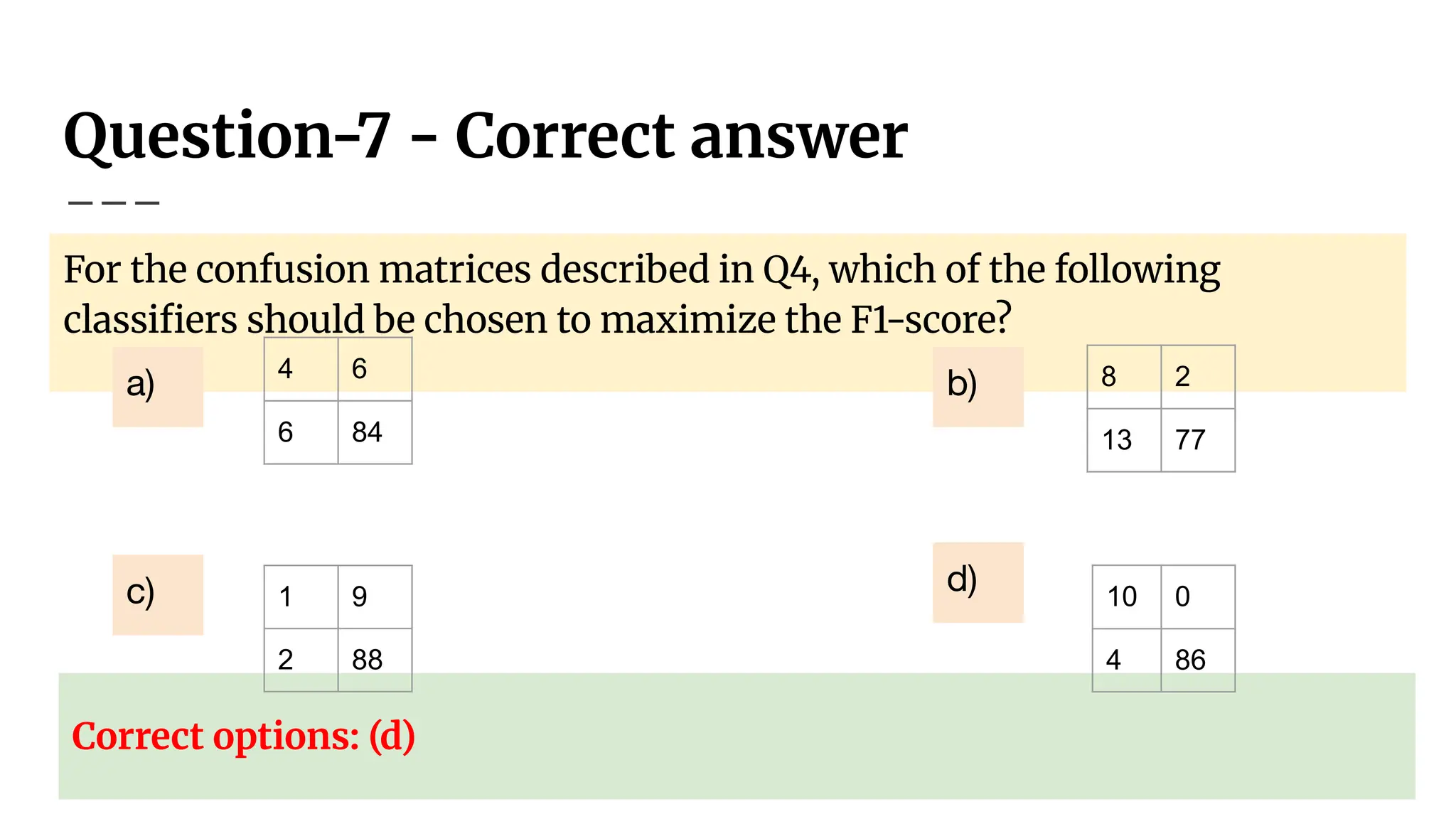
Question-7 - Correctanswer
For the confusion matrices described in Q4, which of the following
classifiers should be chosen to maximize the F1-score?
Correct options: (d)
8 2
13 77
10 0
4 86
b)
d)
4 6
6 84
a)
1 9
2 88
c)
114.
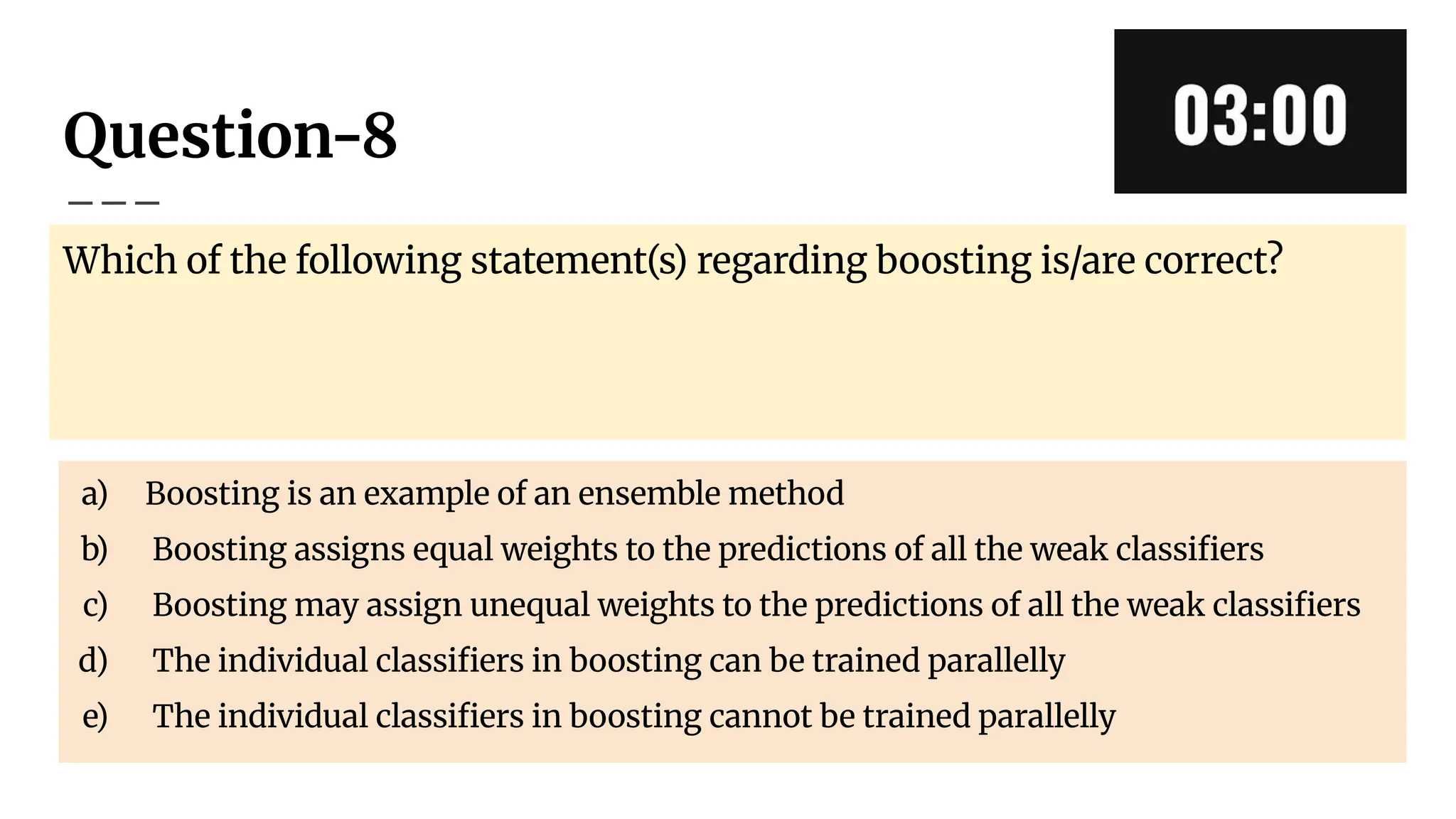
Question-8
Which of thefollowing statement(s) regarding boosting is/are correct?
a) Boosting is an example of an ensemble method
b) Boosting assigns equal weights to the predictions of all the weak classifiers
c) Boosting may assign unequal weights to the predictions of all the weak classifiers
d) The individual classifiers in boosting can be trained parallelly
e) The individual classifiers in boosting cannot be trained parallelly
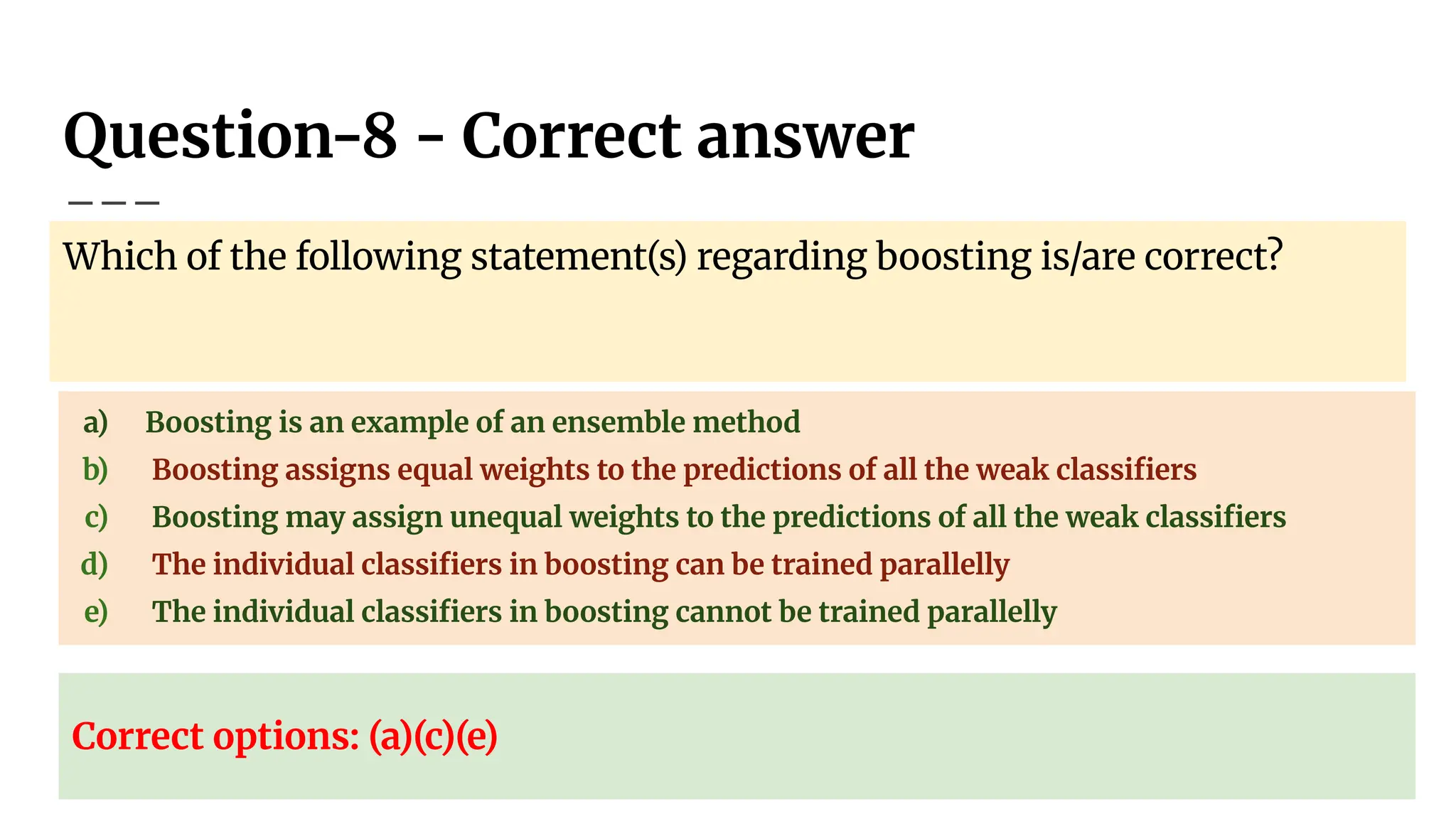
115.
Question-8 - Correctanswer
Which of the following statement(s) regarding boosting is/are correct?
a) Boosting is an example of an ensemble method
b) Boosting assigns equal weights to the predictions of all the weak classifiers
c) Boosting may assign unequal weights to the predictions of all the weak classifiers
d) The individual classifiers in boosting can be trained parallelly
e) The individual classifiers in boosting cannot be trained parallelly
Correct options: (a)(c)(e)
116.
Question-9
Which of thefollowing statement(s) about bagging is/are correct?
a) Bagging is an example of an ensemble method
b) The individual classifiers in bagging can be trained in parallel
c) Training sets are constructed from the original dataset by sampling with replacement
d) Training sets are constructed from the original dataset by sampling without replacement
e) Bagging increases the variance of an unstable classifier.
117.
Question-9 - Correctanswer
Which of the following statement(s) about bagging is/are correct?
a) Bagging is an example of an ensemble method
b) The individual classifiers in bagging can be trained in parallel
c) Training sets are constructed from the original dataset by sampling with replacement
d) Training sets are constructed from the original dataset by sampling without replacement
e) Bagging increases the variance of an unstable classifier.
Correct options: (a)(b)(c)
118.
Question-10
Which of thefollowing statement(s) about ensemble methods is/are correct?
a) Ensemble aggregation methods like bagging aim to reduce overfitting and variance
b) Committee machines may consist of different types of classifiers
c) Weak learners are models that perform slightly worse than random guessing
d) Stacking involves training multiple models and stacking their predictions into new
training data
119.
Question-10 - Correctanswer
Which of the following statement(s) about ensemble methods is/are correct?
a) Ensemble aggregation methods like bagging aim to reduce overfitting and variance
b) Committee machines may consist of different types of classifiers
c) Weak learners are models that perform slightly worse than random guessing
d) Stacking involves training multiple models and stacking their predictions into new
training data
Correct options: (a)(b)(d)
![Example
Suppose we classify an image using three different models:
Classifier 1 → predicts "Class 1"
Classifier 2 → predicts "Class 2"
Classifier 3 → predicts "Class 1"
Instead of choosing one arbitrarily, we pass [Class 1, Class 2, Class 1] as input to a
meta-classifier (h) that learns how to weigh these predictions.](https://image.slidesharecdn.com/week-71-250907173835-5ebfc267/75/Confussion-Matrix-in-Machine-Learning-pdf-67-2048.jpg)