BAYESIAN
LEARNING
22, 23, 30
BAYES THEOREM
• Bayesian learning algorithms that calculate
explicit probabilities for hypotheses, such as
the naive Bayes classifier
• researchers show that the naive Bayes
classifier is competitive with decision tree and
neural network algorithms.
Features of Bayesian learning
• Each observed training example can
incrementally decrease or increase the
estimated probability that a hypothesis is
correct
• Prior knowledge can be combined with
observed data to determine the final
probability of a hypothesis
Features of Bayesian learning
• Bayesian methods can accommodate
hypotheses that make probabilistic
predictions
– this pneumonia patient has a 93% chance of
complete recovery")
• New instances can be classified by combining
the predictions of multiple hypotheses,
weighted by their probabilities
BAYES THEOREM
• determining the best hypothesis from some
space H, given the observed training data D
• the most probable hypothesis, given the data
D plus any initial knowledge
• calculate the probability of a hypothesis based
on its prior probability, the probabilities of
observing various data given the hypothesis,
and the observed data itself.
BAYES THEOREM
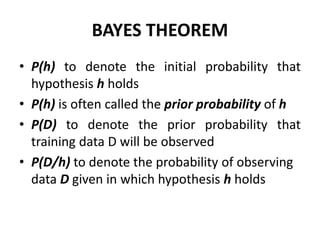
• P(h) to denote the initial probability that
hypothesis h holds
• P(h) is often called the prior probability of h
• P(D) to denote the prior probability that
training data D will be observed
• P(D/h) to denote the probability of observing
data D given in which hypothesis h holds
BAYES THEOREM
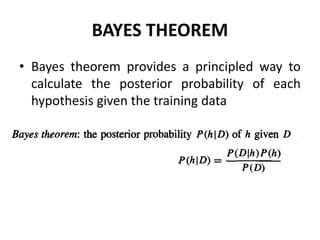
• Bayes theorem provides a principled way to
calculate the posterior probability of each
hypothesis given the training data
BAYES THEOREM
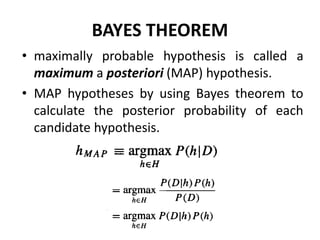
• maximally probable hypothesis is called a
maximum a posteriori (MAP) hypothesis.
• MAP hypotheses by using Bayes theorem to
calculate the posterior probability of each
candidate hypothesis.
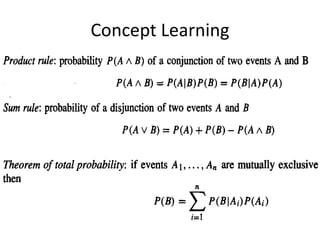
Concept Learning
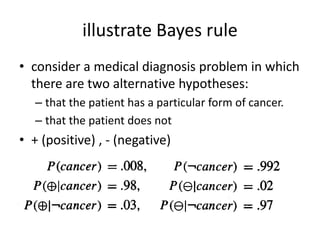
illustrate Bayes rule
• consider a medical diagnosis problem in which
there are two alternative hypotheses:
– that the patient has a particular form of cancer.
– that the patient does not
• + (positive) , - (negative)
illustrate Bayes rule
• We have prior knowledge that over the entire
population of people only .008 have this
disease.
• a correct positive result in only 98% of the
cases in which the disease is actually present
and a correct negative result in only 97% of
the cases in which the disease is not present.
illustrate Bayes rule
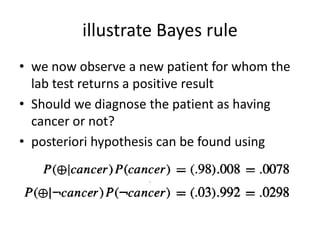
• we now observe a new patient for whom the
lab test returns a positive result
• Should we diagnose the patient as having
cancer or not?
• posteriori hypothesis can be found using

Bayesian learning

  • 1.
  • 2.
    BAYES THEOREM • Bayesianlearning algorithms that calculate explicit probabilities for hypotheses, such as the naive Bayes classifier • researchers show that the naive Bayes classifier is competitive with decision tree and neural network algorithms.
  • 3.
    Features of Bayesianlearning • Each observed training example can incrementally decrease or increase the estimated probability that a hypothesis is correct • Prior knowledge can be combined with observed data to determine the final probability of a hypothesis
  • 4.
    Features of Bayesianlearning • Bayesian methods can accommodate hypotheses that make probabilistic predictions – this pneumonia patient has a 93% chance of complete recovery") • New instances can be classified by combining the predictions of multiple hypotheses, weighted by their probabilities
  • 5.
    BAYES THEOREM • determiningthe best hypothesis from some space H, given the observed training data D • the most probable hypothesis, given the data D plus any initial knowledge • calculate the probability of a hypothesis based on its prior probability, the probabilities of observing various data given the hypothesis, and the observed data itself.
  • 6.
    BAYES THEOREM • P(h)to denote the initial probability that hypothesis h holds • P(h) is often called the prior probability of h • P(D) to denote the prior probability that training data D will be observed • P(D/h) to denote the probability of observing data D given in which hypothesis h holds
  • 7.
    BAYES THEOREM • Bayestheorem provides a principled way to calculate the posterior probability of each hypothesis given the training data
  • 8.
    BAYES THEOREM • maximallyprobable hypothesis is called a maximum a posteriori (MAP) hypothesis. • MAP hypotheses by using Bayes theorem to calculate the posterior probability of each candidate hypothesis.
  • 9.
  • 10.
    illustrate Bayes rule •consider a medical diagnosis problem in which there are two alternative hypotheses: – that the patient has a particular form of cancer. – that the patient does not • + (positive) , - (negative)
  • 11.
    illustrate Bayes rule •We have prior knowledge that over the entire population of people only .008 have this disease. • a correct positive result in only 98% of the cases in which the disease is actually present and a correct negative result in only 97% of the cases in which the disease is not present.
  • 12.
    illustrate Bayes rule •we now observe a new patient for whom the lab test returns a positive result • Should we diagnose the patient as having cancer or not? • posteriori hypothesis can be found using