Decision Trees
This course content is being actively
developed by Delta Analytics, a 501(c)3
Bay Area nonprofit that aims to
empower communities to leverage their
data for good.
Please reach out with any questions or
feedback to inquiry@deltanalytics.org.
Find out more about our mission here.
Delta Analytics builds technical capacity
around the world.
Module 5:
Decision trees
❏ Decision trees
❏ Intuition
❏ The “best” split
❏ Model performance
❏ Model optimization (pruning)
Module Checklist:
Where are we?
We’ve laid much of the groundwork for machine learning, and
introduced our very first algorithm of linear regression.
Now, we can focus on expanding our algorithm toolkit. Decision
trees are another type of algorithm that can accomplish the
same objective of prediction that linear regression can. We will
also go deeper into the pros and cons of decision trees in this
module.
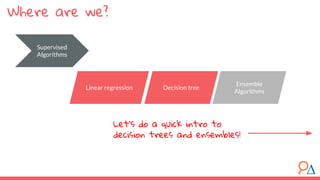
Where are we?
Supervised
Algorithms
Let’s do a quick intro to
decision trees and ensembles!
Linear regression Decision tree
Ensemble
Algorithms
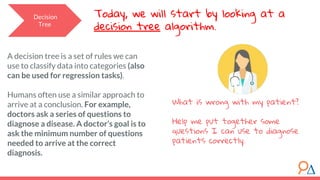
Decision
Tree
Today, we will start by looking at a
decision tree algorithm.
A decision tree is a set of rules we can
use to classify data into categories (also
can be used for regression tasks).
Humans often use a similar approach to
arrive at a conclusion. For example,
doctors ask a series of questions to
diagnose a disease. A doctor’s goal is to
ask the minimum number of questions
needed to arrive at the correct
diagnosis.
What is wrong with my patient?
Help me put together some
questions I can use to diagnose
patients correctly.
Decision
Tree
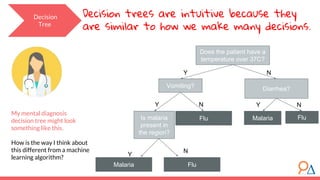
Decision trees are intuitive because they
are similar to how we make many decisions.
My mental diagnosis
decision tree might look
something like this.
How is the way I think about
this different from a machine
learning algorithm?
Does the patient have a
temperature over 37C?
Vomiting? Diarrhea?
NY
Malaria FluFluIs malaria
present in
the region?
Y Y NN
FluMalaria
N
Y
Decision
Tree
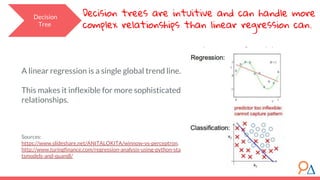
Decision trees are intuitive and can handle more
complex relationships than linear regression can.
A linear regression is a single global trend line.
This makes it inflexible for more sophisticated
relationships.
Sources:
https://www.slideshare.net/ANITALOKITA/winnow-vs-perceptron,
http://www.turingfinance.com/regression-analysis-using-python-sta
tsmodels-and-quandl/
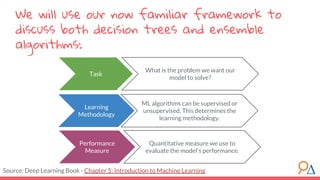
We will use our now familiar framework to
discuss both decision trees and ensemble
algorithms:
Task
What is the problem we want our
model to solve?
Performance
Measure
Quantitative measure we use to
evaluate the model’s performance.
Learning
Methodology
ML algorithms can be supervised or
unsupervised. This determines the
learning methodology.
Source: Deep Learning Book - Chapter 5: Introduction to Machine Learning
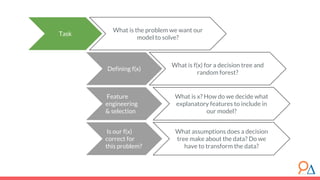
Task
What is the problem we want our
model to solve?
Defining f(x)
What is f(x) for a decision tree and
random forest?
Feature
engineering
& selection
What is x? How do we decide what
explanatory features to include in
our model?
What assumptions does a decision
tree make about the data? Do we
have to transform the data?
Is our f(x)
correct for
this problem?
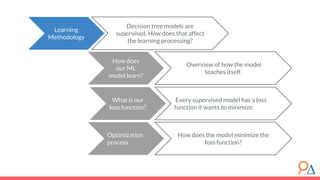
Learning
Methodology
Decision tree models are
supervised. How does that affect
the learning processing?
What is our
loss function?
Every supervised model has a loss
function it wants to minimize.
Optimization
process
How does the model minimize the
loss function?
How does
our ML
model learn?
Overview of how the model
teaches itself.
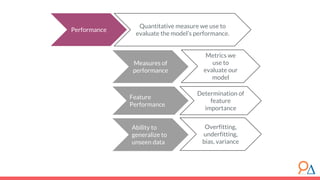
Performance
Quantitative measure we use to
evaluate the model’s performance.
Measures of
performance
Metrics we
use to
evaluate our
model
Feature
Performance
Determination of
feature
importance
Overfitting,
underfitting,
bias, variance
Ability to
generalize to
unseen data
Decision Tree
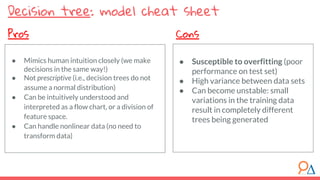
Decision tree: model cheat sheet
● Susceptible to overfitting (poor
performance on test set)
● High variance between data sets
● Can become unstable: small
variations in the training data
result in completely different
trees being generated
● Mimics human intuition closely (we make
decisions in the same way!)
● Not prescriptive (i.e., decision trees do not
assume a normal distribution)
● Can be intuitively understood and
interpreted as a flow chart, or a division of
feature space.
● Can handle nonlinear data (no need to
transform data)
Pros Cons
Task
Task
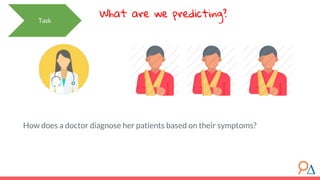
How does a doctor diagnose her patients based on their symptoms?
What are we predicting?
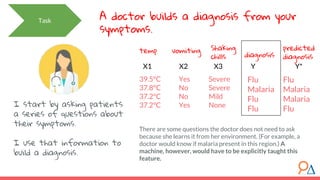
Task A doctor builds a diagnosis from your
symptoms.
I start by asking patients
a series of questions about
their symptoms.
I use that information to
build a diagnosis.
Flu
Malaria
Flu
Flu
diagnosis
Yes
No
No
Yes
Severe
Severe
Mild
None
Shaking
chills
vomitingtemp
X1 X2 X3 Y Y*
39.5°C
37.8°C
37.2°C
37.2°C
predicted
diagnosis
Flu
Malaria
Malaria
Flu
There are some questions the doctor does not need to ask
because she learns it from her environment. (For example, a
doctor would know if malaria present in this region.) A
machine, however, would have to be explicitly taught this
feature.
Task
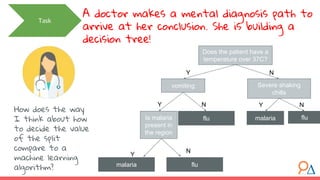
A doctor makes a mental diagnosis path to
arrive at her conclusion. She is building a
decision tree!
How does the way
I think about how
to decide the value
of the split
compare to a
machine learning
algorithm?
Does the patient have a
temperature over 37C?
vomiting Severe shaking
chills
NY
malaria flufluIs malaria
present in
the region
Y Y NN
flumalaria
N
Y
At each split, we can
determine the best
question to maximize the
number of observations
correctly grouped under
the right category.
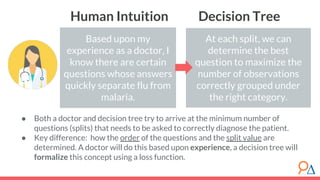
● Both a doctor and decision tree try to arrive at the minimum number of
questions (splits) that needs to be asked to correctly diagnose the patient.
● Key difference: how the order of the questions and the split value are
determined. A doctor will do this based upon experience, a decision tree will
formalize this concept using a loss function.
Based upon my
experience as a doctor, I
know there are certain
questions whose answers
quickly separate flu from
malaria.
Human Intuition Decision Tree
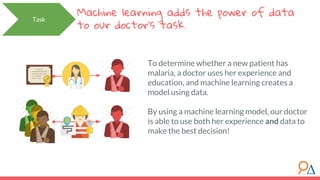
To determine whether a new patient has
malaria, a doctor uses her experience and
education, and machine learning creates a
model using data.
By using a machine learning model, our doctor
is able to use both her experience and data to
make the best decision!
Machine learning adds the power of data
to our doctor’s task.
Task
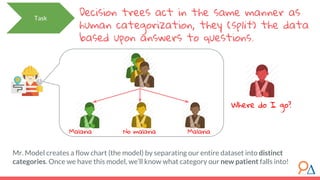
Mr. Model creates a flow chart (the model) by separating our entire dataset into distinct
categories. Once we have this model, we’ll know what category our new patient falls into!
Decision trees act in the same manner as
human categorization, they (split) the data
based upon answers to questions.
Where do I go?
Malaria MalariaNo malaria
Task
To get a sense of how this
“splitting” works, let’s play a
guessing game. I am thinking of
something that is blue.
You may ask 10 questions to
guess what it is.
The first few questions you would
probably ask may include:
- Is it alive? (No)
- Is it in nature? (Yes)
Then, as you got closer to the
answer, your questions would
become more specific.
- Is it solid or liquid? (Liquid)
- Is it the ocean? (Yes!)
Some winning strategies include:
● Use questions early on that
eliminate the most possibilities.
● Questions often start broad and
become more granular.
This process is your mental
decision tree. In fact, this
strategy captures many of the
qualities of our algorithm!
You created your own decision tree based on your own
experience of what you know is blue to make an educated
guess as to what I was thinking of (the ocean).
Similarly, a decision tree model will make an educated guess,
but instead of using experience, it uses data.
Now, let’s build a formal vocabulary for discussing decision
trees.
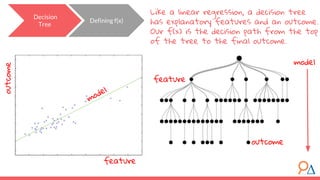
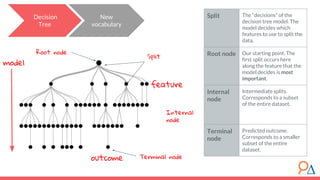
Like a linear regression, a decision tree
has explanatory features and an outcome.
Our f(x) is the decision path from the top
of the tree to the final outcome.
feature
feature
outcome
outcome
model
model
Decision
Tree
Defining f(x)
feature
outcome
model
Decision
Tree
New
vocabulary
Internal
node
Terminal node
Split
Split The “decisions” of the
decision tree model. The
model decides which
features to use to split the
data.
Root node Our starting point. The
first split occurs here
along the feature that the
model decides is most
important.
Internal
node
Intermediate splits.
Corresponds to a subset
of the entire dataset.
Terminal
node
Predicted outcome.
Corresponds to a smaller
subset of the entire
dataset.
Root node
Decision
Tree
New
vocabulary
Splits
Root node
Feature 2
Feature1
Feature3
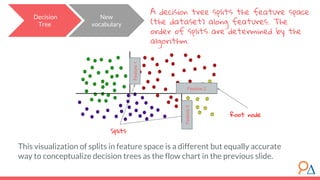
This visualization of splits in feature space is a different but equally accurate
way to conceptualize decision trees as the flow chart in the previous slide.
A decision tree splits the feature space
(the dataset) along features. The
order of splits are determined by the
algorithm.
Task
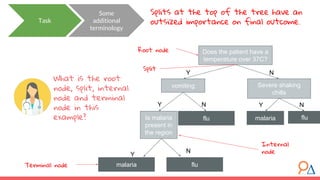
Splits at the top of the tree have an
outsized importance on final outcome.
What is the root
node, split, internal
node and terminal
node in this
example?
Does the patient have a
temperature over 37C?
vomiting Severe shaking
chills
NY
malaria flufluIs malaria
present in
the region
Y Y NN
flumalaria
N
Y
Some
additional
terminology
Internal
node
Terminal node
Split
Root node
Decision
Tree
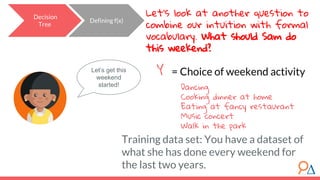
Let’s look at another question to
combine our intuition with formal
vocabulary. What should Sam do
this weekend?
Let’s get this
weekend
started!
Dancing
Cooking dinner at home
Eating at fancy restaurant
Music concert
Walk in the park
Y = Choice of weekend activity
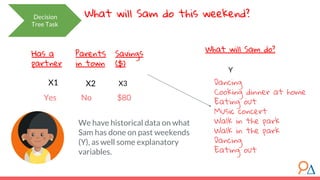
Training data set: You have a dataset of
what she has done every weekend for
the last two years.
Defining f(x)
Decision
Tree Task
What will Sam do this weekend?
Dancing
Cooking dinner at home
Eating out
Music concert
Walk in the park
Walk in the park
Dancing
Eating out
Y
What will Sam do?
$80No
Savings
($)
X2
Parents
in town
Has a
partner
Yes
X3X1
We have historical data on what
Sam has done on past weekends
(Y), as well some explanatory
variables.
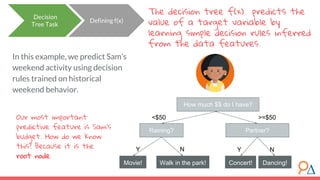
In this example, we predict Sam’s
weekend activity using decision
rules trained on historical
weekend behavior.
How much $$ do I have?
Raining? Partner?
>=$50<$50
Concert! Dancing!Walk in the park!Movie!
Y Y NN
Decision
Tree Task
Defining f(x)
The decision tree f(x) predicts the
value of a target variable by
learning simple decision rules inferred
from the data features.
Our most important
predictive feature is Sam’s
budget. How do we know
this? Because it is the
root node.
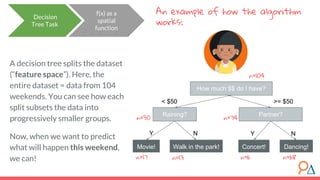
A decision tree splits the dataset
(“feature space”). Here, the
entire dataset = data from 104
weekends. You can see how each
split subsets the data into
progressively smaller groups.
Now, when we want to predict
what will happen this weekend,
we can!
How much $$ do I have?
Raining? Partner?
< $50
Concert! Dancing!Walk in the park!Movie!
Y Y NN
Decision
Tree Task
f(x) as a
spatial
function
>= $50
n=104
n=17
n=30 n=74
n=6n=13
An example of how the algorithm
works:
n=68
How much $$ do I have?
Raining? Partner?
< $50
Concert! Dancing!Walk in the park!Movie!
Y Y NN
Decision
Tree Task
f(x) as a
spatial
function
>= $50
n=104
n=17
n=30 n=74
n=6n=13
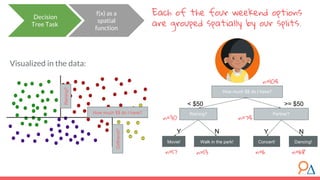
Each of the four weekend options
are grouped spatially by our splits.
n=68
Visualized in the data:
How much $$ do I have?
Raining?
Girlfriend?
Now we understand the mechanics of the decision tree task.
But how does a decision tree learn? How does it know where
to split the data, and in what order?
We turn now to examine decision trees’ learning
methodology.
Learning Methodology
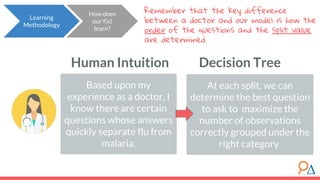
At each split, we can
determine the best question
to ask to maximize the
number of observations
correctly grouped under the
right category.
Based upon my
experience as a doctor, I
know there are certain
questions whose answers
quickly separate flu from
malaria.
Remember that the key difference
between a doctor and our model is how the
order of the questions and the split value
are determined.
Human Intuition Decision Tree
Learning
Methodology
How does
our f(x)
learn?
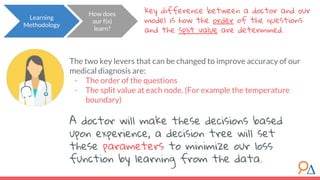
key difference between a doctor and our
model is how the order of the questions
and the split value are determined.
Learning
Methodology
How does
our f(x)
learn?
The two key levers that can be changed to improve accuracy of our
medical diagnosis are:
- The order of the questions
- The split value at each node. (For example the temperature
boundary)
A doctor will make these decisions based
upon experience, a decision tree will set
these parameters to minimize our loss
function by learning from the data.
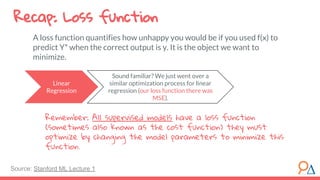
Recap: Loss function
Linear
Regression
A loss function quantifies how unhappy you would be if you used f(x) to
predict Y* when the correct output is y. It is the object we want to
minimize.
Remember: All supervised models have a loss function
(sometimes also known as the cost function) they must
optimize by changing the model parameters to minimize this
function.
Sound familiar? We just went over a
similar optimization process for linear
regression (our loss function there was
MSE).
Source: Stanford ML Lecture 1
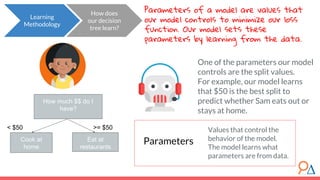
Values that control the
behavior of the model.
The model learns what
parameters are from data.
Parameters
How does
our decision
tree learn?
Parameters of a model are values that
our model controls to minimize our loss
function. Our model sets these
parameters by learning from the data.
Learning
Methodology
One of the parameters our model
controls are the split values.
For example, our model learns
that $50 is the best split to
predict whether Sam eats out or
stays at home.
How much $$ do I
have?
Cook at
home
Eat at
restaurants
< $50 >= $50
How does
our decision
tree learn?
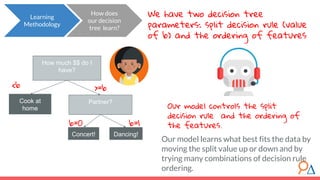
We have two decision tree
parameters: split decision rule (value
of b) and the ordering of features
Learning
Methodology
>=b
How much $$ do I
have?
Cook at
home
<b
Partner?
Concert! Dancing!
b=0 b=1
Our model controls the split
decision rule and the ordering of
the features.
Our model learns what best fits the data by
moving the split value up or down and by
trying many combinations of decision rule
ordering.
Central problem: How do we learn
the “best” split?
How does
our decision
tree learn?
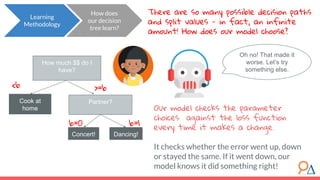
There are so many possible decision paths
and split values - in fact, an infinite
amount! How does our model choose?
Learning
Methodology
>=b
How much $$ do I
have?
Cook at
home
<b
Partner?
Concert! Dancing!
b=0 b=1
Our model checks the parameter
choices against the loss function
every time it makes a change.
It checks whether the error went up, down
or stayed the same. If it went down, our
model knows it did something right!
Oh no! That made it
worse. Let’s try
something else.
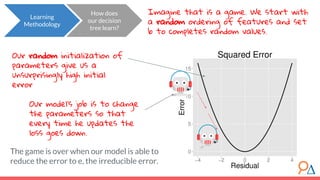
Our random initialization of
parameters give us a
unsurprisingly high initial
error
How does
our decision
tree learn?
Imagine that is a game. We start with
a random ordering of features and set
b to completes random values.
Learning
Methodology
Our model’s job is to change
the parameters so that
every time he updates the
loss goes down.
The game is over when our model is able to
reduce the error to e, the irreducible error.
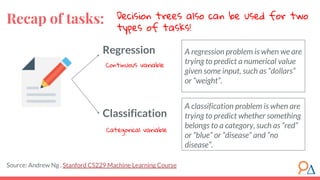
Regression
Classification
Continuous variable
Categorical variable
A classification problem is when are
trying to predict whether something
belongs to a category, such as “red”
or “blue” or “disease” and “no
disease”.
A regression problem is when we are
trying to predict a numerical value
given some input, such as “dollars”
or “weight”.
Source: Andrew Ng , Stanford CS229 Machine Learning Course
Decision trees also can be used for two
types of tasks!
Recap of tasks:
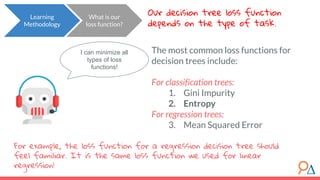
What is our
loss function?
Our decision tree loss function
depends on the type of task.
Learning
Methodology
I can minimize all
types of loss
functions!
The most common loss functions for
decision trees include:
For classification trees:
1. Gini Impurity
2. Entropy
For regression trees:
3. Mean Squared Error
For example, the loss function for a regression decision tree should
feel familiar. It is the same loss function we used for linear
regression!
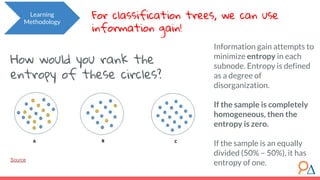
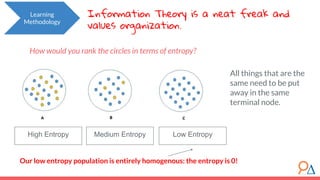
Information gain attempts to
minimize entropy in each
subnode. Entropy is defined
as a degree of
disorganization.
If the sample is completely
homogeneous, then the
entropy is zero.
If the sample is an equally
divided (50% – 50%), it has
entropy of one.
Learning
Methodology
For classification trees, we can use
information gain!
How would you rank the
entropy of these circles?
Source
All things that are the
same need to be put
away in the same
terminal node.
Learning
Methodology
Information Theory is a neat freak and
values organization.
How would you rank the circles in terms of entropy?
Low EntropyHigh Entropy Medium Entropy
Our low entropy population is entirely homogenous: the entropy is 0!
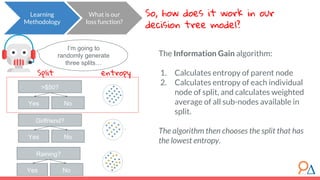
The Information Gain algorithm:
1. Calculates entropy of parent node
2. Calculates entropy of each individual
node of split, and calculates weighted
average of all sub-nodes available in
split.
The algorithm then chooses the split that has
the lowest entropy.
What is our
loss function?
Learning
Methodology
So, how does it work in our
decision tree model?
I’m going to
randomly generate
three splits…
>$50?
Yes No
Girlfriend?
Yes No
Raining?
Yes No
Split entropy
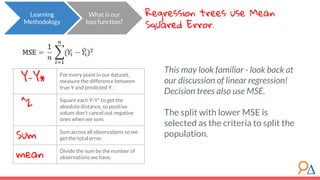
This may look familiar - look back at
our discussion of linear regression!
Decision trees also use MSE.
The split with lower MSE is
selected as the criteria to split the
population.
What is our
loss function?
Learning
Methodology
Regression trees use Mean
Squared Error.
Y-Y* For every point in our dataset,
measure the difference between
true Y and predicted Y.
^2 Square each Y-Y* to get the
absolute distance, so positive
values don’t cancel out negative
ones when we sum.
Sum Sum across all observations so we
get the total error.
mean Divide the sum by the number of
observations we have.
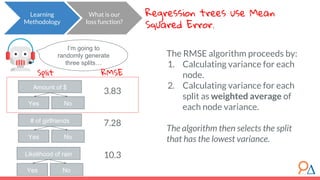
The RMSE algorithm proceeds by:
1. Calculating variance for each
node.
2. Calculating variance for each
split as weighted average of
each node variance.
The algorithm then selects the split
that has the lowest variance.
What is our
loss function?
Learning
Methodology
Regression trees use Mean
Squared Error.
I’m going to
randomly generate
three splits…
Amount of $
Yes No
# of girlfriends
Yes No
Likelihood of rain
Yes No
Split RMSE
3.83
7.28
10.3
Model Performance
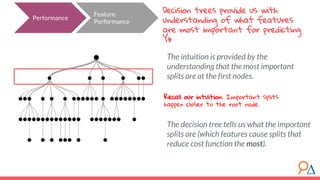
Decision trees provide us with
understanding of what features
are most important for predicting
Y*
Recall our intuition: Important splits
happen closer to the root node.
The intuition is provided by the
understanding that the most important
splits are at the first nodes.
The decision tree tells us what the important
splits are (which features cause splits that
reduce cost function the most).
Performance
Feature
Performance
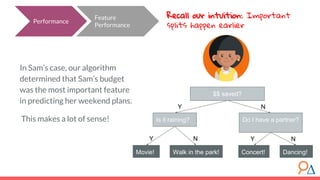
In Sam’s case, our algorithm
determined that Sam’s budget
was the most important feature
in predicting her weekend plans.
This makes a lot of sense!
$$ saved?
Is it raining? Do I have a partner?
NY
Concert! Dancing!Walk in the park!Movie!
Y Y NN
Performance
Feature
Performance
Recall our intuition: Important
splits happen earlier
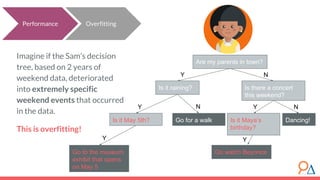
Go watch Beyonce
Imagine if the Sam’s decision
tree, based on 2 years of
weekend data, deteriorated
into extremely specific
weekend events that occurred
in the data.
This is overfitting!
Are my parents in town?
Is it raining? Is there a concert
this weekend?
NY
Is it Maya’s
birthday?
Dancing!Go for a walkIs it May 5th?
Y Y NN
Go to the museum
exhibit that opens
on May 5
Y Y
Performance Overfitting
Performance
Ability to
generalize to
unseen data
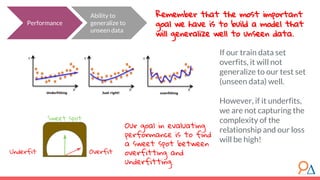
Our goal in evaluating
performance is to find
a sweet spot between
overfitting and
underfitting.
If our train data set
overfits, it will not
generalize to our test set
(unseen data) well.
However, if it underfits,
we are not capturing the
complexity of the
relationship and our loss
will be high!
Underfit Overfit
Sweet spot
Remember that the most important
goal we have is to build a model that
will generalize well to unseen data.
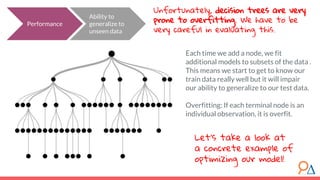
Each time we add a node, we fit
additional models to subsets of the data .
This means we start to get to know our
train data really well but it will impair
our ability to generalize to our test data.
Overfitting: If each terminal node is an
individual observation, it is overfit.
Performance
Ability to
generalize to
unseen data
Let’s take a look at
a concrete example of
optimizing our model!
Unfortunately, decision trees are very
prone to overfitting. We have to be
very careful in evaluating this.
Model Optimization
Go watch Beyonce
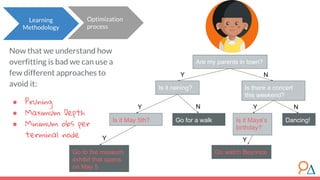
Now that we understand how
overfitting is bad we can use a
few different approaches to
avoid it:
● Pruning
● Maximum Depth
● Minimum obs per
terminal node
Are my parents in town?
Is it raining? Is there a concert
this weekend?
NY
Is it Maya’s
birthday?
Dancing!Go for a walkIs it May 5th?
Y Y NN
Go to the museum
exhibit that opens
on May 5
Y Y
Learning
Methodology
Optimization
process
Pruning, max depth and n_ obs in a terminal node are all
examples of hyperparameters.
Learning
Methodology
Pruning, max depth and n_ obs in a terminal node are all
decision tree hyperparameters set before training.
Their values are not learned from the data so
the model cannot say anything about them.
Hyperparameters are higher level settings of a
model that are fixed before training begins.
You, not the model
decide what the
hyperparameters are!
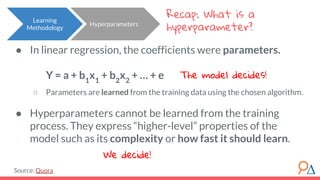
● In linear regression, the coefficients were parameters.
Y = a + b1
x1
+ b2
x2
+ … + e
○ Parameters are learned from the training data using the chosen algorithm.
● Hyperparameters cannot be learned from the training
process. They express “higher-level” properties of the
model such as its complexity or how fast it should learn.
Source: Quora
Recap: What is a
hyperparameter?
The model decides!
We decide!
Learning
Methodology
Hyperparameters
Learning
Methodology
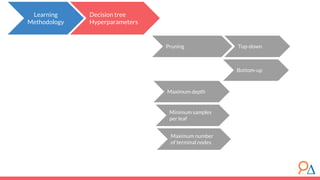
Decision tree
Hyperparameters
Pruning Top-down
Bottom-up
Maximum depth
Minimum samples
per leaf
Maximum number
of terminal nodes
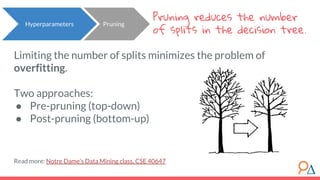
Limiting the number of splits minimizes the problem of
overfitting.
Two approaches:
● Pre-pruning (top-down)
● Post-pruning (bottom-up)
Read more: Notre Dame’s Data Mining class, CSE 40647
Pruning reduces the number
of splits in the decision tree.
Hyperparameters Pruning
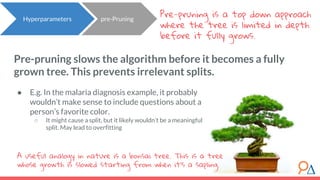
Pre-pruning slows the algorithm before it becomes a fully
grown tree. This prevents irrelevant splits.
Pre-pruning is a top down approach
where the tree is limited in depth
before it fully grows.
● E.g. In the malaria diagnosis example, it probably
wouldn’t make sense to include questions about a
person’s favorite color.
○ It might cause a split, but it likely wouldn’t be a meaningful
split. May lead to overfitting
Hyperparameters pre-Pruning
A useful analogy in nature is a bonsai tree. This is a tree
whose growth is slowed starting from when it’s a sapling.
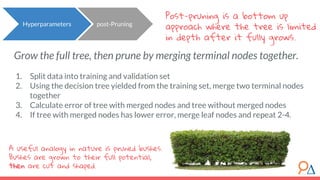
Post-pruning is a bottom up
approach where the tree is limited
in depth after it fully grows.
Grow the full tree, then prune by merging terminal nodes together.
1. Split data into training and validation set
2. Using the decision tree yielded from the training set, merge two terminal nodes
together
3. Calculate error of tree with merged nodes and tree without merged nodes
4. If tree with merged nodes has lower error, merge leaf nodes and repeat 2-4.
Hyperparameters post-Pruning
A useful analogy in nature is pruned bushes.
Bushes are grown to their full potential,
then are cut and shaped.
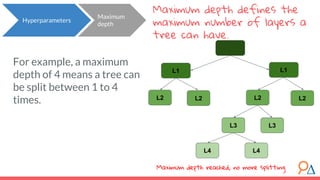
Maximum depth defines the
maximum number of layers a
tree can have.
For example, a maximum
depth of 4 means a tree can
be split between 1 to 4
times.
L1 L1
L2
L3 L3
L4 L4
L2 L2 L2
Maximum depth reached, no more splitting
Hyperparameters
Maximum
depth
Go watch Beyonce
Are my parents in town?
Is it raining? Is there a concert
this weekend?
NY
Is it Maya’s
birthday?
Dancing!Go for a walkIs it May 5th?
Y Y NN
Y
Go to the museum
exhibit that opens
on May 12
Y
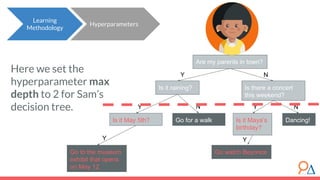
Here we set the
hyperparameter max
depth to 2 for Sam’s
decision tree.
Learning
Methodology
Hyperparameters
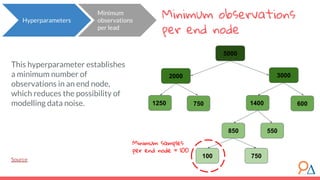
Minimum observations
per end node
This hyperparameter establishes
a minimum number of
observations in an end node,
which reduces the possibility of
modelling data noise.
Source
5000
2000 3000
1250
850 550
100 750
750 1400 600
Minimum samples
per end node = 100
Hyperparameters
Minimum
observations
per lead
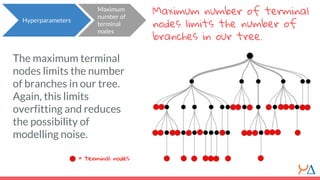
Maximum number of terminal
nodes limits the number of
branches in our tree.
The maximum terminal
nodes limits the number
of branches in our tree.
Again, this limits
overfitting and reduces
the possibility of
modelling noise.
= terminal nodes
Hyperparameters
Maximum
number of
terminal
nodes
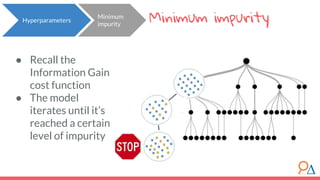
Minimum impurity
● Recall the
Information Gain
cost function
● The model
iterates until it’s
reached a certain
level of impurity
Hyperparameters
Minimum
impurity
Which hyperparameter should I use?
No objectively best hyperparameter for each model.
Use trial and error - see how each changes your
results!
Learning
Methodology
Hyperparameters
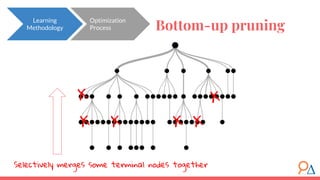
Bottom-up pruning
X
X
X
X
Selectively merges some terminal nodes together
X X
Learning
Methodology
Optimization
Process
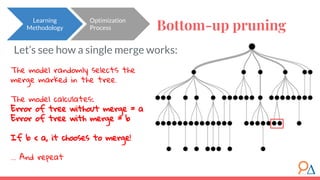
Bottom-up pruning
The model randomly selects the
merge marked in the tree.
The model calculates:
Error of tree without merge = a
Error of tree with merge = b
If b < a, it chooses to merge!
… And repeat
Let’s see how a single merge works:
Learning
Methodology
Optimization
Process
Go watch Beyonce
Are my parents in town?
Is it raining? Is there a concert
this weekend?
NY
Is Beyonce
playing?
Dancing!Go for a walkIs it May 5th?
Y Y NN
Go to the museum
exhibit that opens
on May 12
Y Y
Learning
Methodology
Optimization
Process
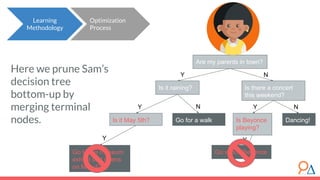
Here we prune Sam’s
decision tree
bottom-up by
merging terminal
nodes.
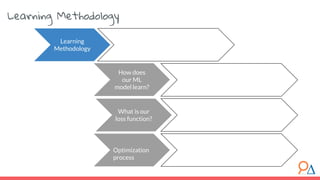
Learning Methodology
Learning
Methodology
What is our
loss function?
Optimization
process
How does
our ML
model learn?
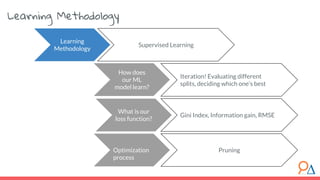
Learning
Methodology
Supervised Learning
What is our
loss function?
Gini Index, Information gain, RMSE
Optimization
process
Pruning
Learning Methodology
How does
our ML
model learn?
Iteration! Evaluating different
splits, deciding which one’s best
End of the module.
✓ Decision trees
✓ Intuition
✓ The “best” split
✓ Model performance
✓ Model optimization (pruning)
Checklist:
Advanced resources
● Textbooks
○ An Introduction to Statistical Learning with Applications in R (James, Witten, Hastie and
Tibshirani): Chapter 8
○ The Elements of Statistical Learning: Data Mining, Inference, and Prediction (Hastie,
Tibshirani, Friedman): Chapter 9
● Online resources
○ Analytics Vidhya’s guide to understanding tree-based methods
Want to take this further? Here are
some resources we recommend:
You are on fire! Go straight to the
next module here.
Need to slow down and digest? Take a
minute to write us an email about
what you thought about the course. All
feedback small or large welcome!
Email: sara@deltanalytics.org
Congrats! You finished
module 5!
Find out more about
Delta’s machine
learning for good
mission here.

Module 5: Decision Trees

  • 1.
  • 2.
    This course contentis being actively developed by Delta Analytics, a 501(c)3 Bay Area nonprofit that aims to empower communities to leverage their data for good. Please reach out with any questions or feedback to inquiry@deltanalytics.org. Find out more about our mission here. Delta Analytics builds technical capacity around the world.
  • 3.
  • 4.
    ❏ Decision trees ❏Intuition ❏ The “best” split ❏ Model performance ❏ Model optimization (pruning) Module Checklist:
  • 5.
    Where are we? We’velaid much of the groundwork for machine learning, and introduced our very first algorithm of linear regression. Now, we can focus on expanding our algorithm toolkit. Decision trees are another type of algorithm that can accomplish the same objective of prediction that linear regression can. We will also go deeper into the pros and cons of decision trees in this module.
  • 6.
    Where are we? Supervised Algorithms Let’sdo a quick intro to decision trees and ensembles! Linear regression Decision tree Ensemble Algorithms
  • 7.
    Decision Tree Today, we willstart by looking at a decision tree algorithm. A decision tree is a set of rules we can use to classify data into categories (also can be used for regression tasks). Humans often use a similar approach to arrive at a conclusion. For example, doctors ask a series of questions to diagnose a disease. A doctor’s goal is to ask the minimum number of questions needed to arrive at the correct diagnosis. What is wrong with my patient? Help me put together some questions I can use to diagnose patients correctly.
  • 8.
    Decision Tree Decision trees areintuitive because they are similar to how we make many decisions. My mental diagnosis decision tree might look something like this. How is the way I think about this different from a machine learning algorithm? Does the patient have a temperature over 37C? Vomiting? Diarrhea? NY Malaria FluFluIs malaria present in the region? Y Y NN FluMalaria N Y
  • 9.
    Decision Tree Decision trees areintuitive and can handle more complex relationships than linear regression can. A linear regression is a single global trend line. This makes it inflexible for more sophisticated relationships. Sources: https://www.slideshare.net/ANITALOKITA/winnow-vs-perceptron, http://www.turingfinance.com/regression-analysis-using-python-sta tsmodels-and-quandl/
  • 10.
    We will useour now familiar framework to discuss both decision trees and ensemble algorithms: Task What is the problem we want our model to solve? Performance Measure Quantitative measure we use to evaluate the model’s performance. Learning Methodology ML algorithms can be supervised or unsupervised. This determines the learning methodology. Source: Deep Learning Book - Chapter 5: Introduction to Machine Learning
  • 11.
    Task What is theproblem we want our model to solve? Defining f(x) What is f(x) for a decision tree and random forest? Feature engineering & selection What is x? How do we decide what explanatory features to include in our model? What assumptions does a decision tree make about the data? Do we have to transform the data? Is our f(x) correct for this problem?
  • 12.
    Learning Methodology Decision tree modelsare supervised. How does that affect the learning processing? What is our loss function? Every supervised model has a loss function it wants to minimize. Optimization process How does the model minimize the loss function? How does our ML model learn? Overview of how the model teaches itself.
  • 13.
    Performance Quantitative measure weuse to evaluate the model’s performance. Measures of performance Metrics we use to evaluate our model Feature Performance Determination of feature importance Overfitting, underfitting, bias, variance Ability to generalize to unseen data
  • 14.
  • 15.
    Decision tree: modelcheat sheet ● Susceptible to overfitting (poor performance on test set) ● High variance between data sets ● Can become unstable: small variations in the training data result in completely different trees being generated ● Mimics human intuition closely (we make decisions in the same way!) ● Not prescriptive (i.e., decision trees do not assume a normal distribution) ● Can be intuitively understood and interpreted as a flow chart, or a division of feature space. ● Can handle nonlinear data (no need to transform data) Pros Cons
  • 16.
  • 17.
    Task How does adoctor diagnose her patients based on their symptoms? What are we predicting?
  • 18.
    Task A doctorbuilds a diagnosis from your symptoms. I start by asking patients a series of questions about their symptoms. I use that information to build a diagnosis. Flu Malaria Flu Flu diagnosis Yes No No Yes Severe Severe Mild None Shaking chills vomitingtemp X1 X2 X3 Y Y* 39.5°C 37.8°C 37.2°C 37.2°C predicted diagnosis Flu Malaria Malaria Flu There are some questions the doctor does not need to ask because she learns it from her environment. (For example, a doctor would know if malaria present in this region.) A machine, however, would have to be explicitly taught this feature.
  • 19.
    Task A doctor makesa mental diagnosis path to arrive at her conclusion. She is building a decision tree! How does the way I think about how to decide the value of the split compare to a machine learning algorithm? Does the patient have a temperature over 37C? vomiting Severe shaking chills NY malaria flufluIs malaria present in the region Y Y NN flumalaria N Y
  • 20.
    At each split,we can determine the best question to maximize the number of observations correctly grouped under the right category. ● Both a doctor and decision tree try to arrive at the minimum number of questions (splits) that needs to be asked to correctly diagnose the patient. ● Key difference: how the order of the questions and the split value are determined. A doctor will do this based upon experience, a decision tree will formalize this concept using a loss function. Based upon my experience as a doctor, I know there are certain questions whose answers quickly separate flu from malaria. Human Intuition Decision Tree
  • 21.
    To determine whethera new patient has malaria, a doctor uses her experience and education, and machine learning creates a model using data. By using a machine learning model, our doctor is able to use both her experience and data to make the best decision! Machine learning adds the power of data to our doctor’s task. Task
  • 22.
    Mr. Model createsa flow chart (the model) by separating our entire dataset into distinct categories. Once we have this model, we’ll know what category our new patient falls into! Decision trees act in the same manner as human categorization, they (split) the data based upon answers to questions. Where do I go? Malaria MalariaNo malaria Task
  • 23.
    To get asense of how this “splitting” works, let’s play a guessing game. I am thinking of something that is blue. You may ask 10 questions to guess what it is.
  • 24.
    The first fewquestions you would probably ask may include: - Is it alive? (No) - Is it in nature? (Yes)
  • 25.
    Then, as yougot closer to the answer, your questions would become more specific. - Is it solid or liquid? (Liquid) - Is it the ocean? (Yes!)
  • 26.
    Some winning strategiesinclude: ● Use questions early on that eliminate the most possibilities. ● Questions often start broad and become more granular. This process is your mental decision tree. In fact, this strategy captures many of the qualities of our algorithm!
  • 27.
    You created yourown decision tree based on your own experience of what you know is blue to make an educated guess as to what I was thinking of (the ocean). Similarly, a decision tree model will make an educated guess, but instead of using experience, it uses data. Now, let’s build a formal vocabulary for discussing decision trees.
  • 28.
    Like a linearregression, a decision tree has explanatory features and an outcome. Our f(x) is the decision path from the top of the tree to the final outcome. feature feature outcome outcome model model Decision Tree Defining f(x)
  • 29.
    feature outcome model Decision Tree New vocabulary Internal node Terminal node Split Split The“decisions” of the decision tree model. The model decides which features to use to split the data. Root node Our starting point. The first split occurs here along the feature that the model decides is most important. Internal node Intermediate splits. Corresponds to a subset of the entire dataset. Terminal node Predicted outcome. Corresponds to a smaller subset of the entire dataset. Root node
  • 30.
    Decision Tree New vocabulary Splits Root node Feature 2 Feature1 Feature3 Thisvisualization of splits in feature space is a different but equally accurate way to conceptualize decision trees as the flow chart in the previous slide. A decision tree splits the feature space (the dataset) along features. The order of splits are determined by the algorithm.
  • 31.
    Task Splits at thetop of the tree have an outsized importance on final outcome. What is the root node, split, internal node and terminal node in this example? Does the patient have a temperature over 37C? vomiting Severe shaking chills NY malaria flufluIs malaria present in the region Y Y NN flumalaria N Y Some additional terminology Internal node Terminal node Split Root node
  • 32.
    Decision Tree Let’s look atanother question to combine our intuition with formal vocabulary. What should Sam do this weekend? Let’s get this weekend started! Dancing Cooking dinner at home Eating at fancy restaurant Music concert Walk in the park Y = Choice of weekend activity Training data set: You have a dataset of what she has done every weekend for the last two years. Defining f(x)
  • 33.
    Decision Tree Task What willSam do this weekend? Dancing Cooking dinner at home Eating out Music concert Walk in the park Walk in the park Dancing Eating out Y What will Sam do? $80No Savings ($) X2 Parents in town Has a partner Yes X3X1 We have historical data on what Sam has done on past weekends (Y), as well some explanatory variables.
  • 34.
    In this example,we predict Sam’s weekend activity using decision rules trained on historical weekend behavior. How much $$ do I have? Raining? Partner? >=$50<$50 Concert! Dancing!Walk in the park!Movie! Y Y NN Decision Tree Task Defining f(x) The decision tree f(x) predicts the value of a target variable by learning simple decision rules inferred from the data features. Our most important predictive feature is Sam’s budget. How do we know this? Because it is the root node.
  • 35.
    A decision treesplits the dataset (“feature space”). Here, the entire dataset = data from 104 weekends. You can see how each split subsets the data into progressively smaller groups. Now, when we want to predict what will happen this weekend, we can! How much $$ do I have? Raining? Partner? < $50 Concert! Dancing!Walk in the park!Movie! Y Y NN Decision Tree Task f(x) as a spatial function >= $50 n=104 n=17 n=30 n=74 n=6n=13 An example of how the algorithm works: n=68
  • 36.
    How much $$do I have? Raining? Partner? < $50 Concert! Dancing!Walk in the park!Movie! Y Y NN Decision Tree Task f(x) as a spatial function >= $50 n=104 n=17 n=30 n=74 n=6n=13 Each of the four weekend options are grouped spatially by our splits. n=68 Visualized in the data: How much $$ do I have? Raining? Girlfriend?
  • 37.
    Now we understandthe mechanics of the decision tree task. But how does a decision tree learn? How does it know where to split the data, and in what order? We turn now to examine decision trees’ learning methodology.
  • 38.
  • 39.
    At each split,we can determine the best question to ask to maximize the number of observations correctly grouped under the right category. Based upon my experience as a doctor, I know there are certain questions whose answers quickly separate flu from malaria. Remember that the key difference between a doctor and our model is how the order of the questions and the split value are determined. Human Intuition Decision Tree Learning Methodology How does our f(x) learn?
  • 40.
    key difference betweena doctor and our model is how the order of the questions and the split value are determined. Learning Methodology How does our f(x) learn? The two key levers that can be changed to improve accuracy of our medical diagnosis are: - The order of the questions - The split value at each node. (For example the temperature boundary) A doctor will make these decisions based upon experience, a decision tree will set these parameters to minimize our loss function by learning from the data.
  • 41.
    Recap: Loss function Linear Regression Aloss function quantifies how unhappy you would be if you used f(x) to predict Y* when the correct output is y. It is the object we want to minimize. Remember: All supervised models have a loss function (sometimes also known as the cost function) they must optimize by changing the model parameters to minimize this function. Sound familiar? We just went over a similar optimization process for linear regression (our loss function there was MSE). Source: Stanford ML Lecture 1
  • 42.
    Values that controlthe behavior of the model. The model learns what parameters are from data. Parameters How does our decision tree learn? Parameters of a model are values that our model controls to minimize our loss function. Our model sets these parameters by learning from the data. Learning Methodology One of the parameters our model controls are the split values. For example, our model learns that $50 is the best split to predict whether Sam eats out or stays at home. How much $$ do I have? Cook at home Eat at restaurants < $50 >= $50
  • 43.
    How does our decision treelearn? We have two decision tree parameters: split decision rule (value of b) and the ordering of features Learning Methodology >=b How much $$ do I have? Cook at home <b Partner? Concert! Dancing! b=0 b=1 Our model controls the split decision rule and the ordering of the features. Our model learns what best fits the data by moving the split value up or down and by trying many combinations of decision rule ordering.
  • 44.
    Central problem: Howdo we learn the “best” split?
  • 45.
    How does our decision treelearn? There are so many possible decision paths and split values - in fact, an infinite amount! How does our model choose? Learning Methodology >=b How much $$ do I have? Cook at home <b Partner? Concert! Dancing! b=0 b=1 Our model checks the parameter choices against the loss function every time it makes a change. It checks whether the error went up, down or stayed the same. If it went down, our model knows it did something right! Oh no! That made it worse. Let’s try something else.
  • 46.
    Our random initializationof parameters give us a unsurprisingly high initial error How does our decision tree learn? Imagine that is a game. We start with a random ordering of features and set b to completes random values. Learning Methodology Our model’s job is to change the parameters so that every time he updates the loss goes down. The game is over when our model is able to reduce the error to e, the irreducible error.
  • 47.
    Regression Classification Continuous variable Categorical variable Aclassification problem is when are trying to predict whether something belongs to a category, such as “red” or “blue” or “disease” and “no disease”. A regression problem is when we are trying to predict a numerical value given some input, such as “dollars” or “weight”. Source: Andrew Ng , Stanford CS229 Machine Learning Course Decision trees also can be used for two types of tasks! Recap of tasks:
  • 48.
    What is our lossfunction? Our decision tree loss function depends on the type of task. Learning Methodology I can minimize all types of loss functions! The most common loss functions for decision trees include: For classification trees: 1. Gini Impurity 2. Entropy For regression trees: 3. Mean Squared Error For example, the loss function for a regression decision tree should feel familiar. It is the same loss function we used for linear regression!
  • 49.
    Information gain attemptsto minimize entropy in each subnode. Entropy is defined as a degree of disorganization. If the sample is completely homogeneous, then the entropy is zero. If the sample is an equally divided (50% – 50%), it has entropy of one. Learning Methodology For classification trees, we can use information gain! How would you rank the entropy of these circles? Source
  • 50.
    All things thatare the same need to be put away in the same terminal node. Learning Methodology Information Theory is a neat freak and values organization. How would you rank the circles in terms of entropy? Low EntropyHigh Entropy Medium Entropy Our low entropy population is entirely homogenous: the entropy is 0!
  • 51.
    The Information Gainalgorithm: 1. Calculates entropy of parent node 2. Calculates entropy of each individual node of split, and calculates weighted average of all sub-nodes available in split. The algorithm then chooses the split that has the lowest entropy. What is our loss function? Learning Methodology So, how does it work in our decision tree model? I’m going to randomly generate three splits… >$50? Yes No Girlfriend? Yes No Raining? Yes No Split entropy
  • 52.
    This may lookfamiliar - look back at our discussion of linear regression! Decision trees also use MSE. The split with lower MSE is selected as the criteria to split the population. What is our loss function? Learning Methodology Regression trees use Mean Squared Error. Y-Y* For every point in our dataset, measure the difference between true Y and predicted Y. ^2 Square each Y-Y* to get the absolute distance, so positive values don’t cancel out negative ones when we sum. Sum Sum across all observations so we get the total error. mean Divide the sum by the number of observations we have.
  • 53.
    The RMSE algorithmproceeds by: 1. Calculating variance for each node. 2. Calculating variance for each split as weighted average of each node variance. The algorithm then selects the split that has the lowest variance. What is our loss function? Learning Methodology Regression trees use Mean Squared Error. I’m going to randomly generate three splits… Amount of $ Yes No # of girlfriends Yes No Likelihood of rain Yes No Split RMSE 3.83 7.28 10.3
  • 54.
  • 55.
    Decision trees provideus with understanding of what features are most important for predicting Y* Recall our intuition: Important splits happen closer to the root node. The intuition is provided by the understanding that the most important splits are at the first nodes. The decision tree tells us what the important splits are (which features cause splits that reduce cost function the most). Performance Feature Performance
  • 56.
    In Sam’s case,our algorithm determined that Sam’s budget was the most important feature in predicting her weekend plans. This makes a lot of sense! $$ saved? Is it raining? Do I have a partner? NY Concert! Dancing!Walk in the park!Movie! Y Y NN Performance Feature Performance Recall our intuition: Important splits happen earlier
  • 57.
    Go watch Beyonce Imagineif the Sam’s decision tree, based on 2 years of weekend data, deteriorated into extremely specific weekend events that occurred in the data. This is overfitting! Are my parents in town? Is it raining? Is there a concert this weekend? NY Is it Maya’s birthday? Dancing!Go for a walkIs it May 5th? Y Y NN Go to the museum exhibit that opens on May 5 Y Y Performance Overfitting
  • 58.
    Performance Ability to generalize to unseendata Our goal in evaluating performance is to find a sweet spot between overfitting and underfitting. If our train data set overfits, it will not generalize to our test set (unseen data) well. However, if it underfits, we are not capturing the complexity of the relationship and our loss will be high! Underfit Overfit Sweet spot Remember that the most important goal we have is to build a model that will generalize well to unseen data.
  • 59.
    Each time weadd a node, we fit additional models to subsets of the data . This means we start to get to know our train data really well but it will impair our ability to generalize to our test data. Overfitting: If each terminal node is an individual observation, it is overfit. Performance Ability to generalize to unseen data Let’s take a look at a concrete example of optimizing our model! Unfortunately, decision trees are very prone to overfitting. We have to be very careful in evaluating this.
  • 60.
  • 61.
    Go watch Beyonce Nowthat we understand how overfitting is bad we can use a few different approaches to avoid it: ● Pruning ● Maximum Depth ● Minimum obs per terminal node Are my parents in town? Is it raining? Is there a concert this weekend? NY Is it Maya’s birthday? Dancing!Go for a walkIs it May 5th? Y Y NN Go to the museum exhibit that opens on May 5 Y Y Learning Methodology Optimization process
  • 62.
    Pruning, max depthand n_ obs in a terminal node are all examples of hyperparameters. Learning Methodology Pruning, max depth and n_ obs in a terminal node are all decision tree hyperparameters set before training. Their values are not learned from the data so the model cannot say anything about them. Hyperparameters are higher level settings of a model that are fixed before training begins. You, not the model decide what the hyperparameters are!
  • 63.
    ● In linearregression, the coefficients were parameters. Y = a + b1 x1 + b2 x2 + … + e ○ Parameters are learned from the training data using the chosen algorithm. ● Hyperparameters cannot be learned from the training process. They express “higher-level” properties of the model such as its complexity or how fast it should learn. Source: Quora Recap: What is a hyperparameter? The model decides! We decide! Learning Methodology Hyperparameters
  • 64.
    Learning Methodology Decision tree Hyperparameters Pruning Top-down Bottom-up Maximumdepth Minimum samples per leaf Maximum number of terminal nodes
  • 65.
    Limiting the numberof splits minimizes the problem of overfitting. Two approaches: ● Pre-pruning (top-down) ● Post-pruning (bottom-up) Read more: Notre Dame’s Data Mining class, CSE 40647 Pruning reduces the number of splits in the decision tree. Hyperparameters Pruning
  • 66.
    Pre-pruning slows thealgorithm before it becomes a fully grown tree. This prevents irrelevant splits. Pre-pruning is a top down approach where the tree is limited in depth before it fully grows. ● E.g. In the malaria diagnosis example, it probably wouldn’t make sense to include questions about a person’s favorite color. ○ It might cause a split, but it likely wouldn’t be a meaningful split. May lead to overfitting Hyperparameters pre-Pruning A useful analogy in nature is a bonsai tree. This is a tree whose growth is slowed starting from when it’s a sapling.
  • 67.
    Post-pruning is abottom up approach where the tree is limited in depth after it fully grows. Grow the full tree, then prune by merging terminal nodes together. 1. Split data into training and validation set 2. Using the decision tree yielded from the training set, merge two terminal nodes together 3. Calculate error of tree with merged nodes and tree without merged nodes 4. If tree with merged nodes has lower error, merge leaf nodes and repeat 2-4. Hyperparameters post-Pruning A useful analogy in nature is pruned bushes. Bushes are grown to their full potential, then are cut and shaped.
  • 68.
    Maximum depth definesthe maximum number of layers a tree can have. For example, a maximum depth of 4 means a tree can be split between 1 to 4 times. L1 L1 L2 L3 L3 L4 L4 L2 L2 L2 Maximum depth reached, no more splitting Hyperparameters Maximum depth
  • 69.
    Go watch Beyonce Aremy parents in town? Is it raining? Is there a concert this weekend? NY Is it Maya’s birthday? Dancing!Go for a walkIs it May 5th? Y Y NN Y Go to the museum exhibit that opens on May 12 Y Here we set the hyperparameter max depth to 2 for Sam’s decision tree. Learning Methodology Hyperparameters
  • 70.
    Minimum observations per endnode This hyperparameter establishes a minimum number of observations in an end node, which reduces the possibility of modelling data noise. Source 5000 2000 3000 1250 850 550 100 750 750 1400 600 Minimum samples per end node = 100 Hyperparameters Minimum observations per lead
  • 71.
    Maximum number ofterminal nodes limits the number of branches in our tree. The maximum terminal nodes limits the number of branches in our tree. Again, this limits overfitting and reduces the possibility of modelling noise. = terminal nodes Hyperparameters Maximum number of terminal nodes
  • 72.
    Minimum impurity ● Recallthe Information Gain cost function ● The model iterates until it’s reached a certain level of impurity Hyperparameters Minimum impurity
  • 73.
    Which hyperparameter shouldI use? No objectively best hyperparameter for each model. Use trial and error - see how each changes your results! Learning Methodology Hyperparameters
  • 74.
    Bottom-up pruning X X X X Selectively mergessome terminal nodes together X X Learning Methodology Optimization Process
  • 75.
    Bottom-up pruning The modelrandomly selects the merge marked in the tree. The model calculates: Error of tree without merge = a Error of tree with merge = b If b < a, it chooses to merge! … And repeat Let’s see how a single merge works: Learning Methodology Optimization Process
  • 76.
    Go watch Beyonce Aremy parents in town? Is it raining? Is there a concert this weekend? NY Is Beyonce playing? Dancing!Go for a walkIs it May 5th? Y Y NN Go to the museum exhibit that opens on May 12 Y Y Learning Methodology Optimization Process Here we prune Sam’s decision tree bottom-up by merging terminal nodes.
  • 77.
    Learning Methodology Learning Methodology What isour loss function? Optimization process How does our ML model learn?
  • 78.
    Learning Methodology Supervised Learning What isour loss function? Gini Index, Information gain, RMSE Optimization process Pruning Learning Methodology How does our ML model learn? Iteration! Evaluating different splits, deciding which one’s best
  • 79.
    End of themodule.
  • 80.
    ✓ Decision trees ✓Intuition ✓ The “best” split ✓ Model performance ✓ Model optimization (pruning) Checklist:
  • 81.
  • 82.
    ● Textbooks ○ AnIntroduction to Statistical Learning with Applications in R (James, Witten, Hastie and Tibshirani): Chapter 8 ○ The Elements of Statistical Learning: Data Mining, Inference, and Prediction (Hastie, Tibshirani, Friedman): Chapter 9 ● Online resources ○ Analytics Vidhya’s guide to understanding tree-based methods Want to take this further? Here are some resources we recommend:
  • 83.
    You are onfire! Go straight to the next module here. Need to slow down and digest? Take a minute to write us an email about what you thought about the course. All feedback small or large welcome! Email: sara@deltanalytics.org
  • 84.
    Congrats! You finished module5! Find out more about Delta’s machine learning for good mission here.