3. COMPOSITE VIDEO
      SIGNAL
COMPOSITE VIDEO SIGNAL
  Consist of :
‱ Camera signal - corresponding to the desired picture
  information
‱ Blanking pulses – to make the retrace invisible
‱ Synchronizing pulses – to synchronize the transmitter and
  receiver scanning
              -horizontal sync pulse
              -vertical sync pulse
              -their amplitudes are kept same
              -but their duration are different
              -needed consecutively and not simultaneously
               with the picture signal – so sent on a time division
               basis
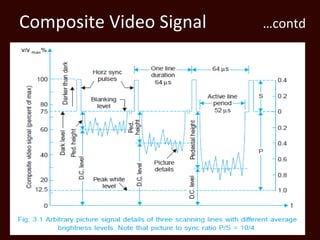
Composite Video Signal   
contd
Composite video signal                                                
contd
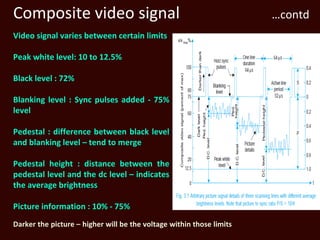
Video signal varies between certain limits

Peak white level: 10 to 12.5%

Black level : 72%

Blanking level : Sync pulses added - 75%
level

Pedestal : difference between black level
and blanking level – tend to merge

Pedestal height : distance between the
pedestal level and the dc level – indicates
the average brightness

Picture information : 10% - 75%
Darker the picture – higher will be the voltage within those limits
DC component of the video signal
‱ Average value or dc component
  corresponding to the average brightness of
  the scene
‱ Average brightness can change only from
  frame to frame and not from line to line
‱ Low pedestal height – scene darker
‱ Larger pedestal height – higher average
  brightness
blanking pulses . . .
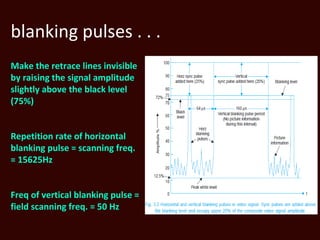
Make the retrace lines invisible
by raising the signal amplitude
slightly above the black level
(75%)


Repetition rate of horizontal
blanking pulse = scanning freq.
= 15625Hz


Freq of vertical blanking pulse =
field scanning freq. = 50 Hz
Sync Pulse and Video Signal Amplitude Ratio
P/S RATIO = 10/4

Justification:
‱ If the picture signal amplitude is ↑ at the expense
  of sync pulses – when S/N ratio at the receiver falls,
  sync pulse amplitude becomes insufficient to keep
  the picture locked
‱ If the sync pulse amplitude is ↑ at the expense of
  the picture signal, then the raster remains locked
  but the amplitude of the picture content will be too
  low
‱ P/S ratio of 10/4 represents the most efficient use
  of TV system
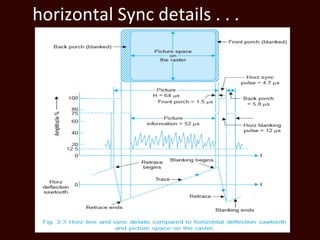
horizontal Sync details . . .
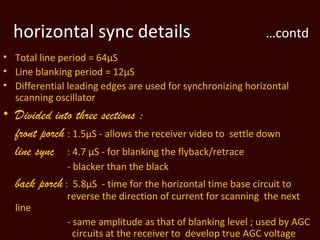
horizontal sync details                                   
contd
‱ Total line period = 64”S
‱ Line blanking period = 12”S
‱ Differential leading edges are used for synchronizing horizontal
  scanning oscillator
‱ Divided into three sections :
  front porch : 1.5”S - allows the receiver video to settle down
  line sync : 4.7 ”S - for blanking the flyback/retrace
              - blacker than the black
  back porch : 5.8”S - time for the horizontal time base circuit to
              reverse the direction of current for scanning the next
  line
              - same amplitude as that of blanking level ; used by AGC
                circuits at the receiver to develop true AGC voltage
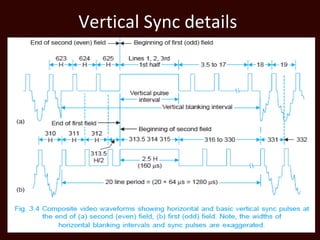
Vertical Sync details
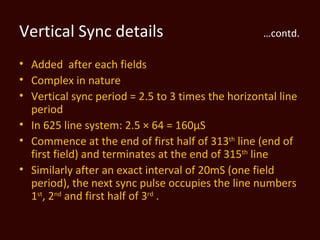
Vertical Sync details                              
contd.

‱ Added after each fields
‱ Complex in nature
‱ Vertical sync period = 2.5 to 3 times the horizontal line
  period
‱ In 625 line system: 2.5 × 64 = 160”S
‱ Commence at the end of first half of 313th line (end of
  first field) and terminates at the end of 315th line
‱ Similarly after an exact interval of 20mS (one field
  period), the next sync pulse occupies the line numbers
  1st, 2nd and first half of 3rd .
Vertical sync details                               
contd
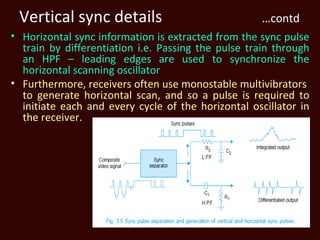
‱ Horizontal sync information is extracted from the sync pulse
  train by differentiation i.e. Passing the pulse train through
  an HPF – leading edges are used to synchronize the
  horizontal scanning oscillator
‱ Furthermore, receivers often use monostable multivibrators
  to generate horizontal scan, and so a pulse is required to
  initiate each and every cycle of the horizontal oscillator in
  the receiver.
Shortcomings and its solution
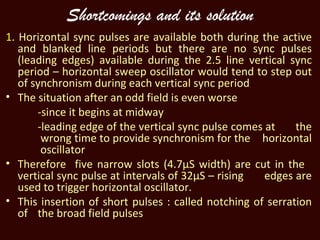
1. Horizontal sync pulses are available both during the active
   and blanked line periods but there are no sync pulses
   (leading edges) available during the 2.5 line vertical sync
   period – horizontal sweep oscillator would tend to step out
   of synchronism during each vertical sync period
‱ The situation after an odd field is even worse
       -since it begins at midway
       -leading edge of the vertical sync pulse comes at    the
        wrong time to provide synchronism for the horizontal
        oscillator
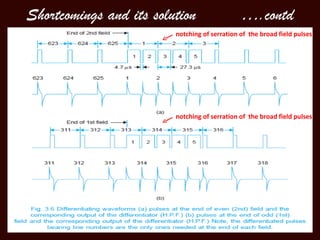
‱ Therefore five narrow slots (4.7”S width) are cut in the
   vertical sync pulse at intervals of 32”S – rising  edges are
   used to trigger horizontal oscillator.
‱ This insertion of short pulses : called notching of serration
   of the broad field pulses
Shortcomings and its solution                  
.contd
                         notching of serration of the broad field pulses


                         notching of serration of the broad field pulses
Shortcomings and its solution                      
.contd
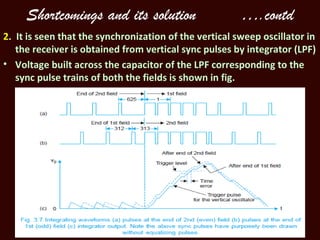
2. It is seen that the synchronization of the vertical sweep oscillator in
   the receiver is obtained from vertical sync pulses by integrator (LPF)
‱ Voltage built across the capacitor of the LPF corresponding to the
   sync pulse trains of both the fields is shown in fig.
Shortcomings and its solution                        
.contd
‱ Each horizontal pulse cause a slight rise in voltage across the capacitor,
  but this is reduced to zero by the time the next pulse arrives (charging
  period=4.7”S and discharging period = 59.3”S)

‱ But during broad serrated region, capacitor has more time to charge
  and only 4.7”S to discharge

‱ Situation is different for the beginning of the 2nd field-here the last
  horizontal pulse corresponding to the beginning of the 313th line is
  separated from the first vertical pulse by only half-a-line.

‱ Therefore the voltage developed a/c the vertical filter will not have
  enough time to reach zero before the arrival of the 1st vertical pulse
‱ Hence the voltage developed a/c the o/p filter is some what higher at
  each instant as compared to the voltage developed at the beginning of
  the 1st field (shown as dotted chain)
‱ i.e. Oscillator get triggered a fraction of a second early as compared to
  the first field - upset the desired interlacing sequence

‱ Equalizing pulses are used to solve this problem
Equalizing pulses
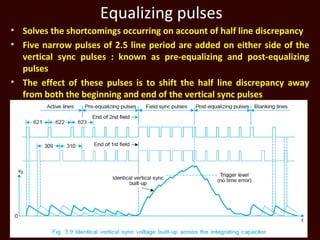
‱ Solves the shortcomings occurring on account of half line discrepancy
‱ Five narrow pulses of 2.5 line period are added on either side of the
  vertical sync pulses : known as pre-equalizing and post-equalizing
  pulses
‱ The effect of these pulses is to shift the half line discrepancy away
  from both the beginning and end of the vertical sync pulses
Equalizing pulses                                          . . . contd

‱ Pre-equalizing pulses:
      - 2.3”S duration
      - result in the discharge of the capacitor to zero voltage
        in both the fields

‱ Post-equalizing pulses: necessary for a fast discharge of the
       capacitor to ensure triggering of the vertical oscillator at
       proper time

‱ With the insertion of equalizing pulses:
      - the voltage rise and fall profile is the same for both the
        field sequences
      - the vertical oscillator is triggered at the proper instants.
        i.e. exactly at an interval of 1/50th of a second.

Composite video signal

  • 1.
  • 2.
    COMPOSITE VIDEO SIGNAL Consist of : ‱ Camera signal - corresponding to the desired picture information ‱ Blanking pulses – to make the retrace invisible ‱ Synchronizing pulses – to synchronize the transmitter and receiver scanning -horizontal sync pulse -vertical sync pulse -their amplitudes are kept same -but their duration are different -needed consecutively and not simultaneously with the picture signal – so sent on a time division basis
  • 3.
  • 4.
    Composite video signal 
contd Video signal varies between certain limits Peak white level: 10 to 12.5% Black level : 72% Blanking level : Sync pulses added - 75% level Pedestal : difference between black level and blanking level – tend to merge Pedestal height : distance between the pedestal level and the dc level – indicates the average brightness Picture information : 10% - 75% Darker the picture – higher will be the voltage within those limits
  • 5.
    DC component ofthe video signal ‱ Average value or dc component corresponding to the average brightness of the scene ‱ Average brightness can change only from frame to frame and not from line to line ‱ Low pedestal height – scene darker ‱ Larger pedestal height – higher average brightness
  • 6.
    blanking pulses .. . Make the retrace lines invisible by raising the signal amplitude slightly above the black level (75%) Repetition rate of horizontal blanking pulse = scanning freq. = 15625Hz Freq of vertical blanking pulse = field scanning freq. = 50 Hz
  • 7.
    Sync Pulse andVideo Signal Amplitude Ratio P/S RATIO = 10/4 Justification: ‱ If the picture signal amplitude is ↑ at the expense of sync pulses – when S/N ratio at the receiver falls, sync pulse amplitude becomes insufficient to keep the picture locked ‱ If the sync pulse amplitude is ↑ at the expense of the picture signal, then the raster remains locked but the amplitude of the picture content will be too low ‱ P/S ratio of 10/4 represents the most efficient use of TV system
  • 8.
  • 9.
    horizontal sync details 
contd ‱ Total line period = 64”S ‱ Line blanking period = 12”S ‱ Differential leading edges are used for synchronizing horizontal scanning oscillator ‱ Divided into three sections : front porch : 1.5”S - allows the receiver video to settle down line sync : 4.7 ”S - for blanking the flyback/retrace - blacker than the black back porch : 5.8”S - time for the horizontal time base circuit to reverse the direction of current for scanning the next line - same amplitude as that of blanking level ; used by AGC circuits at the receiver to develop true AGC voltage
  • 10.
  • 11.
    Vertical Sync details 
contd. ‱ Added after each fields ‱ Complex in nature ‱ Vertical sync period = 2.5 to 3 times the horizontal line period ‱ In 625 line system: 2.5 × 64 = 160”S ‱ Commence at the end of first half of 313th line (end of first field) and terminates at the end of 315th line ‱ Similarly after an exact interval of 20mS (one field period), the next sync pulse occupies the line numbers 1st, 2nd and first half of 3rd .
  • 12.
    Vertical sync details 
contd ‱ Horizontal sync information is extracted from the sync pulse train by differentiation i.e. Passing the pulse train through an HPF – leading edges are used to synchronize the horizontal scanning oscillator ‱ Furthermore, receivers often use monostable multivibrators to generate horizontal scan, and so a pulse is required to initiate each and every cycle of the horizontal oscillator in the receiver.
  • 13.
    Shortcomings and itssolution 1. Horizontal sync pulses are available both during the active and blanked line periods but there are no sync pulses (leading edges) available during the 2.5 line vertical sync period – horizontal sweep oscillator would tend to step out of synchronism during each vertical sync period ‱ The situation after an odd field is even worse -since it begins at midway -leading edge of the vertical sync pulse comes at the wrong time to provide synchronism for the horizontal oscillator ‱ Therefore five narrow slots (4.7”S width) are cut in the vertical sync pulse at intervals of 32”S – rising edges are used to trigger horizontal oscillator. ‱ This insertion of short pulses : called notching of serration of the broad field pulses
  • 14.
    Shortcomings and itssolution 
.contd notching of serration of the broad field pulses notching of serration of the broad field pulses
  • 15.
    Shortcomings and itssolution 
.contd 2. It is seen that the synchronization of the vertical sweep oscillator in the receiver is obtained from vertical sync pulses by integrator (LPF) ‱ Voltage built across the capacitor of the LPF corresponding to the sync pulse trains of both the fields is shown in fig.
  • 16.
    Shortcomings and itssolution 
.contd ‱ Each horizontal pulse cause a slight rise in voltage across the capacitor, but this is reduced to zero by the time the next pulse arrives (charging period=4.7”S and discharging period = 59.3”S) ‱ But during broad serrated region, capacitor has more time to charge and only 4.7”S to discharge ‱ Situation is different for the beginning of the 2nd field-here the last horizontal pulse corresponding to the beginning of the 313th line is separated from the first vertical pulse by only half-a-line. ‱ Therefore the voltage developed a/c the vertical filter will not have enough time to reach zero before the arrival of the 1st vertical pulse ‱ Hence the voltage developed a/c the o/p filter is some what higher at each instant as compared to the voltage developed at the beginning of the 1st field (shown as dotted chain) ‱ i.e. Oscillator get triggered a fraction of a second early as compared to the first field - upset the desired interlacing sequence ‱ Equalizing pulses are used to solve this problem
  • 17.
    Equalizing pulses ‱ Solvesthe shortcomings occurring on account of half line discrepancy ‱ Five narrow pulses of 2.5 line period are added on either side of the vertical sync pulses : known as pre-equalizing and post-equalizing pulses ‱ The effect of these pulses is to shift the half line discrepancy away from both the beginning and end of the vertical sync pulses
  • 18.
    Equalizing pulses . . . contd ‱ Pre-equalizing pulses: - 2.3”S duration - result in the discharge of the capacitor to zero voltage in both the fields ‱ Post-equalizing pulses: necessary for a fast discharge of the capacitor to ensure triggering of the vertical oscillator at proper time ‱ With the insertion of equalizing pulses: - the voltage rise and fall profile is the same for both the field sequences - the vertical oscillator is triggered at the proper instants. i.e. exactly at an interval of 1/50th of a second.