DISCOVER . LEARN . EMPOWER
University Institute of Engineering
DEPARTMENT OF COMPUTER SCIENCE
& ENGINEERING
Bachelor of Engineering (Computer Science & Engineering)
Subject Name : Foundation Course in Wireless and Mobile
Communication
Subject Code: ECO-455
Topic: Lecture-1.3.1 & 1.3.2
Lecture- Prepared by: Naveen Chander
Introduction to Modulation
2
Two signals are involved in the Modulation process.
1.Message signals also known as baseband signals. Baseband signals are
the band of frequencies representing the original signal.
2.The other signal involved with this is a high-frequency sinusoidal wave.
This signal is called the carrier signal.
3.The frequency of Baseband signal is usually low whereas the frequency of
the carrier signals is almost, always higher than that of the baseband signal.
Definition of Modulation
• Modulation is the process of changing one or more properties
(Amplitude, Frequency and phase) of the carrier signal in proportional
to the modulating signal(baseband signal).
• The process of superimposing a low-frequency signal on a high-
frequency carrier signal.
• The process of varying the RF carrier wave in accordance with the
information in a low-frequency signal
3
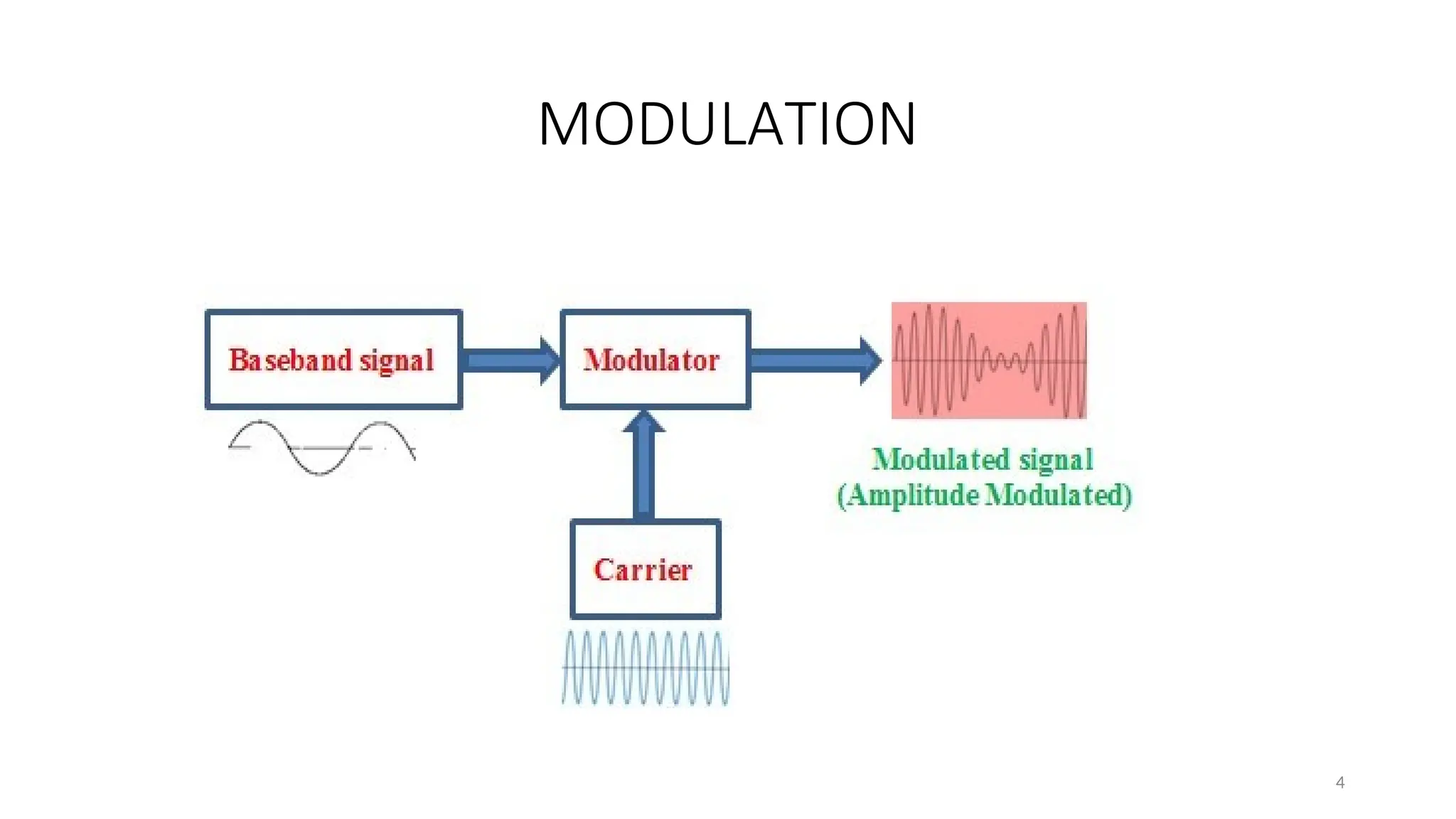
MODULATION
4
Need of Modulation
• Increase the Signal Strength
• Size of the Antenna
• Prevent interference by frequency translation
• Wireless Communication System
5
Need of Modulation
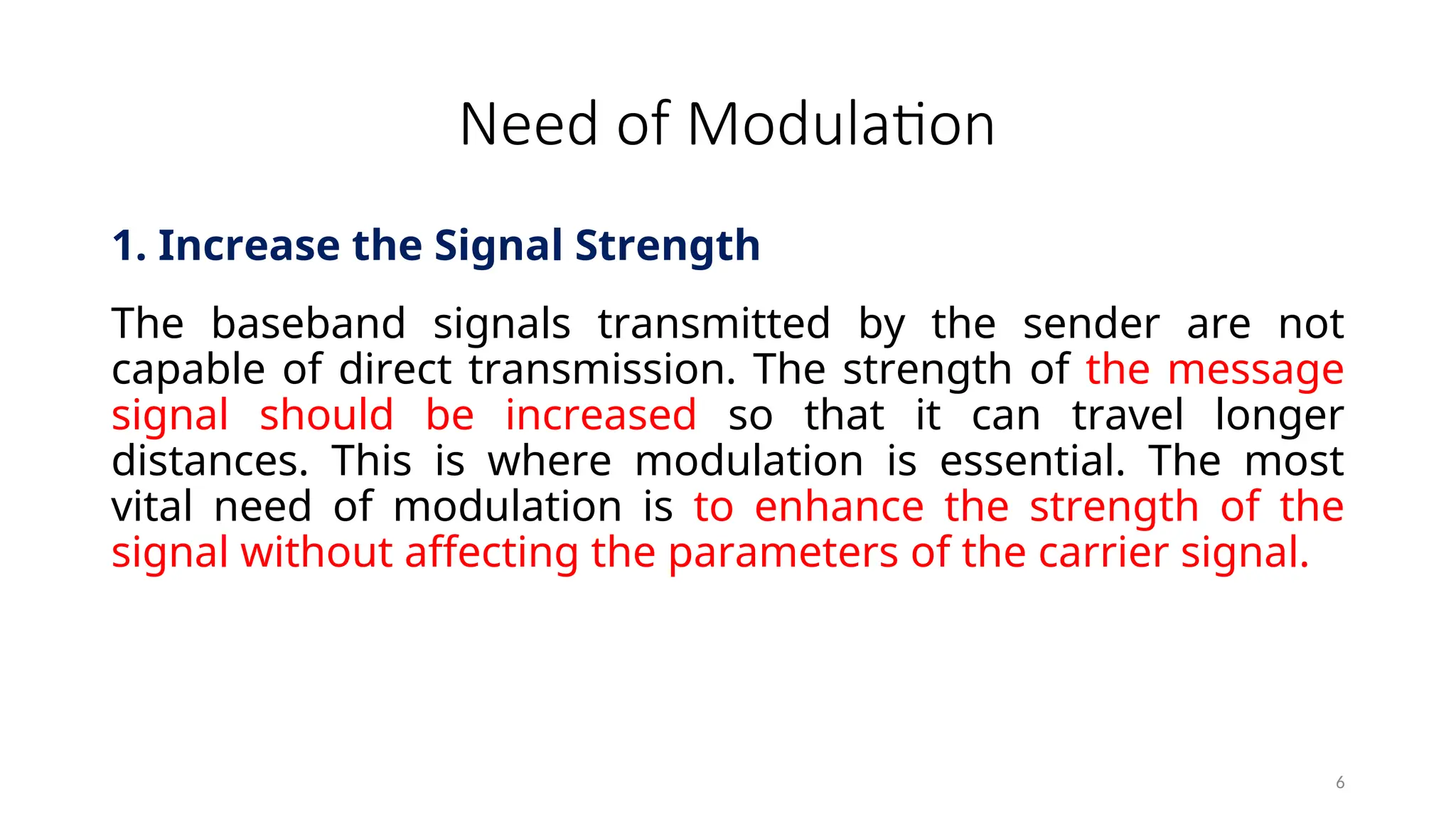
1. Increase the Signal Strength
The baseband signals transmitted by the sender are not
capable of direct transmission. The strength of the message
signal should be increased so that it can travel longer
distances. This is where modulation is essential. The most
vital need of modulation is to enhance the strength of the
signal without affecting the parameters of the carrier signal.
6
Need of Modulation
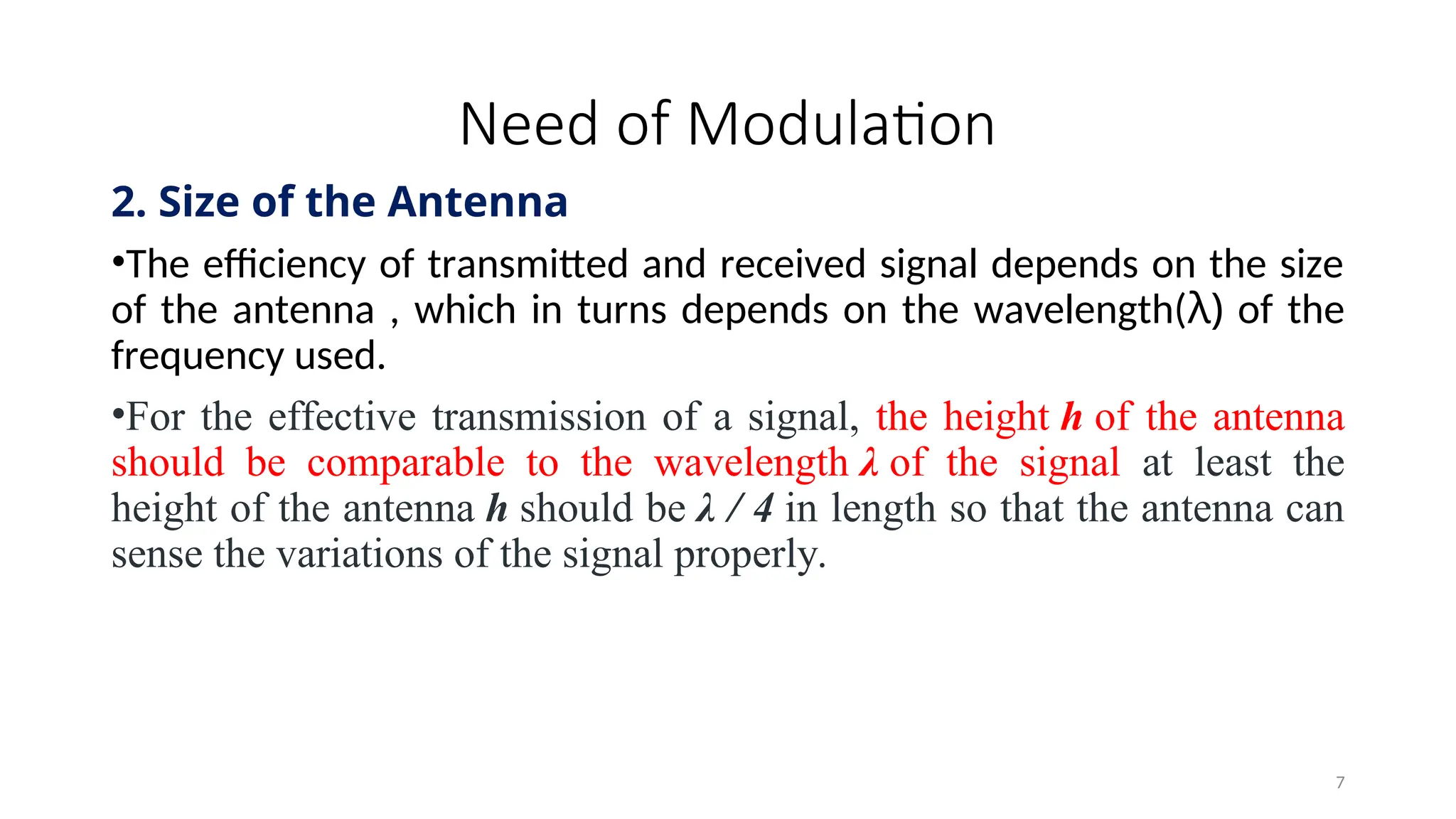
2. Size of the Antenna
•The efficiency of transmitted and received signal depends on the size
of the antenna , which in turns depends on the wavelength(λ) of the
frequency used.
•For the effective transmission of a signal, the height h of the antenna
should be comparable to the wavelength λ of the signal at least the
height of the antenna h should be λ / 4 in length so that the antenna can
sense the variations of the signal properly.
7
Need of Modulation
2. Size of the Antenna
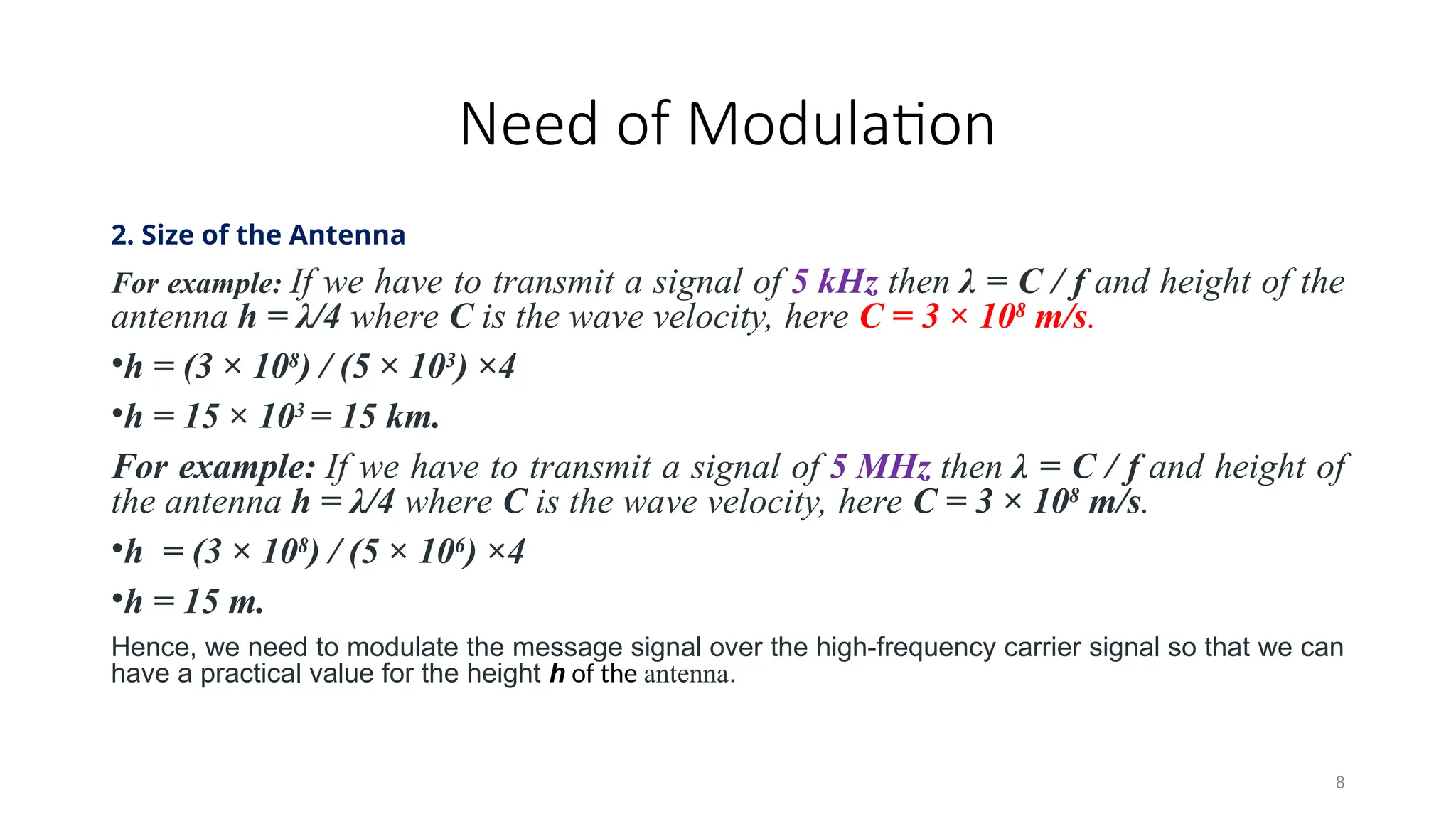
For example: If we have to transmit a signal of 5 kHz then λ = C / f and height of the
antenna h = λ/4 where C is the wave velocity, here C = 3 × 10⁸
m/s.
•h = (3 × 10⁸
) / (5 × 10³
) ×4
•h = 15 × 103
= 15 km.
For example: If we have to transmit a signal of 5 MHz then λ = C / f and height of
the antenna h = λ/4 where C is the wave velocity, here C = 3 × 10⁸
m/s.
•h = (3 × 10⁸
) / (5 × 10⁶
) ×4
•h = 15 m.
Hence, we need to modulate the message signal over the high-frequency carrier signal so that we can
have a practical value for the height h of the antenna.
8
Need of Modulation
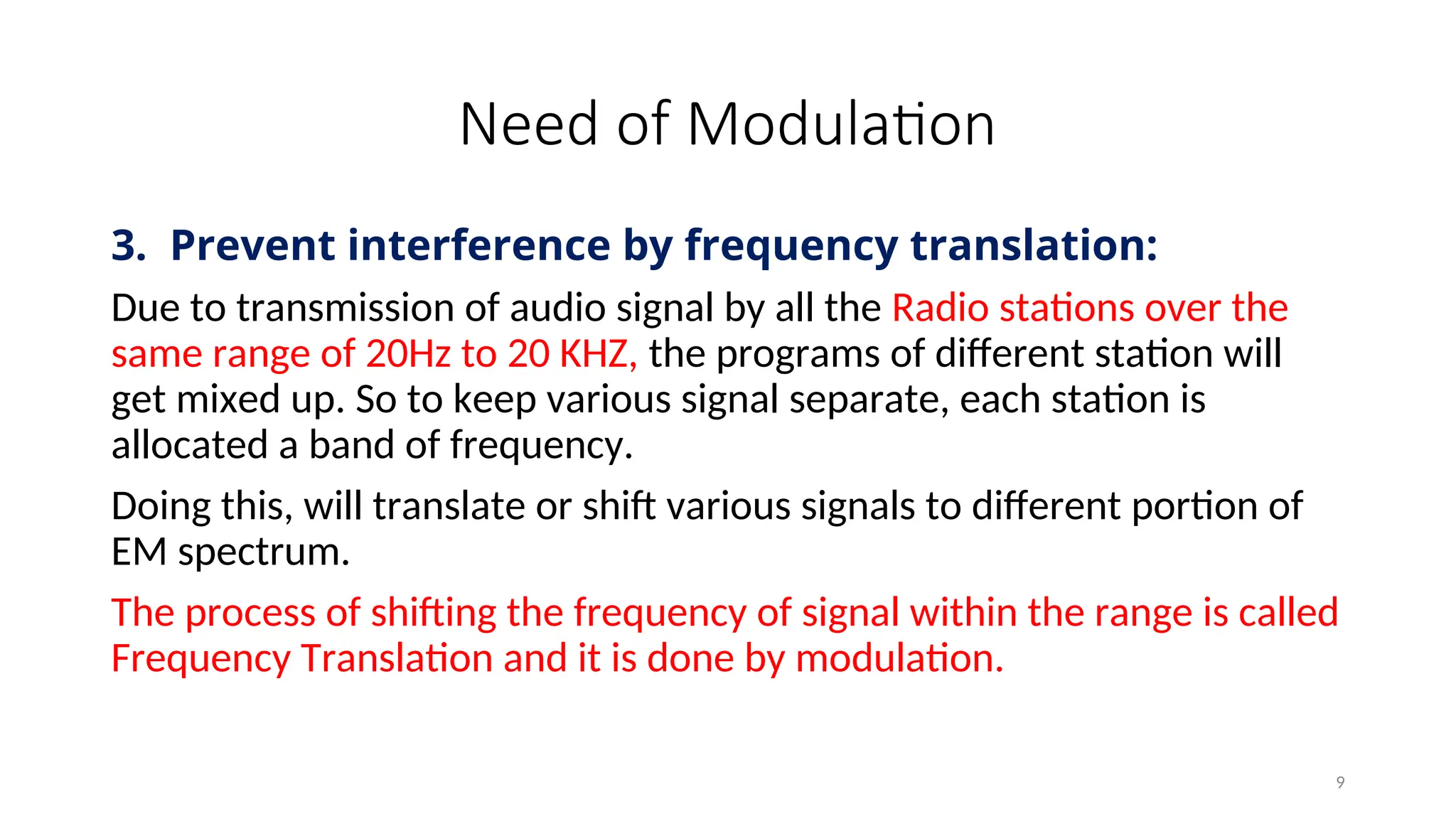
3. Prevent interference by frequency translation:
Due to transmission of audio signal by all the Radio stations over the
same range of 20Hz to 20 KHZ, the programs of different station will
get mixed up. So to keep various signal separate, each station is
allocated a band of frequency.
Doing this, will translate or shift various signals to different portion of
EM spectrum.
The process of shifting the frequency of signal within the range is called
Frequency Translation and it is done by modulation.
9
Need of Modulation
4. Wireless Communication System
By using modulation to transmit the signals through space to long
distances, we have removed the need for wires in the communication
systems. The technique of modulation helped humans to use the
wireless equipment in a big way in their lives. Telephones no longer
had to remain plugged to a wall. All the benefits of modulation have
raised our standards of living in a considerable manner.
10
Types of Modulation
11
Analog Modulation
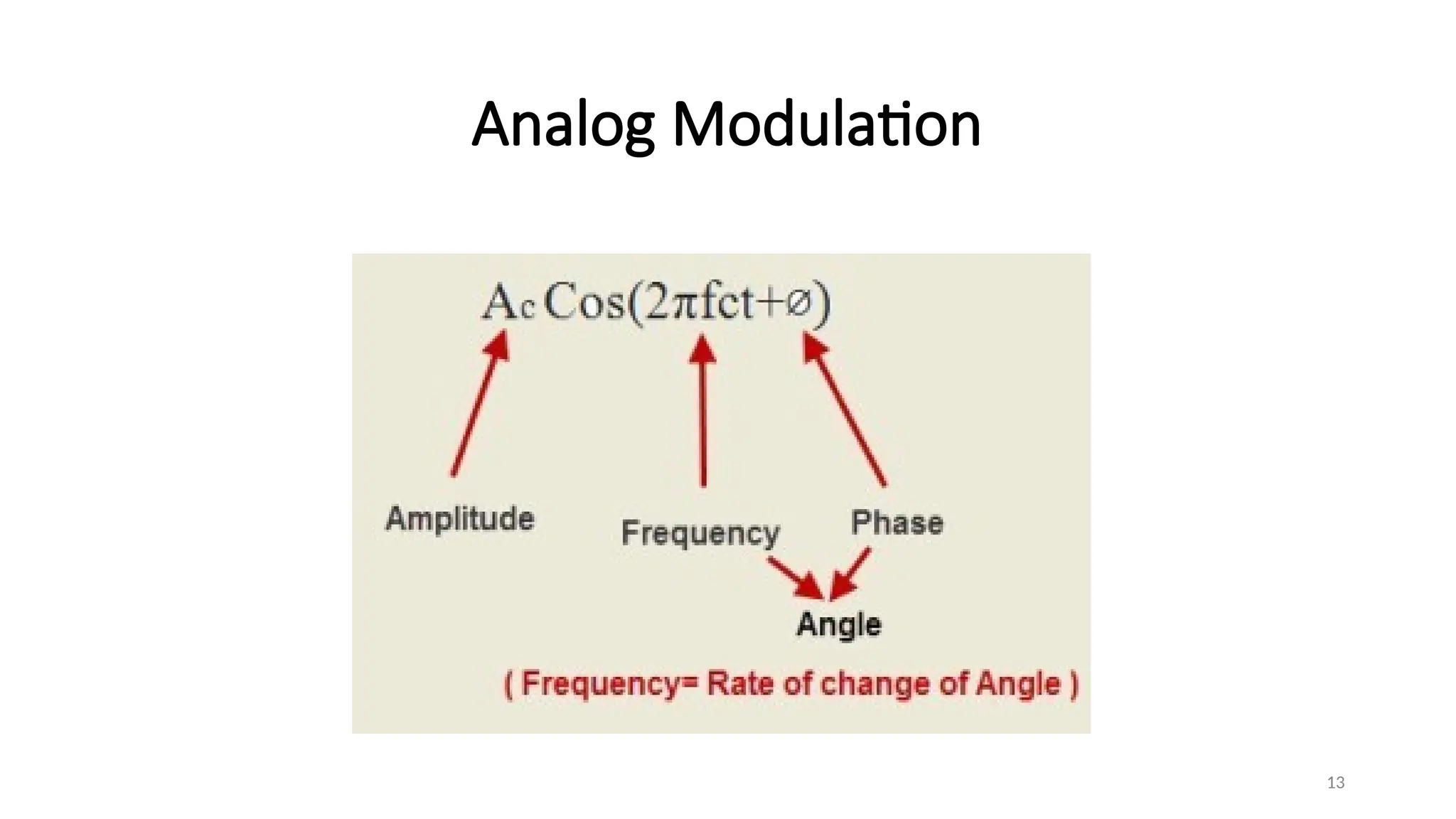
In analog modulation, analog signal (sinusoidal signal) is used as
a carrier signal that modulates the message signal or data signal.
The general function Sinusoidal wave’s is shown in the figure
below, in which, three parameters can be altered to get
modulation: –
They are amplitude, frequency and phase; so, the types of
analog modulation are:
12
Analog Modulation
13
Types of Modulation
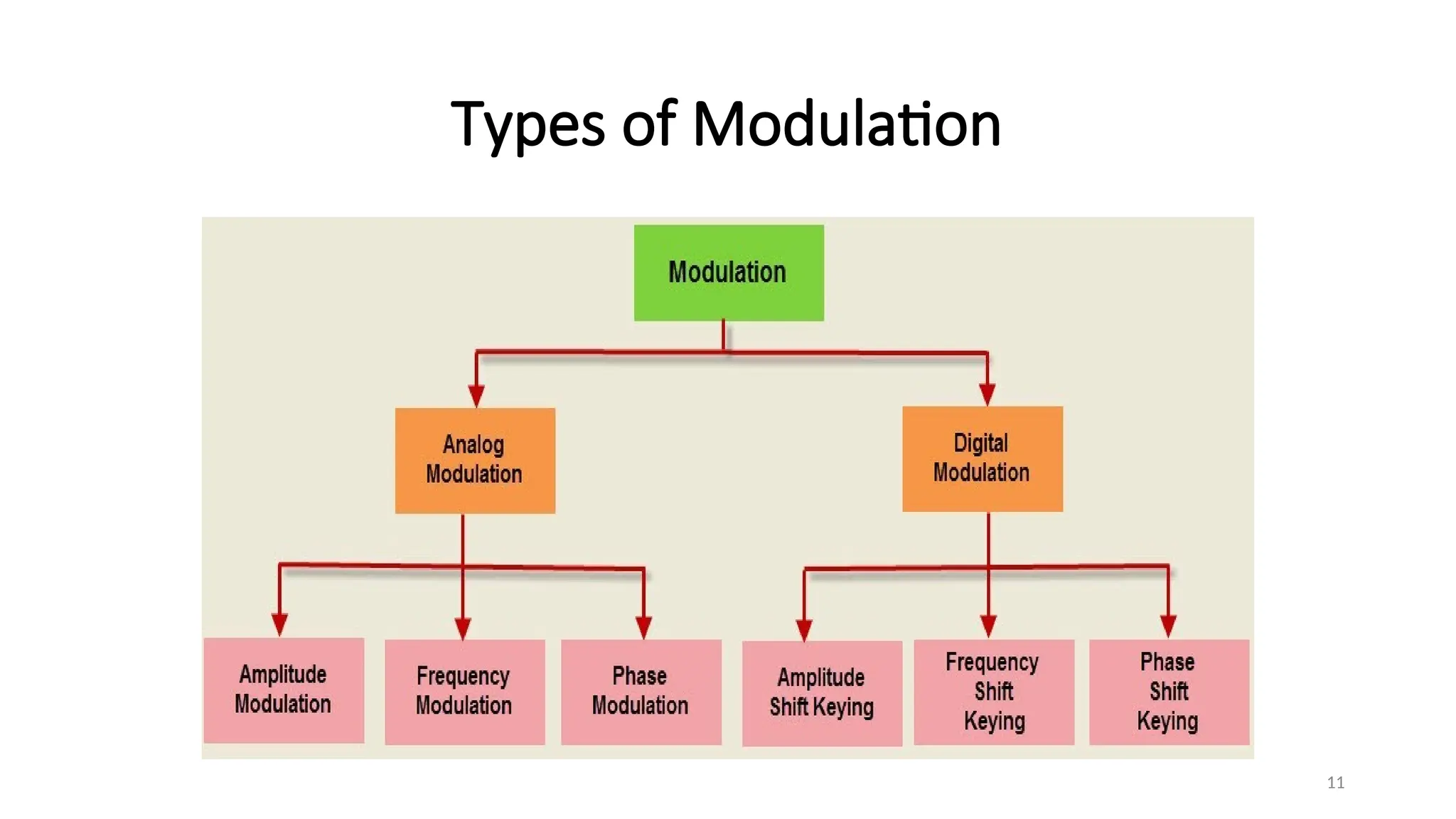
There are Two types of Modulation
1. Analog Modulation:
•Amplitude Modulation(AM)
•Frequency Modulation(FM)
•Phase Modulation(PM)
2. Digital Modulation:
•Amplitude Shift Key(ASK)
•Frequency Shift Key( FSK)
•Phase Shift Key( PSK)
14
Amplitude Modulation(AM)
• A continuous-wave goes on continuously without any intervals
and it is the baseband message signal, which contains the
information. This wave has to be modulated.
• According to the standard definition, “The amplitude of the
carrier signal varies in accordance with the instantaneous
amplitude of the modulating signal.” Which means, the
amplitude of the carrier signal containing no information varies
as per the amplitude of the signal containing information, at
each instant.
15
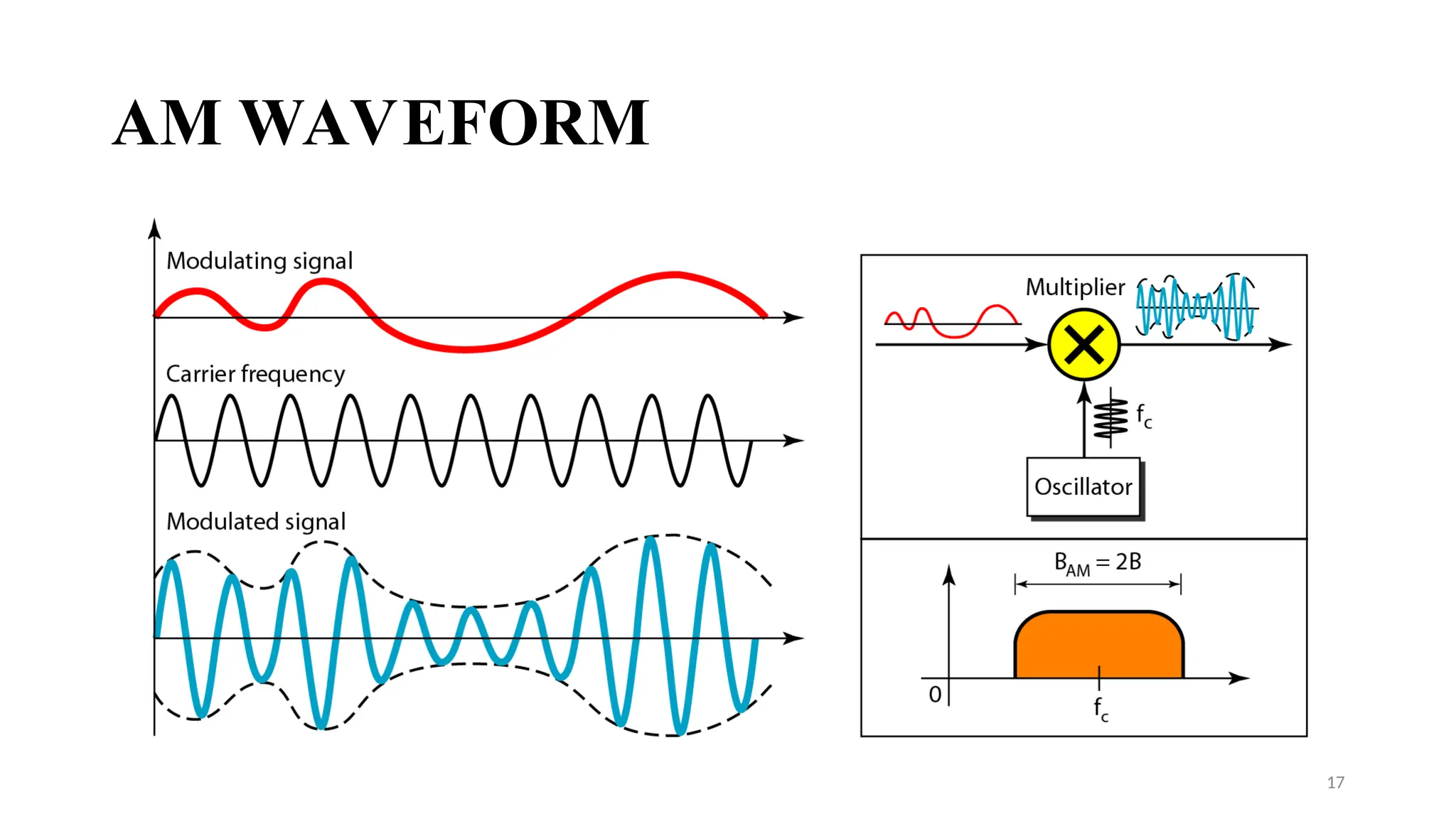
Amplitude Modulation Waveform
• The first figure shows the modulating wave, which is the
message signal.
• The next one is the carrier wave, which is a high frequency
signal and contains no information.
• While, the last one is the resultant modulated wave.
16
AM WAVEFORM
17
Mathematical Expressions of AM
Following are the mathematical expressions for these waves.
•Time-domain Representation of the Waves
Let the modulating signal be,
m(t)=Am sin ⁡
Wmt
and the carrier signal be,
c(t)=Ac sin⁡Wct
Where,
Am and Ac are the amplitude of the modulating signal and the carrier signal
respectively.
fm and fc are the frequency of the modulating signal and the carrier signal
respectively.
Then, the equation of Amplitude Modulated wave will be
y(t)=A’ Sin Wct ; where, A’ = [Ac+m(t)]
18
Mathematical Expressions of AM
y(t)=[Ac+m(t)]sin⁡
Wct
=[Ac+Am sin Wmt]sin⁡
Wct
=Ac[1+(Am/Ac) sinWmt]sin⁡
Wct (equation1)
where, [μ=Am/Ac] (equation2)
μ is Modulation index
Rearrange the Equation 1 as below.
y(t)=Ac[1+μsin⁡
(Wmt)]sin⁡
(Wct) (equation 3)
19
Mathematical Expressions of AM
Now,
y(t)=Ac[1+μsin⁡
(Wmt)]sin⁡
(Wct) (equation 3)
y(t)=Acsin⁡
(Wct)+ Ac μ sin⁡⁡
(Wct) sin(Wmt)
y(t)=Acsin⁡
(Wct)+ 2[Ac μ sin⁡⁡
(Wct) sin(Wmt)/2]
y(t)=Acsin⁡
(Wct)+ (Ac μ/2). 2sin⁡⁡
(Wct) sin(Wmt)
y(t)=Acsin⁡
(Wct)+ (Ac μ/2)[cos⁡⁡
(Wc+Wm)t. cos⁡⁡
(Wc-Wm)t] (equation 4)
In the process of Amplitude Modulation, the modulated wave consists of the carrier
wave and two sidebands. The modulated wave has the information only in the
sidebands. Sideband is nothing but a band of frequencies, containing power, which
are the lower and higher frequencies of the carrier frequency.
20
Mathematical Expressions of AM
y(t)=Acsin⁡
(Wct)+ (Ac μ/2)[cos⁡ ⁡
(Wc+Wm)t. cos⁡ ⁡
(Wc-Wm)t]
(equation 4)
•In the process of Amplitude Modulation, the modulated
wave consists of the carrier wave and two sidebands. The
modulated wave has the information only in the sidebands.
•Sideband is nothing but a band of frequencies, containing
power, which are the lower and higher frequencies of the
carrier frequency.
21
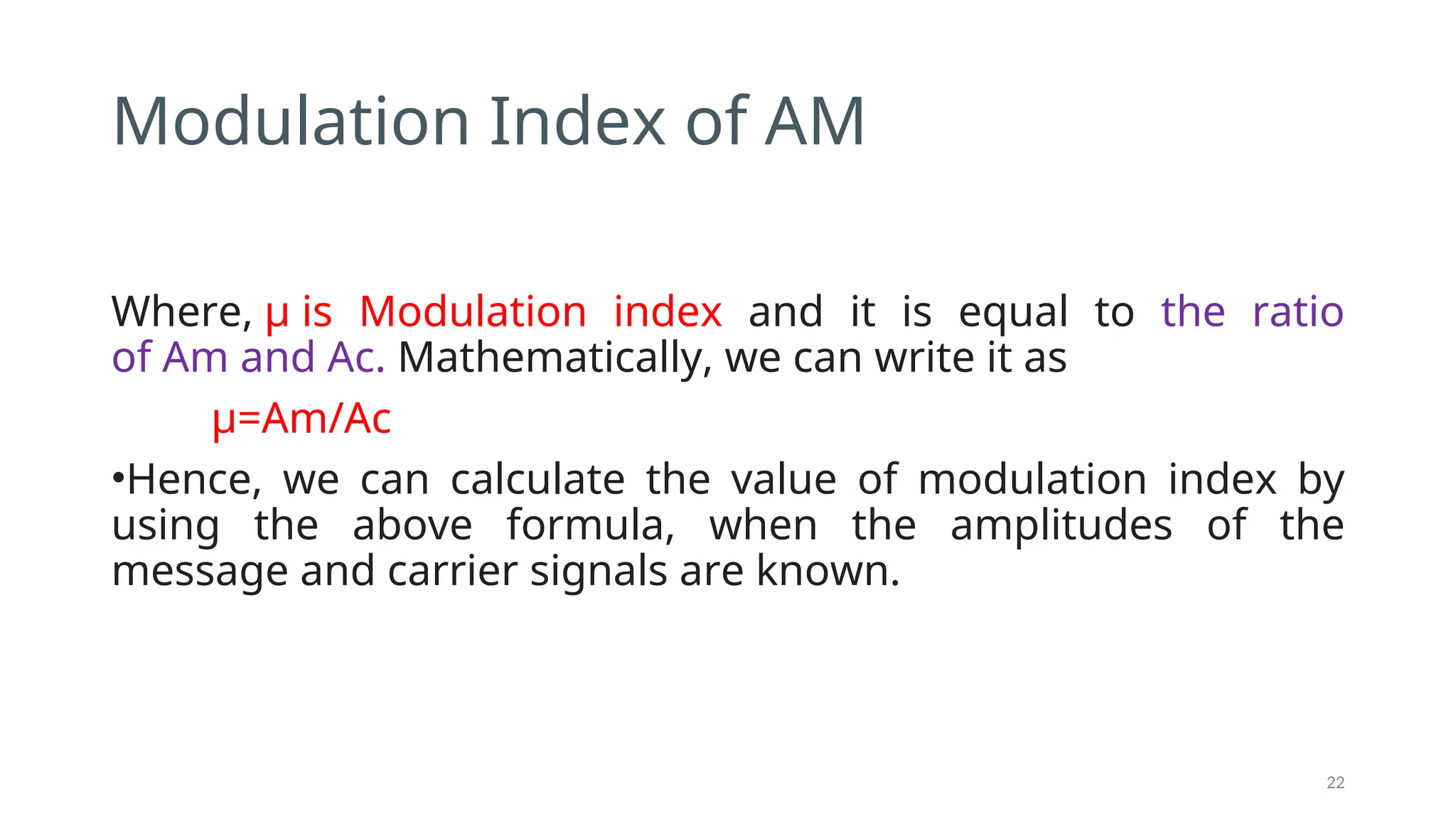
Modulation Index of AM
Where, μ is Modulation index and it is equal to the ratio
of Am and Ac. Mathematically, we can write it as
μ=Am/Ac
•Hence, we can calculate the value of modulation index by
using the above formula, when the amplitudes of the
message and carrier signals are known.
22
Modulation Index of AM
A carrier wave, after being modulated, if the modulated level
is calculated, then such an attempt is called as Modulation
Index or Modulation Depth.
It states the level of modulation that a carrier wave
undergoes.
23
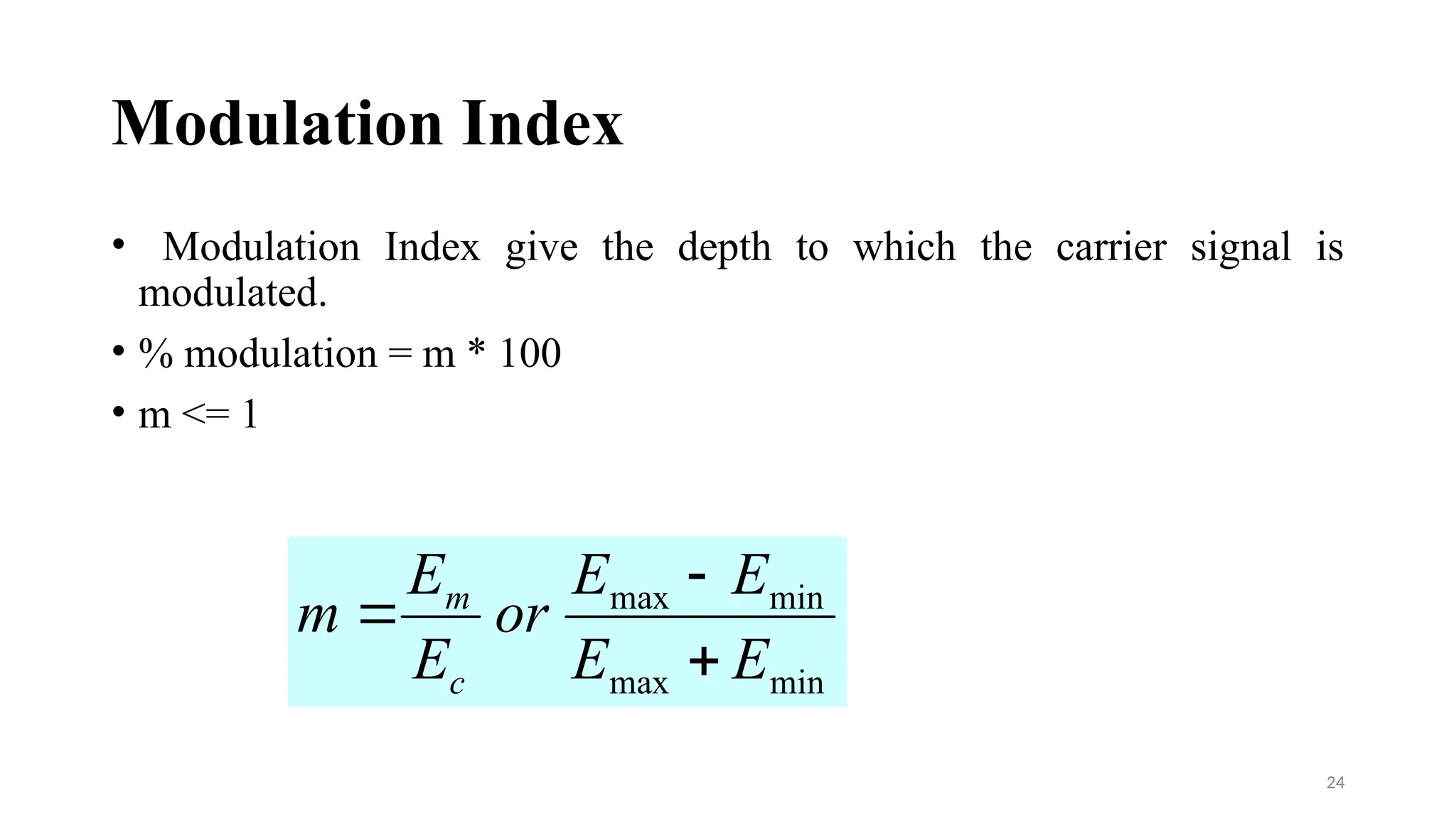
Modulation Index
• Modulation Index give the depth to which the carrier signal is
modulated.
• % modulation = m * 100
• m <= 1
24
min
max
min
max
E
E
E
E
or
E
E
m
c
m



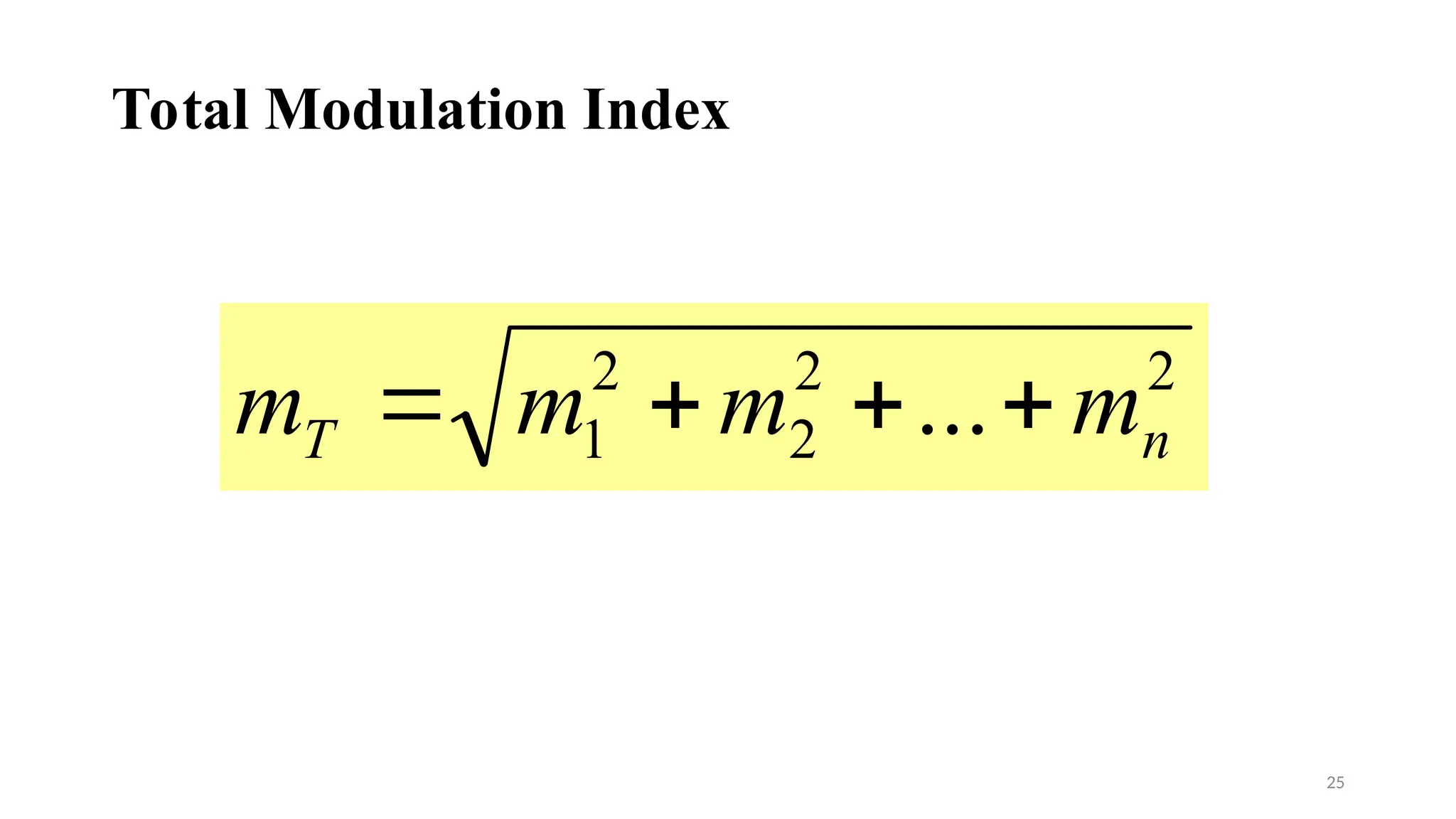
Total Modulation Index
25
2
2
2
2
1 ... n
T m
m
m
m 



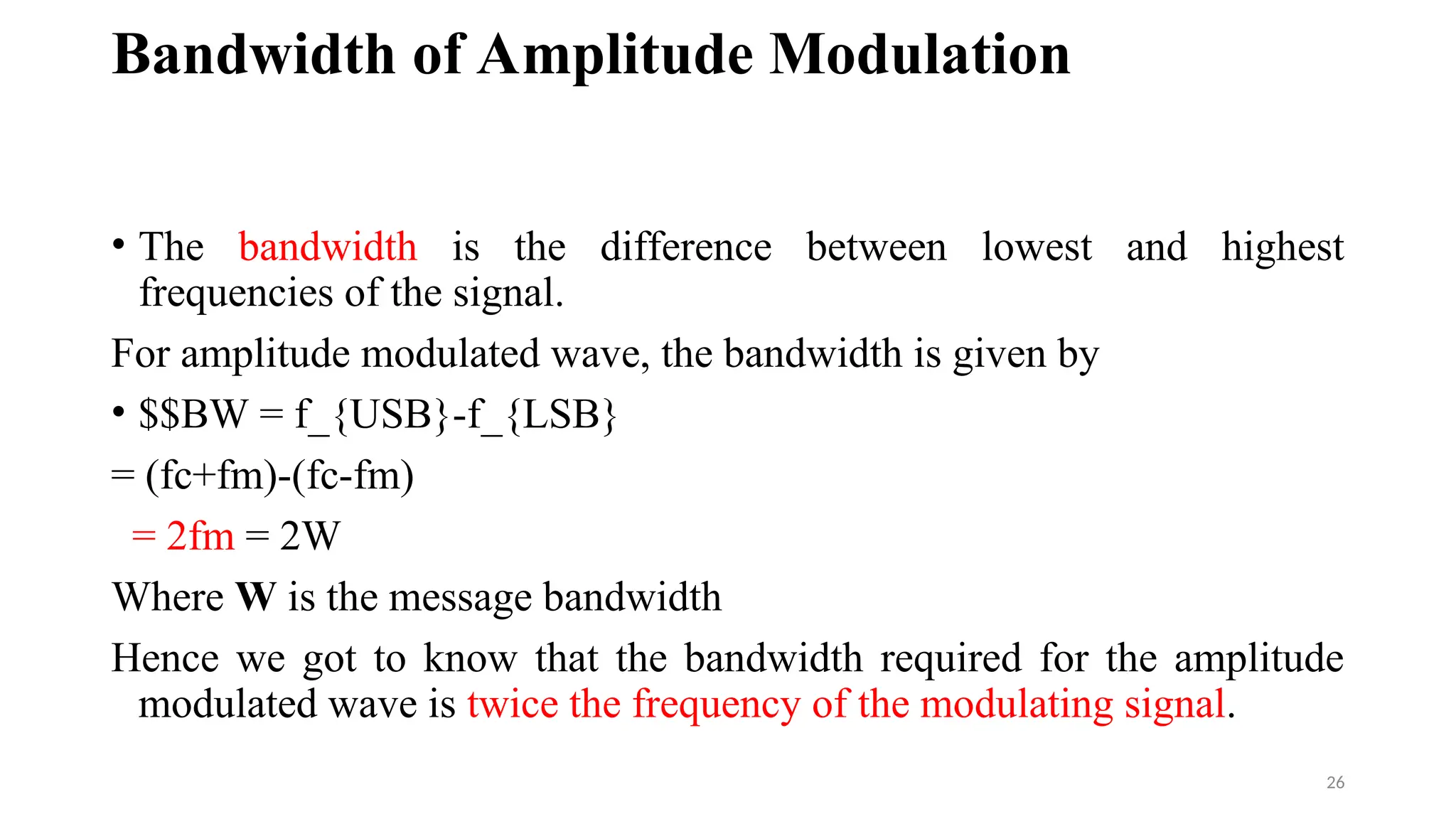
Bandwidth of Amplitude Modulation
• The bandwidth is the difference between lowest and highest
frequencies of the signal.
For amplitude modulated wave, the bandwidth is given by
• $$BW = f_{USB}-f_{LSB}
= (fc+fm)-(fc-fm)
= 2fm = 2W
Where W is the message bandwidth
Hence we got to know that the bandwidth required for the amplitude
modulated wave is twice the frequency of the modulating signal.
26
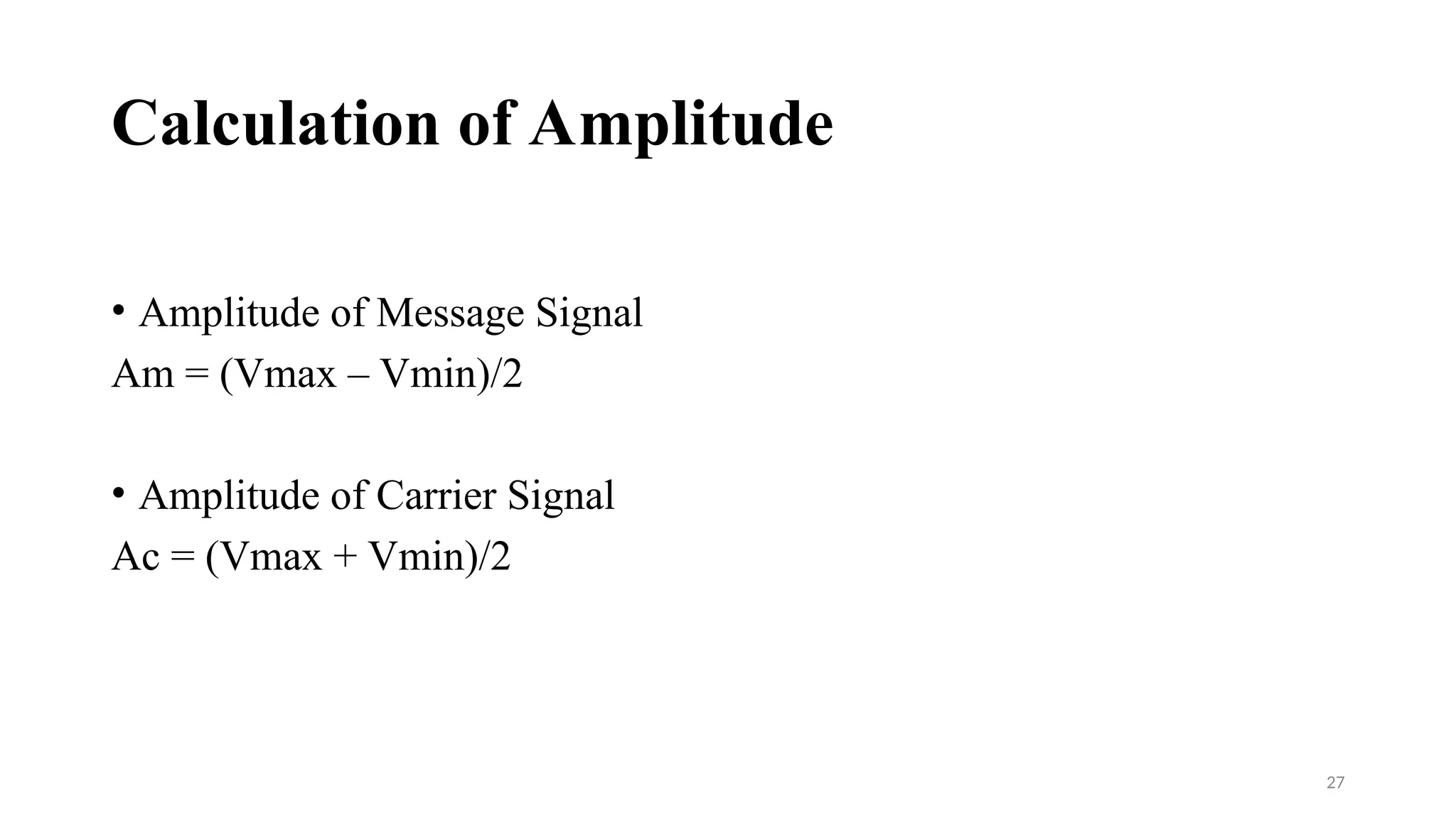
Calculation of Amplitude
• Amplitude of Message Signal
Am = (Vmax – Vmin)/2
• Amplitude of Carrier Signal
Ac = (Vmax + Vmin)/2
27
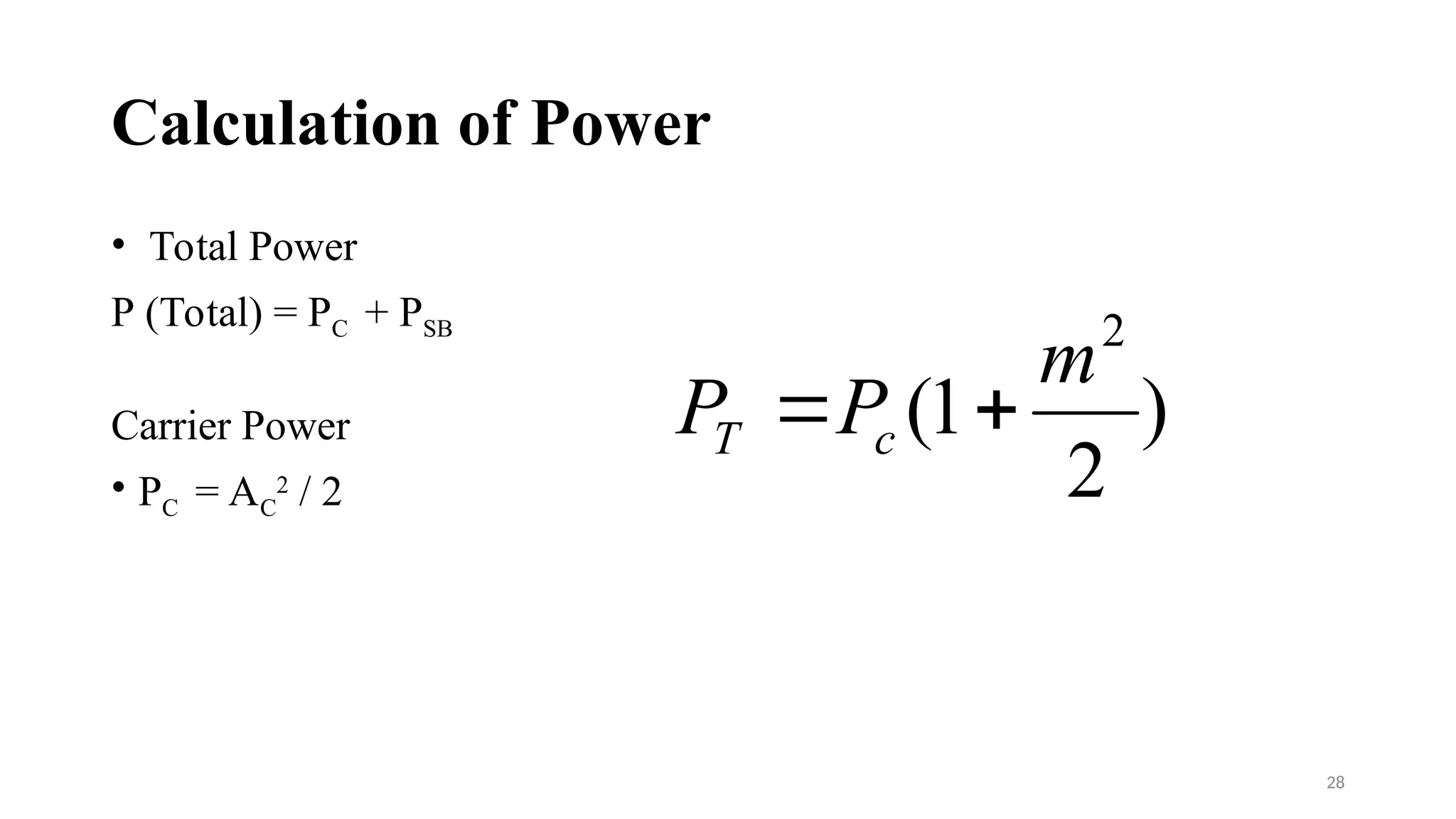
Calculation of Power
• Total Power
P (Total) = PC + PSB
Carrier Power
• PC = AC
2
/ 2
28
)
2
1
(
2
m
P
P c
T 

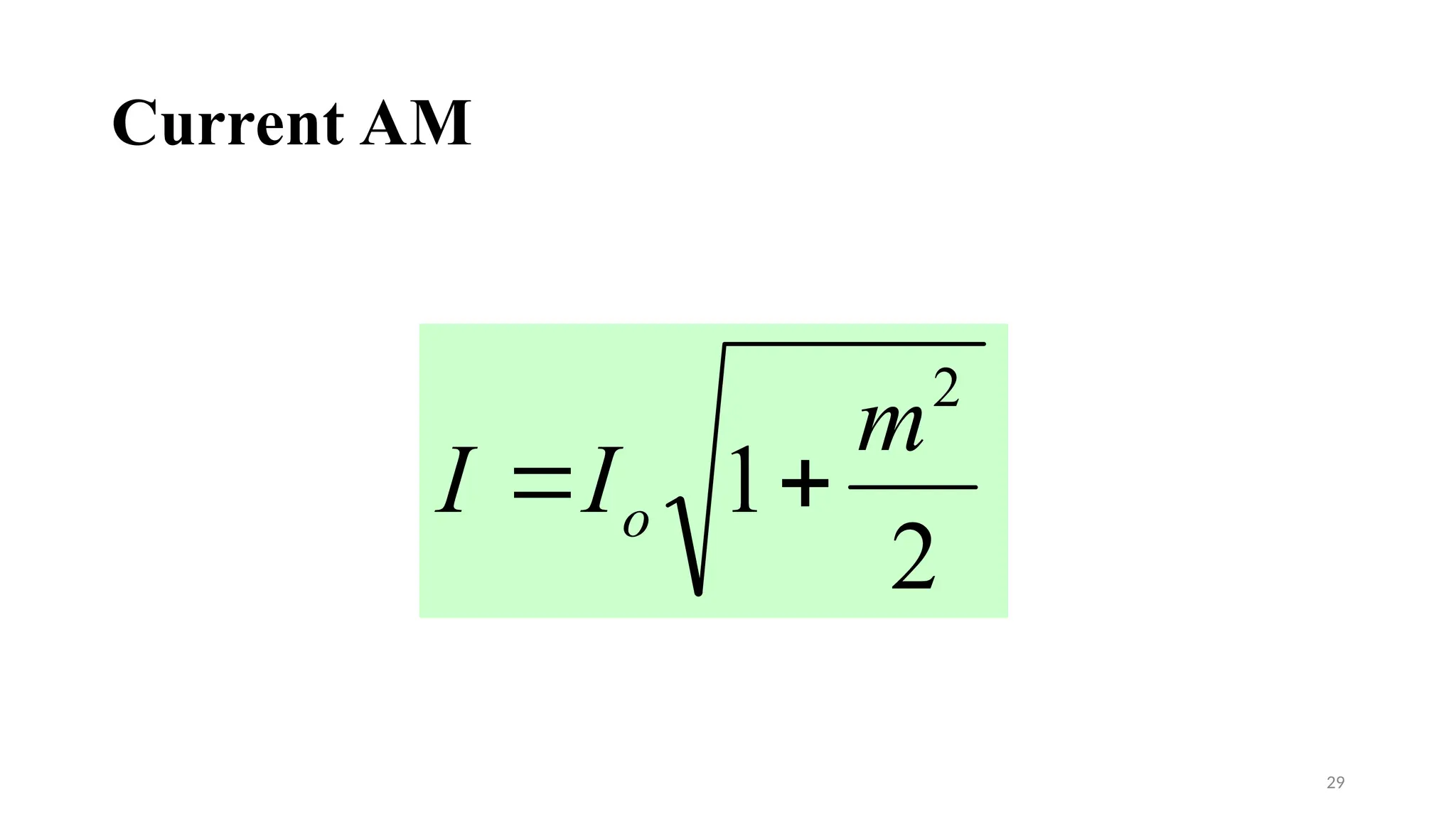
Current AM
29
2
1
2
m
I
I o 

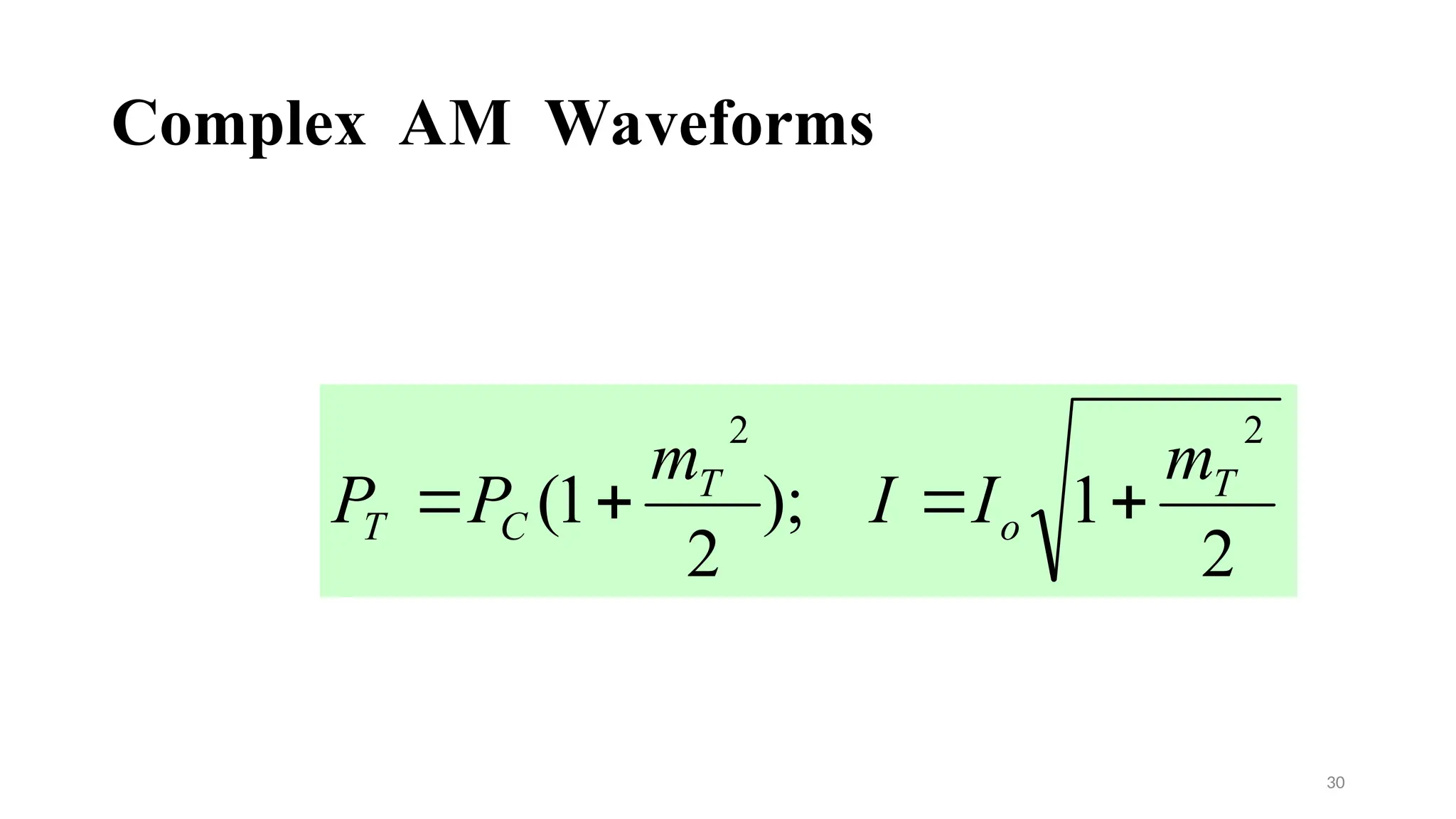
Complex AM Waveforms
30
2
1
);
2
1
(
2
2
T
o
T
C
T
m
I
I
m
P
P 




Importance of Modulation, Principles of Amplitude Modulation (AM).ppt

  • 1.
    DISCOVER . LEARN. EMPOWER University Institute of Engineering DEPARTMENT OF COMPUTER SCIENCE & ENGINEERING Bachelor of Engineering (Computer Science & Engineering) Subject Name : Foundation Course in Wireless and Mobile Communication Subject Code: ECO-455 Topic: Lecture-1.3.1 & 1.3.2 Lecture- Prepared by: Naveen Chander
  • 2.
    Introduction to Modulation 2 Twosignals are involved in the Modulation process. 1.Message signals also known as baseband signals. Baseband signals are the band of frequencies representing the original signal. 2.The other signal involved with this is a high-frequency sinusoidal wave. This signal is called the carrier signal. 3.The frequency of Baseband signal is usually low whereas the frequency of the carrier signals is almost, always higher than that of the baseband signal.
  • 3.
    Definition of Modulation •Modulation is the process of changing one or more properties (Amplitude, Frequency and phase) of the carrier signal in proportional to the modulating signal(baseband signal). • The process of superimposing a low-frequency signal on a high- frequency carrier signal. • The process of varying the RF carrier wave in accordance with the information in a low-frequency signal 3
  • 4.
  • 5.
    Need of Modulation •Increase the Signal Strength • Size of the Antenna • Prevent interference by frequency translation • Wireless Communication System 5
  • 6.
    Need of Modulation 1.Increase the Signal Strength The baseband signals transmitted by the sender are not capable of direct transmission. The strength of the message signal should be increased so that it can travel longer distances. This is where modulation is essential. The most vital need of modulation is to enhance the strength of the signal without affecting the parameters of the carrier signal. 6
  • 7.
    Need of Modulation 2.Size of the Antenna •The efficiency of transmitted and received signal depends on the size of the antenna , which in turns depends on the wavelength(λ) of the frequency used. •For the effective transmission of a signal, the height h of the antenna should be comparable to the wavelength λ of the signal at least the height of the antenna h should be λ / 4 in length so that the antenna can sense the variations of the signal properly. 7
  • 8.
    Need of Modulation 2.Size of the Antenna For example: If we have to transmit a signal of 5 kHz then λ = C / f and height of the antenna h = λ/4 where C is the wave velocity, here C = 3 × 10⁸ m/s. •h = (3 × 10⁸ ) / (5 × 10³ ) ×4 •h = 15 × 103 = 15 km. For example: If we have to transmit a signal of 5 MHz then λ = C / f and height of the antenna h = λ/4 where C is the wave velocity, here C = 3 × 10⁸ m/s. •h = (3 × 10⁸ ) / (5 × 10⁶ ) ×4 •h = 15 m. Hence, we need to modulate the message signal over the high-frequency carrier signal so that we can have a practical value for the height h of the antenna. 8
  • 9.
    Need of Modulation 3.Prevent interference by frequency translation: Due to transmission of audio signal by all the Radio stations over the same range of 20Hz to 20 KHZ, the programs of different station will get mixed up. So to keep various signal separate, each station is allocated a band of frequency. Doing this, will translate or shift various signals to different portion of EM spectrum. The process of shifting the frequency of signal within the range is called Frequency Translation and it is done by modulation. 9
  • 10.
    Need of Modulation 4.Wireless Communication System By using modulation to transmit the signals through space to long distances, we have removed the need for wires in the communication systems. The technique of modulation helped humans to use the wireless equipment in a big way in their lives. Telephones no longer had to remain plugged to a wall. All the benefits of modulation have raised our standards of living in a considerable manner. 10
  • 11.
  • 12.
    Analog Modulation In analogmodulation, analog signal (sinusoidal signal) is used as a carrier signal that modulates the message signal or data signal. The general function Sinusoidal wave’s is shown in the figure below, in which, three parameters can be altered to get modulation: – They are amplitude, frequency and phase; so, the types of analog modulation are: 12
  • 13.
  • 14.
    Types of Modulation Thereare Two types of Modulation 1. Analog Modulation: •Amplitude Modulation(AM) •Frequency Modulation(FM) •Phase Modulation(PM) 2. Digital Modulation: •Amplitude Shift Key(ASK) •Frequency Shift Key( FSK) •Phase Shift Key( PSK) 14
  • 15.
    Amplitude Modulation(AM) • Acontinuous-wave goes on continuously without any intervals and it is the baseband message signal, which contains the information. This wave has to be modulated. • According to the standard definition, “The amplitude of the carrier signal varies in accordance with the instantaneous amplitude of the modulating signal.” Which means, the amplitude of the carrier signal containing no information varies as per the amplitude of the signal containing information, at each instant. 15
  • 16.
    Amplitude Modulation Waveform •The first figure shows the modulating wave, which is the message signal. • The next one is the carrier wave, which is a high frequency signal and contains no information. • While, the last one is the resultant modulated wave. 16
  • 17.
  • 18.
    Mathematical Expressions ofAM Following are the mathematical expressions for these waves. •Time-domain Representation of the Waves Let the modulating signal be, m(t)=Am sin ⁡ Wmt and the carrier signal be, c(t)=Ac sin⁡Wct Where, Am and Ac are the amplitude of the modulating signal and the carrier signal respectively. fm and fc are the frequency of the modulating signal and the carrier signal respectively. Then, the equation of Amplitude Modulated wave will be y(t)=A’ Sin Wct ; where, A’ = [Ac+m(t)] 18
  • 19.
    Mathematical Expressions ofAM y(t)=[Ac+m(t)]sin⁡ Wct =[Ac+Am sin Wmt]sin⁡ Wct =Ac[1+(Am/Ac) sinWmt]sin⁡ Wct (equation1) where, [μ=Am/Ac] (equation2) μ is Modulation index Rearrange the Equation 1 as below. y(t)=Ac[1+μsin⁡ (Wmt)]sin⁡ (Wct) (equation 3) 19
  • 20.
    Mathematical Expressions ofAM Now, y(t)=Ac[1+μsin⁡ (Wmt)]sin⁡ (Wct) (equation 3) y(t)=Acsin⁡ (Wct)+ Ac μ sin⁡⁡ (Wct) sin(Wmt) y(t)=Acsin⁡ (Wct)+ 2[Ac μ sin⁡⁡ (Wct) sin(Wmt)/2] y(t)=Acsin⁡ (Wct)+ (Ac μ/2). 2sin⁡⁡ (Wct) sin(Wmt) y(t)=Acsin⁡ (Wct)+ (Ac μ/2)[cos⁡⁡ (Wc+Wm)t. cos⁡⁡ (Wc-Wm)t] (equation 4) In the process of Amplitude Modulation, the modulated wave consists of the carrier wave and two sidebands. The modulated wave has the information only in the sidebands. Sideband is nothing but a band of frequencies, containing power, which are the lower and higher frequencies of the carrier frequency. 20
  • 21.
    Mathematical Expressions ofAM y(t)=Acsin⁡ (Wct)+ (Ac μ/2)[cos⁡ ⁡ (Wc+Wm)t. cos⁡ ⁡ (Wc-Wm)t] (equation 4) •In the process of Amplitude Modulation, the modulated wave consists of the carrier wave and two sidebands. The modulated wave has the information only in the sidebands. •Sideband is nothing but a band of frequencies, containing power, which are the lower and higher frequencies of the carrier frequency. 21
  • 22.
    Modulation Index ofAM Where, μ is Modulation index and it is equal to the ratio of Am and Ac. Mathematically, we can write it as μ=Am/Ac •Hence, we can calculate the value of modulation index by using the above formula, when the amplitudes of the message and carrier signals are known. 22
  • 23.
    Modulation Index ofAM A carrier wave, after being modulated, if the modulated level is calculated, then such an attempt is called as Modulation Index or Modulation Depth. It states the level of modulation that a carrier wave undergoes. 23
  • 24.
    Modulation Index • ModulationIndex give the depth to which the carrier signal is modulated. • % modulation = m * 100 • m <= 1 24 min max min max E E E E or E E m c m   
  • 25.
    Total Modulation Index 25 2 2 2 2 1... n T m m m m    
  • 26.
    Bandwidth of AmplitudeModulation • The bandwidth is the difference between lowest and highest frequencies of the signal. For amplitude modulated wave, the bandwidth is given by • $$BW = f_{USB}-f_{LSB} = (fc+fm)-(fc-fm) = 2fm = 2W Where W is the message bandwidth Hence we got to know that the bandwidth required for the amplitude modulated wave is twice the frequency of the modulating signal. 26
  • 27.
    Calculation of Amplitude •Amplitude of Message Signal Am = (Vmax – Vmin)/2 • Amplitude of Carrier Signal Ac = (Vmax + Vmin)/2 27
  • 28.
    Calculation of Power •Total Power P (Total) = PC + PSB Carrier Power • PC = AC 2 / 2 28 ) 2 1 ( 2 m P P c T  
  • 29.
  • 30.