EEE 3105 : Communication Systems
Course Instructor: Dr. Mosabber Uddin Ahmed
Purpose and Types of Modulation
▪Modulation is a process that causes a shift in the range of frequencies
in a signal.
▪To modulate means “to change”.
▪Modulation may be done by varying the amplitude, phase or frequency
of a high frequency carrier in accordance with the amplitude of the
message signal.
▪This process involves: Baseband/message signal →Modulating signal
Carrier signal
Modulated signal
Baseband and Carrier Communication
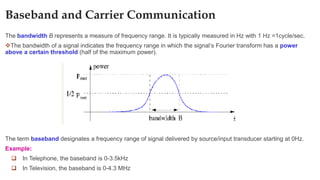
The bandwidth B represents a measure of frequency range. It is typically measured in Hz with 1 Hz =1cycle/sec.
❖The bandwidth of a signal indicates the frequency range in which the signal‘s Fourier transform has a power
above a certain threshold (half of the maximum power).
The term baseband designates a frequency range of signal delivered by source/input transducer starting at 0Hz.
Example:
❑ In Telephone, the baseband is 0-3.5kHz
❑ In Television, the baseband is 0-4.3 MHz
Baseband and Carrier Communication
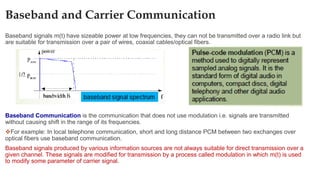
Baseband signals m(t) have sizeable power at low frequencies, they can not be transmitted over a radio link but
are suitable for transmission over a pair of wires, coaxial cables/optical fibers.
Baseband Communication is the communication that does not use modulation i.e. signals are transmitted
without causing shift in the range of its frequencies.
❖For example: In local telephone communication, short and long distance PCM between two exchanges over
optical fibers use baseband communication.
Baseband signals produced by various information sources are not always suitable for direct transmission over a
given channel. These signals are modified for transmission by a process called modulation in which m(t) is used
to modify some parameter of carrier signal.
Baseband and Carrier Communication
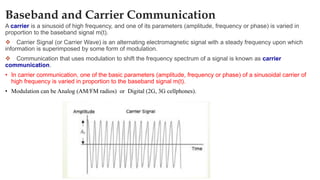
A carrier is a sinusoid of high frequency, and one of its parameters (amplitude, frequency or phase) is varied in
proportion to the baseband signal m(t).
❖ Carrier Signal (or Carrier Wave) is an alternating electromagnetic signal with a steady frequency upon which
information is superimposed by some form of modulation.
❖ Communication that uses modulation to shift the frequency spectrum of a signal is known as carrier
communication.
• In carrier communication, one of the basic parameters (amplitude, frequency or phase) of a sinusoidal carrier of
high frequency is varied in proportion to the baseband signal m(t).
• Modulation can be Analog (AM/FM radios) or Digital (2G, 3G cellphones).
Purpose of Modulation
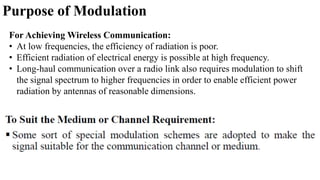
For Achieving Wireless Communication:
• At low frequencies, the efficiency of radiation is poor.
• Efficient radiation of electrical energy is possible at high frequency.
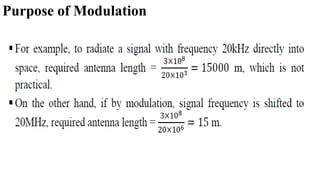
• Long-haul communication over a radio link also requires modulation to shift
the signal spectrum to higher frequencies in order to enable efficient power
radiation by antennas of reasonable dimensions.
Purpose of Modulation
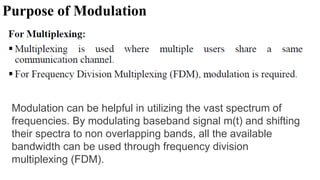
Modulation can be helpful in utilizing the vast spectrum of
frequencies. By modulating baseband signal m(t) and shifting
their spectra to non overlapping bands, all the available
bandwidth can be used through frequency division
multiplexing (FDM).
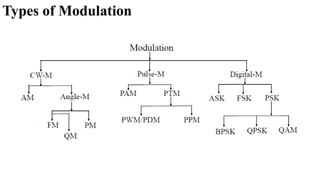
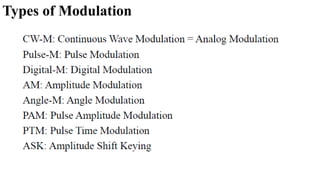
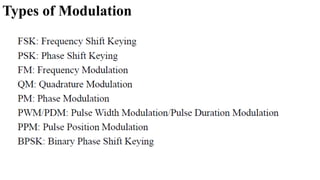
Types of Modulation
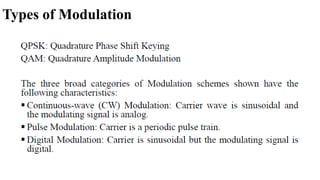
Types of Modulation
Types of Modulation
Types of Modulation
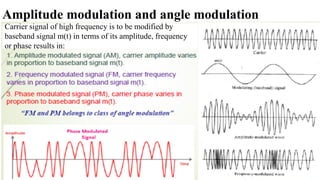
Amplitude modulation and angle modulation
Carrier signal of high frequency is to be modified by
baseband signal m(t) in terms of its amplitude, frequency
or phase results in:
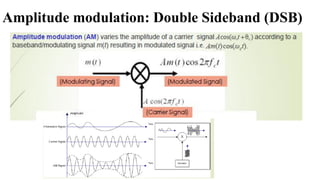
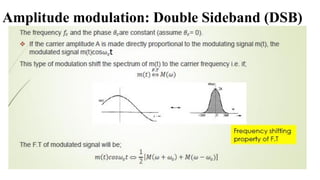
Amplitude modulation: Double Sideband (DSB)
t
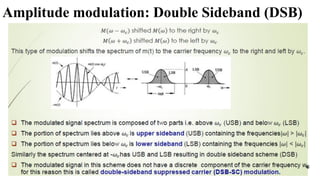
Amplitude modulation: Double Sideband (DSB)
c
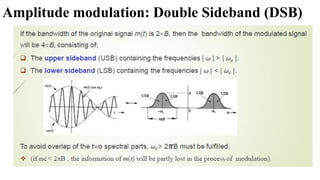
Amplitude modulation: Double Sideband (DSB)
𝜋
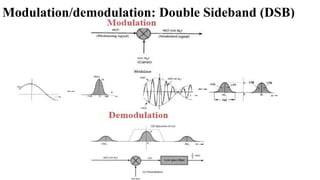
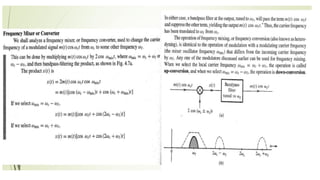
Modulation/demodulation: Double Sideband (DSB)
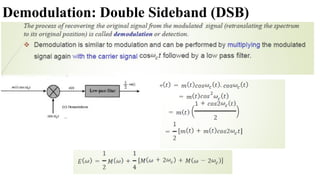
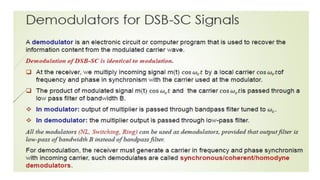
Demodulation: Double Sideband (DSB)
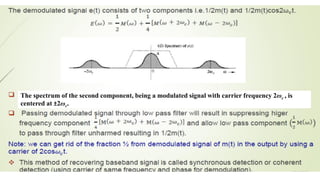
The spectrum of the second component, being a modulated signal with carrier frequency 2ωc , is
centered at ±2ωc.
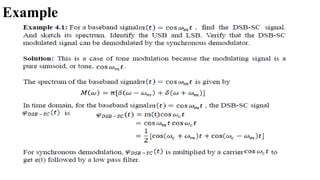
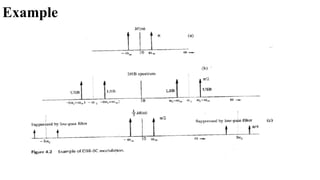
Example
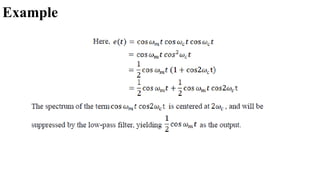
Example
Example
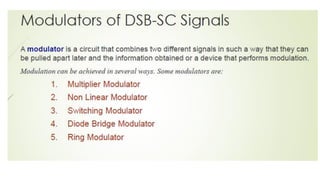
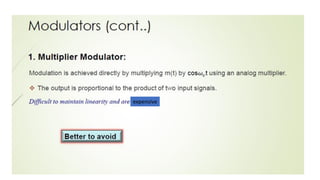
expensive
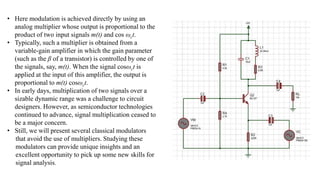
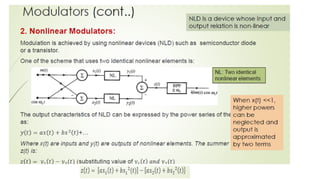
• Here modulation is achieved directly by using an
analog multiplier whose output is proportional to the
product of two input signals m(t) and cos ωct.
• Typically, such a multiplier is obtained from a
variable-gain amplifier in which the gain parameter
(such as the β of a transistor) is controlled by one of
the signals, say, m(t). When the signal cosωct is
applied at the input of this amplifier, the output is
proportional to m(t) cosωct.
• In early days, multiplication of two signals over a
sizable dynamic range was a challenge to circuit
designers. However, as semiconductor technologies
continued to advance, signal multiplication ceased to
be a major concern.
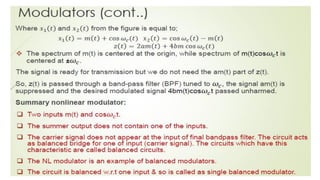
• Still, we will present several classical modulators
that avoid the use of multipliers. Studying these
modulators can provide unique insights and an
excellent opportunity to pick up some new skills for
signal analysis.
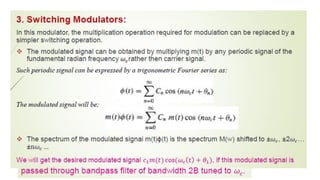
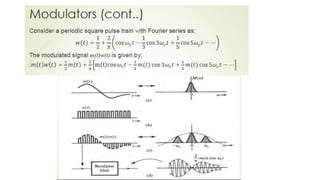
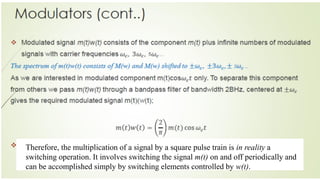
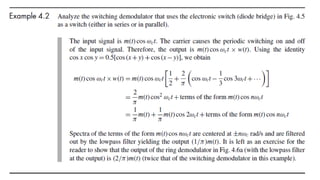
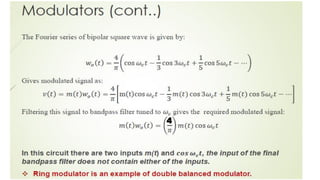
Therefore, the multiplication of a signal by a square pulse train is in reality a
switching operation. It involves switching the signal m(t) on and off periodically and
can be accomplished simply by switching elements controlled by w(t).
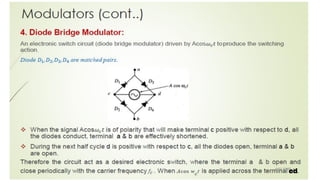
cd
4
Lecture 3: amplitude modulation and demodulation.pdf

Lecture 3: amplitude modulation and demodulation.pdf

  • 1.
    EEE 3105 :Communication Systems Course Instructor: Dr. Mosabber Uddin Ahmed
  • 2.
    Purpose and Typesof Modulation ▪Modulation is a process that causes a shift in the range of frequencies in a signal. ▪To modulate means “to change”. ▪Modulation may be done by varying the amplitude, phase or frequency of a high frequency carrier in accordance with the amplitude of the message signal. ▪This process involves: Baseband/message signal →Modulating signal Carrier signal Modulated signal
  • 3.
    Baseband and CarrierCommunication The bandwidth B represents a measure of frequency range. It is typically measured in Hz with 1 Hz =1cycle/sec. ❖The bandwidth of a signal indicates the frequency range in which the signal‘s Fourier transform has a power above a certain threshold (half of the maximum power). The term baseband designates a frequency range of signal delivered by source/input transducer starting at 0Hz. Example: ❑ In Telephone, the baseband is 0-3.5kHz ❑ In Television, the baseband is 0-4.3 MHz
  • 4.
    Baseband and CarrierCommunication Baseband signals m(t) have sizeable power at low frequencies, they can not be transmitted over a radio link but are suitable for transmission over a pair of wires, coaxial cables/optical fibers. Baseband Communication is the communication that does not use modulation i.e. signals are transmitted without causing shift in the range of its frequencies. ❖For example: In local telephone communication, short and long distance PCM between two exchanges over optical fibers use baseband communication. Baseband signals produced by various information sources are not always suitable for direct transmission over a given channel. These signals are modified for transmission by a process called modulation in which m(t) is used to modify some parameter of carrier signal.
  • 5.
    Baseband and CarrierCommunication A carrier is a sinusoid of high frequency, and one of its parameters (amplitude, frequency or phase) is varied in proportion to the baseband signal m(t). ❖ Carrier Signal (or Carrier Wave) is an alternating electromagnetic signal with a steady frequency upon which information is superimposed by some form of modulation. ❖ Communication that uses modulation to shift the frequency spectrum of a signal is known as carrier communication. • In carrier communication, one of the basic parameters (amplitude, frequency or phase) of a sinusoidal carrier of high frequency is varied in proportion to the baseband signal m(t). • Modulation can be Analog (AM/FM radios) or Digital (2G, 3G cellphones).
  • 6.
  • 7.
  • 8.
  • 9.
  • 10.
    Purpose of Modulation ForAchieving Wireless Communication: • At low frequencies, the efficiency of radiation is poor. • Efficient radiation of electrical energy is possible at high frequency. • Long-haul communication over a radio link also requires modulation to shift the signal spectrum to higher frequencies in order to enable efficient power radiation by antennas of reasonable dimensions.
  • 11.
    Purpose of Modulation Modulationcan be helpful in utilizing the vast spectrum of frequencies. By modulating baseband signal m(t) and shifting their spectra to non overlapping bands, all the available bandwidth can be used through frequency division multiplexing (FDM).
  • 12.
  • 13.
  • 14.
  • 15.
  • 16.
    Amplitude modulation andangle modulation Carrier signal of high frequency is to be modified by baseband signal m(t) in terms of its amplitude, frequency or phase results in:
  • 17.
  • 18.
  • 19.
  • 20.
    Amplitude modulation: DoubleSideband (DSB) 𝜋
  • 21.
  • 22.
  • 23.
    Demodulation: Double Sideband(DSB) The spectrum of the second component, being a modulated signal with carrier frequency 2ωc , is centered at ±2ωc.
  • 24.
  • 25.
  • 26.
  • 28.
  • 29.
    • Here modulationis achieved directly by using an analog multiplier whose output is proportional to the product of two input signals m(t) and cos ωct. • Typically, such a multiplier is obtained from a variable-gain amplifier in which the gain parameter (such as the β of a transistor) is controlled by one of the signals, say, m(t). When the signal cosωct is applied at the input of this amplifier, the output is proportional to m(t) cosωct. • In early days, multiplication of two signals over a sizable dynamic range was a challenge to circuit designers. However, as semiconductor technologies continued to advance, signal multiplication ceased to be a major concern. • Still, we will present several classical modulators that avoid the use of multipliers. Studying these modulators can provide unique insights and an excellent opportunity to pick up some new skills for signal analysis.
  • 34.
    Therefore, the multiplicationof a signal by a square pulse train is in reality a switching operation. It involves switching the signal m(t) on and off periodically and can be accomplished simply by switching elements controlled by w(t).
  • 35.
  • 38.