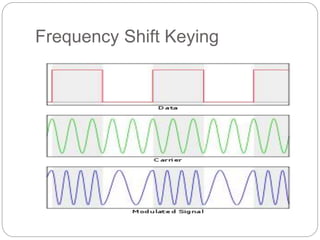
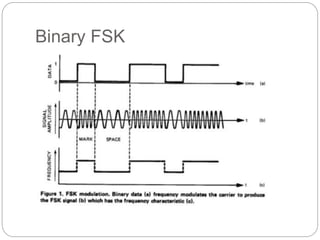
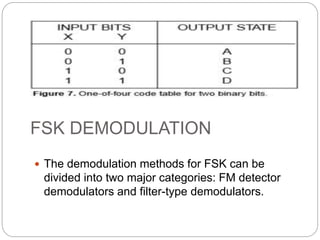
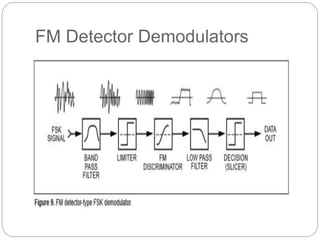
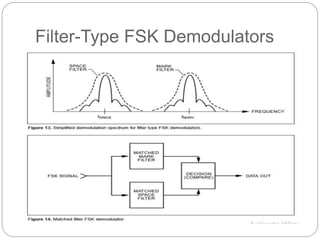
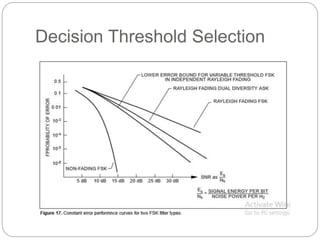
Frequency shift keying (FSK) is a digital modulation technique that encodes digital information by shifting the frequency of a carrier wave. There are different types of FSK including binary FSK, which uses two discrete frequencies to represent binary 1 and 0, and double frequency shift keying (DFSK), which uses four frequencies to transmit two independent data streams simultaneously. FSK modulation can be demodulated using either FM detector demodulators, which treat the FSK signal as an FM signal, or filter-type demodulators, which use optimal filters matched to the FSK signal parameters. The filters are used to detect the mark and space frequencies, and a decision circuit then determines which was transmitted.