Unit – I
Amplitude Modulation &
Demodulati
on-I
COURSE OBJECTIVES
 Students are able to study the
fundamental concepts of the analog
communication system.
 Students are able to analyze various
analog modulation and demodulation
techniques.
 Students are able to know the
working of
various transmitters and receivers.
 Students are able to understand the influence
of noise on the performance of analog
communication systems, and to acquire the
COURSE OUTCOMES
Describe the fundamentals of Analog Communication
Systems
Express the concept of various Analog
Modulation schemes and Multiplexing.
Compute various parameters of continuous and
pulse wave modulation Techniques.
Analyze various continuous and pulse wave modulation
and Demodulation Schemes.
Estimate the performance of Analog
Communication System in the presence of noise.
Identify different Radio receivers and understand
the concept of coding schemes in Information theory.
CONTENTS
 Introduction communication systems
Modulation
Need for Modulation
Introduction to Amplitude Modulation
Power and transmission efficiency
Single tone AM
Generation of AM wave
 Square law Modulator
 Switching modulator
 Detection of AM Wave
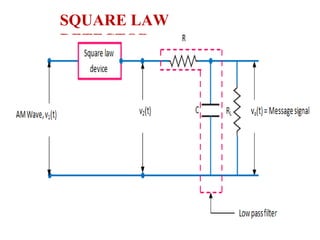
Square law detector
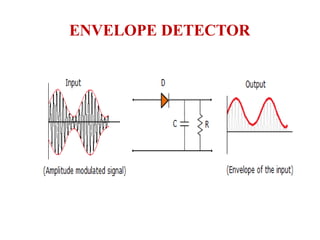
Envelope detector
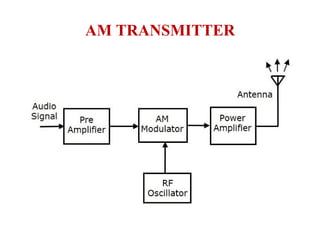
AM Transmitters
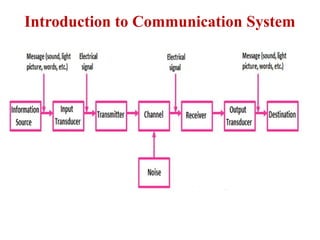
Introduction to Communication System
MODULATION
• It is the process of varying the characteristics of high
frequency carrier in accordance with instantaneous
values of modulating or message or baseband signal.
(Or)
• It is a frequency translation technique which converts
baseband or low frequency signal to bandpass or
high frequency signal.
• Modulation is used in the transmitter.
NEED FOR MODULATION
 To reduce the length or height of antenna
 For multiplexing
 For narrow banding or to use antenna with single
or same length
 To reduce noise effect
 To avoid equipment limitation or to reduce the size of
the equipment.
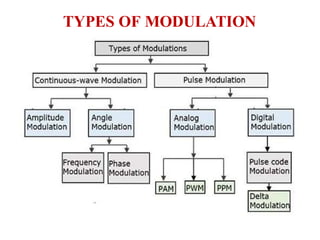
TYPES OF MODULATION
Introduction to Amplitude
Modulation
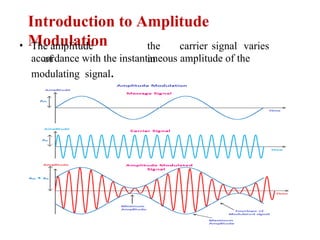
• The amplitude
of
the carrier signal varies
in
accordance with the instantaneous amplitude of the
modulating signal.
POWER AND
TRANSMISSION
EFFICIENCY
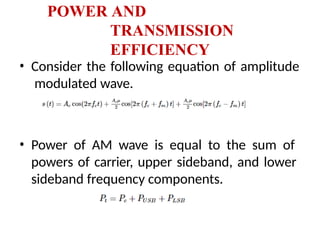
• Consider the following equation of amplitude
modulated wave.
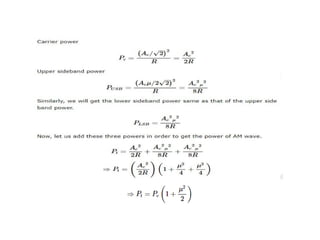
• Power of AM wave is equal to the sum of
powers of carrier, upper sideband, and lower
sideband frequency components.
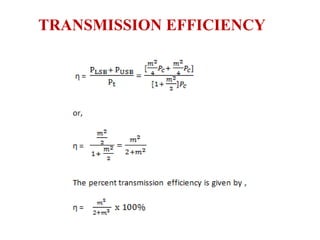
TRANSMISSION EFFICIENCY
SINGLE TONE
AM
• Thestandard equation for
amplitude modulated signal is expressed as,
S(t)= Ac Cos2πfct[1+ma(Cos2πfmt)]
Where, ma = Am/Ac = Modulation
Index
Time Domain representation of AM:
S(t)=AcCos2πfct+μAc/2Cos[2πfc+2πfm]t+μAc/2Cos[2πf
c-2πfm]t
I term: Carrier signal with amplitude Ac and frequency
fc.
II. term: Amplitude= μAc/2, frequency= fc+fm ,
Upper sideband frequency
III.term: Amplitude= μAc/2, frequency= fc-fm ,
Lower sideband frequency
GENERATION OF AM
WAVES
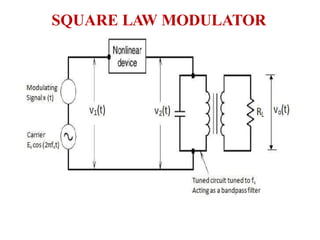
• Square Law Modulator
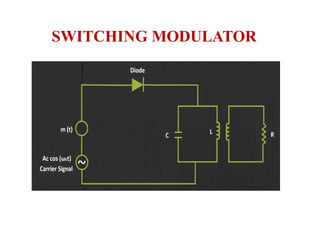
• Switching Modulator
SQUARE LAW MODULATOR
SWITCHING MODULATOR
DETECTION OF AM
WAVE
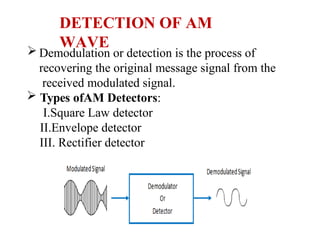
 Demodulation or detection is the process of
recovering the original message signal from the
received modulated signal.
 Types ofAM Detectors:
I.Square Law detector
II.Envelope detector
III. Rectifier detector
SQUARE LAW
DETECTOR
ENVELOPE DETECTOR
AM TRANSMITTER
• https://www.electronics-
notes.com/articles/radio/modulation/am-
diode-detector-demodulator.php
• https://www.tutorialspoint.com/analog_com
munication/analog_communication_numerica
l_problems_2.htm
REFERENCES
21
Unit – 2
Amplitude Modulation &
Demodulati
on-II
COURSE OBJECTIVES
 Students are able to study the fundamental
concepts of the analog communication
system.
 Students are able to analyze various analog
modulation and demodulation techniques.
 Students are able to know the working
of
various transmitters and receivers.
 Students are able to understand the influence
of noise on the performance of analog
communicationsystems, and to acquire the
knowledge about information and capacity.
COURSE OUTCOMES
Describe the fundamentals of Analog Communication
Systems
Express the concept of various Analog
Modulation schemes and Multiplexing.
Compute various parameters of continuous and
pulse wave modulation Techniques.
Analyze various continuous and pulse wave modulation
and Demodulation Schemes.
Estimate the performance of Analog
Communication System in the presence of noise.
Identify different Radio receivers and understand
the concept of coding schemes in Information theory.
CONTENTS
Introduction to DSB-SC
Power calculations
Generation of DSB-SC
 Balanced Modulators
 Ring Modulator
 Coherent detection of DSB-SC
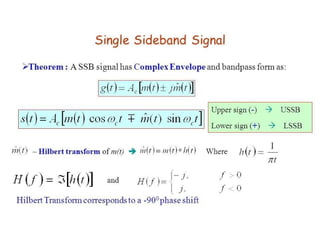
Time domain description of SSB
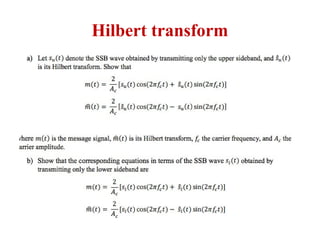
Hilbert transform,
Generation of SSB wave
 Frequency discrimination & Phase discrimination method,
Demodulation of SSB Wave
Introduction to Vestigial sideband (VSB)modulation
Comparison of AM Techniques
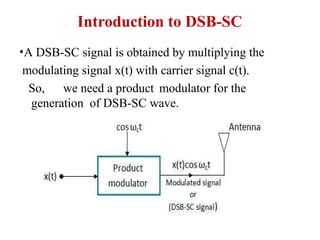
Introduction to DSB-SC
•A DSB-SC signal is obtained by multiplying the
modulating signal x(t) with carrier signal c(t).
So, we need a product modulator for the
generation of DSB-SC wave.
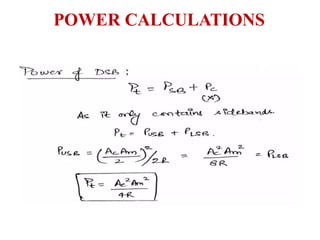
POWER CALCULATIONS
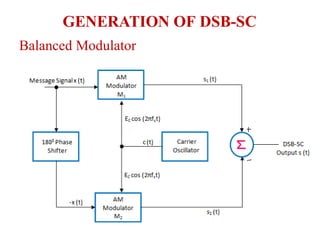
GENERATION OF DSB-SC
Balanced Modulator
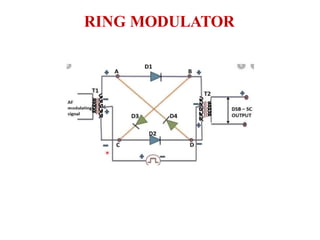
RING MODULATOR
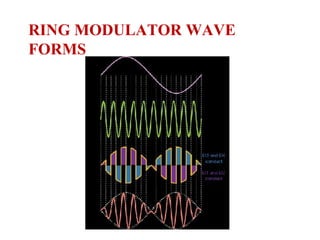
RING MODULATOR WAVE
FORMS
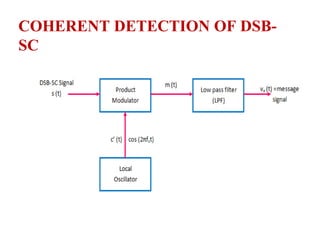
COHERENT DETECTION OF DSB-
SC
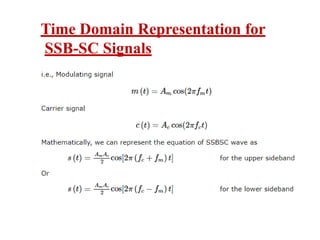
Time Domain Representation for
SSB-SC Signals
Hilbert transform
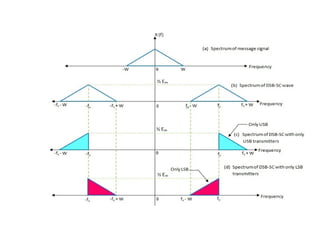
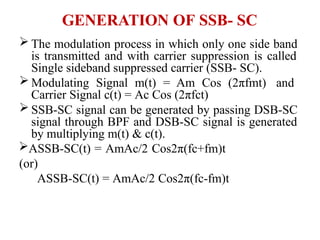
GENERATION OF SSB- SC
 The modulation process in which only one side band
is transmitted and with carrier suppression is called
Single sideband suppressed carrier (SSB- SC).
 Modulating Signal m(t) = Am Cos (2πfmt) and
Carrier Signal c(t) = Ac Cos (2πfct)
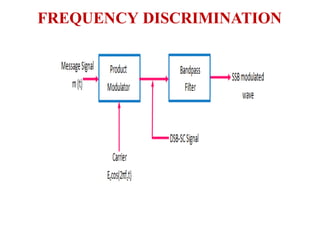
 SSB-SC signal can be generated by passing DSB-SC
signal through BPF and DSB-SC signal is generated
by multiplying m(t) & c(t).
ASSB-SC(t) = AmAc/2 Cos2π(fc+fm)t
(or)
ASSB-SC(t) = AmAc/2 Cos2π(fc-fm)t
FREQUENCY DISCRIMINATION
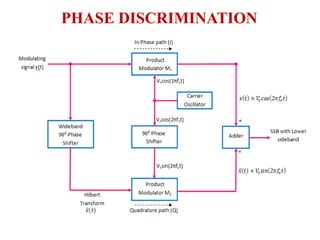
PHASE DISCRIMINATION
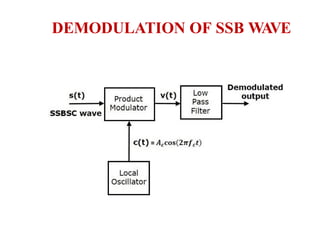
DEMODULATION OF SSB WAVE
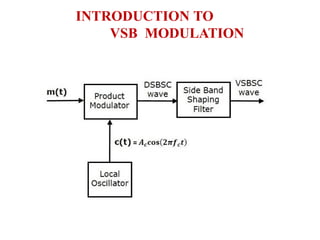
INTRODUCTION TO
VSB MODULATION
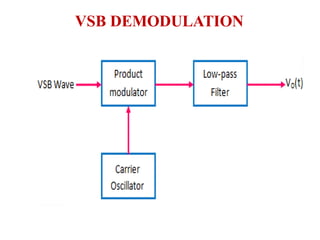
VSB DEMODULATION
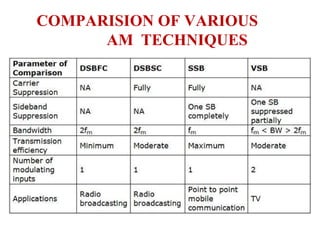
COMPARISION OF VARIOUS
AM TECHNIQUES
• https://www.electronics-
notes.com/articles/radio/modulation/am-diode-detector-
demodulator.php
• https://www.youtube.com/watch?v=OC451cdFLoQ
• https://en.wikipedia.org/wiki/Single-sideband_modulatio
n
• https://www.tutorialspoint.com/analog_communication/an
alog_communication_vsbsc_modulation.htm
• https://www.tutorialspoint.com/analog_communication/an
alog_communication_numerical_problems_2.htm
REFERENCES
23
Unit – 3
Angle Modulation
COURSE OBJECTIVES
 Students are able to study the fundamental
concepts of the analog communication
system.
 Students are able to analyze various analog
modulation and demodulation techniques.
 Students are able to know the working of
various transmitters and receivers.
 Students are able to understand the influence
of noise on the performance of analog
communicationsystems, and to acquire the
knowledge about information and capacity.
COURSE OUTCOMES
Describe the fundamentals of Analog Communication
Systems
Express the concept of various Analog
Modulation schemes and Multiplexing.
Compute various parameters of continuous and
pulse wave modulation Techniques.
Analyze various continuous and pulse wave modulation
and Demodulation Schemes.
Estimate the performance of Analog
Communication System in the presence of noise.
Identify different Radio receivers and understand
the concept of coding schemes in Information theory.
CONTENTS
Concept of angle modulation
 Frequency modulation
Narrow band frequency modulation (NBFM)
 Wide band FM (WBFM)
Generation of FM waves
Indirect method
 Direct method
Demodulation of FM
 Phase modulation
Pre-emphasis& De-emphasis filters
FM Transmitter
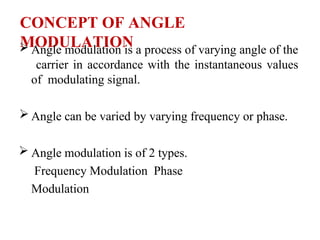
CONCEPT OF ANGLE
MODULATION
 Angle modulation is a process of varying angle of the
carrier in accordance with the instantaneous values
of modulating signal.
 Angle can be varied by varying frequency or phase.
 Angle modulation is of 2 types.
Frequency Modulation Phase
Modulation
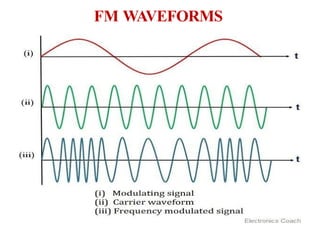
FREQUENCY MODULATION
The process of varying frequency of the carrier in accordance with the
instantaneous values of the modulating signal.
Relation between angle and frequency :
Consider carrier signal c(t)= Ac Cos (wct+φ)
= Ac Cos (2πfct +φ)
Where, Wc = Carrier frequency
φ = Phase
C(t) = Ac Cos[ψ(t)], where,
ψ(t)= wct+φ
i.e Frequency can be obtained by derivating angle and angle can be
obtained
by integrating frequency.
FREQUENCY MODULATION
Frequency modulated signal can be written as,
AFM(t) = Ac Cos [ψi(t)] = Ac Cos [wct + kf m(t)dt]
ʃ
Frequency Deviation in FM:
The instantaneous
frequency, wi = wc + kf
m(t)
FM WAVEFORMS
Types of Frequency Modulation
FM (Frequency Modulation)
Narrowband FM (NBFM) Wideband FM (WBFM)
[When modulation index is small][When modulation index is large]
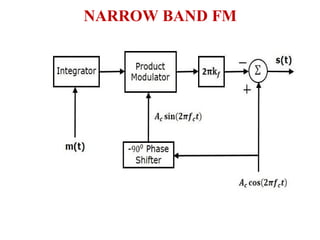
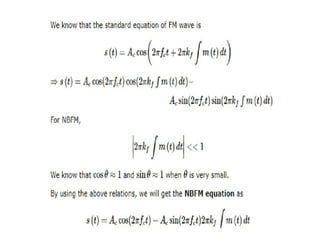
NARROW BAND FM
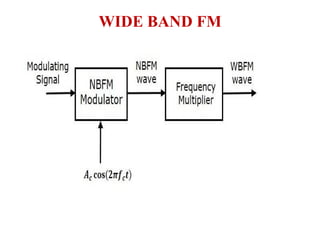
WIDE BAND FM
Generation of FM waves
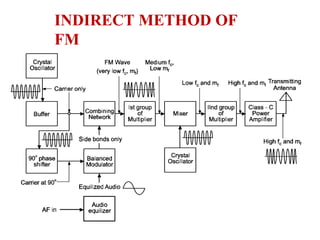
• Indirect Method Of FM
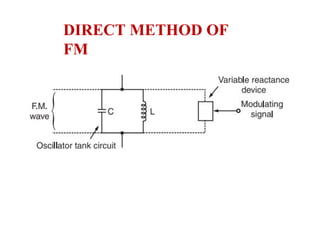
• Direct Method Of FM
INDIRECT METHOD OF
FM
DIRECT METHOD OF
FM
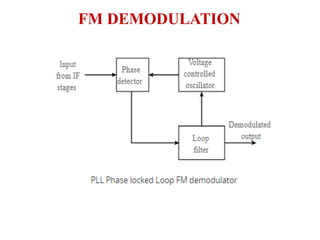
FM DEMODULATION
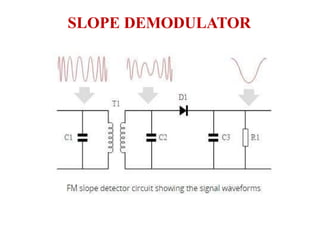
SLOPE DEMODULATOR
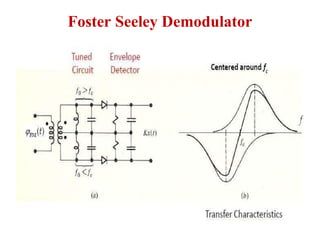
Foster Seeley Demodulator
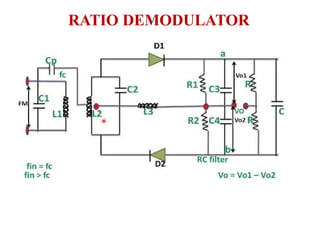
RATIO DEMODULATOR
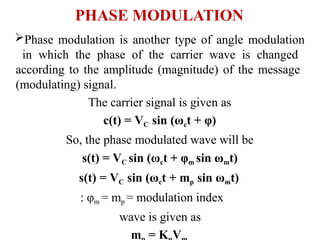
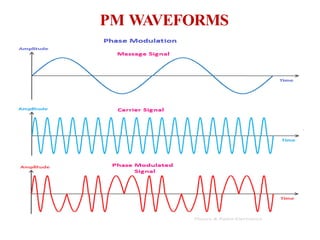
PHASE MODULATION
Phase modulation is another type of angle modulation
in which the phase of the carrier wave is changed
according to the amplitude (magnitude) of the message
(modulating) signal.
The carrier signal is given as
c(t) = VC sin (ωct + φ)
So, the phase modulated wave will be
s(t) = VC sin (ωct + φm sin ωmt)
s(t) = VC sin (ωct + mp sin ωmt)
: φm = mp = modulation index
wave is given as
m = K V
PM WAVEFORMS
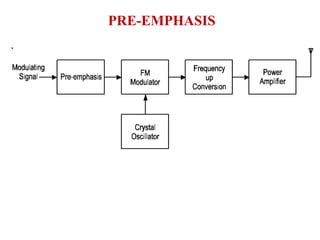
PRE-EMPHASIS
.
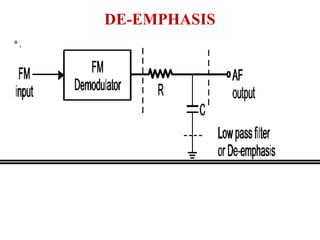
DE-EMPHASIS
•.
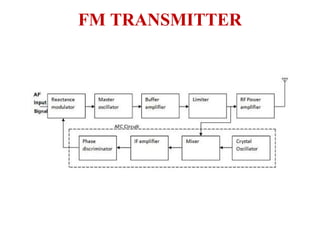
FM TRANSMITTER
• https://en.wikipedia.org/wiki/Frequency_modulatio
n
• https://en.wikipedia.org/wiki/Phase_modulation
• https://www.daenotes.com/electronics/communicati
on-system/pre-emphasis-and-de-emphasis
• https://www.etechnog.com/2019/10/fm-
transmitter-block-diagram-working.html
REFERENCES
25
Unit-4
Radio Receivers & Noise
COURSE OBJECTIVES
 Students are able to study the fundamental
concepts of the analog communication
system.
 Students are able to analyze various analog
modulation and demodulation techniques.
 Students are able to know the working of
various transmitters and receivers.
 Students are able to understand the influence
of noise on the performance of analog
communicationsystems, and to acquire the
knowledge about information and capacity.
COURSE OUTCOMES
Describe the fundamentals of Analog Communication
Systems
Express the concept of various Analog
Modulation schemes and Multiplexing.
Compute various parameters of continuous and
pulse wave modulation Techniques.
Analyze various continuous and pulse wave modulation
and Demodulation Schemes.
Estimate the performance of Analog
Communication System in the presence of noise.
Identify different Radio receivers and understand
the concept of coding schemes in Information theory.
CONTENTS
 Introduction to radio receivers
 Parameters
Superheterodyne AM Receiver.
Superheterodyne FM Receiver
Review of noise
 Noise sources
Noise figure
Performance analysis of AM
Performance analysis of DSB-SC
Performance analysis of SSB-SC
Introduction to radio receivers
In radio communications, a radio receiver (receiver or
simply radio) is an electronic device that receives radio
waves and converts the information carried by them to a
usable form.
Types of Receivers:The TRF(Tuned radio frequency)
receiver and super heterodyne receiver are the two main
configuration of the receivers, they have real practical
or commercial significance.
Most of the present day receivers use superheterodyne
configuration.
But the TRF receivers are simple and easy to
understand.
PARAMETERS
1.Sensitivity
2.Selectivity
3.Fidelity
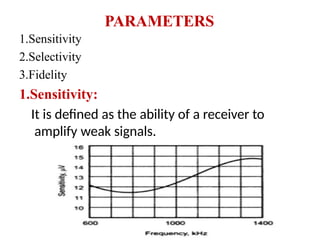
1.Sensitivity:
It is defined as the ability of a receiver to
amplify weak signals.
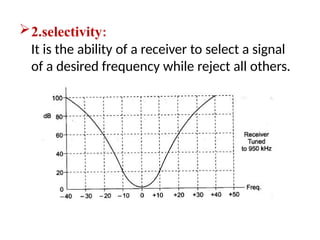
2.selectivity:
It is the ability of a receiver to select a signal
of a desired frequency while reject all others.
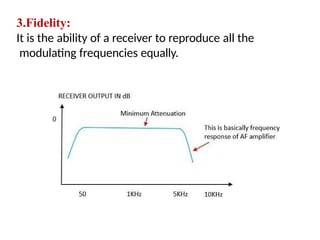
3.Fidelity:
It is the ability of a receiver to reproduce all the
modulating frequencies equally.
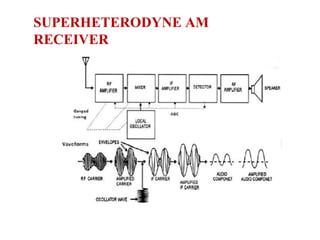
SUPERHETERODYNE AM
RECEIVER
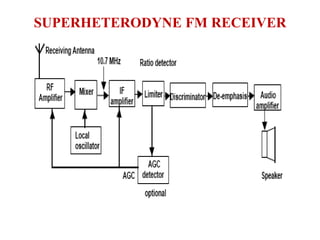
SUPERHETERODYNE FM RECEIVER
REVIEW OF
NOISE
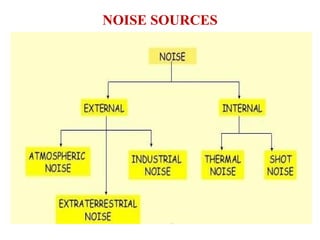
It is an unwanted signal which tends to interfere with
the modulating signal.
Types of noise:
Noise is basically divided into
•External Noise
•Internal Noise
NOISE SOURCES
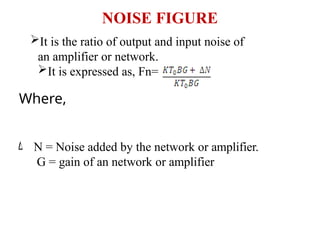
NOISE FIGURE
It is the ratio of output and input noise of
an amplifier or network.
It is expressed as, Fn=
Where,
N = Noise added by the network or amplifier.
G = gain of an network or amplifier
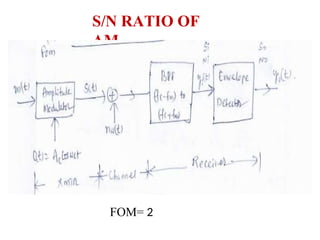
S/N RATIO OF
AM
FOM= 2
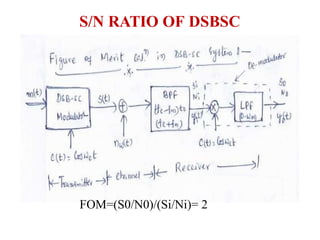
S/N RATIO OF DSBSC
FOM=(S0/N0)/(Si/Ni)= 2
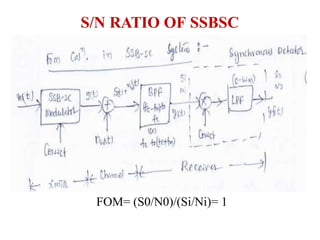
S/N RATIO OF SSBSC
FOM= (S0/N0)/(Si/Ni)= 1
REFERENCES
• https://mrcet.com/downloads/digital_notes/ECE
/III%20Year/ANALOG%20COMMUNICATIONS-
18.pdf
• https://electronicsdesk.com/noise-in-
communication-system.html
• https://www.youtube.com/watch?v=WT1Y97riA
QQ
• https://www.ncbi.nlm.nih.gov/pmc/articles/PMC
4098065/
• https://ccrma.stanford.edu/~jos/sasp/Filtered_W
hite_Noise.html
Unit – 5
Analog Pulse Modulation Schemes
And Information Theory
COURSE OBJECTIVES
 Students are able to study the fundamental
concepts of the analog communication
system.
 Students are able to analyze various analog
modulation and demodulation techniques.
 Students are able to know the working of
various transmitters and receivers.
 Students are able to understand the influence
of noise on the performance of analog
communication systems, and to acquire the
knowledge about information and capacity.
COURSE OUTCOMES
Describe the fundamentals of Analog Communication
Systems
Express the concept of various Analog
Modulation schemes and Multiplexing.
Compute various parameters of continuous and
pulse wave modulation Techniques.
Analyze various continuous and pulse wave modulation
and Demodulation Schemes.
Estimate the performance of Analog
Communication System in the presence of noise.
Identify different Radio receivers and understand
the concept of coding schemes in Information theory.
CONTENTS
Pulse amplitude modulation (PAM) & demodulation
Transmission bandwidth
 Pulse-Time Modulation
Pulse Duration modulation and demodulation
Pulse Position modulation and demodulation
Multiplexing Techniques FDM, TDM.
 Introduction to information theory
Entropy
Mutual information
Channel capacity theorem
Shannon-Fano encoding algorithm
PULSE MODULATION
The process of transmitting the signals in the form of
pulses by using some special techniques.
There are two types of pulse modulation systems,
Pulse Amplitude Modulation
Pulse Time Modulation
Pulse time modulation is further divided into,
Pulse Width Modulation
Pulse Position Modulation
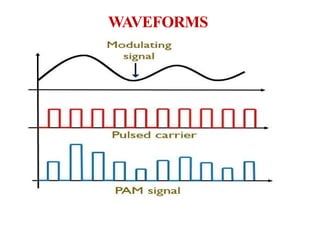
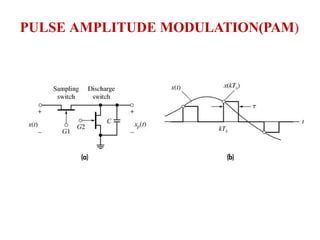
PULSE AMPLITUDE MODULATION(PAM)
WAVEFORMS
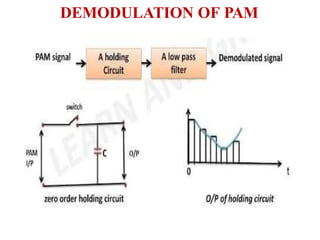
DEMODULATION OF PAM
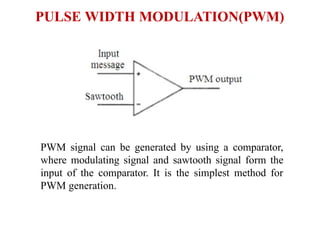
PULSE WIDTH MODULATION(PWM)
PWM signal can be generated by using a comparator,
where modulating signal and sawtooth signal form the
input of the comparator. It is the simplest method for
PWM generation.
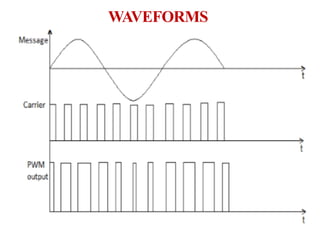
WAVEFORMS
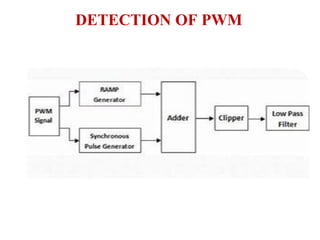
DETECTION OF PWM
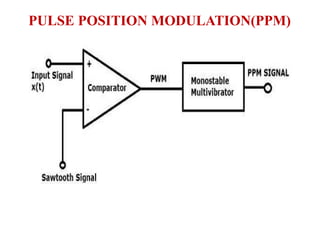
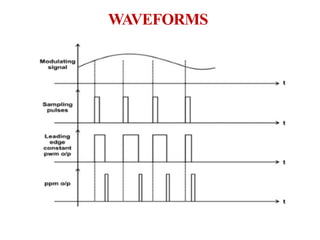
PULSE POSITION MODULATION(PPM)
WAVEFORMS
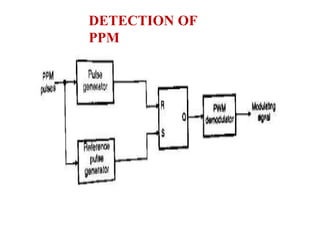
DETECTION OF
PPM
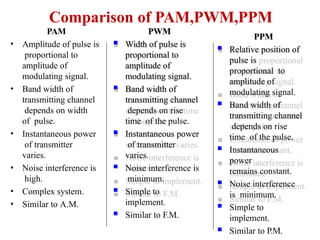
Comparison of PAM,PWM,PPM
PAM
• Amplitude of pulse is
proportional to
amplitude of
modulating signal.
• Band width of
transmitting channel
depends on width
of pulse.
• Instantaneous power
of transmitter
varies.
• Noise interference is
high.
• Complex system.
• Similar to A.M.
PWM
 Width of pulse is
proportional to
amplitude of
modulating signal.
 Band width of
transmitting channel
depends on rise
time of the pulse.
 Instantaneous power
of transmitter
varies.
 Noise interference is
minimum.
 Simple to
implement.
 Similar to F.M.
PPM
 Relative position of
pulse is
proportional to
amplitude of
modulating signal.
 Band width of
transmitting channel
depends on rise
time of the pulse.
 Instantaneous
power
remains constant.
 Noise interference
is minimum.
 Simple to
implement.
 Similar to P.M.
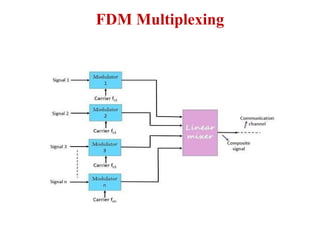
FDM Multiplexing
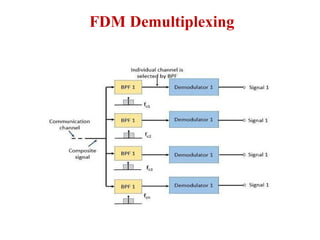
FDM Demultiplexing
Time Division Multiplexing (TDM)
• Time division multiplexing shares a circuit among
two or more terminals by having them take turns,
dividing the circuit “vertically.”
• Time on the circuit is allocated even when data are
not transmitted, so that some capacity is wasted when
a terminal is idle.
• Time division multiplexing is generally more efficient
and less expensive to maintain than frequency
division multiplexing, because it does not need guard
bands.
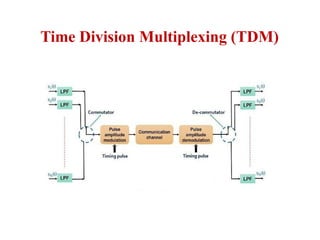
Time Division Multiplexing (TDM)
INFORMATION THEORY
 Information is defined as a sequence of letters,
alphabets, symbols which carries a message with
specific meaning.
Source of Information:
The sources of information can be divided into 2
types.
Analog Information sources
Digital information sources
 Analog information sources produce continuous
amplitude continuous time electrical waveforms.
 The unit of information is bit.
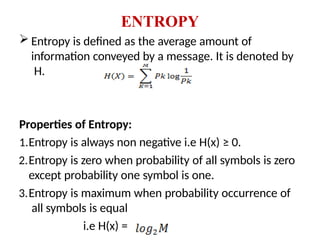
ENTROPY
 Entropy is defined as the average amount of
information conveyed by a message. It is denoted by
H.
Properties of Entropy:
1.Entropy is always non negative i.e H(x) ≥ 0.
2.Entropy is zero when probability of all symbols is zero
except probability one symbol is one.
3.Entropy is maximum when probability occurrence of
all symbols is equal
i.e H(x) =
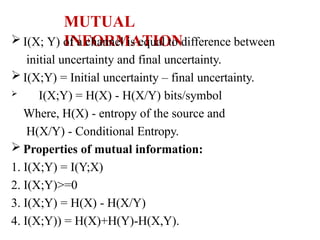
MUTUAL
INFORMATION
 I(X; Y) of a channel is equal to difference between
initial uncertainty and final uncertainty.
 I(X;Y) = Initial uncertainty – final uncertainty.
 I(X;Y) = H(X) - H(X/Y) bits/symbol
Where, H(X) - entropy of the source and
H(X/Y) - Conditional Entropy.
 Properties of mutual information:
1. I(X;Y) = I(Y;X)
2. I(X;Y)>=0
3. I(X;Y) = H(X) - H(X/Y)
4. I(X;Y)) = H(X)+H(Y)-H(X,Y).
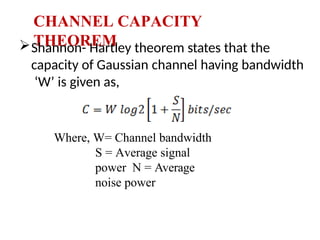
CHANNEL CAPACITY
THEOREM
Shannon- Hartley theorem states that the
capacity of Gaussian channel having bandwidth
‘W’ is given as,
Where, W= Channel bandwidth
S = Average signal
power N = Average
noise power
SHANNON FANO
ALGORITHM
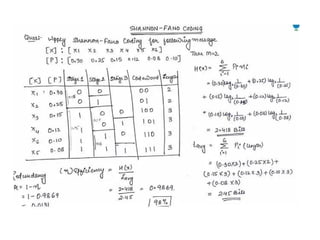
Shannon Fano coding is source encoding technique
which is used to remove the redundancy (repeated
information). The following steps are involved
1.For a given list of symbols, develop a corresponding
list of probabilities or frequency counts so that each
symbol’s relative frequency of occurrence is known.
2.Sort the lists of symbols according to frequency, with
the most frequently occurring symbols at the left and
the least common at the right.
3.Divide the list into two parts, with the total frequency
counts of the left part being as close to the total of the
right as possible.
4.The left part of the list is assigned the binary digit 0,
and the right part is assigned the digit 1. This means
that the codes for the symbols in the first part will all
start with 0, and the codes in the second part will all
start with 1.
5. Recursively apply the steps 3 and 4 to each of the two
halves, subdividing groups and adding bits to the
codes until each symbol has become a corresponding
code leaf on the tree.
• https://www.tutorialspoint.com/analog_communication/anal
og_communication_multiplexing.htm
• https://www.tutorialspoint.com/analog_communication/anal
og_communication_sampling.htm
• https://www.scesasaram.in/wp- content/uploads/2020/0
4/EEE_6_ICS_6.1 Analog-Pulse- Modulation.pdf
• https://www.youtube.com/watch?v=2XjqS1clY_E
• https://www.slideshare.net/sanjeev2419/pulse-modulation-
121168648
REFERENCES
27

ANALOG COMMUNICATIONS including AM, FM modulation

  • 1.
    Unit – I AmplitudeModulation & Demodulati on-I
  • 2.
    COURSE OBJECTIVES  Studentsare able to study the fundamental concepts of the analog communication system.  Students are able to analyze various analog modulation and demodulation techniques.  Students are able to know the working of various transmitters and receivers.  Students are able to understand the influence of noise on the performance of analog communication systems, and to acquire the
  • 3.
    COURSE OUTCOMES Describe thefundamentals of Analog Communication Systems Express the concept of various Analog Modulation schemes and Multiplexing. Compute various parameters of continuous and pulse wave modulation Techniques. Analyze various continuous and pulse wave modulation and Demodulation Schemes. Estimate the performance of Analog Communication System in the presence of noise. Identify different Radio receivers and understand the concept of coding schemes in Information theory.
  • 4.
    CONTENTS  Introduction communicationsystems Modulation Need for Modulation Introduction to Amplitude Modulation Power and transmission efficiency Single tone AM Generation of AM wave  Square law Modulator  Switching modulator  Detection of AM Wave Square law detector Envelope detector AM Transmitters
  • 5.
  • 6.
    MODULATION • It isthe process of varying the characteristics of high frequency carrier in accordance with instantaneous values of modulating or message or baseband signal. (Or) • It is a frequency translation technique which converts baseband or low frequency signal to bandpass or high frequency signal. • Modulation is used in the transmitter.
  • 7.
    NEED FOR MODULATION To reduce the length or height of antenna  For multiplexing  For narrow banding or to use antenna with single or same length  To reduce noise effect  To avoid equipment limitation or to reduce the size of the equipment.
  • 8.
  • 9.
    Introduction to Amplitude Modulation •The amplitude of the carrier signal varies in accordance with the instantaneous amplitude of the modulating signal.
  • 10.
    POWER AND TRANSMISSION EFFICIENCY • Considerthe following equation of amplitude modulated wave. • Power of AM wave is equal to the sum of powers of carrier, upper sideband, and lower sideband frequency components.
  • 12.
  • 13.
    SINGLE TONE AM • Thestandardequation for amplitude modulated signal is expressed as, S(t)= Ac Cos2πfct[1+ma(Cos2πfmt)] Where, ma = Am/Ac = Modulation Index Time Domain representation of AM: S(t)=AcCos2πfct+μAc/2Cos[2πfc+2πfm]t+μAc/2Cos[2πf c-2πfm]t I term: Carrier signal with amplitude Ac and frequency fc. II. term: Amplitude= μAc/2, frequency= fc+fm , Upper sideband frequency III.term: Amplitude= μAc/2, frequency= fc-fm , Lower sideband frequency
  • 14.
    GENERATION OF AM WAVES •Square Law Modulator • Switching Modulator
  • 15.
  • 16.
  • 17.
    DETECTION OF AM WAVE Demodulation or detection is the process of recovering the original message signal from the received modulated signal.  Types ofAM Detectors: I.Square Law detector II.Envelope detector III. Rectifier detector
  • 18.
  • 19.
  • 20.
  • 21.
  • 22.
    Unit – 2 AmplitudeModulation & Demodulati on-II
  • 23.
    COURSE OBJECTIVES  Studentsare able to study the fundamental concepts of the analog communication system.  Students are able to analyze various analog modulation and demodulation techniques.  Students are able to know the working of various transmitters and receivers.  Students are able to understand the influence of noise on the performance of analog communicationsystems, and to acquire the knowledge about information and capacity.
  • 24.
    COURSE OUTCOMES Describe thefundamentals of Analog Communication Systems Express the concept of various Analog Modulation schemes and Multiplexing. Compute various parameters of continuous and pulse wave modulation Techniques. Analyze various continuous and pulse wave modulation and Demodulation Schemes. Estimate the performance of Analog Communication System in the presence of noise. Identify different Radio receivers and understand the concept of coding schemes in Information theory.
  • 25.
    CONTENTS Introduction to DSB-SC Powercalculations Generation of DSB-SC  Balanced Modulators  Ring Modulator  Coherent detection of DSB-SC Time domain description of SSB Hilbert transform, Generation of SSB wave  Frequency discrimination & Phase discrimination method, Demodulation of SSB Wave Introduction to Vestigial sideband (VSB)modulation Comparison of AM Techniques
  • 26.
    Introduction to DSB-SC •ADSB-SC signal is obtained by multiplying the modulating signal x(t) with carrier signal c(t). So, we need a product modulator for the generation of DSB-SC wave.
  • 27.
  • 29.
  • 30.
  • 31.
  • 32.
  • 33.
    Time Domain Representationfor SSB-SC Signals
  • 36.
  • 37.
    GENERATION OF SSB-SC  The modulation process in which only one side band is transmitted and with carrier suppression is called Single sideband suppressed carrier (SSB- SC).  Modulating Signal m(t) = Am Cos (2πfmt) and Carrier Signal c(t) = Ac Cos (2πfct)  SSB-SC signal can be generated by passing DSB-SC signal through BPF and DSB-SC signal is generated by multiplying m(t) & c(t). ASSB-SC(t) = AmAc/2 Cos2π(fc+fm)t (or) ASSB-SC(t) = AmAc/2 Cos2π(fc-fm)t
  • 38.
  • 39.
  • 40.
  • 41.
  • 42.
  • 43.
  • 44.
    • https://www.electronics- notes.com/articles/radio/modulation/am-diode-detector- demodulator.php • https://www.youtube.com/watch?v=OC451cdFLoQ •https://en.wikipedia.org/wiki/Single-sideband_modulatio n • https://www.tutorialspoint.com/analog_communication/an alog_communication_vsbsc_modulation.htm • https://www.tutorialspoint.com/analog_communication/an alog_communication_numerical_problems_2.htm REFERENCES 23
  • 45.
    Unit – 3 AngleModulation
  • 46.
    COURSE OBJECTIVES  Studentsare able to study the fundamental concepts of the analog communication system.  Students are able to analyze various analog modulation and demodulation techniques.  Students are able to know the working of various transmitters and receivers.  Students are able to understand the influence of noise on the performance of analog communicationsystems, and to acquire the knowledge about information and capacity.
  • 47.
    COURSE OUTCOMES Describe thefundamentals of Analog Communication Systems Express the concept of various Analog Modulation schemes and Multiplexing. Compute various parameters of continuous and pulse wave modulation Techniques. Analyze various continuous and pulse wave modulation and Demodulation Schemes. Estimate the performance of Analog Communication System in the presence of noise. Identify different Radio receivers and understand the concept of coding schemes in Information theory.
  • 48.
    CONTENTS Concept of anglemodulation  Frequency modulation Narrow band frequency modulation (NBFM)  Wide band FM (WBFM) Generation of FM waves Indirect method  Direct method Demodulation of FM  Phase modulation Pre-emphasis& De-emphasis filters FM Transmitter
  • 49.
    CONCEPT OF ANGLE MODULATION Angle modulation is a process of varying angle of the carrier in accordance with the instantaneous values of modulating signal.  Angle can be varied by varying frequency or phase.  Angle modulation is of 2 types. Frequency Modulation Phase Modulation
  • 50.
    FREQUENCY MODULATION The processof varying frequency of the carrier in accordance with the instantaneous values of the modulating signal. Relation between angle and frequency : Consider carrier signal c(t)= Ac Cos (wct+φ) = Ac Cos (2πfct +φ) Where, Wc = Carrier frequency φ = Phase C(t) = Ac Cos[ψ(t)], where, ψ(t)= wct+φ i.e Frequency can be obtained by derivating angle and angle can be obtained by integrating frequency.
  • 51.
    FREQUENCY MODULATION Frequency modulatedsignal can be written as, AFM(t) = Ac Cos [ψi(t)] = Ac Cos [wct + kf m(t)dt] ʃ Frequency Deviation in FM: The instantaneous frequency, wi = wc + kf m(t)
  • 52.
  • 53.
    Types of FrequencyModulation FM (Frequency Modulation) Narrowband FM (NBFM) Wideband FM (WBFM) [When modulation index is small][When modulation index is large]
  • 54.
  • 56.
  • 57.
    Generation of FMwaves • Indirect Method Of FM • Direct Method Of FM
  • 58.
  • 59.
  • 60.
  • 61.
  • 62.
  • 63.
  • 64.
    PHASE MODULATION Phase modulationis another type of angle modulation in which the phase of the carrier wave is changed according to the amplitude (magnitude) of the message (modulating) signal. The carrier signal is given as c(t) = VC sin (ωct + φ) So, the phase modulated wave will be s(t) = VC sin (ωct + φm sin ωmt) s(t) = VC sin (ωct + mp sin ωmt) : φm = mp = modulation index wave is given as m = K V
  • 65.
  • 66.
  • 67.
  • 68.
  • 69.
    • https://en.wikipedia.org/wiki/Frequency_modulatio n • https://en.wikipedia.org/wiki/Phase_modulation •https://www.daenotes.com/electronics/communicati on-system/pre-emphasis-and-de-emphasis • https://www.etechnog.com/2019/10/fm- transmitter-block-diagram-working.html REFERENCES 25
  • 70.
  • 71.
    COURSE OBJECTIVES  Studentsare able to study the fundamental concepts of the analog communication system.  Students are able to analyze various analog modulation and demodulation techniques.  Students are able to know the working of various transmitters and receivers.  Students are able to understand the influence of noise on the performance of analog communicationsystems, and to acquire the knowledge about information and capacity.
  • 72.
    COURSE OUTCOMES Describe thefundamentals of Analog Communication Systems Express the concept of various Analog Modulation schemes and Multiplexing. Compute various parameters of continuous and pulse wave modulation Techniques. Analyze various continuous and pulse wave modulation and Demodulation Schemes. Estimate the performance of Analog Communication System in the presence of noise. Identify different Radio receivers and understand the concept of coding schemes in Information theory.
  • 73.
    CONTENTS  Introduction toradio receivers  Parameters Superheterodyne AM Receiver. Superheterodyne FM Receiver Review of noise  Noise sources Noise figure Performance analysis of AM Performance analysis of DSB-SC Performance analysis of SSB-SC
  • 74.
    Introduction to radioreceivers In radio communications, a radio receiver (receiver or simply radio) is an electronic device that receives radio waves and converts the information carried by them to a usable form. Types of Receivers:The TRF(Tuned radio frequency) receiver and super heterodyne receiver are the two main configuration of the receivers, they have real practical or commercial significance. Most of the present day receivers use superheterodyne configuration. But the TRF receivers are simple and easy to understand.
  • 75.
    PARAMETERS 1.Sensitivity 2.Selectivity 3.Fidelity 1.Sensitivity: It is definedas the ability of a receiver to amplify weak signals.
  • 76.
    2.selectivity: It is theability of a receiver to select a signal of a desired frequency while reject all others.
  • 77.
    3.Fidelity: It is theability of a receiver to reproduce all the modulating frequencies equally.
  • 78.
  • 79.
  • 80.
    REVIEW OF NOISE It isan unwanted signal which tends to interfere with the modulating signal. Types of noise: Noise is basically divided into •External Noise •Internal Noise
  • 81.
  • 82.
    NOISE FIGURE It isthe ratio of output and input noise of an amplifier or network. It is expressed as, Fn= Where, N = Noise added by the network or amplifier. G = gain of an network or amplifier
  • 83.
  • 84.
    S/N RATIO OFDSBSC FOM=(S0/N0)/(Si/Ni)= 2
  • 85.
    S/N RATIO OFSSBSC FOM= (S0/N0)/(Si/Ni)= 1
  • 86.
    REFERENCES • https://mrcet.com/downloads/digital_notes/ECE /III%20Year/ANALOG%20COMMUNICATIONS- 18.pdf • https://electronicsdesk.com/noise-in- communication-system.html •https://www.youtube.com/watch?v=WT1Y97riA QQ • https://www.ncbi.nlm.nih.gov/pmc/articles/PMC 4098065/ • https://ccrma.stanford.edu/~jos/sasp/Filtered_W hite_Noise.html
  • 87.
    Unit – 5 AnalogPulse Modulation Schemes And Information Theory
  • 88.
    COURSE OBJECTIVES  Studentsare able to study the fundamental concepts of the analog communication system.  Students are able to analyze various analog modulation and demodulation techniques.  Students are able to know the working of various transmitters and receivers.  Students are able to understand the influence of noise on the performance of analog communication systems, and to acquire the knowledge about information and capacity.
  • 89.
    COURSE OUTCOMES Describe thefundamentals of Analog Communication Systems Express the concept of various Analog Modulation schemes and Multiplexing. Compute various parameters of continuous and pulse wave modulation Techniques. Analyze various continuous and pulse wave modulation and Demodulation Schemes. Estimate the performance of Analog Communication System in the presence of noise. Identify different Radio receivers and understand the concept of coding schemes in Information theory.
  • 90.
    CONTENTS Pulse amplitude modulation(PAM) & demodulation Transmission bandwidth  Pulse-Time Modulation Pulse Duration modulation and demodulation Pulse Position modulation and demodulation Multiplexing Techniques FDM, TDM.  Introduction to information theory Entropy Mutual information Channel capacity theorem Shannon-Fano encoding algorithm
  • 91.
    PULSE MODULATION The processof transmitting the signals in the form of pulses by using some special techniques. There are two types of pulse modulation systems, Pulse Amplitude Modulation Pulse Time Modulation Pulse time modulation is further divided into, Pulse Width Modulation Pulse Position Modulation
  • 92.
  • 93.
  • 94.
  • 95.
    PULSE WIDTH MODULATION(PWM) PWMsignal can be generated by using a comparator, where modulating signal and sawtooth signal form the input of the comparator. It is the simplest method for PWM generation.
  • 96.
  • 97.
  • 98.
  • 99.
  • 100.
  • 101.
    Comparison of PAM,PWM,PPM PAM •Amplitude of pulse is proportional to amplitude of modulating signal. • Band width of transmitting channel depends on width of pulse. • Instantaneous power of transmitter varies. • Noise interference is high. • Complex system. • Similar to A.M. PWM  Width of pulse is proportional to amplitude of modulating signal.  Band width of transmitting channel depends on rise time of the pulse.  Instantaneous power of transmitter varies.  Noise interference is minimum.  Simple to implement.  Similar to F.M. PPM  Relative position of pulse is proportional to amplitude of modulating signal.  Band width of transmitting channel depends on rise time of the pulse.  Instantaneous power remains constant.  Noise interference is minimum.  Simple to implement.  Similar to P.M.
  • 102.
  • 103.
  • 104.
    Time Division Multiplexing(TDM) • Time division multiplexing shares a circuit among two or more terminals by having them take turns, dividing the circuit “vertically.” • Time on the circuit is allocated even when data are not transmitted, so that some capacity is wasted when a terminal is idle. • Time division multiplexing is generally more efficient and less expensive to maintain than frequency division multiplexing, because it does not need guard bands.
  • 105.
  • 106.
    INFORMATION THEORY  Informationis defined as a sequence of letters, alphabets, symbols which carries a message with specific meaning. Source of Information: The sources of information can be divided into 2 types. Analog Information sources Digital information sources  Analog information sources produce continuous amplitude continuous time electrical waveforms.  The unit of information is bit.
  • 107.
    ENTROPY  Entropy isdefined as the average amount of information conveyed by a message. It is denoted by H. Properties of Entropy: 1.Entropy is always non negative i.e H(x) ≥ 0. 2.Entropy is zero when probability of all symbols is zero except probability one symbol is one. 3.Entropy is maximum when probability occurrence of all symbols is equal i.e H(x) =
  • 108.
    MUTUAL INFORMATION  I(X; Y)of a channel is equal to difference between initial uncertainty and final uncertainty.  I(X;Y) = Initial uncertainty – final uncertainty.  I(X;Y) = H(X) - H(X/Y) bits/symbol Where, H(X) - entropy of the source and H(X/Y) - Conditional Entropy.  Properties of mutual information: 1. I(X;Y) = I(Y;X) 2. I(X;Y)>=0 3. I(X;Y) = H(X) - H(X/Y) 4. I(X;Y)) = H(X)+H(Y)-H(X,Y).
  • 109.
    CHANNEL CAPACITY THEOREM Shannon- Hartleytheorem states that the capacity of Gaussian channel having bandwidth ‘W’ is given as, Where, W= Channel bandwidth S = Average signal power N = Average noise power
  • 110.
    SHANNON FANO ALGORITHM Shannon Fanocoding is source encoding technique which is used to remove the redundancy (repeated information). The following steps are involved 1.For a given list of symbols, develop a corresponding list of probabilities or frequency counts so that each symbol’s relative frequency of occurrence is known. 2.Sort the lists of symbols according to frequency, with the most frequently occurring symbols at the left and the least common at the right. 3.Divide the list into two parts, with the total frequency counts of the left part being as close to the total of the right as possible.
  • 111.
    4.The left partof the list is assigned the binary digit 0, and the right part is assigned the digit 1. This means that the codes for the symbols in the first part will all start with 0, and the codes in the second part will all start with 1. 5. Recursively apply the steps 3 and 4 to each of the two halves, subdividing groups and adding bits to the codes until each symbol has become a corresponding code leaf on the tree.
  • 113.
    • https://www.tutorialspoint.com/analog_communication/anal og_communication_multiplexing.htm • https://www.tutorialspoint.com/analog_communication/anal og_communication_sampling.htm •https://www.scesasaram.in/wp- content/uploads/2020/0 4/EEE_6_ICS_6.1 Analog-Pulse- Modulation.pdf • https://www.youtube.com/watch?v=2XjqS1clY_E • https://www.slideshare.net/sanjeev2419/pulse-modulation- 121168648 REFERENCES 27