ANALOG COMMUNICATION SYSTEMS
By
Ms. Swati Shrrpal Halunde
Assistant Professor DEPT. of
E.C.E S.I.T.C.O.E. Yadrav-
Ichalkaranji
RADIO RECEIVER MEASUREMENTS &INFORMATION & CHANNEL CAPACITY
Radio receiver measurements
The important characteristics of superheterodyne
radio receiver are,
• Sensitivity
• Selectivity
• Fidelity
Sensitivity:
• It is defined as the ability of receiver to amplify
weak signals
• It is defined in terms of voltage which must be
applied at the receiver input terminals to provide a
standard output power at the receiver output.
Radio receiver measurements
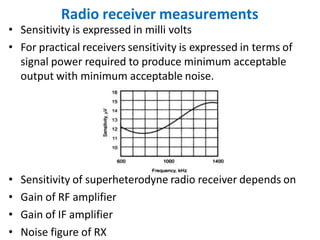
• Sensitivity is expressed in milli volts
• For practical receivers sensitivity is expressed in terms of
signal power required to produce minimum acceptable
output with minimum acceptable noise.
• Sensitivity of superheterodyne radio receiver depends on
• Gain of RF amplifier
• Gain of IF amplifier
• Noise figure of RX
Radio receiver measurements
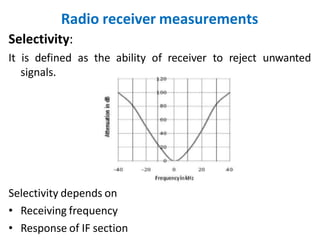
Selectivity:
It is defined as the ability of receiver to reject unwanted
signals.
Selectivity depends on
• Receiving frequency
• Response of IF section
Radio receiver measurements
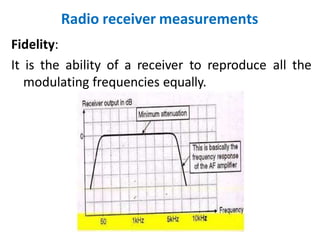
Fidelity:
It is the ability of a receiver to reproduce all the
modulating frequencies equally.
INFORMATION & CHANNEL CAPACITY
Information:
Information is defined as a sequence of letters,
carries a message with
alphabets, symbols which
specific meaning.
Source of Information:
The sources of information can be divided into 2 types.
•Analog Information sources
•Digital information sources
Analog information sources produce continuous
amplitude continuous time electrical waveforms.
Discrete information sources produces messages
consisting of discrete letters or symbols.
Information content of a message
• The information content of a message is represented by
the probability or uncertainty of the event associated
with the message.
• The probability of occurrence of a message is inversely
related to amount of information.
• Therefore, a message with least probability of
occurrence will have maximum amount of information.
• The relation between information content of message
and its probability of occurrence is given by,
Ik = log (1/Pk)
• The unit of information is bit.
• Ik = log 2(1/Pk) bits, Ik = log10 (1/Pk)Decits, Ik = loge(1/Pk)
nats.
Entropy (Average information content)
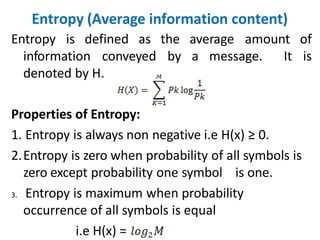
Entropy is defined as
information conveyed
denoted by H.
the average
by a message. It
amount of
is
Properties of Entropy:
1. Entropy is always non negative i.e H(x) ≥ 0.
2.Entropy is zero when probability of all symbols is
zero except probability one symbol is one.
3. Entropy is maximum when probability
occurrence of all symbols is equal
i.e H(x) =
Entropy of symbols in long independent
sequences
• In a statistically independent sequence, the occurrence
of a particular symbol during a time interval is
independent of occurrence of symbols at other time
interval.
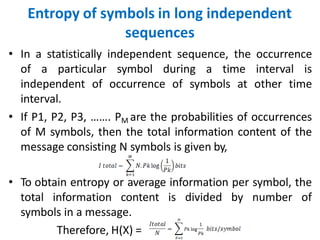
• If P1, P2, P3, ……. PM are the probabilities of occurrences
of M symbols, then the total information content of the
message consisting N symbols is given by,
• To obtain entropy or average information per symbol, the
total information content is divided by number of
symbols in a message.
Therefore, H(X) =
Entropy of symbols in long dependent
sequences
• In statistically dependent sequences,
occurrence of one message alters the
occurrence of other message.
• Due to this type of dependency, amount of
information coming from a source is gradually
decreased.
• To determine the entropy and information
rate of symbols for
dependent sequences a
long statistically
special model is
developed which is Markoff statistical model.
Markoff statistical model for information
sources
A random process in which probability of future
values depends on probability of previous events
is called Markoff process.
The sequence generated from such process is
called Markoff sequence.
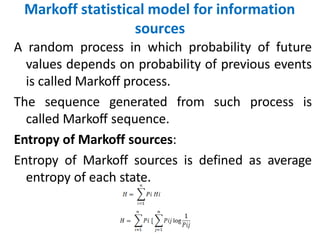
Entropy of Markoff sources:
Entropy of Markoff sources is defined as average
entropy of each state.
Information rate of Markoff sources
The information rate of Markoff sources is given by,
R = rH
Where, r = Rate at which symbols are generated
H= Entropy of Markoff sources
Information rate is measured in bits/sec
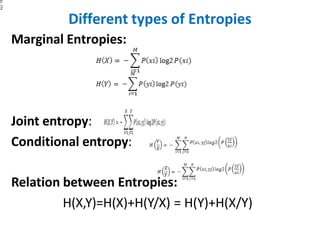
Different types of Entropies
Marginal Entropies:
Joint entropy:
Conditional entropy:
Relation between Entropies:
H(X,Y)=H(X)+H(Y/X) = H(Y)+H(X/Y)
Mutual Information
I(X; Y) of a channel is equal to difference between
initial uncertainty and final uncertainty.
I(X;Y) = Initial uncertainty – final uncertainty.
I(X;Y) = H(X) - H(X/Y) bits/symbol
Where, H(X) - entropy of the source andH(X/Y) -
Conditional Entropy.
Properties of mutual information:
1. I(X;Y) = I(Y;X)
2. I(X;Y)>=0
3. I(X;Y) = H(X) - H(X/Y)
4. I(X;Y)) = H(X)+H(Y)-H(X,Y).
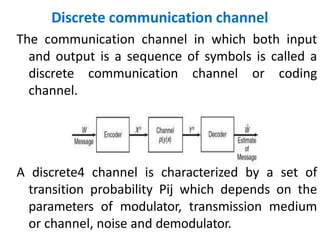
Discrete communication channel
The communication channel in which both input
and output is a sequence of symbols is called a
discrete communication channel or coding
channel.
A discrete4 channel is characterized by a set of
transition probability Pij which depends on the
parameters of modulator, transmission medium
or channel, noise and demodulator.
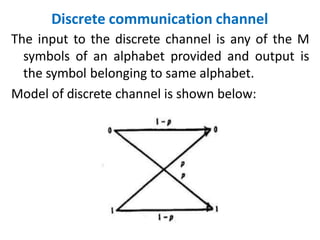
Discrete communication channel
The input to the discrete channel is any of the M
symbols of an alphabet provided and output is
the symbol belonging to same alphabet.
Model of discrete channel is shown below:
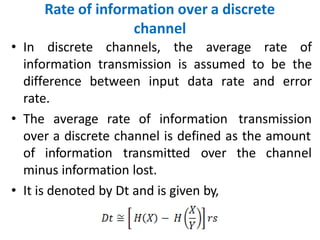
Rate of information over a discrete
channel
• In discrete channels, the average rate of
information transmission is assumed to be the
difference between input data rate and error
rate.
• The average rate of information transmission
over a discrete channel is defined as the amount
the channel
of information transmitted over
minus information lost.
• It is denoted by Dt and is given by,
Capacity of discrete memoryless channel
The maximum allowable rate of information that
can be transmitted over a discrete channel is
called capacity of memoryless channel.
When channel matches with the source, maximum
rate of transmission takes place.
Therefore, channel capacity,
C= max [I(X,Y)] = Max [ H(X) – H(X/Y) ]
M-Ary discrete memoryless channel
The channel which transmit and receive one of the
‘m’ possible symbols depending on the present
input and independent of previous input is called
M-Ary discrete memoryless channel.
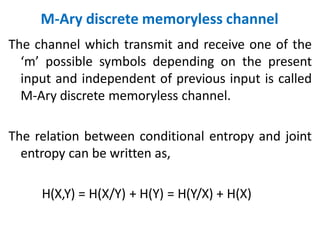
The relation between conditional entropy and joint
entropy can be written as,
H(X,Y) = H(X/Y) + H(Y) = H(Y/X) + H(X)
Capacity of Gaussian channel- Shannon
Hartley Theorem
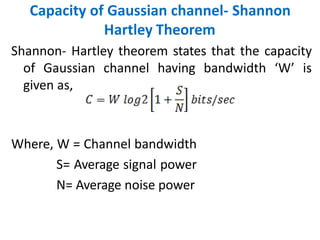
Shannon- Hartley theorem states that the capacity
of Gaussian channel having bandwidth ‘W’ is
given as,
Where, W = Channel bandwidth
S= Average signal power
N= Average noise power
Shannon- Fano algorithm
Shannon Fano coding is source encoding technique
which is used to remove the redundancy
(repeated information). The following steps
are involved
1. For a given list of symbols, develop a
corresponding list of probabilities or frequency
counts so that each symbol’s relative frequency of
occurrence is known.
2. Sort the lists of symbols according to frequency,
with the most frequently occurring symbols at
the left and the least common at the right.
Shannon- Fano algorithm
3. Divide the list into two parts, with the total
frequency counts of the left part being as close to
the total of the right as possible.
4. The left part of the list is assigned the binary digit
0, and the right part is assigned the digit 1. This
means that the codes for the symbols in the first
part will all start with 0, and the codes in the
second part will all start with 1.
5. Recursively apply the steps 3 and 4 to each of the
two halves, subdividing groups and adding bits to
the codes until each symbol has become a
corresponding code leaf on the tree.

Radio receiver and information coding .pptx

  • 1.
    ANALOG COMMUNICATION SYSTEMS By Ms.Swati Shrrpal Halunde Assistant Professor DEPT. of E.C.E S.I.T.C.O.E. Yadrav- Ichalkaranji RADIO RECEIVER MEASUREMENTS &INFORMATION & CHANNEL CAPACITY
  • 2.
    Radio receiver measurements Theimportant characteristics of superheterodyne radio receiver are, • Sensitivity • Selectivity • Fidelity Sensitivity: • It is defined as the ability of receiver to amplify weak signals • It is defined in terms of voltage which must be applied at the receiver input terminals to provide a standard output power at the receiver output.
  • 3.
    Radio receiver measurements •Sensitivity is expressed in milli volts • For practical receivers sensitivity is expressed in terms of signal power required to produce minimum acceptable output with minimum acceptable noise. • Sensitivity of superheterodyne radio receiver depends on • Gain of RF amplifier • Gain of IF amplifier • Noise figure of RX
  • 4.
    Radio receiver measurements Selectivity: Itis defined as the ability of receiver to reject unwanted signals. Selectivity depends on • Receiving frequency • Response of IF section
  • 5.
    Radio receiver measurements Fidelity: Itis the ability of a receiver to reproduce all the modulating frequencies equally.
  • 6.
    INFORMATION & CHANNELCAPACITY Information: Information is defined as a sequence of letters, carries a message with alphabets, symbols which specific meaning. Source of Information: The sources of information can be divided into 2 types. •Analog Information sources •Digital information sources Analog information sources produce continuous amplitude continuous time electrical waveforms. Discrete information sources produces messages consisting of discrete letters or symbols.
  • 7.
    Information content ofa message • The information content of a message is represented by the probability or uncertainty of the event associated with the message. • The probability of occurrence of a message is inversely related to amount of information. • Therefore, a message with least probability of occurrence will have maximum amount of information. • The relation between information content of message and its probability of occurrence is given by, Ik = log (1/Pk) • The unit of information is bit. • Ik = log 2(1/Pk) bits, Ik = log10 (1/Pk)Decits, Ik = loge(1/Pk) nats.
  • 8.
    Entropy (Average informationcontent) Entropy is defined as information conveyed denoted by H. the average by a message. It amount of is Properties of Entropy: 1. Entropy is always non negative i.e H(x) ≥ 0. 2.Entropy is zero when probability of all symbols is zero except probability one symbol is one. 3. Entropy is maximum when probability occurrence of all symbols is equal i.e H(x) =
  • 9.
    Entropy of symbolsin long independent sequences • In a statistically independent sequence, the occurrence of a particular symbol during a time interval is independent of occurrence of symbols at other time interval. • If P1, P2, P3, ……. PM are the probabilities of occurrences of M symbols, then the total information content of the message consisting N symbols is given by, • To obtain entropy or average information per symbol, the total information content is divided by number of symbols in a message. Therefore, H(X) =
  • 10.
    Entropy of symbolsin long dependent sequences • In statistically dependent sequences, occurrence of one message alters the occurrence of other message. • Due to this type of dependency, amount of information coming from a source is gradually decreased. • To determine the entropy and information rate of symbols for dependent sequences a long statistically special model is developed which is Markoff statistical model.
  • 11.
    Markoff statistical modelfor information sources A random process in which probability of future values depends on probability of previous events is called Markoff process. The sequence generated from such process is called Markoff sequence. Entropy of Markoff sources: Entropy of Markoff sources is defined as average entropy of each state.
  • 12.
    Information rate ofMarkoff sources The information rate of Markoff sources is given by, R = rH Where, r = Rate at which symbols are generated H= Entropy of Markoff sources Information rate is measured in bits/sec
  • 13.
    Different types ofEntropies Marginal Entropies: Joint entropy: Conditional entropy: Relation between Entropies: H(X,Y)=H(X)+H(Y/X) = H(Y)+H(X/Y)
  • 14.
    Mutual Information I(X; Y)of a channel is equal to difference between initial uncertainty and final uncertainty. I(X;Y) = Initial uncertainty – final uncertainty. I(X;Y) = H(X) - H(X/Y) bits/symbol Where, H(X) - entropy of the source andH(X/Y) - Conditional Entropy. Properties of mutual information: 1. I(X;Y) = I(Y;X) 2. I(X;Y)>=0 3. I(X;Y) = H(X) - H(X/Y) 4. I(X;Y)) = H(X)+H(Y)-H(X,Y).
  • 15.
    Discrete communication channel Thecommunication channel in which both input and output is a sequence of symbols is called a discrete communication channel or coding channel. A discrete4 channel is characterized by a set of transition probability Pij which depends on the parameters of modulator, transmission medium or channel, noise and demodulator.
  • 16.
    Discrete communication channel Theinput to the discrete channel is any of the M symbols of an alphabet provided and output is the symbol belonging to same alphabet. Model of discrete channel is shown below:
  • 17.
    Rate of informationover a discrete channel • In discrete channels, the average rate of information transmission is assumed to be the difference between input data rate and error rate. • The average rate of information transmission over a discrete channel is defined as the amount the channel of information transmitted over minus information lost. • It is denoted by Dt and is given by,
  • 18.
    Capacity of discretememoryless channel The maximum allowable rate of information that can be transmitted over a discrete channel is called capacity of memoryless channel. When channel matches with the source, maximum rate of transmission takes place. Therefore, channel capacity, C= max [I(X,Y)] = Max [ H(X) – H(X/Y) ]
  • 19.
    M-Ary discrete memorylesschannel The channel which transmit and receive one of the ‘m’ possible symbols depending on the present input and independent of previous input is called M-Ary discrete memoryless channel. The relation between conditional entropy and joint entropy can be written as, H(X,Y) = H(X/Y) + H(Y) = H(Y/X) + H(X)
  • 20.
    Capacity of Gaussianchannel- Shannon Hartley Theorem Shannon- Hartley theorem states that the capacity of Gaussian channel having bandwidth ‘W’ is given as, Where, W = Channel bandwidth S= Average signal power N= Average noise power
  • 21.
    Shannon- Fano algorithm ShannonFano coding is source encoding technique which is used to remove the redundancy (repeated information). The following steps are involved 1. For a given list of symbols, develop a corresponding list of probabilities or frequency counts so that each symbol’s relative frequency of occurrence is known. 2. Sort the lists of symbols according to frequency, with the most frequently occurring symbols at the left and the least common at the right.
  • 22.
    Shannon- Fano algorithm 3.Divide the list into two parts, with the total frequency counts of the left part being as close to the total of the right as possible. 4. The left part of the list is assigned the binary digit 0, and the right part is assigned the digit 1. This means that the codes for the symbols in the first part will all start with 0, and the codes in the second part will all start with 1. 5. Recursively apply the steps 3 and 4 to each of the two halves, subdividing groups and adding bits to the codes until each symbol has become a corresponding code leaf on the tree.