Immunoassays
Prepared by:-
Dhwani Khandhar (19mph315)
M.Pharm Sem I
Department Of Pharmaceutical Analysis , Nirma University
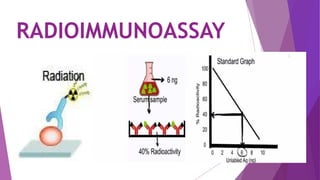
RADIOIMMUNOASSAY
RADIOIMMUNOASSAY
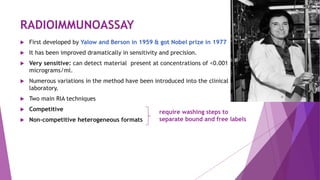
 First developed by Yalow and Berson in 1959 & got Nobel prize in 1977
 It has been improved dramatically in sensitivity and precision.
 Very sensitive: can detect material present at concentrations of <0.001
micrograms/ml.
 Numerous variations in the method have been introduced into the clinical
laboratory.
 Two main RIA techniques
 Competitive
 Non-competitive heterogeneous formats
require washing steps to
separate bound and free labels
Radioimmunoassay (RIA)
 Radioimmunoassay (RIA) – used radioisotopes as labels.
 Allows the quantitative detection of a trace level of analytes
 contributes to the advancement of basic research and clinical
medicine.
 Generate standard curve with known amounts of unlabeled antigen
 Measure unknown using standard curve.
 RIA may be formatted in a solid phase procedure for easy separation
of bound and free labels.
RADIOIMMUNOASSAY
• The competitive assay follows:
THE LAW OF MASS ACTION
• The Scatchard plot of the ratio of bound to
free antibody to analyte concentration is
commonly used to evaluate antibody
performance.
• Kinetics of Antigen-Antibody Reaction section,
from the following equation:
B/F = Ka ([Ab]t − B)
Where, B = bound antigen or analyte
F = free antigen
• y-axis - B/F ratio that is proportional to free
[Ab] from [Ab]t − B , equal to free [Ag].
• Ka represents the slope of the plot.
Figure: Scatchard plot for
cyclosporine determination
The affinity constant Ka is 8.1 × 10⁹ L/M
for the antibody specific to
cyclosporine.
RADIOIMMUNOASSAY
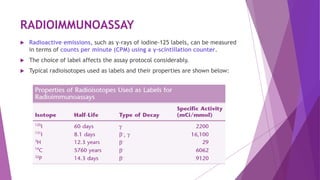
 Radioactive emissions, such as γ-rays of iodine-125 labels, can be measured
in terms of counts per minute (CPM) using a γ-scintillation counter.
 The choice of label affects the assay protocol considerably.
 Typical radioisotopes used as labels and their properties are shown below:
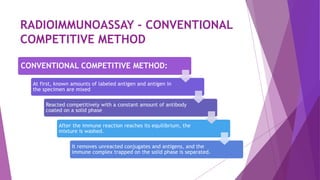
CONVENTIONAL COMPETITIVE METHOD:
At first, known amounts of labeled antigen and antigen in
the specimen are mixed
Reacted competitively with a constant amount of antibody
coated on a solid phase
After the immune reaction reaches its equilibrium, the
mixture is washed.
It removes unreacted conjugates and antigens, and the
immune complex trapped on the solid phase is separated.
RADIOIMMUNOASSAY - CONVENTIONAL
COMPETITIVE METHOD
Assay principle of competitive radioimmunoassay
(RIA) using first antibody as solid phase.
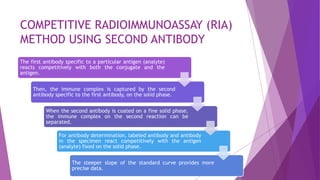
COMPETITIVE RADIOIMMUNOASSAY (RIA)
METHOD USING SECOND ANTIBODY
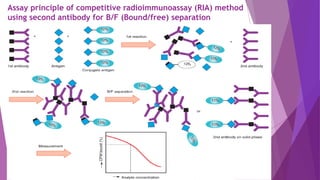
The first antibody specific to a particular antigen (analyte)
reacts competitively with both the conjugate and the
antigen.
Then, the immune complex is captured by the second
antibody specific to the first antibody, on the solid phase.
When the second antibody is coated on a fine solid phase,
the immune complex on the second reaction can be
separated.
For antibody determination, labeled antibody and antibody
in the specimen react competitively with the antigen
(analyte) fixed on the solid phase.
The steeper slope of the standard curve provides more
precise data.
Assay principle of competitive radioimmunoassay (RIA) method
using second antibody for B/F (Bound/free) separation
IMMUNORADIOMETRIC ASSAYS OR
SANDWICH ASSAYS (NON COMPETITIVE ASSAY)
 Immunoradiometric assays or sandwich assays have alternative relationships
between analyte and antibody.
 The classical competitive assay achieves an immunologic response with a
minimum amount of antibody; the sandwich assay uses a large amount of
antibody on the solid phase.
 Monoclonal antibody technology has made it possible to manufacture large
quantities of specific antibodies at moderate costs, thereby allowing the
sandwich assay to be exploited.
 The sandwich assay, which uses excess antibody, is more sensitive than
the competitive assay.
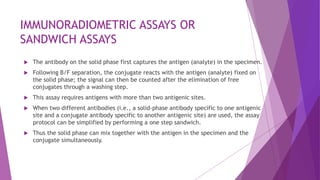
IMMUNORADIOMETRIC ASSAYS OR
SANDWICH ASSAYS
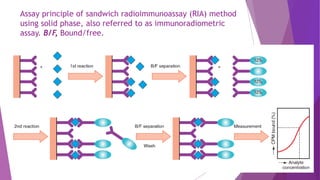
 The antibody on the solid phase first captures the antigen (analyte) in the specimen.
 Following B/F separation, the conjugate reacts with the antigen (analyte) fixed on
the solid phase; the signal can then be counted after the elimination of free
conjugates through a washing step.
 This assay requires antigens with more than two antigenic sites.
 When two different antibodies (i.e., a solid-phase antibody specific to one antigenic
site and a conjugate antibody specific to another antigenic site) are used, the assay
protocol can be simplified by performing a one step sandwich.
 Thus the solid phase can mix together with the antigen in the specimen and the
conjugate simultaneously.
IMMUNORADIOMETRIC ASSAYS OR
SANDWICH ASSAYS
 In this assay, the signal generated is proportional to the analyte concentration
present in the specimen, as in the two-step sandwich assay.
 This assay method can be applied to antibody detection with an assay format
using antigen as the solid phase or labeled antigen.
 For a two-step format, antigen as the solid phase or labeled antibody specific to
the target antibody can be used.
 Using the sandwich format, assay sensitivity is high compared to competitive
method
Assay principle of sandwich radioimmunoassay (RIA) method
using solid phase, also referred to as immunoradiometric
assay. B/F, Bound/free.
ENZYME IMMUNOASSAY
ENZYME IMMUNOASSAY
 Quantitative immunoassays using enzymes as labels were developed as
alternatives to radioisotopes.
 The most widely used are the
 Enzyme-linked immunosorbent assay (ELISA)
 Enzyme Immunoassay (EIA)
 Enzyme-multiplied immunoassay technique (EMIT)
 Essentially, heterogeneous EIAs are similar to RIAs, except that they use
enzymes as labels.
 Improvements in EIAs have provided many innovative formats with different
degrees of speed, sensitivity, simplicity, and precision.
Enzyme immunoassay (EIA),
 The enzyme immunoassay (EIA), uses enzymes as label.
 Enzymes can amplify signals, depending on the turnover of enzyme catalytic
activity.
 Efforts to improve substrates and to increase sensitivity have led to the
introduction of chromophore, fluorophore, and later chemiluminescent
compounds.
 Depending on the substrate chosen, the assay method can be defined
 Fluorescent enzyme immunoassay
 Chemiluminescent enzyme immunoassay
Advantages of Enzyme Immunoassay
1. Sensitive assays can be developed by the amplification effect of
enzymes.
2. Reagents are relatively cheap and can have a long shelf life.
3. Multiple simultaneous assays can be developed.
4. A wide variety of assay configurations can be developed.
5. Equipment can be inexpensive and is widely available.
6. No radiation hazards occur during labeling or disposal of wastes.
Disadvantages of Enzyme Immunoassay
1. Measurement of enzyme activity can be more complex than measurement of
the activity of some types of radioisotopes.
2. Enzyme activity may be affected by plasma constituents.
3. Homogeneous assays at the present time have the sensitivity of 10−9 M and are
not as sensitive as radio immunoassays.
4. Homogeneous EIAs for large protein molecules have been developed but
require complex immunochemical reagents
HETEROGENEOUS ENZYME
IMMUNOASSAYS
 The assay principle of heterogeneous EIAs is similar to that of RIAs, except that
enzyme activity, not radioactivity, is measured .
 EIAs require a secondary process to obtain signals through the catalytic reaction of
enzymes.
 Microtiter plate wells, plastic beads, plastic tubes, magnetic particles, and latex
with filters, among others, can be used as the solid phase for the separation of
bound and free conjugates.
 The use of small magnetic particles and latex allows shortening of the
immunoreaction time, thereby reducing the total assay time.
 The development of substrates to be cleaved by enzymes was marked by the
introduction of colorimetric and fluorometric substrates, and later
chemiluminescent substrates, which increased the signal sensitivity.
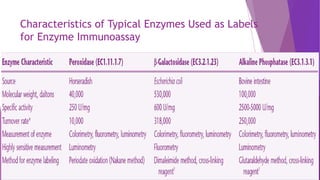
 The enzymes commonly used in various heterogeneous EIAs are peroxidase,
alkaline phosphatase, β- galactosidase, glucose oxidase, urease, and catalase.
Characteristics of Typical Enzymes Used as Labels
for Enzyme Immunoassay
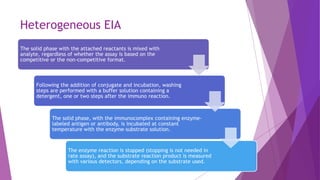
Heterogeneous EIA
The solid phase with the attached reactants is mixed with
analyte, regardless of whether the assay is based on the
competitive or the non-competitive format.
Following the addition of conjugate and incubation, washing
steps are performed with a buffer solution containing a
detergent, one or two steps after the immuno reaction.
The solid phase, with the immunocomplex containing enzyme-
labeled antigen or antibody, is incubated at constant
temperature with the enzyme–substrate solution.
The enzyme reaction is stopped (stopping is not needed in
rate assay), and the substrate reaction product is measured
with various detectors, depending on the substrate used.
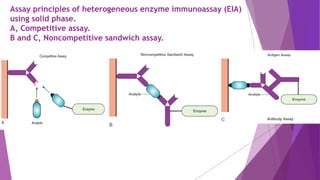
Assay principles of heterogeneous enzyme immunoassay (EIA)
using solid phase.
A, Competitive assay.
B and C, Noncompetitive sandwich assay.
Colorimetric Enzyme Immunoassay
 In this assay, enzyme reaction is performed by using chromogenic
substrates to develop a color by prime catalytic reaction.
 Example:
 horseradish peroxidase, catalyzing ABTS (diammonium salt of 2,2′-
azinodi[{ 3-ethyl-benzothiazoline-6-sulfonate}]) with H2O2 to form a
green color
 alkaline phosphatase specific to the p-nitrophenyl phosphate to form a
yellow color.
 Both enzymes are the most commonly used types of colorimetric enzyme
immunoassays.
 A spectrophotometer is used to measure the optical density of the
resulting chromogen.
 Many instruments are available for the measurement of optical density in
tubes or microtiter plates, ranging from a fully automated system that
performs sample pipetting and data printout to simpler manual devices.
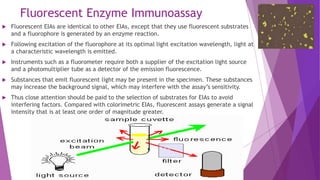
Fluorescent Enzyme Immunoassay
 Fluorescent EIAs are identical to other EIAs, except that they use fluorescent substrates
and a fluorophore is generated by an enzyme reaction.
 Following excitation of the fluorophore at its optimal light excitation wavelength, light at
a characteristic wavelength is emitted.
 Instruments such as a fluorometer require both a supplier of the excitation light source
and a photomultiplier tube as a detector of the emission fluorescence.
 Substances that emit fluorescent light may be present in the specimen. These substances
may increase the background signal, which may interfere with the assay’s sensitivity.
 Thus close attention should be paid to the selection of substrates for EIAs to avoid
interfering factors. Compared with colorimetric EIAs, fluorescent assays generate a signal
intensity that is at least one order of magnitude greater.
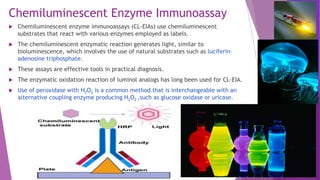
Chemiluminescent Enzyme Immunoassay
 Chemiluminescent enzyme immunoassays (CL-EIAs) use chemiluminescent
substrates that react with various enzymes employed as labels.
 The chemiluminescent enzymatic reaction generates light, similar to
bioluminescence, which involves the use of natural substrates such as luciferin–
adenosine triphosphate.
 These assays are effective tools in practical diagnosis.
 The enzymatic oxidation reaction of luminol analogs has long been used for CL-EIA.
 Use of peroxidase with H2O2 is a common method that is interchangeable with an
alternative coupling enzyme producing H2O2 ,such as glucose oxidase or uricase.
HOMOGENEOUS ENZYME IMMUNOASSAYS
 Conventional heterogeneous EIAs have equal sensitivity to RIAs in many
applications.
 Various types of homogeneous EIAs are available.
 In each of these assays, the Ag–Ab interaction modulates the activity of the
enzyme or enzyme label in the presence of the substrate. Modulation of the
enzyme activity reflects the degree of the immunochemical reaction.
 Homogeneous EIAs can be classified as competitive and noncompetitive
binding assays.
 Competitive assays usually consist of enzyme-labeled antigens. However, the
antigen (analyte) may be conjugated to the substrate or to a prosthetic group
of the enzyme in other assay formats.
 In contrast, noncompetitive binding assays use a conjugate of antibody
labeled with enzyme.
Classification and Characteristics of Typical
Homogeneous Enzyme Immunoassays
Enzyme-Multiplied Immunoassay
Technique (EMIT)
 In EMIT, the conjugation of enzymes to haptens does not disrupt enzyme activity;
however, the binding of hapten-specific antibodies to haptens results in inhibition of
enzyme activity.
 Free haptens in the standard or sample relieve this inhibition by competing for
antibodies.
 Thus in the presence of antibodies, enzyme activity is proportional to the
concentration of free haptens.
 In the EMIT assay system, malate dehydrogenase and glucose-6-phosphate
dehydrogenase have been found to be most useful because they are less likely to be
affected by serum constituents.
 These assays generally measure drugs at a concentration of milligrams per litre.
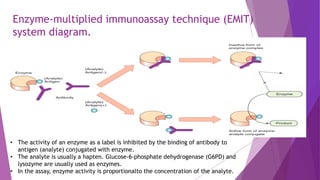
Enzyme-multiplied immunoassay technique (EMIT)
system diagram.
• The activity of an enzyme as a label is inhibited by the binding of antibody to
antigen (analyte) conjugated with enzyme.
• The analyte is usually a hapten. Glucose-6-phosphate dehydrogenase (G6PD) and
lysozyme are usually used as enzymes.
• In the assay, enzyme activity is proportionalto the concentration of the analyte.
Substrate-Labeled Fluorescent
Immunoassay
 The substrate-labelled fluorescent immunoassay (SLFIA) uses a characteristic
fluorogenic substrate, umbelliferyl β-galactoside, attached to the antigen
(analyte) as a conjugate.
 Umbelliferone is the fluorescent product produced when the substrate is
cleaved with the enzyme β-galactosidase, which cannot cleave the substrate–
antigen complex when it is reacted with the specific antibody.
 The free antigen (analyte) in the specimen solution competes with the
antigen conjugated with the substrate to form the immunocomplex.
 The antigen concentration in the sample is proportional to the fluorescent
intensity of the cleaved fluorescent product.
 SLFIA can be used to assay drugs and haptens, as well as protein ligands such
as IgG and IgM.
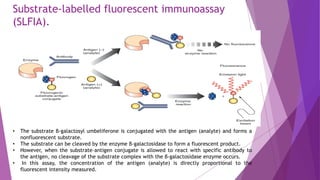
Substrate-labelled fluorescent immunoassay
(SLFIA).
• The substrate β-galactosyl umbeliferone is conjugated with the antigen (analyte) and forms a
nonfluorescent substrate.
• The substrate can be cleaved by the enzyme β-galactosidase to form a fluorescent product.
• However, when the substrate–antigen conjugate is allowed to react with specific antibody to
the antigen, no cleavage of the substrate complex with the β-galactosidase enzyme occurs.
• In this assay, the concentration of the antigen (analyte) is directly proportional to the
fluorescent intensity measured.
Apoenzyme Reactivation Immunoassay (ARIS)
 ARIS is a homogeneous assay using the prosthetic group consisting of flavin
adenine dinucleotide (FAD)-conjugated antigen (analyte) and glucose oxidase
apoenzyme.
 The antigen (analyte) and a constant amount of analyte–FAD conjugate compete for
a limited amount of specific antibody. At equilibrium, the level of free conjugate is
proportional to the amount of antigen (analyte) in thespecimen.
 The apoenzyme combines with the free but not with the antibody-bound form of
conjugate to reactivate glucose oxidase activity in proportion to the amount of
free conjugate in the mixture.
 Active enzyme is generated in the procedure, and an amplification mechanism is
built into this assay.
 ARIS has been used to assay for theophylline and IgG, high-molecular-weight
proteins (e.g.,thyroid binding globulin)as well as other haptens such as phenytoin
and hormones.
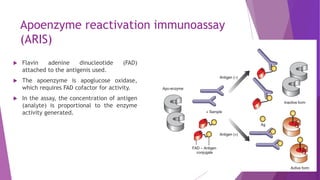
Apoenzyme reactivation immunoassay
(ARIS)
 Flavin adenine dinucleotide (FAD)
attached to the antigenis used.
 The apoenzyme is apoglucose oxidase,
which requires FAD cofactor for activity.
 In the assay, the concentration of antigen
(analyte) is proportional to the enzyme
activity generated.
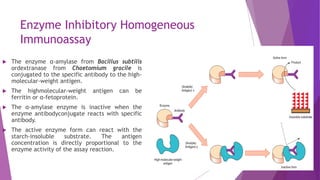
Enzyme Inhibitory Homogeneous
Immunoassay
 The enzyme α-amylase from Bacillus subtilis
ordextranase from Chaetomium gracile is
conjugated to the specific antibody to the high-
molecular-weight antigen.
 The highmolecular-weight antigen can be
ferritin or α-fetoprotein.
 The α-amylase enzyme is inactive when the
enzyme antibodyconjugate reacts with specific
antibody.
 The active enzyme form can react with the
starch-insoluble substrate. The antigen
concentration is directly proportional to the
enzyme activity of the assay reaction.
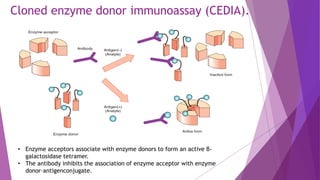
Cloned enzyme donor immunoassay (CEDIA).
• Enzyme acceptors associate with enzyme donors to form an active β-
galactosidase tetramer.
• The antibody inhibits the association of enzyme acceptor with enzyme
donor–antigenconjugate.
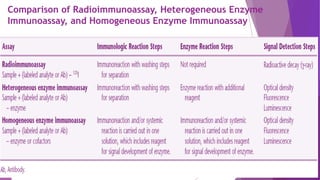
Comparison of Radioimmunoassay, Heterogeneous Enzyme
Immunoassay, and Homogeneous Enzyme Immunoassay
REFERENCES:
 McPherson RA, Pincus MR. Henry's Clinical Diagnosis and Management by
Laboratory Methods E-Book. Elsevier Health Sciences; 2017 Apr 5.p 862-889.
THANK YOU

Immunoassays

  • 1.
    Immunoassays Prepared by:- Dhwani Khandhar(19mph315) M.Pharm Sem I Department Of Pharmaceutical Analysis , Nirma University
  • 2.
  • 3.
    RADIOIMMUNOASSAY  First developedby Yalow and Berson in 1959 & got Nobel prize in 1977  It has been improved dramatically in sensitivity and precision.  Very sensitive: can detect material present at concentrations of <0.001 micrograms/ml.  Numerous variations in the method have been introduced into the clinical laboratory.  Two main RIA techniques  Competitive  Non-competitive heterogeneous formats require washing steps to separate bound and free labels
  • 4.
    Radioimmunoassay (RIA)  Radioimmunoassay(RIA) – used radioisotopes as labels.  Allows the quantitative detection of a trace level of analytes  contributes to the advancement of basic research and clinical medicine.  Generate standard curve with known amounts of unlabeled antigen  Measure unknown using standard curve.  RIA may be formatted in a solid phase procedure for easy separation of bound and free labels.
  • 5.
    RADIOIMMUNOASSAY • The competitiveassay follows: THE LAW OF MASS ACTION • The Scatchard plot of the ratio of bound to free antibody to analyte concentration is commonly used to evaluate antibody performance. • Kinetics of Antigen-Antibody Reaction section, from the following equation: B/F = Ka ([Ab]t − B) Where, B = bound antigen or analyte F = free antigen • y-axis - B/F ratio that is proportional to free [Ab] from [Ab]t − B , equal to free [Ag]. • Ka represents the slope of the plot. Figure: Scatchard plot for cyclosporine determination The affinity constant Ka is 8.1 × 10⁹ L/M for the antibody specific to cyclosporine.
  • 6.
    RADIOIMMUNOASSAY  Radioactive emissions,such as γ-rays of iodine-125 labels, can be measured in terms of counts per minute (CPM) using a γ-scintillation counter.  The choice of label affects the assay protocol considerably.  Typical radioisotopes used as labels and their properties are shown below:
  • 7.
    CONVENTIONAL COMPETITIVE METHOD: Atfirst, known amounts of labeled antigen and antigen in the specimen are mixed Reacted competitively with a constant amount of antibody coated on a solid phase After the immune reaction reaches its equilibrium, the mixture is washed. It removes unreacted conjugates and antigens, and the immune complex trapped on the solid phase is separated. RADIOIMMUNOASSAY - CONVENTIONAL COMPETITIVE METHOD
  • 8.
    Assay principle ofcompetitive radioimmunoassay (RIA) using first antibody as solid phase.
  • 9.
    COMPETITIVE RADIOIMMUNOASSAY (RIA) METHODUSING SECOND ANTIBODY The first antibody specific to a particular antigen (analyte) reacts competitively with both the conjugate and the antigen. Then, the immune complex is captured by the second antibody specific to the first antibody, on the solid phase. When the second antibody is coated on a fine solid phase, the immune complex on the second reaction can be separated. For antibody determination, labeled antibody and antibody in the specimen react competitively with the antigen (analyte) fixed on the solid phase. The steeper slope of the standard curve provides more precise data.
  • 10.
    Assay principle ofcompetitive radioimmunoassay (RIA) method using second antibody for B/F (Bound/free) separation
  • 11.
    IMMUNORADIOMETRIC ASSAYS OR SANDWICHASSAYS (NON COMPETITIVE ASSAY)  Immunoradiometric assays or sandwich assays have alternative relationships between analyte and antibody.  The classical competitive assay achieves an immunologic response with a minimum amount of antibody; the sandwich assay uses a large amount of antibody on the solid phase.  Monoclonal antibody technology has made it possible to manufacture large quantities of specific antibodies at moderate costs, thereby allowing the sandwich assay to be exploited.  The sandwich assay, which uses excess antibody, is more sensitive than the competitive assay.
  • 12.
    IMMUNORADIOMETRIC ASSAYS OR SANDWICHASSAYS  The antibody on the solid phase first captures the antigen (analyte) in the specimen.  Following B/F separation, the conjugate reacts with the antigen (analyte) fixed on the solid phase; the signal can then be counted after the elimination of free conjugates through a washing step.  This assay requires antigens with more than two antigenic sites.  When two different antibodies (i.e., a solid-phase antibody specific to one antigenic site and a conjugate antibody specific to another antigenic site) are used, the assay protocol can be simplified by performing a one step sandwich.  Thus the solid phase can mix together with the antigen in the specimen and the conjugate simultaneously.
  • 13.
    IMMUNORADIOMETRIC ASSAYS OR SANDWICHASSAYS  In this assay, the signal generated is proportional to the analyte concentration present in the specimen, as in the two-step sandwich assay.  This assay method can be applied to antibody detection with an assay format using antigen as the solid phase or labeled antigen.  For a two-step format, antigen as the solid phase or labeled antibody specific to the target antibody can be used.  Using the sandwich format, assay sensitivity is high compared to competitive method
  • 14.
    Assay principle ofsandwich radioimmunoassay (RIA) method using solid phase, also referred to as immunoradiometric assay. B/F, Bound/free.
  • 15.
  • 16.
    ENZYME IMMUNOASSAY  Quantitativeimmunoassays using enzymes as labels were developed as alternatives to radioisotopes.  The most widely used are the  Enzyme-linked immunosorbent assay (ELISA)  Enzyme Immunoassay (EIA)  Enzyme-multiplied immunoassay technique (EMIT)  Essentially, heterogeneous EIAs are similar to RIAs, except that they use enzymes as labels.  Improvements in EIAs have provided many innovative formats with different degrees of speed, sensitivity, simplicity, and precision.
  • 17.
    Enzyme immunoassay (EIA), The enzyme immunoassay (EIA), uses enzymes as label.  Enzymes can amplify signals, depending on the turnover of enzyme catalytic activity.  Efforts to improve substrates and to increase sensitivity have led to the introduction of chromophore, fluorophore, and later chemiluminescent compounds.  Depending on the substrate chosen, the assay method can be defined  Fluorescent enzyme immunoassay  Chemiluminescent enzyme immunoassay
  • 18.
    Advantages of EnzymeImmunoassay 1. Sensitive assays can be developed by the amplification effect of enzymes. 2. Reagents are relatively cheap and can have a long shelf life. 3. Multiple simultaneous assays can be developed. 4. A wide variety of assay configurations can be developed. 5. Equipment can be inexpensive and is widely available. 6. No radiation hazards occur during labeling or disposal of wastes.
  • 19.
    Disadvantages of EnzymeImmunoassay 1. Measurement of enzyme activity can be more complex than measurement of the activity of some types of radioisotopes. 2. Enzyme activity may be affected by plasma constituents. 3. Homogeneous assays at the present time have the sensitivity of 10−9 M and are not as sensitive as radio immunoassays. 4. Homogeneous EIAs for large protein molecules have been developed but require complex immunochemical reagents
  • 20.
    HETEROGENEOUS ENZYME IMMUNOASSAYS  Theassay principle of heterogeneous EIAs is similar to that of RIAs, except that enzyme activity, not radioactivity, is measured .  EIAs require a secondary process to obtain signals through the catalytic reaction of enzymes.  Microtiter plate wells, plastic beads, plastic tubes, magnetic particles, and latex with filters, among others, can be used as the solid phase for the separation of bound and free conjugates.  The use of small magnetic particles and latex allows shortening of the immunoreaction time, thereby reducing the total assay time.  The development of substrates to be cleaved by enzymes was marked by the introduction of colorimetric and fluorometric substrates, and later chemiluminescent substrates, which increased the signal sensitivity.  The enzymes commonly used in various heterogeneous EIAs are peroxidase, alkaline phosphatase, β- galactosidase, glucose oxidase, urease, and catalase.
  • 21.
    Characteristics of TypicalEnzymes Used as Labels for Enzyme Immunoassay
  • 22.
    Heterogeneous EIA The solidphase with the attached reactants is mixed with analyte, regardless of whether the assay is based on the competitive or the non-competitive format. Following the addition of conjugate and incubation, washing steps are performed with a buffer solution containing a detergent, one or two steps after the immuno reaction. The solid phase, with the immunocomplex containing enzyme- labeled antigen or antibody, is incubated at constant temperature with the enzyme–substrate solution. The enzyme reaction is stopped (stopping is not needed in rate assay), and the substrate reaction product is measured with various detectors, depending on the substrate used.
  • 23.
    Assay principles ofheterogeneous enzyme immunoassay (EIA) using solid phase. A, Competitive assay. B and C, Noncompetitive sandwich assay.
  • 24.
    Colorimetric Enzyme Immunoassay In this assay, enzyme reaction is performed by using chromogenic substrates to develop a color by prime catalytic reaction.  Example:  horseradish peroxidase, catalyzing ABTS (diammonium salt of 2,2′- azinodi[{ 3-ethyl-benzothiazoline-6-sulfonate}]) with H2O2 to form a green color  alkaline phosphatase specific to the p-nitrophenyl phosphate to form a yellow color.  Both enzymes are the most commonly used types of colorimetric enzyme immunoassays.  A spectrophotometer is used to measure the optical density of the resulting chromogen.  Many instruments are available for the measurement of optical density in tubes or microtiter plates, ranging from a fully automated system that performs sample pipetting and data printout to simpler manual devices.
  • 25.
    Fluorescent Enzyme Immunoassay Fluorescent EIAs are identical to other EIAs, except that they use fluorescent substrates and a fluorophore is generated by an enzyme reaction.  Following excitation of the fluorophore at its optimal light excitation wavelength, light at a characteristic wavelength is emitted.  Instruments such as a fluorometer require both a supplier of the excitation light source and a photomultiplier tube as a detector of the emission fluorescence.  Substances that emit fluorescent light may be present in the specimen. These substances may increase the background signal, which may interfere with the assay’s sensitivity.  Thus close attention should be paid to the selection of substrates for EIAs to avoid interfering factors. Compared with colorimetric EIAs, fluorescent assays generate a signal intensity that is at least one order of magnitude greater.
  • 26.
    Chemiluminescent Enzyme Immunoassay Chemiluminescent enzyme immunoassays (CL-EIAs) use chemiluminescent substrates that react with various enzymes employed as labels.  The chemiluminescent enzymatic reaction generates light, similar to bioluminescence, which involves the use of natural substrates such as luciferin– adenosine triphosphate.  These assays are effective tools in practical diagnosis.  The enzymatic oxidation reaction of luminol analogs has long been used for CL-EIA.  Use of peroxidase with H2O2 is a common method that is interchangeable with an alternative coupling enzyme producing H2O2 ,such as glucose oxidase or uricase.
  • 27.
    HOMOGENEOUS ENZYME IMMUNOASSAYS Conventional heterogeneous EIAs have equal sensitivity to RIAs in many applications.  Various types of homogeneous EIAs are available.  In each of these assays, the Ag–Ab interaction modulates the activity of the enzyme or enzyme label in the presence of the substrate. Modulation of the enzyme activity reflects the degree of the immunochemical reaction.  Homogeneous EIAs can be classified as competitive and noncompetitive binding assays.  Competitive assays usually consist of enzyme-labeled antigens. However, the antigen (analyte) may be conjugated to the substrate or to a prosthetic group of the enzyme in other assay formats.  In contrast, noncompetitive binding assays use a conjugate of antibody labeled with enzyme.
  • 28.
    Classification and Characteristicsof Typical Homogeneous Enzyme Immunoassays
  • 29.
    Enzyme-Multiplied Immunoassay Technique (EMIT) In EMIT, the conjugation of enzymes to haptens does not disrupt enzyme activity; however, the binding of hapten-specific antibodies to haptens results in inhibition of enzyme activity.  Free haptens in the standard or sample relieve this inhibition by competing for antibodies.  Thus in the presence of antibodies, enzyme activity is proportional to the concentration of free haptens.  In the EMIT assay system, malate dehydrogenase and glucose-6-phosphate dehydrogenase have been found to be most useful because they are less likely to be affected by serum constituents.  These assays generally measure drugs at a concentration of milligrams per litre.
  • 30.
    Enzyme-multiplied immunoassay technique(EMIT) system diagram. • The activity of an enzyme as a label is inhibited by the binding of antibody to antigen (analyte) conjugated with enzyme. • The analyte is usually a hapten. Glucose-6-phosphate dehydrogenase (G6PD) and lysozyme are usually used as enzymes. • In the assay, enzyme activity is proportionalto the concentration of the analyte.
  • 31.
    Substrate-Labeled Fluorescent Immunoassay  Thesubstrate-labelled fluorescent immunoassay (SLFIA) uses a characteristic fluorogenic substrate, umbelliferyl β-galactoside, attached to the antigen (analyte) as a conjugate.  Umbelliferone is the fluorescent product produced when the substrate is cleaved with the enzyme β-galactosidase, which cannot cleave the substrate– antigen complex when it is reacted with the specific antibody.  The free antigen (analyte) in the specimen solution competes with the antigen conjugated with the substrate to form the immunocomplex.  The antigen concentration in the sample is proportional to the fluorescent intensity of the cleaved fluorescent product.  SLFIA can be used to assay drugs and haptens, as well as protein ligands such as IgG and IgM.
  • 32.
    Substrate-labelled fluorescent immunoassay (SLFIA). •The substrate β-galactosyl umbeliferone is conjugated with the antigen (analyte) and forms a nonfluorescent substrate. • The substrate can be cleaved by the enzyme β-galactosidase to form a fluorescent product. • However, when the substrate–antigen conjugate is allowed to react with specific antibody to the antigen, no cleavage of the substrate complex with the β-galactosidase enzyme occurs. • In this assay, the concentration of the antigen (analyte) is directly proportional to the fluorescent intensity measured.
  • 33.
    Apoenzyme Reactivation Immunoassay(ARIS)  ARIS is a homogeneous assay using the prosthetic group consisting of flavin adenine dinucleotide (FAD)-conjugated antigen (analyte) and glucose oxidase apoenzyme.  The antigen (analyte) and a constant amount of analyte–FAD conjugate compete for a limited amount of specific antibody. At equilibrium, the level of free conjugate is proportional to the amount of antigen (analyte) in thespecimen.  The apoenzyme combines with the free but not with the antibody-bound form of conjugate to reactivate glucose oxidase activity in proportion to the amount of free conjugate in the mixture.  Active enzyme is generated in the procedure, and an amplification mechanism is built into this assay.  ARIS has been used to assay for theophylline and IgG, high-molecular-weight proteins (e.g.,thyroid binding globulin)as well as other haptens such as phenytoin and hormones.
  • 34.
    Apoenzyme reactivation immunoassay (ARIS) Flavin adenine dinucleotide (FAD) attached to the antigenis used.  The apoenzyme is apoglucose oxidase, which requires FAD cofactor for activity.  In the assay, the concentration of antigen (analyte) is proportional to the enzyme activity generated.
  • 35.
    Enzyme Inhibitory Homogeneous Immunoassay The enzyme α-amylase from Bacillus subtilis ordextranase from Chaetomium gracile is conjugated to the specific antibody to the high- molecular-weight antigen.  The highmolecular-weight antigen can be ferritin or α-fetoprotein.  The α-amylase enzyme is inactive when the enzyme antibodyconjugate reacts with specific antibody.  The active enzyme form can react with the starch-insoluble substrate. The antigen concentration is directly proportional to the enzyme activity of the assay reaction.
  • 36.
    Cloned enzyme donorimmunoassay (CEDIA). • Enzyme acceptors associate with enzyme donors to form an active β- galactosidase tetramer. • The antibody inhibits the association of enzyme acceptor with enzyme donor–antigenconjugate.
  • 37.
    Comparison of Radioimmunoassay,Heterogeneous Enzyme Immunoassay, and Homogeneous Enzyme Immunoassay
  • 38.
    REFERENCES:  McPherson RA,Pincus MR. Henry's Clinical Diagnosis and Management by Laboratory Methods E-Book. Elsevier Health Sciences; 2017 Apr 5.p 862-889.
  • 39.