ECG
http://emergencymedic.blogspot.com
DR. JAKEER HUSSAIN
DNB, IDCCM
» INTRODUCTION
» ECG BASICS
» ECG COMPONENTS
» RATE CALCULATION
» AXIS DETERMINATION
» RHYTHMS
» INTRESTING ECGS
HISTORY
• 1842- Italian scientist Carlo Matteucci realizes that
electricity is associated with the heart beat
• 1876- Irish scientist Marey analyzes the electric
pattern of frog’s heart
• 1895 - William Einthoven , credited for the invention
of EKG
• 1906 - using the string electrometer EKG,
William Einthoven diagnoses some heart problems
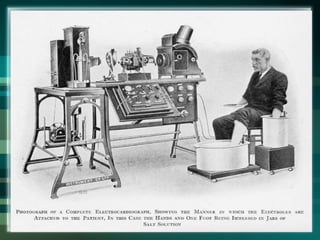
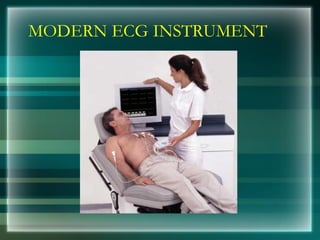
MODERN ECG INSTRUMENT
What is an EKG?
•The electrocardiogram (EKG) is a representation
of the electrical events of the cardiac cycle.
•Each event has a distinctive waveform
•the study of waveform can lead to greater insight
into a patient’s cardiac pathophysiology.
•Electrocardiograph – is the instrument that
records the electrical activity of the heart
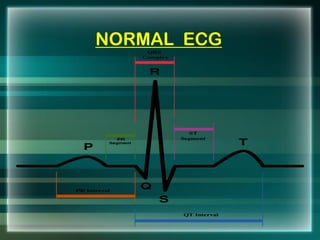
NORMAL ECG
With EKGs we can identify
Arrhythmias
Myocardial ischemia and infarction
Pericarditis
Chamber hypertrophy
Electrolyte disturbances (i.e. hyperkalemia,
hypokalemia)
Drug toxicity (i.e. digoxin and drugs which prolong
the QT interval)
Pacemakers of the Heart
• SA Node - Dominant pacemaker with an
intrinsic rate of 60 - 100 beats/minute.
• AV Node - Back-up pacemaker with an
intrinsic rate of 40 - 60 beats/minute.
• Ventricular cells - Back-up pacemaker with
an intrinsic rate of 20 - 45 bpm.
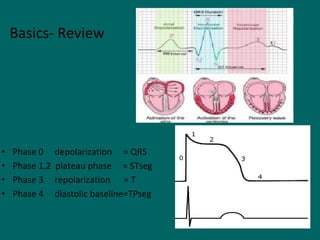
• Phase 0 depolarization = QRS
• Phase 1,2 plateau phase = STseg
• Phase 3 repolarization = T
• Phase 4 diastolic baseline=TPseg
Basics- Review
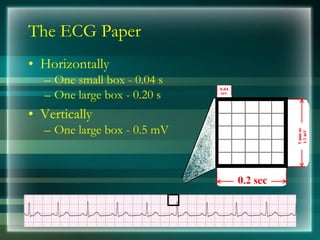
The ECG Paper
• Horizontally
– One small box - 0.04 s
– One large box - 0.20 s
• Vertically
– One large box - 0.5 mV
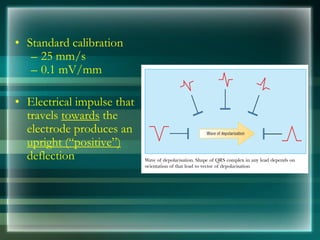
• Standard calibration
– 25 mm/s
– 0.1 mV/mm
• Electrical impulse that
travels towards the
electrode produces an
upright (“positive”)
deflection
EKG Leads
which measure the difference in electrical potential
between two points
1. Bipolar Leads: Two different points on the body
2. Unipolar Leads: One point on the body and a virtual
reference point with zero electrical potential, located in
the center of the heart
EKG Leads
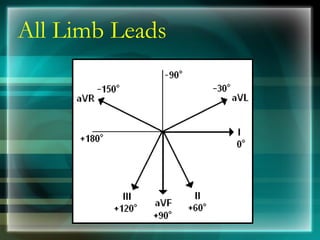
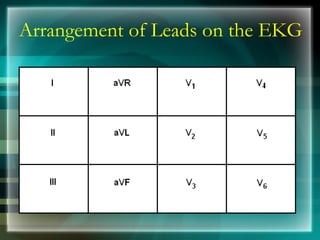
The standard EKG has 12 leads:
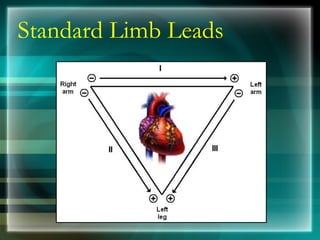
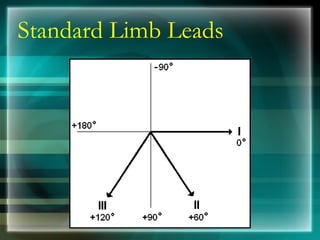
3 Standard Limb Leads
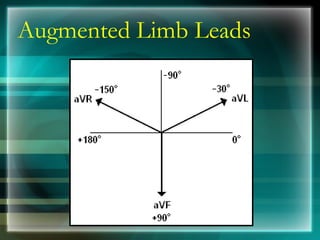
3 Augmented Limb Leads
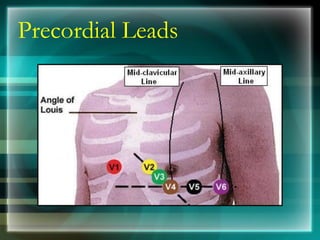
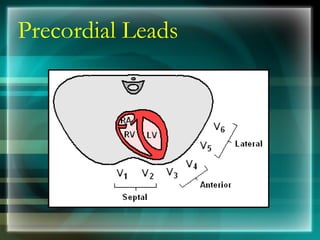
6 Precordial Leads
Standard Limb Leads
Standard Limb Leads
Augmented Limb Leads
All Limb Leads
Precordial Leads
Precordial Leads
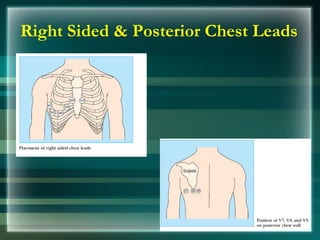
Right Sided & Posterior Chest Leads
Arrangement of Leads on the EKG
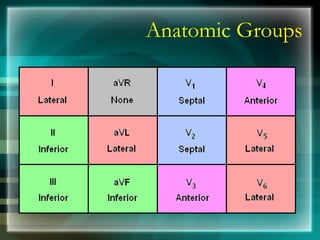
Anatomic Groups
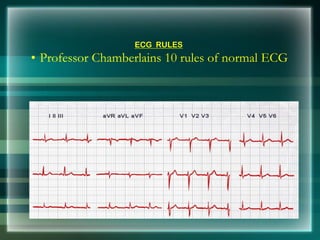
ECG RULES
• Professor Chamberlains 10 rules of normal ECG
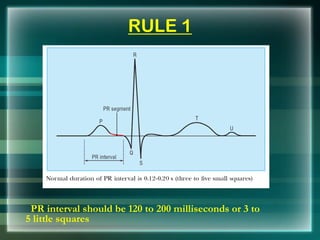
RULE 1
PR interval should be 120 to 200 milliseconds or 3 to
5 little squares
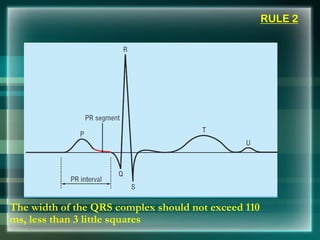
RULE 2
The width of the QRS complex should not exceed 110
ms, less than 3 little squares
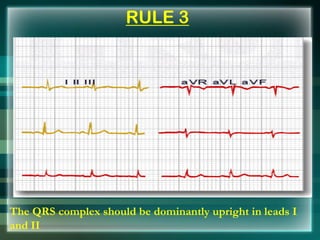
RULE 3
The QRS complex should be dominantly upright in leads I
and II
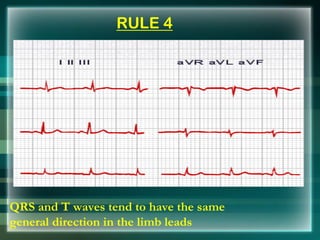
RULE 4
QRS and T waves tend to have the same
general direction in the limb leads
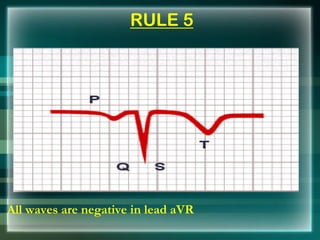
RULE 5
All waves are negative in lead aVR
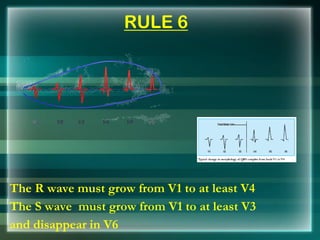
RULE 6
The R wave must grow from V1 to at least V4
The S wave must grow from V1 to at least V3
and disappear in V6
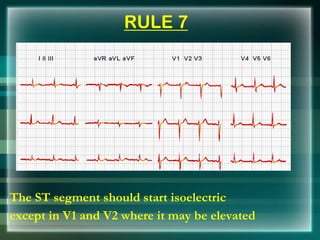
RULE 7
The ST segment should start isoelectric
except in V1 and V2 where it may be elevated
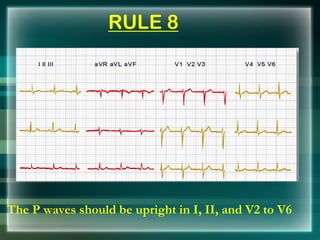
RULE 8
The P waves should be upright in I, II, and V2 to V6
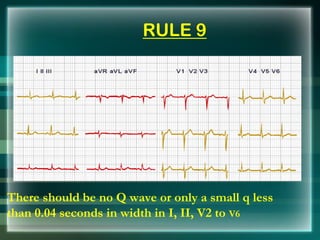
RULE 9
There should be no Q wave or only a small q less
than 0.04 seconds in width in I, II, V2 to V6
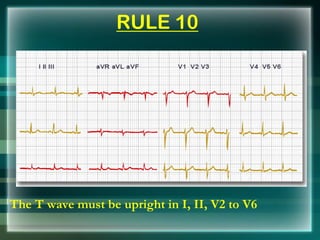
RULE 10
The T wave must be upright in I, II, V2 to V6
ECG COMPONENTS
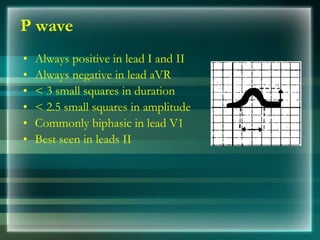
P wave
• Always positive in lead I and II
• Always negative in lead aVR
• < 3 small squares in duration
• < 2.5 small squares in amplitude
• Commonly biphasic in lead V1
• Best seen in leads II
Right Atrial Enlargement
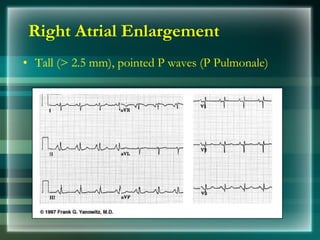
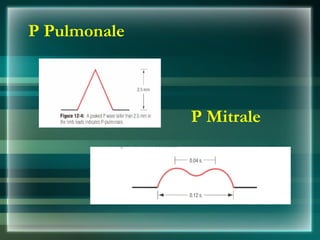
• Tall (> 2.5 mm), pointed P waves (P Pulmonale)
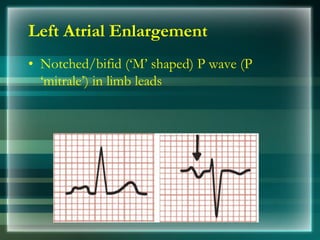
• Notched/bifid (‘M’ shaped) P wave (P
‘mitrale’) in limb leads
Left Atrial Enlargement
P Pulmonale
P Mitrale
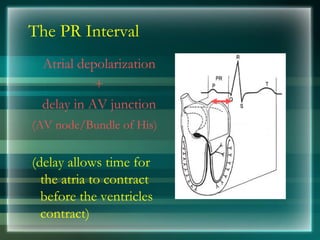
The PR Interval
Atrial depolarization
+
delay in AV junction
(AV node/Bundle of His)
(delay allows time for
the atria to contract
before the ventricles
contract)
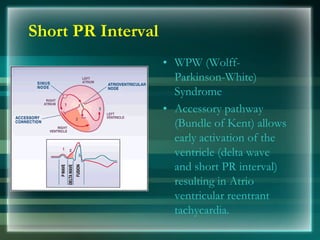
Short PR Interval
• WPW (Wolff-
Parkinson-White)
Syndrome
• Accessory pathway
(Bundle of Kent) allows
early activation of the
ventricle (delta wave
and short PR interval)
resulting in Atrio
ventricular reentrant
tachycardia.
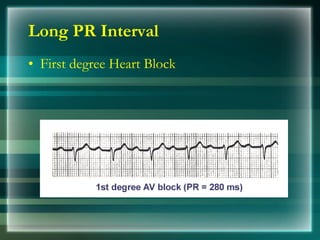
Long PR Interval
• First degree Heart Block
➢ can be due to:
• inferior MI
• digitalis toxicity
• hyperkalemia
• increased vagal tone
• acute rheumatic fever
• myocarditis.
QRS Complexes
• Non pathological Q waves may present in I, III, aVL,
V5, and V6
• R wave in lead V6 is smaller than V5.
• Depth of the S wave, should not exceed 30 mm
• Pathological Q wave > 2mm deep and > 1mm wide or
> 25% amplitude of the subsequent R wave
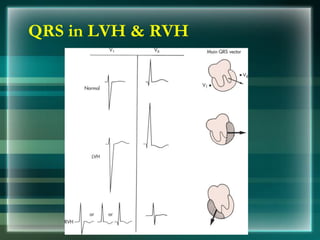
QRS in LVH & RVH
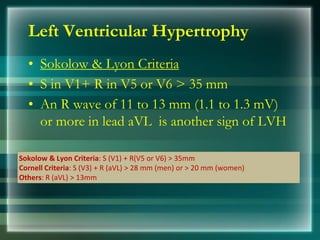
Left Ventricular Hypertrophy
• Sokolow & Lyon Criteria
• S in V1+ R in V5 or V6 > 35 mm
• An R wave of 11 to 13 mm (1.1 to 1.3 mV)
or more in lead aVL is another sign of LVH
Sokolow & Lyon Criteria: S (V1) + R(V5 or V6) > 35mm
Cornell Criteria: S (V3) + R (aVL) > 28 mm (men) or > 20 mm (women)
Others: R (aVL) > 13mm
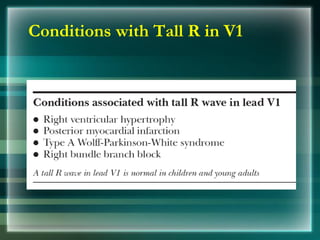
Conditions with Tall R in V1
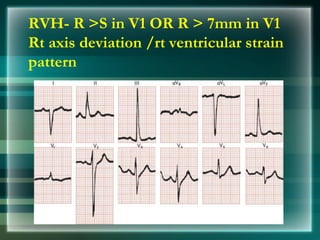
RVH- R >S in V1 OR R > 7mm in V1
Rt axis deviation /rt ventricular strain
pattern
ST Segment
• ST Segment is flat (isoelectric)
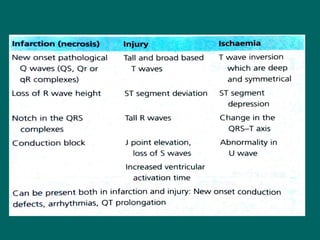
• Elevation or depression of ST segment by 1
mm or more
• “J” (Junction) point is the point between
QRS and ST segment.
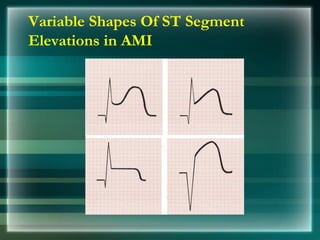
Variable Shapes Of ST Segment
Elevations in AMI
T wave
• Normal T wave is asymmetrical, first half having a
gradual slope than the second
• Should be at least 1/8 but less than 2/3 of the
amplitude of the R
• T wave amplitude rarely exceeds 10 mm
• Abnormal T waves are symmetrical, tall, peaked,
biphasic or inverted.
• T wave follows the direction of the QRS deflection.
IT waves Inversion are seen in the following conditions:
• Normal finding in children
• Persistent juvenile T wave pattern
• Myocardial ischaemia and infarction
• Bundle branch block
• Ventricular hypertrophy (‘strain’ patterns)
• Pulmonary embolism
• Hypertrophic cardiomyopathy
• Raised intracranial pressure
T wave inversion in lead III is a normal variant. New T-
wave inversion (compared with prior ECGs) is always
abnormal. Pathological T wave inversion is usually
symmetrical and deep (>3mm).
» Biphasic T waves- wellens type 2 syndrome
» Camel hump T waves- severe
hypokalaemia(U waves) and sinus
tachycardia (hidden p waves )
QT interval
1. Total duration of Depolarization and
Repolarization of ventricles.
2. QT interval decreases when heart rate increases
3. For HR = 70 bpm, QT<0.40 sec.
4. QT interval should be 0.35 0.45 s,
5. Should not be more than half of the interval
between adjacent R waves (RR interval).
Examples of Long QT syndromes- Jervell and Lange
-nielsen syndrome and Romano Ward syndrome
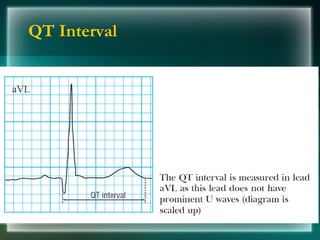
QT Interval
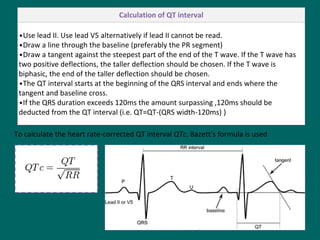
To calculate the heart rate-corrected QT interval QTc. Bazett's formula is used
Calculation of QT interval
•Use lead II. Use lead V5 alternatively if lead II cannot be read.
•Draw a line through the baseline (preferably the PR segment)
•Draw a tangent against the steepest part of the end of the T wave. If the T wave has
two positive deflections, the taller deflection should be chosen. If the T wave is
biphasic, the end of the taller deflection should be chosen.
•The QT interval starts at the beginning of the QRS interval and ends where the
tangent and baseline cross.
•If the QRS duration exceeds 120ms the amount surpassing ,120ms should be
deducted from the QT interval (i.e. QT=QT-(QRS width-120ms) )
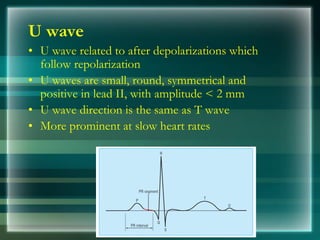
U wave
• U wave related to after depolarizations which
follow repolarization
• U waves are small, round, symmetrical and
positive in lead II, with amplitude < 2 mm
• U wave direction is the same as T wave
• More prominent at slow heart rates
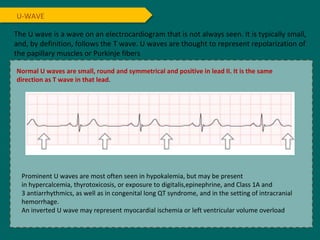
U-WAVE
Prominent U waves are most often seen in hypokalemia, but may be present
in hypercalcemia, thyrotoxicosis, or exposure to digitalis,epinephrine, and Class 1A and
3 antiarrhythmics, as well as in congenital long QT syndrome, and in the setting of intracranial
hemorrhage.
An inverted U wave may represent myocardial ischemia or left ventricular volume overload
The U wave is a wave on an electrocardiogram that is not always seen. It is typically small,
and, by definition, follows the T wave. U waves are thought to represent repolarization of
the papillary muscles or Purkinje fibers
Normal U waves are small, round and symmetrical and positive in lead II. It is the same
direction as T wave in that lead.
HEART RATE
Determining the Heart Rate
Rule of 300/1500
10 Second Rule
Rule of 300
For Regular rhythms-
Count the number of “big boxes” between two
QRS complexes, and divide this into 300. (smaller
boxes with 1500)
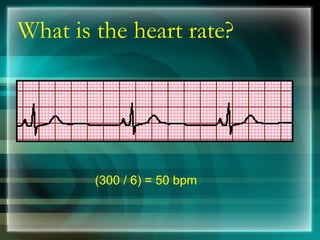
What is the heart rate?
(300 / 6) = 50 bpm
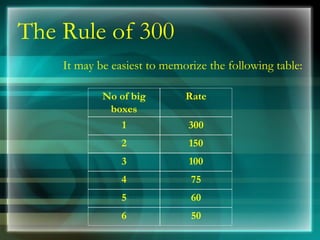
The Rule of 300
It may be easiest to memorize the following table:
No of big
boxes
Rate
1 300
2 150
3 100
4 75
5 60
6 50
10 Second Rule
For irregular rhythms-
ECG record 10 seconds of rhythm per page,
Count the number of beats present on the EKG
Multiply by 6 .
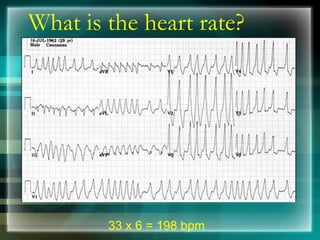
What is the heart rate?
33 x 6 = 198 bpm
AXIS
The QRS Axis
The QRS axis represents overall direction of the
heart’s electrical activity.
Abnormalities hint at:
Ventricular enlargement
Conduction blocks (i.e. hemiblocks)
The QRS Axis
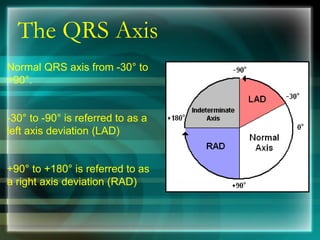
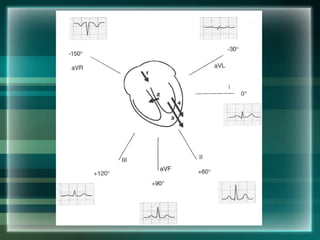
Normal QRS axis from -30° to
+90°.
-30° to -90° is referred to as a
left axis deviation (LAD)
+90° to +180° is referred to as
a right axis deviation (RAD)
Determining the Axis
• The Quadrant Approach
• The Equiphasic Approach
Determining the Axis
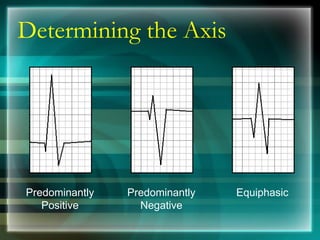
Predominantly
Positive
Predominantly
Negative
Equiphasic
The Quadrant Approach
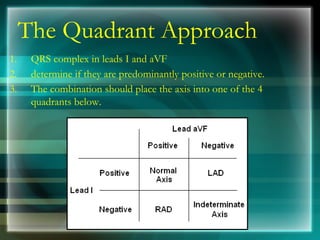
1. QRS complex in leads I and aVF
2. determine if they are predominantly positive or negative.
3. The combination should place the axis into one of the 4
quadrants below.
The Quadrant Approach
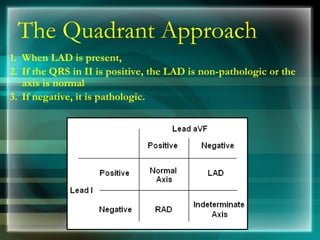
1. When LAD is present,
2. If the QRS in II is positive, the LAD is non-pathologic or the
axis is normal
3. If negative, it is pathologic.
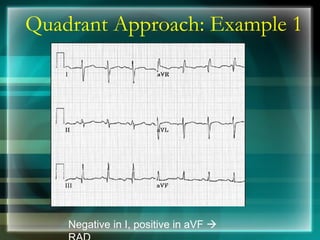
Quadrant Approach: Example 1
Negative in I, positive in aVF →
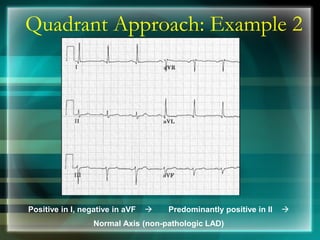
Quadrant Approach: Example 2
Positive in I, negative in aVF → Predominantly positive in II →
Normal Axis (non-pathologic LAD)
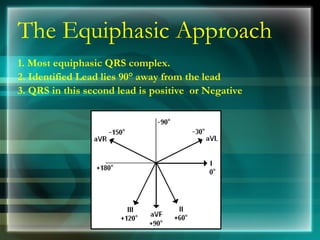
The Equiphasic Approach
1. Most equiphasic QRS complex.
2. Identified Lead lies 90° away from the lead
3. QRS in this second lead is positive or Negative
ARRHYTHMIAS
Arrhythmias
Arrhythmias can arise from problems in the:
• Sinus node
• Atrial cells
• AV junction
• Ventricular cells
SA Node Problems
The SA Node can:
• fire too slow
• fire too fast Sinus Bradycardia
Sinus Tachycardia
Sinus Tachycardia may be an appropriate
response to stress.
Atrial Cell Problems
Atrial cells can:
• fire occasionally
from a focus
• fire continuously
due to a looping re-
entrant circuit
Premature Atrial Contractions
(PACs)
Atrial Flutter
AV Junctional Problems
The AV junction can:
• fire continuously due
to a looping re-
entrant circuit
• block impulses
coming from the SA
Node
Paroxysmal
Supraventricular
Tachycardia
AV Junctional Blocks
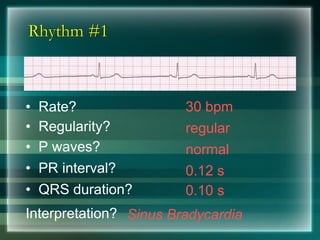
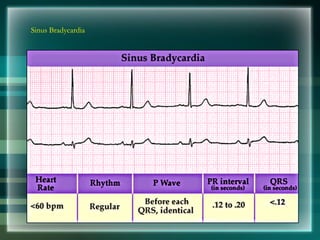
Rhythm #1
30 bpm• Rate?
• Regularity? regular
normal
0.10 s
• P waves?
• PR interval? 0.12 s
• QRS duration?
Interpretation? Sinus Bradycardia
Sinus Bradycardia
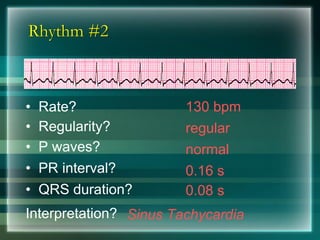
Rhythm #2
130 bpm• Rate?
• Regularity? regular
normal
0.08 s
• P waves?
• PR interval? 0.16 s
• QRS duration?
Interpretation? Sinus Tachycardia
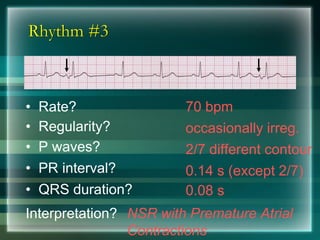
Rhythm #3
70 bpm• Rate?
• Regularity? occasionally irreg.
2/7 different contour
0.08 s
• P waves?
• PR interval? 0.14 s (except 2/7)
• QRS duration?
Interpretation? NSR with Premature Atrial
Contractions
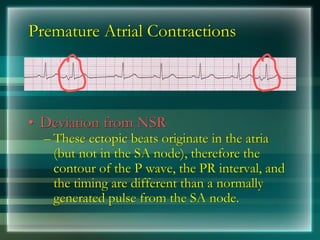
Premature Atrial Contractions
• Deviation from NSR
– These ectopic beats originate in the atria
(but not in the SA node), therefore the
contour of the P wave, the PR interval, and
the timing are different than a normally
generated pulse from the SA node.
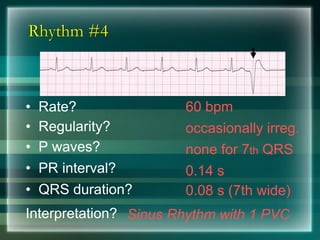
Rhythm #4
60 bpm• Rate?
• Regularity? occasionally irreg.
none for 7th QRS
0.08 s (7th wide)
• P waves?
• PR interval? 0.14 s
• QRS duration?
Interpretation? Sinus Rhythm with 1 PVC
RHYTHM
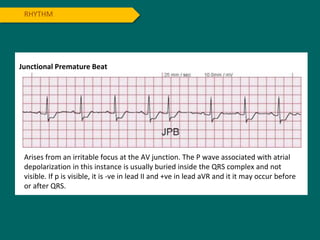
Junctional Premature Beat
Arises from an irritable focus at the AV junction. The P wave associated with atrial
depolarization in this instance is usually buried inside the QRS complex and not
visible. If p is visible, it is -ve in lead II and +ve in lead aVR and it it may occur before
or after QRS.
Supraventricular Arrhythmias
• Atrial Fibrillation
• Atrial Flutter
• Paroxysmal Supraventricular Tachycardia
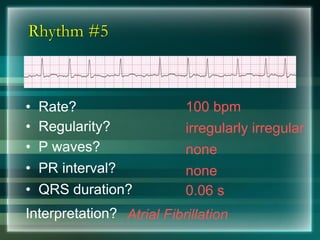
Rhythm #5
100 bpm• Rate?
• Regularity? irregularly irregular
none
0.06 s
• P waves?
• PR interval? none
• QRS duration?
Interpretation? Atrial Fibrillation
Atrial Fibrillation
• Deviation from NSR
– No organized atrial depolarization, so no
normal P waves (impulses are not originating
from the sinus node).
– Atrial activity is chaotic (resulting in an
irregularly irregular rate).
– Common, affects 2-4%, up to 5-10% if > 80
years old
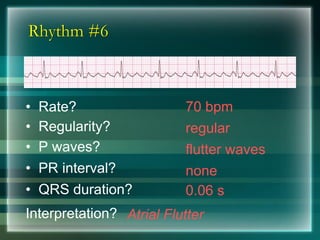
Rhythm #6
70 bpm• Rate?
• Regularity? regular
flutter waves
0.06 s
• P waves?
• PR interval? none
• QRS duration?
Interpretation? Atrial Flutter
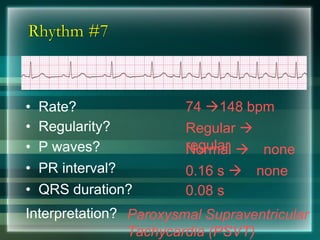
Rhythm #7
74 →148 bpm• Rate?
• Regularity? Regular →
regularNormal → none
0.08 s
• P waves?
• PR interval? 0.16 s → none
• QRS duration?
Interpretation? Paroxysmal Supraventricular
Tachycardia (PSVT)
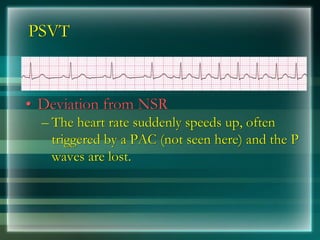
PSVT
• Deviation from NSR
– The heart rate suddenly speeds up, often
triggered by a PAC (not seen here) and the P
waves are lost.
Ventricular Arrhythmias
• Ventricular Tachycardia
• Ventricular Fibrillation
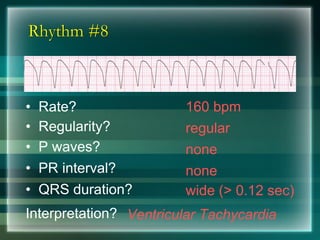
Rhythm #8
160 bpm• Rate?
• Regularity? regular
none
wide (> 0.12 sec)
• P waves?
• PR interval? none
• QRS duration?
Interpretation? Ventricular Tachycardia
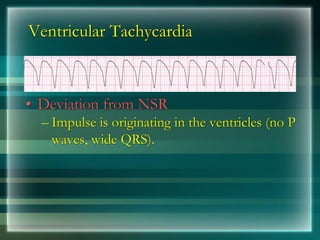
Ventricular Tachycardia
• Deviation from NSR
– Impulse is originating in the ventricles (no P
waves, wide QRS).
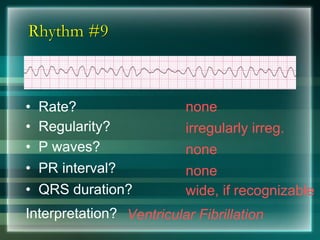
Rhythm #9
none• Rate?
• Regularity? irregularly irreg.
none
wide, if recognizable
• P waves?
• PR interval? none
• QRS duration?
Interpretation? Ventricular Fibrillation
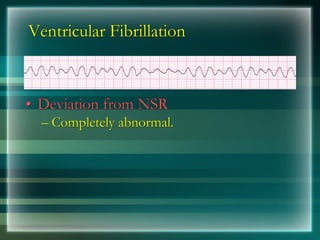
Ventricular Fibrillation
• Deviation from NSR
– Completely abnormal.
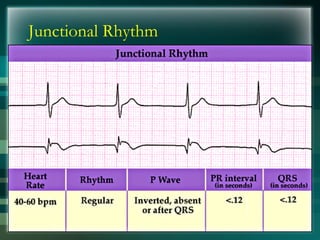
Junctional Rhythm
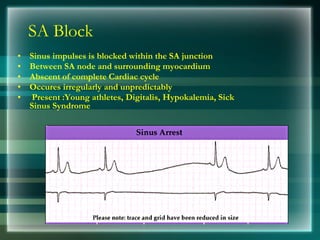
SA Block
• Sinus impulses is blocked within the SA junction
• Between SA node and surrounding myocardium
• Abscent of complete Cardiac cycle
• Occures irregularly and unpredictably
• Present :Young athletes, Digitalis, Hypokalemia, Sick
Sinus Syndrome
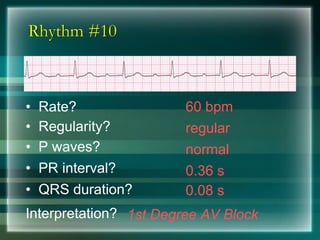
Rhythm #10
60 bpm• Rate?
• Regularity? regular
normal
0.08 s
• P waves?
• PR interval? 0.36 s
• QRS duration?
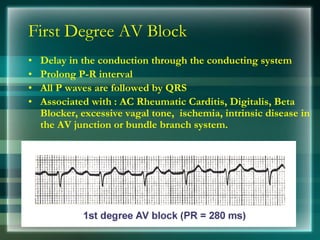
Interpretation? 1st Degree AV Block
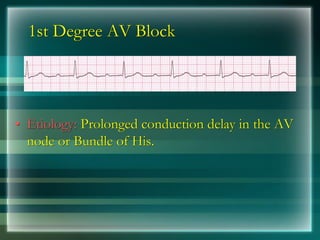
1st Degree AV Block
• Etiology: Prolonged conduction delay in the AV
node or Bundle of His.
First Degree AV Block
• Delay in the conduction through the conducting system
• Prolong P-R interval
• All P waves are followed by QRS
• Associated with : AC Rheumatic Carditis, Digitalis, Beta
Blocker, excessive vagal tone, ischemia, intrinsic disease in
the AV junction or bundle branch system.
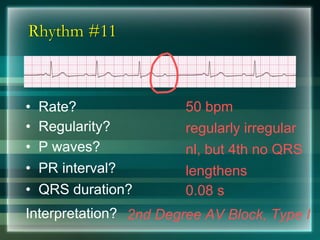
Rhythm #11
50 bpm• Rate?
• Regularity? regularly irregular
nl, but 4th no QRS
0.08 s
• P waves?
• PR interval? lengthens
• QRS duration?
Interpretation? 2nd Degree AV Block, Type I
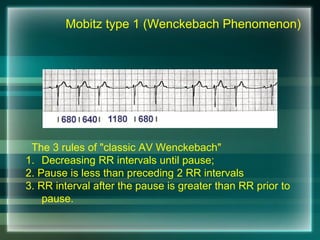
The 3 rules of "classic AV Wenckebach"
1. Decreasing RR intervals until pause;
2. Pause is less than preceding 2 RR intervals
3. RR interval after the pause is greater than RR prior to
pause.
Mobitz type 1 (Wenckebach Phenomenon)
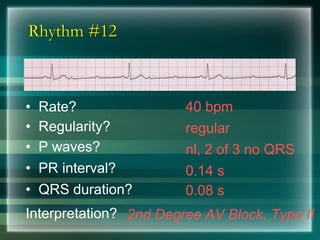
Rhythm #12
40 bpm• Rate?
• Regularity? regular
nl, 2 of 3 no QRS
0.08 s
• P waves?
• PR interval? 0.14 s
• QRS duration?
Interpretation? 2nd Degree AV Block, Type II
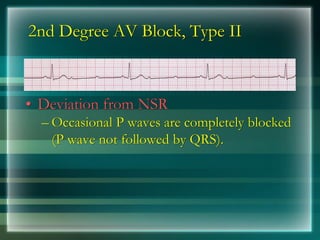
2nd Degree AV Block, Type II
• Deviation from NSR
– Occasional P waves are completely blocked
(P wave not followed by QRS).
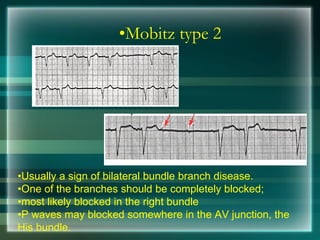
•Mobitz type 2
•Usually a sign of bilateral bundle branch disease.
•One of the branches should be completely blocked;
•most likely blocked in the right bundle
•P waves may blocked somewhere in the AV junction, the
His bundle.
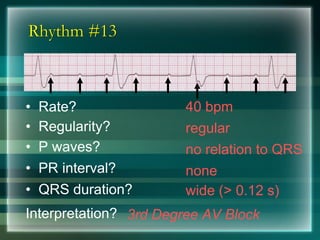
Rhythm #13
40 bpm• Rate?
• Regularity? regular
no relation to QRS
wide (> 0.12 s)
• P waves?
• PR interval? none
• QRS duration?
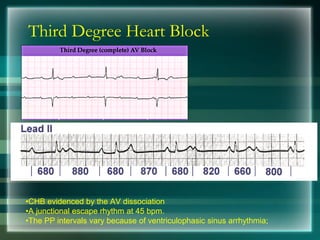
Interpretation? 3rd Degree AV Block
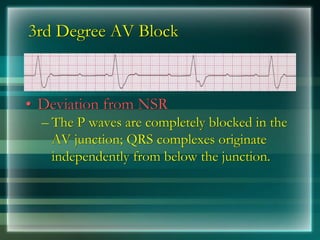
3rd Degree AV Block
• Deviation from NSR
– The P waves are completely blocked in the
AV junction; QRS complexes originate
independently from below the junction.
Third Degree Heart Block
•CHB evidenced by the AV dissociation
•A junctional escape rhythm at 45 bpm.
•The PP intervals vary because of ventriculophasic sinus arrhythmia;
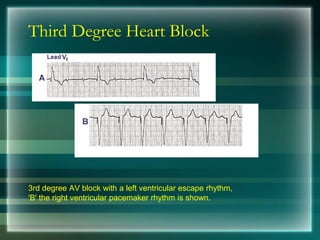
Third Degree Heart Block
3rd degree AV block with a left ventricular escape rhythm,
'B' the right ventricular pacemaker rhythm is shown.
RHYTHM
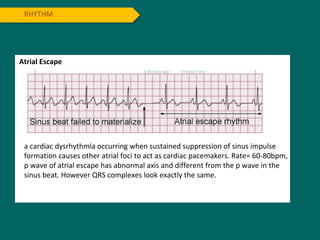
Atrial Escape
a cardiac dysrhythmia occurring when sustained suppression of sinus impulse
formation causes other atrial foci to act as cardiac pacemakers. Rate= 60-80bpm,
p wave of atrial escape has abnormal axis and different from the p wave in the
sinus beat. However QRS complexes look exactly the same.
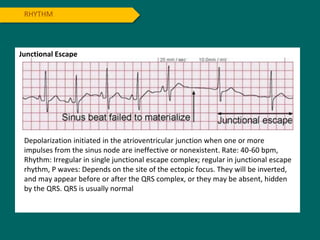
RHYTHM
Junctional Escape
Depolarization initiated in the atrioventricular junction when one or more
impulses from the sinus node are ineffective or nonexistent. Rate: 40-60 bpm,
Rhythm: Irregular in single junctional escape complex; regular in junctional escape
rhythm, P waves: Depends on the site of the ectopic focus. They will be inverted,
and may appear before or after the QRS complex, or they may be absent, hidden
by the QRS. QRS is usually normal
RHYTHM
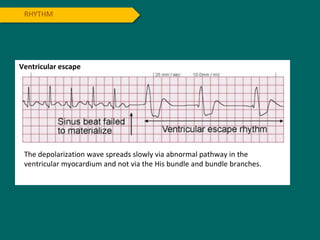
Ventricular escape
The depolarization wave spreads slowly via abnormal pathway in the
ventricular myocardium and not via the His bundle and bundle branches.
RHYTHM
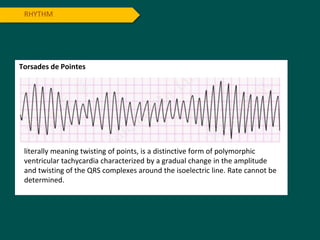
Torsades de Pointes
literally meaning twisting of points, is a distinctive form of polymorphic
ventricular tachycardia characterized by a gradual change in the amplitude
and twisting of the QRS complexes around the isoelectric line. Rate cannot be
determined.
RHYTHM
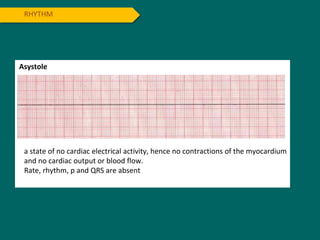
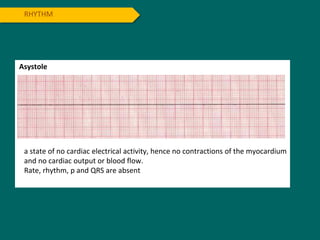
Asystole
a state of no cardiac electrical activity, hence no contractions of the myocardium
and no cardiac output or blood flow.
Rate, rhythm, p and QRS are absent
RHYTHM
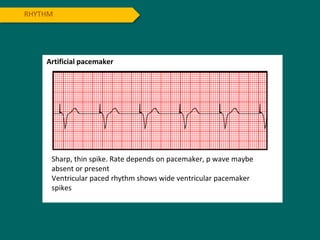
Artificial pacemaker
Sharp, thin spike. Rate depends on pacemaker, p wave maybe
absent or present
Ventricular paced rhythm shows wide ventricular pacemaker
spikes
RHYTHM
Asystole
a state of no cardiac electrical activity, hence no contractions of the myocardium
and no cardiac output or blood flow.
Rate, rhythm, p and QRS are absent
INTRESTING ECGS
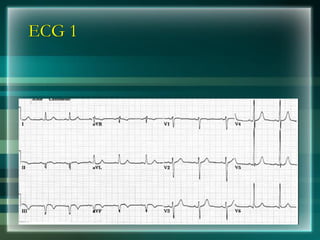
ECG 1
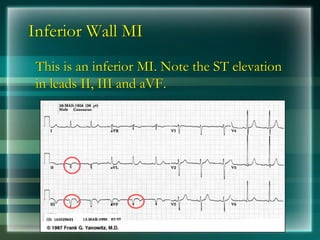
Inferior Wall MI
This is an inferior MI. Note the ST elevation
in leads II, III and aVF.
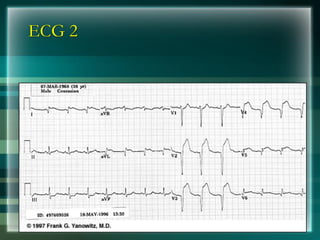
ECG 2
Anterolateral MI
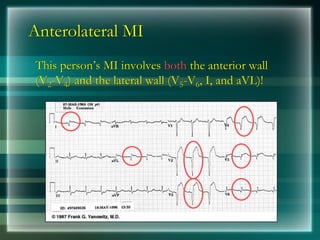
This person’s MI involves both the anterior wall
(V2-V4) and the lateral wall (V5-V6, I, and aVL)!
Diagnosing a MI
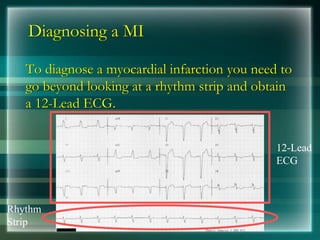
To diagnose a myocardial infarction you need to
go beyond looking at a rhythm strip and obtain
a 12-Lead ECG.
Rhythm
Strip
12-Lead
ECG
ST Elevation (cont)
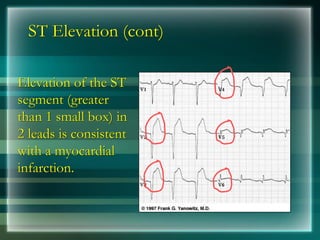
Elevation of the ST
segment (greater
than 1 small box) in
2 leads is consistent
with a myocardial
infarction.
Anterior MI
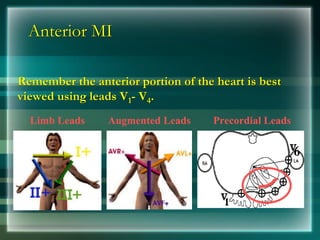
Remember the anterior portion of the heart is best
viewed using leads V1- V4.
Limb Leads Augmented Leads Precordial Leads
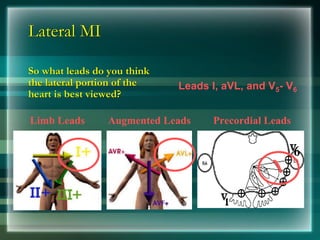
Lateral MI
So what leads do you think
the lateral portion of the
heart is best viewed?
Limb Leads Augmented Leads Precordial Leads
Leads I, aVL, and V5- V6
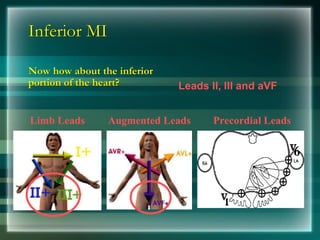
Inferior MI
Now how about the inferior
portion of the heart?
Limb Leads Augmented Leads Precordial Leads
Leads II, III and aVF
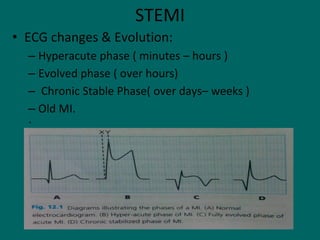
STEMI
• ECG changes & Evolution:
– Hyperacute phase ( minutes – hours )
– Evolved phase ( over hours)
– Chronic Stable Phase( over days– weeks )
– Old MI.
`
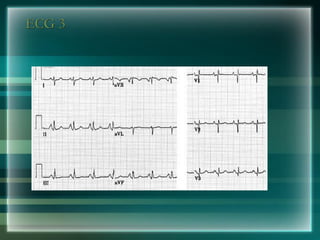
ECG 3
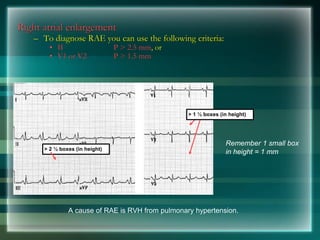
Right atrial enlargement
– To diagnose RAE you can use the following criteria:
• II P > 2.5 mm, or
• V1 or V2 P > 1.5 mm
Remember 1 small box
in height = 1 mm
A cause of RAE is RVH from pulmonary hypertension.
> 2 ½ boxes (in height)
> 1 ½ boxes (in height)
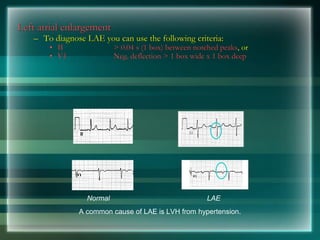
Left atrial enlargement
– To diagnose LAE you can use the following criteria:
• II > 0.04 s (1 box) between notched peaks, or
• V1 Neg. deflection > 1 box wide x 1 box deep
Normal LAE
A common cause of LAE is LVH from hypertension.
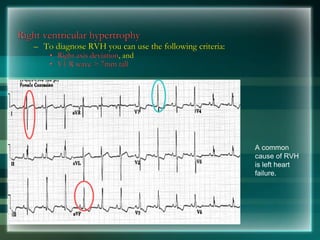
Right ventricular hypertrophy
– To diagnose RVH you can use the following criteria:
• Right axis deviation, and
• V1 R wave > 7mm tall
A common
cause of RVH
is left heart
failure.
Right ventricular hypertrophy
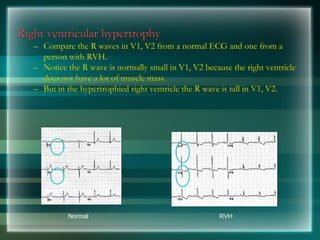
– Compare the R waves in V1, V2 from a normal ECG and one from a
person with RVH.
– Notice the R wave is normally small in V1, V2 because the right ventricle
does not have a lot of muscle mass.
– But in the hypertrophied right ventricle the R wave is tall in V1, V2.
Normal RVH
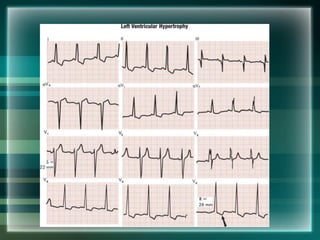
Left ventricular hypertrophy
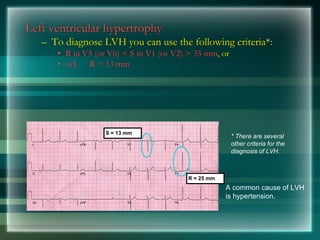
– To diagnose LVH you can use the following criteria*:
• R in V5 (or V6) + S in V1 (or V2) > 35 mm, or
• avL R > 13 mm
A common cause of LVH
is hypertension.
* There are several
other criteria for the
diagnosis of LVH.
S = 13 mm
R = 25 mm
ECG 4
ECG 5
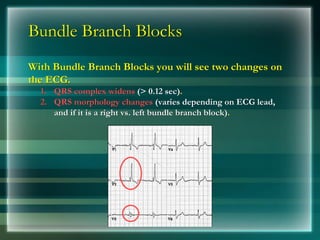
Bundle Branch Blocks
With Bundle Branch Blocks you will see two changes on
the ECG.
1. QRS complex widens (> 0.12 sec).
2. QRS morphology changes (varies depending on ECG lead,
and if it is a right vs. left bundle branch block).
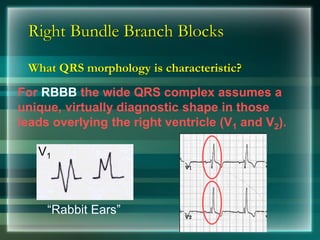
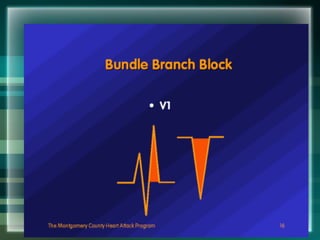
Right Bundle Branch Blocks
What QRS morphology is characteristic?
V1
For RBBB the wide QRS complex assumes a
unique, virtually diagnostic shape in those
leads overlying the right ventricle (V1 and V2).
“Rabbit Ears”
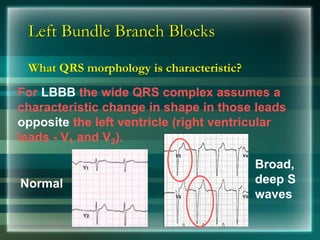
Left Bundle Branch Blocks
What QRS morphology is characteristic?
For LBBB the wide QRS complex assumes a
characteristic change in shape in those leads
opposite the left ventricle (right ventricular
leads - V1 and V2).
Broad,
deep S
waves
Normal
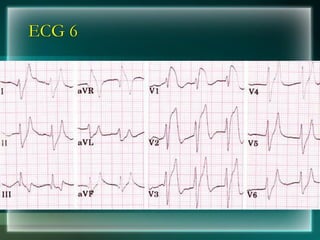
ECG 6
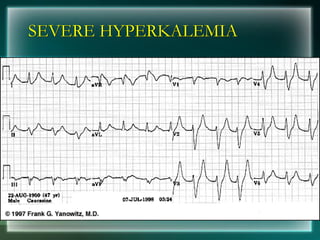
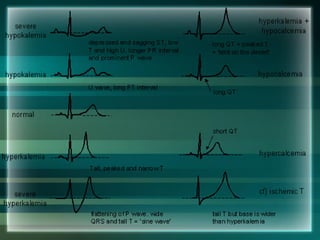
SEVERE HYPERKALEMIA
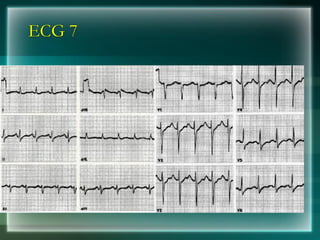
ECG 7
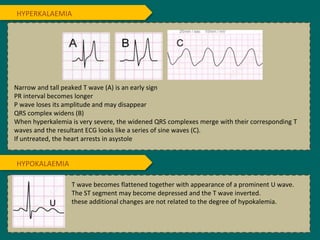
Narrow and tall peaked T wave (A) is an early sign
PR interval becomes longer
P wave loses its amplitude and may disappear
QRS complex widens (B)
When hyperkalemia is very severe, the widened QRS complexes merge with their corresponding T
waves and the resultant ECG looks like a series of sine waves (C).
If untreated, the heart arrests in asystole
T wave becomes flattened together with appearance of a prominent U wave.
The ST segment may become depressed and the T wave inverted.
these additional changes are not related to the degree of hypokalemia.
HYPERKALAEMIA
HYPOKALAEMIA
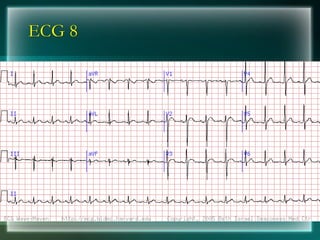
ECG 8
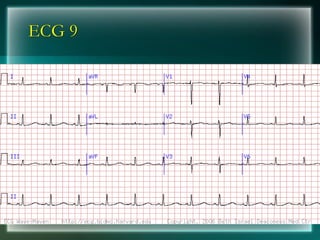
ECG 9
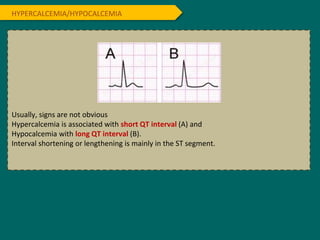
Usually, signs are not obvious
Hypercalcemia is associated with short QT interval (A) and
Hypocalcemia with long QT interval (B).
Interval shortening or lengthening is mainly in the ST segment.
HYPERCALCEMIA/HYPOCALCEMIA
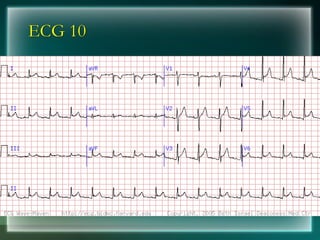
ECG 10
ACUTE PERICARDITIS
• stage 1 – widespread STE and PR
depression with reciprocal changes in aVR
(occurs the first two weeks)
• Stage 2 – normalization of ST changes;
generalized T wave flattening (1 to 3 weeks)
• Stage 3– Flattened T waves become
inverted (3 to several weeks)
• Stage 4 – ECG returns to normal (several
weeks onwards)
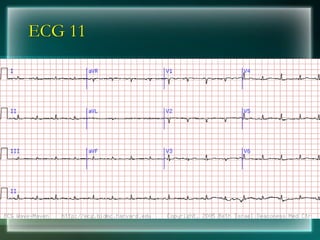
ECG 11
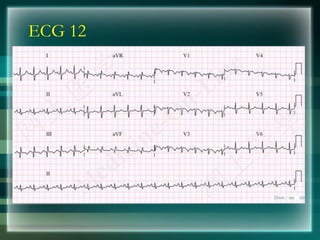
ECG 12
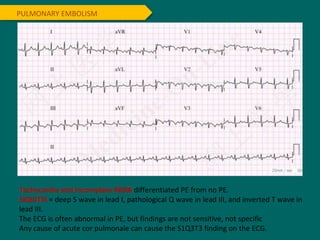
PULMONARY EMBOLISM
Tachycardia and incomplete RBBB differentiated PE from no PE.
SIQIIITIII = deep S wave in lead I, pathological Q wave in lead III, and inverted T wave in
lead III.
The ECG is often abnormal in PE, but findings are not sensitive, not specific
Any cause of acute cor pulmonale can cause the S1Q3T3 finding on the ECG.
l
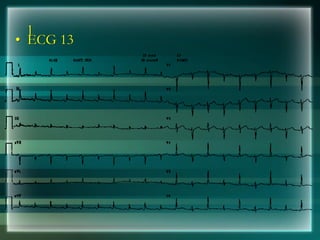
• ECG 13
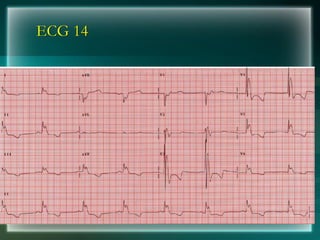
ECG 14
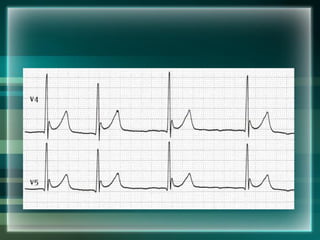
OSBORNE WAVES or J waves
HYPOTHERMIA
Hypercalacemia
Neurological causes like head injury or
SAH
THANK YOU

Ecg basics

  • 1.
  • 2.
    » INTRODUCTION » ECGBASICS » ECG COMPONENTS » RATE CALCULATION » AXIS DETERMINATION » RHYTHMS » INTRESTING ECGS
  • 3.
    HISTORY • 1842- Italianscientist Carlo Matteucci realizes that electricity is associated with the heart beat • 1876- Irish scientist Marey analyzes the electric pattern of frog’s heart • 1895 - William Einthoven , credited for the invention of EKG • 1906 - using the string electrometer EKG, William Einthoven diagnoses some heart problems
  • 5.
  • 6.
    What is anEKG? •The electrocardiogram (EKG) is a representation of the electrical events of the cardiac cycle. •Each event has a distinctive waveform •the study of waveform can lead to greater insight into a patient’s cardiac pathophysiology. •Electrocardiograph – is the instrument that records the electrical activity of the heart
  • 7.
  • 8.
    With EKGs wecan identify Arrhythmias Myocardial ischemia and infarction Pericarditis Chamber hypertrophy Electrolyte disturbances (i.e. hyperkalemia, hypokalemia) Drug toxicity (i.e. digoxin and drugs which prolong the QT interval)
  • 9.
    Pacemakers of theHeart • SA Node - Dominant pacemaker with an intrinsic rate of 60 - 100 beats/minute. • AV Node - Back-up pacemaker with an intrinsic rate of 40 - 60 beats/minute. • Ventricular cells - Back-up pacemaker with an intrinsic rate of 20 - 45 bpm.
  • 10.
    • Phase 0depolarization = QRS • Phase 1,2 plateau phase = STseg • Phase 3 repolarization = T • Phase 4 diastolic baseline=TPseg Basics- Review
  • 11.
    The ECG Paper •Horizontally – One small box - 0.04 s – One large box - 0.20 s • Vertically – One large box - 0.5 mV
  • 12.
    • Standard calibration –25 mm/s – 0.1 mV/mm • Electrical impulse that travels towards the electrode produces an upright (“positive”) deflection
  • 13.
    EKG Leads which measurethe difference in electrical potential between two points 1. Bipolar Leads: Two different points on the body 2. Unipolar Leads: One point on the body and a virtual reference point with zero electrical potential, located in the center of the heart
  • 14.
    EKG Leads The standardEKG has 12 leads: 3 Standard Limb Leads 3 Augmented Limb Leads 6 Precordial Leads
  • 15.
  • 16.
  • 17.
  • 18.
  • 19.
  • 20.
  • 21.
    Right Sided &Posterior Chest Leads
  • 22.
  • 23.
  • 24.
    ECG RULES • ProfessorChamberlains 10 rules of normal ECG
  • 25.
    RULE 1 PR intervalshould be 120 to 200 milliseconds or 3 to 5 little squares
  • 26.
    RULE 2 The widthof the QRS complex should not exceed 110 ms, less than 3 little squares
  • 27.
    RULE 3 The QRScomplex should be dominantly upright in leads I and II
  • 28.
    RULE 4 QRS andT waves tend to have the same general direction in the limb leads
  • 29.
    RULE 5 All wavesare negative in lead aVR
  • 30.
    RULE 6 The Rwave must grow from V1 to at least V4 The S wave must grow from V1 to at least V3 and disappear in V6
  • 31.
    RULE 7 The STsegment should start isoelectric except in V1 and V2 where it may be elevated
  • 32.
    RULE 8 The Pwaves should be upright in I, II, and V2 to V6
  • 33.
    RULE 9 There shouldbe no Q wave or only a small q less than 0.04 seconds in width in I, II, V2 to V6
  • 34.
    RULE 10 The Twave must be upright in I, II, V2 to V6
  • 35.
  • 36.
    P wave • Alwayspositive in lead I and II • Always negative in lead aVR • < 3 small squares in duration • < 2.5 small squares in amplitude • Commonly biphasic in lead V1 • Best seen in leads II
  • 37.
    Right Atrial Enlargement •Tall (> 2.5 mm), pointed P waves (P Pulmonale)
  • 38.
    • Notched/bifid (‘M’shaped) P wave (P ‘mitrale’) in limb leads Left Atrial Enlargement
  • 39.
  • 40.
    The PR Interval Atrialdepolarization + delay in AV junction (AV node/Bundle of His) (delay allows time for the atria to contract before the ventricles contract)
  • 41.
    Short PR Interval •WPW (Wolff- Parkinson-White) Syndrome • Accessory pathway (Bundle of Kent) allows early activation of the ventricle (delta wave and short PR interval) resulting in Atrio ventricular reentrant tachycardia.
  • 42.
    Long PR Interval •First degree Heart Block
  • 43.
    ➢ can bedue to: • inferior MI • digitalis toxicity • hyperkalemia • increased vagal tone • acute rheumatic fever • myocarditis.
  • 44.
    QRS Complexes • Nonpathological Q waves may present in I, III, aVL, V5, and V6 • R wave in lead V6 is smaller than V5. • Depth of the S wave, should not exceed 30 mm • Pathological Q wave > 2mm deep and > 1mm wide or > 25% amplitude of the subsequent R wave
  • 45.
  • 46.
    Left Ventricular Hypertrophy •Sokolow & Lyon Criteria • S in V1+ R in V5 or V6 > 35 mm • An R wave of 11 to 13 mm (1.1 to 1.3 mV) or more in lead aVL is another sign of LVH Sokolow & Lyon Criteria: S (V1) + R(V5 or V6) > 35mm Cornell Criteria: S (V3) + R (aVL) > 28 mm (men) or > 20 mm (women) Others: R (aVL) > 13mm
  • 48.
  • 49.
    RVH- R >Sin V1 OR R > 7mm in V1 Rt axis deviation /rt ventricular strain pattern
  • 50.
    ST Segment • STSegment is flat (isoelectric) • Elevation or depression of ST segment by 1 mm or more • “J” (Junction) point is the point between QRS and ST segment.
  • 51.
    Variable Shapes OfST Segment Elevations in AMI
  • 52.
    T wave • NormalT wave is asymmetrical, first half having a gradual slope than the second • Should be at least 1/8 but less than 2/3 of the amplitude of the R • T wave amplitude rarely exceeds 10 mm • Abnormal T waves are symmetrical, tall, peaked, biphasic or inverted. • T wave follows the direction of the QRS deflection.
  • 53.
    IT waves Inversionare seen in the following conditions: • Normal finding in children • Persistent juvenile T wave pattern • Myocardial ischaemia and infarction • Bundle branch block • Ventricular hypertrophy (‘strain’ patterns) • Pulmonary embolism • Hypertrophic cardiomyopathy • Raised intracranial pressure T wave inversion in lead III is a normal variant. New T- wave inversion (compared with prior ECGs) is always abnormal. Pathological T wave inversion is usually symmetrical and deep (>3mm).
  • 54.
    » Biphasic Twaves- wellens type 2 syndrome » Camel hump T waves- severe hypokalaemia(U waves) and sinus tachycardia (hidden p waves )
  • 55.
    QT interval 1. Totalduration of Depolarization and Repolarization of ventricles. 2. QT interval decreases when heart rate increases 3. For HR = 70 bpm, QT<0.40 sec. 4. QT interval should be 0.35 0.45 s, 5. Should not be more than half of the interval between adjacent R waves (RR interval). Examples of Long QT syndromes- Jervell and Lange -nielsen syndrome and Romano Ward syndrome
  • 56.
  • 57.
    To calculate theheart rate-corrected QT interval QTc. Bazett's formula is used Calculation of QT interval •Use lead II. Use lead V5 alternatively if lead II cannot be read. •Draw a line through the baseline (preferably the PR segment) •Draw a tangent against the steepest part of the end of the T wave. If the T wave has two positive deflections, the taller deflection should be chosen. If the T wave is biphasic, the end of the taller deflection should be chosen. •The QT interval starts at the beginning of the QRS interval and ends where the tangent and baseline cross. •If the QRS duration exceeds 120ms the amount surpassing ,120ms should be deducted from the QT interval (i.e. QT=QT-(QRS width-120ms) )
  • 58.
    U wave • Uwave related to after depolarizations which follow repolarization • U waves are small, round, symmetrical and positive in lead II, with amplitude < 2 mm • U wave direction is the same as T wave • More prominent at slow heart rates
  • 59.
    U-WAVE Prominent U wavesare most often seen in hypokalemia, but may be present in hypercalcemia, thyrotoxicosis, or exposure to digitalis,epinephrine, and Class 1A and 3 antiarrhythmics, as well as in congenital long QT syndrome, and in the setting of intracranial hemorrhage. An inverted U wave may represent myocardial ischemia or left ventricular volume overload The U wave is a wave on an electrocardiogram that is not always seen. It is typically small, and, by definition, follows the T wave. U waves are thought to represent repolarization of the papillary muscles or Purkinje fibers Normal U waves are small, round and symmetrical and positive in lead II. It is the same direction as T wave in that lead.
  • 60.
  • 61.
    Determining the HeartRate Rule of 300/1500 10 Second Rule
  • 62.
    Rule of 300 ForRegular rhythms- Count the number of “big boxes” between two QRS complexes, and divide this into 300. (smaller boxes with 1500)
  • 63.
    What is theheart rate? (300 / 6) = 50 bpm
  • 64.
    The Rule of300 It may be easiest to memorize the following table: No of big boxes Rate 1 300 2 150 3 100 4 75 5 60 6 50
  • 65.
    10 Second Rule Forirregular rhythms- ECG record 10 seconds of rhythm per page, Count the number of beats present on the EKG Multiply by 6 .
  • 66.
    What is theheart rate? 33 x 6 = 198 bpm
  • 67.
  • 68.
    The QRS Axis TheQRS axis represents overall direction of the heart’s electrical activity. Abnormalities hint at: Ventricular enlargement Conduction blocks (i.e. hemiblocks)
  • 69.
    The QRS Axis NormalQRS axis from -30° to +90°. -30° to -90° is referred to as a left axis deviation (LAD) +90° to +180° is referred to as a right axis deviation (RAD)
  • 70.
    Determining the Axis •The Quadrant Approach • The Equiphasic Approach
  • 71.
  • 72.
    The Quadrant Approach 1.QRS complex in leads I and aVF 2. determine if they are predominantly positive or negative. 3. The combination should place the axis into one of the 4 quadrants below.
  • 73.
    The Quadrant Approach 1.When LAD is present, 2. If the QRS in II is positive, the LAD is non-pathologic or the axis is normal 3. If negative, it is pathologic.
  • 74.
    Quadrant Approach: Example1 Negative in I, positive in aVF →
  • 75.
    Quadrant Approach: Example2 Positive in I, negative in aVF → Predominantly positive in II → Normal Axis (non-pathologic LAD)
  • 76.
    The Equiphasic Approach 1.Most equiphasic QRS complex. 2. Identified Lead lies 90° away from the lead 3. QRS in this second lead is positive or Negative
  • 78.
  • 79.
    Arrhythmias Arrhythmias can arisefrom problems in the: • Sinus node • Atrial cells • AV junction • Ventricular cells
  • 80.
    SA Node Problems TheSA Node can: • fire too slow • fire too fast Sinus Bradycardia Sinus Tachycardia Sinus Tachycardia may be an appropriate response to stress.
  • 81.
    Atrial Cell Problems Atrialcells can: • fire occasionally from a focus • fire continuously due to a looping re- entrant circuit Premature Atrial Contractions (PACs) Atrial Flutter
  • 82.
    AV Junctional Problems TheAV junction can: • fire continuously due to a looping re- entrant circuit • block impulses coming from the SA Node Paroxysmal Supraventricular Tachycardia AV Junctional Blocks
  • 83.
    Rhythm #1 30 bpm•Rate? • Regularity? regular normal 0.10 s • P waves? • PR interval? 0.12 s • QRS duration? Interpretation? Sinus Bradycardia
  • 84.
  • 85.
    Rhythm #2 130 bpm•Rate? • Regularity? regular normal 0.08 s • P waves? • PR interval? 0.16 s • QRS duration? Interpretation? Sinus Tachycardia
  • 86.
    Rhythm #3 70 bpm•Rate? • Regularity? occasionally irreg. 2/7 different contour 0.08 s • P waves? • PR interval? 0.14 s (except 2/7) • QRS duration? Interpretation? NSR with Premature Atrial Contractions
  • 87.
    Premature Atrial Contractions •Deviation from NSR – These ectopic beats originate in the atria (but not in the SA node), therefore the contour of the P wave, the PR interval, and the timing are different than a normally generated pulse from the SA node.
  • 88.
    Rhythm #4 60 bpm•Rate? • Regularity? occasionally irreg. none for 7th QRS 0.08 s (7th wide) • P waves? • PR interval? 0.14 s • QRS duration? Interpretation? Sinus Rhythm with 1 PVC
  • 89.
    RHYTHM Junctional Premature Beat Arisesfrom an irritable focus at the AV junction. The P wave associated with atrial depolarization in this instance is usually buried inside the QRS complex and not visible. If p is visible, it is -ve in lead II and +ve in lead aVR and it it may occur before or after QRS.
  • 90.
    Supraventricular Arrhythmias • AtrialFibrillation • Atrial Flutter • Paroxysmal Supraventricular Tachycardia
  • 91.
    Rhythm #5 100 bpm•Rate? • Regularity? irregularly irregular none 0.06 s • P waves? • PR interval? none • QRS duration? Interpretation? Atrial Fibrillation
  • 92.
    Atrial Fibrillation • Deviationfrom NSR – No organized atrial depolarization, so no normal P waves (impulses are not originating from the sinus node). – Atrial activity is chaotic (resulting in an irregularly irregular rate). – Common, affects 2-4%, up to 5-10% if > 80 years old
  • 93.
    Rhythm #6 70 bpm•Rate? • Regularity? regular flutter waves 0.06 s • P waves? • PR interval? none • QRS duration? Interpretation? Atrial Flutter
  • 94.
    Rhythm #7 74 →148bpm• Rate? • Regularity? Regular → regularNormal → none 0.08 s • P waves? • PR interval? 0.16 s → none • QRS duration? Interpretation? Paroxysmal Supraventricular Tachycardia (PSVT)
  • 95.
    PSVT • Deviation fromNSR – The heart rate suddenly speeds up, often triggered by a PAC (not seen here) and the P waves are lost.
  • 96.
    Ventricular Arrhythmias • VentricularTachycardia • Ventricular Fibrillation
  • 97.
    Rhythm #8 160 bpm•Rate? • Regularity? regular none wide (> 0.12 sec) • P waves? • PR interval? none • QRS duration? Interpretation? Ventricular Tachycardia
  • 98.
    Ventricular Tachycardia • Deviationfrom NSR – Impulse is originating in the ventricles (no P waves, wide QRS).
  • 99.
    Rhythm #9 none• Rate? •Regularity? irregularly irreg. none wide, if recognizable • P waves? • PR interval? none • QRS duration? Interpretation? Ventricular Fibrillation
  • 100.
    Ventricular Fibrillation • Deviationfrom NSR – Completely abnormal.
  • 101.
  • 102.
    SA Block • Sinusimpulses is blocked within the SA junction • Between SA node and surrounding myocardium • Abscent of complete Cardiac cycle • Occures irregularly and unpredictably • Present :Young athletes, Digitalis, Hypokalemia, Sick Sinus Syndrome
  • 103.
    Rhythm #10 60 bpm•Rate? • Regularity? regular normal 0.08 s • P waves? • PR interval? 0.36 s • QRS duration? Interpretation? 1st Degree AV Block
  • 104.
    1st Degree AVBlock • Etiology: Prolonged conduction delay in the AV node or Bundle of His.
  • 105.
    First Degree AVBlock • Delay in the conduction through the conducting system • Prolong P-R interval • All P waves are followed by QRS • Associated with : AC Rheumatic Carditis, Digitalis, Beta Blocker, excessive vagal tone, ischemia, intrinsic disease in the AV junction or bundle branch system.
  • 106.
    Rhythm #11 50 bpm•Rate? • Regularity? regularly irregular nl, but 4th no QRS 0.08 s • P waves? • PR interval? lengthens • QRS duration? Interpretation? 2nd Degree AV Block, Type I
  • 107.
    The 3 rulesof "classic AV Wenckebach" 1. Decreasing RR intervals until pause; 2. Pause is less than preceding 2 RR intervals 3. RR interval after the pause is greater than RR prior to pause. Mobitz type 1 (Wenckebach Phenomenon)
  • 108.
    Rhythm #12 40 bpm•Rate? • Regularity? regular nl, 2 of 3 no QRS 0.08 s • P waves? • PR interval? 0.14 s • QRS duration? Interpretation? 2nd Degree AV Block, Type II
  • 109.
    2nd Degree AVBlock, Type II • Deviation from NSR – Occasional P waves are completely blocked (P wave not followed by QRS).
  • 110.
    •Mobitz type 2 •Usuallya sign of bilateral bundle branch disease. •One of the branches should be completely blocked; •most likely blocked in the right bundle •P waves may blocked somewhere in the AV junction, the His bundle.
  • 111.
    Rhythm #13 40 bpm•Rate? • Regularity? regular no relation to QRS wide (> 0.12 s) • P waves? • PR interval? none • QRS duration? Interpretation? 3rd Degree AV Block
  • 112.
    3rd Degree AVBlock • Deviation from NSR – The P waves are completely blocked in the AV junction; QRS complexes originate independently from below the junction.
  • 113.
    Third Degree HeartBlock •CHB evidenced by the AV dissociation •A junctional escape rhythm at 45 bpm. •The PP intervals vary because of ventriculophasic sinus arrhythmia;
  • 114.
    Third Degree HeartBlock 3rd degree AV block with a left ventricular escape rhythm, 'B' the right ventricular pacemaker rhythm is shown.
  • 115.
    RHYTHM Atrial Escape a cardiacdysrhythmia occurring when sustained suppression of sinus impulse formation causes other atrial foci to act as cardiac pacemakers. Rate= 60-80bpm, p wave of atrial escape has abnormal axis and different from the p wave in the sinus beat. However QRS complexes look exactly the same.
  • 116.
    RHYTHM Junctional Escape Depolarization initiatedin the atrioventricular junction when one or more impulses from the sinus node are ineffective or nonexistent. Rate: 40-60 bpm, Rhythm: Irregular in single junctional escape complex; regular in junctional escape rhythm, P waves: Depends on the site of the ectopic focus. They will be inverted, and may appear before or after the QRS complex, or they may be absent, hidden by the QRS. QRS is usually normal
  • 117.
    RHYTHM Ventricular escape The depolarizationwave spreads slowly via abnormal pathway in the ventricular myocardium and not via the His bundle and bundle branches.
  • 118.
    RHYTHM Torsades de Pointes literallymeaning twisting of points, is a distinctive form of polymorphic ventricular tachycardia characterized by a gradual change in the amplitude and twisting of the QRS complexes around the isoelectric line. Rate cannot be determined.
  • 119.
    RHYTHM Asystole a state ofno cardiac electrical activity, hence no contractions of the myocardium and no cardiac output or blood flow. Rate, rhythm, p and QRS are absent
  • 120.
    RHYTHM Artificial pacemaker Sharp, thinspike. Rate depends on pacemaker, p wave maybe absent or present Ventricular paced rhythm shows wide ventricular pacemaker spikes
  • 121.
    RHYTHM Asystole a state ofno cardiac electrical activity, hence no contractions of the myocardium and no cardiac output or blood flow. Rate, rhythm, p and QRS are absent
  • 122.
  • 123.
  • 124.
    Inferior Wall MI Thisis an inferior MI. Note the ST elevation in leads II, III and aVF.
  • 125.
  • 126.
    Anterolateral MI This person’sMI involves both the anterior wall (V2-V4) and the lateral wall (V5-V6, I, and aVL)!
  • 127.
    Diagnosing a MI Todiagnose a myocardial infarction you need to go beyond looking at a rhythm strip and obtain a 12-Lead ECG. Rhythm Strip 12-Lead ECG
  • 128.
    ST Elevation (cont) Elevationof the ST segment (greater than 1 small box) in 2 leads is consistent with a myocardial infarction.
  • 129.
    Anterior MI Remember theanterior portion of the heart is best viewed using leads V1- V4. Limb Leads Augmented Leads Precordial Leads
  • 130.
    Lateral MI So whatleads do you think the lateral portion of the heart is best viewed? Limb Leads Augmented Leads Precordial Leads Leads I, aVL, and V5- V6
  • 131.
    Inferior MI Now howabout the inferior portion of the heart? Limb Leads Augmented Leads Precordial Leads Leads II, III and aVF
  • 132.
    STEMI • ECG changes& Evolution: – Hyperacute phase ( minutes – hours ) – Evolved phase ( over hours) – Chronic Stable Phase( over days– weeks ) – Old MI. `
  • 134.
  • 135.
    Right atrial enlargement –To diagnose RAE you can use the following criteria: • II P > 2.5 mm, or • V1 or V2 P > 1.5 mm Remember 1 small box in height = 1 mm A cause of RAE is RVH from pulmonary hypertension. > 2 ½ boxes (in height) > 1 ½ boxes (in height)
  • 136.
    Left atrial enlargement –To diagnose LAE you can use the following criteria: • II > 0.04 s (1 box) between notched peaks, or • V1 Neg. deflection > 1 box wide x 1 box deep Normal LAE A common cause of LAE is LVH from hypertension.
  • 137.
    Right ventricular hypertrophy –To diagnose RVH you can use the following criteria: • Right axis deviation, and • V1 R wave > 7mm tall A common cause of RVH is left heart failure.
  • 138.
    Right ventricular hypertrophy –Compare the R waves in V1, V2 from a normal ECG and one from a person with RVH. – Notice the R wave is normally small in V1, V2 because the right ventricle does not have a lot of muscle mass. – But in the hypertrophied right ventricle the R wave is tall in V1, V2. Normal RVH
  • 139.
    Left ventricular hypertrophy –To diagnose LVH you can use the following criteria*: • R in V5 (or V6) + S in V1 (or V2) > 35 mm, or • avL R > 13 mm A common cause of LVH is hypertension. * There are several other criteria for the diagnosis of LVH. S = 13 mm R = 25 mm
  • 140.
  • 141.
  • 142.
    Bundle Branch Blocks WithBundle Branch Blocks you will see two changes on the ECG. 1. QRS complex widens (> 0.12 sec). 2. QRS morphology changes (varies depending on ECG lead, and if it is a right vs. left bundle branch block).
  • 143.
    Right Bundle BranchBlocks What QRS morphology is characteristic? V1 For RBBB the wide QRS complex assumes a unique, virtually diagnostic shape in those leads overlying the right ventricle (V1 and V2). “Rabbit Ears”
  • 144.
    Left Bundle BranchBlocks What QRS morphology is characteristic? For LBBB the wide QRS complex assumes a characteristic change in shape in those leads opposite the left ventricle (right ventricular leads - V1 and V2). Broad, deep S waves Normal
  • 146.
  • 147.
  • 148.
  • 149.
    Narrow and tallpeaked T wave (A) is an early sign PR interval becomes longer P wave loses its amplitude and may disappear QRS complex widens (B) When hyperkalemia is very severe, the widened QRS complexes merge with their corresponding T waves and the resultant ECG looks like a series of sine waves (C). If untreated, the heart arrests in asystole T wave becomes flattened together with appearance of a prominent U wave. The ST segment may become depressed and the T wave inverted. these additional changes are not related to the degree of hypokalemia. HYPERKALAEMIA HYPOKALAEMIA
  • 151.
  • 152.
  • 153.
    Usually, signs arenot obvious Hypercalcemia is associated with short QT interval (A) and Hypocalcemia with long QT interval (B). Interval shortening or lengthening is mainly in the ST segment. HYPERCALCEMIA/HYPOCALCEMIA
  • 154.
  • 155.
    ACUTE PERICARDITIS • stage1 – widespread STE and PR depression with reciprocal changes in aVR (occurs the first two weeks) • Stage 2 – normalization of ST changes; generalized T wave flattening (1 to 3 weeks) • Stage 3– Flattened T waves become inverted (3 to several weeks) • Stage 4 – ECG returns to normal (several weeks onwards)
  • 156.
  • 157.
  • 158.
    PULMONARY EMBOLISM Tachycardia andincomplete RBBB differentiated PE from no PE. SIQIIITIII = deep S wave in lead I, pathological Q wave in lead III, and inverted T wave in lead III. The ECG is often abnormal in PE, but findings are not sensitive, not specific Any cause of acute cor pulmonale can cause the S1Q3T3 finding on the ECG.
  • 159.
  • 160.
  • 162.
    OSBORNE WAVES orJ waves HYPOTHERMIA Hypercalacemia Neurological causes like head injury or SAH
  • 163.