SOFT SKILLS AND PERSONALITY
DEVELOPMENT
TOPIC: MODES OF DATA TRANSFER
SUBMITTED BY
MOHAMMAD AZHAR UD DIN
ROLL NO:13YYSB6009
INTRODUCTION
Binary information received from an external
device is usually stored in memory. Information
transferred from the central computer into an
external device also is originally from the memory.
Data transfer between the central computer and
input and output devices may be handle in a
variety of modes.
Different Modes of Data
Transfer
Programmed I/O.
Interrupt - initiated I/O.
Direct Memory Access(DMA).
PROGRAMMED I/O
These operations are a result of I/O instructions written
in the computer program. Data transfer is initiated by an
instruction in the program . Usually the data transfer
data between CPU register and peripheral has to be
constantly monitored. Once a data transfer is initiated ,
the CPU is required to monitor the interface to see when
a transfer can again be made.
APPLICATION OF
PROGRAMMED
I/O METHOD
Useful in small low speed computers.
Used in systems that are dedicated to monitor a
device continuously.
Used in the data register.
Used to check the status of the flag bit and branch.
INTERRUPT INITIATED
I/O
This can be avoided by using an interrupt facility
and special commands to inform the interface to
issue an interrupt request signal when the data are
available from the device.
Meanwhile , The interfaces keeps monitoring
The device. When the interface determines that the
device is ready for data transfer, it generates an
interrupt request to the computer.
SERVICES ROUTINES OF
INTERRUPT INITIATED I/O
Service routines of interrupt initiated I/O can be
chosen in two ways.
 vectored interrupt
 Non-vectored interrupt
DIRECT MEMORY ACCESS(DMA)
The interface transfer data into and out of the memory
unit through the memory bus. The CPU initiates the
transfer of supplying the interface with the starting
address and the number of words needed to be
transferred and then proceed to execute other tasks .
When the request is granted by the memory controller,
the DMA transfer the data directly into memory.
DIRECT MEMORY ACCESS(DMA)
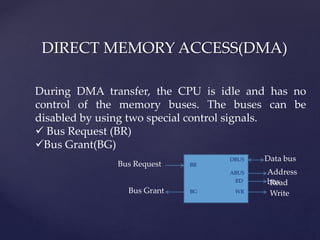
During DMA transfer, the CPU is idle and has no
control of the memory buses. The buses can be
disabled by using two special control signals.
 Bus Request (BR)
Bus Grant(BG)
Data bus
Address
busRead
Write
DBUS
ABUS
RD
WR
BR
BG
Bus Request
Bus Grant
I/O PROCESSOR
Many computer combines the interface logic with the
requirements for the direct memory access into one
unit and call it an I/O processor. The I/O can handle
many peripherals through a DMA and interrupt
facility.
The computer is divided into three separate modules
in such a system:-
o Memory unit
o CPU
o IOP

Modes of data transfer

  • 1.
    SOFT SKILLS ANDPERSONALITY DEVELOPMENT TOPIC: MODES OF DATA TRANSFER SUBMITTED BY MOHAMMAD AZHAR UD DIN ROLL NO:13YYSB6009
  • 2.
    INTRODUCTION Binary information receivedfrom an external device is usually stored in memory. Information transferred from the central computer into an external device also is originally from the memory. Data transfer between the central computer and input and output devices may be handle in a variety of modes.
  • 3.
    Different Modes ofData Transfer Programmed I/O. Interrupt - initiated I/O. Direct Memory Access(DMA).
  • 4.
    PROGRAMMED I/O These operationsare a result of I/O instructions written in the computer program. Data transfer is initiated by an instruction in the program . Usually the data transfer data between CPU register and peripheral has to be constantly monitored. Once a data transfer is initiated , the CPU is required to monitor the interface to see when a transfer can again be made.
  • 5.
    APPLICATION OF PROGRAMMED I/O METHOD Usefulin small low speed computers. Used in systems that are dedicated to monitor a device continuously. Used in the data register. Used to check the status of the flag bit and branch.
  • 6.
    INTERRUPT INITIATED I/O This canbe avoided by using an interrupt facility and special commands to inform the interface to issue an interrupt request signal when the data are available from the device. Meanwhile , The interfaces keeps monitoring The device. When the interface determines that the device is ready for data transfer, it generates an interrupt request to the computer.
  • 7.
    SERVICES ROUTINES OF INTERRUPTINITIATED I/O Service routines of interrupt initiated I/O can be chosen in two ways.  vectored interrupt  Non-vectored interrupt
  • 8.
    DIRECT MEMORY ACCESS(DMA) Theinterface transfer data into and out of the memory unit through the memory bus. The CPU initiates the transfer of supplying the interface with the starting address and the number of words needed to be transferred and then proceed to execute other tasks . When the request is granted by the memory controller, the DMA transfer the data directly into memory.
  • 9.
    DIRECT MEMORY ACCESS(DMA) DuringDMA transfer, the CPU is idle and has no control of the memory buses. The buses can be disabled by using two special control signals.  Bus Request (BR) Bus Grant(BG) Data bus Address busRead Write DBUS ABUS RD WR BR BG Bus Request Bus Grant
  • 10.
    I/O PROCESSOR Many computercombines the interface logic with the requirements for the direct memory access into one unit and call it an I/O processor. The I/O can handle many peripherals through a DMA and interrupt facility. The computer is divided into three separate modules in such a system:- o Memory unit o CPU o IOP