DMA Controller
Module 5. Input and
output Organization
By
Ananta patekar.
Aditya pokharker.
Shubham kuwar.
Types of data transfer mode
• Programmed I/O
• Interrupt driven I/O
• DMA (Direct Memory Access)
]
Programmed I/O
• Operation:-
1. Address the Device.
2. Check its status.
3. IF ready
perform operation
else
check another device
Interrupt driven I/O
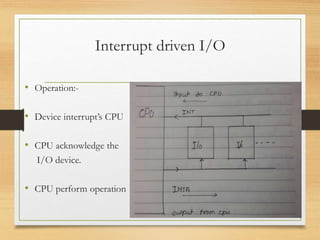
• Operation:-
• Device interrupt’s CPU
• CPU acknowledge the
I/O device.
• CPU perform operation
Direct Memory Access
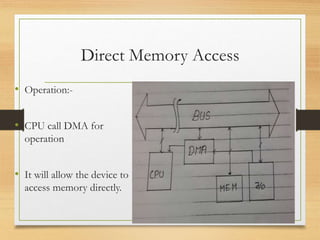
• Operation:-
• CPU call DMA for
operation
• It will allow the device to
access memory directly.
Need of DMA
• DMA, or Direct Memory Access, is a sub controller
that can access memory in sequential order without
intervention from the processor. DMA is used to
moving around large amounts of data in the
computer without taking time away from the
processor.
• The first major uses of DMA included drive
controllers and sound cards.
Basic operation’s of DMA
• DMA provide direct access to memory.
• For fast operation DMA work as a bus master.
• Direct Memory Access is a method of transferring
data between peripherals and memory without using
the CPU.
DMA Data Transfer
• It is data transfer technique directly between memory
and I/O without CPU intervention.
• Under the supervision of extra hardware called
DMA controller .
• Fastest type of data transfer technique among this
parallel group.
DMA Data Transfer
• 1. The I/O device asserts DRQ signal.
• 2. DMA controller send HOLD signal to
microprocessor
• 3. microprocessor Send HLDA to DMA Controller& DMA
Takes charge of system bus.
• 4. DMA give DMA ACK(back) signal to I/O devices
• 5.now, DMA controller places memory address on address bus
and data bytes from memory transfer to I/O .
• 6.DMA Controller updates memory address register and word
count register.
• 7. when internal count = 0 then DMA Controller sets
HOLD=0
• 8. now processor regain the charge od the system bus which
continues the normal operation.
Types DMA based data transfer
techniques
• Byte /cycle stealing mode.
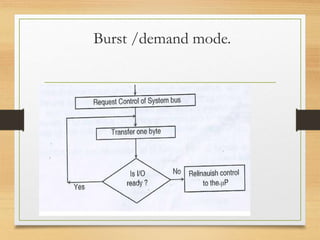
• Burst /demand mode.
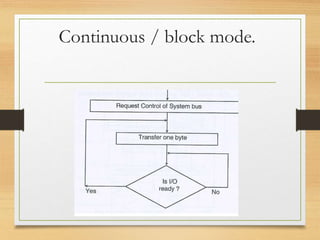
• Continuous / block mode.
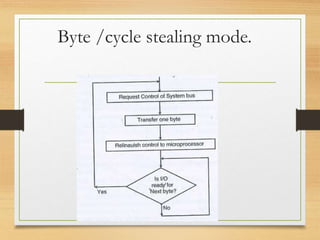
Byte /cycle stealing mode.
Burst /demand mode.
Continuous / block mode.
Questions
1) Q. Write short note on DMA/programmed i/o and
interrupt i/o?
M[15]
2) Q. Explain in brief DMA data transfer techniques
with diagram?
M[10 ]
Direct memory access

Direct memory access

  • 1.
    DMA Controller Module 5.Input and output Organization By Ananta patekar. Aditya pokharker. Shubham kuwar.
  • 2.
    Types of datatransfer mode • Programmed I/O • Interrupt driven I/O • DMA (Direct Memory Access) ]
  • 3.
    Programmed I/O • Operation:- 1.Address the Device. 2. Check its status. 3. IF ready perform operation else check another device
  • 4.
    Interrupt driven I/O •Operation:- • Device interrupt’s CPU • CPU acknowledge the I/O device. • CPU perform operation
  • 5.
    Direct Memory Access •Operation:- • CPU call DMA for operation • It will allow the device to access memory directly.
  • 6.
    Need of DMA •DMA, or Direct Memory Access, is a sub controller that can access memory in sequential order without intervention from the processor. DMA is used to moving around large amounts of data in the computer without taking time away from the processor. • The first major uses of DMA included drive controllers and sound cards.
  • 7.
    Basic operation’s ofDMA • DMA provide direct access to memory. • For fast operation DMA work as a bus master. • Direct Memory Access is a method of transferring data between peripherals and memory without using the CPU.
  • 8.
    DMA Data Transfer •It is data transfer technique directly between memory and I/O without CPU intervention. • Under the supervision of extra hardware called DMA controller . • Fastest type of data transfer technique among this parallel group.
  • 9.
  • 10.
    • 1. TheI/O device asserts DRQ signal. • 2. DMA controller send HOLD signal to microprocessor • 3. microprocessor Send HLDA to DMA Controller& DMA Takes charge of system bus. • 4. DMA give DMA ACK(back) signal to I/O devices • 5.now, DMA controller places memory address on address bus and data bytes from memory transfer to I/O . • 6.DMA Controller updates memory address register and word count register. • 7. when internal count = 0 then DMA Controller sets HOLD=0 • 8. now processor regain the charge od the system bus which continues the normal operation.
  • 11.
    Types DMA baseddata transfer techniques • Byte /cycle stealing mode. • Burst /demand mode. • Continuous / block mode.
  • 12.
  • 13.
  • 14.
  • 15.
    Questions 1) Q. Writeshort note on DMA/programmed i/o and interrupt i/o? M[15] 2) Q. Explain in brief DMA data transfer techniques with diagram? M[10 ]