Modern  Homo sapiens Contemporary Populations
Migration of  Homo sapiens After peopling the Old World, others migrated to new worlds.  H. sapiens migrated to the  Near East by 90,000 BP East Asia by 50,000 BP Europe and Australia by 40,000 BP New World by 15,000-30,000 BP
Polytypic Traits When populations migrate They may become reproductively isolated The potential for speciation exists This is mitigated by gene flow, no matter whether we all came out of Africa whether we all evolved in different regions
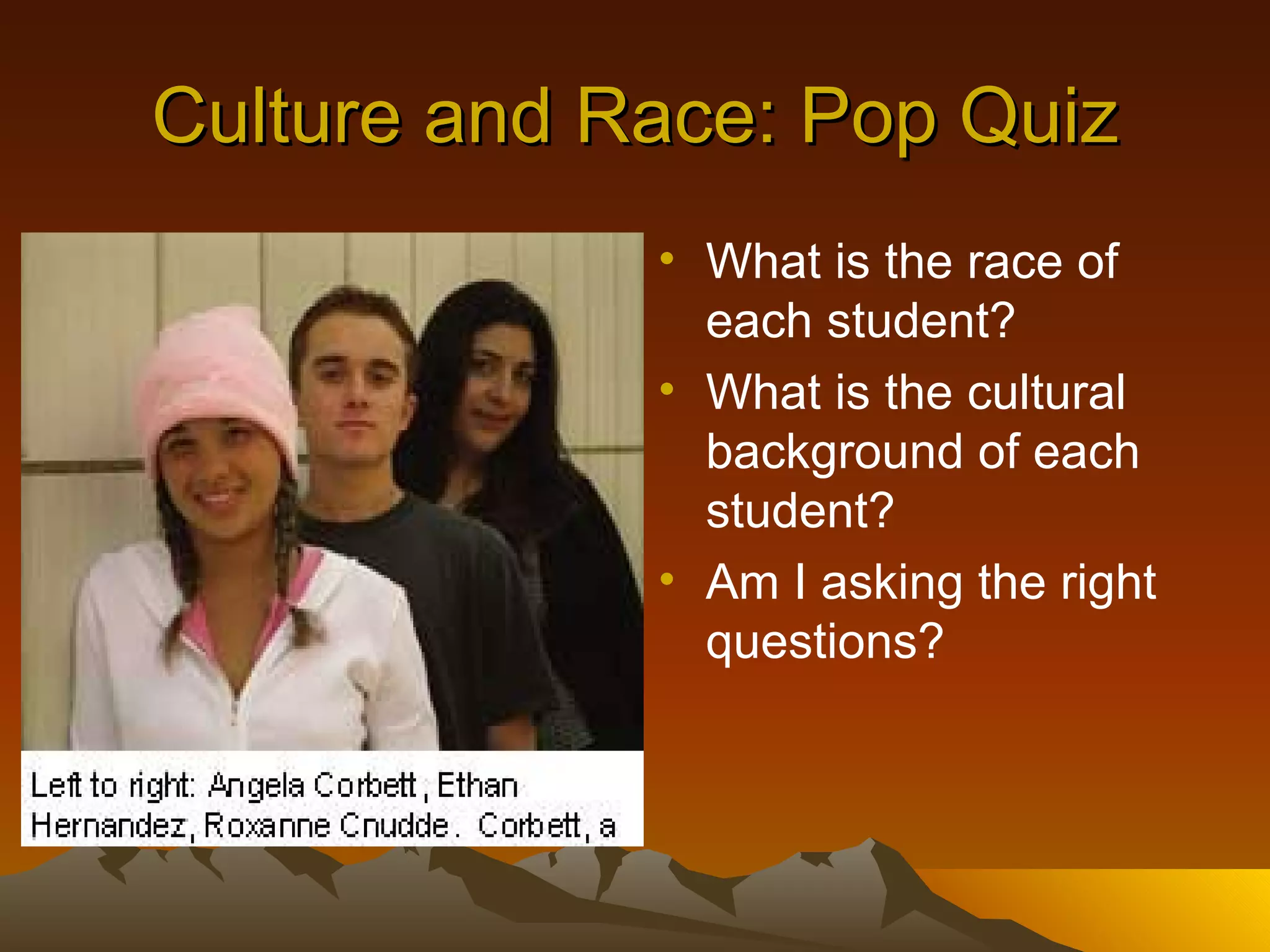
Culture and Race: Pop Quiz What is the race of each student? What is the cultural background of each student? Am I asking the right questions?
Culture and Race: The Answers The first student is  Angela Corbett : An African American, Native Indian “Caucasian” (actually Irish), Hispanic The second student is  Ethan Hernandez: A Latino and Caucasian The third student is Roxanne  Cnudde : Of American Indian, Spanish, Mexican And Belgian “heritage.”
Defining Race What is race? Skin color? Hair texture? Race is Inherited genetically Polytypical outcome of speciation Too often confused with culture
Defining Culture Culture is Based on learned behavior Shared by a group Conveyed by symbolic behavior, principally language Patterned or Integrated Too often confused with race Chicanos: self-reference as  la raza: “ Race” and “ethnicity” used interchangeably in that term
Race and Culture: Related but Different Capacity for culture is inherited through the genes Capacity for language Capacity for tool making and use Genes do not determine the Language we speak: English, French, Mandarin Tools we make and use: handaxes, pneumatic hammers or drills, computers East Indians are as competent English speakers or computer users as North Americans are How do we know? They’re taking our jobs!
Why the Confusion? Scientific versus Folk Taxonomy Scientific taxonomy: Race has no validity There is greater variation within groups than between groups
Folk Taxonomy Opinion polls: Caucasian, Negroid, Mongoloid Ignores other variants too long to list Ignores complexities of the following: Skin color: Shades throughout the spectrum Hair texture: Straight to curly to kinky Blood type: No correlation with other attributes
Clines and Discontinuous Traits Definition of Clinal Distribution (Clines) A geographic continuum In the variation of a particular trait What are these particular traits? Skin color  (by melanin content, white to very dark brown) Body build  (by weight and surface area) Discontinuous Variation : Traits with little or no variation Example: red hair in United Kingdom
What Can We Conclude About Race? I Race is a product of  genes  --microevolution (polytypic) Culture is the product of learning in a shared linguistic context Can we ignore race? As a purely biological concept, yes “ Race is unsupported by scientific evidence We cannot ignore biological variations, such as sickle cell anemia blacks Or Tay-Sachs disease among Eastern European Jews
What Can We Conclude about Race As a cultural construct,  Visible differences are always addressed sociologically Folk taxonomies persist—including  la raza A person I know is half-Armenian On a form asking race/ethnicity, she writes “Human” Lately, she has written “Person of Color, Medium Beige” How do I know all this? She’s my wife. (I’m person of no-color myself.)
How did we become all one species? Skin color and hair texture are both products of several genes— polygenic --so we can expect variation We move around a lot Caribou and reindeer stayed put Over 10,000 years evolved into separate subspecies of  Rangifer tarandus : reindeer in Eurasia, caribou in North America   (see text, pp. 293-295) We’ve  been around up to 130,000 years, maybe more We’re always in search for better resources for food, clothing, and shelter Transportation improvements also helped
Adaptation: Skin Pigmentation Skin color may be adaptive: Gloger’s Rule : Within a species, more pigmented populations live near the Equator (map, upper left) Lighter populations live further away from the Equator  Rationale: melanin serves as protection against ultraviolet rays of sun Applies to all mammals and even birds (sparrows, lower left)
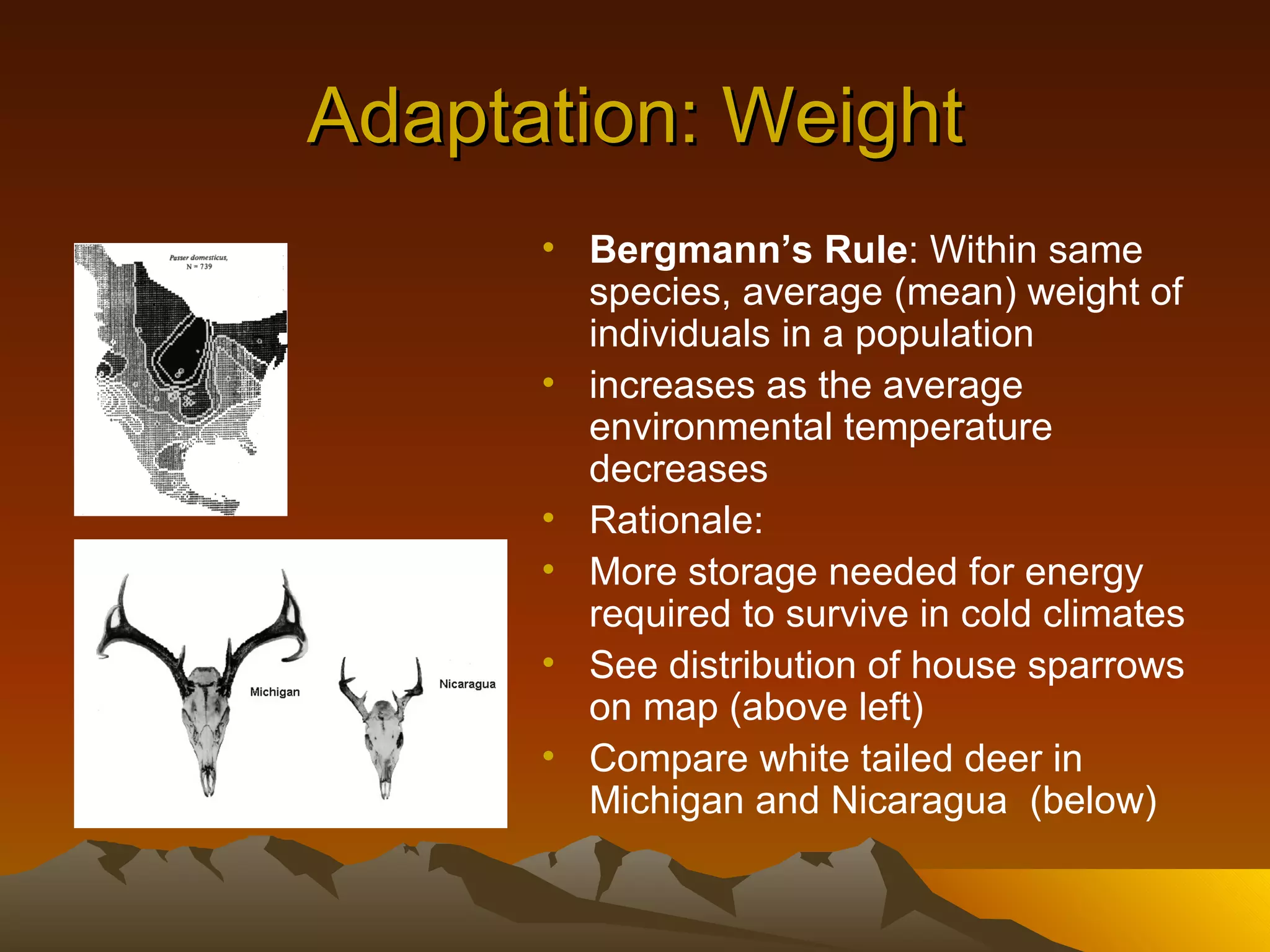
Adaptation: Weight Bergmann’s Rule : Within same species, average (mean) weight of individuals in a population increases as the average environmental temperature decreases Rationale: More storage needed for energy required to survive in cold climates See distribution of house sparrows on map (above left) Compare white tailed deer in Michigan and Nicaragua  (below)
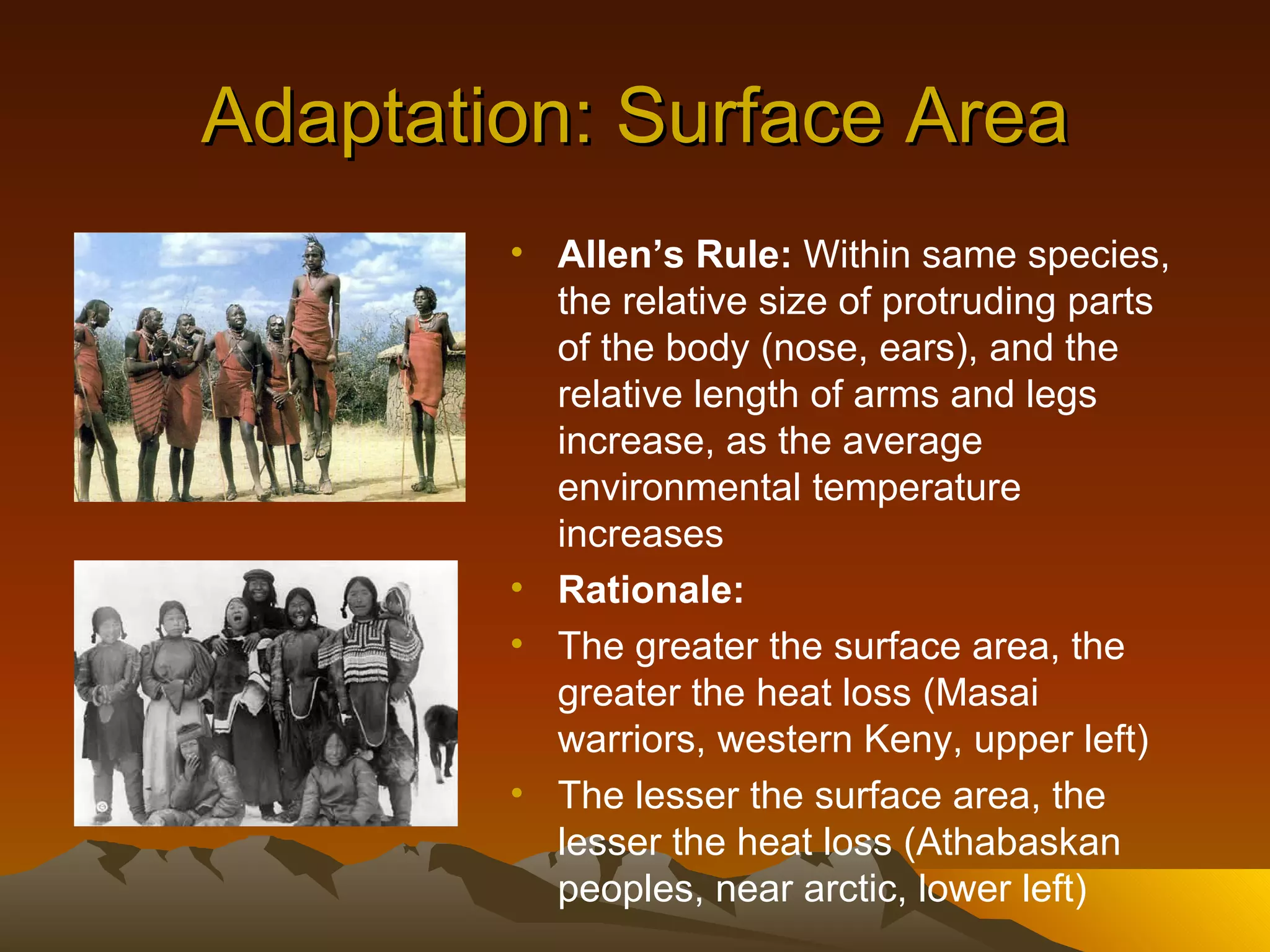
Adaptation: Surface Area Allen’s Rule:  Within same species, the relative size of protruding parts of the body (nose, ears), and the relative length of arms and legs increase, as the average environmental temperature increases Rationale:  The greater the surface area, the greater the heat loss (Masai warriors, western Keny, upper left) The lesser the surface area, the lesser the heat loss (Athabaskan peoples, near arctic, lower left)
Testing the “Rules” Some populations do conform to the “rules” Lighter skin is usually found in the north (Gloger’s Rule) Greater fat is found among Inuit, other circumpolar peoples (Bergmann’s Rule) Limbs tend to be shorter among northern peoples (Allen’s Rule) Darker skin is found among equatorial peoples Thinner and long-limbed populations are  also found among equatorial populations
Exceptions: Biological Features and Why Culture Matters Dark skinned populations also found in the north (Inuit, East Asians), contrary to Gloger’s Rule Northern Europeans (Scandinavian) are long-limbed and thin, contrary to Allen’s Rule Cultural adaptations are more important than biological ones Culture separates us from direct pressures of natural selection Question: How do tropical animals survive in extremely cold climates—like the Inuit (Eskimo)?
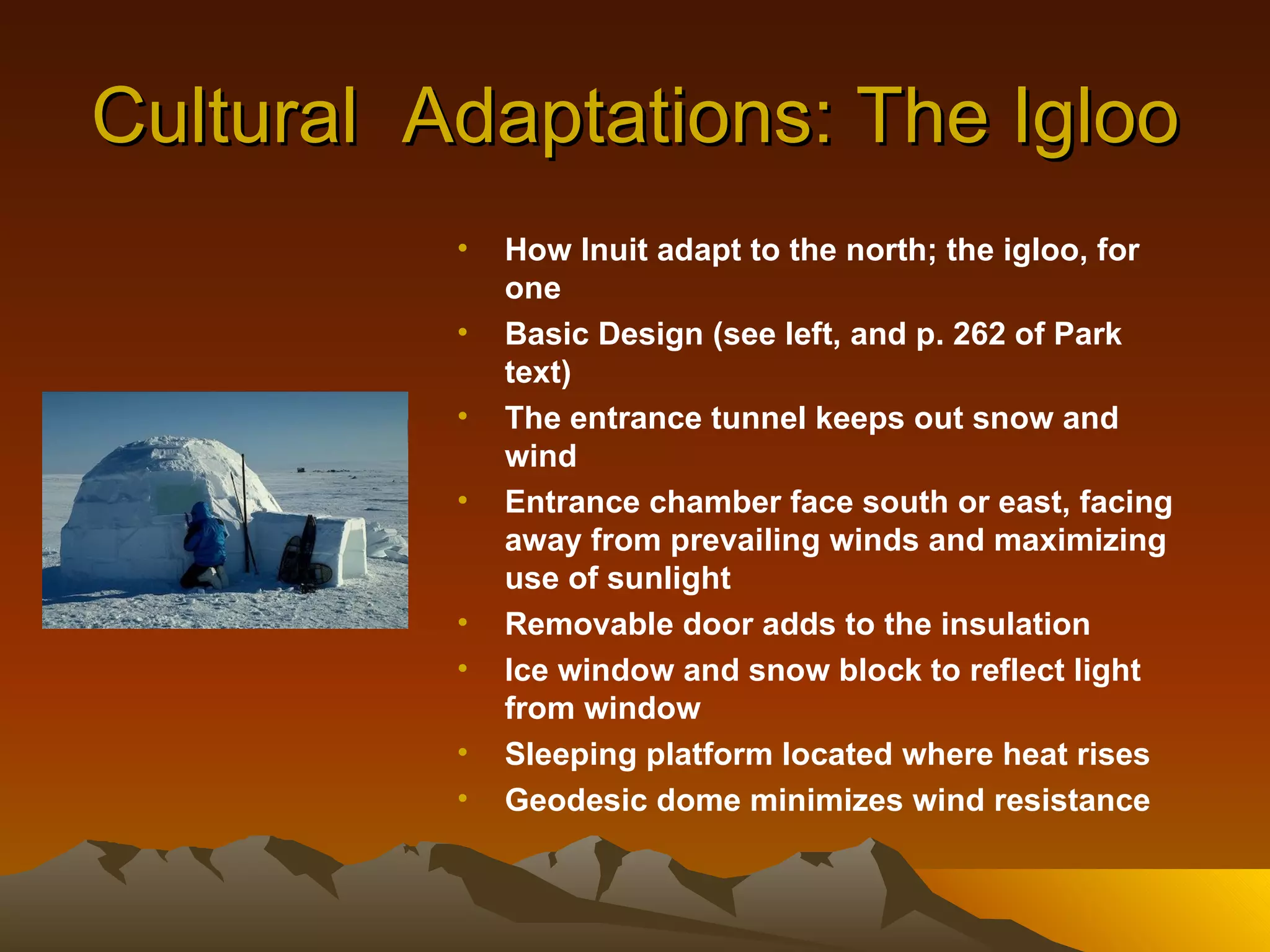
Cultural  Adaptations: The Igloo How Inuit adapt to the north; the igloo, for one Basic Design (see left, and p. 262 of Park text) The entrance tunnel keeps out snow and wind Entrance chamber face south or east, facing away from prevailing winds and maximizing use of sunlight Removable door adds to the insulation Ice window and snow block to reflect light from window Sleeping platform located where heat rises Geodesic dome minimizes wind resistance
Cultural Adaptations and Evolution Subsistence strategies is another cultural adaptation  Hunting and gathering involves heavy dependence on nature (!Kung hunters, upper left) Horticulture: affords greater control of food sources, encourages settlement Agriculture: leads to complex societies Agriculture, such as this subak irrigation system, allows an unprecedented productvity This Balinese system kept the land producing for more than 1,000 years (lower left)
Racism: A Cultural Phenomenon Folk taxonomy Misinterpretation of biological attributes that involve an unwarranted connection between biological attributes with culture Example: Eugenics, or breeding a “superior race” that Francis Galton, a cousin of Darwin, founded Example: “Intelligence”:  Abilities come in several forms, and there are several kinds of intelligence.  The threefold category of “Negroid,” “Caucasoid,” and “Mongoloid” has long been refuted, yet this term is still used in police work and even among some sociologists
Measuring Population Stability: Hardy-Weinberg Equilibrium To understand change, we need to examine factors of stability. Hardy-Weinberg Equilibrium is a contrary-to-fact formula of population stability This  formula shows how genotypic  frequencies predict static populations with no evolutionary change In othr words, mating is random—no partner preference—no mutation occurs, no migration or gene flow, and no genetic drift This formula is named after Godfrey Hardy, a mathematician and Wilhelm Weinberg, a physicist, who developed it
Seven Conditions of the Hardy-Weinberg Equilibrium These are the seven conditions, none of which exists in the real world 1 .   mutation  is not occurring 2.   natural selection  is not occurring 3.   the population is infinitely large 4.   all members of the population breed 5.   all mating is totally  random 6.   everyone produces the same number of offspring 7.   there is no migration in or out of the population
Sickle Cell Anemia as Example, I Refresher on Sickle Cell Anemia A – hemoglobin free of sickle cells S – hemoglobin with sickle cells AS – sickle cell/non-sickle cell heterozygotes
Sickle Cell Anemia as Example, II Conditions of homozygotes/ heterozygotes AA – Normal but subject to malaria SS – Subject to sickle cell anemia AS – Subject to neither sickle cell anemia nor to malaria
Hardy-Weinberg Equilibrium: 2 X 2 Table A Null Hypothesis: the assumption that nothing is happening Basic Table (A-normal; S-sickle cell anemia) Genotype Product of Frequencies   AA p X p  =  p2 AS p X q  =  pq   =  2pq SA q X p  =  qp SS q X q   =  q2
Hardy-Weinberg Equilibrium: The Formula p2  + 2pq   +  q2 =  1 (100%) The frequencies are percentages The percentages can be any proportion This predicts that Through the generations The percentages of traits remain the same
Hardy-Weinberg Equilibrium: Indications of Evolutionary Change If the percentages change, some evolutionary change has occurred Mutation Nonrandom mating Migration (gene flow) Change by chance (genetic drift—if a frequency is very low)
Use of the Hardy-Weinberg Equilibrium Presence of diseases, such as AIDS/HIV Impact on population Relations with disease-causing species, such as the green monkey Genetic diseases impact Demographic changes, such as migration (blood types have been used)
Conclusion What we have covered: The fallacy of race The confusion between race and culture Explanations of human physical variations The Hardy-Weinberg Equilibrium to anticipate the changes that do take place.

Modern Homo Sapiens: Contemporary Problems

  • 1.
    Modern Homosapiens Contemporary Populations
  • 2.
    Migration of Homo sapiens After peopling the Old World, others migrated to new worlds. H. sapiens migrated to the Near East by 90,000 BP East Asia by 50,000 BP Europe and Australia by 40,000 BP New World by 15,000-30,000 BP
  • 3.
    Polytypic Traits Whenpopulations migrate They may become reproductively isolated The potential for speciation exists This is mitigated by gene flow, no matter whether we all came out of Africa whether we all evolved in different regions
  • 4.
    Culture and Race:Pop Quiz What is the race of each student? What is the cultural background of each student? Am I asking the right questions?
  • 5.
    Culture and Race:The Answers The first student is Angela Corbett : An African American, Native Indian “Caucasian” (actually Irish), Hispanic The second student is Ethan Hernandez: A Latino and Caucasian The third student is Roxanne Cnudde : Of American Indian, Spanish, Mexican And Belgian “heritage.”
  • 6.
    Defining Race Whatis race? Skin color? Hair texture? Race is Inherited genetically Polytypical outcome of speciation Too often confused with culture
  • 7.
    Defining Culture Cultureis Based on learned behavior Shared by a group Conveyed by symbolic behavior, principally language Patterned or Integrated Too often confused with race Chicanos: self-reference as la raza: “ Race” and “ethnicity” used interchangeably in that term
  • 8.
    Race and Culture:Related but Different Capacity for culture is inherited through the genes Capacity for language Capacity for tool making and use Genes do not determine the Language we speak: English, French, Mandarin Tools we make and use: handaxes, pneumatic hammers or drills, computers East Indians are as competent English speakers or computer users as North Americans are How do we know? They’re taking our jobs!
  • 9.
    Why the Confusion?Scientific versus Folk Taxonomy Scientific taxonomy: Race has no validity There is greater variation within groups than between groups
  • 10.
    Folk Taxonomy Opinionpolls: Caucasian, Negroid, Mongoloid Ignores other variants too long to list Ignores complexities of the following: Skin color: Shades throughout the spectrum Hair texture: Straight to curly to kinky Blood type: No correlation with other attributes
  • 11.
    Clines and DiscontinuousTraits Definition of Clinal Distribution (Clines) A geographic continuum In the variation of a particular trait What are these particular traits? Skin color (by melanin content, white to very dark brown) Body build (by weight and surface area) Discontinuous Variation : Traits with little or no variation Example: red hair in United Kingdom
  • 12.
    What Can WeConclude About Race? I Race is a product of genes --microevolution (polytypic) Culture is the product of learning in a shared linguistic context Can we ignore race? As a purely biological concept, yes “ Race is unsupported by scientific evidence We cannot ignore biological variations, such as sickle cell anemia blacks Or Tay-Sachs disease among Eastern European Jews
  • 13.
    What Can WeConclude about Race As a cultural construct, Visible differences are always addressed sociologically Folk taxonomies persist—including la raza A person I know is half-Armenian On a form asking race/ethnicity, she writes “Human” Lately, she has written “Person of Color, Medium Beige” How do I know all this? She’s my wife. (I’m person of no-color myself.)
  • 14.
    How did webecome all one species? Skin color and hair texture are both products of several genes— polygenic --so we can expect variation We move around a lot Caribou and reindeer stayed put Over 10,000 years evolved into separate subspecies of Rangifer tarandus : reindeer in Eurasia, caribou in North America (see text, pp. 293-295) We’ve been around up to 130,000 years, maybe more We’re always in search for better resources for food, clothing, and shelter Transportation improvements also helped
  • 15.
    Adaptation: Skin PigmentationSkin color may be adaptive: Gloger’s Rule : Within a species, more pigmented populations live near the Equator (map, upper left) Lighter populations live further away from the Equator Rationale: melanin serves as protection against ultraviolet rays of sun Applies to all mammals and even birds (sparrows, lower left)
  • 16.
    Adaptation: Weight Bergmann’sRule : Within same species, average (mean) weight of individuals in a population increases as the average environmental temperature decreases Rationale: More storage needed for energy required to survive in cold climates See distribution of house sparrows on map (above left) Compare white tailed deer in Michigan and Nicaragua (below)
  • 17.
    Adaptation: Surface AreaAllen’s Rule: Within same species, the relative size of protruding parts of the body (nose, ears), and the relative length of arms and legs increase, as the average environmental temperature increases Rationale: The greater the surface area, the greater the heat loss (Masai warriors, western Keny, upper left) The lesser the surface area, the lesser the heat loss (Athabaskan peoples, near arctic, lower left)
  • 18.
    Testing the “Rules”Some populations do conform to the “rules” Lighter skin is usually found in the north (Gloger’s Rule) Greater fat is found among Inuit, other circumpolar peoples (Bergmann’s Rule) Limbs tend to be shorter among northern peoples (Allen’s Rule) Darker skin is found among equatorial peoples Thinner and long-limbed populations are also found among equatorial populations
  • 19.
    Exceptions: Biological Featuresand Why Culture Matters Dark skinned populations also found in the north (Inuit, East Asians), contrary to Gloger’s Rule Northern Europeans (Scandinavian) are long-limbed and thin, contrary to Allen’s Rule Cultural adaptations are more important than biological ones Culture separates us from direct pressures of natural selection Question: How do tropical animals survive in extremely cold climates—like the Inuit (Eskimo)?
  • 20.
    Cultural Adaptations:The Igloo How Inuit adapt to the north; the igloo, for one Basic Design (see left, and p. 262 of Park text) The entrance tunnel keeps out snow and wind Entrance chamber face south or east, facing away from prevailing winds and maximizing use of sunlight Removable door adds to the insulation Ice window and snow block to reflect light from window Sleeping platform located where heat rises Geodesic dome minimizes wind resistance
  • 21.
    Cultural Adaptations andEvolution Subsistence strategies is another cultural adaptation Hunting and gathering involves heavy dependence on nature (!Kung hunters, upper left) Horticulture: affords greater control of food sources, encourages settlement Agriculture: leads to complex societies Agriculture, such as this subak irrigation system, allows an unprecedented productvity This Balinese system kept the land producing for more than 1,000 years (lower left)
  • 22.
    Racism: A CulturalPhenomenon Folk taxonomy Misinterpretation of biological attributes that involve an unwarranted connection between biological attributes with culture Example: Eugenics, or breeding a “superior race” that Francis Galton, a cousin of Darwin, founded Example: “Intelligence”: Abilities come in several forms, and there are several kinds of intelligence. The threefold category of “Negroid,” “Caucasoid,” and “Mongoloid” has long been refuted, yet this term is still used in police work and even among some sociologists
  • 23.
    Measuring Population Stability:Hardy-Weinberg Equilibrium To understand change, we need to examine factors of stability. Hardy-Weinberg Equilibrium is a contrary-to-fact formula of population stability This formula shows how genotypic frequencies predict static populations with no evolutionary change In othr words, mating is random—no partner preference—no mutation occurs, no migration or gene flow, and no genetic drift This formula is named after Godfrey Hardy, a mathematician and Wilhelm Weinberg, a physicist, who developed it
  • 24.
    Seven Conditions ofthe Hardy-Weinberg Equilibrium These are the seven conditions, none of which exists in the real world 1 .  mutation is not occurring 2.   natural selection is not occurring 3.   the population is infinitely large 4.   all members of the population breed 5.   all mating is totally random 6.   everyone produces the same number of offspring 7.   there is no migration in or out of the population
  • 25.
    Sickle Cell Anemiaas Example, I Refresher on Sickle Cell Anemia A – hemoglobin free of sickle cells S – hemoglobin with sickle cells AS – sickle cell/non-sickle cell heterozygotes
  • 26.
    Sickle Cell Anemiaas Example, II Conditions of homozygotes/ heterozygotes AA – Normal but subject to malaria SS – Subject to sickle cell anemia AS – Subject to neither sickle cell anemia nor to malaria
  • 27.
    Hardy-Weinberg Equilibrium: 2X 2 Table A Null Hypothesis: the assumption that nothing is happening Basic Table (A-normal; S-sickle cell anemia) Genotype Product of Frequencies AA p X p = p2 AS p X q = pq = 2pq SA q X p = qp SS q X q = q2
  • 28.
    Hardy-Weinberg Equilibrium: TheFormula p2 + 2pq + q2 = 1 (100%) The frequencies are percentages The percentages can be any proportion This predicts that Through the generations The percentages of traits remain the same
  • 29.
    Hardy-Weinberg Equilibrium: Indicationsof Evolutionary Change If the percentages change, some evolutionary change has occurred Mutation Nonrandom mating Migration (gene flow) Change by chance (genetic drift—if a frequency is very low)
  • 30.
    Use of theHardy-Weinberg Equilibrium Presence of diseases, such as AIDS/HIV Impact on population Relations with disease-causing species, such as the green monkey Genetic diseases impact Demographic changes, such as migration (blood types have been used)
  • 31.
    Conclusion What wehave covered: The fallacy of race The confusion between race and culture Explanations of human physical variations The Hardy-Weinberg Equilibrium to anticipate the changes that do take place.